A while back I wrote a little bit about writers doing research. Writer Christina “DZA” Marie invited me over to her place to flesh that idea out a bit more, with a particular focus on fantasy writers doing research. It’s a thing!
A while back I wrote a little bit about writers doing research. Writer Christina “DZA” Marie invited me over to her place to flesh that idea out a bit more, with a particular focus on fantasy writers doing research. It’s a thing!
You may remember last year when I finally got around to seeing Whiplash, the highly praised 2014 film about a young drummer and his abusive mentor, and that I didn’t much care for it. Based on that, when I saw a headline over at the AV Club about a “jazz musician who is not a fan of Whiplash” I smirked and decided to check it out. It actually led to a misconceptions about the nature of writing fiction that I wanted to highlight.
The review itself, which you can watch here, really isn’t as negative as the headline. In fact, the jazzer in question, Adam Neely, winds up by calling Whiplash “great,” so he doesn’t exactly take a dump on it. What he does is point out some things about modern jazz education that the movie gets wrong and laments that because Whiplash is about the only pop culture portrayal of that setting it’s likely to be what people think of it. I get it – I can similarly pick nits from just about any lawyer movie.
But before getting to that, Neely goes through a lot of stuff the movie gets right, highlighting a lot of inside details that ring true. He credits this to writer/director Damian Chazelle’s having been in a similar jazz ensemble in high school and goes so far as to say “these sorts of things could only come from playing in a jazz band.”
That’s where the writer in me started shaking his head.
It’s indisputable that Chazelle drew on his own experiences when writing Whiplash – he’s said so in interviews. However, the idea that only someone who had been through those experiences could write such a story fundamentally misunderstands what writers do. It’s a common mistake and one I blame on the one piece of advice about writing that just about everybody has heard – “write what you know.”
It’s not the worst advice, particularly for new writers. Learning the actual craft of writing fiction is easier when the story you’re telling is one you’re familiar with and takes place in the world you know. Having said that, it’s not an iron-clad piece of advice. After all, if all writers stuck to writing what they knew we’d have a lot fewer books and the genre of speculative fiction would shrink to near meaninglessness.
So writers spend a lot of time writing about what they don’t know. How? Research!

In much the same way that an actor who’s going to play a police officer, say, will learn about what police officers do and how they do it, a writer who wanted to write about cops could do the same thing. There’s an entire section of one of the writer forums I hang out on dedicated to research and people looking for answers to questions from people who have actual expertise in that area.
That’s even true when you’re writing fantasy. As I’ve said before, one of the great things about fantasy is that you can make up anything you want, but it’s still important to have some realism about the world you’re creating. In The Water Road I had a character take an arrow to the leg. Since it wasn’t meant to be a fatal wound, I needed to know how to get it out. I did some research, found out that it’s more complicated than I thought and that the kind of arrow used could say something about the character that loosed it in the first place. Reality informed my fantasy.
So kudos to Chazelle for getting those details right, but he’s not the only one who could have done so. Any good writer would have done their research before writing a story set in a particular world. It’s part of what we do.

I do have to say one thing about Neely’s overall impression of Whiplash. It’s interesting that he points out one of the flaws in the film I did – that nobody seems to really enjoy the music they’re abusing themselves to make – but that for him, the musician, it didn’t harm the movie. For me it did, which just goes to show that even when two people agree on what’s wrong with a movie (or book or song or . . .), it means different things to them. Such is art.
Over the weekend I reached a milestone on Gods of the Empire.

That’s right – I finally have a complete, full, and edited draft of this book! It’s now time to print out a hard copy (I do my own editing electronically) and let my beta reader have a crack at it. It felt really good to put the finishing touches on it, since this is the first book in a “new” universe I’ve finished since The Water Road back in October of 2015.
So what’s next for this project? Obviously, my beta reader gets to bleed all over it with that there red pen, so I’ll have to see what’s left after that. Probably another edit from me, then it’s off to figure out how to let loose this book upon the world. I might shop it around a bit or go directly to the DIY route like I’ve done in the past.
As for me? I’m taking the week off from worrying about words and world building and all that jazz.

After that, I’m not quite sure. I don’t want to dive right into the next book in this trilogy, Widows of the Empire, but I may plot it out and leave the actual writing for later this year. I’ve also got some stand-alone novel ideas I might work up, as well as the sequel to Moore Hollow. Finally, I’ve got some short story ideas kicking around that I might focus on.
Regardless, Gods of the Empire is well on its way to being finished!
Sometimes it’s interesting to see where creative types do their work, to get a feel for the environment that leads to their creativity. In the spirit of creative transparency, and the fact that it’s a new year and all, I thought I’d share mine.
This is where I work:

Ha! That’s actually where I work, but it’s not really what I’m on about (my office is on the back side, anyway). Here’s where I get my creative juices flowing:
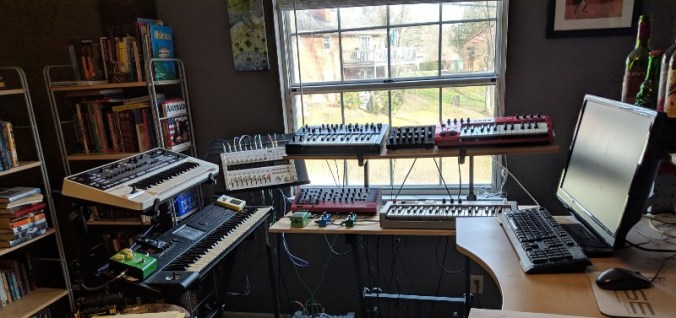
If you’re thinking “that’s a lot of musical equipment for a writer’s room” you’re not wrong. It just so happens that the PC on the right is what I use both to do most of my writing and where I weave bits of music together to make a final product (like this).
Here’s another, more atmospheric pic, with everything turned on:
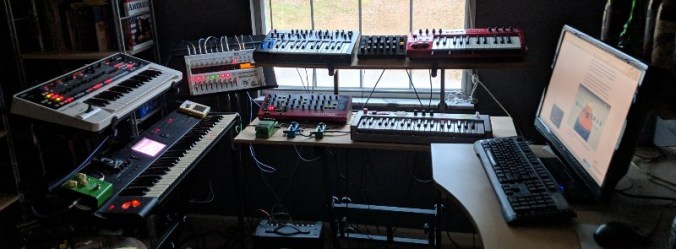
For the gear curious out there – on the left there’s a Korg M50 (bottom, with a Kaosilator on the far end) and a Roland Gaia (top), then in the middle there’s a Nord Rack 2X and Alesis Micron, which controls the Nord (bottom), and a Novation Bass Station II and Moog Minitaur with Behringer controller (top). Everything runs into the Zoom R16 mixer/recorder in between.
The words, by contrast, go straight from my brain to the PC, via the keyboard, although I occasionally knock out some words in other locales. Who knew you could write so much on your phone?
I suppose that’s the real lesson – where does the magic happen? Everywhere.
One person’s trash is another’s treasure, as the saying goes. I think the literary version of that might be that one person’s second book problem is another person’s interesting, deep dive into character lives.
Remember last year when I blogged about the second book problem – the tendency for middle books in trilogies to sag a little bit given their place in the middle of the overall narrative? At the time I was laboring under the assumption that most people would agree on when second books were problematic or not. A recent experience has convinced me otherwise.
A Gathering of Shadows is the second book in V.E. Schwab’s Shades of Magic trilogy.

It’s set in a kind of alternate history world during the 19th century where there are actually four Londons existing in parallel worlds with different levels of magic (ours is “grey” London, which about sums up the magical nature of it). The first book in the series, A Darker Shade of Magic, has a lot of hopping between worlds as it spirals towards a universe-altering conclusion.
The second book, by contrast, is a lot more sedate. It takes place mostly in red London, where magic is like air and just about everybody makes use of it in some way or another. A kind of World Cup of magic called the Element Games brings together the two main characters, Kel and Lilah, who were separated at the end of book one. We get deep into the tournament and what it means politically in the world of red London. All the while, occasionally, we pop over to black London (where a magical incident years before basically turned it into a burned over hellscape) and see that something bigger is brewing.
To be honest, the brewing seemed like it was part of another book. I was really grooving on the tournament, the way it allowed us to get more into the heads of Lilah and Kel (and his brother, Rhyl), not to mention a couple of new characters. It seemed like the perfect use of a second book, to deepen both the world in which the story takes place and the people in it whom we are supposed to care about. Then the tournament wraps up a little early and the black London stuff comes crashing down on our heroes. It all happens so fast that I think it would have worked better as an expanded second part of the book or as a short, brutal epilogue to setup the final book in the series. Still, overall, a good read and I’m definitely on board for the conclusion of the trilogy.
And, don’t get me wrong, lots of people love this book (and the series). But there were more than a few super pissed fans of the first book who thought A Gathering of Shadows was just boring filler – until the very end, when the black London stuff comes calling. In other words, they felt just the opposite of the way I did about it (one reader said it was “is majorly afflicted with the infamous 2nd book syndrome”). One person even suggested that all the important things that happen in this book could be collapsed into the first chapter of the final volume of the trilogy.
Are those folks wrong? Yes and no. I think they’re wrong because books (or stories of any kind) do more than simply push the major plot along and there’s a lot of other stuff going on for most of A Gathering of Shadows, stuff that I happen to enjoy (a lot of books, beginnings of them, get described as “slow,” but I love the time spent settling into a place or getting to know characters). On the other hand, it isn’t wrong to say that by the end of A Gathering of Shadows not a lot has happened on the grand “fate of the worlds” scale on which the first book operated. I can understand the frustration, even if I don’t share it.
While this is another in a long line of examples of why all are is personal, it’s also an example of people wanting different things from extended works. A trilogy or series, by definition, invites readers in and lets them spend more time in a world than a single story. It’s not surprising that a writer might take that time to do things other than move the plot along. But it’s also no surprise that fans brought back to the world by a quick-paced first book might find a second one slow if it can’t match that pace.
Neither set of readers is wrong in their expectations (or their permissions), but neither is a writer “wrong” for taking one path over the other. It’s worth thinking about what people said about the first book before deciding to slow things down in the second. Maybe that’s the best way to tell the entire story you mean to tell, or maybe it’s a second-book trap you’re falling into. As with most things about writing, a little forethought can head off some disappointment down the road.
I’m not a big fan of New Year’s Resolutions. It’s not as if you file them with some official registry and, when you start to slip, government drones bust in to keep you on the straight and narrow.
I prefer to use the start of the year as a time to take stock, to think about what the coming year might hold. So let’s do that, shall we?
To start with, my initial goal for 2019 is to finish up Gods of the Empire, the first book in my new trilogy. As you’ll recall, this project was originally going to be a series of shorter books, but morphed into a trilogy of longer books. As a result, I basically wrote the first book in two separate parts. They’ve now been fused together for a complete manuscript. It’s a couple of edits away from “done” and, I hope, will see the light of day this year.
Beyond that, things are fairly wide open.
Obviously, at some point, I’ll need to get cracking on the second book in this trilogy, Widows of the Empire. It’s largely planned out (in broad strokes, at least), but I’m not sure whether I’ll want to jump right back into that world or get some distance before I get working on book two in earnest.
I’m also planning to go back and revive something I thought was a standalone novel – Moore Hollow. I’ve had more than one person ask about a sequel, which I’d never intended, but I’ve come around. It’s now going to be the first book in a series in which Ben Potter moves to West Virginia and investigates various weirdnesses. Getting cracking on the second book in that series is high on my list of priorities, too.
There are bound to be some shorter projects that pop up here and there, too. Last year, between rounds of Gods of the Empire, I actually wrote a novelette (I think) set in the expanded Moore Hollow universe because the idea lodged itself in my brain and wouldn’t go away. That same kind of thing is likely to happen again. Only time will tell.
So there you have it – no resolutions, but some plans and some goals. Now let’s get out there and take on 2019!

I think I was first exposed to dystopia in fifth grade. Not that my fifth grade teacher was some kind of demon or sadist, mind you. But it was around that time that I read for the first time, in quick succession, 1984, Brave New World, and Anthem (not to mention discovered its musical adaptation). There’s something seductive and compelling about dystopias, warnings about how things can go so very wrong. I’ve dived back into them a lot over the years, on the screen and on the page.
I’ve had less experience with utopias. I’ve never read the Thomas More work that gave birth to the name, if not the concept. I did read Plato’s Republic in college, but it’s hard to look at that as really being utopic to modern eyes. The other utopian novel I really remember reading is Edward Bellamy’s Looking Backward. Written in 1888, it’s about a guy who sleeps for more than a century and awakes to find it a socialist paradise. Given what had actually happened by the time 2000 rolled around, it was a hilariously out of date prediction.
But I started thinking more about utopias as works of fiction recently after I read Island.
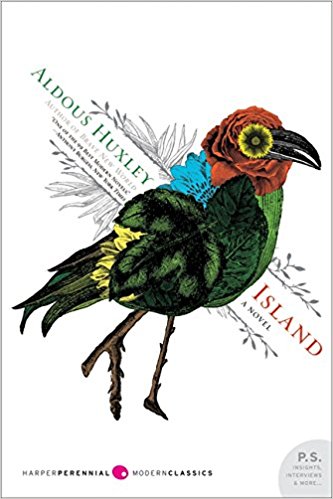
It’s Aldous Huxley’s last novel and a kind of rejoinder to Brave New World. It covers a lot of the same big ideas as the earlier dystopian novel, but in an (allegedly) positive way. There’s a chart in the Wikipedia entry for the book that does a good job of boiling down the comparison:

Whatever the charms of Pala, the fictional southeast Asian island nation that provides the backdrop for Island, it’s not a very engaging work of fiction. Nominally it’s about a Brit, Will, who washes ashore there (intentionally, it seems) and experiences all the island’s many facets while recovering from his injuries. Said facets are a blend Buddhism, western liberalism, and (to at least one person’s eyes) Scientology and make sense in a lot of ways. Still, Will just basically drifts from place to place and while some individual scenes are well executed (there’s a very expected death later on that’s really touching), there isn’t much of a story.
I think this might be a problem inherent to utopian stories. Dystopias are about struggle, usually individuals standing up to some kind of overwhelming force. It’s easy to empathize with those characters, to buy into their struggle. Likewise, it’s easy to see where the antagonists in such stories are coming from. Written well, they think they’re doing the right thing, too. It’s the basis of good conflict, which is what drama is all about. In utopias, by contrast, everyone is pretty much happy. There’s not much conflict and, thus, not much drama. The narrative can be interesting, maybe even occasionally compelling, but it’s hardly something that sucks you in as a reader.
Another issue with utopias is that they can often seem kind of dystopic, depending on your point of view. I mentioned Plato’s Republic earlier, in which he sketches out his version of an ideal society – one that is anti-democratic, requires a rigid class system, and squishes individuals for the benefit of the state – that sounds more like a dystopia to me. Huxley’s Pala sounds like a pretty nice place – tropical weather, mind expanding drugs, all the sex you can have, creative alternatives to criminal justice – but it’s not perfect. For one thing there are mynah birds constantly harping out slogans (“Attention! Here and now, boys!”) that would be aggravating to no end. For another, all this apparently comes from the top down, mandated via a government overhaul that happened a generation or two back. There’s no indication what happens when somebody dissents from this version of the perfect life, how that’s handled. The only naysayers are the soon-to-be ruler and his European mother who are so out of touch that it’s clear Huxley doesn’t want you to take them seriously.
But the thing that struck me the most as dystopic in Island comes near the end, when the main character is talking with a local child about Oedipus Rex. They have the play in Pala, but it has a happy ending, wherein two children from Pala enter the play and convince everyone not to kill or maim themselves because none of this is their fault. To the problem of Oedipus being married to his mother, they simply advice stop being married to her. It all reeks of one of those stories modified by a totalitarian regime to show Dear Leader giving wisdom to historical figures and changing history. It’s also bizarrely simple minded in terms of a “solution” to the problem.
In the end, what makes it most difficult for me to get into utopias is that they are, at bottom, dreams that we know will never come true. Dystopias, by contrast, always seem prescient and just over the horizon (the good ones, at least). It’s not for nothing the More’s term means “no place.” Huxley basically concedes this in Island, as the book ends with the island’s new ruler (the one with the European mother) joining forces with the neighboring nation’s strongman to begin a quest to “modernize” Pala. Even in fiction, such places can’t last long.
I am, as The Decemberists say, “a writer, writer of fictions,” but does that make me a lying sack of shit? I don’t think so, but I hope I never have to find out in court, at least in Alabama.

William McKinney choked his girlfriend and then stabbed to death her mother’s boyfriend. At his trial he claimed he was acting in self defense (to the stabbing, at least). He was also a writer (unpublished, apparently). Thus, when he was testifying in his own defense, he was asked:
Defense counsel objected to the relevance of all this, but was overruled. The prosecutor continued:
Q. Did you consider yourself a writer? Writer of fiction?
A. Inside that book bag, I’m pretty sure my book was in it maybe.
Q. Okay. Now, so you were writing your own book, right?
A. Well, I had written a book, yes.
Q. Okay. When did you write your book?
A. Back during my incarceration.
Q. And you had it — they were composition notebooks, right?
A. (Witness nods head affirmatively.)
Q. That you had written chapters in; chapter one, chapter two, chapter three? All that, right?
A. Yes, sir.
Q. In fact, that is bigger than the bag that’s State’s Exhibit 47. It was a very large book that you were writing, wasn’t it?
A. Yes, sir, I assume.
Q. Lots of handwritten pages?
A. Yes, sir.
Q. And it was a work of fiction, I assume?
A. Yes, sir.
Q. So you at least considered yourself a writer?
Defense counsel objected to the relevance of all this, but was overruled. The prosecutor continued:
Q. Did you consider yourself a writer? Writer of fiction?
A. No, sir.
Q. You’re not a writer of fiction?
A. I wouldn’t call myself a writer, no, sir.
***
Q. But this book of yours is a work of fiction. But everything you’re testifying here — now, you’re telling us the truth today, aren’t you?
A. Yes, sir.
Q. You know you’re under oath and you’re looking at these folks and you’re going to tell them what happened that day, right?
A. Yes, sir.
In other words, “since you can make something up in one context, why should we believe you in any other situation?” That logic is dubious, at best. But it was good enough, at least for the court of appeals:
McKinney is not entitled to relief on this issue. As the State notes, ‘[t]he obvious inference the prosecutor was trying to draw was that, if McKinney writes novels or other fiction, then his account of the murder of Mr. Jackson [was] also fiction …. Whether McKinney was telling the truth was very relevant and a proper subject for cross-examination.’ (State’s brief, pp. 24-25.) See generally Wiggins v. State, 193 So. 3d 765, 805 (Ala. Crim. App. 2014) (“‘Counsel is given wide latitude and has the right and duty to cross-examine vigorously a defendant who takes the stand in his own defense. “A [prosecutor] may ask a defendant … questions tending to discredit [his] testimony, no matter how disparaging the question may be.”‘ State v. Rush, 340 N.C. 174, 186, 456 S.E.2d 819, 826 (1995).”).
I tend to agree with Eugene Volokh that:
To be sure, it’s perfectly plausible that McKinney was lying, just as it’s plausible that anyone else is lying; but I don’t think that would-be novelists are any more likely to lie on the stand than anyone else, or even any better at lying (unless perhaps they are novelists of proven and substantial gifts).
But I’d go further – even a writer of “proven and substantial gifts” knows the difference between truth and fiction. George RR Martin can spin him some tales, but I don’t think that means he’s lying if he testifies that the light at the intersection was really green. I do tend to agree with Volokh, however, that this was a “wet noodle of an argument” that wasn’t really prejudicial to McKinney. Still, it was irrelevant and the prosecutor was certainly trying to be prejudicial. Intent should count for something.
All in all, I think I’m insulted. I mean, I thought I’d sunk about a low as I could go, in terms of societal approval, by being a public defender. I had no idea that my scarlet letter, warning the wary of my wickedness, would be a W!

The old saw is that you shouldn’t just a book by its cover. That’s a good rule of thumb when you’re dealing with people or if your presented with new ideas, but when it comes to actual books it’s kind of silly. Truth is a cover can often be someone’s first impression of a book and it can say several things about its contents, from the level of professionalism involved to the genre to particular aspects of the story or characters a reader might find intriguing.
Take, for example, the cover of The Water Road:

That cover, I hope, tells you several things. Most notably, that this is the first book in a trilogy, so it’s part of an epic story. The background image and script mark it as fantasy, but the crossed muskets mark it as a different kind of fantasy – this isn’t your traditional sword and sorcery story. Without reading word one, you’ve got some idea of what to expect going in.
I don’t always pay that much attention to covers as a reader, since I do most of my reading via Audible listening and I rarely have the full-sized book in my hand. Not that covers never make a difference – one of my recent reads, Johannes Cabal: Necromancer, I got purely because the cover on the shelf at the bookstore drew me in (it was darkly funny – highly recommended). So, anyway, the blurb usually controls, as it did for Autonomous, by Annalee Newitz. Here’s the first half:
Autonomous features a rakish female pharmaceutical pirate named Jack who traverses the world in her own submarine. A notorious anti-patent scientist who has styled herself as a Robin Hood heroine fighting to bring cheap drugs to the poor, Jack’s latest drug is leaving a trail of lethal overdoses across what used to be North America—a drug that compels people to become addicted to their work.
Pretty cool, huh? I loved the idea of a rogue drug maker slipping through the high seas like a 21st-century Captain Nemo. But here’s the cover for Autonomous:
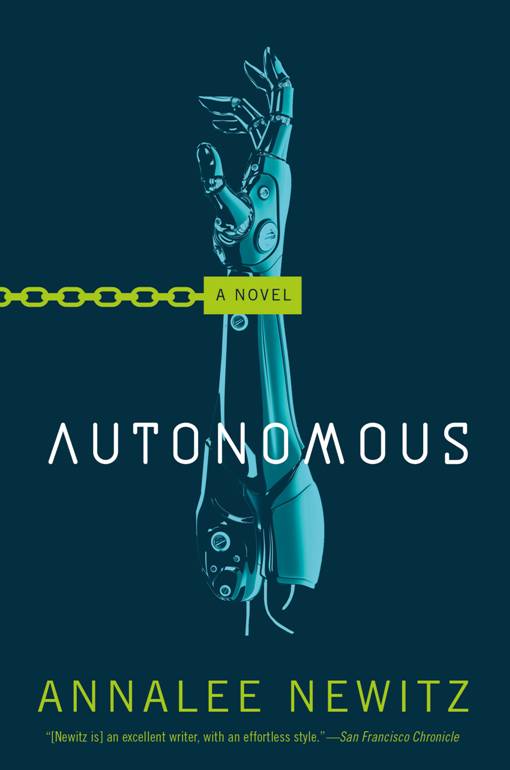
Does that really match the blurb? It doesn’t and, turns out, for good reason. Autonomous (which is pretty good – I recommend it) really isn’t about Jack so much as it is the beings in her orbit, particularly the robots and other enhanced beings. The book is really about their place in the world and what it means to really be free (or not). Hence the title. Hence the mechanical arm in chains. Hence some of my disappointment with the book itself.
Which is to say that covers can be tricky things. We, as authors, want people to judge our books by them – judge them as worthy of picking up, of clicking on, of reading. But they’re also a first impression, something you only get one chance to make. The right cover is a high wire act, one that most of us aren’t comfortable performing without a net.
Since I’m not doing NaNoWriMo this year because I’m still knee deep in working on the first book of the Unari Empire Trilogy, I figured now was a good time to let y’all in on some exciting developments with the book.
First and foremost – it has a title! A working title, at least. Right now the first book in the trilogy is going to be Gods of the Empire. That should be followed by Widows of the Empire and, finally, Heroes of the Empire. Subject to change, of course, but it’s a far sight better than Untitled.
Second, the trilogy has been reshaped somewhat (again). My original plan was to have three main characters whose stories developed through the three books. After doing a lot more writing, I’ve decided to cut one of those characters out, for the most part. He has a role to play in the end of things, so he’ll make an appearance, but I ultimately decided not to make him a main character. It will help keep the word count in the right area and, I hope, sharpen the story a bit by narrowing the focus. He’ll get a stand-alone short story to flesh out his background, eventually.
That means that . . . third – the complete first draft is finally done! Recall that I had what was going to be book one of seven done before restructuring it into a trilogy. Now I’ve written a draft of the second half of the first book, so after a couple of editing passes to bring it up to speed with the first half I will have a good, solid base to start a more holistic edit of Gods of the Empire.
If all goes according to plan, I should have a finished product in the first half of 2019.

Off I go!

