On Death In Fiction

Riffing on the two sides of the debate in the wake of Infinity War – either all those deaths don’t matter because we know they’re coming back or it matters because the people in universe don’t know that. What do writers owe their readers?

This post was inspired by events that take place in Avengers: Infinity War. If you’ve not seen it yet and want to remain unspoiled, be warned, I’ll be talking about major stuff that happens.

Spoilers

With that said . . .

Holy shit, that movie killed a lot of people. I’m not even talking about anonymous nobodies, set dressing to be collateral damage for the big final battle. I’m talking beloved characters, some major, deaths that could be universe shattering, even if we, as savvy modern media consumers do better.

The deaths basically come in bunches. Loki and Heimdahl meet their end at the very beginning, while Gomorra is sacrificed about midway. But the big shit hits the fan when bad guy Thanos gets all the Infinity Stones and snaps his fat fingers, disappearing half the beings in the universe. Among those who disappear into dust (like vampires on Buffy . . ., but they float up to hebbin, rather than down to the ground) are Black Panther and Spider Man. Serious shit.

Or is it? It doesn’t take a crystal ball to see that there’s no way Marvel is going to let all those characters stay dead. The MCU is an impressive feat of storytelling, but it’s first and foremost a money-making property. Black Panther and Spider Man already have other movies in the pipeline – you think they’re going to dump those for the sake of the story? Fat chance.

Which has led to an interesting discussion on line about the end of the movie. On one side are the people who say these deaths (at least the dusty ones, maybe the others) don’t really mean anything because we, the audience know they aren’t permanent. On the other are people who insist that they do have meaning because the other characters in the MCU don’t know these characters will come back and so it’s a big deal for them. Who’s right?

Maybe neither, at least completely. Some of it depends on what the creator is trying to do. If it’s just shock the audience, it’s a pretty hollow means to do so, but that’s not the only thing you accomplish when you kill a character.

Go back to the aforementioned Buffy the Vampire Slayer. Buffy dies at the end of the fifth season, sacrificing herself to save the world (again). It’s no shock that the next season of the show was not a Buffy free zone – she came back from the dead in the first two episodes. That was to be expected. But the show worked through that in very interesting ways. Most importantly, Buffy’s friends thought by bringing her back they pulled her from hell, when in fact she was in heaven (or at least at peace). In other words, it mattered for the rest of the season (and the show, really) that Buffy had died and then gotten better. It wasn’t a simple reset button.

To pull a somewhat vague, non-spoilerly, example from my own writing, I have a book where a major character dies at the end. That death resonates through the next book, motivating what other characters do. I didn’t kill that person off just for a “gasp” moment or to make sure readers know that nobody in that world is safe.

On the other hand, the recently completed season of Agents of Shield ended with an emotional death that, it turns out, really wasn’t, except the people in the universe completely knew it (even if viewers, myself included, were scratching their heads for a bit). That’s just cheap manipulation and is a hollow exercise.

Then there’s always the Deadpool take – announce you’re going to die in the opening credits, show said death twice, have a prolonged death scene later in the film, then wink it away post-credits. But would you expect anything less from that fucker?

Which path will the next Avengers movie take? Too soon to tell, of course (except, I think it’s safe to say, not the Deadpool avenue), but one hopes it’s closer to the Buffy example.

The bottom line, as a writer, is that death, like anything else when it comes to plot, is a tool. As with any tool, it can be used well or poorly. But given the emotional heft that death can have, folks should think long and hard about deploying it as a simple plot point. As with all things – think it out first.

Lessons Learned from Swimming Blindly Through the Aural Seas

When I write I have some idea of where I’m going. As you can see from my experiment with trying to go free form, I need some structure when I write. Nonetheless, when I write I’m acting with intention and purpose – I see where I want to go and try to get there.

When I make music, it’s almost completely the opposite. Essentially, music comes about in one of two ways. First, I get a flash of inspiration when a riff or rhythm or something pops into my head (and, hopefully, onto the computer). Second, I take whatever winds up on “tape” and fiddle around with it, adding things, taking things away, and generally just figuring out what works. I very rarely come to a song idea with a clear conception of what the end product should be.

In other words, when I write, it’s like setting out to sea in a boat, with charts, a destination, and a plan on how to get there. When I make music, it’s more like diving in head first and seeing where the tide sees fit to deposit me. Swimming blindly, if you will.

That’s not to say that the drifting, searching musical creation doesn’t require making choices. Sometimes, those choices are relevant when it comes to thinking about writing, too.

I’ve been thinking about this lately after finishing a new song with the deviously serious title of “Dummy Tickle” (it’s embedded below). I have no idea where that title came from, because this song, all not-quite-four minutes of it, began five years ago.

Which brings me to lesson number one I’ve learned from making music – creativity takes time.

The DAW I use has a metadata field that lets you put just about anything you want in it. I always put (1) when I started the song; (2) when I finished “writing” it; and (3) when I got it in final form (mixed down, etc.). It’s a very rare thing when a song goes from idea to completion in a week or a month. Usually it takes a while, but not five years.

What was I doing with “Dummy Tickle” for five years? I’d like to say I tried out dozens of different things to try and bring the basic idea (that lazy, bouncy bass line and equally laid back melody) to bigger, better life. Nothing really clicked, nothing seemed right. I let it go for a while, but every time I went back and listened to unfinished tracks I thought “there’s something there” and marked it down as something to finish.

Finally, a few weeks ago, something clicked. I don’t know precisely what or why then – maybe a session of playing with the puppies trigger up some kind of endorphin rush or something. How couldn’t they?

Pups
Anyway, the damn burst and I started making progress. It just took some time to get there. Patience really is a virtue, especially when it comes to creative things.

Still, it wasn’t a matter of just banging out a few more notes and being done with things. I was in need of ideas for a transition, a middle section, and started playing around with a couple of chord progressions.

Then I hit on the second lesson I’ve learned from “Dummy Tickle” – sometimes, simpler is better.

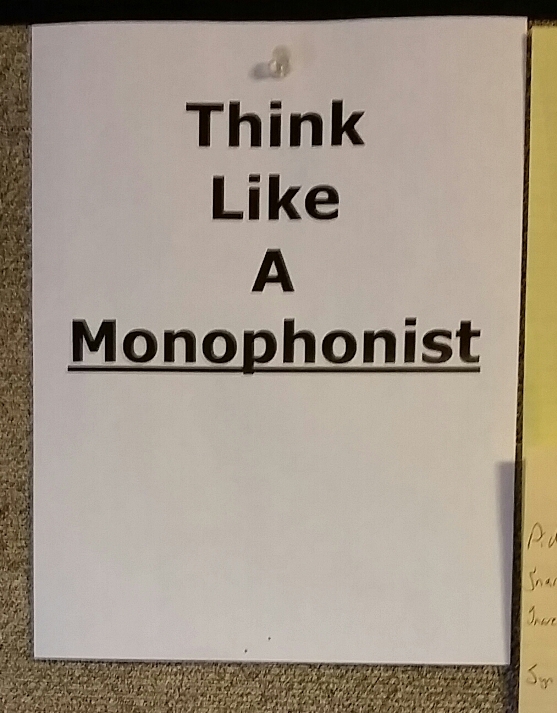
I have a sign tacked to the wall in my studio:

Monphonist Pic

I put it up when I realized that a lot of the early electronic music I like – from ethereal Tangerine Dream to the synth-pop of The Human League and OMD – was done by people with access only to monophonic synthesizers (that is, ones that can make only one sound at a time). That is, they can only make one note at a time. By contrast, without even getting into the virtual synths in my arsenal, I can bring to bear 150 voices! At once! I only have 10 fingers, after all.

My point is I tend to think in chords, even thought single notes are often what’s called for. After struggling to find the right sequence for this song, I backed off and gave it a fresh look. And I looked at my sign. The heart of this song was that simple bass line, the simple melody. Don’t mess that up by building it up unnecessarily. Take the simple route. Thus, that middle section was composed entirely of monophonic lines weaving together – as was the rest of the song.

None of this is Earth shattering. Still, as creators sometimes it’s easy to get wrapped up in the vision of more – more words, more notes, more colors – until you disappear up your own backside in search of your next complexity fix. Sometimes you have to step back and think about what works for the song, book, or whatever it is you’re making. Some of them are just simple little things that don’t have airs on being anything more.

“Dummy Tickle” is like that. A little goof of a tune, a good mood wrought by bouncy synths. Enjoy!

In Praise of Not Finishing Books

As a writer, the idea of people starting to read a book but not finishing it intuitively honks me off. After all, the author went through the trouble to create an entire package that, at least on some level, appealed to you – give them a chance to redeem whatever fault you’ve found in the end! But if I’m honest, as a reader, I’d push back against that – hard.

I wouldn’t be alone. A few years ago eBook platform Kobo (on which all my books are available, by the way), released some data that compared their best seller list with the list of books that readers most often finished. Not surprisingly, some of the best sellers were also some of the least finished. I love the cynical take on this from The Guardian, with respect to Donna Tart’s The Goldfinch (2014’s Pulitzer Prize winner: 37th best selling, only finished by 44% of readers):

Most-unfinished book of the year isn’t a title anyone would hope to win. But her core fans probably read the book to the end, as did a whole raft of new readers, which propelled her up the bestseller charts. And those readers who didn’t finish it still paid for it, so Donna Tartt can mop up those tears with crisp tenners, which will surely ease the pain.

Still, it’s a bit disheartening to know that so many people couldn’t even finish what you’ve written.

Alas, I occasionally find myself in that category as a reader. Even though I see every book I read (or listen to) as a learning experience when it comes to writing, sometimes I still can’t stick it out to the end (witness my “unfinished” shelf at Goodreads, to which I just had to add Jim Butcher’s The Aeronaut’s Windlass, alas). Thus I’m on board with this piece over at Electric Literature that, without shame, promotes non finishing books:

There are many factors that go into whether or when a reader finishes a book. I imagine many people’s reading habits are, like mine, scattered. I have at least a dozen in-progress books on my nightstand — and several more on my phone and e-reader. Readers stop reading a book they enjoy when they put it down and forget to come back. Readers finish books they hate when they are assigned it for book clubs or else they want to hate-read and laugh about with their friends. (Certainly a large percentage of Fifty Shades readers fall into that second category.) Just as a half-read book isn’t necessarily a failure, a completed book is not necessarily a success.

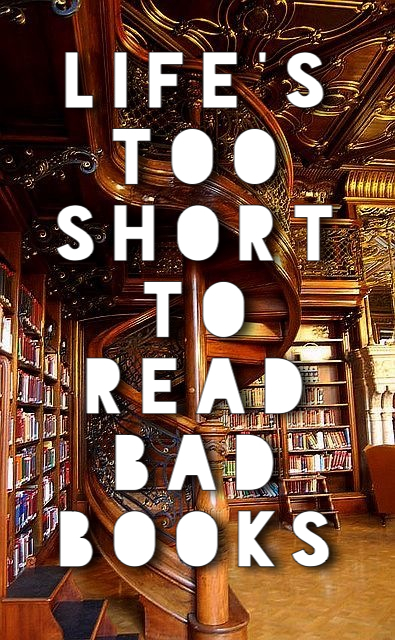
This makes a lot of sense. I said before, in other contexts, that reaction to art is inherently personal. What rocks one person to the core of the their soul will make another yawn. That’s neither right nor wrong, it’s just the way things work. So there’s really no reason to expect everybody to love a book so much that everyone who starts it finishes it. As the saying (attributed to James Joyce) goes:

LifeTooShort

Ultimately, the job of keeping a reader engaged with a book is the author’s. It’s a responsibility we should take seriously. But we shouldn’t forget that readers come to our works in all kinds of ways and for all sorts of reasons. No book is going to connect with all of them, just like some books you’ve read didn’t connect with you. We have to accept that sometimes saying “this isn’t for me” and moving on is best for everybody involved.

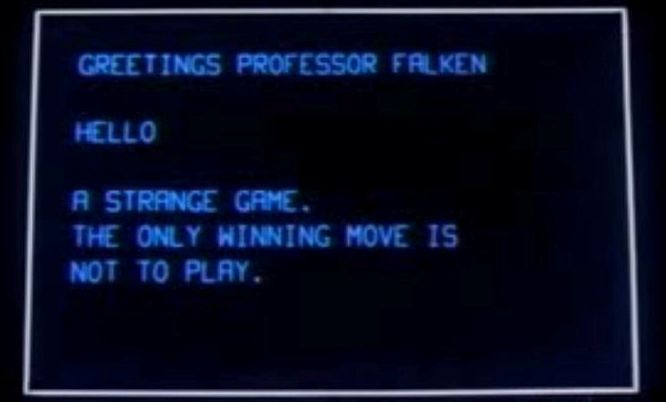
Remember the lesson of the WOPR:

WOPR

It applies to books, too.

Author Interview – Eliot Parker

A few words with mystery writer Eliot Parker, current president of West Virginia Writers, Inc.

Who are you? Where are you? What kind of stuff do you write?

I’m Eliot Parker. I am a West Virginia native. I live in Huntington, West Virginia. I write mystery/thriller novels and short stories.

Tell us about your most recent book, story, or other project

My latest novel is titled Code for Murder. It features Cleveland Homicide Detective Stacy Tavitt who is looking for the killer of Cleveland Browns football player Devon Baker. With little forensic evidence connecting anyone to the case, Stacy sets out to find the killer. When potential suspects in the case are murdered, Stacy realizes Devon Baker’s killer may be more familiar to her than she realizes.

CodeforMurderCover

In what genre do you primarily write? Why did you choose that one?

 I write in the mystery/thriller genre. I got interested in that genre when I was a kid. The first series of books I really enjoyed were the Encyclopedia Brown young adult books. I also loved the Scholastic “Choose Your Mystery” book series where you (as the reader) could choose the decisions and actions that characters made throughout the book. The fun part was going back and reading the book and making different choices to see what happened to the characters. From then, I was hooked as a mystery/thriller reader and those same passions for that genre carry over into my writing.

I’ve asked this question of another writer who works in your genres, so I’ll ask it again to see if you agree – what’s the difference between “mystery” and “thriller”? Aren’t all thrillers about figuring out the mystery of what’s happening?

To me, a thriller can be defined as a story in which the audience is waiting for something significant to happen.  A mystery is a story of revelation, with the action more mental than physical.

Eliot

Tell us briefly about your writing process, from once you’ve got an idea down to having a finished product ready for publication.

I write a little bit each day, five days a week. I use post-it-notes to help me organize characters, plot, setting, etc. I usually get up early in the mornings and write for 30-45 minutes. On weekends, I write more and holiday and summer breaks from school (I teach at Mountwest Community and Technical College) allow me to write more. It takes me about a year-and-a-half to get the first draft of a novel completed.

How complete is a “first draft” (since it’s a year and a half in the making)? What goes on after you reach that point?

A first draft for me is one that is complete. It has the exposition, the climax, and the resolution written. This doesn’t mean that all of the writing is great. In fact, a good bit of it will end up taken out of the book or revised significantly. However, when those three parts are complete, I know I have a first draft. After that point, I step away from the manuscript for several weeks (sometimes months). This allows my mind to remove itself from the characters, plot, etc. of the book. Then, when I go back and read it again with fresh eyes, I feel like I am approaching the story completely new, much like a new reader might do.

Who is the favorite character you’ve created? Why?

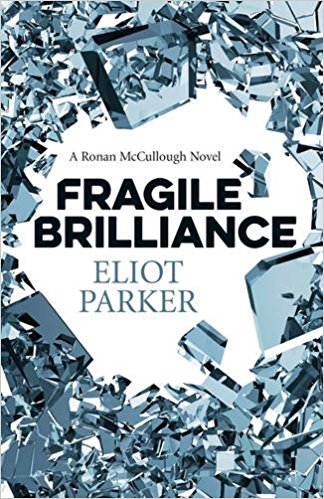
I love all of my characters. Choosing a favorite character is like asking a parent to choose their favorite child. However, my favorite character is Ronan McCullough. He appeared in my novel Fragile Brilliance. I love him because is tough, reckless, but principled. He is my favorite character because it’s so easy for me to get inside his head and his voice when I start writing. I don’t always have that same strong connection with other characters I have created.

FragileCover

What’s the weirdest subject you’ve had to research as a  that you never would have otherwise?

 In the sequel to Fragile Brilliance, titled A Knife’s Edge, I researched innovative technology being developed that allows law enforcement and hospitals to diagnose a host of illness and physical conditions with just one drop of blood, instead of the vials of blood that are required now. I learned more about blood, blood testing, and the process of analyzing blood through my research. I would never have sought out that information on my own if it wasn’t for the book. Blood freaks me out!

What’s the one thing you’ve learned, the hard way, as a writer that you’d share to help others avoid?

 The real part of writing is revision. Writers should know that the first draft is just that, the beginning of the process. Don’t be afraid or surprised to find yourself having to toss out at least 1/3 of what is written and then heavily revise the other 2/3. It’s that process of intense, detailed revision where the novel really finds is core truth and the characters really become what you envision them to be as a writer.

If you won $1 million (tax free, to keep the numbers round and juicy), how would it change your writing life?

 Absolutely! I would quit my job and be a writer full-time. I am working on that now, anyway, minus the lottery winnings.

What’s the last great book you read or new author you discovered?

 The last great book I read was Call Me By Your Name by Andre Aciman. It’s a powerful, moving story about love, saying goodbye, and the pain that comes when we cannot be with the one person that we love more than anything else in the world.

What do you think you’re next project will be?

 I finished the third revision of the next Ronan McCullough novel, titled A Knife’s Edge. It will be out in early 2019. I also have an outline finished for the next Stacy Tavitt novel. I am also working on compiling some short stories that have been published in literary magazines (and some that have not) for a short story collection.

Do you approach your short stories different from your novels (in terms of planning, revising, etc.)? If so, how?

I approach my short stories in the same manner that I do my novels. The only difference is that with short stories, the time spent with those characters and that setting is much shorter.

Author Interview – Cat Pleska

For our first interview of 2018 it’s back to West Virginia to talk with memoirist and editor Cat Pleska.

Who are you? Where are you? What kind of stuff do you write?

I’m a native West Virginian, 7th generation. I have a BA in English, MA in Humanities, and an MFA in Creative Nonfiction. I am an educator, author, and storyteller. I teach full time in an online Master of Liberal Studies program at Arizona State University (go Sun Devils!). I’ve taught at the higher Ed level for 18 years and have taught writing workshops in memoir and personal essay for many years. I have been a History Alive! character (photographer Frances B. Johnston), an essayist for West Virginia Public Radio (7 years), a book reviewer for The Charleston Gazette, and am a reviewer for West Virginia University Press. I am the president of a small nonprofit, 40-year-old WV traditional press, Mountain State Press. I am a cat lady (bordering on crazy cat lady with 6 cats currently), married to Dan, mother to Katie, and pup mom to one dog.

Tell us about your most recent book, story, or other project.

My memoir, Riding on Comets, was published by West Virginia University Press in 2015. About 15 years in the writing, it is a tremendous life accomplishment for me. I’ve edited 10 books, several through the Press and for another book company, Woodland Press. Most recently, Mountain State Press published Voices on Unity: Coming Together, Falling Apart, with 35 writers across the country (22 from WV) speaking to the difficulties of unity in these troubling times. I wanted for writers to have a format, a forum in which to practice what they do best when dramatic times present themselves, and they each stepped up to the plate creating poetry, prose, and song to exercise their right to speak out and speak up. I am super excited about my new book project, working title: The I’s Have It, a travel/personal essay collection about my travels in Iceland and Ireland. I hope to have it completed by summer and ready for revision throughout the fall.
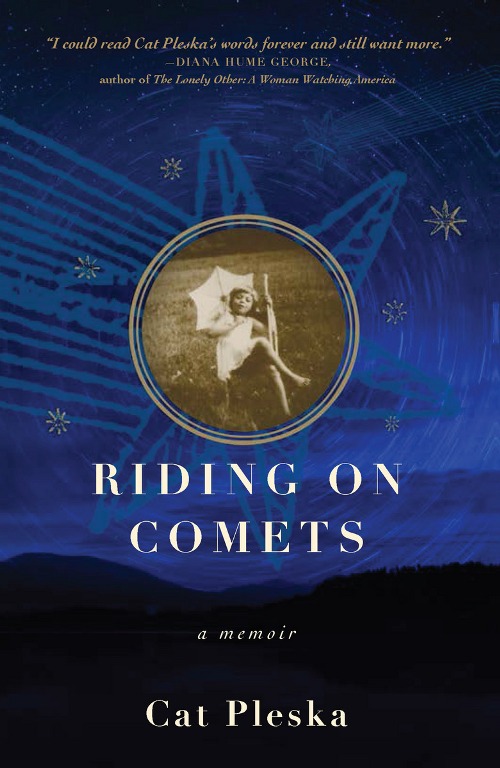
Comets Cover

In what genre do you primarily write? Why did you choose that one?

I write primarily in nonfiction—specifically creative nonfiction, as I like personal writing the best. I call myself a memoirist and personal essayist and that is what I’m published in. The occasional fiction piece or poem floats out, but rarely. Because I come from a family of storytellers, and these were tellers of personal stories, not local or regional tales many might know, I was born into the sense of hearing and imagining in my mind the stories of my people first of all. They did not make up stories; rather, they were true stories told on themselves, so to speak, many times to make you laugh or to make you cry. Each time they told a story, which was every time they gathered, the story was the same—the details did not change. So, truth, to me, was always important. When I heard about creative nonfiction back in . . . the early 90s (when I was in college), I was intrigued. I found out creative nonfiction is the truth told with creative techniques (not making it up), but rather the same way one would tell any story: scene, dialog, description. I was blessed with a partial hyperthymesia, which is recall for one’s childhood. Plus, I was lucky enough to simply ask my family for confirmation of details all through my life.

Have you ever had a situation where you were “stuck” in your writing and could see an easy solution if you were writing fictions and could make things up but had trouble sticking to the truth? If so, how did you work around that?

The truth is I was never “stuck” in my writing due to the fact that I was writing nonfiction. The training I had in fictional techniques (this is about using craft, not lying) helped me present what many think are unessential details as essential, because in truth, they are essential. I let the details tell the story of what really happened. So, if I’m writing about going trick or treating, when I was a child, for example, what’s so significant about that event? Well, what’s significant were the costumes I chose: powerful women characters. What else? That I  wandered neighborhoods as a 9 year old alone. What else? That when I returned, I stood by the front door, looking through the storm door glass and saw a massive orange streak of lightning pattern across an absolutely clear sky. Then it streaked again. I end the story with me wondering what that phenomenon was and what it meant. I really did wonder this. After that piece is one in which my dad disappears at Christmas, drunk again. My mom worrying herself into a state of ill health over his drinking jags. What happened to him? Was he all right? What was going to happen when he returned—if he returned? Although it is exactly what happened, you can see how that the event with the foreboding lightning occurred in Oct. and then comes the Christmas story, and the reader might see the strange phenomenon as foreshadowing. That is what we do with our lives: we look for cause and effect. If someone is stuck in a nonfiction story, that’s my go to: this happened (why? which may cause me to back up with a story that explains) or this happened next: are they connected? Once you explore using those questions, it becomes clear you don’t need to alter anything to become unstuck. I just relax and let the real details flow, letting them do the work of revelation, metaphor, symbolism.

Tell us briefly about your writing process, from once you’ve got an idea down to having a finished product ready for publication.

My ideas usually come from reading, especially other memoirs/essays, but also from the two professional magazines I subscribe to: Writers Chronicle and Poets and Writers. I also get ideas from any number of other places I read, from newspapers, to literary magazines, to National Geographic, to Smithsonian, to fiction. I often just hear a word, such as the one I used above, hyperthymesia, and that’ll send me off into thinking about its definition and what it really means to be along that spectrum. I’ll do further research and then think of personal instances that might fit to include as scene and exposition. Sometimes my ideas come from conversations with people who’ll say to me: you should write about that. Sometimes I’ll review prompts from workshops I’ve been in. My ideas come from words, and it just goes from there.

How do you find people you trust to provide the kind of feedback you need during the editing/polishing process?

That’s actually been a long process and it was by trial and error. First of all, I was in college taking creative writing courses and then in workshops across the country, so I learned what effective criticism is and who knows how to do it and who does not. It is as hard to learn to criticize as it is to write in the first place. The skills are different, and not all writers hone how to criticize effectively. Sometimes, they don’t even know they should learn, but learning how to effectively criticize means you learn more about your own writing in ways you hadn’t thought about. I was in writing critique groups early on, too. But I learned over the years that not all groups work well. I have been in a few in the last few years that were very effective, but eventually, I needed to just write and find a handful of people who are skilled readers—for me (and as a general rule, close in development as a writer as you are). In turn, I am often a reader for them, but not always. And there are people I read for who don’t read for me, and that’s fine. I select who I’ll read, based on what they write, how they write, and the skills I’ve learned that would be helpful to them. Not every reader is a good reader for you and you must learn that. Having my work critiqued is never easy for me—to hear. But I’ve learned to shut out the protesting ego and just listen. I wait a couple days before I approach the piece for possible changes, re-read what they’ve written and then decide in a cold, clear light of a new day if the suggestions are valuable for my piece or not.

Who is the favorite character you’ve created? Why?

Since I’m a creative nonfictionist, I don’t make up characters, but I certainly do develop them. You cannot just write about a person and say, well, she’s this or that. You have to show who that person is. For example, when I wrote about my father in my memoir, it would be easy to make him a bad guy since he was an alcoholic. But my dad was also very intelligent, a hard worker, and when sober a really funny, kind man. You have to create the rounded character even though they are not made up. You have to do your homework. I and my family had to come alive on the pages of my memoir and the same goes for any essays I write about anyone. Real people, researched, and fully, roundly viewed. I have no favorites, although I am fond of myself when I was small, say 5. I say that because that was when I became more aware and absorbed the world around me. Things came alive and so did I. My curiosity was profound and my skill as an observer, as an only child in a world of giants, set me off on my life as a writer more than anything else.

What’s the weirdest subject you’ve had to research as a writer that you never would have otherwise?

The current essay I’m writing about is the Penis Museum in Iceland sort of tops that list. I visited there, but I’d read about it before I went to Iceland. After being there and being . . . rather amazed (I mean, a sperm whale penis? Wow!) I’m still doing some research. In fact, I stumbled across a video interview with a guy who’s gifting his penis in his will to the museum. Apparently 9 inches, un-inflated, as it were, is pretty amazing.

What’s the one thing you’ve learned, the hard way, as a writer that you’d share to help others avoid?

 This is crucial to do: edit, edit, edit, revise, revise, revise then let people read it to edit/revise again and again. Do not ever put a book out there that you haven’t gotten professional editing for. Avoid that urge that this is all you can do and it’s good enough. Take out a loan if you have to, but get it professionally polished. Realize that not everyone is going to love your book. Or read it. Do not worry about that. Why should everyone? Not everyone likes Shakespeare, the bible, Fifty Shades of Grey. Don’t expect 7 billion people will like your writing, no matter how excellent it is. Avoid that expectation and realize there are even some good friends who aren’t going to read it. That’s fine. Don’t sweat it. Concentrate on and be grateful for those who do read it. Be kind. Be confident you’ve got a good book/writing, and you will if you’ve done your homework. Mostly, enjoy the writing. The sales will come.

Unity Cover

If you won $1 million (tax free, to keep the numbers round and juicy), how would it change your writing life?

I would travel half the year and write the other half. When I was 16, I wrote a letter to a person in which I said, “What I want to do when I grow up is to travel and to write.” And that dream has not changed. I’ve been to 8 countries, 4 continents (including no continent—that’s in Iceland and it literally is not any continent, but is a small stretch of land between the American continent and European/Asian continent), and it’s not enough. I’ve written all my life, have been published since 1990, and it’s not enough. So, 1 million in my pocket would set me free to do and be even more. It would be a tremendous blessing.

What’s the last great book you read or new author you discovered?

I’m sort of into the Icelandic authors right now, but I have so many books to be read . . . I’m not ashamed nor will I stop as long as a I have a dime in my pocket buying books—lots of them. I do not care one fig they’re all over the place around here. I’ll get to them as long as the eyeballs last.

Why Iceland? Both as a travel destination and as a focus of your reading?

Because I always wanted to travel since I was very young, my heart leaps up when I come upon a chance to do so. In the case of Iceland, it actually hadn’t been on my radar but a conference called NonfictionNow came up and it was taking place in Reykjavik, Iceland, and I both wanted to go to that conference, one that I had never attended, and to Iceland because a little reading about it told me I’d probably love it (I do!). So, I wrote a paper to submit for a round table event and it was accepted. So, off to Iceland I go. The diversity of attendees was quite fascinating and the conversations were enlightening. But it was the land and its people that fascinated me most. What I found there was a land still forming, but which had a history rich and engaging and that Icelandic is a language spoken that the Vikings would still understand from a thousand years ago. It’s a land where the very pragmatic people believe in elves and trolls (about 50%), where the ministry of highways employs “Troll whispers” to help in highway design. Where there are waterfalls that appear to fall to the center of the Earth, geysers flume, and the land is an incredible glowing green (Greenland is ice; Iceland is green—go figure!). These are just some of the elements that attracted me to Iceland, but the possibility of this still forming land and fascinating citizens (they just voted into law that a company cannot pay a women less than a man for an equal job) fire my imagination of what it would be like to live there. So, I write about it, dream about it, consider what it would mean if I lived there. And by the way: Icelanders love literature, have 100% literacy rate, and almost everyone publishes.

What do you think your next project will be?

As I mentioned, it’ll be The I’s Have It, but beyond that is a novel. I once thought I had two novel ideas and for years I’ve danced around with writing them both from time to time, never really getting very far. A few pages on each at best. But in 2016, I was in Shepherdstown at a local diner for breakfast. It was crowded, so my husband and I were sitting at the counter, drinking coffee, waiting for our order. I was watching the wait staff weave around one another behind the counter, as if they were braiding invisible strands of hair. They moved steadily, efficiently and smoothly and suddenly I realized—this came out of nowhere—that I was not writing two novels; they were the same novel and needed to be joined; that is, braided together. Once I realize that, I started writing the book anew. I was happily into my third chapter when a character came forward that I thought was going to be a minor one, and BOOM! She took over. I haven’t been back to it for while, as I’ve got to reconfigure the whole dang thing—in a way. All I’ve written will work but now it has to be meshed in a new way and I have to think about the structure/theme. Hey! It’s what writers do!

What’s different about the mechanics of writing fiction versus nonfiction?

As for the mechanics, there is not much difference. A good story is a good story, and the elements that make for a good story don’t differ, regardless of what genre you’re writing in (exceptions are hard news writing, scholarly writing, some biographies, although the latter two benefit from using the common mechanics of writing story). Having a facility for detail and good memory, in addition to the fact finding and checking, is a good thing for a memoirist and personal essayist, and a fiction writer as well. My early passive training in a family of storytellers caused me to have a facility with language, sensory detail, dialog, description. Just as someone writing fiction, I know I must have an opening sentence in my nonfiction that captures the audience. I know I have to provide details so the reader can “see” in their mind’s eye what’s going on; There has to be a narrative arc, something connecting the main story themes throughout; I have to build in tension; and writers of any genre who wish to tell a story, true or not, need to think about the universality of what they are writing about: why would anyone read it and care? In the end, the only major difference between writing creative nonfiction and fiction is whether or not you’re careful about fact—what really happened. But you have to break down that fact and think: but what does it mean? What do I think about it and know from it? How did it happen and what was the result? Life is story, and if we’re lucky, we get to tell it.

The Fate of The Messenger

Last month you’ll recall I talked, in rather gushing form, about The Messenger, my project for National Novel Writing Month last year. It was a bold experiment in terms of craft – I was flying by the seat of my pants, rather than working in my more plotted out way – and in terms of style – it was to be a sci-fi romp, something a bit more fun and light than my normal stuff. November was great – I “won” NaNo – and December was all about finishing the thing up.

Well, let me tell you, December sucked. In the words of my perhaps ancestor Robert, things gang aft agley. Hard.

I expected progress to slow down some, without the motivation of NaNo breathing down my neck. For about two weeks I did pretty well, but soon enough my lack of planning caught up with me. Mind you, I didn’t even know how this story would end when I started it, which is startlingly rare for me. Even if the middle bits are squishy I usually start with an idea of the beginning and the end. The more I pushed into The Messenger the more I realized I didn’t know where it was going.

I also started to worry more and more about continuity in the story. Things are always a little out of whack with first drafts, but usually I have copious notes to fall back on. Here I didn’t and it made it easy to get stuck in particular scenes, since I had to dig back through what I’d already written to try and tie things up. More often than not I was finding that I couldn’t tie them up, not in this draft anyway.

So, just as things were getting a little grim, the Christmas break showed up. I was off the entire time between Christmas and New Year’s Day, as was the wife, so plenty of time to finish up The Messenger, right? First I got sick (Merry Xmas, huh?), then the wife took her turn. Any motivation I had for writing dried up quickly. All the doubts I was having about whether I could finish this draft piled on and, as sometimes happens, The Messenger became a smoking crater. It’s dead, at least as a complete first draft.

What does that mean going forward?

Well, for one thing, it means The Messenger is on the back burner for the time being. Hopes of having a solid draft just in need of polishing are out the window. It will take some serious work to get right, work that I’ll be putting in on The Orb of Triska and its sequels for the near future.

For another, it means my experiment with pantsing proved one thing conclusively – I can’t do it. I went out, performed without a net, and fell flat on my face. Oh well, lesson learned.

Another lesson learned is that, maybe, writing big space-based science fiction isn’t for me. I never intended for it to he “hard” sci-fi. In fact, it has a disclaimer at the beginning about how it’s more “Dr. Who than Dr. Asimov” and sticklers looking for strict scientific accuracy should look elsewhere. Nonetheless, when you start flinging characters (of various species) across the galaxy things to worry about pile up. It’s entirely possible that The Messenger may wind up as a fantasy, rather than spacey sci-fi, story.

I still like the basic story of The Messenger. I like some of the things I created to fill in the universe in which it was told. None of that’s going to go to waste, but I can’t say it’ll wind up being what I intended it to be going in. That’s the frustrating joy of writing – almost all the time you wind up with something other than what you intended.

Failure

Writing Resolutions for 2018

Happy New Year, everybody!

Happy-New-Year-Memes

I figured now was as good a time as ever, and this as good a place as any, to set out some goals for the 2018 writing year. I’ve done the same in the past in private and it’s a good way to crystallize my plans, even if they don’t all come off in the end. So, what’s on the agenda for this year?

The Water Road Box Set

Now that The Water Road trilogy is complete, it only makes sense to put together an omnibus version that combines all three books in one convenient package.

2017-525 Front Page Box Set

The plan is to make the box set a Kindle exclusive, thus returning The Water Road trilogy to Kindle Unlimited. The individual books would still be available from Amazon and all other outlets.

Interviews

Last year I decided to try and do some interviews with other writers. I’ve done a few and thought they were fun and interesting and wanted to see if I could repay the favor. I wound up doing 19 interviews with all kinds of writers from all over the world. It was such a rewarding experience that I’m going to do more this year. I’ve already got about a half dozen people lined up.

More Short Stories

I’ve got a couple of finished short stories that need to find homes, so I’ll keep trying to shop those around. I’ve also got a pretty decent backlog of short story ideas, so while I’m polishing longer works I’m planning to knock out a few new short stories. Someday, down the road, there will be enough to make releasing a second collection of short stories a reality. It will include a couple of stories set in the universe of The Water Road.

Speaking of collections, look for The Last Ereph and Other Stories to get a spiffy new cover (done by someone who is not me) sometime this year, too.

Orb of Triska Polishing

Last year, you’ll recall, I finished the first draft of a novel in a new series, The Orb of Triska. My main job for 2018 will be getting that polished up and finished. Once that happens, I’m not quite sure what the next step will be. I may get it ready for publishing, with an eye toward releasing it in 2019. I may sit on it until another book or two (of the planned seven) is done. Or I may shop it around to see if any agents/publishers are interested. A lot will depend on when it’s “done” and how I’m feeling about it then.

Write The Scepter of Maril

Regardless of what becomes of The Orb of Triska one goal for later in the year is to start work on the second book in the Empire Falls series, The Scepter of Maril. If all goes well, it should be my NaNo project for 2018.

I think that about covers it. If you’re wondering about a certain other project I’ve talked about before – I’ll have some info about that in a couple of days.

Genre Bias Rears Its Ugly Head – It’s Science!

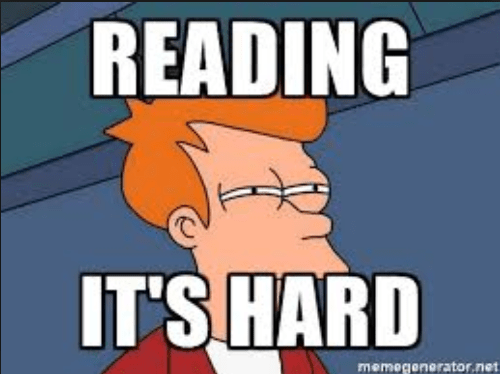
While I was of NaNoing last month an interesting bit of news came out with regards to science fiction and other types of fantastic literature. Put simply – people don’t put as much effort into reading those stories as other types.

ReadingHard

The study went like this:

Their study, detailed in the paper The Genre Effect, saw the academics work with around 150 participants who were given a text of 1,000 words to read. In each version of the text, a character enters a public eating area and interacts with the people there, after his negative opinion of the community has been made public. In the ‘literary’ version of the text, the character enters a diner after his letter to the editor has been published in the town newspaper. In the science fiction version, he enters a galley in a space station inhabited by aliens and androids as well as humans.

After they read the text, participants were asked how much they agreed with statements such as ‘I felt like I could put myself in the shoes of the character in the story’, and how much effort they spent trying to work out what characters were feeling.

The results were, on the face, disappointing:

‘Converting the text’s world to science fiction dramatically reduced perceptions of literary quality, despite the fact participants were reading the same story in terms of plot and character relationships,’ they write. ‘In comparison to narrative realism readers, science fiction readers reported lower transportation, experience taking, and empathy. Science fiction readers also reported exerting greater effort to understand the world of the story, but less effort to understand the minds of the characters. Science fiction readers scored lower in comprehension, generally, and in the subcategories of theory of mind, world, and plot.’

Readers of the science fiction story ‘appear to have expected an overall simpler story to comprehend, an expectation that overrode the actual qualities of the story itself’, so ‘the science fiction setting triggered poorer overall reading’.

In spite of some of the breathless comments I saw online the study does not, as someone points out, imply that reading sci-fi makes you dumber, but implies that people who don’t like sci-fi won’t give it its full attention. It’s nice to have some science to back this up, I guess, but is that any surprise?

That’s the whole reason literary writers, whom I’ve complained about before, don’t like admitting that they write sci-fi or fantasy. This came up against just recently after I finished Emily St. John Mandel’s really excellent Station Eleven (Weekly review forthcoming). It’s a story about survivors of a global pandemic striving to maintain a life that’s something beyond mere survival. It’s a quintessential piece of sci-fi (or, more broadly, speculative fiction), although the author is having none of it:

Thus when Station Eleven was nominated for the National Book Award – it also won the Arthur C. Clarke awards, so take that! – some eyebrows were raised. But when something that is “literary” is it prevented from being something else? I tend to agreed with this:

And yet confusion reigns in this debate, which feels strangely vague and misformulated. It remains unclear exactly what the terms ‘literary fiction’ and ‘genre fiction’ mean. A book like ‘Station Eleven’ is both a literary novel and a genre novel; the same goes for ‘Jane Eyre’ and ‘Crime and Punishment.’ How can two contrasting categories overlap so much? Genres themselves fall into genres: there are period genres (Victorian literature), subject genres (detective fiction), form genres (the short story), style genres (minimalism), market genres (“chick-lit”), mode genres (satire), and so on. How are different kinds of genres supposed to be compared? (‘Literary fiction’ and ‘genre fiction,’ one senses, aren’t really comparable categories.) What is it, exactly, about genre that is unliterary—and what is it in “the literary” that resists genre? The debate goes round and round, magnetic and circular—a lovers’ quarrel among literati.

Listen, I get the concern of writers like Mandel – slap a “sci-fi” or “detective” genre label on a book a certain group of people won’t take it as seriously. But rather than run away from the tag and deny the reality of what you’re writing, why not embrace it? Doing so would help smash conceptions about what genre fiction is and can be. Stand up for the slighted genre kids, rather than lean into the bully who just wants to put them down.

Thoughts From an Experimental NaNoWriMo

Right – so where were we?

Oh, yeah, National Novel Writing Month, also known as NaNoWriMo. Did I have a good month? I’d say I did.

NaNo-2017-Winner-Twitter-Header

The book I started for NaNo, The Messenger, is different for me in a lot of ways. For one thing, it’s pure space-based science fiction. While I’ve written some near-future sci-fi short stories, I’ve not done anything this long or, well, spacey. For another, I started the project having done very little prep work. So to be past 50k words and looking at another month’s writing (at least) to finish it is making me a little giddy.

HappyPuppy

Not an actual picture of the author. Think metaphorically, people!

Let me explain why.

Writers generally like to divide themselves into two groups – plotters and pantsers (putting to one side the ones who don’t accept either label). Plotters, as you might imagine, are people who do a lot of work before they actually start writing a first draft. They outline, develop characters, build worlds and all that kind of stuff before ever sitting down to write “it was a dark and stormy night.” (LINK). Pantsers are the complete opposite – they do little prep before writing and are, as the name implies, flying by the seat of their pants. In truth, I think most people are a little of both. Anybody who writes exactly the same book they planned to write or really sits down with a completely empty noggin and pours out a book are few and far between.

I tend to be a plotter. Lots of that is down to writing fantasy and the heavy lifting of world building. I like to get that stuff out of the way so I can let the story develop against a fairly fixed backdrop. Still, things never go precisely as planned, even when (as with The Bay of Sins, my last NaNo project) you lay out all the chapters you think you’ll need from the beginning. I suspect it’s something like attorneys say about oral arguments – there’s the one you plan to make, the one you actually make, and the one you wished you’d made after the fact.

So The Messenger was a very different experience for me. I had about a page of notes, compiled from thinking about the story over the years, but it was lacking lots of important things. Like, for instance, the names of the main characters or any of the names of the planets or alien races they’d encounter along their way. As for the way? I had an idea of how things began, but after that? I decided to let it see where it went. I’m glad I did, because I don’t think I would have come up with some of these things ahead of time.

It’s particularly interesting to do this one right after finishing the first draft of The Orb of Triska. That has a lot of work done on it before I started writing and I always felt like I knew where I was going. I think that first draft is a much better, more coherent final product, but, of course, neither one of them are “finished” after a first draft. It will be interesting to see how the final products compare once they’ve been polished up.

So that’s how I spent my November.

Also, we got new puppies:

ZariaKalindi

Zaria (L) and Kalindi (R) are ready for their album cover.

How you all been?

November Plans

Folks may know that November is National Novel Writing Month or NaNoWriMo. The idea is to write 50,000 words in a month, which is technically long enough to be classified as a novel (although most modern novels are much longer). I’ve done it several times, the last time being 2015 when I used it to start The Bay of Sins. After being otherwise involved last year, I’ve decided to jump back in for NaNoWriMo 2017.

NaNo2017

That means a couple of things.

First, it means that the first book of my new steampunk series, Empire Falls, is done! Well, the first draft is, at any rate. The Orb of Triska was fun to write and came fairly quickly, clearing the decks to let me jump into something fresh for NaNo. So I’ll put it to the side and get cracking on something different for me – a space opera adventure! It’s based on an idea I’ve had for a while, so I’m excited to get working on it. You can track my progress here:

Second, it means that traffic on the blog will be very light this month. I’ll have a couple of interviews, but other than that I don’t plan for much to be happening ‘round these parts until December. You’ll have to entertain yourselves.

Wish me luck!

WriteAllTheThings