Other Great Lawyer Movies

Several years ago, the American Bar Association Journal put together a list of the “best lawyer movies.” They’ve recently updated it, to their credit (there’s nothing quite so sad as an out of date “best of” list), and it’s full of great movies – Primal Fear, A Few Good Men, To Kill a Mockingbird, etc.. I come not to scorn that list, but to supplement it, with five of my favorite overlooked lawyer movies.

A word on what “lawyer movie” means (to me, at least). It’s a movie where a lawyer is a main, if not the main, character and where the practice of law is important to the plot. It doesn’t have to revolve around a courtroom (although that helps) and, taking a cue from the ABA’s inclusion of A Man for All Seasons, isn’t limited to American lawyers. So, with that said, off we go.

Breaker Morant (1980)

Breaker

Breaker Morant gets bonus points for not only being a great lawyer movie, but a great war movie, too. Set during the Boer War of 1899-1902, it’s the story of three Australian soldiers (although the titular Breaker is of English extraction) put on trial for murder of enemy prisoners and a German missionary. They’re attorney, another Australian, has only every handled land conveyancing before. It is, ironically, a real kangaroo court, with the soldiers being scarified more for the sake of international PR than justice.

That’s because, the movie asks, what is justice in a war where there are no rules? It’s from the Boers that we get the word “commando.” By the time the movie is set they’re fighting a rearguard irregular action that eschewed pitched battles, uniforms and the like. The by-the-book military law ways of dealing with prisoners didn’t really fit with that kind of war. But is the British Empire more interested in enforcing the rule of law or using the Australians as scapegoats? The irony is the murder of the German missionary, of which we knew they are completely guilty, is the one count on which they’re acquitted.

It also contains what might be my favorite last line in all of cinema:


A Soldier’s Story (1984)

ASoldiersStory

Another one that doubles as a great war movie as well as lawyer movie. Only this time the war is World War II and it’s nowhere near the events of the film itself. Based on a Pulitzer Prize winning play, it’s the story of an African-American army officer sent to a Mississippi base to investigate the death of an African-American drill sergeant.

Through the investigation we learn about the sergeant’s unit, a group of African-Americans desperate to do their part to defeat Hitler, but who have been reduced to a semi-barnstorming baseball team (they might get to play the Yankees). There’s an exploration of racism (the fact that the investigating officer is black is just too much for some folks) and abuse of power that spirals into a genuinely satisfying twist. Plus, there’s a hell of a cast, led by Harold Rollins and Adolph Caesar, but also including Robert Townsend, David Allen Grier, and a young Denzel Washington.

The People vs. Larry Flynt (1996)

people_vs_larry_flynt


You don’t want to quit me, I’m your dream client: I’m the most fun, I’m rich, and I’m always in trouble.

Every lawyer has difficult clients, something that the movies aren’t always good at putting up on screen (to see a great portrayal of what it’s like to work with a fraud client watch Shattered Glass). Sadly, most of our difficult clients aren’t as fun or rich as Larry Flynt, though some of them are in trouble even more often than “always.”

The People . . . (directed by the late great Milos Foreman) is a bio-pick, but it spends a lot of time in court, culminating with the most realistic depiction of a Supreme Court argument I’ve ever seen on screen. It’s the culmination of Flynt’s fight against (the late and decidedly not great) Jerry Falwell, who sued Flynt and Hustler over a parody ad that implied Falwell had sex with his mother. For that alone, it makes the list.

The Sweet Hereafter (1997)

SweetHereafter1

Every other movie on my list (and many on the ABA list) has great courtroom scenes. The Sweet Hereafter never gets anywhere near a courtroom, yet it still provides one of the best portraits of what it means to be a lawyer I’ve ever seen.

Mitchell Stephens (played by Ian Holm) is a big city lawyer with a drug-addicted daughter trying to build a case in a small, isolated Canadian town. A school bus has crashed through the ice, killing many of the town’s children and leaving deep scars on just about everyone. Stephens trudges from home to home, trying to sign up plaintiffs for a suit against the bus manufacturer and the school district. Thus, Stephens is literally an ambulance chaser, yet it’s clear he does believe in the righteousness of what he’s doing. He’s not just chasing a payday (though there is that). The melancholy of it all, being absorbed by the traumas of others, comes through in every scene with him. No other movie I’ve seen gets that aspect of what it means to be a lawyer.

Naturally, it all falls apart at the end (thanks to a surviving child, played by Sarah Polley, who’s gone on to direct some great films), which makes it the rare lawyer movie where the lawyer loses. Again, that’s a hard truth for most lawyers (most of my fellow criminal defense lawyers, at least).

Intolerable Cruelty (2003)
intolerable-cruelty6


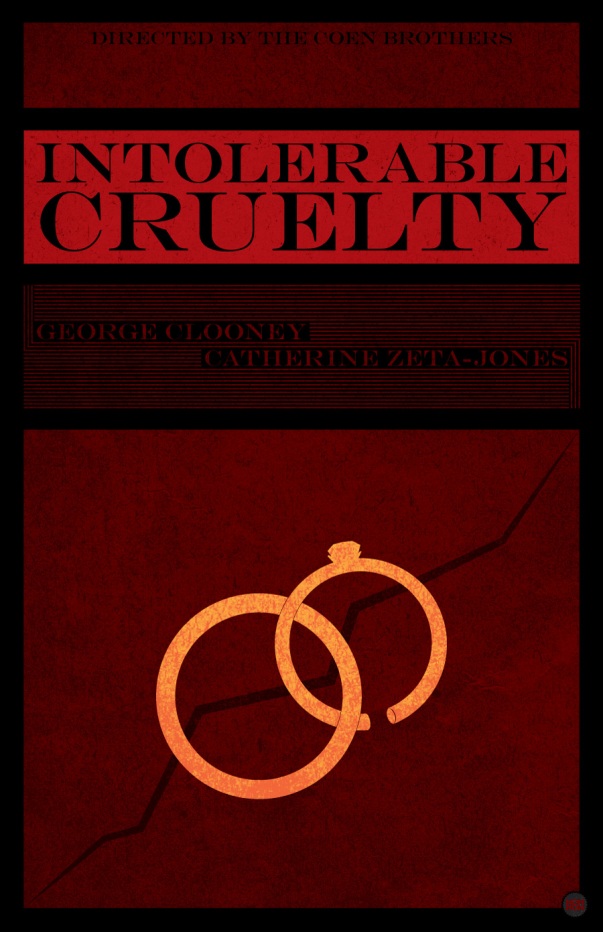
One of the reasons I like to talk about “favorites” instead of “best” is that movies (and all art) strikes different people in different ways and sometimes you love something even if it isn’t a critical darling. I don’t think anybody would call Intolerable Cruelty one of the Cohen Brothers’ best movies, but it is undoubtedly one of my favorites.

That’s largely down to the fact that for the first year of my legal life I was a divorce lawyer. Working for legal aid as the domestic violence specialist I split my time between working with abuse victims to get protective orders and getting them out of marriages. The people I was working with didn’t have enough property (and, thankfully, not many had kids) to fight about most time, much less enough to worry about something like the famous prenup that bears the name of Myles Massey (played with all his old-school movie star charm by George Clooney), but the beats and rhythms of what divorces cases are like are the same regardless of what’s involved. Maybe it’s millions of dollars; maybe it’s the commemorative Smurf glasses from Arby’s. I recognized that on the screen.

Plus, there’s an easy screwball feel to the whole thing (Catherine Zeta-Jones, as the woman who cooks up the scheme to bring Massey to heal, is great, too), with just enough bizarre touches (Massey’s wheezing senior partner, the Baron, etc.), that it’s just fun. Which is something you shouldn’t be able to say about a movie with a divorce lawyer as the main character!

Weekly Read: The Cadaver King and the Country Dentist

There’s a long-running thread on one of the writers’ forums where I hang out about “books you’ve thrown across the room with force.” The examples are most books that are badly written, not otherwise infuriating. That being the case, if I actually had a copy of Radley Balko’s The Cadaver King and the Country Dentist, rather than the Audible file on my phone, I’d definitely have thrown it across the room a few times while reading it. As it is, I can’t afford the new phone, so I just had to grin and bear it.

From the main title you’d think this book might be one of the nifty mysteries where a pair of mismatched souls find the killer in the end. The subtitle dispels that: “A True Story of Injustice in the American South.” The spine of the book is the story of two men wrongfully convicted of murder in Mississippi and what it took to reclaim their freedom. It’s a story with a pair of clear bad guys, but the lesson of the book is much broader than that.

Said bad guys are the ones mentioned in the title. The “Cadaver King” is Steven Hayne, a medical examiner who at one point was doing 4 out of every 5 autopsies in the state (plus others in Louisiana and some in private cases, too). He did so much work for a couple of reasons. One is that, for decades, the death investigation system in Mississippi was completely fucked up. It was left in the hands of local coroners (elected officials, not necessarily medically trained – the history of the office is fascinating and has little to do with death investigations), who then contracted with actual doctors to do autopsies. The other is that Hayne told prosecutors what they wanted to hear, pushing well past the bounds of what science could say to provide clinching evidence that whatever person the state charged was guilty of the crime.

Bad as Hayne was his sidekick, “Country Dentist” Michael West, was even worse. West started out as the purveyor of a an always sketchy and now debunked field of forensic practice that allowed someone to match bite marks they way others might match fingerprints. With Hayne an expert at finding bites on corpses, even when it made no sense, West could be another link between a suspect and a conviction (why nobody questioned the rise in murders that involved biting is a mystery. As the years went on he developed other skills so that, before his eventually unraveling, he was basically a one-man CSI.

It’s not a spoiler to say that Hayne and West get their comeuppance (West is finally pinned down during a deposition about his magical testimony by an Innocence Project lawyer named – I shit you not – Fabricant) and that two innocent men are freed. But that’s far from a happy ending. There are almost certainly others similarly situated in Mississippi and what makes the book so infuriating is that the entire system is setup to keep them in prison. I’ve had to explain this to clients before – once you’re found guilty, it’s next to impossible to prove otherwise. Finality reigns supreme. The system simply doesn’t care if that might not be the truth and most people don’t want to know (one revealing anecdote is how the Innocence Project at the University of Mississippi got pushback initial because people feared it might suggest some alumni had gotten the wrong people convicted). As Balko puts it in the book, “[w]hat you’re about to read didn’t happen by accident.”

That’s bad enough, of course, but when politics and perverse prosecutorial incentives are thrown into the mix it practically guarantees bad outcomes. That’s mostly because politicians have been so good at weaponizing fear of crime (even as crime rates drop to historic lows) and most prosecutors are elected. You’ll rarely lose an election for being too tough on crime, but go the other way and better start planning for another career. And, as Balko points out, this is a bipartisan problem. When a blue-ribbon federal panel issued a report calling into question large swaths of forensic evidence, the Obama Justice Department dismissed it. Truth is, people rarely care about the details of the criminal justice system unless they or someone they love get caught up in it.

But that only works they way it does because, at bottom, the modern American criminal justice system doesn’t place any priority on determining what actually happened in any particular case. Prosecutors want convictions. Defense attorneys want the best results for their clients, which may be at odds with the actual truth of the situation. Defendants, sometimes facing long potential sentences and no real option of winning in court, plead guilty to things they didn’t do. And, as I said, once that verdict is in, the system is not designed to examine it again.

The Cadaver King and the Country Dentist is a good read. It’s engaging and compelling, frightening and maddening. “If you’re not outraged,” the saying goes, “you haven’t been paying attention.” Pay attention. Read this book.

CadaverKing

Birth of an Idea

Some authors hate the “where do you get your ideas?” question. I’ve never really figured out why. I can see why readers might be disappointed with the answers, since they’re much more mundane than they might hope. There is no communication with the muse, no blinding flash of insight, just a keen eye and brain that perpetually asks, “what if?” And the realization having a pen handy is almost always a good idea:

So in service of explaining how that works, I thought I’d describe the process I recently went through were a new story idea crystallized in my mind. It’s as good an example as any of the truth that inspiration is out there everywhere, if you know what to do with it.

Right now in my lawyer day job I have a case pending in the court of appeals where one of the issues involves whether my client had served too much time in prison and might be entitled to credit for that. In my brief I made a couple references to him “banking time.” When the Government responded, for some reason, it turned the word around and repeatedly referenced a “time bank,” which it argued didn’t really exit (it does).

Beyond the fury at the allegation I was making shit up, the phrase “time bank” got lodged in my brain. There was something about it that seemed absurd and specific in a way that “banking time” didn’t.

With “time bank” lodged in my brain like a stepped-on Lego, I went into brainstorming mode, which to my neighbors looks like mowing my yard. I do some of my best thinking about writing while I mow, since it’s not like my mind is taken up with other things. So I turned over this concept in my mind, over and over again – what, precisely is a “time bank”? And how would it differ from a memory bank?

I came up with three different ideas, one sort of modern science fictional, one utterly fantastical, and one kind of in between. Thinking them over I found myself drawn the first, the modern one, and began thinking about how characters might interact with this “time bank.”

The working title is “Down and Out at the Time Bank,” a tale of a poor schmuck who gets in way above his head, but probably comes out of it just fine. Short story or something longer? Don’t know yet, as I’ve got to put it on the back burner while I work on other things. But it’s there, lurking in my ideas file, waiting for me to come back to it.

So, thank you, unnamed Assistant United States Attorney. You’ll win the case in the end (‘cause y’all almost always do), but at least you gave me something worthwhile I can take away from it.

And that, ladies and gents, is where story ideas come from!

We All Need Some Light

The other day at work I was doing some research at a different end of the West Virginia Code that normal and came across a provision that made absolutely no sense to me. It’s WV Code §2-1-2, titled “Ancient Lights” for those playing at home:

The common law of England in regard to ancient lights is not in force in this state.

The background for this is that the prior section (WV Code §2-1-1) adopts English common law “except as altered by the general assembly of Virginia” before June 20, 1863. In other words, we adopted Virginia’s law as is when we left the commonwealth during the Civil War. But apparently it was important to exclude from that this law on “ancient lights.” So what are we missing here in the Mountain State?

Turns out it’s a right to light! In some places, at least. Specifically, it’s a kind of easement, which is a property interest that someone has in someone else’s property – think of someone who has the legal right to use a path across their next door neighbor’s property. In England, if a person has a building with windows that for 20 years have received daylight they can prevent someone else from building in a way as to obstruct the light.

Thus, you have things like this on some old English buildings:

Ancient_lights_signs_Clerkenwell FULL

Pic by Mike Newman via Wikimedia Commons

As it happens, West Virginia isn’t alone in not adopting this doctrine, so very few Americans actually have an enforceable right to light. Which is a shame, since, as the song says, we all need some light.

What Do Verdicts Mean?

Recently there was a small kerfuffle in parts of the atheist blogosphere over, of all things, the guilt of innocence of Jerry Sandusky. Sandusky, you’ll recall, is the long-time assistant to legendary Penn State football coach Joe Paterno who was convicted on dozens of counts of child sexual abuse related to his position there. I’m less interested in the specifics of this case than I am about one particular argument made that raises an interesting question about the criminal justice system.

Things kicked off with a review in Skeptic magazine of a book, The Most Hated Man in America: Jerry Sandusky and the Rush to Judgment, which argues that Sandusky’s trial was tainted by recovered memory therapies and led to a wrongful conviction. The book’s got favorable blurbs from memory expert Elizabeth Loftus and false confessions expert Richard Leo, two names that make my defense lawyer ears prick up. The review was then favorably discussed by some of the atheist heavyweights, including Jerry Coyne and Daniel Dennett.

Others in the atheist blogopshere pushed back, wondering how skeptics could defend Sandusky. While some offered take downs of the review itself, others simply argued that the issue was settled because of Sandusky’s convictions. The leading proponent of that position was PZ Myers who wrote (links removed):

They’ve published a defense of Jerry Sandusky! Look, Jerry Sandusky was found guilty of 45 counts of child sexual abuse. He’s a convicted pedophile. The prosecution brought in a long train of witnesses and evidence of criminal behavior spanning at least 15 years and 10 victims, and this case found him guilty in a community that was full of fanatical Paterno/Sandusky defenders. Anyone remember the riots and protests when the Paterno empire fell? You can’t have a witch hunt when the targets are regarded as holy saints — the evidence was just so overwhelming and undeniable that even angels by repute could be defrocked at last.

Myers may be right about the weight of the evidence, but what I’m more interested in is the idea that because Sandusky was convicted at trial that it’s somehow wrong to examine the evidence against him. After all, the jury has spoken, right?

Except we know that juries get it wrong. Not all the time, certainly (and an overwhelming number of cases never get to a jury anyway), but enough for it to be a concern:

In the past quarter-century, the work of dogged attorneys and advances in forensic science have exonerated more than 2,150 men and women, 161 of those from death row. The Innocence Project, a New York–based nonprofit founded by Barry Scheck and Peter Neufeld in 1992, has freed more than 200 people and spurred the creation of numerous smaller organizations around the country devoted to the same mission. (From 2012–2015, I was the director of the Loyola Law School Project for the Innocent in Los Angeles.) By some estimates there are tens of thousands more wrongfully convicted prisoners languishing behind bars.

Given that, what kind of deference should the public give to guilty jury verdicts?

A quick aside on non guilty verdicts. It’s hard to read anything at all into those, since there are so many reasons why such a verdict could be returned. Maybe the prosecution completely failed to prove its case, or maybe it couldn’t meet the final hurdle to of reasonable doubt. Or maybe the jury nullified in light of sufficient evidence. With a not guilty verdict it’s hard to say much beyond “that guy hasn’t been convicted of anything.”

Back to guilty verdicts – what kind of weight should the general public give them? I may lose some of my defense attorney cred for this, but I’m going to say a lot. The law likes to use lots of “rebuttable presumptions,” things that are taken as true, but can, with sufficient evidence, be shown to be false. For example, in Federal court if you’re arrested on just about any drug offense there’s a presumption that you should be held without bond. You can argue your way out, but it relieves the Government of the need to argue your way in.

I’d grant guilty verdicts that kind of presumption because it’s the one time when a group of people are given one job only – evaluate the evidence presented and, using the filter of the judge’s instructions, determine whether the defendant did it or not (whatever “it” is). Everybody else in the courtroom – the lawyers, the judge, the spectators, the press – all have other things competing for their time and attention. Only the jurors have the clear job of listening to every word of testimony, looking at every exhibit, and deciding what it means.

It’s not a full proof system, for sure. The jurors only hear the evidence presented in court, so if the defendant has a shitty lawyer or a prosecutor who is pushing the boundaries it could present a skewed view of the case. In addition, the rules of evidence pare down the universe of facts that a jury can consider, leading to situations where the “well informed” are “those outside the courtroom.” And, finally, the case itself might be tangential to whatever the defendant is really accused of doing. That Al Capone was convicted of tax evasion does little to show, one way or the other, that he was a mob boss.

Which is why I think a rebuttable presumption is the way to go. It’s perfectly right to say because he was convicted of dozens of sexual abuse counts against children, Sandusky probably actually molested them. But it’s not an ironclad guarantee, as Myers and others seem to suggest. Those who would rebut the presumption, however, have a lot of heavy lifting to do.

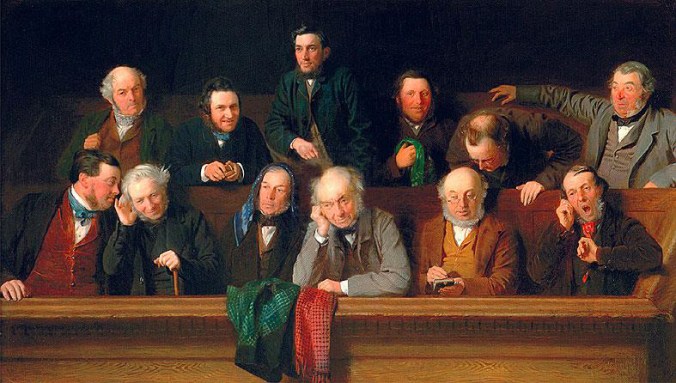
The_Jury_by_John_Morgan

The Jury (1861) by John Morgan, via Wikimedia Commons

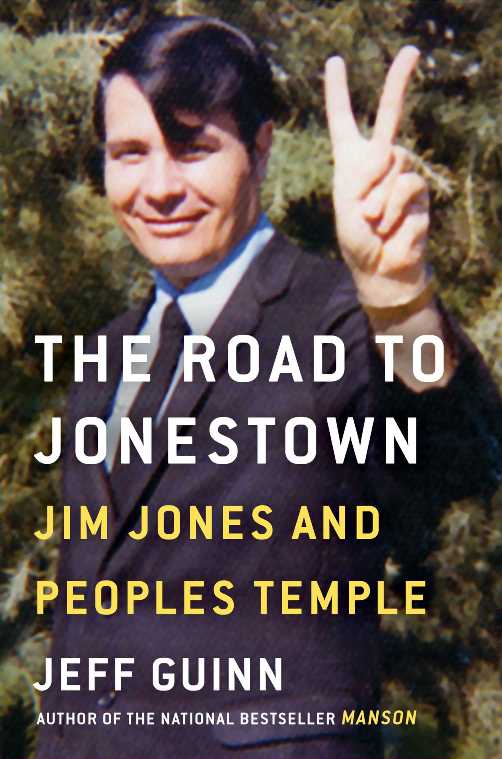
Weekly Read: The Road to Jonestown

There’s a passage in Jeffrey Toobin’s book on Patty Hearst where, after the heiress is captured, her kidnappers demand the Hearst family set up a from scratch program to feed the poor. Various groups come out of the woodwork to try and run the program, including Peoples Temple, the cult led by Jim Jones that, a few years later, would mostly die out in the Guyanese jungle. Toobin presents it as a freakish aside, the intersection of two infamous historical figures. After reading Jeff Guinn’s The Road to Jonestown it becomes clear that there wasn’t anything freakish about it – Jones and his followers could have pulled it off.

That is, perhaps, the most interesting thing about Guinn’s book, which takes a deep dive into the founding of Peoples Temple and the founding, if you will, of Jim Jones. Born poor in rural Indiana Jones gravitated toward two things when young – social justice and fire-breathing religion. Neither of his parents were religious, but he had a neighbor who was constantly on the prowl to recruit souls for Christ and she exposed Jones to her church. He took to preaching and honed a miracle-working approach in Indiana that would serve him well for decades. It was also the spark of the dark charisma that would lead to so many more than 900 dead in Guyana.

Fact is, Peoples Temple got things done for people who were too often left behind by society. Jones and his followers helped drive desegregation in Indianapolis. Both there and later in California they ran nursing homes, drug treatment programs, and, yes, food giveaways. All those programs were successful (at least as successful as other similar programs) and properly run.

The problem was that, from the beginning to the end, Peoples Temple was always the fiefdom of Jim Jones. All the good work came at the expense of a staggering cult of personality that merged with Jones’s rising paranoia (aided, no doubt, by a cocktail of drugs he used to work and sleep) to make for one of the more frightening cults in recent history. Jones was Father, at the very least, and perhaps God herself (or some reincarnation of past holy figures, like Buddha or Jesus) and the only one who could save his people from the destructive world around them.

At first the destruction was nuclear war. That was reason Jones moved Peoples Temple from Indianapolis to California, setting up shop in a rural area north of San Francisco that supposedly was far enough away from primary targets that, with favorable winds, residents could survive a nuclear attack. That fear didn’t keep Jones from barnstorming around the country on a fleet of busses doing revival shtick, however.

The threats quickly became more personal. There were defectors from Peoples Temple, people who either saw Jones for the con man he was or simply grew tires of giving everything they made and owned to the organization. To Jones each was a potential villain, providing fodder to the press or authorities about what went on in the increasingly secretive group. Journalists started to close in, too. The final straw was a group of former members who focused on getting other family members, including children, out of the group who, they claimed, were being held against their will.

Although Jonestown itself had been founded earlier, these existential threats are what drove Jones and most of his followers there well before the settlement was ready to support them. Harsh conditions, piled on top of Jones’s paranoia and iron grip over his followers, soon degraded into homicidal/suicidal tendencies. Jones simulated an attack on the compound and later staged a mock suicide, just to make sure everyone reacted in the proper fashion. By the time San Francisco-area Congressman Leo Ryan arrived in November 1978, the keg was set to blow. Ryan and several others were murdered at a nearby airport, while Jones led the mass of his followers in Jonestown to their death via a mix of cyanide and Flavor-Aid (not Kool-Aid, to set the record straight).

More than 900 people died in Jonestown and there’s always been some controversy over what label to apply to it. Jones called it “radical suicide” (?), but given that at least a third of the dead were children it’s easy to say that many of the deaths were flat out murders. Beyond the children there’s evidence that some adults were held down and injected with poison, rather than having drunk it on their own. Still, hundreds of people, at least, appear to have willingly laid down their lives when Jones said so.

The big question, of course, is why? Guinn doesn’t do much evaluation of the aftermath of Jonestown or bring in any kind of experts to attempt to explain it. Instead, he lets the work he’s already done, showing how Peoples Temple developed, do the work. What he shows is that people really believed in Jones. Some believed in his commitment to social justice. Others came at it from a more religious angle, drawn in by the healings and such that Jones performed on the revival circuit. Because once your religion has primed you to believe miracles exist, why would you doubt the con man that actually says he performs them? Regardless, they believed in Jones and the outside world gave them just enough reason to buy into his paranoid rants. More than anything else, they let Jones come to define their world, to the exclusion of any critical thinking or close examination of what he was doing.

It’s hard not to think of Donald Trump while reading The Road to Jonestown. Not because Trump is going to lead us into ritual suicide (with a side of murder) anytime soon (we hope), but because of the freakishly similar way Trump and Jim Jones interacted with the outside world. To Jones’s followers he was the only person who could solve their problems and save them from the injustices of the world. Trump during the campaign repeatedly expressed similar sentiments. Jones never failed – he was only failed by underlings or thwarted by shadowy outside forces. Likewise, Trump never backs a loser and is constantly doing battle with the “deep state” or “fake news.” More than anything else, Jones and Trump share a complete aversion to dealing with reality. That way lies madness, as Jones and others have proven.

Hopefully, we’re not all on the road to Jonestown again, without quite realizing it.

RoadtoJonestown

Weekly Read: Blood in the Water: The Attica Prison Uprising of 1971 and Its Legacy

On September 9, 1971, inmates at the Attica Correctional Facility in upstate New York (not too far from Buffalo) took control of part of the prison. For the next four days they negotiated with authorities over a list of grievances, at times with the help of notable civilians such as attorneys and journalists. After reaching an impasse, authorities stormed the prison on September 13, killing 43 people – including 10 correctional officers who had been taken hostage. It’s no wonder that the events at Attica galvanized the nation and quickly worked their way into pop culture:

What’s interesting is how different people refer to those events. Some call them a riot, with all the connotations that word brings – senseless violence, brute force, unfocused rage. Others, such as historian Heather Ann Thompson in her Pulitzer-winning book, Blood in the Water, refers to the events as an uprising – an event where a repressed group of men sought change in the only manner available to them. Which camp you fall into probably says a lot about your politics in general.

Which is appropriate because politics is a driving force in Thompson’s book, beginning with the political aspirations of New York’s governor at the time of the uprising, Nelson Rockefeller. He wanted to be president and couldn’t afford to be seen as “soft” on crime or criminals (it’s no surprise that Nixon backed his play at Attica). In addition, he viewed the uprising as the tail end of leftist activism from the 1960s and worried that if the Attica uprising wasn’t suppressed it could spawn an actual revolution.

The inmates didn’t do the most they could to dissuade Rockefeller from this position. Although their long list of demands dealt mostly with conditions at Attica or within the criminal justice system in general, there were (at least at some points) demands for a plan to take anyone who wanted to go to Africa and other broadly political requests.

Having said that, the negotiations made progress. The sticking point turned out to be amnesty for those involved in the uprising. Rockefeller insisted he didn’t have the power to do it (doubtful) and all rested with the local prosecutor. The inmates, for their part, didn’t seem to realize that once one of the correctional officers who had been attacked in the early stage of the uprising had died there was little chance of a blanket amnesty, anyway.

That authorities eventually stormed the prison to regain control wasn’t a surprise. What was surprising was how it was done, with a collection of state troopers, correctional officers, and National Guard troops armed to the teeth. Similar, if smaller, uprisings in other New York facilities (including New York City’s infamous Rikers Island jail) had been put down without the use of firearms and the associated loss of life. Authorities went into Attica with guns blazing, however, and left a horrific toll in their wake.

Thompson’s great achievement in Blood in the Water is taking those four days of the uprising and laying out what happened in serious detail. She also provides a great deal of context for the uprising, placing it as one of a series of such things around the country, not just a sudden, confusing spasm of violence. It’s an important portrait of a watershed event in American history painstakingly pieced together.

Once the uprising is put down, however, the book begins to lag. Initially the response of the state is familiar to anyone in 2017 watching the news when an unarmed black man is gunned down by police. First, authorities lie – in this case, by claiming that the 10 hostages who died during the retaking where killed by inmates, often in ways that involved mutilation. Second, authorities dehumanize the inmates – everyone involved at Attica was a murderer or rapist or similar kind of thug. In truth, many were there for minor parole violations and other non-violent offenses. Third, when the truth comes out – medical examiners refused to be silenced about what actually killed the hostages – the authorities downplay, obfuscate, and at no point apologize or formally correct the record.

It’s no surprise, then, that litigation about Attica – criminal and civil – dragged out for decades. Thompson deploys the same attention to detail to that litigation, but to less effect. There are so many trials with so many different players that the narrative becomes scattered. Also, there are things that jumped out to my lawyer eye that deserved further detail. For example, there were mutual defense groups set up to help defend the Attica inmates during their criminal trials. Such a setup is rife with ethical issues (conflicts of interest, primarily), but Thompson never addresses them. Another example is when there’s a ruling by the judge in one inmate’s case that, we’re told, profoundly impacted several others, but there’s no discussion of the ruling itself.

What Thompson’s exhaustive stroll through the litigation does is drive home just how much the apparatus of the “state” – meaning both the New York and federal governments – were determined not to really find out what went down at Attica. Most obviously that’s borne out by how the New York players obfuscated when it came to the facts, but it’s smaller things, too. There’s the fact about how the state tried to lock the families of the guards who had been injured and held hostage into taking small workers’ compensation payouts rather than actually suing anybody. Or there’s the ultimate brush off – the federal judge handling one of the civil cases went on vacation while the jury was deliberating. It doesn’t paint a good picture of a society coming to grips with a horrific event.

For all its cachet as a touchstone in the culture, it’s amazing that it took until last year for a definitive history of the Attica uprising to be written. For that Thompson deserves all the praise she’s gotten. That the entire story isn’t as gripping as those four days in September of 1991 isn’t her fault. For that part alone, I highly recommend Blood in the Water.

Attica

Not Exactly The Thomas Crown Affair, Is It?

Art heists are great fodder for movies and books. The stakes are usually pretty high, involving unique, priceless works of art. Daring do is often required to pull them off. And it provides a good opportunity for suave characters to behave suavely.

This isn’t one of those stories.

In February 1965, Salvador Dalí painted a version of Christ on the cross – in an hour and a  quarter – and donated to Rikers Island, New York City’s notorious jail complex. Dalí was supposed to meet with some inmate artists, but wasn’t feeling well, so he sent the painting instead. It was hung in the cafeteria, where it proceeded to collect stains from various jailhouse food fights. In 1981, somebody realized what it was (and had it appraised for $250,000) and took it down.

After a short tour around the country and some time in storage, the painting was hung up again at Rikers – but not where the inmates could actually see it. Instead, it was put up in a lobby where jail employees went in and out. In 2003, a group of those employees (four guards) decided to steal it.

The plan was to create a couple of distractions and allow the leader of the scheme to take the Dalí while replacing it with a fake. It didn’t go well:

It was noticeably smaller than the original, an instant tip-off, but the reproduction was also one that, based on descriptions, not even a child would have wanted to claim. Plus, the reproduction of the cafeteria stains were an entirely different color. It was bad.

Then, of course, there was the painting’s presentation. Yes, the glass case had been locked back up with the copy safely inside. But where the original had been displayed in its gold frame, the fake was simply stapled to the back of the box, sans frame.

The whole plan was amateurish at best, but when you factor in the location—a prison teeming with law enforcement officials who spent their days gazing at that exact painting (there were two guard booths in direct view of the Dalí)—it was stupidity at its finest.

The very next day, several guards reported that there was something wrong with the Dalí.

They all got caught, of course, although the ringleader managed to get a not guilty verdict at trial (the others were convicted).  As for the Dalí itself? One of the thieves says that the ringleader got nervous and destroyed it.

On second thought, maybe there is a great story here, in the tradition of a Coen Brothers “heist gone wrong” kind of thing. I’d watch it. I’ll even suggest a theme song:

Dali

Aliens For the Defense!

The first novel-length project I finished (which shall molder in box in my close forevermore) grew out of the fact that criminal defense attorneys routinely have their clients try and tell them whopper stories about “what really happened.” My personal favorite is a colleague’s client who explained that he tested positive for cocaine because he was helping a buddy move a couch and when he picked it up a cloud of white powder erupted and flew up his nose. My book took that phenomenon and aliened it up a bit (it involves the Flatwoods Monster).

Now, in my wife’s home state of Wyoming, somebody is trying to sell something similar, but I doubt any court (or defense attorney) is going to be buying. The defendant was arrested for being drunk in public, but he had a good reason:

Police say a central Wyoming man they arrested for public intoxication claimed he had traveled back in time to warn of an alien invasion.

* * *

The man told police he was only able to time travel because aliens filled his body with alcohol. He noted that he was supposed to be transported to the year 2018, not this year.

I suppose time travel isn’t an exact science, even for aliens But don’t worry, the invasion isn’t until 2048, so we’ve got time to prepare.

In the meantime, might I suggest an expert witness should this gentleman decide to go to trial?

Aliens

The High Price of Needing to Be Right

There are lots of things about the legal system that we lawyers take for granted that make lay people shake their heads or look at you like you’ve got a bamboo plant sprouting from your forehead. One thing that really confuses them are so-called Alford pleas, in which a person pleads guilty to a crime, all the while maintaining that they’re actually innocent. How the hell does that work?

It should be simple enough. You’re charged with a crime. This presents you with two choices – plead guilty or not guilty. Presumably, if you didn’t do it, you plead not guilty and go to trial. Guilty pleas only happen when the person is actually guilty right? Putting to one side for now the fact that that’s not right, let’s tweak the scenario a little. Let’s say you didn’t do it, but you’re afraid the prosecution can win a conviction, anyway. And they’re proposing a deal that would allow you to face considerably less prison time than if you lost at trial. What would you do?

That’s the situation that faced Henry Alford in North Carolina in 1963. He was charged with first-degree murder, but pleaded not guilty. However, the evidence was strong and the prosecution offered to let Alford plead guilty to second-degree murder instead. At the plea hearing, Alford testified that he didn’t kill anyone but didn’t want to risk the death penalty if convicted on first-degree murder. He was convicted and sentenced to 30 years in prison.

Alford went back to court later, claiming his guilty plea was coerced. The case wound its way to the Supreme Court, which upheld the conviction in North Carolina v. Alford, 400 US 25 (1970). After noting that lower courts were split on whether a guilty plea could be accepted when the defendant maintains his innocence, the Court ultimately concluded that:

while most pleas of guilty consist of both a waiver of trial and an express admission of guilt, the latter element is not a constitutional requisite to the imposition of criminal penalty. An individual accused of crime may voluntarily, knowingly, and understandingly consent to the imposition of a prison sentence even if he is unwilling or unable to admit his participation in the acts constituting the crime.

Or, as the West Virginia Supreme Court laid out in its decision approving such pleas, Kennedy v. Frazier, 357 SE2d 43 (1987):

a guilty plea that represents a voluntary and intelligent choice among the alternatives available to a defendant is not coerced within the meaning of the Fifth Amendment simply because it was entered into to avoid the possibility of a significantly higher penalty. . . . An accused may voluntarily, knowingly and understandingly consent to the imposition of a prison sentence even though he is unwilling to admit participation in the crime, if he intelligently concludes that his interests require a guilty plea and the record supports the conclusion that a jury could convict him.

How often do Alford pleas occur? Hard to say, but there is an alarming trend of their use in one particular area, as detailed by two recent articles by ProPublica – where DNA evidence appears to exonerate a convicted defendant, but prosecutors insist on retrying the case.

One article takes a look at a particular murder case in Baltimore from 1987 (fans of David Simon’s book Homicide: A Year On the Killing Streets will recognize the detectives involved). One man turned in what looked to be the murder weapon (it was laying in a yard) in hopes of getting a reward. When the police turned on him, he fingered a second man as the killer. Neither had anything to do with the murder, yet both were convicted for it after separate trials (the story details how this happened – it will turn your stomach).

Years later, DNA tests destroyed the evidence and arguments used to convict the two men. So they were released, right? Of course not – the prosecutors couldn’t admit they’d got the wrong guys. They insisted they would proceed to retry both men, but they did offer something – enter Alford pleas and walk out of prison with a time served sentence. One man took the deal, the other didn’t but was eventually acquitted. As you might expect, their lives since they’ve been released have been quite different.

But it’s not just prosecutors who are wrapped up in insisting they’re right. The entire criminal justice system is designed not to fix mistakes. As the article puts it:

Courts only assess guilt or innocence before a conviction. After that, appellate courts focus solely on fairness. Did everyone follow the rules and live up to their duties?

This is both right and wrong. Appellate courts and courts that review convictions otherwise (as via habeas corpus proceedings) are, generally, looking at procedural issues. As for factual ones, they will defer almost entirely to the jury’s verdict or the trial court’s original decision. Getting a reviewing court to disagree with the original court on a matter of fact is a herculean task. That’s why I say the quote is both right and wrong. It’s wrong is suggesting that appellate courts and others “focus solely on fairness.” In truth, they rarely give a shit about fairness, so long as all the “i”s are dotted and the “t”s crossed.

A second article catalogs numerous cases of similar case in Baltimore. But these scenarios aren’t limited to Charm City. One need only look to the final resolution of the West Memphis Three case to see it pops up all over the country (although, ironically, not in my part of the world – I don’t think I’ve ever seen an Alford plea taken in the Southern District of WV).

I think the Alford plea began as a kind of mercy. In a criminal justice system defined by plea bargains, how can you cut somebody out of their benefits just because they insist they didn’t do it? That it’s turning into a tool for blinkered prosecutors to keep their records intact (and those of the cops who did the investigation) is troubling. Does Alford need reformed or scrapped altogether? Only time will tell, I suppose.