Have Fun Storming the NaNo!

It’s November, which means it’s also National Novel Writing Month!

nanowrimo

I’ve participated in NaNo several times over the years, but I’m sitting this one out. Not because I’m not writing, but because I’m still knee deep in working on the first book of the Unari Trilogy. I’m just not in a good spot to start something new right now.

But, to all of you participating in NaNoWriMo, whether you’re at it for the first time or you’re a seasoned veteran – good luck! Fifty thousand words are only a month away!

have-fun-storming-the-castle

“Killer Queen” – A Short Story

Once again, author Eric Douglas has invited other writers to do some short fiction for Halloween. Once again there’s no word limit or target, so naturally my entry this year is twice as long as last year’s. You can read that one here, as well as my two prior 100-word entries here and here. And, as always, head over to Eric’s place to check out stories from all the other folks.

Now, without ado – “Killer Queen”


Sanchez wasn’t surprised that there was a crush of onlookers and paparazzi when she arrived. A bloody murder at the Calabria Club was just the kind of thing that got social media in an uproar. She whipped out her badge and used it to cut a swath through the gawkers.

“Evening, detective,” said a young officer. “Quite a scene.”

“Nothing like what’s inside, from what I’ve heard,” Sanchez said, slipping under the crime scene tape.

“It ain’t pretty.”

She already knew the basics. They didn’t make any sense, so she did her best to put them out of her mind. She wanted to view the crime scene with the freshest eyes possible.

The Calabria Club was the kind of small, hip club Sanchez could never hope to get into. She imagined it was usually all dim lights and pulsing music. Now it was deadly quiet except for the muffled talk of cops and lit as brightly as the Christmas tree at Rockefeller Center. It was like when you see the person you took home the night before for the first time in the cold light of morning. Never a pretty picture.

The vic was on the floor next to the bar. She was a young woman of indeterminate ethnicity, with long black hair and a short, sparkly silver dress. She lay on her back, hair spread around her head like ink spilled from a well.

Most of her face was gone.

Sanchez leaned down. “Holy shit.”

Doc Forbes, the medical examiner on call, stepped over. “Never seen anything like it.” She pointed to the vic’s throat. “Ripped clear out. I mean, somebody went in with bare hands and literally tore this woman’s throat apart. I’ve seen mob killings, dismemberments, you know? Where they’re sending a message? Never anything like this.” She shivered and walked away.

Sanchez had never seen anything like it, either. The vic’s face was a mess of blood and torn flesh. In a couple of spots Sanchez could even see bone. The vic’s throat was nothing more than a dark, damp chasm where her windpipe had been.

Sanchez shook her head. There was another officer nearby. “There’s a perp, I understand?”

He nodded to a back room.

Sanchez thanked him and headed behind the bar, toward the back office. She knocked and let herself in.

“I don’t believe it,” was the only thing Sanchez could say. “Twitter was right.”

Stina Blomgren, the up and coming model and social media star, sat slumped in a chair, flanked by a pair of officers. Her hands, caked with blood up past the wrist, lay limp on her lap. Her dress had once been electric blue, but now it was a symphony of arterial red streaks and splashes that would have made Pollock proud. A red smear streaked across her face from her lips, mixing with slowly flowing tears. She was mumbling something Sanchez couldn’t quite make out.

Sanchez tapped Cal Cooney, her partner, on the shoulder. “What happened?”

“We’re getting security footage now,” Cooney whispered, all the while keeping an eye on Stina, “but the witnesses all say that she just went nuts and attacked that girl.”

“Is she a friend? A rival?” Sanchez had a hard time figuring out what could make somebody do that to another human being.

“That we don’t know. She’s not being very helpful, saying ‘something just came over me.’ Over and over, that’s it.” Cooney said. He nodded back over his shoulder. “Stina’s purse is in the next room. Take a look through it, see if there’s anything interesting.”

Sanchez nodded and backed out of the room. In a collection of coats and bags she found a small clutch that matched the dress Stina was wearing. She cleared a spot on the table and dumped the contents out. Out came a state ID card and a couple of credit cards with Stina’s name on them. It was definitely hers. No phone. Maybe somebody in the crowd nicked it. The only other thing of interest was a tube of lipstick.

Sanchez picked it up. The tube was plain white plastic, without any of the design elements she was used to. The only thing on it was a small sticker on the bottom. “Killer Queen,” it said, along with “PINTURA,” the cosmetics company.

“Ooh,” she said. Pintura was so hot these days stores could barely keep it on the shelves. Not that it mattered to Sanchez. This would probably go for at least a sixty, seventy bucks a tube, well out of her reach on a detective’s salary. She popped the top. It was a bright, fiery red, more dazzling than any Sanchez had ever seen, sharp and forceful. It was probably a prototype of some kind, given the plain white tube. One thing was certain – Stina wasn’t going to need it where she was going. It was a shame that it would just wind up rotting in an evidence back somewhere.

Sanchez looked around for moment and, convinced she wasn’t seen, slipped the tube into her pocket. One of the perks of the job.

~~~~~

While the Calabria Club Cat Fight, as the press had dubbed it, was bloody and sensational, it was an easy case to put down. The murder had been filmed by multiple security cameras from beginning to end, with a few cell phone videos managing to capture the bloody conclusion. It was just as the witnesses had said – Stina jumped on the victim without provocation and ripped her apart. They didn’t know each other and had barely interacted at the club. Sanchez’s job was to figure out what happened – that was obvious. She’d let the ADAs and their shrinks try to figure out the why. That was above her pay grade, so she moved on to more pleasant things.

Sanchez grabbed her phone and texted Teo, a guy she met on a dating app a couple of weeks back. They’d met once in person, for afternoon coffee, just to check each other out and make sure they weren’t serial killers. He was cute and had been as nervous as she was, so she decided he was okay. She’d also run his name through the databases at the station. Sure, it was against the rules, maybe even illegal, but this wasn’t the kind of thing you took chances with. She was satisfied that Teo wasn’t a criminal, so it was time to push things to the next level.

They agreed to meet for dinner that evening at a small bistro in Sanchez’s neighborhood. She put on her best little black dress, the one that let her show off the curves she had to pretend she didn’t have at work, and grabbed the lipstick she’d taken from Stina’s bag.

She’d gone to the Pintura website to look up the color, but couldn’t find anything called “Killer Queen” in their lineup. That meant it had to be a prototype or early edition. It went on more smoothly than any lipstick she’d ever used. It was as bright red as she’d imagined, like the paint job on a Ferrari. It glistened just a bit, enough to add a thin shine to her lips. She wondered if there was something else in it, as it burned just a bit on her lips. It was like one of those Aztec chocolates that warms up the back of your mouth just as the chocolate flavor dies off. It wasn’t painful, just odd.

~~~~~

She and Teo sat at the bar and had a drink while they waited for their table to be ready, making small talk. He knew she was a cop, but not yet that she worked homicide. It was too early for her to tell stories of blood, bullets, and ripped apart families. Someday she hoped to have someone she could share those burdens with, but for now she kept him entertained with stories from her days as a beat cop. Amusingly insistent drunks, drag queens on bath salts, and neighbors engaged in the most intense disputes over the most mundane things, by contrast, made for good conversation.

Teo laughed at all the right places and showed some compassion when expected.

Teo didn’t have any amusing work stories. He was an office manager for a law firm that handled “boring business stuff,” as he put it. That made for steady work, but wasn’t particularly exciting. He came to life, though, when he talked about music and photography and his rec league basketball team which, he insisted, was the oldest in New York City.

Sanchez nodded and smiled, then did that flirty thing with her hair that was pretty much reflex when she was feeling like this. She liked Teo and could see something worth building here. She was also getting warm, like she already had an entire bottle of whiskey in her. Part of that was the flush of arousal and excitement at how well this date was going, but it was more intense than she’d ever felt before.

They were shown to their table in the corner. They kept talking over an appetizer and salads, but Sanchez increasingly found herself with less to say. Teo picked up the slack, but she started to feel like her mind was slowing down, keeping her from contributing much to the conversation. The warmth that had begun in her belly had risen and become even fiercer. Although it was winter and she knew the restaurant wasn’t hot, she found herself sweating. She became intensely aware of her own breathing.

She finished another glass of wine.

Were all of Teo’s stories this boring? She started noticing that he wasn’t really able to string two coherent thoughts together, like he was just vomiting up a stream of conscious. Was it her? She wiped her forehead, which was hot and damp. She chugged an entire glass of water in one go.

“Are you all right?” Teo asked. He cocked his head a bit, like he was genuinely curious. He touched her hand on the table, but she pulled away.

“Fine,” she said, shaking her head. She closed her eyes and took a deep breath. It felt like her insides were on fire, like electricity was coursing up and down her body. She started breathing fast, like she was running a race. Her heart pounded in her ears, driving on and on like a thumping dance beat. Even after the water and wine her throat was parched. Whatever she did she couldn’t get herself to settle down.

“Melissa,” Teo said. “Are you all right? Can I get you something?”

The table, bare wood without a cloth, was softer than she imagined. Her fingers dug into it while she tried to calm herself. She looked up at Teo. The rest of the restaurant was a blur, but he remained in perfect focus. His look of concern sickened her. Who was he to care about her, anyway? What was his real motivation in all this? That little smile, that smirk he’d worn all night. Something had to be done.

“Melissa?” he asked again. “What’s wrong?”

Sanchez bolted up in her chair, overturning the table and driving Teo to the floor. He yelled something, but the screams that boiled up from inside her, then erupted from her, drowned out his pathetic cries. She went for the face first, slashing and grabbing chunks of dull flesh. Blood flowed, staining her hands, but she didn’t care. She had to keep going.

~~~~~

It wouldn’t have been Cooney’s case anyway – not in his precinct – but it surely would have been taken from him given that his partner was the suspect. Not suspect, killer. A room full of diners saw her do it.

He weaved his way through the onlookers and found the primary, an old friend of his from the academy. Cooney looked at the scene and had flashbacks from the Calabria Club.

“She still here?” he asked.

“In the back,” the primary said. “You look like you’ve seen this before.”

“I don’t know.” Cooney shook his head. “I just don’t know at this point.”

Cooney went to the back room, where Sanchez was sitting in a chair, flanked by a pair of uniformed officers. It gave him a strong sense of déjà vu – blank expression, blood all over her hands and dress, and she kept repeating something over and over. Cooney knelt down beside her.

“Jesus, Michelle, what did you do?” He looked for some kind of understanding in her eyes, but they were blank and empty, like windows of a house where everyone had moved out.

“Something just came over me,” she mumbled. “Something just came over me. Something came over me.”

~~~~~

Pintura Won’t Proceed With “Killer” Line

By Hope Williams, Beauty Business Daily

Cosmetics giant Pintura (NYSE: PNT) quietly announced that it was stopping development on a new line of products that was to be marketed under the “Killer” brand. The press release merely stated that initial reports from beta testers had not been as strong as the company hoped for and, in charting its course for the future, resources were better allocated elsewhere.

The “Killer” line was first announced 18 months ago and received some pushback because of the name’s violent connotations. The company had touted that the products, infused with proprietary compounds developed exclusively for Pintura, would have helped create a bold new look for the modern woman.

Social media has been abuzz with talk of incidents involving some of the “Killer” prototypes. Last month model and Pintura endorser Stina Blomgren was charged with murder after a violent outburst in a New York club, but there is no evidence that she was one of the “Killer” beta testers.

A Pintura spokesperson would not respond to our requests to comment.


Of course, I’m aware of the musical reference (you thought that was a coincidence?).

Happy Halloween!

Halloween2

The Second Book Problem

The old saw goes that, with notable exceptions, sequels never live up to their predecessors. This is a particular issue when it comes to trilogies, as the middle installment often suffers from what some writers and critics call the “second book problem.” What is this, exactly? I think it breaks down into two separate issues.

The first issue is peculiar to speculative fiction, although I could see it coming up in other areas. That is the simple fact that the first volume of a sci-fi or fantasy trilogy is going to have to do some heavy lifting on world building – Is the story set in our world or a completely different one? Are we playing by the physical rules we know (with certain extrapolations) or is scientific accuracy out the window? Are the characters human or not? All of that can (probably should) produce a sense of wonder and awe in the reader as the world unfolds. The initial introduction to Westeros or the Culture or post-apocalyptic Canada should leave the reader a little bit shocked.

That’s gone by the time the second book rolls around. Certainly, a writer should deepen and make more interesting the world in which their story is being told in a second volume, but it’s difficult to capture the initial “wow” factor a second time around. Kings that once ruled the world on the backs of flying, fire-breathing dragons? Awesome shit! The genealogy of those kings, as important as that may be? Not so much.

The second issue is that, just like the middle point of any story, the second part of a trilogy can have a plot that seems to drag a bit. The initial flush of excites as the plot unwinds in the first volume is gone, but the satisfying conclusion of the entire tale in the final volume is still a ways off. At best there’s a lot of clever table setting and some interesting side plots; at worst, there’s a lot of wheel spinning.

“Wait a sec,” you might be thinking, “didn’t you write a trilogy? Aren’t you writing another one? Do you think you’ve solved the second book problem, smart guy?”

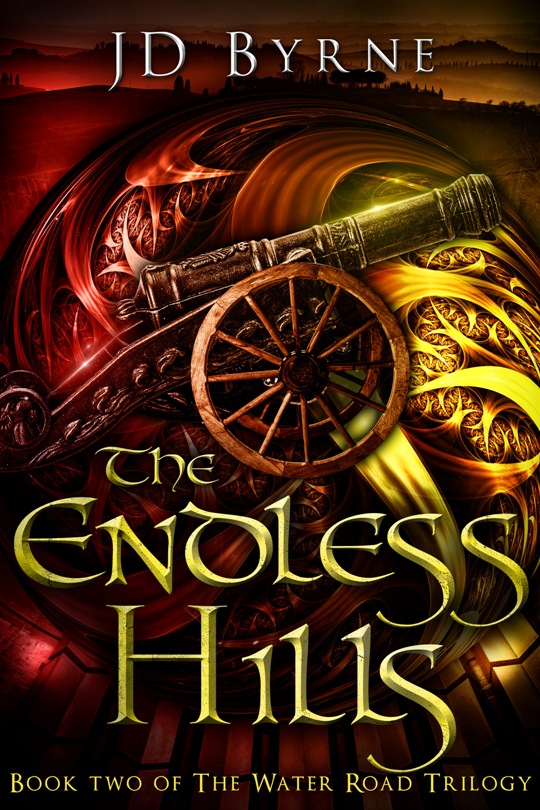
TEH Cover (540x810)

Probably not, but that’s ultimately a question for readers to answer. I tried to make The Endless Hills work as a middle volume by broadening the number of characters to provide a wider view of the conflict that flamed to life in The Water Road. I hope that helped with the second issue, but I’m not so certain about the first.

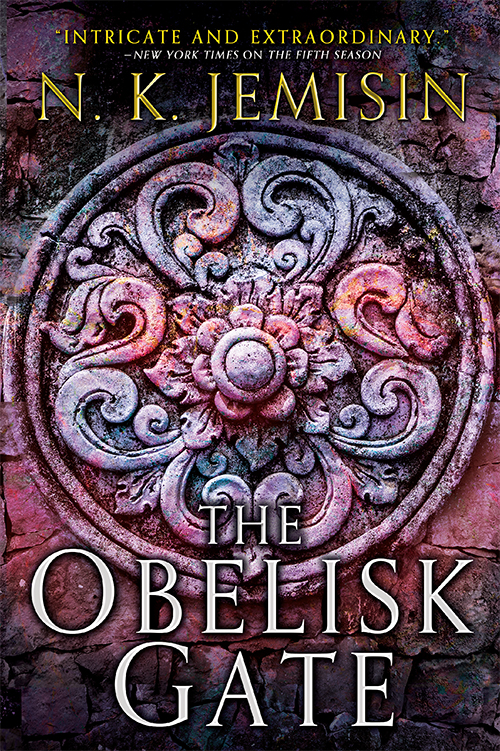
What seems true, however, is that even really excellent writers still fall victim to the second book problem. The hottest writer in fantasy right now is N.K. Jemisin, whose brilliant The Fifth Season I noted a couple of months back. The third book of that trilogy, The Stone Sky (which I’m now deep in the middle of), just won a Hugo, making Jemisin the first writer to win the award three years (and three books) in a row. Still and all, The Obelisk Gate, the second book in the trilogy, can’t help but sag a bit. The world, which gets a lot of depth and shading, isn’t “holy shit!” anymore and one character’s story falls into the “table setting” genre pretty well. It’s still amazingly good (did I mention three Hugos in a row?), but it shows that even someone as talented as Jemisin isn’t immune from second book syndrome.

Jemisin_ObeliskGate_TP

So what makes the exceptions to the rule stand out? Maybe it’s because the next installment was a step down or maybe there’s enough new and different in the second installment to keep the freshness alive. Or, maybe, when a trilogy or series is all said and done we tend to brush over the criticisms of the middle parts the way we kind of brush over the middle parts themselves. It may be inherent to the trilogy format itself. I’m not sure, which is kind of a problem for a writer. Like most things, keeping the issue in mind and trying to deal with it is probably the best course, and keeping in mind that it bedevils just about everyone.

Ideas Will Always Be Free Range

I have a file on my computer that’s full of “what if?” ideas that occur to me from time to time. Most of them will never find their way into an actual story – there’s a fair gulf between “cool idea” and “cool story.” In light of that, it can be cool to see one of those ideas show up on the big screen completely independent of your having it.

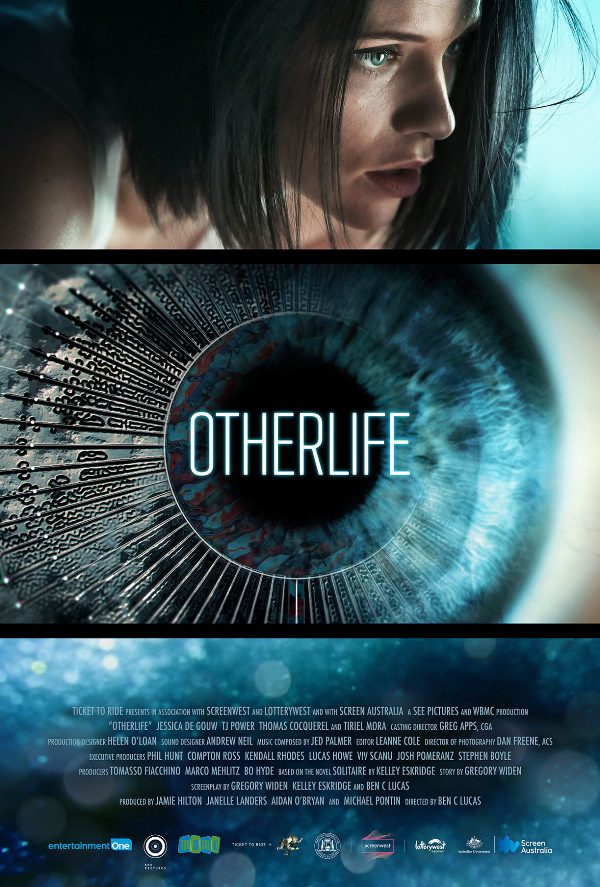
The Australian film OtherLife is based on a nifty “what if” question – what if, via a process involving programmable biotech (don’t call it drugs) dropped into a person’s eye, that person could experience rich and full “memories” of experiences in the blink of an eye? Think of the ability to cram an entire vacation into a few seconds! Actually, that sounds kind of shitty and easily manipulated, but it’s still a cool idea.

Otherlife

In the film the tech’s creator, Ren, is having problems with the system as it gets ready to go public. To help the company with funding, her partner wants to explore a Government-proposed use of the tech – to make criminals experience a long time of confinement without actually having to incarcerate them. Ren is furious (since her motives are purely altruistic and personal) and balks at the idea, of course. Things spiral out from there to a not all that interesting conclusion.

Mostly because that idea – of incarceration by memory – is a really interesting one. You may have guessed by now that’s the one that I wrote down in my “what if?” file years ago. But the film isn’t really interested in exploring the ideas behind that setup, instead using it to jump start the plot and put Ren through a very weird experience. It’s interesting enough to watch, but doesn’t really stick with you for very long, putting thrills and twists ahead of deep thought and head scratching.

Newbie writers sometimes worry about either not having an “original” idea or that if they discuss their own idea in public it will get “stolen.” Fact is, neither of those things is a problem. Ideas are only the beginning. It’s what you do with them that matters, how the characters you create are affected by them. OtherLife takes the “memories of punishment” idea and does one thing with it. If I ever get back to it I’ll do something very different. The world’s big enough for both (and more!) and all the richer for it, too.

Which is funny, because watching Otherlife gave me another neat idea! It has to do with people disappearing and then reappearing and what that does to them and those around them. It’s now sitting in my “what if?” file, quietly tucked away. Maybe one day it’ll become something worth developing.

Things Change

Sometimes I think this should be the theme song of writers:

I mean, even the most devoted planner would have to admit that no lengthy project finishes precisely the way it was planned. Things always change. As my ancestor (why not?) once said, “the best laid schemes o’ Mice an’ Men / Gang aft agley.”

I’ve written before about my current work in progress, The Orb of Triska. My intention was for it to be the first of a seven-book series called Empire Falls. Good news! Editing continues apace and I’m really liking where things are going. But, as I said . . . things change.

The plan was for each book in the series to be about the length of Moore Hollow. At about 85,000 words it’s long enough, but not nearly as long as most fantasy novels these days. All of The Water Road books are north of 130,000, for comparison (for another comparison, A Game of Thrones weighs in at 292,000 – and it’s the shortest of that series!). I thought more, shorter books would work better for this story and planned out each volume accordingly.

Then, between editing passes, I started thinking about it again. The series is going to follow three characters and the stories for two of them didn’t really break into that many parts. It was more like three parts. And the other character, who had a more discrete series of adventures, could be easily reworked into three parts, too. In other words, the bones for another trilogy are there. So, I decided to retool a bit.

Empire Falls the proposed seven-book series is dead. Long live The Unari Trilogy! Each of those will be about the length of The Water Road novels. I don’t think anything major will have to be left out, but everything should flow a lot better in three bigger chunks.

That’s where I am these days. You have to be flexible as a writer. Sometimes the best way to do something isn’t the way you thought it should be done in the first place.

Change

On American Dystopia and the Great White North

Dystopian fiction can be tricky. Assuming you’re setting it on Earth, you either need to have the whole world go to hell, which isn’t all that probable, or the shit show is more localized, in which case you have to address how the rest of the world interacts with the place where the story is set. I’ve been set to thinking about this a bit thanks to two recent bits of television.

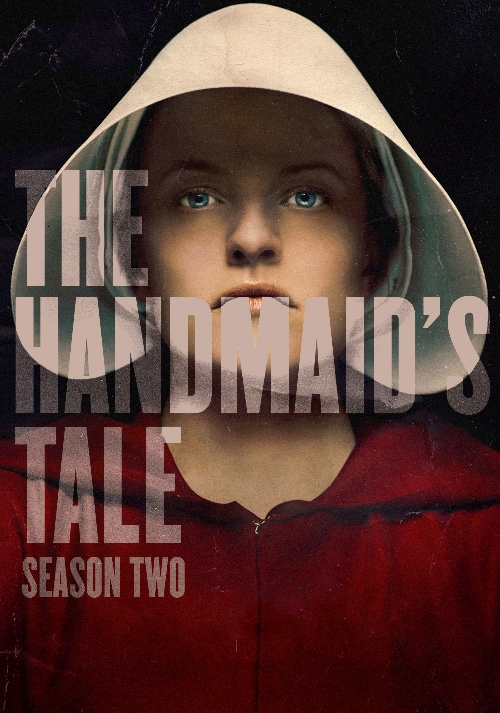
Margaret Atwood’s The Handmaid’s Tale is as localized as dystopia can get. It’s told entirely from the point of view of the titular handmaid, June, and doesn’t concern itself at all with the outside world. Gilead is what she experiences; nothing more.

The TV adaptation probably couldn’t have worked if it maintained that rigorous POV, so it wisely broadened its world from the get go. In the first season, therefore, we learned that June’s husband and her best friend managed to escape to Canada, where there’s a growing population of expats from the area that used to be New England. But we don’t really know what that means in a global socio-political sense.

HandmaidS2

That was evident in the recent episode “Smart Power,” where Commander Fred and his wife, Serena, take a diplomatic trip to the Great White North. They’re received professionally, if coolly, in the manner you’d expect for delegates from a nation with which the Canadians have at least some normal relations. But do they? We don’t really know. Things are complicated when an American agents of some kind offers Serena a new life in Hawaii, one where she actually gets to control her destiny.

All this is a bit confused because we don’t really know how Gilead relates to the rest of the world – or what the rest of the world thinks of Gilead (once some info leaks out during the Commander’s visit, we quickly find out, at least partly). How big is Gilead? We know it’s centered in New England, but what of the rest of the United States? Does Canada recognize it as an independent nation? If so, why? What does the United States look like?

None of these were really important in the book, since it was June’s story above all else. But by broadening the focus (something that had to happen for the TV series to continue), these questions become relevant and I’m not certain the show’s brain trust really has the answers.

The recent HBO adaptation of Farhernheit 451 suffered even more acutely from this problem. It makes explicit the story’s setting (Cleveland) and, via an implausible update that involves the works of humanity encoded into DNA, sets up an endgame where Montag has to help someone escape to Canada to rendezvous with some scientists. We’re never told if that’s just because that’s where they are or because Canada is the safe area we always assume it to be.

F451

This is particularly important to Farhernheit 451 given its semi-hopeful ending of an underground group dedicated to actually memorizing great works of literature to ensure they don’t disappear.* That still happens, but it’s now supplemented with the DNA thing. But if Canada is a safe haven, if it exists outside of the dystopia the United States has become – then why the need to preserve all knowledge? Isn’t it safe elsewhere in the world?

To a certain extent this is an issue with any speculative fiction worldbuilding. Writers need to have some idea what happens beyond the bounds of their stories, since those things should influence those stories in some ways. But it’s compounded dystopian fiction set in the “real” world because readers and viewers presume the world is as it is in real life, unless we’re told otherwise. That can lead to confusion, or at least some disappointments.

* Kudos to the writers for updating the preserved works to include writers who are women and people of color (and even some women of color!). However, the impact is a bit muted since only the minority characters are memorizing the work of minority authors.

Birth of an Idea

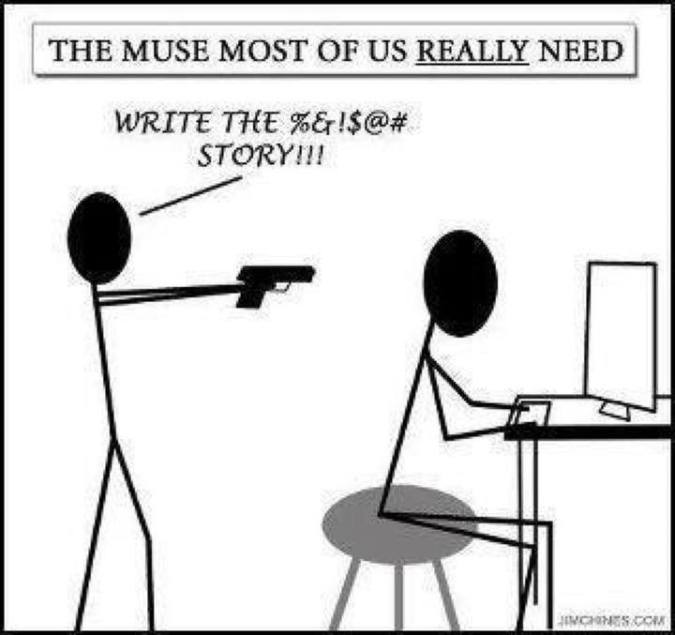
Some authors hate the “where do you get your ideas?” question. I’ve never really figured out why. I can see why readers might be disappointed with the answers, since they’re much more mundane than they might hope. There is no communication with the muse, no blinding flash of insight, just a keen eye and brain that perpetually asks, “what if?” And the realization having a pen handy is almost always a good idea:

So in service of explaining how that works, I thought I’d describe the process I recently went through were a new story idea crystallized in my mind. It’s as good an example as any of the truth that inspiration is out there everywhere, if you know what to do with it.

Right now in my lawyer day job I have a case pending in the court of appeals where one of the issues involves whether my client had served too much time in prison and might be entitled to credit for that. In my brief I made a couple references to him “banking time.” When the Government responded, for some reason, it turned the word around and repeatedly referenced a “time bank,” which it argued didn’t really exit (it does).

Beyond the fury at the allegation I was making shit up, the phrase “time bank” got lodged in my brain. There was something about it that seemed absurd and specific in a way that “banking time” didn’t.

With “time bank” lodged in my brain like a stepped-on Lego, I went into brainstorming mode, which to my neighbors looks like mowing my yard. I do some of my best thinking about writing while I mow, since it’s not like my mind is taken up with other things. So I turned over this concept in my mind, over and over again – what, precisely is a “time bank”? And how would it differ from a memory bank?

I came up with three different ideas, one sort of modern science fictional, one utterly fantastical, and one kind of in between. Thinking them over I found myself drawn the first, the modern one, and began thinking about how characters might interact with this “time bank.”

The working title is “Down and Out at the Time Bank,” a tale of a poor schmuck who gets in way above his head, but probably comes out of it just fine. Short story or something longer? Don’t know yet, as I’ve got to put it on the back burner while I work on other things. But it’s there, lurking in my ideas file, waiting for me to come back to it.

So, thank you, unnamed Assistant United States Attorney. You’ll win the case in the end (‘cause y’all almost always do), but at least you gave me something worthwhile I can take away from it.

And that, ladies and gents, is where story ideas come from!

On Death In Fiction

Riffing on the two sides of the debate in the wake of Infinity War – either all those deaths don’t matter because we know they’re coming back or it matters because the people in universe don’t know that. What do writers owe their readers?

This post was inspired by events that take place in Avengers: Infinity War. If you’ve not seen it yet and want to remain unspoiled, be warned, I’ll be talking about major stuff that happens.

Spoilers

With that said . . .

Holy shit, that movie killed a lot of people. I’m not even talking about anonymous nobodies, set dressing to be collateral damage for the big final battle. I’m talking beloved characters, some major, deaths that could be universe shattering, even if we, as savvy modern media consumers do better.

The deaths basically come in bunches. Loki and Heimdahl meet their end at the very beginning, while Gomorra is sacrificed about midway. But the big shit hits the fan when bad guy Thanos gets all the Infinity Stones and snaps his fat fingers, disappearing half the beings in the universe. Among those who disappear into dust (like vampires on Buffy . . ., but they float up to hebbin, rather than down to the ground) are Black Panther and Spider Man. Serious shit.

Or is it? It doesn’t take a crystal ball to see that there’s no way Marvel is going to let all those characters stay dead. The MCU is an impressive feat of storytelling, but it’s first and foremost a money-making property. Black Panther and Spider Man already have other movies in the pipeline – you think they’re going to dump those for the sake of the story? Fat chance.

Which has led to an interesting discussion on line about the end of the movie. On one side are the people who say these deaths (at least the dusty ones, maybe the others) don’t really mean anything because we, the audience know they aren’t permanent. On the other are people who insist that they do have meaning because the other characters in the MCU don’t know these characters will come back and so it’s a big deal for them. Who’s right?

Maybe neither, at least completely. Some of it depends on what the creator is trying to do. If it’s just shock the audience, it’s a pretty hollow means to do so, but that’s not the only thing you accomplish when you kill a character.

Go back to the aforementioned Buffy the Vampire Slayer. Buffy dies at the end of the fifth season, sacrificing herself to save the world (again). It’s no shock that the next season of the show was not a Buffy free zone – she came back from the dead in the first two episodes. That was to be expected. But the show worked through that in very interesting ways. Most importantly, Buffy’s friends thought by bringing her back they pulled her from hell, when in fact she was in heaven (or at least at peace). In other words, it mattered for the rest of the season (and the show, really) that Buffy had died and then gotten better. It wasn’t a simple reset button.

To pull a somewhat vague, non-spoilerly, example from my own writing, I have a book where a major character dies at the end. That death resonates through the next book, motivating what other characters do. I didn’t kill that person off just for a “gasp” moment or to make sure readers know that nobody in that world is safe.

On the other hand, the recently completed season of Agents of Shield ended with an emotional death that, it turns out, really wasn’t, except the people in the universe completely knew it (even if viewers, myself included, were scratching their heads for a bit). That’s just cheap manipulation and is a hollow exercise.

Then there’s always the Deadpool take – announce you’re going to die in the opening credits, show said death twice, have a prolonged death scene later in the film, then wink it away post-credits. But would you expect anything less from that fucker?

Which path will the next Avengers movie take? Too soon to tell, of course (except, I think it’s safe to say, not the Deadpool avenue), but one hopes it’s closer to the Buffy example.

The bottom line, as a writer, is that death, like anything else when it comes to plot, is a tool. As with any tool, it can be used well or poorly. But given the emotional heft that death can have, folks should think long and hard about deploying it as a simple plot point. As with all things – think it out first.

Lessons Learned from Swimming Blindly Through the Aural Seas

When I write I have some idea of where I’m going. As you can see from my experiment with trying to go free form, I need some structure when I write. Nonetheless, when I write I’m acting with intention and purpose – I see where I want to go and try to get there.

When I make music, it’s almost completely the opposite. Essentially, music comes about in one of two ways. First, I get a flash of inspiration when a riff or rhythm or something pops into my head (and, hopefully, onto the computer). Second, I take whatever winds up on “tape” and fiddle around with it, adding things, taking things away, and generally just figuring out what works. I very rarely come to a song idea with a clear conception of what the end product should be.

In other words, when I write, it’s like setting out to sea in a boat, with charts, a destination, and a plan on how to get there. When I make music, it’s more like diving in head first and seeing where the tide sees fit to deposit me. Swimming blindly, if you will.

That’s not to say that the drifting, searching musical creation doesn’t require making choices. Sometimes, those choices are relevant when it comes to thinking about writing, too.

I’ve been thinking about this lately after finishing a new song with the deviously serious title of “Dummy Tickle” (it’s embedded below). I have no idea where that title came from, because this song, all not-quite-four minutes of it, began five years ago.

Which brings me to lesson number one I’ve learned from making music – creativity takes time.

The DAW I use has a metadata field that lets you put just about anything you want in it. I always put (1) when I started the song; (2) when I finished “writing” it; and (3) when I got it in final form (mixed down, etc.). It’s a very rare thing when a song goes from idea to completion in a week or a month. Usually it takes a while, but not five years.

What was I doing with “Dummy Tickle” for five years? I’d like to say I tried out dozens of different things to try and bring the basic idea (that lazy, bouncy bass line and equally laid back melody) to bigger, better life. Nothing really clicked, nothing seemed right. I let it go for a while, but every time I went back and listened to unfinished tracks I thought “there’s something there” and marked it down as something to finish.

Finally, a few weeks ago, something clicked. I don’t know precisely what or why then – maybe a session of playing with the puppies trigger up some kind of endorphin rush or something. How couldn’t they?

Pups
Anyway, the damn burst and I started making progress. It just took some time to get there. Patience really is a virtue, especially when it comes to creative things.

Still, it wasn’t a matter of just banging out a few more notes and being done with things. I was in need of ideas for a transition, a middle section, and started playing around with a couple of chord progressions.

Then I hit on the second lesson I’ve learned from “Dummy Tickle” – sometimes, simpler is better.

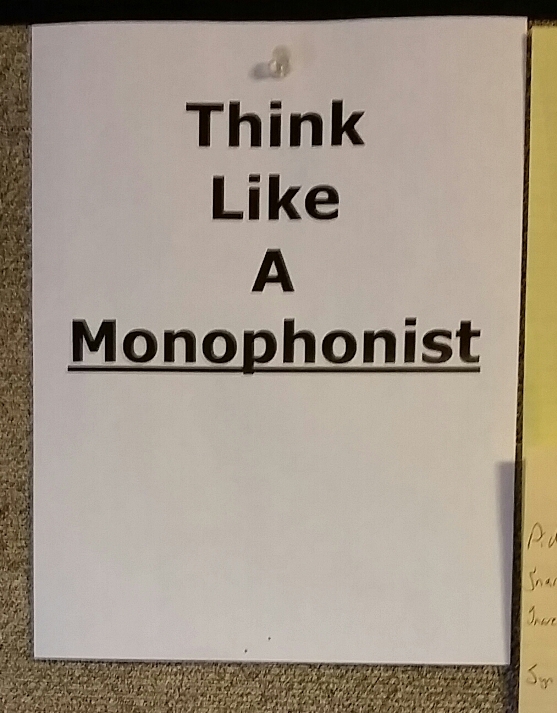
I have a sign tacked to the wall in my studio:

Monphonist Pic

I put it up when I realized that a lot of the early electronic music I like – from ethereal Tangerine Dream to the synth-pop of The Human League and OMD – was done by people with access only to monophonic synthesizers (that is, ones that can make only one sound at a time). That is, they can only make one note at a time. By contrast, without even getting into the virtual synths in my arsenal, I can bring to bear 150 voices! At once! I only have 10 fingers, after all.

My point is I tend to think in chords, even thought single notes are often what’s called for. After struggling to find the right sequence for this song, I backed off and gave it a fresh look. And I looked at my sign. The heart of this song was that simple bass line, the simple melody. Don’t mess that up by building it up unnecessarily. Take the simple route. Thus, that middle section was composed entirely of monophonic lines weaving together – as was the rest of the song.

None of this is Earth shattering. Still, as creators sometimes it’s easy to get wrapped up in the vision of more – more words, more notes, more colors – until you disappear up your own backside in search of your next complexity fix. Sometimes you have to step back and think about what works for the song, book, or whatever it is you’re making. Some of them are just simple little things that don’t have airs on being anything more.

“Dummy Tickle” is like that. A little goof of a tune, a good mood wrought by bouncy synths. Enjoy!