Where the Magic Happens

Sometimes it’s interesting to see where creative types do their work, to get a feel for the environment that leads to their creativity. In the spirit of creative transparency, and the fact that it’s a new year and all, I thought I’d share mine.

This is where I work:

rcbcourthouse

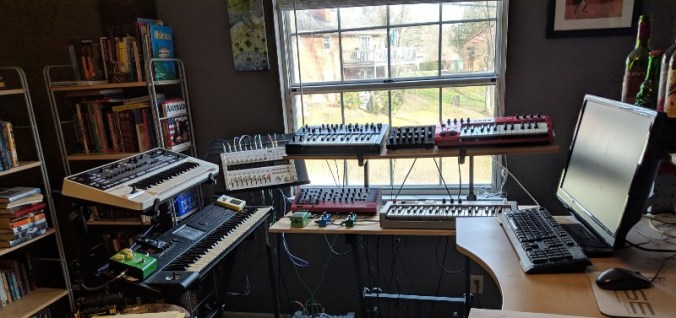
Ha! That’s actually where I work, but it’s not really what I’m on about (my office is on the back side, anyway). Here’s where I get my creative juices flowing:

Studio2

If you’re thinking “that’s a lot of musical equipment for a writer’s room” you’re not wrong. It just so happens that the PC on the right is what I use both to do most of my writing and where I weave bits of music together to make a final product (like this).

Here’s another, more atmospheric pic, with everything turned on:

Studio3

For the gear curious out there – on the left there’s a Korg M50 (bottom, with a Kaosilator on the far end) and a Roland Gaia (top), then in the middle there’s a Nord Rack 2X and Alesis Micron, which controls the Nord (bottom), and a Novation Bass Station II and Moog Minitaur with Behringer controller (top). Everything runs into the Zoom R16 mixer/recorder in between.

The words, by contrast, go straight from my brain to the PC, via the keyboard, although I occasionally knock out some words in other locales. Who knew you could write so much on your phone?

I suppose that’s the real lesson – where does the magic happen? Everywhere.

One Man’s Second Book Problem . . .

One person’s trash is another’s treasure, as the saying goes. I think the literary version of that might be that one person’s second book problem is another person’s interesting, deep dive into character lives.

Remember last year when I blogged about the second book problem – the tendency for middle books in trilogies to sag a little bit given their place in the middle of the overall narrative? At the time I was laboring under the assumption that most people would agree on when second books were problematic or not. A recent experience has convinced me otherwise.

A Gathering of Shadows is the second book in V.E. Schwab’s Shades of Magic trilogy.

gatheringofshadows

It’s set in a kind of alternate history world during the 19th century where there are actually four Londons existing in parallel worlds with different levels of magic (ours is “grey” London, which about sums up the magical nature of it). The first book in the series, A Darker Shade of Magic, has a lot of hopping between worlds as it spirals towards a universe-altering conclusion.

The second book, by contrast, is a lot more sedate. It takes place mostly in red London, where magic is like air and just about everybody makes use of it in some way or another. A kind of World Cup of magic called the Element Games brings together the two main characters, Kel and Lilah, who were separated at the end of book one. We get deep into the tournament and what it means politically in the world of red London. All the while, occasionally, we pop over to black London (where a magical incident years before basically turned it into a burned over hellscape) and see that something bigger is brewing.

To be honest, the brewing seemed like it was part of another book. I was really grooving on the tournament, the way it allowed us to get more into the heads of Lilah and Kel (and his brother, Rhyl), not to mention a couple of new characters. It seemed like the perfect use of a second book, to deepen both the world in which the story takes place and the people in it whom we are supposed to care about. Then the tournament wraps up a little early and the black London stuff comes crashing down on our heroes. It all happens so fast that I think it would have worked better as an expanded second part of the book or as a short, brutal epilogue to setup the final book in the series. Still, overall, a good read and I’m definitely on board for the conclusion of the trilogy.

And, don’t get me wrong, lots of people love this book (and the series). But there were more than a few super pissed fans of the first book who thought A Gathering of Shadows was just boring filler – until the very end, when the black London stuff comes calling. In other words, they felt just the opposite of the way I did about it (one reader said it was “is majorly afflicted with the infamous 2nd book syndrome”). One person even suggested that all the important things that happen in this book could be collapsed into the first chapter of the final volume of the trilogy.

Are those folks wrong? Yes and no. I think they’re wrong because books (or stories of any kind) do more than simply push the major plot along and there’s a lot of other stuff going on for most of A Gathering of Shadows, stuff that I happen to enjoy (a lot of books, beginnings of them, get described as “slow,” but I love the time spent settling into a place or getting to know characters). On the other hand, it isn’t wrong to say that by the end of A Gathering of Shadows not a lot has happened on the grand “fate of the worlds” scale on which the first book operated. I can understand the frustration, even if I don’t share it.

While this is another in a long line of examples of why all are is personal, it’s also an example of people wanting different things from extended works. A trilogy or series, by definition, invites readers in and lets them spend more time in a world than a single story. It’s not surprising that a writer might take that time to do things other than move the plot along. But it’s also no surprise that fans brought back to the world by a quick-paced first book might find a second one slow if it can’t match that pace.

Neither set of readers is wrong in their expectations (or their permissions), but neither is a writer “wrong” for taking one path over the other. It’s worth thinking about what people said about the first book before deciding to slow things down in the second. Maybe that’s the best way to tell the entire story you mean to tell, or maybe it’s a second-book trap you’re falling into. As with most things about writing, a little forethought can head off some disappointment down the road.

Hello, 2019

I’m not a big fan of New Year’s Resolutions. It’s not as if you file them with some official registry and, when you start to slip, government drones bust in to keep you on the straight and narrow.

newyearnewme

I prefer to use the start of the year as a time to take stock, to think about what the coming year might hold. So let’s do that, shall we?

To start with, my initial goal for 2019 is to finish up Gods of the Empire, the first book in my new trilogy. As you’ll recall, this project was originally going to be a series of shorter books, but morphed into a trilogy of longer books. As a result, I basically wrote the first book in two separate parts. They’ve now been fused together for a complete manuscript. It’s a couple of edits away from “done” and, I hope, will see the light of day this year.

Beyond that, things are fairly wide open.

Obviously, at some point, I’ll need to get cracking on the second book in this trilogy, Widows of the Empire. It’s largely planned out (in broad strokes, at least), but I’m not sure whether I’ll want to jump right back into that world or get some distance before I get working on book two in earnest.

I’m also planning to go back and revive something I thought was a standalone novel – Moore Hollow. I’ve had more than one person ask about a sequel, which I’d never intended, but I’ve come around. It’s now going to be the first book in a series in which Ben Potter moves to West Virginia and investigates various weirdnesses. Getting cracking on the second book in that series is high on my list of priorities, too.

There are bound to be some shorter projects that pop up here and there, too. Last year, between rounds of Gods of the Empire, I actually wrote a novelette (I think) set in the expanded Moore Hollow universe because the idea lodged itself in my brain and wouldn’t go away. That same kind of thing is likely to happen again. Only time will tell.

So there you have it – no resolutions, but some plans and some goals. Now let’s get out there and take on 2019!

letsdothis

There Goes My Credibility

I am, as The Decemberists say, “a writer, writer of fictions,” but does that make me a lying sack of shit? I don’t think so, but I hope I never have to find out in court, at least in Alabama.

FryLying

William McKinney choked his girlfriend and then stabbed to death her mother’s boyfriend. At his trial he claimed he was acting in self defense (to the stabbing, at least). He was also a writer (unpublished, apparently). Thus, when he was testifying in his own defense, he was asked:

Defense counsel objected to the relevance of all this, but was overruled. The prosecutor continued:

Q. Did you consider yourself a writer? Writer of fiction?

A. Inside that book bag, I’m pretty sure my book was in it maybe.

Q. Okay. Now, so you were writing your own book, right?

A. Well, I had written a book, yes.

Q. Okay. When did you write your book?

A. Back during my incarceration.

Q. And you had it — they were composition notebooks, right?

A. (Witness nods head affirmatively.)

Q. That you had written chapters in; chapter one, chapter two, chapter three? All that, right?

A. Yes, sir.

Q. In fact, that is bigger than the bag that’s State’s Exhibit 47. It was a very large book that you were writing, wasn’t it?

A. Yes, sir, I assume.

Q. Lots of handwritten pages?

A. Yes, sir.

Q. And it was a work of fiction, I assume?

A. Yes, sir.

Q. So you at least considered yourself a writer?

Defense counsel objected to the relevance of all this, but was overruled. The prosecutor continued:

Q. Did you consider yourself a writer? Writer of fiction?

A. No, sir.

Q. You’re not a writer of fiction?

A. I wouldn’t call myself a writer, no, sir.

***

Q. But this book of yours is a work of fiction. But everything you’re testifying here — now, you’re telling us the truth today, aren’t you?

A. Yes, sir.

Q. You know you’re under oath and you’re looking at these folks and you’re going to tell them what happened that day, right?

A. Yes, sir.

In other words, “since you can make something up in one context, why should we believe you in any other situation?” That logic is dubious, at best. But it was good enough, at least for the court of appeals:

McKinney is not entitled to relief on this issue. As the State notes, ‘[t]he obvious inference the prosecutor was trying to draw was that, if McKinney writes novels or other fiction, then his account of the murder of Mr. Jackson [was] also fiction …. Whether McKinney was telling the truth was very relevant and a proper subject for cross-examination.’ (State’s brief, pp. 24-25.) See generally Wiggins v. State, 193 So. 3d 765, 805 (Ala. Crim. App. 2014) (“‘Counsel is given wide latitude and has the right and duty to cross-examine vigorously a defendant who takes the stand in his own defense. “A [prosecutor] may ask a defendant … questions tending to discredit [his] testimony, no matter how disparaging the question may be.”‘ State v. Rush, 340 N.C. 174, 186, 456 S.E.2d 819, 826 (1995).”).

I tend to agree with Eugene Volokh that:

To be sure, it’s perfectly plausible that McKinney was lying, just as it’s plausible that anyone else is lying; but I don’t think that would-be novelists are any more likely to lie on the stand than anyone else, or even any better at lying (unless perhaps they are novelists of proven and substantial gifts).

But I’d go further – even a writer of “proven and substantial gifts” knows the difference between truth and fiction. George RR Martin can spin him some tales, but I don’t think that means he’s lying if he testifies that the light at the intersection was really green. I do tend to agree with Volokh, however, that this was a “wet noodle of an argument” that wasn’t really prejudicial to McKinney. Still, it was irrelevant and the prosecutor was certainly trying to be prejudicial. Intent should count for something.

All in all, I think I’m insulted. I mean, I thought I’d sunk about a low as I could go, in terms of societal approval, by being a public defender. I had no idea that my scarlet letter, warning the wary of my wickedness, would be a W!

KeepCalm

On Judging A Book By Its Cover

The old saw is that you shouldn’t just a book by its cover. That’s a good rule of thumb when you’re dealing with people or if your presented with new ideas, but when it comes to actual books it’s kind of silly. Truth is a cover can often be someone’s first impression of a book and it can say several things about its contents, from the level of professionalism involved to the genre to particular aspects of the story or characters a reader might find intriguing.

Take, for example, the cover of The Water Road:

TWR Cover

That cover, I hope, tells you several things. Most notably, that this is the first book in a trilogy, so it’s part of an epic story. The background image and script mark it as fantasy, but the crossed muskets mark it as a different kind of fantasy – this isn’t your traditional sword and sorcery story. Without reading word one, you’ve got some idea of what to expect going in.

I don’t always pay that much attention to covers as a reader, since I do most of my reading via Audible listening and I rarely have the full-sized book in my hand. Not that covers never make a difference – one of my recent reads, Johannes Cabal: Necromancer, I got purely because the cover on the shelf at the bookstore drew me in (it was darkly funny – highly recommended). So, anyway, the blurb usually controls, as it did for Autonomous, by Annalee Newitz. Here’s the first half:

Autonomous features a rakish female pharmaceutical pirate named Jack who traverses the world in her own submarine. A notorious anti-patent scientist who has styled herself as a Robin Hood heroine fighting to bring cheap drugs to the poor, Jack’s latest drug is leaving a trail of lethal overdoses across what used to be North America—a drug that compels people to become addicted to their work.

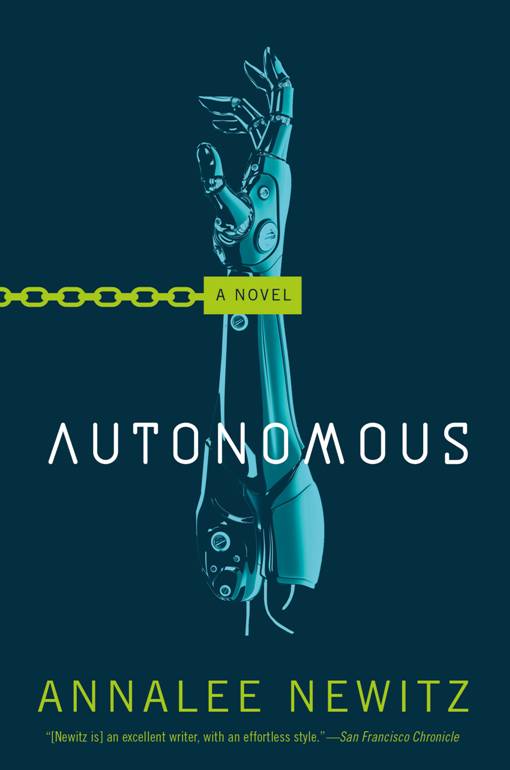
Pretty cool, huh? I loved the idea of a rogue drug maker slipping through the high seas like a 21st-century Captain Nemo. But here’s the cover for Autonomous:

Autonomous_Design by Will Staehle

Does that really match the blurb? It doesn’t and, turns out, for good reason. Autonomous (which is pretty good – I recommend it) really isn’t about Jack so much as it is the beings in her orbit, particularly the robots and other enhanced beings. The book is really about their place in the world and what it means to really be free (or not). Hence the title. Hence the mechanical arm in chains. Hence some of my disappointment with the book itself.

Which is to say that covers can be tricky things. We, as authors, want people to judge our books by them – judge them as worthy of picking up, of clicking on, of reading. But they’re also a first impression, something you only get one chance to make. The right cover is a high wire act, one that most of us aren’t comfortable performing without a net.

And Then There Were Two

Since I’m not doing NaNoWriMo this year because I’m still knee deep in working on the first book of the Unari Empire Trilogy, I figured now was a good time to let y’all in on some exciting developments with the book.

First and foremost – it has a title! A working title, at least. Right now the first book in the trilogy is going to be Gods of the Empire. That should be followed by Widows of the Empire and, finally, Heroes of the Empire. Subject to change, of course, but it’s a far sight better than Untitled.

Second, the trilogy has been reshaped somewhat (again). My original plan was to have three main characters whose stories developed through the three books. After doing a lot more writing, I’ve decided to cut one of those characters out, for the most part. He has a role to play in the end of things, so he’ll make an appearance, but I ultimately decided not to make him a main character. It will help keep the word count in the right area and, I hope, sharpen the story a bit by narrowing the focus. He’ll get a stand-alone short story to flesh out his background, eventually.

That means that . . . third – the complete first draft is finally done! Recall that I had what was going to be book one of seven done before restructuring it into a trilogy. Now I’ve written a draft of the second half of the first book, so after a couple of editing passes to bring it up to speed with the first half I will have a good, solid base to start a more holistic edit of Gods of the Empire.

If all goes according to plan, I should have a finished product in the first half of 2019.

meme-plan-comes-together

Off I go!

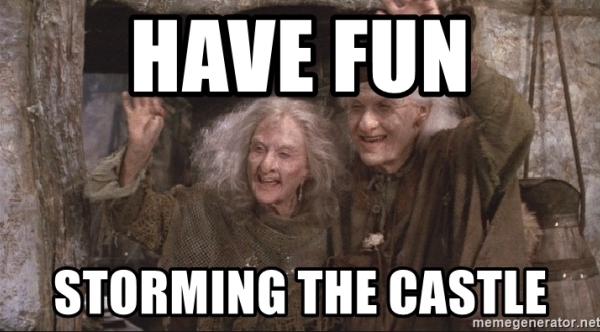
Have Fun Storming the NaNo!

It’s November, which means it’s also National Novel Writing Month!

nanowrimo

I’ve participated in NaNo several times over the years, but I’m sitting this one out. Not because I’m not writing, but because I’m still knee deep in working on the first book of the Unari Trilogy. I’m just not in a good spot to start something new right now.

But, to all of you participating in NaNoWriMo, whether you’re at it for the first time or you’re a seasoned veteran – good luck! Fifty thousand words are only a month away!

have-fun-storming-the-castle

“Killer Queen” – A Short Story

Once again, author Eric Douglas has invited other writers to do some short fiction for Halloween. Once again there’s no word limit or target, so naturally my entry this year is twice as long as last year’s. You can read that one here, as well as my two prior 100-word entries here and here. And, as always, head over to Eric’s place to check out stories from all the other folks.

Now, without ado – “Killer Queen”


Sanchez wasn’t surprised that there was a crush of onlookers and paparazzi when she arrived. A bloody murder at the Calabria Club was just the kind of thing that got social media in an uproar. She whipped out her badge and used it to cut a swath through the gawkers.

“Evening, detective,” said a young officer. “Quite a scene.”

“Nothing like what’s inside, from what I’ve heard,” Sanchez said, slipping under the crime scene tape.

“It ain’t pretty.”

She already knew the basics. They didn’t make any sense, so she did her best to put them out of her mind. She wanted to view the crime scene with the freshest eyes possible.

The Calabria Club was the kind of small, hip club Sanchez could never hope to get into. She imagined it was usually all dim lights and pulsing music. Now it was deadly quiet except for the muffled talk of cops and lit as brightly as the Christmas tree at Rockefeller Center. It was like when you see the person you took home the night before for the first time in the cold light of morning. Never a pretty picture.

The vic was on the floor next to the bar. She was a young woman of indeterminate ethnicity, with long black hair and a short, sparkly silver dress. She lay on her back, hair spread around her head like ink spilled from a well.

Most of her face was gone.

Sanchez leaned down. “Holy shit.”

Doc Forbes, the medical examiner on call, stepped over. “Never seen anything like it.” She pointed to the vic’s throat. “Ripped clear out. I mean, somebody went in with bare hands and literally tore this woman’s throat apart. I’ve seen mob killings, dismemberments, you know? Where they’re sending a message? Never anything like this.” She shivered and walked away.

Sanchez had never seen anything like it, either. The vic’s face was a mess of blood and torn flesh. In a couple of spots Sanchez could even see bone. The vic’s throat was nothing more than a dark, damp chasm where her windpipe had been.

Sanchez shook her head. There was another officer nearby. “There’s a perp, I understand?”

He nodded to a back room.

Sanchez thanked him and headed behind the bar, toward the back office. She knocked and let herself in.

“I don’t believe it,” was the only thing Sanchez could say. “Twitter was right.”

Stina Blomgren, the up and coming model and social media star, sat slumped in a chair, flanked by a pair of officers. Her hands, caked with blood up past the wrist, lay limp on her lap. Her dress had once been electric blue, but now it was a symphony of arterial red streaks and splashes that would have made Pollock proud. A red smear streaked across her face from her lips, mixing with slowly flowing tears. She was mumbling something Sanchez couldn’t quite make out.

Sanchez tapped Cal Cooney, her partner, on the shoulder. “What happened?”

“We’re getting security footage now,” Cooney whispered, all the while keeping an eye on Stina, “but the witnesses all say that she just went nuts and attacked that girl.”

“Is she a friend? A rival?” Sanchez had a hard time figuring out what could make somebody do that to another human being.

“That we don’t know. She’s not being very helpful, saying ‘something just came over me.’ Over and over, that’s it.” Cooney said. He nodded back over his shoulder. “Stina’s purse is in the next room. Take a look through it, see if there’s anything interesting.”

Sanchez nodded and backed out of the room. In a collection of coats and bags she found a small clutch that matched the dress Stina was wearing. She cleared a spot on the table and dumped the contents out. Out came a state ID card and a couple of credit cards with Stina’s name on them. It was definitely hers. No phone. Maybe somebody in the crowd nicked it. The only other thing of interest was a tube of lipstick.

Sanchez picked it up. The tube was plain white plastic, without any of the design elements she was used to. The only thing on it was a small sticker on the bottom. “Killer Queen,” it said, along with “PINTURA,” the cosmetics company.

“Ooh,” she said. Pintura was so hot these days stores could barely keep it on the shelves. Not that it mattered to Sanchez. This would probably go for at least a sixty, seventy bucks a tube, well out of her reach on a detective’s salary. She popped the top. It was a bright, fiery red, more dazzling than any Sanchez had ever seen, sharp and forceful. It was probably a prototype of some kind, given the plain white tube. One thing was certain – Stina wasn’t going to need it where she was going. It was a shame that it would just wind up rotting in an evidence back somewhere.

Sanchez looked around for moment and, convinced she wasn’t seen, slipped the tube into her pocket. One of the perks of the job.

~~~~~

While the Calabria Club Cat Fight, as the press had dubbed it, was bloody and sensational, it was an easy case to put down. The murder had been filmed by multiple security cameras from beginning to end, with a few cell phone videos managing to capture the bloody conclusion. It was just as the witnesses had said – Stina jumped on the victim without provocation and ripped her apart. They didn’t know each other and had barely interacted at the club. Sanchez’s job was to figure out what happened – that was obvious. She’d let the ADAs and their shrinks try to figure out the why. That was above her pay grade, so she moved on to more pleasant things.

Sanchez grabbed her phone and texted Teo, a guy she met on a dating app a couple of weeks back. They’d met once in person, for afternoon coffee, just to check each other out and make sure they weren’t serial killers. He was cute and had been as nervous as she was, so she decided he was okay. She’d also run his name through the databases at the station. Sure, it was against the rules, maybe even illegal, but this wasn’t the kind of thing you took chances with. She was satisfied that Teo wasn’t a criminal, so it was time to push things to the next level.

They agreed to meet for dinner that evening at a small bistro in Sanchez’s neighborhood. She put on her best little black dress, the one that let her show off the curves she had to pretend she didn’t have at work, and grabbed the lipstick she’d taken from Stina’s bag.

She’d gone to the Pintura website to look up the color, but couldn’t find anything called “Killer Queen” in their lineup. That meant it had to be a prototype or early edition. It went on more smoothly than any lipstick she’d ever used. It was as bright red as she’d imagined, like the paint job on a Ferrari. It glistened just a bit, enough to add a thin shine to her lips. She wondered if there was something else in it, as it burned just a bit on her lips. It was like one of those Aztec chocolates that warms up the back of your mouth just as the chocolate flavor dies off. It wasn’t painful, just odd.

~~~~~

She and Teo sat at the bar and had a drink while they waited for their table to be ready, making small talk. He knew she was a cop, but not yet that she worked homicide. It was too early for her to tell stories of blood, bullets, and ripped apart families. Someday she hoped to have someone she could share those burdens with, but for now she kept him entertained with stories from her days as a beat cop. Amusingly insistent drunks, drag queens on bath salts, and neighbors engaged in the most intense disputes over the most mundane things, by contrast, made for good conversation.

Teo laughed at all the right places and showed some compassion when expected.

Teo didn’t have any amusing work stories. He was an office manager for a law firm that handled “boring business stuff,” as he put it. That made for steady work, but wasn’t particularly exciting. He came to life, though, when he talked about music and photography and his rec league basketball team which, he insisted, was the oldest in New York City.

Sanchez nodded and smiled, then did that flirty thing with her hair that was pretty much reflex when she was feeling like this. She liked Teo and could see something worth building here. She was also getting warm, like she already had an entire bottle of whiskey in her. Part of that was the flush of arousal and excitement at how well this date was going, but it was more intense than she’d ever felt before.

They were shown to their table in the corner. They kept talking over an appetizer and salads, but Sanchez increasingly found herself with less to say. Teo picked up the slack, but she started to feel like her mind was slowing down, keeping her from contributing much to the conversation. The warmth that had begun in her belly had risen and become even fiercer. Although it was winter and she knew the restaurant wasn’t hot, she found herself sweating. She became intensely aware of her own breathing.

She finished another glass of wine.

Were all of Teo’s stories this boring? She started noticing that he wasn’t really able to string two coherent thoughts together, like he was just vomiting up a stream of conscious. Was it her? She wiped her forehead, which was hot and damp. She chugged an entire glass of water in one go.

“Are you all right?” Teo asked. He cocked his head a bit, like he was genuinely curious. He touched her hand on the table, but she pulled away.

“Fine,” she said, shaking her head. She closed her eyes and took a deep breath. It felt like her insides were on fire, like electricity was coursing up and down her body. She started breathing fast, like she was running a race. Her heart pounded in her ears, driving on and on like a thumping dance beat. Even after the water and wine her throat was parched. Whatever she did she couldn’t get herself to settle down.

“Melissa,” Teo said. “Are you all right? Can I get you something?”

The table, bare wood without a cloth, was softer than she imagined. Her fingers dug into it while she tried to calm herself. She looked up at Teo. The rest of the restaurant was a blur, but he remained in perfect focus. His look of concern sickened her. Who was he to care about her, anyway? What was his real motivation in all this? That little smile, that smirk he’d worn all night. Something had to be done.

“Melissa?” he asked again. “What’s wrong?”

Sanchez bolted up in her chair, overturning the table and driving Teo to the floor. He yelled something, but the screams that boiled up from inside her, then erupted from her, drowned out his pathetic cries. She went for the face first, slashing and grabbing chunks of dull flesh. Blood flowed, staining her hands, but she didn’t care. She had to keep going.

~~~~~

It wouldn’t have been Cooney’s case anyway – not in his precinct – but it surely would have been taken from him given that his partner was the suspect. Not suspect, killer. A room full of diners saw her do it.

He weaved his way through the onlookers and found the primary, an old friend of his from the academy. Cooney looked at the scene and had flashbacks from the Calabria Club.

“She still here?” he asked.

“In the back,” the primary said. “You look like you’ve seen this before.”

“I don’t know.” Cooney shook his head. “I just don’t know at this point.”

Cooney went to the back room, where Sanchez was sitting in a chair, flanked by a pair of uniformed officers. It gave him a strong sense of déjà vu – blank expression, blood all over her hands and dress, and she kept repeating something over and over. Cooney knelt down beside her.

“Jesus, Michelle, what did you do?” He looked for some kind of understanding in her eyes, but they were blank and empty, like windows of a house where everyone had moved out.

“Something just came over me,” she mumbled. “Something just came over me. Something came over me.”

~~~~~

Pintura Won’t Proceed With “Killer” Line

By Hope Williams, Beauty Business Daily

Cosmetics giant Pintura (NYSE: PNT) quietly announced that it was stopping development on a new line of products that was to be marketed under the “Killer” brand. The press release merely stated that initial reports from beta testers had not been as strong as the company hoped for and, in charting its course for the future, resources were better allocated elsewhere.

The “Killer” line was first announced 18 months ago and received some pushback because of the name’s violent connotations. The company had touted that the products, infused with proprietary compounds developed exclusively for Pintura, would have helped create a bold new look for the modern woman.

Social media has been abuzz with talk of incidents involving some of the “Killer” prototypes. Last month model and Pintura endorser Stina Blomgren was charged with murder after a violent outburst in a New York club, but there is no evidence that she was one of the “Killer” beta testers.

A Pintura spokesperson would not respond to our requests to comment.


Of course, I’m aware of the musical reference (you thought that was a coincidence?).

Happy Halloween!

Halloween2

The Second Book Problem

The old saw goes that, with notable exceptions, sequels never live up to their predecessors. This is a particular issue when it comes to trilogies, as the middle installment often suffers from what some writers and critics call the “second book problem.” What is this, exactly? I think it breaks down into two separate issues.

The first issue is peculiar to speculative fiction, although I could see it coming up in other areas. That is the simple fact that the first volume of a sci-fi or fantasy trilogy is going to have to do some heavy lifting on world building – Is the story set in our world or a completely different one? Are we playing by the physical rules we know (with certain extrapolations) or is scientific accuracy out the window? Are the characters human or not? All of that can (probably should) produce a sense of wonder and awe in the reader as the world unfolds. The initial introduction to Westeros or the Culture or post-apocalyptic Canada should leave the reader a little bit shocked.

That’s gone by the time the second book rolls around. Certainly, a writer should deepen and make more interesting the world in which their story is being told in a second volume, but it’s difficult to capture the initial “wow” factor a second time around. Kings that once ruled the world on the backs of flying, fire-breathing dragons? Awesome shit! The genealogy of those kings, as important as that may be? Not so much.

The second issue is that, just like the middle point of any story, the second part of a trilogy can have a plot that seems to drag a bit. The initial flush of excites as the plot unwinds in the first volume is gone, but the satisfying conclusion of the entire tale in the final volume is still a ways off. At best there’s a lot of clever table setting and some interesting side plots; at worst, there’s a lot of wheel spinning.

“Wait a sec,” you might be thinking, “didn’t you write a trilogy? Aren’t you writing another one? Do you think you’ve solved the second book problem, smart guy?”

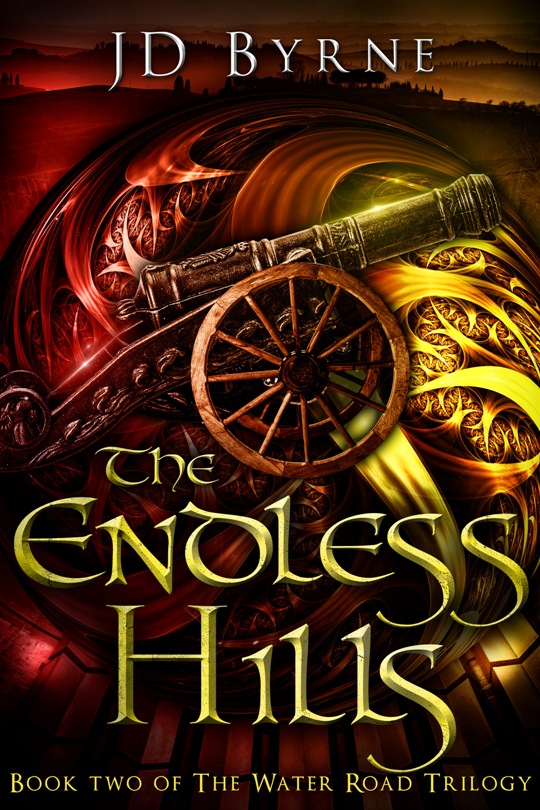
TEH Cover (540x810)

Probably not, but that’s ultimately a question for readers to answer. I tried to make The Endless Hills work as a middle volume by broadening the number of characters to provide a wider view of the conflict that flamed to life in The Water Road. I hope that helped with the second issue, but I’m not so certain about the first.

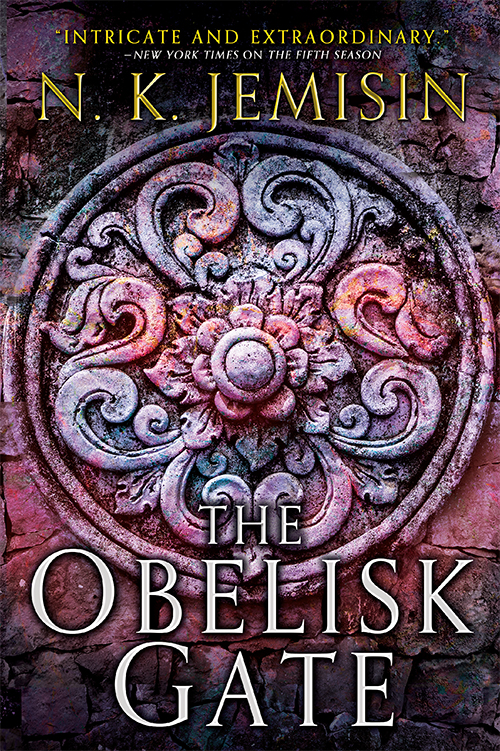
What seems true, however, is that even really excellent writers still fall victim to the second book problem. The hottest writer in fantasy right now is N.K. Jemisin, whose brilliant The Fifth Season I noted a couple of months back. The third book of that trilogy, The Stone Sky (which I’m now deep in the middle of), just won a Hugo, making Jemisin the first writer to win the award three years (and three books) in a row. Still and all, The Obelisk Gate, the second book in the trilogy, can’t help but sag a bit. The world, which gets a lot of depth and shading, isn’t “holy shit!” anymore and one character’s story falls into the “table setting” genre pretty well. It’s still amazingly good (did I mention three Hugos in a row?), but it shows that even someone as talented as Jemisin isn’t immune from second book syndrome.

Jemisin_ObeliskGate_TP

So what makes the exceptions to the rule stand out? Maybe it’s because the next installment was a step down or maybe there’s enough new and different in the second installment to keep the freshness alive. Or, maybe, when a trilogy or series is all said and done we tend to brush over the criticisms of the middle parts the way we kind of brush over the middle parts themselves. It may be inherent to the trilogy format itself. I’m not sure, which is kind of a problem for a writer. Like most things, keeping the issue in mind and trying to deal with it is probably the best course, and keeping in mind that it bedevils just about everyone.

Ideas Will Always Be Free Range

I have a file on my computer that’s full of “what if?” ideas that occur to me from time to time. Most of them will never find their way into an actual story – there’s a fair gulf between “cool idea” and “cool story.” In light of that, it can be cool to see one of those ideas show up on the big screen completely independent of your having it.

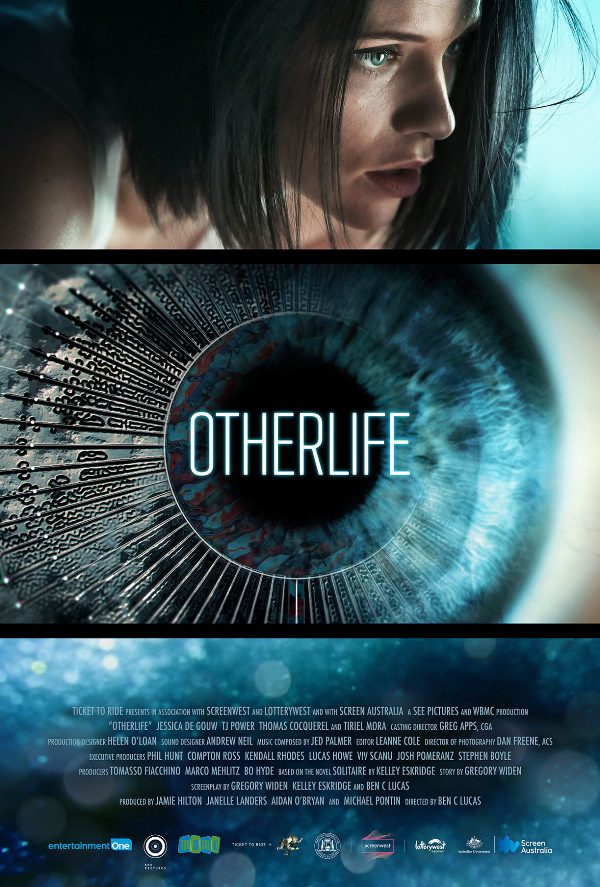
The Australian film OtherLife is based on a nifty “what if” question – what if, via a process involving programmable biotech (don’t call it drugs) dropped into a person’s eye, that person could experience rich and full “memories” of experiences in the blink of an eye? Think of the ability to cram an entire vacation into a few seconds! Actually, that sounds kind of shitty and easily manipulated, but it’s still a cool idea.

Otherlife

In the film the tech’s creator, Ren, is having problems with the system as it gets ready to go public. To help the company with funding, her partner wants to explore a Government-proposed use of the tech – to make criminals experience a long time of confinement without actually having to incarcerate them. Ren is furious (since her motives are purely altruistic and personal) and balks at the idea, of course. Things spiral out from there to a not all that interesting conclusion.

Mostly because that idea – of incarceration by memory – is a really interesting one. You may have guessed by now that’s the one that I wrote down in my “what if?” file years ago. But the film isn’t really interested in exploring the ideas behind that setup, instead using it to jump start the plot and put Ren through a very weird experience. It’s interesting enough to watch, but doesn’t really stick with you for very long, putting thrills and twists ahead of deep thought and head scratching.

Newbie writers sometimes worry about either not having an “original” idea or that if they discuss their own idea in public it will get “stolen.” Fact is, neither of those things is a problem. Ideas are only the beginning. It’s what you do with them that matters, how the characters you create are affected by them. OtherLife takes the “memories of punishment” idea and does one thing with it. If I ever get back to it I’ll do something very different. The world’s big enough for both (and more!) and all the richer for it, too.

Which is funny, because watching Otherlife gave me another neat idea! It has to do with people disappearing and then reappearing and what that does to them and those around them. It’s now sitting in my “what if?” file, quietly tucked away. Maybe one day it’ll become something worth developing.