Let’s Play the Feud!

I’m currently reading Authors In Court: Scenes from the Theater of Copyright, which uses a handful of case studies to track the development of copyright law since its introduction in England via the Statute of Anne in 1710. I haven’t even gotten through the first case yet and already I’m entertained. To anyone who thinks folks way back when were more civilized than modern, crass, digital folks, think again.

That first case involves Alexander Pope, English author (and second most quoted writer in The Oxford Dictionary of Quotations, according to Wikipedia – behind only Shakespeare), and a contemporary publisher named Edmund Curll. They’re in the book because, eventually, Pope sued Curll for publishing some of his letters in which, Pope argued, he retained the copyright. But things got ugly long before that.

Curll and Pope were very different people. Pope was a country gentleman, an elite. He was a writer, but he didn’t do it for a living (heaven forefend!). Curll, by contrast, was a scrappy businessman, doing anything he could to make a buck. He developed a reputation as a low-rent publisher, becoming (among other things) the first publisher in England to be convicted of obscenity.

What set the feud alight was a book Curll published called Court Poems, which purported to contain works by Pope (among others). The poems were scandalous and Pope was upset, either because he or a friend was designated as the author of some of them. Rather than just send a nasty letter, Pope got even in a much more emphatic way:

shortly after the book appeared, Pop contrived to encounter Curll at a tavern in Fleet Street. There, under the pretense of sharing a glass of wine as a sign of reconciliation, Pope dosed Curll’s drink.

Said dose was an “emetic,” a word which sent me scrambling to the dictionary. Long story short – it’s something that makes you puke.

Poisoning a professional rival so that he puked is a pretty dick move. But Pope wasn’t done:

A few days later, adding insult to injury, Pope published a comic pamphlet couched in the sensationalist style of a Grub Street production, a style not entirely different from that of, say, a modern supermarket tabloid. Titled A Full and True Account of a Horrid and Barbarous Revenge by Poison on the Body of Mr. Edmund Curll, Bookseller, Pope’s undated pamphlet, identified only as “by an Eye Witness,” reports on the tavern episode and then veers off into malicious fantasy as the stricken Curll, convinced that he is dying, makes his last will and testament.

In the end he is spared from death by “a plentiful foetid Stool.” Pope still wasn’t done, writing two more pamphlets expanding the fantasy and, eventually , devolving into anti-Semitism.

Future chapters involve Harriet Beecher-Stowe and J.D. Salinger, among others. I wonder if they taunted their rivals with bodily fluids (and tales thereof), too?

They might, given that the Pope/Curll feud is just one of many in literary history that went beyond simple sniping at each other. For example, Gore Vidal once compared Norman Mailer to Charles Manson – so Mailer punched him at a party (leading to Vidal’s retort – “once again, words fail Norman Mailer). Hell, Mario Vargas Llosa punched Gabriel Garcia Marquez in 1976 and neither ever explained why (although this article suggests it was over a woman and, therefore, isn’t really a literary feud at all) .

Of course, writers being writers they’re more likely to lash out at each other with words rather than fists. Playwright Lillian Hellman sued critic Mary McCarthy after McCarthy said that “every word she writes is a lie, including ‘and’ and ‘the.’” Hellman got the last laugh, dying before the suit could be heard. Salman Rushdie responded to John Updike making fun of a name he used in one of his books by suggesting that Updike “stay in his parochial neighbourhood and write about wife-swapping, because it’s what he can do.” Finally, after Colson Whitehead gave a book by Richard Ford a particularly nasty review in the New York Times, Ford spit on Whitehead at a party. Whitehead shot back that this “wasn’t the first time some old coot had drooled on me” and that other critical reviewers (there were a bunch, apparently) best “get a rain poncho, in case of inclement Ford.”

If nothing else, feuds tend to be good for business. Pope and Curll, certainly, made hay out of their beef. Maybe what I need to do is go honk off some famous author and start a heated back and forth! Yeah, that’s the ticket!

pope-and-curll

Adios to the Hex

Here’s a bit of technical for you – the 2018 World Cup is already underway. Has been for months. What we normally think of as the “World Cup” – such as the event in Russia next summer or the last shindig in Brazil – is actually the World Cup “finals.” They only take about a month. The process of getting to the finals takes over a year, winnowing the field down from 210 countries to a relative handful.

One of the neat things about the process is that FIFA allocates slots in the finals to each confederation, but let’s each confederation figure out how to fill its allocation. Europe, for example, divides up into groups, with the winners advancing and some number of second-place teams matching up in playoffs for the other spots. South American, by contrast, puts everybody in one group and plays a true round robin tournament (easy to do when you only have 10 countries). Most other confederations use some group structure to do away with a number of nations over two or three phases.

CONCACAF – the federation that covers North America, Central America and the Caribbean – works that way. Two rounds of preliminaries produce six teams that battle it out in “The Hex” – ten games, home and away. The top three go to the finals, while the fourth has to playoff against someone else (from Asia, this time around) to get in. The bottom two go home. While the region isn’t the toughest as far as talent, the 10-game format still makes for a great combination of slim margins and long hauls. Witness 2014, when Mexico had to claw back into fourth place and win the play off to get to Brazil, or the current Hex, where the US is barely in fourth place after laying goose eggs in our first two games.

Sadly, The Hex is almost certainly dead. Last year, when FIFA announced that the World Cup finals would expand to 48 teams (from 32) in 2026, everybody was fairly certain that would be the case. All the extra spots would call for a massive reorganization of qualifying the world round. But now, with FIFA announcing the allocations for 2026, it’s official – there’s no point having The Hex if six teams will qualify for the finals from CONCACAF.

I’m not sure whether the expanded World Cup finals will be an improvement over the current setup. The bloated European Championships last year included an awful lot of dull group games, although the knockout rounds were better. And I’m all for letting more people get to the biggest dance in the world (sorry, March Madness). But it will undoubtedly depressurize qualifying, at least in most confederations.

So, adios to The Hex.

Hex

The False Unity of Opposition

I had a thought on election night back in November, as we slowly crawled to the fact of President Trump. I wished I’d blogged it back then, but I’ll just have to ask you to trust me about this.

The thought, as I sat there and contemplated Republican control of both houses of Congress and the White House, was this – can the “party of no” go from playing opposition to actually governing? Recent events suggest they may not.

Since the passage of the Affordable Care Act (aka “Obamacare”), Republicans have pledged to repeal it. It was a promise Trump embraced enthusiastically during the campaign. If there was one clear thing Americans could expect a united GOP power structure to do, it was to gut Obamacare. Last Friday, House Speaker Paul Ryan withdrew the proposed “repeal and replace” bill, rather than watch it go down in flames on the House floor. Democrats only had to smirk from the sidelines.

What the hell happened? How could a party so unified in the past about a goal fall apart so quickly?

Because being the opposition helps creates a false sense of unity among those doing the opposing. Think about it – so long as the only thing a group has to do is say “no” to some outsider they don’t have to deal with their own internal divisions.

Make no mistake – during the Obama years, the GOP was the opposition. While they controlled both the House and Senate (for varying lengths of time), it wasn’t enough to override a veto, if it came to that. Measures with bipartisan support were possible (if vanishingly rare), but true GOP proposals were dead on arrival. Hence those 54 votes to repeals of the ACA, none of which actually accomplished anything (aside from being red meat for fund raising).

That’s not quite true – it papered over the differences in the party itself. After all, when the default position is anti-whatever the other party wants, it’s easy to stick together. It doesn’t matter why you take that position, only that you do. That one group of reps are coming from a deeply ideological direction and a second from a  more moderate one is irrelevant so long as they both arrive at the same result.

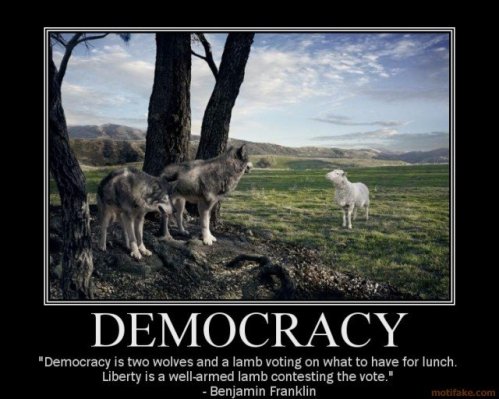
There’s an old saying that pure democracy is two wolves and a sheep voting on what’s for dinner. While we can assume there’s at least two votes not to eat the wolves, we might not assume there’s the same support for eating the sheep. After all, one of the wolves could be a vegetarian.

So now, I suppose, the question is – how long before the GOP wolves finally figure out how to eat the sheep.

Democracy_f59523_1766271

Water Road Wednesday – Thank Yous

The first time I had something called The Water Road in my (virtual) hands was the fall of 2009. The book was my NaNoWriMo project that year, my second “winner” (the first is in the back of my closet, probably permanently). The process started some time before that, what with character sketches and some basic world building.

But the very first thing I remember writing was a Neldathi creation myth. It poured out in a very un-fantastic place.

Every year my office and our Federal Defender counterparts in the Northern District of West Virginia put on a two-day seminar for private attorneys who handle court appointed criminal cases. We alternate hosting and in 2009 the Northern District hosted up in Morgantown. Through the day and a half of the seminar (on breaks or during sessions that didn’t really apply to me), I sketched out this story about the Maker of Worlds and how she created this world in which I was going to tell this story.

Naturally, I had to account for the titular river, as fantastic a thing as there is in The Water Road universe. It was not born of a pleasant impulse:

Eons passed before the Maker of Worlds remembered her watery creation with the one continent upon it.  In the time that had passed, The Land had become full of life.  Not only animals and plants, but intelligent beings, who lived together in communities and created a society.  The Land was rich and plentiful, but its inhabitants still found things to fight about.  They constantly warred, on upon the other, seemingly without end.  When the Maker saw what had become of her world, she was depressed.  And she was angry.

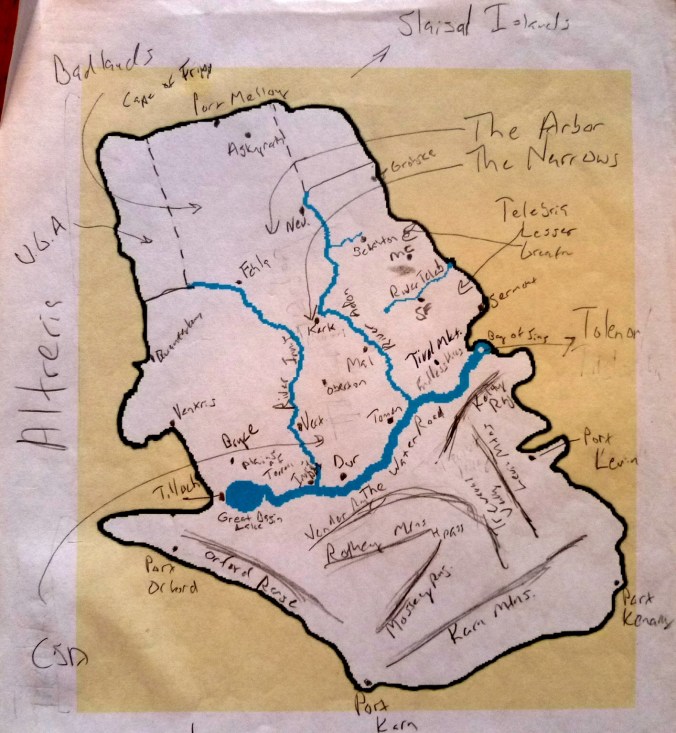
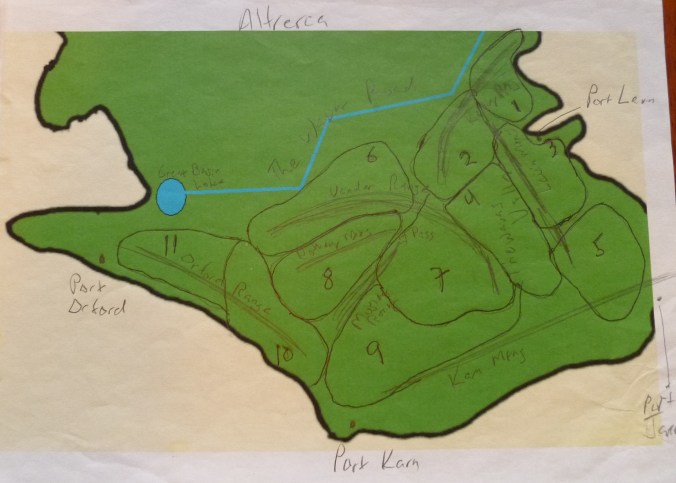
In her anger, the Maker of Worlds lashed out at her creation.  She drove a single finger into the soil on the east side of The Land.  Then, she drug it across the entire breadth of The Land, changing it forever.  In the wake of the Maker’s finger came Great Basin Lake and The Water Road.  To the south of the river, great mountains heaved up from the soil, all the way south to the cold southern seas.  To the north, The Land cracked and two great rivers were formed as water rushed into the fissures.  The far north, beyond the reach of the waters, became barren, dry, and unhospitable.  The people of The Land were likewise shattered, north and south, divided by the The Water Road into Neldathi and Altrerian.  Many multitudes died.

Much as I enjoyed pulling that together, I knew it wasn’t part of the story itself. It was essentially a note to myself – something I didn’t intend anybody else to see. But it started something inside me, lit a fuse that wasn’t going to go out. It got so insistent that when the final session wound up I plopped myself down in a big chair in the hotel lobby, pen in hand and a legal pad, and scratched out:

It had been ten years since Gaven had been confronted by an angry Neldathi with a gun.

I didn’t get much further than that (I was months away from NaNo), but I’d crossed the Rubicon. There was no going back after that.

All of which is a roundabout way of saying that I never really thought I’d be here, looking back on eight years of work and being “done” with The Water Road. So I wanted to take care of one last piece of business, to acknowledge everybody who helped me get here. Thanks . . .

Firstly, to my family, friends, and coworkers who put up with a “writer” in their midst, who asked supportive questions and never made me feel like I was wasting my time chasing a silly dream.

To the members of West Virginia Writers, Inc., the Absolute Write Water Cooler, and KBoards who are quick with their advice, encouragement, and support. Great writing may be mostly about talent, but being a great writer means recognizing that those others out there who do what you do are allies and colleagues, not rivals.

To Empire Books & News in Huntington, West Virginia, who support local authors not because they’re some kind of odd curiosity that draws gawkers, but because they have great stories to tell, too.

To my copy editor, Claudette, who plowed through all three books of The Water Road, helping them be the best, most professional products they can be.

To the fine folks at Deranged Doctor Designs who did the covers for The Water Road trilogy. I get compliments on them almost everywhere they pop up.

And, of course, big thanks to readers who have told me how much they’ve enjoyed these books. That’s the greatest reward a writer could hope for.

Finally, to my wife, Kelly. When we met I was someone who had  a few ideas and thought, maybe, I could write something, sometime. Back by her voracious reading habit, she’s pushed and supported me through all this, providing valuable, honest feedback and sharing in my happiness at getting this all done. I love you, sweetie.

On to new things!

Author Interview – Yawatta Hosby

This time we talk with Yawatta Hosby, who wants to tell you about the things that go thump in the dark.

Who are you? Where are you? What kind of stuff do you write?

Hi, I’m Yawatta Hosby, a sassy leo, a quirky INTJ, a creative soul. I like keeping people on their toes, which gets me into trouble sometimes ha ha. I live in the eastern panhandle of West Virginia, and I write dark and creepy stuff. The monsters in my books are always human.

For those who don’t know the lingo, what’s “INTJ”? And how do you think that impacts your life as a writer?

INTJ means I’m very introverted, always in my head. I’m curious about everything and go out of my way to explore all answers. I like to think outside the box, and I’m always seeking the truth. INTJ means I’m a determined strategist.

Being this way definitely impacts my writing. It makes me write in a straightforward way, perhaps too fast paced. I’m not emotional, so I rely on my critique partners and beta-readers to let me know when my scenes lack emotional drama or when a character is acting too calm during a situation when they should be upset, depressed, happy, etc.

Tell us about your most recent book, story, or other project.

I published Twisted Obsession, which is a dark suspense novella. Miki traps his ex, Finia, into having a baby with him. The more she refuses to love Miki, the more he lashes out. He believes Finia is the perfect woman and Jahlin is the perfect son. He’ll do anything necessary to get his happy ending.

Twisted Obsession - High Resolution

In what genre do you primarily write? Why did you choose that one?

I primarily write in the horror genre. I chose it because it’s fun to scare myself. I get inspired by my fears, so I can relate to my characters. I absolutely love slasher films like Wrong Turn, Scream, and Texas Chainsaw Massacre. The more bloody gore, the better. When I write my stories, I always think in terms of what I’d like to see on the big screen.

I always have a hard time defining “horror” as a genre – what does it mean to you? Where’s the dividing line between fiction about bad people doing bad things and horror?

To me, horror means the book scared me to death. It gave me chills or it disgusted me (in a good way). The dividing line between fiction about bad people doing bad things and horror is horror will bring out the fear in you. Horror will give you nightmares or force you to keep the lights on. Fiction about people doing bad things can be suspense, thrillers, or crime fiction. It’s scary or creepy, but it doesn’t really go there in terms of being offensive or frightening.

When I watched The Strangers with Scott Speedman and Liv Tyler, I had nightmares for two weeks and was afraid to answer the door if someone knocked. The Strangers is horror. Fear with Reese Witherspoon and Mark Wahlberg was an awesome movie. Mark played an awesome villain. In fact, he creeped me out, but I didn’t have nightmares afterwards. I’d label Fear as suspense, a movie about people doing bad things.

Tell us briefly about your writing process, from once you’ve got an idea down to having a finished product ready for publication.

I have two notebooks–a book of observations and a story ideas one. Whenever I get an idea, I write it down. I usually work on multiple WIPs at once. I’m addicted to notebooks, so each story gets written in its own notebook. I don’t attempt to type anything in Google Docs or Microsoft Word until I write ‘the end.’ This helps me stay in writing mode, turning my inner-editor off.

After my story is typed, I revise it. Then, I get feedback from critique partners. I keep making rounds of edits until I’m satisfied after listening to beta-readers and an editor. My first two books I had a line by line editor. With Twisted Obsession, I took a chance with a developmental editor. She was worth every penny, making my book a creepy one to the max.

What did your developmental editor did that surprised you or really make you say that was the right decision?

My developmental editor Monica loved my Chapter 29 of Twisted Obsession. Some of my beta-readers had urged me to change the ending, but Monica said what happened to the son had to be done. She suggested I add scenes to make Miki a even more vile, creepy, demented villain. Monica really pushed me to keep the dark and twisted mood throughout the novella.

Author

Who is the favorite character you’ve created? Why?

My favorite character is Rae from my debut novel, One By One. I felt so bad for her. She watched killers torture her parents right in front of her face. Ten years later, her brother asks her to visit their vacation home, seeking closure. She’s depressed and withdrawn at the beginning of the book, but learns to toughen up and fight back towards the end.

What’s the weirdest subject you’ve had to research as a writer that you never would have otherwise?

The weirdest subject I’ve had to research was if there’s a death penalty in Ireland. I have a story idea where a little girl grows up to find out her dad was a serial killer. He’s not dead like her family told her. He’s actually rotting away in prison. It makes sense why she has certain urges.

So? Do they have the death penalty in Ireland? I think I know the answer, but . . .

Ha ha, they don’t have the death penalty in Ireland anymore. I believe it was abolished in 1964.

What’s the one thing you’ve learned, the hard way, as a writer that you’d share to help others avoid?

Writing takes discipline and hard work. You have to set a writing schedule and protect your writing time. Trust me, the people in your life will test you! I’m a fast writer, finishing a first draft within a month and a half. But, I’m a slow reviser. I lack motivation during this stage. Maybe because it’s a lot of pressure to get the pacing and flow of the story right. I urge writers to find motivation when creating projects. Writing doesn’t have to be a lonely activity.

Do your schedule your writing so that you write for a specific amount of time or do you try and reach a certain quota each day?

I schedule my writing so that I write for a specific time. I find that I’m more productive in multiple fifteen minute increments throughout the day.

If you won $1 million (tax free, to keep the numbers round and juicy), how would it change your writing life?

That would be grand! I’d quit my 9 to 5 and write full time. I’d travel the world to become a traveler blogger for a while, then I’d share my short film scripts with local actors, or anyone interested in the production side of things to direct my own films and put up on YouTube. Hopefully small indie projects would help land me a staff writing position for a popular tv show. Once I got tired of LA (if that’s even possible!), I’d buy a vacation home in Maine so I could focus on writing novels.

I’d go to writing conferences and wrifing retreats. Since I’m shy, I’d pay for a writing buddy to go with me. Somewhere in this fantasy, I’d focus on creating comics and graphic novels too. If only money could buy more hours in the day ha ha.

What’s the last great book you read or new author you discovered?

I really enjoyed Homesick by Richard Simms. He had a way of bringing his characters to life with their narrations. A family moves into a house with a dreaded history. A history that repeats itself. A history that shows no mercy.

What do you think you’re next project will be?

My next book will be the sequel to One By One. It’s called Six Plus One. In the first book, Detective Brown vows to keep his daughter, Alta, safe. He can’t keep that promise. Alta and her friends take a road trip to Green Bank, West Virginia. The quiet town with no WiFi known for its satellite used to find signals from extrasserials. Filming their alien-centric web series in the woods should be an in and out situation, but a killer has other plans in mind. The crew of Aliens R Us disappears–not from the town’s legend.

Yawatta Online

WebFacebookTwitter

Water Road Wednesday – The Bay of Sins Is Here!

Today’s the big day – after several delays (sorry about that), the saga of The Water Road trilogy is complete:

tbs-cover-900x1350

The Bay of Sins is now available from Amazon in both eBook and paperback form! For just 99 cents!

In fact, for the next few days, in celebration of the trilogy being complete, you can get each volume for just 99 cents.

The one that started it all, The Water Road:

TWR Cover

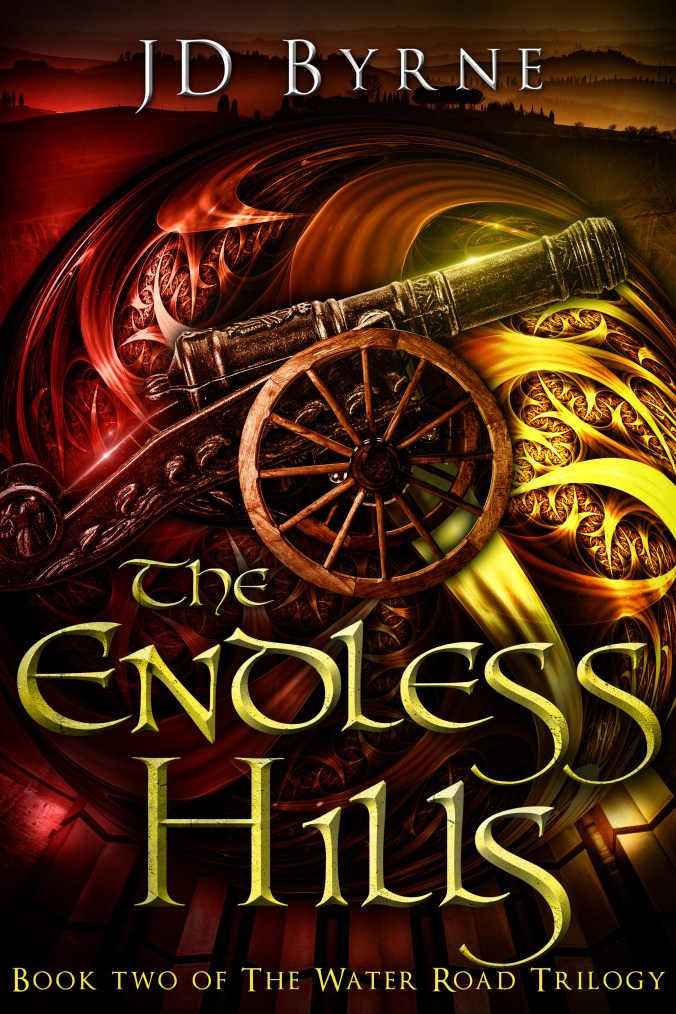
The follow up that tackles the costs of war, The Endless Hills:

TEH Cover (1800x2700)

Each just 99 cents!  They’re not likely to be this price again for a very long time.

Next week – final thoughts on an 8-year journey.

Come Watch Me Read!

All this month my abode of Putnam County is having “Tastes and Talents: A month featuring Putnam’s finest  food, art, and music!” I’m happy to say that I’m a part of this, with a reading next Wednesday at the Putnam County Public library.*

TastesAndTalents Graphic

I’ll be reading a few different things, maybe, just possibly, including a new short story I’ve been working on. I’ll also be giving away a few books as part of the world’s easiest fantasy/sci-fi trivia game. This will also be my first appearance once The Bay of Sins comes out, so I’ll have the complete The Water Road trilogy with me for sale.

And if that’s not enough – there be cupcakes!  Serendipity Cupcake Boutique will be providing some tasty treats. So even if you don’t enjoy what you hear, you’ll enjoy what you eat. Can’t beat that, can you?

For more details check here on Facebook (be sure to tell us if you’re going or interested) and see the full roster of Tastes and Talents events here.

* Don’t let Google fool you – the library is behind Liberty Square on Route 34 (as you head toward Winfield), not down past the new elementary school out toward Hurricane.

Three Laws to Rule Them All!

If you’re any kind of science fiction fan, you’re familiar with Isaac Asimov. He didn’t come up with the concept of robots, but a lot of what we picture when we think about robots in fiction (and otherwise) flows from his stories and novels about robots.

Among his contributions are the Three Laws of Robotics. They debuted in a 1942 story called “Runaround” and go like this:

1. A robot may not injure a human being or, through inaction, allow a human being to come to harm.

2 A robot must obey the orders given it by human beings except where such orders would conflict with the First Law.

3. A robot must protect its own existence as long as such protection does not conflict with the First or Second Laws.

The Three Laws were a response to the hoary trope (even in 1942!) of robots run amok, turning on their masters. In other words, turning into Bender:

Bender

If you’re already programming them, why not program them not to kill you? Seems sensible.

Which is why, perhaps, one of my local legislators is appropriating Asimov’s Three Laws for West Virginia’s. Feast your eyes on House Bill 2881, introduced last week. It would amend “the Code of West Virginia, 1931” – dig our retro legal code! – by inserting language addressing legal requirements for a “robot” or “autonomous vehicle.” Anything look familiar?

§15-14-3. Minimum safety standards for robotic technology.

(a) A robot may not be enabled, by design or human command, to injure a human being.

(b) A robot shall be designed to obey the orders given to it by human beings except where such orders would conflict with subsection (a).

(c) A robot shall be designed to protect its own existence so long as such protection does not conflict with subsection (a) or subsection (b).

All right, it doesn’t track Asimov’s Three Laws word for word, but it’s pretty damned close. Frankly, given the dumb stuff our legislature tends to come up with, cribbing a law about robots from Asimov seems pretty astute, not to mention slightly ahead of the curve. It’s not like you can just throw the three together – you got to get the order right:

the_three_laws_of_robotics

What’s funny – or disturbing – is that Asimov himself wrote a short story about autonomous cars. It doesn’t end well. They may not take well to the Three Laws.

Maybe we should think about this a bit.

Water Road Wednesday – Final Excerpt from The Bay of Sins

In this final excerpt from The Bay of Sins, Hirrek scours the Neldathi city of Albandala for information about the murder of a thek. He needs to ask questions some people don’t want to hear. They’re happy to vent their displeasure toward him:

The continued celebration made the enclave louder than the others he had visited. It was nearly impossible for him to hear what people around him were saying as he passed by. The crowd was thick enough that just moving through it without running into people was a challenge. Without knowing it, his avoidance maneuvers eventually took him to the outskirts of the enclave, near the edge of the city itself. He breathed a bit more easily there, enjoying the open space. The din of the crowd rumbled in the background.

That was how they took him by surprise. The first blow knocked him to the ground, his face landing hard on dirty packed snow. He managed to roll over and see three people standing over him. All had the green and white Elein stripes in their braids.

“Keeps poking around,” one of them said. He was younger than Hirrek and not as big. “Like he’s got a right to know something.”

“You’d think he’d learned by now that nobody wants to talk with him,” said another. He was older and standing back from the other two a bit.

“People can talk to whomever they want,” Hirrek said, getting ready to stand up.

The third one, about Hirrek’s age and even bigger than he was, kicked him in the side. “How’s that for talking?”

The first one laughed. The older one didn’t. Hirrek made a note of that as he crumpled to the snow and tried to catch his breath.

“If you have nothing to say, that’s fine,” Hirrek said after a few moments, managing to make it to his hands and knees. “But you have no right to keep me from talking to others.”

“Who gave you the right to start asking?” asked the second man. The third one kicked Hirrek again, sending him back to the ground, face first.

Hirrek spat dirty snow from his mouth and did everything possible to hide the pain he’d endured so far. “The Maker gave me that right, as she did for all of you.” He didn’t expect that to work, but wanted to see what they said at the mention of the Maker of Worlds.

“A blasphemer as well,” said the first man.

“One goes along with the other,” said the third.

“You see?” said the older man. He looked to be the leader of this little group. “This is what you get when you give yourself over to the blasphemy of one god. This one’s from Clan Dost, not that you’d know it to look at him. He’s free to do whatever he wants, but what right does he have to tell us?”

“Yeah!” the other two said.

“He thinks just because his father pretends he’s jeyn now he can go anywhere he likes.”

“My father doesn’t think he’s jeyn, and doesn’t pretend to be,” Hirrek said, slowly getting back to his hands and knees.

“What does he think he is, then?” asked the second man.

“He thinks he’s doing his best for his people,” Hirrek said, speaking slowly and trying to get a good feeling for where his attackers were. The two younger ones were on either side of him now, while the older man stood a few feet in front of him. They weren’t thinking this through very well. “The best for the Neldathi people. All of them.”

“He’s not got the right,” the third man said, before he tried to kick Hirrek one more time.

This time he was ready. Hirrek lunged forward just as the kick came. The man’s foot glanced harmlessly off his lower leg while Hirrek sprang on the older man. He was taken completely by surprise and was driven to the ground by Hirrek’s charge. Hirrek wasted little time exploiting his advantage, punching him twice in the face and knocking him out.

He stood and readied himself for the others, but neither had come to the aid of their master. They stood with fists raised, poised on the balls of their feet, but neither moved.

“I don’t have any business with you,” Hirrek said, eyes flitting back and forth between the two men. “But him, I need to talk to.” He kicked at the foot of their master. “That means either you can leave or I can make you leave, since I don’t need either one of you to make it through the night. Understand?”

It was an empty threat. He was outnumbered and wasn’t carrying a weapon. He didn’t want to be known as walking through the city interrogating people with a knife in his hand, so he’d intentionally gone out without anything threatening in his possession. He’d give anything to have one secreted away in one of his furs. He just hoped that the others thought he was armed.

They looked at each other, then dropped their fists and took a few steps back.

“Don’t want to have nothing to do with you,” the first one said. “Right?”

“Right,” said the big one.

They turned and walked off together, hurrying but not running back to the crowd, the noise, and the fire.

Hirrek grabbed the other man, still thoroughly unconscious, under each arm and began to drag him through the snow toward the center of the city.

The Bay of Sins arrives March 22 – pre order now for the low launch price of 99 cents! Get The Water Road and The Endless Hills while you’re at it!

tbs-cover-900x1350