On Storytelling and Stakes

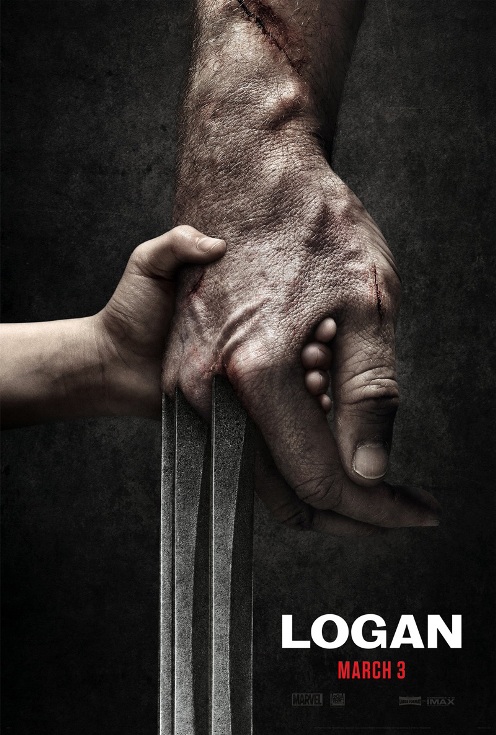
The wife and I went to see Logan, the last of Hugh Jackman’s Wolverine appearances, the weekend it came out. It’s really excellent and reminded me of how good the 2013 entry, The Wolverine, was (the original origin story in 2009, not so much). In fact, I’d go so far as to say that those two movies are among my favorites of all the modern era superhero movies. I tried to figure out what that was, if there was something about them that really set them apart from, say, something in the Avengers canon or one of Christopher Nolan’s Batman flicks. Turns out, I think it’s because they’re smaller movies. Or, at least, the stakes involved are small enough that you can actually care about them.

I first noticed this in connection with Star Trek. Think about it – in the original series the jeopardy in each episode was usually faced by either Kirk, Spock, or McCoy or some combination thereof. A few episodes extended to other crew members and, on a very rare occasion, to the entire Enterprise. But the show never really tasked our heroes with something so grand as saving Earth or the galaxy or whatnot. The only thing in that area that jumps to mind is “City on the Edge of Forever,” which did involve setting the universe right, but, critically, the real drama was all about the main trio and, specifically, whether Kirk can let his love interest die as she must to set things right.

When we get to the movies, though, the stakes became increasingly high. How many of them involve some Earth-shattering baddie that only the Enterprise crew can stop (where is the rest of Starfleet at these times, anyway?). Paradoxically, that actually ramps down the tension, because who really thinks our heroes aren’t going to literally save the universe? An example proves the point – what’s almost universally hailed as the best of the Trek flicks? The Wrath of Khan. Which is, at its heart, about Kirk and an old foe battling it out until the end (universe altering tech in the background to one side).

Returning to The Wolverine and Logan, in both those flicks the stakes are fairly low, in terms of superhero movies. They play more like short stories, side plots in a bigger novel wherein the fate of the world hangs in the balance. But when it’s just the fate of a few (including our hero), things hit a lot closer to home. In other words, it’s easier (for me, at least) to become emotionally invested in the fate of Logan and his young charge than it is to really care whether a gaggle of X-persons stop Apocalypse because, come one, of course they will.

Although it’s horrific, the old adage attributed to Stalin (who would know from horrifics) that “one death is a tragedy, a million is a statistic” is true. It’s easier for people to empathize with a single other human being rather than a large group defined by broad common traits. The same is true in fiction. Sometimes you make a bigger impact by telling a smaller story.

Logan

Author Interview – R.G. Yoho

Joining me this time is R.G Yoho – West Virginia native and Ohio resident with a deep connection to the West.

Who are you? Where are you? What kind of stuff do you write?

Hi there. My name is R.G. Yoho. Most people call me “Bob.” I was born in Parkersburg, WV, but, as a child, my father moved us to another cattle farm across the river from there, in Little Hocking, Ohio. I now live in another part of that huge metropolitan area of Little Hocking. And although I live in Ohio, I will ALWAYS be nothing other than a proud West Virginian. I have published three non-fiction works, one book of historical fiction, and five traditional Westerns.

What is it about Westerns that appeals to you? Particularly since you neither grew up nor live in the West?

What appeals to me? The short answer: I don’t know.

I will, however, state that the West has ALWAYS appealed to those who were born elsewhere. Many of the Old West’s most prominent figures were not originally from the West.

Annie Oakley was born in Ohio. Doc Holliday was from Georgia. James Butler Hickok and Wyatt Earp were from Illinois. Billy the Kid was from New York, Pat Garrett was from Alabama. Bat Masterson was born in Canada.

Perhaps my personal interest has a little something to do with growing up around cows. You cannot possibly understand our country’s Westward experience without knowing how critically important cattle were to the development and expansion of the West.

In the turbulent era of Reconstruction immediately following the Civil War, they weren’t only a major food source; cattle drives also drove the American economy. They led to the expansion of the railroads. Cattle provided employment for many poor Southerners, former Confederates and former slaves alike, both seeking to make a new life for themselves.

Cows and cowboys, they are so intertwined and crucial to the culture and the imagery of the American West. They are a part of the mythology, the symbolism, the rugged individualism, the heroism, and the reality of the West. And in a larger sense, they also largely defined the United States in the minds and eyes of the rest of the world. I particularly like that.

Arguably, the Western is the only uniquely-American form of literature. I am proud to be a part of it. There you have it. So much for the short answer.

Tell us about your most recent book, story, or other project.

My most recent work was Return to Matewan, which deals with the West Virginia coal mine wars of the early Twentieth Century. Despite the fact my books generally have a number of historical characters or incidents, this is the first one I would truly call historical fiction. The coal mine wars were an absolutely fascinating period in American and West Virginia history. In addition, the time period and the subject matter won’t make it a great departure from my Westerns.

Matewan cover-20150926-124650861

In what genre do you primarily write? Why did you choose that one?

First and foremost, I am a Western author. Even though my interests might occasionally take me in a different direction, I will always return to my first love, the Western.

My passion for them is a direct result of my dad’s influence. He started us off early on John Wayne films and television series, like Bonanza, Gunsmoke, and Rawhide. He rarely left for work without a Louis L’Amour paperback in his lunch bucket. I eventually read one of them, a book called Flint. It was then I became hooked on the genre.

Later, I realized that L’Amour wasn’t a young man and I wondered who would write books like that when he passed off the scene. I eventually reached the conclusion: Why not me?

Tell us briefly about your writing process, from once you’ve got an idea down to having a finished product ready for publication.

Ideas come easily to me. I have more of them than I have time to write them. But every book becomes extremely difficult in the pages from about 10-100. That is when I always want to quit and go on to the next project. After that, it is a piece of cake. It’s much like when I used to run half marathons; I always finished strong.

Unlike a lot of potential authors, I’m much better at finishing books than I am at starting them. Approaching the finish, I smell blood in the water. And when that happens, my wife often has to remind me that there are other things in life needing my attention.

Also, I revise constantly while writing. I only do one draft, if you can call it that. I constantly reread and rewrite a sentence or a paragraph until it suits me. I don’t move on until I’m satisfied it is the best I can write at that moment in time. By the time I’m ready to turn over the book to my publisher, I’m sick of it. I don’t care if I ever see it again. That feeling is gone by publication.

I understand what you say about pages 10-100 being a slog. So what do you do when you’re in that zone and need to keep yourself moving?

Perhaps the greatest benefit of having successfully completed a number of books is that there’s never really any doubt whether I can finish them. The question really involves whether or not I have the will to finish them.

Based on past experience, I know my writing progress won’t always be that stilted or difficult. The words will eventually flow like water if I only keep priming the pump.

In my own case, that means I need to park my rump in a chair and just write. Nothing meaningful was ever created without labor. And I’ve also noticed over the years that discipline often gives birth to inspiration. Some of my most inspired writing was done on the days when I started with absolutely nothing in mind; however, that is often when the struggling, wordless hours are suddenly transformed into a remarkable clarity of word and thought which is almost magical.

Once you truly understand or have personally experienced what I’m talking about, as a writer, you’ll forever hunger to recapture it. And if you are diligent in pursuing your gift, you most certainly will.

The way you describe your editing-while-writing process it sounds like you never actually read through a draft. How do you keep things straight for continuity purposes?

Unlike most of the authors I know, I never went to college to study writing. I am largely self-taught, which might not make me the best example to follow for method or technique. Maybe I never properly learned the things I shouldn’t do as an author. Maybe my writing advice should come with a warning: Do not try this at home!

I do read my books, mostly out loud, from start to finish at the end of the writing and editing process. While writing, I also read the chapters to my wife, who occasionally points out something I missed. Hearing them helps me to get a sense of the language and manner of speech, and also to recognize when it doesn’t sound right. And along the way, I make changes.

I will say that continuity isn’t a problem if you are constantly reading, re-reading, and rewriting a chapter. It tends to stay with you. And once I’ve passed Page 100 in a story, I have difficulty sleeping at night because I can’t wait to return to my story in the morning. At that point, continuity isn’t an issue; staying married is.

Who is the favorite character you’ve created? Why?

My favorite character would have to be Kellen Malone, who is the lead character in my ongoing series of Westerns. He’s just a man of great courage, character, and conviction, all qualities that I greatly admire in people.

He first appeared in Death Comes to Redhawk,  a stand-alone book, written almost twenty years ahead of penning the sequel. I liked Malone so much, when I returned to writing Westerns, I just had to revisit his character.

Perhaps best of all, I love his interplay, the spirited give and take between Kellen Malone and Joe Clements.

Books

You mention that you “returned to writing Westerns” when you decided to do a sequel for Kellen Malone. Was that more because you wanted to return to that genre or that character?

This, JD, is undoubtedly your toughest question for me to answer, because it forces me dwell on some things that I don’t much care to discuss.

Early in my writing career, sometime in the early 90’s, my literary agent had one of my Western manuscripts on the desk of a big New York publisher. But before we could actually sign a contract, they said the market for Westerns died. After that I became disheartened and stopped writing Westerns, perhaps one of the most foolhardy decisions I ever made. And that is why I say that you absolutely have to believe in yourself, above and beyond everyone else.

I did, however, publish my first book in 2001, but it wasn’t a Western. And my precious mother never lived to see me realize my great desire to see my Westerns in print. It remains one of my greatest regrets in life.

My return to Westerns was primarily my second attempt to enter the world of Western fiction. It began with a retooling of Death Comes to Redhawk, which reintroduced me to Kellen Malone. I wrote one entirely new scene for the book and refashioned the ending.

Revisiting Kellen Malone was like spending time with an old friend. And that experience made me want to spend more time with him. Obviously, this second attempt was much more successful for me.

You must understand that I penned Redhawk when my daughter was about 2-3 years old. My first Western was published when she was around 18-20. And when it was published, my daughter knew almost nothing about my Western writing past. She was just too young to remember and we never spoke about it.

We live with our lives as they are, not as how they might have been.

What’s the weirdest subject you’ve had to research as a writer that you never would have otherwise?

As a Western author, I am sure that my search history will probably be less bizarre than someone who writes other types of general fiction. But to answer your question, I would have to say: Serial killers in the Old West.

What’s the one thing you’ve learned, the hard way, as a writer that you’d share to help others avoid?

When it comes to your writing, listen to everybody. Lean on everybody. Learn from everybody, but don’t believe in anybody but yourself. You must determine and define for yourself what success looks like. Nobody else but you can map out the pathway for YOUR success. Trust your instincts. Make your own way. And don’t let anything or anybody stop you from getting there.

If you won $1 million (tax free, to keep the numbers round and juicy), how would it change your writing life?

It’s strange you asked this question, because my wife and I have often spoken about what it would take for me to leave right now. It’s a fun question to think about, but despite my time around cows and horses, I haven’t experienced any success at roping unicorns or rainbows.

The answer might be different if I was younger, but at this stage of my life, $1 million would absolutely guarantee that I would quit my full-time job. Half that much would do the same thing for me. I might even seriously consider it for a quarter of $1 million. But $1 million? You might be taking your life in your hands if you were standing anywhere between me and the gate!
And with those significant and time-consuming obstacles removed from my life, I could devote those same hours to writing more books. It would increase my production to no less than two books a year and perhaps three. I would also have the time and the money to make at least one additional trip out West per year, which would allow me much more time for research.

Perhaps best of all, I could devote all of this time to writing, without stealing any more time away from my wife, the most precious thing in my life, who will be celebrating our 35th  wedding anniversary in 2017.

You mention trips out West. Have those always been research? Vacation? A mix of both?

A number of years ago, I took my entire family on a vacation out West. Other than working trips for my employer, that was my first time in the West.  I loved it.

The Western Writers of America have their yearly conventions during the summer. They also rotate the events from city-to-city, state-to-state. Two years ago, we were in Lubbock, TX, and last year we were in Cheyenne, WY. This year is in Kansas City, MO, and Billings, MT, in 2018.

At the end of these conferences, I always try to take some days to research and explore the areas around our conventions sites. When it comes to writing, there’s just nothing that will compare to walking the places your characters walk. Even better  is when you have the chance to actually touch history, like when I sat down to breakfast at Buffalo Bill’s Irma Hotel in Cody, WY, eating upon the original cherry wood bar, a gift to Cody from Queen Victoria and shipped across the seas, after his Wild West Shows in Europe.

In Texas, I rented a horse and rode down into Palo Duro Canyon, the second largest canyon in the country. While in Wyoming, I drove across the state to Cody. I had the chance to ride on Cedar Mountain, which some say is haunted by spirits. Although Wild Bill Cody isn’t buried there, his 1906 will stated that it was the place he wished to be buried. And I can certainly understand the attraction it must have held for him.

I also attended the Tucson Book Festival a couple of years ago, and made my way down to visit Tombstone, the stomping grounds of Wyatt and Doc.

Now, whenever I go out West, I always try to see some of the area on horseback. It’s become something of a tradition with me. There’s probably not a better way to see the West than the way people of that time saw it, looking through the ears of a horse.

I absolutely love the West; I feel completely at home there. My publisher even stated that I was “born in the wrong century.” And if I have my way, I will eventually make my home somewhere around Tucson from January through March.

AuthorPic

 What’s the last great book you read or new author you discovered?

Ride the Wind.

Lucia St. Clair Robson isn’t by any means a new author or strictly a Western writer, but her work is certainly new to me. Moreover, I probably wouldn’t have begun reading her work had I not gotten the rare opportunity to know her.

Last year at the Western Writers Convention in Cheyenne, Wyoming, I learned Lucia was seeking a ride to Thermopolis and I was going all the way to Cody. I gave her a lift, which allowed me to spend no less than 5-6 hours with her that day. I gained another close friend and the experience forever transformed my ideas about historical fiction.

 What do you think you’re next project will be?

In my last Western, The Evil Day, one or more of the characters suffers a great loss. Those kinds of personal tragedies cannot help but make some profound changes in an individual’s life. They can also break him, perhaps beyond repair. I want to explore those changes—and their aftermath—for him and the other characters involved.

Connect With R.G. Yoho on Facebook or at his Website

Water Road Wednesday – Second Excerpt from The Bay of Sins

In this excerpt from The Bay of Sins, Rurek arrives in Modrozon Crossing looking for someone. Not a friend, but a familiar face from readers of The Endless Hills – the thief turned soldier Martoh. In between, these two have developed a little bit of bad blood.

 Martoh sits down:

“Well, well, well,” he said, looking very satisfied with himself. “I believe the words were, ‘I’ll never come anywhere near this place again, you filthy criminal.’ Was that about right, Rurek?” While he spoke, he fiddled with the bracelet on his wrist.

Rurek cleared his throat. “Nice to see you too, Martoh. Believe me, when I said that I meant it. If circumstances were any different I wouldn’t be here.”

“Then I am truly touched that, in your hour of need, you found your way back here.” He signaled to someone, and a drink, some kind of deep-green alcohol, arrived within moments. “Have you had the ordem? It is a local specialty, requires a special kind of grain that grows wild around here. Very strong, but a wonderfully complex flavor, if you can handle it.” He took a long, slow sip and set the glass down on the table. “The girl is fine, by the way. I thought you might like to know.”

“I don’t care.” That was a lie. There wasn’t a night he didn’t think about the little girl and what her life was like in Wellston. He wasn’t about to let Martoh know that, however.

Martoh shrugged. “So be it. What, then, brings you so low that you would go back on your word and return to Modrozon Crossing, to this pub, and seek me out? I hope you did not gamble away all that money. It was so hard-earned.”

“After a fashion,” Rurek said, stifling a chuckle. “I got the money I needed to do what I needed to do. Problem is, now I’m not sure what to do with what I’ve got.”

“How cryptic. If you will not tell me what the problem is, I cannot help you.”

“Except I don’t really trust you.”

“You must trust me a little, Rurek, or you would have gone somewhere else. Did I cheat you? Did I tell you I would pay and then not pay, or pay less than we agreed?”

“No.” Rurek had to admit that.

“Did I lie to you about the nature of the work? And I mean lie, Rurek, really tell you something that was not true?”

“You didn’t tell me—”

Martoh raised a hand. “I told you what you needed to know to complete the task. Entirely accurate information. That you did not ask more questions, better questions, before taking my money is not my fault. You needed the money badly enough to keep you from asking those questions.”

“You’re being overly technical.”

“Overly technical is what put me in prison. Why should I not use it to my advantage now?”

Rurek knew Martoh had been in prison before the war and that he didn’t think he belonged there, but he didn’t know details. He didn’t want to know. “If that’s how you want to live your life.”

“It is.” Martoh sat back, looked out the window, and smiled. “Now that our reunion is out of the way, what is it that you think I might do for you?”

The Bay of Sins arrives March 22 – pre order now for the low launch price of 99 cents!. Get The Water Road and The Endless Hills while you’re at it!

tbs-cover-900x1350

Weekly Read: The Goblin Emperor

I was really excited when I started The Goblin Emperor and found that the titular character was named Maia. After all, we’ve got one of those!

MaiaGoblin2.jpg
We’ve never figured out what the non-Chihuahua part of our Maia is, so I’ve taken to calling her Goblin Dog. Close enough.

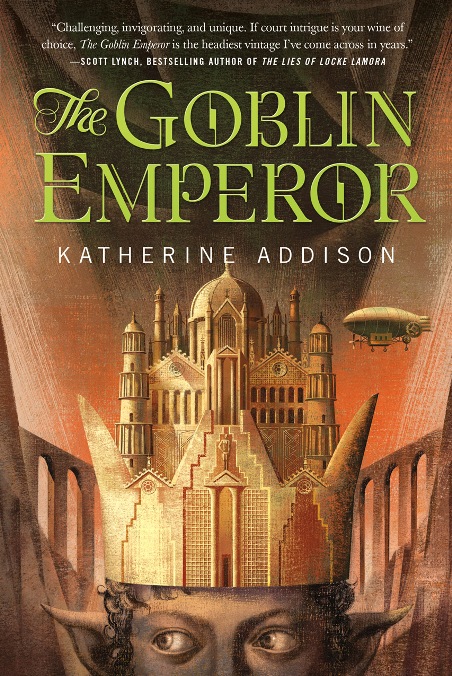
The Maia of The Goblin Emperor is not part Chihuahua, but is part Goblin in an empire ruled by Elves. He’s the fifth (I think) son of the emperor, the result of a dalliance with a Goblin princess (who dies while Maia’s young). An assassination via airship crash (the tech level is one of the neat touches of The Goblin Emperor) eliminates not only the emperor but all his other heirs. The empire, thus, is forced to turn its eyes to Maia, who’s been raised in internal exile without any hint that he might one day wield power.

That’s the setup of The Goblin Emperor, but it’s a setup that never really pays off. You see, it’s not quite accurate to just say that the book is Maia’s story – he’s the title character, after all. No, the book is completely Maia’s story because his is the only point of view in the book. This is a serious problem because while some interesting things happen around Maia as emperor and even to him, he, himself, isn’t all that interesting.

As a for instance, the airship bombing that sets off the plot is investigated throughout the book and is resolved in the end. Rather than being on the ground with the person doing the investigating (an interesting character in his own right), we get the answers in a letter he writes to Maia explaining his findings. In other words, we aren’t shown the investigation – and all the interesting world building info that comes with it – we’re told about it. For a book with an assassination, a coup attempt, and a second attempted at regicide, it’s surprising dull.

That’s because the book is mostly about Maia easing into his role as emperor. What sets Maia apart from the traditional fantasy emperor is that he’s fundamentally a good guy and is trying to do the right thing, often in the face of traditional resistance (one review called him “one of the most lovable characters we’ve met in ages”). He treats his servants well (actually caring about their well being is a radical act) and he seems particularly tuned in to the desire of women to be something other than marriage fodder and breeding stock.

Having said that, Maia’s good nature is never given any real scope. Only near the end of the book does he finally realize that, as the emperor, he can do just about anything he fucking wants. He never tries to jump start any societal reform or really change things, even in light of the anti-tradition philosophy that powered the assassination. So, yes, Maia is good, but not very ambitious. Not for nothing but the major project he oversees during the book is the plan to build a bridge – not actually build it, mind you, just approve of its building.

The general lack of “oomph” in the story is a shame, because the world of The Goblin Emperor is interesting. For one thing it lacks humans, which is not very common in fantasy (I should know). For another while there are magical things that happen (the investigator of the airship explosion talks to the dead, in some fashion or another), there’s no capital M “Magic” involved (if you know what I mean). Finally, the folkways of the court that Maia has to navigate are interesting in their own right, they just don’t support much of an actual story. The writing is very lovely in spots, too.

Wikipedia slots this book under the heading of “fantasy of manners,” which I’m lead to believe is kind of like a “comedy of manners” but not necessarily with the comedy. I can see that. Such things are good background details for me, but ultimately I need more for a completely satisfying read. If you’re less in need of a driving plot, though, you’ll probably enjoy The Goblin Emperor much more than I did.

goblinemp_rev_comp_sm

Water Road Wednesday – First Excerpt from The Bay of Sins

The first excerpt from The Bay of Sins. In this scene, Mida, the healer in Innisport who Antrey put in charge of the city, has been arrested and charged with treason and collaboration with the Neldathi. Using a code delivered via a wadded up piece of paper thrown over a wall, she reached out to her neighbor in prison:

After supper, when she knew she’d be left alone for the night, Mida moved the desk chair next to the wall she shared with C4 and waited. She wasn’t sure if her neighbor would try to make contact first, but Mida thought it wise to wait. Such communication was against the rules, and she wanted the defense, if only in her head, that she didn’t break them first. She was on the verge of giving up and getting into bed when she heard it.

Six taps, faint, like a small metal pick scratching on rock. The sound repeated itself over and over.

The night before, Mida had pried a piece of metal out from under the desk. It was part of a brace that held the desk up, but it was already lose when she found it, and the desk seemed perfectly sturdy without it. She fetched the metal from its hiding place near the toilet and tapped six times in response, then waited.

The code came, slowly and deliberately. Mida wasn’t certain if the other person was being slow for her benefit or not, but she appreciated it regardless. You are new?

Yes, Mida tapped back, quietly sounding out each letter. Two days ago. You?

Long time, came the answer, a little quicker this time. What for?

I don’t know. It was only partially untrue. She was certain it had something to do with Phichan’s need to punish those who worked with the Neldathi during the occupation, but she had no idea what the specific charges were yet. You?

War.

War is over. Mida didn’t understand.

Not for me. Name?

Mida chuckled. They were prisoners, and, naturally, went straight to talking about why they were in prison. Small details like names were secondary. Mida Innis, Healer, she tapped back. You?

Bist, her neighbor tapped, of Clan Kohar.

The Bay of Sins arrives March 22. Get The Water Road and The Endless Hills now!

tbs-cover-900x1350

Really Denmark?

You see a headline about a blasphemy prosecution and assume it’s about some Third World dictatorship or Alt-Right fever dream. But dateline Copenhagen? Really? Per The Volokh Conspiracy (aggregating other sources):

A Danish prosecutor says a 42-year-old man in northern Denmark has been charged with blasphemy for allegedly burning the Quran and posting a video of it on Facebook.

Jan Reckendorff says it was the first time since 1971 that a person was charged for ‘publicly mocking a religious community’s religious doctrines or worship,’ adding it is punishable by imprisonment for up to four months or fine.

No prosecutions in my lifetime? Either the Danes are very pious or this is the kind of stifling speech law that gets used so rarely that it’s impossible to say what’s allowed and what isn’t. The other few cases that have been prosecuted suggest just that:

This marks the fourth time in history anyone has been prosecuted under Denmark’s blasphemy clause: four people were sentenced for posting posters mocking Jewish teachings in 1938; two people were fined for carrying out a fake baptism at a masked ball in 1946; and two programme leaders at Danish Radio were exonerated in 1971 for airing a song mocking Christianity.

I mean, come on, Denmark. You’re one of those magical European places that liberals like me point to and say, “see, if they can do all these humane things, why can’t we?” Then you go and do something like this. I guess nobody’s perfect.

But, still, Denmark – really?!?

really-snl

A New Layer of Beta Readers

Here’s a dirty little secret – almost no writers sit down at the keyboard (or with pen in hand, if you’re a retro kind of person), open the channels to the muse, and let flow a stream of writing that becomes the final product. Between blank page and finished product there are a lot of stages, some of which include input from other people. Generally we call those people beta readers. They read a work in progress and provide feedback. What the writer does with that feedback varies from person to person and suggestion to suggestion.

While most beta readers are just that – readers – sometimes you might need a beta with a particular background to provide feedback on a story. Writing a sci-fi story set largely in a genetics lab? You might want to have someone who’s worked in one read through it, just to make sure the little detail ring true. Writing a fantasy story that involves a lot of swordplay? Might want to have someone who knows about such things give it a read to make sure characters aren’t treating broadswords like fencing foils (or vice versa).

So it’s not a surprise that, as writers start to concern themselves more with diversity in their work, that a new crop of betas is emerging – sensitivity readers:

These advising angels—part fact-checkers, part cultural ambassadors—are new additions to the book publishing ecosystem. Either hired by individual authors or by publishing houses, sensitivity readers are members of a minority group tasked specifically with examining manuscripts for hurtful, inaccurate, or inappropriate depictions of that group.


On the site Writing in the Margins, which launched in 2012, the author Justina Ireland articulates the goal of this new fleet of experts: to point out the “internalized bias and negatively charged language” that can arise when writers create ‘outside of [their] experiences.’

While critics may bemoan such a development as just another example of political correctness run amok, the Slate article points out that it’s really down to the oldest of Western motivations – the profit motive. Younger readers, in particular, desire more diversity in their fiction, so this is a way to provide a product they want to read.

Besides, the ultimate issue with any beta reader’s feedback isn’t the feedback itself, it’s what the author does with it. For example, one author in the article talks about how she changed some bits involving a black college student because the feedback from beta readers was that students at historically black colleges wouldn’t speak the way she had the character speaking. It’s not a matter of offense, it’s a matter of trying to portray something unfamiliar as accurately as possible.

Having said that, the very subjectivity of the undertaking makes it kind of hit or miss. That’s obvious from a distinction the author of the Slate story makes:

Some sensitivity readers draw distinctions between offensive descriptions and offensive descriptions that appear to enjoy the blessing of the author. If Lolita had been written from Dolores’ point of view, Ireland said, “it might be useful to have an advocate of children’s rights, a childhood sexual assault survivor, or a psychologist read the manuscript and give critique”; but since it was told from the perspective of a pedophile—not regarded as a marginalized group—that wasn’t necessary. Still, it’s a messy project for one reader to suss out authorial intent. While sensitivity remains a positive value in most literature, and perhaps one of the greatest priorities for young adult literature, enforcing it at the expense of other merits, including invention, humor, or shock, might come at a cost. Cultural sensitivities fluctuate over time. What will the readers of the future make of ours?

Buried in that interesting observation is the whopper that pedophiles are “not regarded as a marginalized group.” In an already marginalized bunch (criminals), pedophiles are at the bottom of the heap. Consider the ongoing registration requirements for people convicted of such offenses, the closest thing the 21st Century has to a scarlet letter. That all may be for the good (a discussion for a different time), but to say they’re not regarded as marginalized is so erroneous that it questions the entire endeavor.

Which is a shame, because I think the development of sensitivity readers is, in general, a good thing. At the very least, it’s a tool for writers who want to do their utmost to tell a story that doesn’t offend anyone. More likely, it lets writers who aren’t part of a particular socio-economic, ethic, or racial group bring more diversity to their work by providing valuable feedback about characters they might otherwise not be familiar with. Like anything else, a sensitivity beta reader is a tool for a writer to use. Whether it’s a tool wisely used is, in the end, up to the writer.

Water Road Wednesday – It Returns!

Hey, everybody – remember these? I know it’s been a while, but I am beyond pleased to announce that the final chapter of The Water Road trilogy, The Bay of Sins, is complete! It will be released on March 22, 2017.

tbs-cover-900x1350

What’s happening as the story roars to a conclusion? Glad you asked:

The war is over, but nothing is settled.

On the Neldathi side of the Water Road the clans are slowly pulling apart following a sudden murder. Hirrek is tasked with getting to the bottom of a mystery: was this killing the random act of a violent, unstable man? Or was it something more sinister, a hint of what the Neldathi thought they’d defeated during the war? The unity won in blood may be slipping away.

In the rebuilding city of Innisport, life is returning to something like normal. That’s largely due to Mida, given the task of rebuilding the city by Antrey Ranbren herself. After Mida hands power over to the Guild of Politicians, she finds herself on trial for her life, charged with treason and being a collaborator. Along the way she meets someone, a curious remnant of the war, who makes her rethink the way she sees those that destroyed her city.

In the meantime, Antrey returns from exile, escaping to the wilderness of Telebria. She gains new allies, including Rurek, and a new foe, the Sentinel Faerl. He’s best known among the other Sentinels as the man who let Antrey slip away once before, getting all his men killed in the process. Now he has a chance for redemption and revenge. But Antrey is willing to do anything to ensure that her legacy does not slip away.

The chase is on, as the saga of The Water Road barrels toward its explosive conclusion.

I’ll have more from The Bay of Sins in the next few weeks, all leading up to the big launch event on March 22.

Moore Hollow Is Free – Three Days Only!

For the first time, and possibly the last, my debut novel, Moore Hollow is absolutely free at Amazon, today through Wednesday.

Moore Hollow is about a guy, Ben Potter, whose life is a shambles. As a journalist he’s hit rock bottom, writing dreck about monsters and ghouls to make ends meet after a big story blew up in his face. As a son he’s a disappointment, unwilling to follow his father, grandfather, and great grandfather into the family business. As a father, he’s mostly just not there.

Now a new assignment could change all that. All he has to do is go from London to the hills of West Virginia to investigate the strangest of stories his great grandfather told. Did a sleazy politician really raise the dead to try and win an election? And if he did, what happened to the zombies? Could they still exist? Ben needs to find out, to solve the mystery and find a way to get his life back on track.

But once he finds the answer, Ben has to face a whole new batch of problems. Does he use what he learns to put his life back on track? Or is he compelled to do the right thing, even if it leaves his life a mess?

The hardest part of a mystery is deciding what to do once you’ve solved it.

Pageflex Persona [document: PRS0000030_00047]

Get your free copy here before time runs out!

Free Stuff – Not Just Mine!

This weekend (through Sunday) myself and several other writers are giving away free stories and books!

febpromo-pic2

As you can see here, there’s a pretty wide array of genres and styles, so be sure a check to find something that appeals to you.

My contribution is “The Destiny Engine,” my steampunk take on a Brothers Grimm tale.

DE Cover

All you need to do is click here, join my mailing list, and I’ll send you a copy in whatever format you want (within reason – I’m scrawling it out on parchment!)