Author Interview – Lisa McCombs

Join me for a discussion with award winner (and superhero!) Lisa McCombs.

Who are you? Where are you? What kind of stuff do you write?

I have always been a writer and can prove that by the five unfinished Harlequin-type romance manuscripts in my closet. The YA genre really speaks to me, though, now more than ever. After teaching teens for years, I retired two years ago and miss my young people. By writing about them, they are still in my life and because of my past relationships with them, I feel that I know what they want/need to read.

Tell us about your most recent book, story, or other project.

Bombs Bursting in Air was published in the fall of 2016 after winning first place in novel length fiction at the West Virginia Writer’s conference. To this day I have no idea how this story evolved so effortlessly, but I finished a completed first draft in less than two months. My goal is to create a young adult Christian series set in the same (imaginary) town of Ellison. All stand-alone novels are told in first person but will alternate between female and male perspective and will share references to characters and events in previous stories.

Cover

In what genre do you primarily write? Why did you choose that one?

My main writing genre is young adult primarily due to the fact that I taught teenagers for 33 years and have a strong relationship with that age group. As a language arts teacher I had the opportunity to share my love for books with many reluctant readers who taught me how to write for them.

Tell us briefly about your writing process, from once you’ve got an idea down to having a finished product ready for publication.

I have kept a journal since diaries were the rage so my collection of ideas is never ending. When I latch on to a writing topic I am totally consumed and find myself looking at the world through my character’s eyes. The first thing I do is something Cheryl Ware (a successful WV children’s author) presented at a state conference years ago and which I continue to use in my own presentations. First I name my main character and assign the following attributes to that character: physical description, age and gender, at least one bad habit and/or fear, and an interest. I develop a setting to include geographic location, physical format, era, and time of year.  Next I make a list of possible conflicts faced by the main character as well as a complementary list of possible resolutions. Then I do a timed free write similar to what is done during NaNoWriMo (November is National Novel Writing Month and is an awesome way to jump start a writing project.) I am lucky to have several people in my life who usually agree to peruse my writing project(s) after I clean it up enough to share.

Who is the favorite character you’ve created? Why?

This is difficult because once I start writing about a character I pretty much become that character. I really relate strongly to Abby in my first YA novel by that same name. She attends the same schools as I and her life reflects a lot of my young years. Right now Lilah Rose is my favorite character. Probably because she is my newest character and we spend a great deal of time together.

What’s the weirdest subject you’ve had to research as a writer that you never would have otherwise?

Ironically, I was diagnosed with multiple sclerosis in 2001 and began a fourteen year quest to learn as much as possible about this disease. Since I never thought to be in the position of living with an incurable situation, I would never have thought to become as invested as I am in what I refer to as an alphabet disease: MS, MD, ASL. The more I read about my condition the more fascinated I became. I kept a journal of my daily life with relapsing-remitting multiple sclerosis. When a dear friend actually died with complications due to MS, I realized that I needed to share my knowledge with other folks suffering from the MonSter. This resulted in the publication of I Have MS. What’s Your Super Power?: A Common Sense Guide to Living With MS in 2016. As an advocate of the National Multiple Sclerosis Society, I continue my research daily.

Cover2

What’s the one thing you’ve learned, the hard way, as a writer that you’d share to help others avoid?

Proofread, proofread, and proofread. Ask someone you trust to look at your work and proofread again.

Do you have a proofreading strategy that you’ve honed over the years to catch most mistakes?

I always read my work out loud to myself. I have done this for years, even back in undergrad school. Drove my roommates crazy. Fortunately I have a couple of people I can trust to read over my work and be honest in their critique. Proofreading is monotonous, yes, but obviously necessary. After I have edited my own work several times and a second/third party have done their part, I read it again. Then…I put it down for a few days before reading it again.

[back to things you’ve learned – JDB]

Learn as much as you can about self-promoting. I am NOT a business person but writing is a business so this is an evil necessity in publishing. Even Stephen King self-promotes.

Okay, these are TWO things I have learned the hard way, but they are so, so important.

Promoting often seems like the hardest part of being a writer (the actual writing is easy by comparison) – have you learned any particularly effective way to promote yourself and your work?

You are absolutely correct in stating that the actual writing is the easy part. I am not and never have been a sales person. I don’t even like to shop! Retail is not my specialty in any form. The best promotion tip I can give is be relentless in sharing your work, but do not threaten your self-respect in doing so. Reading a chapter or favorite passage from your work when in a public setting is the most effective promo I have found of late. Know your audience and cater toward their needs.

If you won $1 million (tax free, to keep the numbers round and juicy), how would it change your writing life?

I would start my own writing retreat in the hills of Randolph County, West Virginia. I already have the location selected (It is for sale right now!).This would be a year round sanctuary for artists (writers, musicians, painters) seeking an inspirational setting for creating. I would hold writing camps and instructional opportunities for writers in the provided cabins. And, of course, I would reside there as well.

What’s the last great book you read or new author you discovered?

There are so many gifted hidden secrets in my little state of West by God Virginia. I am constantly discovering new writing talent. Danielle DeVoris probably my current interest. She lives and writes (long-handed!) in Morgantown. I love her character (defrocked -priest – turned exorcist) Jimmy Holiday.

I recently read Summer Haze by Michael J. Tucker and became totally infatuated with his story-telling prowess. Tucker is not from WV, but his story is definitely Appalachian. He isn’t really a new author, but new to me.

I could never recommend a favorite book, though. My favorite book is usually the last one I read. Fortunately I work closely with a West Virginia publishing house (Headline Books), so I get to rub elbows with many fantastic state authors.

What do you think you’re next project will be?

Right now I am working on what will be the third novel in my YA Christian series. This is kind of out of order, but the second book told in the male perspective is a very rough draft on hold because I have fallen in love with my new character, Lilah Rose, and cannot seem to get back in the head of that last character right now. But, he’s still there…and actually has been for years. I just want to get him right, so he is marinating for a while.

Did you envisage Lilah Rose as a major character when you created her? Or did she develop into one as she went along (to the point of taking over your next project)?

Lilah Rose has been the main character in my current project from the beginning, but as the story develops so does one other character. I like to bounce secondary characters off of the main one, experimenting with their dynamics, kind of testing their relationship. My plan is to develop my latest YA novel, Bombs Bursting in Air into a series of stand-alone installments that encompass an entire community. The characters will change, but they will also have a bond with familiar characters from other novels. For instance, Sacred Sanctuary (aka the Church of Go) has a HUGE role in all the books as the focal point of the town of Ellison. All of my characters attend the same schools and know the same town landmarks. The novels will alternate between female and male perspective in an attempt to attract all young readers, regardless of gender. (This means Lilah Rose is not the next book in the series. I am just stuck on her right now.)

Visit Lisa online at https://lisa-mccombs.blogspot.com/

Weekly Listen: ROSFest 2017

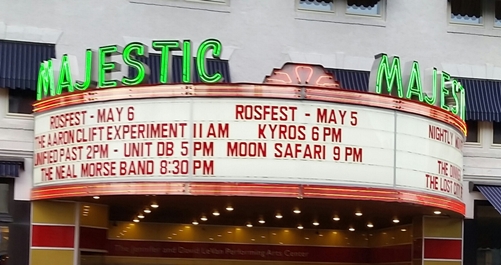
I’ve returned from my annual trek to Gettysburg for the Rites of Spring Festival – aka ROSFest. This was ROSFest number seven for me, which  is low compared to some folks, but it doesn’t seem like I’ve been going that long!. Kudos as always to George Roldan and the crew who keep things running smoothly year after year.

ROSFest Marquee

My thoughts on the bands:

Kyros – I liked them as Synathesia a couple years back and I think they’ve improved with (a little bit of) age. Their sound is heavy without being obnoxious and there’s lots of juicy keyboard work to go around (it’s a great ad for the Korg Kronos). Liked ‘em, bought the new album. Note – this was the first of three keyboardist/frontmen for the weekend – surely a record?

Moon Safari – I like, but don’t love, them (after about 90 minutes things just seem too sweet) but they delivered a good set, as expected based on their last appearance. The newer material didn’t thrill me. I continue to be amazed at their ability to harmonize after two hours.

Aaron Clift Experiment – I thought this was generally good, melodic stuff, although as somebody else pointed out it wasn’t particularly “proggy.” Only a few tunes really connected. I liked the fact that they brought a string quartet (once the sound guy saw they were there). But I disappointed that the keyboard player didn’t do more in a band with his name on it. Second keyboardist/frontman of the festival.

Unified Past –  These guys just didn’t work for me. Heavy prog with metal-style vocals with lots of instrumental pyrotechnics. Ephemeral Sun’s John Battema apparently stepped in at late notice to keep the band from having to cancel, so kudos to him – their material gave him quite a workout! I thought the Christ Squire “tribute” was odd, given that the bass player (with his Rick!) walked off stage for it.

dB Unit – The surprise of the fest for me. As other’s have mentioned, this was basically a few guys from Unitopia augmented by Steve Unruh (on violin, flute, and percussion). I only have one Unitopia album which is all right, so the idea of this collection of musicians didn’t thrill me. But the music was great and nice contrast from the metallic bombast of the rest of the day. Unruh is amazing. If they don’t make an album, I hope we get a recording of this set, at least. Slight demerit for using a bass backing track occasionally.

Neal Morse Band – Although I hadn’t heard much of Neal’s solo stuff going in, I knew what to expect musically from his days with Spock’s Beard, Transatlantic and, now, Flying Colors (whose second album I picked up). Aside from the prog-metal gloss on proceedings, it met expectations. Nothing stuck with me, but it was an enjoyable process as it went through. Neal and his band are all monster players and he’s a great frontman (number 3 in the . . . trinity of keyboard-based frontmen), so it was fun to watch.

The Fierce and the Dead – I suppose they were the “weird” band for the weekend, given the all-instrumental music. A great way to start Sunday. They reminded me of a heavier, more concise Forever Einstein (if that makes any sense). There were a few bits where they spaced out and kind of provided some breathing space. Great rapport with the audience. Pity they’re Arsenal fans!

Evership – This was another pleasant surprise. Young  band (they’ve been an actual band less than a year) cranking out adventurous (in terms of lyrical themes) symphonic prog with a heavy (but not overwhelming) edge. Lots of acoustic guitar work added a nice texture. Plus, they had cool toys on stage – a Theremin! a (pink) double-neck bass! a CP-80! Unfortunately, the lead guitar tone cut through my brain like a laser.

Edensong – Every year I skip out on one band (there’s only so much music a mind can handle) and I knew they’d be the one this year. I wanted to rest up for Anglagard and, having seen Edensong at 3RP long ago, knew their stuff really wasn’t for me. I hung around for a few tunes (all new, I think) and confirmed that thought. Major demerits for using obvious backing tracks (especially considering ACE’s string quartet from the day before).

Anglagard – This was my highest expectation of the weekend and they met it. They were a little looser (improvisational?) than I thought they’d be, but it worked. Loved bathing in the glow of real Melotron strings for the evening!

All in all another pretty good year.

This Argument Makes No Sense

Authorities in New Orleans have begun removing from public land a group of monuments dedicated to the Confederacy. It says something about how touchy a subject this is that the people doing the work had to be masked and protected by police snipers.

Among all the wrangling about this there’s one argument from the enablers of the Lost Cause that I just don’t understand, since it makes no fucking sense. It’s made repeatedly in the comments to this story in the Guardian. Here’s a representative sample, responding to the article’s point that this isn’t an issue of erasing history:

Yes it does. You have removed a piece of history from public view. Say you were walking past it with your young child and they said, “Daddy, what does that statue represent” then you could explain to them. Otherwise they are unlikely to learn about the past that has been removed, unless they teach it in school. But even then it’s not the same because it’s just words in books. It’s like removing fossils.

I can only figure that this is a post-hoc rationalization for a knee-jerk opposition to anything perceived as being done in the name of “political correctness,” because a couple seconds of thought shows is just doesn’t make a damned bit of sense.

Take this to its logical conclusion – once a monument of some kind has been erected, it can never be taken down without “erasing history.” If that’s true, we’re not exactly innocent:

IRAQ-BRITAIN-IRAQ-MILITARY-HUSSEIN-AUCTION-HISTORY-FILES

Then there’s the wholesale destruction of Nazi symbols and such in Germany following World War II. Or the toppling of statues of Stalin or Lenin following the end of the Cold War. The idea that monuments have infinite shelf lives simply isn’t rooted in history.

Beyond that, if a monument is history that can never be erased, does it create a perpetual obligation upon future taxpayers to keep it in good repair? Neither of those things can be true – they just don’t make any sense.

Let’s hypothesize using a silly example. In Futurama we learn that, sometime between Fry being frozen and thawed out, New York had a supervillain for a governor. Not only did he “collect” a bunch of famous monuments from around the world, he even added himself to Mount Rushmore:

Futurama_Mt_Rushmore

Now, years after the fact, are the citizens of New New York required to look at the face of evil everyday in the name of history? Do they have to pay to keep the super villain’s face looking crisp and life like? I’d say the answer is clearly no, but I’m not sure how those “this is erasing history” people could reach that conclusion.

Monuments and memorials are put up for a reason – because the people of that community at that time thought they were appropriate. There’s no magic in those intentions, nothing that shields the thing memorialized from future scrutiny. It’s entirely appropriate for future communities to decide that this thing is no longer worth celebrating.

Come See Me!

I wanted to let folks know about a couple of places I’ll be in the upcoming months. One’s fast approaching, the other’s more of a “mark your calendars, save the date” kind of thing.

Vandalia-Con

On May 26-28 I’ll be at the historic Blennerhassett Hotel in Parkersburg, West Virginia for Vandalia-Con 2017.

VandaliaCon

Vandalia-Con is:

Vandalia-Con is a Steampunk/Science-Fiction Convention that raises funds to provide uninsured WV women with breast and cervical cancer screening, diagnostic and treatment services.

This will be my first experience with a “Con” and I’m really excited about it. It’s for a good cause, too, which is the cherry on top. Also, the steampunk vibe will go well with my next novel project (yes, I made a decision!)

West Virginia Book Festival

Two years ago the West Virginia Book Festival was reborn, just in time for me to participate as a published author. Unfortunately, I booked myself elsewhere before I knew the dates for last year’s version. No such problem this year!

2010_Bookfest_Logo

On October 27 & 28 I’ll be at the (in the process of being remodeled) Charleston Civic Center for the 2017 version! I’m looking forward to a great slate of writers being there and meeting and greeting plenty of readers over two days. Mark your calendar!

I’m hoping to have some other appearances scheduled this summer and fall, too.

Author Interview – S J Brown

This time I talk with an author who shoots first and writes stories later (mostly) – S J Brown.

Who are you? Where are you? What kind of stuff do you write?

I am S J Brown, a writer, wildlife photographer, grandma, wife, mother, spouse, and tree hugger. My home base is in West Virginia, but I tend to cross the state line constantly. I write about life, about me, and about critters.

Tell us about your most recent book, story, or other project.

I am currently in the finishing stages of a project my sister and I embarked on together. It is a memoir that covers 12 years of our lives. The working title is Sisters. It has been quite a journey that we can’t wait to share it.

How did you come to write a book with your sister? Were there any major squabbles you had along the way?

Our Mother wrote a book for family.  It accented the difference between her childhood and mine. So that got me thinking about writing a memoir.  Then at a Writers Conference I took a workshop on collaborative writing.  When I returned home I called my sister and learned that she had been thinking the same thing.

There weren’t any squabbles while we worked on the book.  We did most of our squabbling when we were younger. I admit from time to time I got impatient waiting for her to respond to my emails.  We live about 250 miles apart so much of the writing was done through e mail and over the phone.  We also spent a few weekends together just focusing on the book. There were times when we laughed until we cried.  There were serious discussions and agonizing about how much to share, where to end the book and if there would be another book to follow this one.

In what genre do you primarily write? Why did you choose that one?

I primarily write memoirs. Early in my writing career a trusted soul told me to write what I know and I took that to heart.

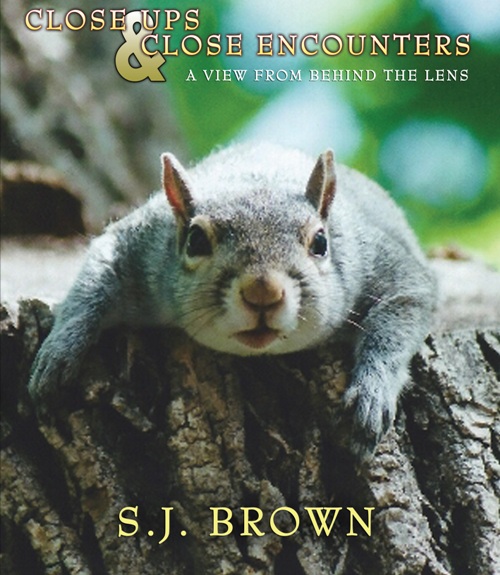
I was at an exhibit talking to a patron about the story behind getting one of my photos. After our conversation a fellow writer tapped me on the shoulder and whispered in my ear, “girl you have to write this shit down.” I went home that evening and put aside the manuscript I was working on and began Close Ups & Close Encounters, my first full length published manuscript.

Cover 3-26-23

So what, in brief, was the story behind that picture (and do you have a digital one you could share)?

As you can see it is a pretty close shot. I was using a 300 mm lens. I stood behind some bushes and snapped a picture of the bear. Normally I would take a shot and then take a step closer to the critter I am photographing.  However each time I clicked the shutter button this bear moved closer to me.  We did this several times before my spotter got nervous and whispered that we needed to back out of there.  Of course I took a few more shots including this one before I backed out of the area. I used film when photographing wildlife.  I think the bear could hear the camera advancing the film and he was curious about the sound.

Bear

Tell us briefly about your writing process, from once you’ve got an idea down to having a finished product ready for publication.

My writing process is a bit different than most writers. I begin with a photograph. My goal is to take the reader to that time and place. My first draft generally is just notes to myself. The second draft is actually sentences and paragraphs. The third draft I tweak the descriptions and emotions a bit. Then I set it aside for a few weeks before giving it one more read through before I place it into someone else’s hands. I always want a fresh set of eyes on the work. A fresh set of eyes will spot typos, and places where the story skips or lags a bit.

Since you start, generally, with a photograph, does that mean when you’re looking for good shots you try to get something that might make for good writing afterwards? Or do you just get lucky sometimes?

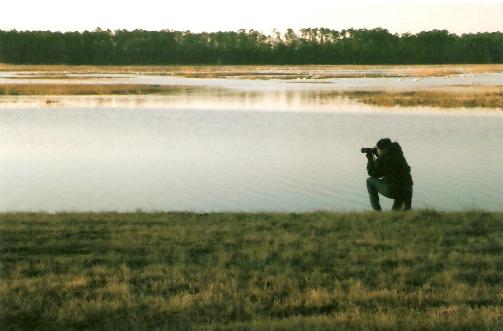
When I am in the field I’m not thinking about stories to write, I am concentrating on the critter in front of me. In the field the encounter is as important as the resulting photograph.    It is important to pay attention to the animal’s behavior so that I don’t get in trouble.  Wildlife photography involves skill, research, and a bit of luck  every time I go out in the field. To get the shot that I eventually used for the cover of “Close Ups and Close Encounters” I had to climb a tree and wait.  Sometimes I lay on the ground, other times I need to climb, or get into a boat to get a good shot. Since every picture tells a story the writing comes later.

Who is the favorite character you’ve created? Why?

I can’t really give you an answer to this question since I don’t create characters. I write about real people. Life truly can be stranger than fiction.

What’s the weirdest subject you’ve had to research as a writer that you never would have otherwise?

I haven’t really researched anything weird or strange for my writing. I do most of my research before photo trips. It helps to know as much as possible about my wild subjects before I encounter them in the field.

Before my first trip to Florida to photograph critters I researched alligators, manatees and a few other wild creatures. However when I was on the ground face to face with an alligator all that knowledge just disappeared when I knew I was too close to him.. I couldn’t remember how far he could lunge, how he would warn me to back off, or how fast he could move. So I took a few photos and began talking to him as I backed away.

Okay so I have gotten off topic here but your next question is probably what do you say to an alligator when you are close enough to hear him breathe. It doesn’t really matter he can’t understand what you are saying. You just have to keep your voice calm and pleasant so he knows you aren’t a threat.

Promo Shot Horizontal

How do you select the subjects you photograph?

My spotter often says I will photograph anything that moves.  What critters I photograph depends on where I am.  I have traveled from Maine to Florida and as far west as Colorado  to capture critters on film. The extreme northern United States have Moose, and Puffins can be found at certain times of the year.  The extreme south eastern states have alligators. When I head west I can find Big Horn Sheep, and Prairie Dogs. Then there are white tailed deer, wild horses, raccoons, and a huge variety of birds, so I guess he is right I will photograph almost anything that moves.

Photographing wildlife has led to doing things I never dreamed I would do.  I have flipped horseshoe crabs, tagged Monarch Butterflies, and banned ducks.  I have met some fascinating people and been to incredible places.  Every time I return home I am ready to go out and do it again.

What’s the one thing you’ve learned, the hard way, as a writer that you’d share to help others avoid?

Don’t let life get in the way. There is always something else you need to be doing, or somewhere you need to be. Make the time to write, write often, and get your thoughts down. I began writing in High School, had my first piece published when I was 18 and then life got in the way, my writing was put aside and it was decades before I got back to writing.

If you won $1 million (tax free, to keep the numbers round and juicy), how would it change your writing life?

I would get a laptop and write from the road.

What’s the last great book you read or new author you discovered?

The Glass Castle by Jeannette Walls. This book grabbed me from the first sentence and didn’t let me go. To me that is the true meaning of a great book. The words should put the reader in the scene and compel them to turn the page.

What do you think you’re next project will be?

My next project is already in progress. I am writing a follow up to Sisters. The working title is The Little Middle Sister. The select few that have read Sisters asked how I got from there to where I am now.  It has definitely been a journey I wouldn’t want to repeat, but I am happy to share the details.

This was fun. Thanks for having me here.

S J Brown on the Web

Is Originality an Illusion?

On their second album echolyn has a multipart suite that chronicles their struggle to make their kind of music in a world that doesn’t really appreciate it. An early section is called “Only Twelve,” a reference to the fact that the Western musical scales only has 12 tones. It’s not that diverse a palate to work with. A later section, however, suggests that’s not the right way to think about it. It’s called “Twelve’s Enough.”

But recent evidence suggests that 12 might not really be enough. As this article lays out, more and more pop artists are getting sued for lifting bits of music from other sources (Ed Sheeran, whose music I couldn’t pick out of a sonic lineup, appears to be a great transgressor). This is not likely to be a result purely of coincidence:

[quote]Bennett [a forensic musicologist – JDB] then goes very deep into the maths, proposing a scenario where he and I each decide to write a melody. ‘I might start on C and you might start on E – two of the seven notes in the major scale. The odds [against us choosing the same note] aren’t exactly one in seven, but you get the idea. Then you come to the second note: I might choose D, you might choose another E. So then we’ve got a seven to the power of two probability, and that’s just within two pitch choices.’[/quote]

The analysis goes much deeper but as you can see from just two notes, the probabilities don’t look good for coincidence. That shouldn’t be a huge surprise. We interact with art – music, literature, you name it – from the day we’re born. How could we not internalize things and, perhaps, come to think of them as our own? As Bennett admits, there’s a line between copying and plagiarizing.

Having said all that, artists have always copied from one another. There are entire traditions – folk music and the blues come to mind – that are based on taking work done by others making it your own. Hell, it’s been said (by Picasso, possibly) that good artists copy, but great artists steal (http://quoteinvestigator.com/2013/03/06/artists-steal/).

The issue of going too far with borrowing is where this all meshes with the law of copyright. We want to protect creators and incentivize creativity, but we don’t want to shut down the natural drift of ideas that occurs in culture. Is the list of court cases about pop plagiarism an indictment of our current copyright scheme?

That’s the idea behind what is surely the best piece of legal/regulatory speculative fiction ever written, Spider Robinson’s “Melancholy Elephants.” It’s about a word where copyright protection is eternal and, as a result, it becomes increasingly difficult for people to create new things because everything can be traced to something that came before.

We haven’t reached that point yet, although we might be close. Before we go too far, it’s worth thinking about whether we want to live in a world where every idea, every melody, every story is owned by a single person (or corporate entity) for all of time.

Author Interview – Eric Fritzius

Joining me this month is a local purveyor of spooky tales about weird, wondrous, and just plain weird things.

Who are you? Where are you? What kind of stuff do you write?

I am Eric Fritzius, a freelance writer, actor, director, instructor, podcaster, and playwright living atop a hill in Greenbrier County, W.Va.  I’m the outgoing secretary for West Virginia Writers, Inc. an organization in celebration of writers and writing in Appalachia.  I write short fiction, short nonfiction and short plays primarily.  Occasionally my writing is published and my plays performed.

How does your work in the theater, as a writer, actor, and a director, influence or inform your short story writing?

Tremendously.  From elementary school, my earliest form of creative writing was writing plays.  My dad did community theatre, so I got to see him act in The White Sheep of the Family and The Man Who Came to Dinner.  I would follow along with the script to help him learn his lines, which was the first chance for me to see how a play is constructed on the page.  I was fascinated and immediately began trying to write my own.  I had no idea what the story would be, but my 4th grade mind wanted it to include Mission Impossible style mask removal, with characters revealing themselves as other characters.  In other words, it was unstageable and remains unfinished.  (Okay, I may admit to that one being a failed project.)  In high school I started attending a drama camp in which we wrote a three act musical comedy in the space of a week.  That was like going to boot camp each year.  You had to learn to tell complete stories using only dialogue and stage directions, with limited storytelling because you’re mostly limited to one set and therefore one setting.  You also had to learn what plot points your characters should summarize and which ones to portray, cause you had a definite limit of how long the play could run.  And I learned a lot about using music to help tell the story.  After seven years of that camp, I developed an ear for natural sounding dialogue and the rhythms of speech.  And when I began writing prose, it tended to be dialogue heavy.   To the point that I’ve adapted a couple of my short stories for the stage and have experimented with adapting a stage story to prose.

All writers are supposed to get into the heads of their characters and know their motivations.  But acting as a character tends to turn this process up a notch, because that’s essential to the job—particularly when you’re playing characters without a lot of dialogue, as I have often done.  It’s not enough to just do what the script describes your character doing and saying, you also have to know why they’re doing and saying it in order to portray it accurately.  And that’s rarely spelled out for you in the script.  Similarly, as a director, I have to be in the heads of all the characters in order to make the play work and appear to be happening as naturally and logically as I can.  Which is basically what writers do with their stories, except with prose the limiters of set and time get removed and you have an unlimited budget to work with in terms of set.  And, in genre, an unlimited special effects budget.

Tell us about your most recent book, story, or other project.

My most recent book is also my first; a collection of short modern fantasy fiction called A Consternation of Monsters.  It was recently published as an audiobook, for which I did the narration.

consternation audiobook cover 1-1-16 thumb

How did you come to produce your own audiobook version of Consternation and were there any stories that presented any hurdles in shifting them from the page to the aural realm?

Having a background in radio, podcasting, and acting, I thought that doing audiobooks would be no sweat.  I have a small home recording studio which I had already to record a few stories for my promotional Consternation of Monsters podcast.  These weren’t audiobook recordings, per se, but instead recorded live readings at author events, recordings of stage adaptations of my stories, or were audiobook/radio drama hybrids, complete with sound effects and sometimes other people playing roles.  To record a mere audiobook, I foolishly thought, would be a step down in difficulty.

Before I attempted it, though, I was hired to record an audiobook for author S.D. Smith for his middle-grade novel The Blackstar of Kingston.  He and I had met a few months earlier and I was very impressed with his debut novel The Green Ember–a fantasy series he describes as “rabbits with swords”—and he enjoyed my podcast work.  He already had an audiobook for The Green Ember, skillfully narrated by Joel Clarkson.  However, Blackstar was a prequel to Ember, set a century before. It made sense that it could have a different narrator as it shared no characters.

Recording Blackstar was a true learning experience, and a humbling one at that.  All of the acting, broadcasting and narrating expertise I thought I possessed seemed to evaporate in the face of portraying a dozen characters, in a variety of accents from across the UK, while also maintaining the level of tension and intensity that some of the chapters required.  I would sit at the mic, furious with myself for my inability to get my mouth around simple words, or at the disgusting smacky noises I kept hearing in every syllable, or at the UPS driver daring to make his deliveries in my neighborhood, whose truck my mic easily picked up.  I wound up recording the whole thing twice and then re-recording some of the individual chapters three or four times each before I was happy.  (Fortunately they were short chapters, the longest of which might take fifteen minutes to read.)

The major learning curve was in engineering the recordings to the standards of ACX.com (which is Audible’s self-publishing arm for audiobooks).  This wasn’t like a podcast that you could record, edit, upload and walk away.  You had to have a consistent product across all chapters, with all audio files falling within the same range of levels.  I wound up being quite proud of the end-product, but it was far more difficult to achieve than I had thought.  It was great experience to have, though, before recording the stories for Consternation.

I recorded and edited all but my final two stories in early 2016, just a month after finishing Blackstar.  Then I got royally busy casting and directing a play festival, then a number of other jobs, and wasn’t able to get back to it until November.  By then I needed a refresher course on how to engineer the files and found a good tutorial source.  Unfortunately, it was too good and my new recordings sounded better than the ones from January.  I had to re-record everything using the new techniques.  Then, just when I thought I had everything recorded, edited, and mastered, I wound up accidentally saving the brand new version of “The Wise Ones” on top of the newly recorded and edited version of “Old Country.”  (What can I say–both involve other-worldly mobsters and they got mixed up in my noggin.)  Fortunately, I had an unedited backup of the “Old Country” file, so I didn’t have to start from scratch, but it was a mistake that cost me several hours in editing and mastering.

In what genre do you primarily write? Why did you choose that one?

I tend to write modern fantasy, but I was kind of drug kicking and screaming into it.  Growing up in small town Mississippi, I was mostly a science fiction fan.  I was drawn to stories of ordinary people who were pulled out of their boring daily routine and thrown into adventure.  I cut my teeth on reruns of `70s era Doctor Who (only a handful of years after their original broadcast, really).  Tom Baker was my Doctor and his remains my favorite.  From Who, I found my way to Douglas Adams’ work, after mistaking an episode of the Hithchiker’s Guide to the Galaxy TV series for Doctor Who due to the BBC video production “look” they shared.  I loved it and soon devoured all the books.  This then led me to Neil Gaiman, who had written a nonfiction biography of Hitchhiker’s in the late `80s called Don’t Panic (in which 8th grade me was astounded to learn that Douglas Adams used to work on Baker-era Doctor Who).When Gaiman began writing comics, I remembered his name and started picking up his work, reading The Sandman, and Black Orchid, following on to his early novels Good Omens (with Terry Pratchet), Neverwhere and have been a fan since.  Back then, I dreamed of writing funny sci-fi, like Adams.  And if anyone were to ask if I was “into” fantasy, I would deny it with vehemence because I thought of fantasy as sword and sorcery.  But I loved Gaiman’s ability to create wondrous and often dangerous worlds that seemed to be just on the other side of a veil from our own.  And his books were definitely fantasy, moving beyond magical realism into Gods and monsters walking around modern earth.  Like my other favorite, Ray Bradbury, he took the ordinary dull world and revealed that the strange and wonderful existed within it.  His characters often began in an ordinary, dull existence, but were pulled into adventure, usually with an enigmatic guide or two to show them the way.  Great shades of Doctor Who, really.  And the fact that Gaiman has gone on to write for the modern Doctor Who makes me immensely happy.

I also write mundane stories, though, where nothing strange or supernatural happens at all.

What determines whether a story is “mundane” or has supernatural element? Does the supernatural element lead to the story or does the story demand something out of the ordinary?

A mundane story, to me, is any story lacking genre elements, or any sort of magical realism.  Doesn’t make it boring by any means—as the term mundane has come to be thought of—but just a story grounded in reality.

I find writing mundane stories more of a challenge than genre stories, but the temptation to try and turn them into genre stories against their will is often strong.  With genre, writers often have an instant hook of the fantastic that will keep a certain demographic of reader—fans of genre—reading.  Without those elements, I feel like I have to do more heavy lifting in order to make my worlds and characters real and interesting enough to hook the readers of all.  Now this shouldn’t be the case, because writers of genre fiction are supposed to do this same kind of heavy lifting in addition to the world-building necessary to bring the fantastical elements they include to life.  Somehow, though, what should be easier on paper seems harder to me.  I’ve found myself mid-way through a mundane story before, have hit a snag in my narrative and have thought “Oh, if I could just have Miss Zeddie show up now I’d be home free and could crack this story, no problem.”  In those situations, I know I have to stick to the mundane because to do otherwise would be cheating the story somehow.

Seems strange to say it, but I don’t think I’d ever considered if there is a difference in writing technique between my mundane stories and genre stories, or if the genre elements themselves are what leads to the story or vice versa. There are no mundane stories in A Consternation of Monsters, though there is one (“Puppet Legacy”) that is 95 percent mundane, with a hint at larger genre elements, and a feint at others.  In 9 out of the 10 stories, though, it was the genre element that inspired the story.  By contrast, many of my mundane stories (which I nearly have a collection’s worth gathered), are often, though not always, character-driven first with the stories building out from there.

Tell us briefly about your writing process, from once you’ve got an idea down to having a finished product ready for publication.

My process, if you’d call it that, is pretty varied and can sometimes take years and I pick up and put down a given story until it’s finished.  For every short story I have been able to dash off a draft in an afternoon, I probably have five that have taken months or years to finish.  (I find it’s best to have a hard deadline with embarrassment on the line should I not meet it.)

However, I find my ideas often start as a glimpse of an image in the middle of a story, which I have to then write up to, figuring out how that image comes to be, and then write beyond it to see what happens next.  For instance, back in the mid oughts, my wife and I went on a glacier tour on Resurrection Bay, near Seward, AK.  The scenery was gorgeous and inspiring on its own, and we got to see some pretty big wildlife up close, including whales surfacing near the boat.  On the way back to Seward, the boat moving along at a faster clip, I found myself imagining what might happen were a blue whale to burst out of the bay, directly in our path?  It was an image, but not a story.  Even if something catastrophic happened to the boat, like it capsizing, it was still just an incident with no inherent conflict.  But what if, I continued to wonder, the hypothetical whale had surfaced in order to exact vengeance upon a specific passenger? Not so much in the way of the 1980s killer whale movie Orca, in which the titular creature exacted revenge on Richard Harris (and Bo Derrek’s leg, to some degree) for killing his mate and child.  More of a Day of the Jackal, except with a whale as the assassin.  That was the point when I realized it wasn’t really a whale to begin with.  And then some new, exciting, and improbable images entered my noggin.  At this point I had some basics, but the ultimate story itself wasn’t cracked for months yet.

Probably a year later, I took an online test to see if I might be a good candidate to become a transcriptionist.  (I type nearly 100 words per minute, so it seemed a skill that might have value.)  The test required you to listen to a sample recording and transcribe it exactly, including making notations for any stray noises in the room, such as coughs, farts, sneezes, etc., with those sounds described in [bracketed text] on a separate line.  The transcription folks never called me, but knowing the format of a transcription gave me the key into my story of the whale/non-whale in Resurrection Bay.  In an instant I knew who my main character was, and how to get into and out of the story.  The rest of the details in between those points filled themselves in as I went.

This became my short story “The Ones that Aren’t Crows”, (which can be heard as a podcast at my website).

Sometimes, though, I’m lucky enough to have stories arrive in my head fully formed.  “Limited Edition,” which is the longest story in my book, dropped into my head, almost fully formed after I read a single sentence.  It was a writing challenge issued to me by a friend, who said I had to write a short story in which the following sentence appeared: Something told him that in all the world, there was no other fork quite like this one.

When you set aside stories and then come back to them later, do you always intend to come back to them or, when you set them aside, do think they’re failed projects that just aren’t going to work?

I don’t believe in failed projects.  I insist on believing that all stories can be made to work.  Eventually.  However, the number of story fragments in my NPROGRESS directory would seem to argue otherwise.

I read a piece from Neil Gaiman in which he describes trying to write his novel Coraline on a few different occasions. He’d come back to it every now and then, averaging 2000 words a year, and make a little more progress only to find he did not yet possess the skill to write further.  After 12 years he said he decided that he wasn’t likely to get any better than he was in that moment, so he may as well get on with it and finish it.  I can absolutely sympathize with this.  I definitely have begun stories that I didn’t possess the skill to complete at the time.  Some of these have to gestate for a while, with occasional revisits by me until one day something just clicks and I’m able to finish it.  Or I don’t.

Of the stories in Consternation that falls into this category is “Old Country,” a story I started in the late 1990s as a way to flesh out a particular corner of the history of the shared fictional universe my friends and I had created.  It began with the idea of a guy the mob is unhappy with being called in advance of his own hit, just to make him squirm, and because they believe his knowing will make no difference in the outcome.  The setting was the pre-cell-phone `80s, when a mobster could just call you at home and then have his henchmen cut your phone line afterward and hang out to make sure you stayed put.  I knew what the turn of the story would be, and I knew how the guy would escape his fate.  What I didn’t know was how to get from the phone call about the hit part and the escape his fate part.  Seemed like it needed something special.  And so the story sat there as a beginning and ending only for a few years.  Somewhere in the mid-2000s, I met an older lady at a writing event who chatted with me for quite some time on the topic of quilting.  It’s not a topic I have a lot to offer on.  So after I exhausted the story of my own grandmother taking up quilting later in life, and then officially retiring from it as soon as she’d finished a quilt for each grandchild, I was done.  The lady, though, had quite a depth of knowledge on the topic and was willing to share it—all about spiral quilts and block quilts and patchwork quilts and art quilts, and on and on.  Under other circumstances, I might have needed to gnaw off my own leg to escape (to paraphrase Douglas Adams).  But instead, I was fascinated by her stories because of a secret she revealed to me as to her quilting process.  The lady said that when trying to decide what style of quilt to work on, she would frequently be petitioned by the spirits of her dead family members, each of whom had an opinion as to what sort of quilt she should work on.  They would apparently argue with each other, and with her, until she finally made a choice.  Some days the spiral quilt “people” won.  Some days the block quilt “people” won.  It was a magical realism sort of moment for me, because she said it quite matter-of-factly, and with no reservation about telling all this to a stranger.  It was awesome from a character-study standpoint.  Thinking back on that conversation later, the elements of it merged into Martin’s grandmothers and their mystical quilting skills, and suddenly my story had the middle it was in need of.

Eric Fritzius-cropped

Who is the favorite character you’ve created? Why?

Probably have to go with Miss Zeddie on this.  She’s a wise old woman who appears in two stories in Consternation (including “Limited Edition”), and is referenced in a third, by a Mexican gray wolf named Fungus.  Truth be told, though, I didn’t create her.  At least, not initially. A friend from college, named Marcus Hammack, created her as a non-player character in a role-playing game my friends and I played.  It was a game set in a fictional universe that we collectively created.  Madam Z, as she was called, was an enigmatic, mysterious, and frustrating figure for our player characters to meet.  On the surface she was just an odd, wise, yet still very cranky old lady.  Somehow, though, she was simultaneously the most intimidating figure our characters had encountered.  Marcus’s masterful storytelling skills implied a great deal of power in her, while at the same time showing only a tiny bit of that during the actual game.  I was immediately curious as to her backstory, and kept trying to guess things about her over the course of our sessions.  Ultimately, Marcus revealed that he’d developed no backstory for her whatsoever.  She was a character he’d kind of created on the fly to help guide our characters because we’d obviously not picked up on the clues he’d been feeding us otherwise.  I was disappointed, but, after he graduated, I became her custodian, free to apply the backstory I’d been dreaming up as I saw fit.

We meet the old cranky version of Zeddie in Consternation.  A younger, less-jaded version of her will appear in the next collection.  (Oh, and we’ve already met her brother.)

What’s the weirdest subject you’ve had to research as a writer that you never would have otherwise?

It’s been a goodly number of years since, but I had to research the ancient origins of the Mafia for my story “Old Country.”  I couldn’t begin to tell you my sources at the time, but a Googling will bring up some that exist currently.  Being the internet, there is, naturally, disagreement.  But the version I chose to align with was one that speculated La Cosa Nostra began a few centuries back as groups of Sicilian farmers who organized to defend their land against the kind of repeated invasions Sicily has seen across its history.  People think I made all that up for the story, but if you remove the dark warriors—who I did make up—you’re left with basic history.

I suspect, though, that the answer to this question will change once I have a draft on a different short story—another that I’ve been wrestling with for a few years.  Its current title, “Draft of Chapter 13 from the Unpublished Memoir of Baron Ladislaus Hengelmüller von Hengervár, Austro-Hungarian Ambassador, 1894 – 1913” might give you an indication as to the era I’m researching. Despite its “assigned reading” sounding title, the story is an action adventure.

What’s the one thing you’ve learned, the hard way, as a writer that you’d share to help others avoid?

A lot of time and trouble can be saved by reading and taking to heart Stephen King’s On Writing.  There are around six pages near the middle of the book (you’ll know them when you get there) where he breaks down some hard truths of the writing game that often take writers years to learn on their own.  Or, indeed, accept.  Some of the advice he gives I had heard from others before in regard to my own work, sometimes for years, and had either not believed the advice at the time, or just stubbornly refused to follow it.  I’ve now come around.  I teach Mr. King’s advice to my own students, giving full credit to Uncle Steve when I do.  I then advise them to go read Ray Bradbury and see how gloriously and elegantly such rules can be broken by a master.  I’m certain Mr. King would agree.

If you won $1 million (tax free, to keep the numbers round and juicy), how would it change your writing life?

I suspect I’d get even less writing done.  Unless, maybe, I used the money to pay people to give me deadlines.

What’s the last great book you read or new author you discovered?

I’m super late to the party on the Kingkiller Chronicles.  I’m not usually drawn to historical fantasy, though I have dipped into it more and more in the last decade.  And I did my best to resist this series, too, despite multiple people whose opinions I respect telling me I would love it.  It took hearing Patrick Rothfuss speak at the WV Book Festival last year before I realized I had been wrong the whole time.  His talk was so good that I decided I was doing myself a disservice by not reading The Name of the Wind.  So I picked that up and it’s fantastic, as billed.  I had to buy autographed copies for a couple of the people who’d been telling me to read it for years, to make up for ignoring their advice.

What do you think you’re next project will be?

I’m currently directing a play called The People at the Edge of Town(May 19-20, 2017, at the Pocahontas County Opera House, in Marlinton)by WV playwright, A.J. DeLauder.  It’s a play largely about small town politics, class warfare, friendship, and family secrets set in a town council chamber.  After that, I have secretarial and contest coordinator duties to wrap up for West Virginia Writers, Inc.  Then I hope to get back to working on my own writing and voiceover projects, including the next collection of short stories.  It will likely have another inadvisable collective noun title, too.  A Solace of Baba Yaga, maybe.

Where to Find Eric Online

Web

Facebook

Twitter

YouTube


What I’ve Been Up To

With The Water Road trilogy wrapped up I figured this might be a good time to check in and let folks know what I’m doing, writer wise. The TLDR version – cranking through some short stories and trying to plan the next big project.

Short Stories

After the epic feel of The Water Road I decided to dig back into my bag o’ ideas and work up a couple of the shorter ones. This isn’t to suggest that returning to short stories is a way to “take it easy” or some such. Building worlds and characters in a few thousand words, versus hundreds of pages, can be a challenge in its own right. It’s a different discipline in the writing world, but one that’s very rewarding.

The first of the new stories is “To the Sound of Birds.” It was inspired by some very odd noises I heard during an autocross years ago. Animal noises, of a sort, coming from the woods across the street from the venue. The idea came to me then and I’d kicked it around for a while before I got a chance to sit down and finish it. I’m about to try and find it a home and let it loose upon the world.

The other isn’t quite finished, but should be in a week or so. It’s called “The Miracle at MarvoMart” and is about a guy who gets in over his head with a good thing that turns very bad. This one, too, came from an idea that occurred during an autocross – more precisely, during a bathroom break. I never set out to write a story set largely in a public men’s room, but that’s where I’ve ended up!

Aside from those two, I’ve also pulled out and polished a story I wrote a while ago in which the main character is this little girl:

MaiaTalkstoYou

Along with her two feline companions (at the time the story was written). It’s about what the animals get up to while their people aren’t around. It involves dragons and a whole unexplored world under the house. At one time it was going to be a series of stories, but I never got past the first one. An anthology popped up that I thought this story would be good for, so I sent it in. We’ll see if anything comes of it. Don’t worry, it’s for grownups – they curse and such.

I’m also working on one final story in The Water Road universe, set between The Endless Hills and The Bay of Sins. It would explain why, when two characters meet in The Bay of Sins, they are not particularly fond of one another.

The Next Big Thing

As I’ve said before I’m having a hard time figuring out what my next novel project will be. I have a lot of ideas, but none of them have roared up and demanded to be written right the fuck now (at least not yet).

One of the issues is that before I even think about ideas there’s a preliminary question to answer – should my next project be a standalone novel or the first in a new series? Some ideas lend themselves better to one or the other, but there are pros and cons to each choice. A stand alone novel probably sees the light of day sooner, but a series gives me the opportunity to really dig into a new world in detail. Until I make that decision, it’s hard to know where I’m headed.

As far as series ideas, the main one would be a several volume steampunkish fantasy set in a global superpower that’s slowly falling apart. I’ve done a lot of background work on it, so it’s probably the most “shovel ready.” Another series idea is to expand the universe of my short story “The Last Ereph” into a common setting for a bunch of unrelated stories. Finally, there’s a trilogy about the nature of magic I’ve been toying with.

The stand alone ideas are more wide ranging. For one thing, they include a couple of ideas that fall solidly into the science fiction category. I’ve written some short sci-fi, but my longer projects have all tended toward fantasy. I’d like to change that, so that might be a deciding factor. One of those idea is more serious, philosophical, and somewhat relevant to the current political climate. Another is more of a fun, planet-trotting adventure. As for fantasy ideas, one that I’m keen on doing (at some point) is my version of the standard fantasy quest, although it has a neat twist at the core of it (or so I think).

So that’s where I am. At least right now as I post this. From here on out – who knows?

Water Road Wednesday – Rand McNally Edition

Just when I thought I was done, then keep pulling me back in!

I’ve had more than one reader ask about whether there are any maps of Altreria, the land that’s the setting for The Water Road trilogy. Strictly speaking, in terms of something I’d be happy putting in the back of a published book – the answer is “no.”

However, in the spirit of sharing my work and showing how I do things – I’ve dug out a couple of hand-made maps from my notes. These are what I used to keep myself oriented in the world of The Water Road. At least at the beginning.

In the spirit of Michael Feldman, three disclaimers:

First, these are crude, hand drawn, and simply photographed. They’re not great quality, but I never expected anybody aside from me to see them. Judge accordingly.

Second, place names and such are noted in my horrific hand writing. Enter at your own risk (although I’ll be happy to translate, if asked).

Finally, I made these before I even started The Water Road and while I added to them on occasion afterwards, I didn’t change things on the map to match the text. As an example, “Port Keneally” became “Port Jaray” in the books (Keneally just didn’t feel right, when push came to shove – sorry, Mike).

With those disclaimers, here we go . . .

A map of the continent of Altreria itself:

AltreriaMap

A few highlights. The long blue ribbon running across the continent is, of course, The Water Road. The two north-south tributaries are the River Innis and the River Adon. The Guildlands are west of the Innis and the Kingdom of Telebria is to the east of the Adon. In between is the Confederation of the Arbor. North of the rivers are the Badlands. The little speck of land in the Bay of Sins is the island city of Tolenor. South of The Water Road, of course, are the Neldathi mountains.

And here’s a different view of the Neldathi mountains, with the great circuit of each clan drawn in:

NeldathiMap

For those scoring at home, here’s how the numbers match up to the clan:

  1.  Dost
  2. Haglein
  3. Chellein
  4. Volakeyn
  5. Mughein
  6. Kohar
  7. Akan
  8. Uzkaheyn
  9. Elein
  10. Sheylan
  11. Paleyn

This one also gives you a better idea of the names of the mountain ranges and Islander cities. Yes, many of them are named after musicians. Albandala, the city Antrey founds in The Water Road is somewhere near the Hogarth Pass.

Weekly Read: The Collapsing Empire

I don’t think this is unique to me, but it’s at least unusual that my entry into the realm of John Scalzi fan began not with his books, but with his blog, Whatever. I was a regular reader there for a few years before I started working through his ever expanding bibliography.

What’s more unusual is that, for the most part, I don’t care for Scalzi’s most well developed universe, the Old Man’s War series. I read the first book and liked it well enough, but military sci-fi has never been my favorite corner of the genre. I’m much more into Scalzi’s stand alone work, from The Android’s Dream to Redshirts to Lock In. Which is to say I was stoked when I heard Scalzi was opening up another space opera series.

The Collapsing Empire has, at its core (or “Hub,” I suppose) a terrific idea. Humanity is spread across a multitude of worlds (Earth not being one of them, anymore), thanks to a faster-than-light McGuffin called “The Flow.” The Flow works . . . well, nobody is really sure why it works. But it does work, like a hyperspace equivalent of the jet stream or ocean currents, carrying spaceships along at post-light speed and making interstellar travel possible, if a pain in the ass.

Since people can only go where The Flow takes them, there are certain routes of travel. All lead to a planet called Hub, where the titular empire is headquartered. On the other end of the travelled galaxy is End, a sort of Australia (they send the troublemakers there) that, also, happens to be the only place where humans live under the open sky. The problem, as the book begins, is that The Flow is starting to fail. The bigger problem – most of the empire has no idea about it yet.

This is all background, against which a few stories play out. There’s a new emperox (not a typo – it’s a gender neutral imperial title) trying to figure out her new life. End is experiencing one of its periodic rebellions, although this one might actually stick. And someone is trying to inform the powers that be about the problem with the Flow. All of this is interesting, but none of it seems like a fully formed story.

That is The Collapsing Empire’s biggest problem – it’s not a complete story. Even in the context of a series (of which this is the first), it’s not too much to expect an individual volume to actually have some resolution. This doesn’t, really. In the end, it feels more like an extended, epic prologue or a backfill sequel than it does a novel of its own.

Which is a shame, because until you realize that the end is coming and there’s no way things are going to even try to wrap up, The Collapsing Empire is a fun read. Scalzi’s characters are well drawn and interesting. His great creation in this book is Lady Kiva, the “owner’s representative” on a ship that has to deal with The Flow and the rebellion on End.* She’s quick of wit, free with the word “fuck,” and willing to sleep with just about anything that moves. Think of her as Captain Jack Harkness’s long lost more vulgar cousin. The new emperox, Cardenia, isn’t developed quite as well, but her desire not to do the job sets up an interesting story going forward.**

Which brings me back to my complaint – this is all setup. It’s interesting setup. I’m definitely on board for the next book in the series, because I want to see how all this starts to shake out. But I’m left wanting more right now, something a little more solid and whole.

Still, I’m hooked. That counts for something.

* Bonus fun note – the ship names are great. A pair of sister ships are called the Yes Sir, That’s My Baby and No Sir, I Don’t Mean Maybe.

** Bonus fun note – the emperox has access to a “memory room,” in which she can summon the computer-generated simulacrum of any prior emperox. The discussions she has in there are all the better for the simulacra knowing just what they are.

CollapsingEmpire