Weekly Read: The Last Emperox

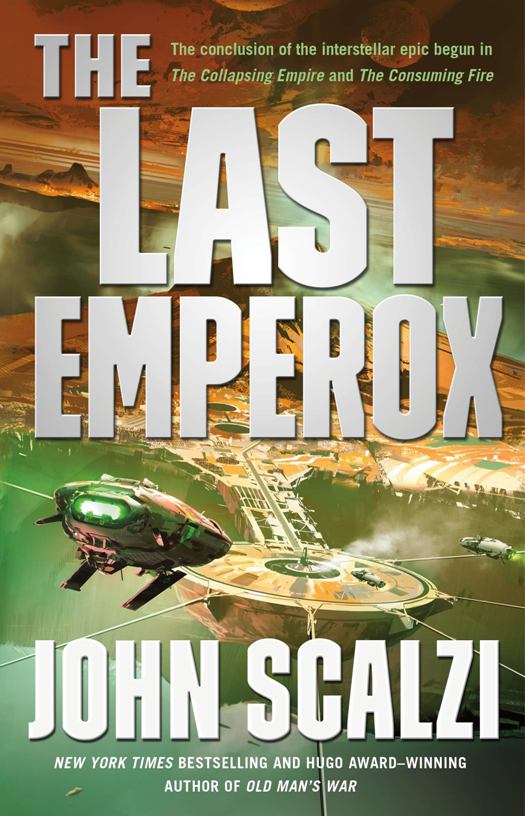
I like John Scalzi. I really do. I came to him via his blog, Whatever, before I read any of his books, so I kind of got to “know” him first before I knew his work. I like the snark. I like the politics (mostly). I like the open and honest way he talks about his writing and the business aspects of it. He seems like a very open guy who is helpful to emerging writers and still a complete geeky fanboy about established ones (and, for the few moments he stopped by my table at the WV Book Festival a couple years ago, just a nice guy).

I wish I liked his books better.

Late last year when I was putting together my list of favorite books from the last decade I was surprised that only one of Scalzi’s made the initial cut based on how I’d rated them on Goodreads. Redshirts, which wound up making the final list, was the only one I’d given at least four starts. I’d enjoyed all the others – there were no 2-star clunkers – but most things didn’t get beyond “like” to “really loved.”

I mention that because I really hoped that The Last Emperox, the last book in the Interdependency trilogy, would break through that ceiling. The first two books (I reviewed the first one here) had a lot of promise, but seemed rushed, like there was more in them. With the end in sight I’d hoped it would tie things together in a super satisfying way. Instead, it was more of the same – good and good fun in spots, but ultimately short of great.

The best part of The Last Emperox (and the entire trilogy) is the idea of The Flow. Analogized to a kind of river in space it’s the in-universe way of travelling between distant stars. It isn’t really FTL, but it works like it. The operative fact for the trilogy is that The Flow is collapsing, which is going to cut off planets from each other and basically dooming human civilization.

Against this backdrop the story of the trilogy is various people coming to grips with this. Some are trying to solve the problem, some are trying to profit off of it, and some are trying just do the right thing. This is fairly interesting and some of the characters involved are great. Kiva Lagos is a great, fun character to read about. The suddenly and unexpectedly enthroned Emperox Grayland II is pretty interesting, too, as are several of the supporting players (one is essentially a sentient spaceship). All good stuff.

The problem is that all these interesting people are racing around pushing the plot so hard that sometimes the books come off like extended Wikipedia entries. Part of this has to do with some things that Scalzi does repeatedly that don’t work for me (your mileage may vary, as they say). One is that something will happen – suddenly, with no warning (given who the POV characters are), and often violently. Then we’ll get a couple of characters talk about what happened. It’s like in-world telling instead of showing. Plots – in the sense of plotting, conniving, conspiring – are a lot more fun when you can see the gears working during the wind up. Just getting the incident itself with an ex post explanation isn’t very satisfying.

Another thing that happens repeatedly is that something happens to a character that should move them off the board – a conspiracy foiled or an assassination – that really doesn’t mean anything in the end. The evil doer caught in the act escapes, the target of death really escaped serious harm – all explained after the fact. It gets to the point that when a very major “death” occurs in The Last Emperox you can’t care about it very much because there’s little chance it’s real.

Those issues wouldn’t matter all that much if the ending wasn’t so underwhelming. As I said, the entire motivation for this tale is that The Flow is collapsing and civilization is at risk. Folks come up with a clever way to save it and . . . then we learn that will happen years in the future, after this book is over. So, yay? You think it’s heading for a galaxy-defining moment and it just doesn’t.

Which brings me to my biggest gripe with this trilogy – it doesn’t feel like a complete story. It feels more like the first part of a larger trilogy (for epic space opera these books aren’t long), where a certain challenge is surmounted but the big one that would overarc the series has a lot of legs left to it.

I suppose that’s appropriate, though. The first two books mostly left me feeling the same way – I liked a lot of what they had to offer, but felt there was more there, lurking in the aether. I know the old show biz saying is “leave them wanting more,” but I’m not sure it applies to books – trilogies, especially.

LastEmperox

My Characters Don’t Speak to Me

Creativity is a weird thing. A book is a book or a song is a song, but different writers can get to that finished product in lots of different ways. That’s made clear to me whenever writers talk about being pantsers instead of plotters. Pantsers, generally speaking, make it all up as they go along, without any great amount of planning, notes, and the like. Plotters, by contrast, do all that stuff before they start writing. I’ve learned, the hard way, than I’m more plotter than pantser. I admire pantsers for the way they write, but to me it’s as foreign an experience as it would be if I tried to write the last part of the Unari Empire trilogy in Tagalog.

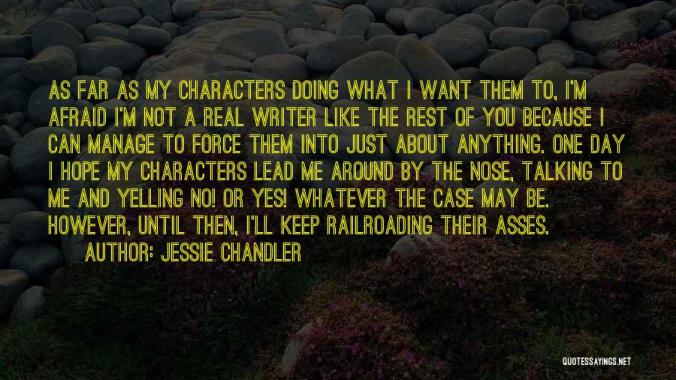
There’s another group of authors of which I am not a part when it comes to the creative process. That’s the group who talk about the characters in their stories like they are independent, sentient beings. Some talk about how they don’t write dialog, they just transcribe conversations their characters have on their own. Others give their characters agency and talk about how they can’t control what they do. As at least one well-known writer put it:

Philip Pullman, author of the His Dark Materials trilogy, reports negotiating a deal with his character Mrs. Coulter to get her to spend time in a cave in one of his books. Some authors have reported that their characters give them unsolicited advice about the writer’s own life!

I just don’t get this. One of the amazing things about writing fiction is that I, as the author, am God, in a big G omniscient and omnipotent sense. Characters only exist because I create them and they only do what I tell them to. Their words are my words. Does it means they always develop the way I first intend them to? No, but that’s me changing my mind, not them rebelling.

Maybe I look at it this way because I started writing seriously as a lawyer and in legal writing you’re at the whim of so many other things – the law, the facts, your clients. In fact, it’s my clients who behave the way some writers talk about their characters – with complete free will and a dazzling inability to control themselves.

I always figure that when writers talked about characters talking to them or doing things against the writer’s will it was a way for writers to deal with the vagaries of the creative act, with a heaping helping of metaphor baked in (we’re talking about writers, after all). But I’m apparently wrong and in the minority on this, according to recent research with authors from the Edinburgh book festival:

Researchers at Durham University teamed up with the Guardian and the Edinburgh international book festival to survey 181 authors appearing at the 2014 and 2018 festivals. Sixty-three per cent said they heard their characters speak while writing, with 61% reporting characters were capable of acting independently.

‘I hear them in my mind. They have distinct voice patterns and tones, and I can make them carry on conversations with each other in which I can always tell who is ‘talking’,’ said one anonymous writer. ‘They sometimes tell me that what I have in mind for them isn’t right – that they would never behave or speak that way. I don’t usually answer back,’ said another.

Beyond that, 15% of writers surveyed say even talked back to their characters. So, what, are they crazy? Not so much:

Even though some authors reported that their characters had a life of their own, the researchers were keen to stress that there was no question of writers confusing fiction with reality. When the academics rated the writers on how prone they were to hallucinations, they did not score differently to other samples of the population. ‘Hearing voices and other unusual experiences are not in themselves a symptom of a mental health problem,’ they wrote. ‘This shows that vivid imaginative states – including losing control of one’s own imagination – [are] a healthy and safe thing which is important for how some people create fiction.’

Then what’s going on here? Researchers think that these writers aren’t sharing a singular experience, but it’s more that they’re describing a myriad of experiences that occur during the writing process. In other words, to say “they hear their characters talk to them” really flattens the nuance of the issue.

There’s part of me who thinks like this guy, like I’m missing out on something:

CharactersTalk

I get what he’s saying. There’s something transcendent and beyond the realm of grinding craft when characters talk to you. You’re not just writing, at that point, your communing with the muse, you’re tapping into the essential forces of the universe.

But I don’t think that can be right. Neither he nor I are missing out on anything – we just work differently. Truth is, while there may be a wrong way to write a book, there are probably an infinite number of “right” ways, because what works best for one writer might not work at all for others.

So, I guess I’m fine with the idea that my characters don’t talk to me. In place of the psychic connection that others have with their creations, I’ll happily sit back and make mine do whatever the hell I want while theirs are wreaking havoc!

Raplh

Sometimes Writing Is Just Filling In the Holes

I can only assume that no piece of art – novel, symphony, painting – comes out complete and perfect in one pass. Creators have to go back and fix things, right? If not I must be doing it very very wrong.

When I write a first draft it’s all about momentum. The goal is to keep putting one foot in front of the other moving the story forward. I’m not saying that I just slap words on the page with the intention to repair them later, but there is a sense of urgency to keep going. For my writing style, until I have an actual story I have a hard time nipping and tucking it into something that readers will (hopefully) enjoy.

As a result, sometimes there are times when I leave holes that need to be filled on a second pass.  A lot of times it’s a sentence or a paragraph, usually replaced with something in all caps like “WRITE SOMETHING EXCITING HERE.” That’s particularly true if I’m writing a chapter where characters get into danger and I know they’re going to get out, but haven’t figure out how yet.

What sucks about this strategy is that I usually forget I’ve done it until I come around for a second draft. For me a second draft is where I can make sure things that need to be connected and make sense. Wait, the bad guy in Chapter 5 was an expert marksman, but in Chapter 9 he can’t hit the broad side of a barn? That kind of thing gets fixed in a second draft, along with making sure characters develop like I want and such. And, of course, I fill in holes.

As I said, I usually forget about these holes, but it’s not a big deal to put down the virtual red pen, fire up the writing brain, and knock out a few sentences.

Sometimes, unfortunately, you get this:

Chapter34

That’s Chapter 34 of the first draft of Widows of the Empire. As you can see, when I came round on my second draft, there wasn’t anything there.

Did I panic? Just a little bit. It was one of those situations where I knew, generally, what had to happen in that chapter but at first pass I didn’t have a good idea of how it should happen. I don’t know what it was when I was in the first draft but the particular synapses I needed just weren’t firing at that point.

Did they fire later? Thankfully, yes, although not without complication. I sketched out what I wanted to happen in that chapter, then went back to my red pen and the rest of the manuscript, planning to write that chapter when I was finished. A day or two, tops, and that would be that.

Then the COVID-19 lockdown happened. I’m fortunate in that my day job is both essential (the wheels of justice may slow the fuck down, but they don’t stop) and I can do it safely from home, so my life hasn’t been upended nearly as much as it has for some people. Nonetheless, the change in my daily life, along with the existential dread of the whole situation, sapped my creativity. Literary creativity, anyway.

It took a couple of weeks, but I finally found the spark again and, in a few days, pounded out a chapter that I think is exciting and a little tragic. It moves the pieces along in a way that should deepen the main character involved. It felt good.

All of which is a long way of saying there is now a complete second draft of Widows of the Empire. And it’s waiting for my virtual red pen. Patience, my sweet . . .

Selma

What Makes A Compelling Main Character?

Last week I started a book. The two main characters were from a different race and were essentially vampires, although they weren’t called that. It was kind of a romance, kind of coming of age, but it involved a lot of sex and murder, without any hint of conscience or consequence. Nor was there any other character trying to put a stop to it.

I didn’t finish the book.

I decided to bail because I couldn’t get into either of the main characters at all. It wasn’t that they were bad or did evil things – I don’t need the protagonist of every book to be a flawless hero (read The Water Road if you don’t believe me). But there has to be something there and it made me start to think about what we expect, as readers, from our main characters.

Stories are all about characters. Regardless of how inventive the world building or how labyrinthine the plot, if the people who are living in that world and doing those things don’t connect with readers than it’s kind of a wasted exercise.

Do main characters have to be good heroes who strive to do right and seem like really fun/nice people to be around? That’s certainly one way to go. Having your main character be someone who’s easy to root for makes it easy for readers to be swept away in their story. Those kinds of characters tend to be kind of dull, though, since they’re always doing the right things for the right reasons. Still, people generally want good to triumph over evil, so it’s one approach to take.

A more subtle approach would be to have a main character who has flaws and sometimes makes bad decisions, but who’s heart is basically in the right place. This is where most main characters fall, I think. Since I referenced The Water Road before I’d say that’s where Antrey belongs. She does a horrible thing, but spends the rest of the trilogy trying to make up for it and learn from it.

But what about bad guys? Anti-heroes? Can’t people identify with main characters who are generally doing wrong? Of course! It’s a much trickier situation.

One of my favorite main characters I’ve come across recently (and who I’ve mentioned recently) is Johannes Cabal, necromancer and start of the series that bears his name. Nobody would accuse Cabal of being a good guy – in fact, a lot of his troubles come from the fact that he’s fundamentally involved in wicked shit (when your first book involves making a second deal with the devil, you’re working overtime). Why do I like him? For one thing, he’s funny. He gives very few fucks about the people he comes across. That, I think, is key to having a main character who’s a bad guy – if they’re fun to watch do what they do, even if it’s evil, it’s easier to be on their side, so to speak. Also, deep down in Cabal’s core, he’s trying to do a good thing – cure the human race of the disease of death. It’s a laudable goal, even if the only way to get there is to slog through darkness.

Another way you can make a main character who does bad thing someone to root for is make their antagonist even worse. The wife and I stumbled across Freaks this weekend on Netflix. Neither a remake of the Tod Browning classic or an adaptation of the Marillion tune, it’s about a little girl with powers and a father trying to protect her. Not “evil,” particularly, but since the kid has no idea of her powers or personal boundaries she does some seriously bad things. That said, the government agency charged with hunting these people down was even worse. It’s easy to wish for a bad, but perhaps redeemable, character against someone who just wants to exterminate them.

I suppose the bottom line for any main character (or any character, really) is that readers have to be interested in them. Maybe not love them, but at least be curious about them and where they’re going. It’s easy to buy in with heroes and people trying to do good. But even people wandering around doing evil have to be interesting. If they’re not, why waste your time reading about them?

BondCat

New Short Story – “The Nickel Tour”

I’m taking part in this year’s version of the NYC Midnight Short Story contest. The way it works is that for every round folks are divided into groups and each group is given a particular assignment in terms of genre, scenario, and a required character, along with a limited amount of time to write a story. As the competition goes on (there are four rounds in total) the time given to write the stories shrinks (as do the maximum word counts, thankfully).

The first round stories were due back in January. I was drawn into a group where the required genre was sci-fi, the scenario was a job interview, and the character was a mercenary. The word limit was 2500 words. The results finally came in last week and I made it out of the first group! So along with about 800 others I had to write a new story last weekend for the second round. We’ll see how that goes.

Here’s the story from the first round, “The Nickel Tour.” I took the title from a phrase used in my office when we interview someone and then show them around the office. That definitely played into the story and the setting. Enjoy!

The Nickel Tour

Reynolds was having a hard time taking his eyes off the stun grenade sitting on of the table. It was inert, or so the mercenary sitting across from them had said. Ada – that was all, just Ada – had assured her interviewers that unless the lights along the centerline were flashing it was perfectly safe, a harmless lump about the size of an egg, shaped like a rugby ball. Nothing to worry about.

Nearly all the other mercenaries interviewed for this new security position had been caught at the building checkpoint trying to bring in some kind of weapon. Ada hadn’t, which made her all the more impressive. She didn’t even look like a merc. The others looked like they had all come from central casting, clad in leather and with enough scars to fill a plastic surgery convention. Ada sat calmly, in a tailored light grey suit, with short blond hair, and blouse buttoned up to her neck. If someone from outside walked in on this, she would look like just another lawyer trying to get a job. Yet, somehow, she got that grenade into the office.

“You’ve had experience with sudden, emergent, rapidly changing situations?” Tacey, one of the partners, asked.

“Yes, ma’am,” Ada said, shifting to look the attorney directly in the eyes. “I was part of the response team that dealt with the environmental collapse on Keneally Station out in The Ring. There was a sudden spike in CO2 levels, along with failing hydroponics and water regulators. Within a day the place was becoming toxic. Needless to say, people there were panicked and had to be contained.”

The way she said “contained” made Reynolds’ mouth dry. She made the violent control of desperate people sound like no more than a Saturday picnic.

“What about more long term problems? Something that you just can’t fix overnight?” Dipali, the senior partner, asked.

“Sir, I was on the Revenant when that mess went down,” she said, shifting again. “I can assure you, there was no short term solution there, but we managed to keep a lid on things.”

“What happened on the Revenant?” Reynolds asked. The others at the table looked at him like he’d asked them why water was wet.

“It was a long haul liner bound for Europa,” Ada explained. “There was some unpleasantness aboard.”

“On a cruise ship?” Reynolds asked, chuckling nervously.

“It wasn’t that kind of a liner, sir,” Ada continued. “It was full of refugees wanting to start a new life off-world. What the agents hadn’t realized is that they put a bunch of people in this ship who came from different clans that had been battling each other for generations – in business, arts, politics. Left with months of nothing to do other than stew on old grudges in close quarters, things turned . . . unpleasant.”

Everyone else around the table nodded, so Reynolds didn’t ask anything else. He returned his attention to the stun grenade and wondered how many of them she’d used during that “unpleasantness.”

“Your resume is impressive,” Tacey said, “but almost all of it is off-world.”

Ada nodded. “I’ve spent most of my career in The Ring, working for various mining co-ops. There was also a stint on Mars as part of a personal security detail. And I did a pair of deep space runs. I’m very comfortable in space. I’m very comfortable taking control of situations.”

“Then why come back to Earth? Why now?”

“Life in space can be very transitory, very unsettled,” she said. “I’ve reached the point in my life where I want more permanence. It sounds corny, but I just want to find a place to call home, maybe raise a family.”

“How long have you been off-world?” asked Dipali.

“Long enough that I need to make the choice before my body does it for me,” Ada said. “I’ve chosen Earth and I think this position would suit me very well.”

Tacey asked, “any experience with interdimensional beings?”

She squirmed in her seat. “Nothing professionally, ma’am. I’ve seen the vids, I’ve done some reading. I can assure you, however, that  I’m very good at getting up to speed in a new situation.”

The members of the hiring committee looked at each other and nodded.

“I think that’s all we need,” Dipali said, standing and extending his hand. “We’ll be in touch before the end of the week. For now, Reynolds here will give you the nickel tour. It was very nice to meet you.”

“You, too, sir.” Ada shook hands before everyone else left the room, leaving her and Reynolds alone. “Does every interviewee get to see the office?”

Reynolds shook his head. “You’re the first. I’d say that’s a good sign.” He nodded to the grenade. “Should you pick that up?”

“Leave it,” she said. “It’s a paperweight.”

“You’re the expert,” he said, opening the door into the back office.

The offices of Dipali, Tacey, and Waldroup were like one of those tunnel systems that prairie rodents dig. The outside world sees, at most, the reception area and one of the two conference rooms adjacent to it. Only employees, the odd repair person, and select interviewees get to see what lies beyond.

“Probably seems a little confusing,” Reynolds said as he led her back past a cube farm filled with busy legal assistants. “It will actually make perfect sense once we get back out front.”

“It’s a circle,” Ada said. “But lead on.”

They paused for some  introductions, then continued into the more secluded area of the attorneys’ offices.

“How many attorneys are there?” Ada asked after they’d met another pair of associates.

“A dozen,” Reynolds said. “The three partners on the front door, a couple of junior partners, and then the associates, like me.”

“How long have you worked here?”

“Couple of years. That’s why I was in on your interview, since I was the last hire. It’s kind of a tradition.”

“And what is it you do, exactly?” She was in earnest, information gathering mode, not just making idle chit chat.

“I specialize in cultural understandings, and misunderstandings, in interdimensional contract law. I was brought on when the firm started doing interdimensional work. It’s the same reason we’re hiring a security specialist.”

Ada nodded as they walked down the curved corridor. “Cultural understandings? You make sure nobody’s feelings get hurt?”

He shook his head. “A contract is a meeting of the minds between two parties, or more, to do particular things. You have to know the cultural background of each party to know how that meeting of the minds happens or if it happens at all. Think of it as a way to avoid any . . . unpleasantness.”

Ada nodded at the call back. “Like what?”

“You said you’ve never dealt with an interdimensional being before.”

She shook her head. “Only humans out in space.”

“Well, consider how contract terms might mean different things to a human from our world and, say, a human from Earth-13, where the sky is purple and the sun never really sets. Or if the other party to the contract is a being of pure energy, like the Sostu. Some of our clients are Tuv’O, which for all the world look just like orchids. But they’re sentient!” Reynolds couldn’t help getting excited when he talked about his work.

“And they need contracts?” Ada asked, tugging at her collar.

“Doesn’t everyone?”

“If they’re plants, then how do they,” she paused for a moment, swallowing hard, “how do they get around, much less to another dimension?”

“They’re carried around by a bonded pair of Ez’ak – think a Chihuahua crossed with a beetle – with whom they communicate telepathically. It’s really fascinating.”

“If you say so.”

“Now you’re in for a real treat,” Reynolds said. He knocked on a door, then opened it, letting Ada walk in before him. “Meet Frunobulax.”

Ada looked around the cramped room, jammed with sleek, black computer equipment. On top of one black box, near the door, was a small orb, pulsing with pale orange light. “Who?”

“It’s our office AI,” Reynolds said. “Say hi to Ada, Fru.”

The orb’s glow intensified and deepened into the color of a rich sunset. “Hello, Ada,” it said in a smooth, controlled voice that was clearly artificial without sounding like a computer.

“Had much experience with AI?” Reynolds asked.

Ada shook her head. “Just about every ship making runs out past Luna has some kind of AI, but nothing like this.”

“Fru is the cutting edge of AI and machine learning. He was given basic programming, then let loose on the entirety of human knowledge to develop a personality. That’s where he got the name.”

Ada looked at him, confused.

“Frunobulax has something to do with Frank Zappa,” Reynolds explained. “Fru fell deep into his discography during his learning phase and liked the name.”

“It is a very large poodle dog,” Fru threw in.

She nodded, still not getting it. “What does Fru do?”

“I handle most of the background office functions, from environmental controls to lighting,” Fru said.

“All of that’s out of human hands?” Ada asked, voice cracking slightly.

Reynolds nodded. “Those factors can be very important, depending on which clients are around,” Reynolds explained. “Fru is much better at handling them in real time than we’d ever be.”

“I can also analyze data at a much faster rate than the humans,” Fru continued. “And, of course, I manage the mathematics behind the rift generator.”

Her eyes went wide. “What did it say?”

Reynolds grinned. “Come on,” he said, leading her out of the room, closing the door behind him.

They walked past a few more doors, as the loop that was the inner office turned back toward reception, when they came to a black door without any visible handle. Ada looked around as they walked, like all of a sudden she was plotting an exit strategy.

“You’ll like this,” Reynolds said, grinning like a kid showing off his Christmas toys. He leaned in to a panel near the door while a laser scanned his eyes. Once a soft “bong” confirmed he’d passed that test, he exhaled on the panel. It turned green and the door whisked open. He stepped into the doorway to hold it open while Ada walked inside.

The room itself was about the size of a two-car garage. It was immaculately clean, with what appeared to be bare white walls, floor, and ceiling. At the far end was an arch of dull grey metal, studded with pulsing, purple emitters.

When Ada saw it, her hands shot too her mouth, like she’d seen a ghost.

“Pretty cool, huh?” Reynolds said, beaming.

“This law firm really has an interdimensional rift generator?” She said, mouth agape. “I hoped that computer was joking!”

Reynolds nodded. “I said we were on the cutting edge of interdimensional law. How else could we be? It’s a small one, but it gets the job done.”

She gave him a sharp look. “Is that legal?”

“It’s not illegal,” Reynolds said with a shrug. “There’s no law against it, if that’s what you mean. This is an office full of lawyers. You think they’d do something that might be against the law?”

Ada didn’t seem convinced. “But all the other rift generators are in space, either in Earth orbit or out in The Ring.”

“Because that’s where they were first built,” Reynolds said, strolling around the room. “There’s nothing about rift generation that requires vacuum or zero gravity. No reason why you shouldn’t have one on Earth.”

“No reason?” Her voice was rising. She undid the top button on her blouse with one hand and fanned herself with the other. “What about Field Station? That, that . . . thing they summoned?”

“An early calculation error,” Reynolds said, waving away her concern. “Fru would never let that happen here.”

“What about that entire mining colony in The Ring, the one that just disappeared?”

“Sabotage, of course” Reynolds said. “That’s why we’re hiring a security specialist. Are you all right?”

Ada was breathing fast, taking gulping breaths.

“Come on, let’s finish up the tour.” He repeated the process to open the door and Ada ran out ahead of him into the hallway. She was doubled over, gasping, hands on her knees.

Reynolds started to pat her on the back, but thought better of it. “Maybe should have saved that for another day. It’s probably a lot to take in.”

She stood and nodded. “That a device capable of ripping apart the fabric of space, and perhaps wiping out the Earth in the process, is in the hands of a boutique law firm? Yeah, that’s one way to put it.”

“We’re not James Bond villains,” Reynolds said, chuckling. “Come on, we’ll stop by Mr. Waldroup’s office, so you can meet him.”

“Actually, if it’s all right, I should be going,” Ada said. “I know you’ve got work to do and I need to get to the shuttle pad to catch my flight back to Luna.”

Reynolds stopped and was going to ask why she didn’t want to meet the one named partner she hadn’t seen yet, but decided against it. “Sure, Ada. Whatever you say.”

Walking back towards reception he had a hard time matching her pace without starting to trot. It was like she knew where she was going now and was intent on getting there as quickly as possible.

When they reached reception, Reynolds took a couple of longer strides just to make sure she couldn’t bolt straight through the door. He was certain she could brush him aside if need be, but he hoped she wouldn’t end a job interview like that.

Ada stopped, ran a hand through her hair, and took a deep breath. She held out her hand. “Thanks for the tour. It was . . . eye opening.”

“You’re welcome,” Reynolds said. “Like Mr. Dipali said, I’m sure you’ll hear something back by the end of the week.”

She nodded, stepped around him, and through the door.

“Safe travels,” Reynolds said, waving at the closed glass front door.

“What was that all about?” asked the receptionist.

Reynolds shrugged. “Beats me.”

The next morning, Reynolds was checking his email when a new message arrived. The subject line said “Sorry.” It was from Ada.

“Thanks for the tour yesterday,” she said. “I’ve decided that coming back to Earth isn’t the right decision for me, so I won’t be joining your firm.”

“I wanted to tell you to go grab that stun grenade, if you can,” the message continued. “You can activate it by twisting the narrow end three times to the right, then twice to the left. After that, all you have to do is compress it between your hands, throw it, and run like hell.”

“Memorize that, Reynolds,” she said in closing. “You’re going to need it.”

Reynolds locked his workstation and headed for the conference room.

JobInterview

On Fictional History and Fictional Places

Fiction is fake, by definition. Otherwise it would be nonfiction, right? Any character you create doesn’t exist in the real world if you’re writing fiction, even if you’re writing about a historical figure. Still, a lot of fiction takes place in what we think of as the “real” world. What happens when the real world isn’t enough and you decide to create enclaves of pure fiction within it? Well, then things get interesting.

I had a chance to ponder this recently thanks to a couple of things I consumed that leaned heavily into fictional history and fictional places. Neither quite worked and I’m not sure if all that non-existent history or fake places weren’t part of the problem.

As for fake history, I finally had a chance to see Once Upon a Time . . . in Hollywood, the latest Quentin Tarantino epic. I’m a fan of most of his stuff, and while I found a lot to admire about Once Upon a Time . . . (Brad Pitt, in particular, is as good as everybody said he was), there’s some interesting alternate history in it that didn’t really work for me.

Hollywood

Sitting alongside the story of a TV star on the downside of his career (Leo DiCaprio) and his buddy/stunt man (Pitt) in 1969 Los Angeles is the story of Sharon Tate. Tate, as you’ll recall, was married to Roman Polanski at the time (hilariously portrayed as looking almost exactly like Austin Powers and not yet a rapist) and would be brutally murdered by members of the Manson Family that August. Spoiler alert, I guess – in the world Tarantino builds, that doesn’t happen. Instead, the would-be murderers go to the house next door, where Dicaprio’s character lives and Pitt’s is on acid, and are violently dispatched with a combination of the world’s best pit bull and a flame thrower (which somehow makes sense). The movie ends with everybody else getting on with their lives, the spirit of the 1960s not yet brutally ended.

The odd thing about all this is that it seems backwards. Usually when we’re talking alternate history the pivot point – where it diverges from our reality – is at or near the beginning of the story. The rest of it is exploring the “what if this happened?” question. For a timely example, the HBO adaptation of Philip Roth’s The Plot Against America begins as Charles Lindberg runs for, and wins, the presidency in 1940 on an isolationist platform bolstered by anti-Semitism. What happens next is what we’re going to find out in the next few weeks.

The closer comparison with Once Upon a Time . . . is Tarantino’s prior bit of historical revisionism, Inglorious Basterds. In that one a group of Jewish American Army soldiers during World War II put Hitler down in a bloody, fiery way. It’s clearer wish fulfillment, in my opinion, since everybody knows Hitler was a monster. It also leans heavily on the speculative fiction trope of time travelling to kill Hitler, so it makes more intuitive sense. There’s certainly some wish fulfillment in Once Upon a Time . . . – of course it’s a better world where murder victims aren’t actually murdered and the would-be killers get instant justice – but the way it comes about makes less sense. There’s nothing explaining why the Manson kids go to the wrong house and neither the DiCaprio nor Pitt characters do anything other than react to a home invasion – they aren’t heroes who intentionally foil a plot. I just don’t get the point of the exercise.

It’s easier to see the point of using completely made up geography in fiction, but even that can be tricky. Full disclosure – I’ve done it myself (Moore Hollow is set in a fictional West Virginia county), so I’m not against the idea. It does honk me off a little bit when it comes out of nowhere, though.

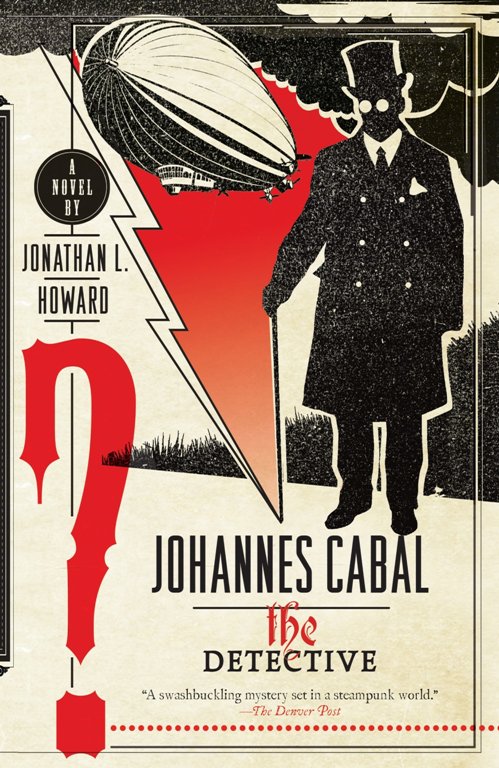
One of my great finds of last year was Johannes Cabal the Necromancer, a darkly funny book about a guy trying to conquer death by bringing people back from it. In that book the titular hero (I use the term loosely) has to obtain 100 souls for Satan in order to win his own back, with the devil providing a nightmarish carnival train to aid in the process. As I said, it’s funny in a dark, sarcastic kind of way (in some ways it puts me in mind of a horror version of Hitchhiker’s Guide to the Galaxy) and, so far as I can remember, takes place entirely in our world. Not our real world, obviously (see, bringing people back from the dead, Satan, souls, etc.), but at least it looks like ours. It all happens in the UK, with Cabal’s family coming from Germany.

Imagine my surprise when I dove into the sequel, Johannes Cabal the Detective, and found out that it takes place entirely in a pair of made up countries somewhere in Europe (with a third thrown in for good political measure).

CabalDetective

I understand why the author did this – the story requires particular political and military maneuvers that don’t fit established history and it’s hard to manipulate real places to do your fictional building. Nonetheless, it’s kind of a shock to have these made up places thrown at you without warning. Had the first book mentioned them or been set in them it would have been different. That neither Cabal nor his sidekick have any connection to these places doesn’t help the story, but that’s a separate issue.

Of course, there are entire genres of fantasy that take place in worlds that have no relation to this one. The Water Road trilogy takes place on another world entirely (with no human beings!), as does Gods of the Empire and its sequels. But with those you know going in what you’re getting into. Changing the game midstream seems like a miscalculation to me. The question with everything, whether it’s fake history or made up locations, is what works best for the story? What best serves the character? Sometimes the answer to both is something completely new and unexpected. But sometimes it’s not.

Plus ca change . . .

There has always been controversial art. The reasons change – whether it’s the frank depiction of sex, or violence, or challenges to religious or political orthodoxy – but the fact that words or images piss people off is as old as time. We tend to think there’s more of it going around these days because social media tends to amplify controversies when they emerge. Just because the cacophony is louder doesn’t mean it’s any kind of major change in society.

This was driven home to me by a recent article in The Atlantic. Though the current title is “The First Novelist Accused of Cultural Appropriation,” the title that shows on the browser tab, which more accurately captures the theme of the piece, is “Could My Father Have Published ‘Nat Turner’ Today?” Bucking the usual rule of headline questions, the answer, from the story itself, appears to be yes.

Some background first. The literary controversy of the year so far has been American Dirt, a novel by Jeanine Cummins. With a major push from its publisher, and a spot on Oprah’s list, it was poised to be the breakout title of the year.

AmericanDirt

It’s about a woman and her son fleeing Mexico after a drug kingpin murders the rest of their family and, ultimately, their experiences as migrants heading to the United States. This article does a good job of highlight the resulting controversy, which ranged from questions of cultural appropriation (Cummins is neither Latina nor a migrant) to how writers of color are locked out of the publishing industry to the fact that, maybe, the book just isn’t that good at what it wants to be (this is an interesting takedown along those lines ).

The merits of the arguments about the book aren’t really important. What you need to know is that some people took issue with what was set to be a wildly popular book (there was a film deal before it was even published) and weren’t silent about it. Thanks to social media, blogs and what not their complaints reached a fairly wide audience.

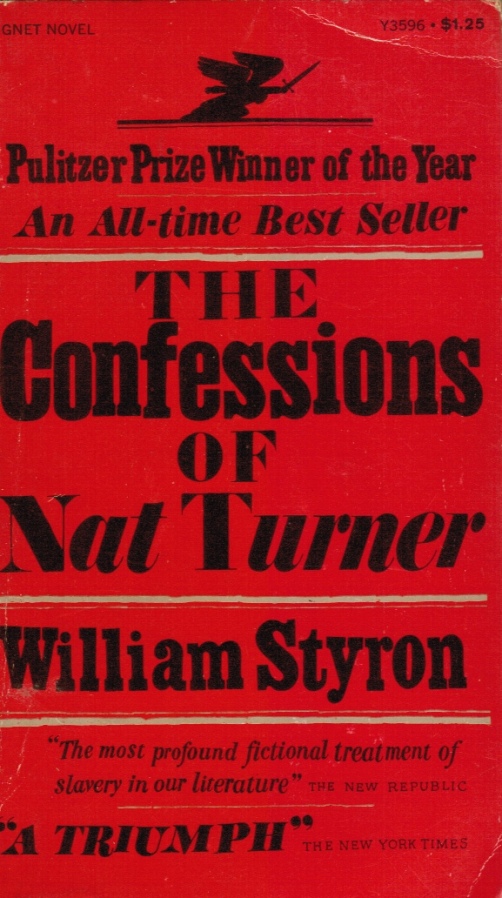
Back to the Atlantic piece. The subject is The Confessions of Nat Turner and the “My Father” in the title is William Styron – the author of the article is his daughter, Alexandra. The Confessions of Nat Turner came out in 1967. Turner, of course, was the leader of a slave revolt in antebellum Virginia. The book is a fictional narrative of Turner as told to a prosecutor who will try Turner after the revolt. It won the Pulitzer Prize, so it must be pretty good.

NatTurner

Nonetheless, it led to some controversy, driven largely by the fact that Styron wasn’t black, much less a slave. How could he write a narrative from the standpoint of one? If it’s a familiar objection, it’s worth looking at how familiar the arc of reaction to the book is to what happened with American Dirt.

First, there was a swell of praise from traditional sources:

Through much of 1967, he was at ease, enjoying the swell of prepublication buzz for Nat Turner. The Book-of-the-Month Club (the Oprah’s Book Club of its time) paid my father the highest price for a novel in the company’s history. The paperback, serial, and foreign rights sold in a frenzy. Hollywood came calling. That July, when riots erupted in Newark, New Jersey, and in Detroit, newspapers asked him to help white America understand what was happening. By October, when the first reviews appeared, Nat Turner was a juggernaut. ‘Magnificent,’ The New York Times declared. “A new peak in the literature of the South,’ Time wrote. ‘It will endure as one of the great novels by an American author in this century,’ the Los Angeles Times predicted. In November, my father was awarded an honorary degree by Wilberforce University, a historically black institution in Ohio.

At this point, as Styron’s daughter points out, with one exception “no black writers were invited to critique Nat Turner in any major national publication.” Slowly, however, those overlooked voices started rising:

The first signs of black dissent appeared by the new year. Articles in, among other publications, The New Leader, The Negro Digest, and Freedomways condemned the novel and the white media that endorsed it. Around the same time, an ugly spat erupted in The Nation between my father and the Marxist scholar of African-American history, Herbert Aptheker. (They both behaved like self-important assholes.) In February, The New York Times ran the first of several pieces exposing an angrier vein: ‘Styron’s Nat Turner, the house nigger,’ declared the professor Michael Thelwell, ‘is the spiritual ancestor of the contemporary middle-class Negro … [the] type with whom whites including Mr. Styron feel most comfortable.’ The writer William Strickland groused that the novel was ‘the worst thing that’s happened to Nat Turner since he was hanged.’ My father’s critics took issue with the book’s dialect and character development, with what he put in (a master who teaches Nat to read, motive for the rebellion separate from bondage) and what he left out (a black wife, unyielding conviction). But probably his greatest crime, as my father reflected 25 years later in an essay for American Heritage, was ‘apparent from the book’s first sentence: How dare a white man write so intimately of the black experience, even presuming to become Nat Turner by speaking in the first person?’ In June 1968, the backlash reached its zenith when Beacon Press published William Styron’s Nat Turner: Ten Black Writers Respond. The book generated its own front-page notices, and kept the Nat Turner dispute alive well into the summer.


The backlash led to the film (to star James Earl Jones) to be shelved.
None of this is to say that the detractors of American Dirt or Nat Turner had the right of it. Maybe they do, but I’ve never read either book, so I don’t know. My point is that the experience of Nat Turner that Styron’s daughter lays out sounds almost exactly like what happened with American Dirt. Maybe the controversy didn’t burn so brightly, since it didn’t have social media to fan the flames, but it still burned pretty good.

Which is only to observe, as the song says, the more things change, the more they stay the same. Anyone who writes a book (or makes a movie or paints a picture) risks blowback, whether the blowback is warranted or not. The arts are simultaneously vague and subject to so many interpretations, yet stir such deep passions. It will be a change when new books are written that don’t provoke any negative reaction. Human nature being what it is, I don’t see that happening any time soon.

Dear US Soccer – Please Shut Up and Settle

I practice criminal law, criminal defense to be precise. I’m glad I do, because there’s a clarity of focus in it that can be a bit hazy in other legal areas. My job is to do the best for my client in court, period – whether that means an acquittal, a better sentence, or (as in my practice, for the most part) a successful result on appeal. Very very rarely are the other considerations to worry about. That the public doesn’t like the process is irrelevant – I’m trying to keep my guy out of a cage.

Civil law is different, particularly civil defense. People who get sued are often really determined to prevail on court, to prove to the world that they’re right. But part of their lawyer’s job is to suggest that winning in court is not necessarily going to solve their problem. A criminal defendant is rarely made worse off by a bold defense in court. A civil defendant, by contrast, particularly a corporation without any real personality – well, sometimes the big machine gets it right:

WinningMove

That went through my head when I read about US Soccer’s pleading last week in its ongoing litigation with the US Women’s National Team (USWNT) over equal pay. I don’t know enough about employment law to know if the arguments made in it are legally sound or have a chance of success, but I’ll assume they do. Question is, what does US Soccer think a “win” would look like at this point?

This article at SI breaks down the federation’s latest argument, which basically has two parts. The first is one familiar to anyone who has brushed up against the legal system – non fregit eum, et emit eam (aka “you broke it, you brought it”):

Stolzenbach first asserts that the fundamental flaw of the players’ legal theory is that they compare a pay system that their own labor union, the U.S. Women’s National Soccer Team Players Association, negotiated with the pay of players who aren’t in their bargaining unit—players on the men’s team.

To that end, U.S. Soccer stresses that courts have consistently rejected attempts by unionized employees to compare their employment terms to employees who are outside of their bargaining unit.

This is the kind of procedural argument I’d expect any lawyer to make. It appears to be the equivalent to how plea bargains are treated in criminal law – once you sign one, you’re stuck with it. Assume A and B are charged in an indictment and A decides to get a good early plea bargain. B sticks it out and, later, either gets a better deal or goes to trial and is acquitted. Can A back out of his plea? Not a chance. Courts routinely hold that so long as you weren’t misinformed, mistaken, or misled into making a guilty plea then you won’t be able to back out of it later. Whether this is a winning argument in the context of the USWNT case I don’t know, but it seems fairly standard.

The other one, though . . . yikes. It has to do with whether the job of USWNT player is “roughly equal in terms of effort, skill, and responsibility” to that of US Men’s National Team (USMNT) player. It was bad enough to point out that in terms of “responsibility” that the USWNT may not have the same earning potential as the USMNT (while eliding the fact that the USMNT choked and missed out on its last big earning opportunity – the 2018 World Cup).

From there it got worse:

Stolzenbach attempts to supplement this argument, even wading into some territory that could be described as misogynistic.

He insists that men’s players face much more demanding working conditions and thus have fundamentally different—and, by implication, harder—jobs. He contends that men’s players encounter ‘opposing fan hostility’ in road environments, particularly in Mexico and Central America, that is ‘unmatched’ by anything experienced by women’s players. Stolzenbach stresses that the women don’t play in Mexico, Central America or the Caribbean when trying to qualify for tournament play. Further, Stolzenbach maintains that ‘science’ confirms there are different levels of speed and strength required for men’s and women’s players. He insists it is not a ‘sexist stereotype’ to recognize this distinction.


Now, if US Soccer was fighting to stay out of jail I might question this strategy, but you do what you have to do. But at the end of the day, US Soccer is going to have to continue to do business with the USWNT (and the USMNT, who have publicly supported the drive for equal pay) and, more importantly, the American public. Why on Earth would they want to denigrate about the only good thing coming out of American soccer at the moment?

Let’s recap. The women are undefeated in more than a dozen matches, just swept through the She Believes cup against quality competition, are the two-time defendant champions of the world (with two other World Cups prior), and are gearing up to try and win their fifth gold medal at this summer’s Olympics. By contrast, the men failed to qualify for the last World Cup (to be fair, so did traditional powers Italy, Chile, and the Netherlands), their furthest progression in the Cup came before the Second World War, and they’ve ceded the pole position in the region to Mexico. Oh, and the Olympics? The men haven’t qualified since 2008.

Whether those comparisons are apples to oranges or not is irrelevant. In the public eye, US Soccer has precisely one broadly loved group whom people outside of soccer fanatics care anything about – the USWNT. Building the game in the United States – at all levels, men’s and women’s – requires public support. Pissing off a large swath of the public with arguments like this – even if it’s a winner legally – is a long-term losing proposition. It’s not just my criminal law mind that thinks this is a bad play (in response to this tweet):

USSoccerTweet1

Indeed, the backlash from this filing has been swift and fierce. US Soccer eventually apologized, but the players weren’t buying it. The president of the federation resigned and, apparently, the law firm responsible was fired.

Ultimately, as to what comes next, I think Alexi Lalas has it about right:

USSoccerTweet2

This really isn’t a legal fight. It can’t be won in a courtroom. It’s only going to be won in the court of public opinion and that’s going to require some serious groveling on US Soccer’s part. So, let’s get to it, US Soccer – shut up and settle this thing already!

Please-Shut-Up-Morgan-Freeman-Picture

What Censorship Isn’t

For a while, back when The Water Road was finished, I tried to shop is around to agents as a first step in trying to get it published. The entire process put me off (a topic for another day) and I decided to self publish, a decision I’ve been very happy with. Still, if I’d known I had some kind of Constitutional right to a publisher, maybe I would have stuck with it a little longer.

The big literary news last week involved a new memoir by Woody Allen. Allen is, of course, a legendary director of such classics as Annie Hall and Sleeper. He’s also been accused of sexually abusing his daughter, Dylan. It doesn’t help perception that he wound up marrying a woman who was practically, if not technically and legally, his step daughter. Oh, and Manhattan, too. Suffice to say, in a #MeToo world, Allen has become a bit of a pariah.

It’s not surprising, then, that when Hachette Book Group announced the release date for Allen’s memoir Ronan Farrow, Allen’s son and one of the leading #MeToo journalists, decided to cut ties with the publisher. More surprising was that, a few days later, there was a walkout by a bunch of Hachette employees over the memoir. As a result, late last week, Hatchette announced it would not be publishing Allen’s memoirs after all. The rights revert to Allen, who’s free to find another publisher or jump into the world of self publishing.

When the news broke last Friday it was the talk of Twitter. In particular, there were lots of people complaining that Allen was being “censored” by losing his publishing deal. Comments like this (screen capped from responses to this Tweet):

AllenTwit1AllenTwit2AllenTwit3

Putting to one side any breach of contract action Allen might make against Hatchette, let’s make one thing very clear – this is not an act of censorship.

Here’s the thing – so long as you’ve got some kind of outlet for the speech you want to make, you’re not being censored. Everyone has a right to speak, but nobody has a right to use any particular platform or amplification for your talk. If the government swoops down and shuts you up, that’s censorship. If private individuals decide they don’t want to be in business with you, that’s just business.

I’m open to being convinced that actual censorship can be exercised by private companies, but I’ve yet to see an example that really went beyond a private entity wanting to not do business with a particular speaker – which the private entity has a right to do as part of its own free speech. In fact, usually when people complain about companies like YouTube or Twitter taking action against hate speech or what have you and wrap themselves in the First Amendment, they’re the ones demanding state action to compel speech (as well as generally showing a poor grasp of the First Amendment).

The bottom line is this –if Woody Allen has some sort of right have his memoir published by a major publishing house, than there are thousands (if not more) of writers out there who are being repressed daily by not being given publishing deals. One cannot be true unless the other one is, which should make things pretty clear.

Repressed

On Killing Other People’s Darlings

I’ve never really understood fan fiction. That’s when people who aren’t the creators of a work – book, movie, TV series – write stories in that world using those characters. Occasionally it’s done with the permission of the original creator (such as Eric Flint’s 1632 series), but mostly it’s done in the literary equivalent of under the table.

I get the idea of wanting your favorite characters to have continuing adventures and to have such an attachment to a created world that you want to play around in it. I think if I found out people were writing fan fiction about Antrey or Aton or any of the other character’s I’ve created I’d be flattered. But it takes a lot of work to write good, interesting stories (and don’t get me wrong – some fan fiction is really good), so why not take the time and effort and direct into original characters and locations? It seems like a wasted opportunity to me.

Still, if it makes people happy to do it and they’re not making money off the work of others, have at it. As I said, I can understand wanting to continue the adventures of favorite characters and my understanding is that’s largely what most fan fiction is about.

Then I learned about deathfic.

Deathfic is fan fiction based around the death, sometimes gruesome and involved, of a character. I initially thought it involved dispatching bad guys who maybe escaped the ultimate punishment in the original work. It wouldn’t be too hard to imagine a gruesomely appropriate death for The Commander from The Handmaid’s Tale, for example. But, no, it’s something quite different:

deathfic, the kind of fan fiction in which a beloved character dies, typically in a way that is as painful for the reader as possible. ‘Sometimes I’m just in the mood to hole up and read the saddest thing I can find on the internet,’ Rachel says.

* * *

A baseline assumption of love is that a person you adore is not someone you would like to watch die. Presumably, you would also not like to be the sole architect of that person’s death. But to deathfic writers, the genre isn’t about having some kind of sick control over the life of someone else. It’s about a different kind of control entirely.


So, I guess that’s a thing? Again, seems like an odd thing to do to characters you care about, but whatever rocks your boat, I suppose. And I get, as the article points out, that sometimes writing fiction (even fan fiction) can be a way of working through issues happening in real life, including the deaths of loved ones.

Where things get a little creepy is when the people being killed off aren’t fictional characters at all:

There is deathfic for almost every fictional character and real-life celebrity you can imagine. You can find stories in which Rihanna dies and is reborn as a modern Messiah, and hundreds in which members of the K-pop supergroup BTS haunt one another as beautiful ghosts. These can be “crack” stories, in which writers are openly striving to make the strangest fictional reality they can imagine. BuzzFeed, for instance, has documented the rise of Justin Bieber deathfic, which includes freak accidents and maimings of all kinds.

That’s just fucked up. I mean the any celebrity “reborn as a modern Messiah” angle has some possibilities, but writing death scenes for famous people is just macabre as shit. Not saying you shouldn’t be allowed to do it, but if that’s your thing, maybe you want to get some help?

An old chestnut of writing advice is to “kill your darlings.” It doesn’t necessarily mean characters – it applies to any part of your writing not being so precious that it’s off limits from being cut – but it works that way, too. Killing someone else’s darlings, well, that may be a bridge too far. In the end, though, they’re only real on paper, so I guess there’s no harm.

KillEmAll