Is Sci-Fi More “Serious” Than Fantasy?

Fantasy has a reputation for taking itself pretty seriously. Outside of some outliers like Terry Pratchet’s Discworld books, the prevailing image of fantasy is that it’s about big deal themes of good against evil, fulfilling destinies, and such like that. The Lord of the Rings is not a “day in the life” story with no big stakes, after all. Indeed, in a lot of ways fantasy can seem – to use an epithet thrown at progressive rock all the time – “pretentious.” But for all that, when it comes to dealing with the big questions, the ones that probe the nature of reality and humanity, do people take science fiction more seriously than fantasy? Even to the point of letting that reflect how they categorize a story?

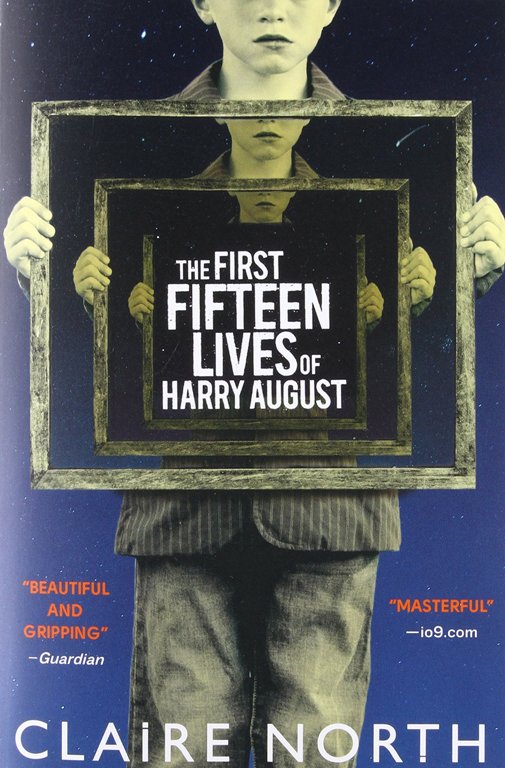
This occurred to me after I’d finished up The First Fifteen Lives of Harry August, by Claire North.

HarryAugust

The setup is this – the title character is one of a few select people in the world who live their lives over and over again. When they die, they basically go back to the beginning and are reborn, but with the collected memories of their prior lives still intact. Thus these are some seriously “ahead of their time” children roaming around, as you might guess. The story follows Harry as he lives a bunch of his lives and tries to stop another of his kind that is seeking a revelation will destroy the world. It’s pretty good, and has some really excellent bits. I recommend it.

When I finished the book I do what I usually do and seek out reviews to see what others thought about it. To my surprise, I saw a lot of people file The First Fifteen Lives of Harry August under “science fiction,” which made little sense to me. Sure, there’s some discussion of quantum mechanics and parallel worlds (at i09, Charlie Jane Anders lists all this as reasons why “it’s a real science fiction book,” so what do I know?), but what makes the story go is the completely fantastic bit where these people live their lives over and over again. It’s never explained, much less with some kind of semi-plausible scientific reason. For all we know a genie thousands of years ago granted somebody’s wish and it got out of hand.

The mechanics don’t matter much because North uses them to deal with issues of free will, destiny, and the price of the pursuit of ultimate knowledge. These are the kinds of big issues that science fiction sometimes tackles, but that doesn’t mean that every story that does that is science fiction. Could it just be that people expect sci-fi to be more thoughtful about this stuff than fantasy?

Regular readers know one of my pet peeves is when people who write “Literature,” rather than just tell stories, write something that’s unambiguously fantasy or sci-fi but refuse to label it as such because of genre snobbery. This feels kind of the same way. Sure, fantasy is fine for satisfying tales of good vanquishing evil or ass-kicking vampire slayers, but if you want to ponder the big questions, well, it’s not for that. But why not?

Any story can plumb the depths of the big questions that have plagued humanity since we started walking upright. Genre doesn’t limit the stories you can tell, only change the way that they’re told. Embrace the idea that deep thoughts can come from anywhere in the library.

Serious

Why Do I Love Bad (Fictional!) Lawyers?

Popular culture is full of lawyers. As both a lawyer and a writer, I apologize for that, but the legal profession is a pretty rich vein of drama (and even comedy) for writers. There’s crime and deceit, business dealings and family squabbles. The law touches every area of life (for good or for ill), so it’s a great way to examine life itself.

There are plenty of heroic lawyers in pop culture. Perry Mason’s having a kind of resurgence with the new, gritty, noir-flavored HBO series. Atticus Finch is a popular choice for crusader who launched a thousand earnest legal careers.* There are countless others, of course, lawyers who fight for the little guy (or gal) or justice or law in the abstract. They’re fine, of course, but when you always win, things can get kind of stale.

Which is why some of us – or maybe just speaking for myself here – have more of an affinity with the legal bad boys, the ones who work on the edges of professional ethics, for whatever reason. There’s a quite a rogue’s gallery and I pretty much love every one of them. They’re the patron saints of the legal profession, in my eyes.

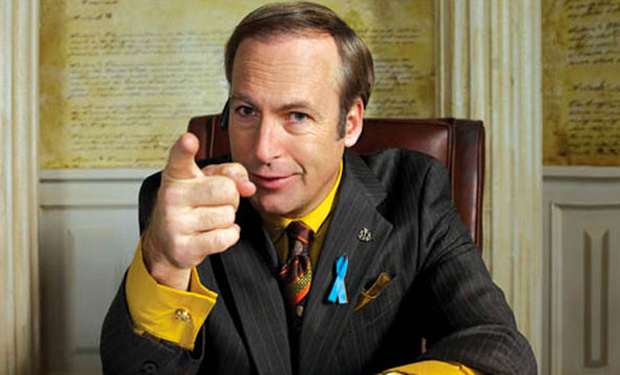
Front of mind at this point can be none other than Jimmy McGill, aka Saul Goodman, of Breaking Bad and his own prequel spinoff, Better Call Saul (which is better than the original, I think):

Saul2

The “patron saint” thing is kind of a joke, but the fact that Saul is about a struggling criminal defense lawyer makes it instantly more relatable to me, even if I never find myself nearly dead in the desert hauling two duffle bags full of drug cartel money (let’s hope). He is a sleaze, no doubt, and it eventually gets him into serious trouble, but at least early on he’s willing to use that sleaze to help the underdog and generally fuck with “law and order.” While I can’t say I approve of Jimmy’s methods, I appreciate the attitude. It’s one that sustains long-time public defenders like me.

Of more long standing in the pantheon is the one, the only “law talking guy,” Lionel Hutz:

Hutz2

Voiced by the wonderful Phil Hartman on The Simpson, Hutz is just a master class in legal incompetence. He marvels at how useful law books can be. He changes the terms of his retainer by marking up his own business cards. He shudders at the otherwise happy thought of a world without lawyers. He requests “bad court thingies.” And, most notably, he’s always looking out for himself:

Deep in the heart of every lawyer lurks the certainty that, if nothing else, they’re better than Hutz.

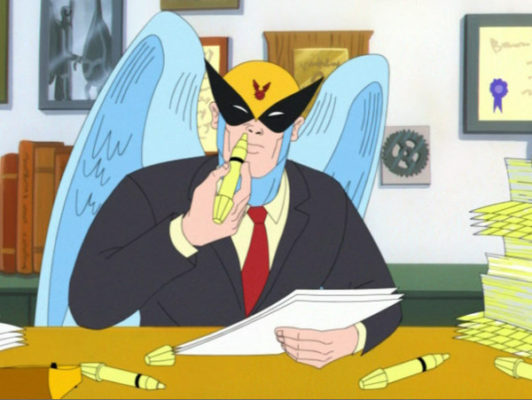
He’s not the only cartoon lawyer with a hold on my heart. How can I not love Harvey Birdman?

Harvey

Harvey’s less an idol for his legal acumen that he is for his ability to keep a calm head on his . . . wings, while everything else falls apart around him. It’s an important skill for an attorney, especially a criminal defense lawyer. Besides, who wouldn’t want to have an eagle for an assistant?

But if we’re going old school, there’s one sleazy lawyer that was lodged in my brain long before I was anywhere near a law school – Steve Dallas:

SteveDallas

Looking back I’m a little appalled at my love for Bloom County’s legal scholar. He’s a loud mouthed, rude, misogynistic, frat boy – precisely the kind of person I’d loathe if I met him (or saw him online) today. I mean, he did have cool cars, so that counts for something. And he was, come to think of it, the only professional in Bloom County (among the regular cast, at least). He had credentials and never let anybody else forget it. Like Harvey, he also recognized the value of good help:

SteveOpus2SteveOpus1

When it comes to all these guys (and they are all guys – I’ve noticed) I’m reminded of that idea, from Tolstoy, that all happy families are the same, but dysfunctional ones are unique in their dysfunction. I think that’s true for fictional lawyers, too. Good-hearted crusaders are important and uplifting, but they’re not always much fun. Bring on the bad boys!

* Years ago I went to a legal writing seminar where, for the session on issue spotting, we used the facts of To Kill a Mockingbird. A mere 45 minutes later he was facing a lengthy ineffective assistance of counsel charge.

I Have Returned

Hi, folks! Did you miss me?

As promised, my hiatus was pleasantly productive. I finished up the third draft of Widows of the Empire while I was away. I’m just about to dive into draft four, which will be the final one before it goes off to beta readers and an editor. What that means for you, dear reader, is that I should be able to get Widows out into the world sometime in early 2021!

I’ve already got another great cover from Deranged Doctor Design. Here’s a taste:

Title Only

More to come, maybe before the year is out!

Progress

Summer Hiatus

Holy hell, is it July already? I suppose pandemic time really has done a number on us. Anyway, I’ve been busy on Widows of the Empire, just about to finish the third draft. Just one more and . . . well, y’all get to read it. So, I’m giving myself a bit of a break and stepping away from the blog for the rest of the month. I’ll see you in August.

Until then, I’ll leave these two in charge.

BlogMonitorDogs

Zaria already looks very skeptical, doesn’t she?

Weekly Read: Dangerous Melodies: Classical Music in America from the Great War Through the Cold War

Music, those who make it and consume it often think, is a universal language. A beautiful melody or an infectious rhythm or a soothing wash of noise doesn’t require any kind of verbal communication to enjoy. Surely if there’s something that can exist outside of the mess that is politics, music should be yet. Sadly, the takeaway from Jonathan Rosenberg’s Dangerous Melodies: Classical Music in America from the Great War Through the Cold War is that politics, like religion, poisons everything, in spite of anyone’s best intentions otherwise.

Dangerous Melodies examines this through a particular lens – the American classical music community and how it interact with the First and Second World Wars and the early part of the Cold War. In each era, political considerations informed what was played, by whom and where.

One of the fascinating things about the WWI section of this book (along with PANDEMIC, which of course covers that time period) is how fervent people were with regards to the war and the United States’ role in it. Of course, this was the period of the Sedition Act and the Supreme Court’s deeply horrible First Amendment law, but it really brings the xenophobia home when you hear about German musicians being interned for nothing more than their nationality.

German composers proved a particularly tricky proposition, since, at the time, the American classical music scene was heavily indebted to Germany composers and musicians. Wagner, of course, featured prominently in all this, but he at least had the good sense to be dead when the conflict began. Discussions about whether to continue to stage his operas or play his music were a bit more esoteric than those surrounding, say, Richard Strauss, who was both very popular in American concert halls and still alive to cash the checks.

If the issue during the First World War was what to do with Germans in general, in the Second World War there was some attempt to distinguish between garden variety Germans and actual Nazis. This was easier said than done, however, since some great conductors were at least Nazi-adjacent, if not actual (if unenthusiastic) party members. Their rehabilitation after the war mirrored those of their predecessors in the Great War – in that the result of the uproar had little to do with actual facts and more to do with repeated assertions of bad behavior (I shook my head reading how a judge in a court case involving one conduct admitted there was no evident to prove his alleged sin, but enough people believed it that it didn’t matter).

One odd part about the Second World War is that, at least as Dangerous Melodies tells it, is that Wagner came roaring back and was basically unscathed. To the extent the Nazis glorified him and tried to make a paragon of the Reich it didn’t impact his work being played in the United States. On the other hand, there’s no discussion of Wagner’s well-documented anti-Semitism, which would seem like a pretty good reason for programming other stuff while the Holocaust is happening.

Where the intersection of classical music and the two World Wars was largely about restricting what was played (with one notable exception I’ll discuss in a moment), once the Cold War begins the tables turn. The universalists gain the upper hand, only to see that universalism weaponized in the name of American foreign policy. American orchestras made numerous state-funded tours of Europe, including behind the Iron Curtain. At best this was benevolent cultural exchange, but there was also some hope that it might show the Soviets that we weren’t all a bunch of burger eating, beer swilling, country music fans, either.

As an aside, after I read this book I listened to the Wind of Change podcast. Done by Patrick Radden Keefe (he of the amazing Say Nothing), it’s a deep dive into the conspiracy theory that the CIA wrote the Scorpions’ late Cold War hit of the same name. It doesn’t really prove that, but along the way it talks about how the American government used the same kind of state-sponsored cultural junkets in more popular music forms, too – sometimes without the knowledge of the artists.

There was one composer whose career spanned the Second World War and Cold War to devastating effect. One of the most famous and celebrated musical achievements of the Second World War was Dmitri Shostakovich’s Seventh Symphony, called Leningrad. Premiering in 1942 it was seen as embodying the resistance of the residents of that city (now, once again, St. Petersburg) to a lengthy Nazi siege. There was even a kind of bidding war over the US premier! It was a big fucking deal in a way that I don’t think we can comprehend in 2020.

But when the Cold War began, Shostakovich was drafted into the Soviet Union’s culture war against the West. There’s an episode in the book where a conference arranged in New York – assailed by Red hunters for being anti-American – winds up becoming a mouthpiece for Soviet propaganda, giving a not particularly enthusiastic speech condemning Western music that he pretty clearly didn’t write. Shostakovich got both the highs and the lows, in other words, of political influence in music.

As it happens, after I read the book, I dug out my recording of Shostakovich’s Seventh I have by the Dallas Symphony. The liner notes go into a little more detail on his most famous work and its political impact. According to his memoirs, published in 1979, it wasn’t the war anthem people made it out to be (it “had been planned” before the war started):

Naturally, fascism is repugnant to me, but not only German fascism, any form of it is repugnant. Nowadays people like to recall the prewar period as being an idyllic time, saying that everything was fine until Hitler bothered us. Hitler is a criminal, that’s clear, but so is Stalin.

* * *

Actually, I have nothing against calling the Seventh the Leningrad Symphony, but it’s not about Leningrad under siege, it’s about the Leningrad that Stalin destroyed and that Hitler merely finished off.

Where does that leave music and politics? As Shostakovich learned, they’re inexorably intertwined. Thinking that music can escape the taint of politics when nothing else can is a pipe dream. At best what music can do, better than just about any other form of art, is escape the shackles of the political sometimes and reach across barriers. It ain’t much, but it ain’t nothing.

DangerousMelodies

On Writing For Posterity

One of the interesting things about life on an Internet forum is how cyclical it is. Since new people are always joining, and few of them think to do deep searches when they first arrive in the happy flush of finding the forum, some evergreen topics show up again and again. If you log in to the Progressive Ears forums tonight for the first time and think, “I’ll ask everybody what they really think ‘prog’ is!”, rest assured you’re not the first one. See also, “why are fantasy and science fiction lumped together” on any genre-related space.

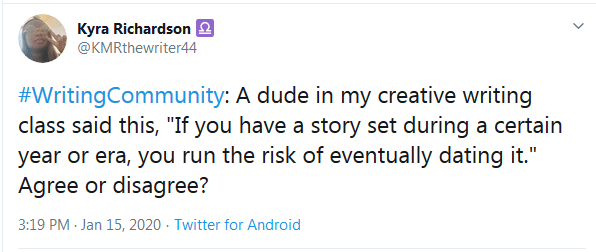
Writers’ forums are no different. New writers are a combination of boundless enthusiams and depths of doubt that lead them to ask a lot of questions. Naturally, most of them have been asked and answered before. A favorite one of those, perhaps second only to worries about other writers stealing ideas, is a concern about writing something that feels “dated.” This tweet from Kyra Richardson earlier this year lays it out as good as any:

PosterityTweet

I’ve always thought that was an odd question to ask, but could never figure out why until just recently when it hit me like a two-by-four: it’s incredibly presumptuous.

Let’s be clear, when people talk about their writing feeling dated, they’re not talking about a current or modern audience. Few people worry that between the time they write the book and it’s published that the references will become dated. Instead, they’re talking about readers in the future, people who are going to turn to the book many years down the road, perhaps when the author is dead. They’re talking about writing for posterity, the kind of impact and success that every artist dreams about, but a vanishingly few actually obtain. It’s like a teenaged laptop musician working on his first track worrying about what he’s going to wear to the Grammys.

Lots of people write books. Even though lots of people also read them, the chances of any particular book being read by more than a handful of people is pretty slim. As a result, unless you already have an audience and think they might carry on for a while, worrying about posterity while writing a book is super presumptuous.

Write the best book you can. Tell the story you want to tell. Is it full of sly jokes about things that are popular right now? Don’t worry. Make it compelling. Give readers characters to care about. If you do all that, they’ll handle the references. If they care about the people involved, they’ll learn. It’s why I’ve learned a lot of very particular British references over the years – to fully understand Marillion (and others) lyrics.

Don’t worry about posterity. If you connect with readers in the here and now, you’re ahead of the game. Posterity will take care of itself.

Posterity

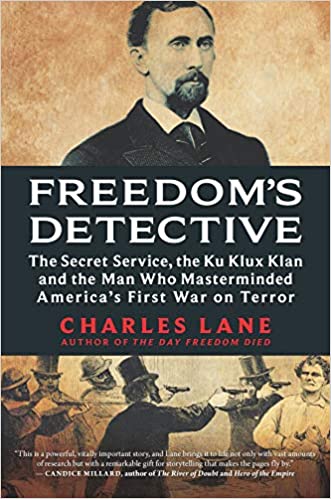
Weekly Read: Freedom’s Detective: The Secret Service, the Ku Klux Klan, and the Man Who Masterminded America’s First War on Terror 

This is an interesting book (more interesting than compelling, sadly, given its detached, journalistic style) to think about in these times. I actually read it a couple of months ago, but it’s crept back to relevance over the past couple of weeks. How could it not, given that it tells the story of the United States’ first concerted effort to deal with racial terrorism, which also gave rise to an unprecedented expansion of police power and tactics?

It’s the story of Hiram C. Whitley, who from 1869 to 1875 was the chief of the Secret Service. At that time, the Secret Service’s primary job was dealing with counterfeiters (it’s Presidential protection role didn’t come until ??) – which it still does, by the way (one of my great Fourth Circuit victories involved a counterfeiting case). When Whitely took over he broadened the Service’s mandate (via bureaucratic slight-of-hand and without Congressional authorization) into a broader criminal investigative unit with its sights trained the Ku Klux Klan.

Not that Whitley was particularly a crusader for human rights. Before the Civil War he did some work as a slave hunter and he essentially bought his first child. During the war he led a Union regiment in New Orleans with such brutality that his men nearly mutinied. He was a shameless self promoter who wasn’t above working outside the law when he thought it was justified. He tortured prisoners. He arrested men and executed searches without warrants. He was even involved in a Watergate-style burglary and scandal later in his career.

His most lasting contribution, however, is introducing the concept of the undercover work to American law enforcement. The idea that you had to use bad people – or at least good people pretending to be bad – to catch other bad people was scandalous. In fact, the book recounts how in one counterfeiting trial, where the case was built on undercover work, the judge actually gave the jury a cautionary instruction about how unreliable undercover officers were! If only we could get an instruction like that now.

If anything, Whitley seems like the archetype of a character we’ve become familiar with over the years from all kinds of police fiction – the cop who can’t follow the rules, but it still celebrated in the end because he gets the bad guys (a trope that’s getting some fresh looks these days). You can’t argue that Whitley’s targets were evil – not just the Klan by political machines in New York City were targets – but, as this review points out, none of those resulted in convictions, partly due to Whitley’s overreaching. One of my chief criticisms of the book is that author Charles Lane doesn’t really examine what Whitley’s legacy was or how he was an exemplar of lots of cops that came after him.

That’s why the book had come back to mind in the wake of the police killing of George Floyd and the related protests. As a society we’ve been conditioned to give cops the benefit of the doubt (there’s even a “good faith” exception the exclusionary rule for Fourth Amendment violations), mostly on the expectation that if they cross the line they’ve got a damned good reason. But lines are drawn for a reason and not everybody the cops cross the line to get are “bad guys” and, even if they are, they deserve the due process of the law, too.

I won’t say we can draw a direct line from Whitley’s abuses to Derek Chauvin’s knee on George Floyd’s neck 150 years later, but there are definitely echoes there. If Whitely really was “Freedom’s Detective,” it’s worth wondering what kind of freedom it was and whether, too often, it’s been the freedom to behave badly in the name of doing good.

FreedomDetective

Which Details Matter?

World building is typically something we think is the concern of sci-fi and fantasy writers. If you’re going to tell a story set in a world that is either not ours or significantly different from it, you need to define those differences. But the truth is that all writers should be concerned with world building. Writers of all kinds of fiction need to flesh out the world in which their characters exist. Even if it’s the real world, it’s likely a part of it that the reader isn’t familiar with. Even non-fiction writers need to do the same – to build a place for their story to take place in order for it to make sense.

Of course, not everything about the world you’re working in is important for a reader to know. Finding the right level of detail can be hard, since you might send signals to readers that you never intend and actually mess up the world building you’re trying to do.

If you’ve read Gods of the Empire you know that Lady Belwyn has a music room. In an early draft I mentioned in one scene, as Hagan entered the room, that she was playing a “Colebeck etude.” I could have just said “etude” or even just named the instrument she was playing, but I thought throwing a composer’s name in would make it feel more like something from a lived-in world. Plus, it let me give a shoutout to the progressive rock world and name check Julian Colebeck, longtime keyboard player with Steve Hackett. To my knowledge, he’s never written an etude.

“But wait,” you’re saying. “I’ve read Gods of the Empire and I don’t remember anything about Colebeck in it.” You’re right, because I wound up taking it out. To a person, everyone in my writers group seized on the fact that there was a new name thrown at them when they read that scene. They wondered if this Colebeck person was important to the story. Would he come up again? Is this something important to remember for later down the road? Since the answer to all of those questions was “no,” I just decided to take it out. It’s at the point of the book where readers are still finding their feet on Oiwa and in the Unari Empire, so it was more important to remove a distraction.

My mistake, I think, was in introducing a variable that’s completely unknown without definition. If I was writing something in the real world – say, a sequel to Moore Hollow – and I had a similar character, I might have her playing a piece by Mozart or Liszt or Stravinsky. That would provide a nice little detail, but only because those names aren’t variables – they’re real composers who exist in this world. So long as the name is familiar enough for a reader to nod at it, that’s all you need. If you know those three names you can figure out what it’s saying about the character that she plays Stravinsky instead of Mozart.

But sometimes you need a reference to be just as fictional as your characters, even if your story takes place in the real world. In my opinion, it’s more distracting to try and avoid this than it is to take a sentence or two and define your fictional reference. This jumped out at me listening to The Getaway, an Audible Original by Greer Hendricks and Sarah Pekkanen.

Giveaway

It’s about a woman, a press secretary in the wake of a losing campaign, who goes on a yoga retreat where bad things happen. She does so partly because of how this retreat was praised by an unnamed actress she follows on social media.

The first time this person came up the main character just called her “an actress she follows,” which I thought was weird. It’s important enough to mention that this influencer’s praise was part of the reason to go on the retreat, but she doesn’t have a name? All right, it’s a throw away. But the second time it came up it really annoyed me. And the third. And the fourth. This really does seem to be an important detail – nay, it’s critical to the fairly dubious setup! (needless to say I’m not recommending The Getaway) – yet the story doesn’t define it. It could be as simple as a name and that she’s the star of some TV series or movie. No need for more than that, but just something to suggest that this actress is a real person in this world.

As always, it’s a question of balance and where to draw the line. There are no hard and fast rules when it comes to building your world, except maybe one: Does this detail serve the story? Does it deepen the reader’s understanding of the world or the characters? Okay, so that’s two questions, but you get the point.

Details

New Short Story – “Puffery”

Remember last month when I said I was doing the NYC Midnight Short Story Contest? My first story, “The Nickel Tour,” was good enough to get me through to the second round. Now the results are in for that one and, well, I won’t make it to the third round. “Puffery” garnered an honorable mention, but didn’t place in the top 5 (out of 25 in the group). Given that it was outside my usual genre and style, I’m still pretty pleased with it.

For this round, my group was assigned to write a political satire on the subject of medical tourism, with a warlord character in it. After a false start I slipped into the right mode and wrote something that is definitely influenced by the time and place in which I wrote it. It also allowed me to create a character that I think I want do more with in the future.

Until then, enjoy!

Puffery

Milo slipped into the Trapezoidal Office just as the Generalissimo said, “what’s in the bay?”

Advisors were arrayed around the room, each clutching papers and trying to hide behind one another. Milo didn’t even recognize some of the faces. He’d made the right decision not bothering to learn names. What was the point? They’d be gone soon enough.

“A plague ship, sir,” the Minister of Defense said.

“From America,” threw in Kevefe, the Generalissimo’s son-in-law. Educated in America, married to the Generalissimo’s beloved eldest daughter, he was the one the man always tasked with doing anything important, from managing the Generalissimo’s properties to trying to negotiate treaties. His title should have been Minister of Everything. “They’re having a plague. It’s whipping through the south right now, like Sherman a generation ago.”

The American south was the closest large land mass to Oflana, the small island the Generalissimo had made his stronghold. It wasn’t even at large as Charleston, the nearest American city.

“And why are they here?” the Generalissimo asked, putting his elbows on his desk. It was enormous, made of dark walnut with ornate carvings of mythical sea creatures on each leg. He  told people it was made from the beams of the British frigate that Sadont, the national hero of Oflana, boarded and captured when the island won its independence. He would take any opportunity to tie himself to that legend. The truth of the desk, so far as anybody could tell all, is that the Generalissimo had found it in an estate sale in Savannah during one of his “diplomatic” missions.

“Because we are a day’s steamship voyage from Charleston,” Defense said. “Perhaps two, depending on weather.”

The Generalissimo looked as confused as ever. “But why now?”

Milo knew how this dance worked. The Generalissimo worked through the problem in his own time and in his own peculiar way. Everyone would have their say, but he had to make the final decision, even if everyone else knew it was the wrong one. Milo decided he had to goose the process along.

“Sir?” He raised his hand like a grade school child.

“Yes, Minister of Information?” the Generalissimo said, slightly slurring his words.

“Sir, that ship is here because of what you said on the radio last week.” Every week the Generalissimo took over the island’s five radio stations for his Voice of Oflana broadcasts. Ranging from five minutes to five hours, depending on his mood that particular day, it was his chance to talk to his people, who had little choice but to listen.

“Last week?” The Generalissimo looked at Kevefe, squinting, like he was trying to dredge the memory from the depths of his mind.

“You talked about the plague in America, how their hospitals and doctors couldn’t cope,” Kevefe said. “Things of that nature.”

“Due respect, sir,” Milo said before the Generalissimo could move on, “it was much more than that.”

The Generalissimo looked at him, slumped in his seat, hands outstretched. “How much more?”

Milo took a deep breath. “You also discussed the medical system here on Oflana. You called it the best in the world.”

“Of course,” the Generalissimo said. “We only have the best things here in Oflana.”

Milo knew that might be true for the Generalissimo and his family, but that for the rest of them modern medical treatment was more hope than reality. He pushed on anyway, leaving truth bloodied in a ditch yet again. “You also said the plague would not strike Oflana,” Milo closed his eyes and quoted verbatim, “because it knows in its heart that we have the medicine to kill it.” It was times like this that Milo cursed his eidetic memory.

“So?”

The Minister of Health sheepishly raised his hand. “Sir, that pronouncement may have been premature.”

“Are you suggesting I lied?” the Generalissimo said, slowly rising from his chair, his ever expanding girth straining the medal-covered white uniform he was wearing.

Health’s eyes went wide, but before he could defend himself the hammer came down.

“You’re fired!” the Generalissimo boomed, pointing to the door with great emphasis. “Get out!”

“Sir, I,” Health began to say.

“Do I need to call for Boze?” the Generalissimo said, invoking the name of his security chief, a massive islander who could snap Health, or anyone else in the room, in two.

Faced with a fate worse than termination, Health scurried out the door.

“If I even said that, about having a cure for the plague,” the Generalissimo said, returning to his seat. “I don’t think I said that.”

The advisors all exchanged wary glances. Milo just managed to avoid rolling his eyes. Not only had he heard the Generalissimo say those exact words, now the man had gone and fired the person who should be put in charge of dealing with that plague ship slipping into the dock.

“Rest assured, sir,” the Minister of the Interior jumped in, “our physicians will deal with this pestilence with care, skill, and strength.”

“We’re about to find out,” Milo said. There was a clock tick-tocking in his brain, knowing that the American ship was going to reach the dock in any moment. “Sir, that’s why they’ve come. They think there’s a cure here, and they’ve come to get it.”

Milo could tell that the Generalissimo was still missing some links in the chain. “Your broadcasts sometimes reach the American mainland. It depends on weather conditions, if I’m correct.”

Across the room the Minister of Technology nodded vigorously.

“In addition, although you expelled a number of American journalists last month, there are still a few foreign reporters here. I’m sure they heard your broadcast.”

The Generalissimo shook his head. “Deadbeat losers. Why do I let them come here and cause trouble?”

“They’ll be gone by morning,” Kevefe said with a wave of his hand.

“Er,” Milo said, lump in his throat, “that won’t solve the problem, sir.”

“Why not?” Kevefe glared at him.

Milo tugged at his collar. “They surely know that this plague ship is arriving. Anyone can see down into the bay from the city. And the ship is quite large.”

The Generalissimo leaned forward. “Larger than the Dominator?”

Dominator was the pride of the Oflan navy. For all intents and purposes it was the Oflan navy.

Milo chose his words carefully. “I’m no expert, sir, but I can say that it is not nearly as impressive as Dominator. Nonetheless, it’s carrying hundreds of people.”

“All infected?” At least something was getting through to him.

Milo shrugged. “It could be healthy people trying to escape from the plague. Or it could be sick people looking for a cure. We’ll only know for certain once they dock.”

The Generalissimo furled his brow. “Don’t we have radios? To talk to the ship?”

Milo wasn’t in the mood to handle this question, so he did what he had to do. “I believe that the Minister of Technology could best answer that question, sir.”

Technology shot Milo a look that said he would pay for this in the coming days. “Recall, sir, that the land-to-sea radios were damaged in the storm two years ago.”

“Ah, yes,” the Generalissimo said, “the great hurricane I turned away from the island.”

Hurricane Robert took dead aim on Oflana, turning off to the east and out to sea at the last moment. While it spared the island and the city the worst of the winds, the bay at the bottom of the hill had still been swamped by the storm surge. Hundreds lost their lives.

“Yes,” Technology continued, “well, sir, those systems have never been repaired.”

“Why not?” The Generalissimo said.

The truth was that the money went to rebuilding the swimming pool in the Generalissimo’s palace, but Milo certainly wasn’t going to say that.

“It went,” Technology started. He apparently thought better of it, too, the firing of Health still fresh in everyone’s memory. “I don’t recall specifically, sir. Regardless, there’s no way to contact that ship until it docks.”

Milo checked his watch. They had, at most, five more minutes to make a decision.

“Then how do we deal with this?” the Generalissimo asked, relaxing again. “Why not just send them back? I’ll defend my people against any threat. Keep that infected ship off our land.”

“That would look very bad,” Milo said. “This plague is fast acting. If there are sick people on that ship and they don’t get any kind of treatment they may die before they get back to Charleston. The press would have a field day.”

“The press hate me,” the Generalissimo said. “Even if we don’t send the ship back, they’ll say bad things. Lies and slander over and over again.”

Milo wasn’t about to get into this now, so he dodged the barb. “Is there another option?”

“We let them dock,” Interior said. “If they’re healthy refugees, we take them while stating this is a onetime situation. Any other ship will be turned back. If they’re sick, they go to the hospital and we’ll treat them the best we can.”

That was a bad option, too, Milo knew. It would lay bare the Generalissimo’s claims that the plague could be treated here. These people, if sick, would overwhelm the island’s small hospital and most likely die horrible deaths, but at least their ends might come with some dignity and care. “Sir, we really have to make a decision. That ship is about to dock.”

The room fell silent. Milo held his breath, bouncing up and down on the balls of his feet, waiting.

“Let them in,” the Generalissimo said, after what seemed like an eternity. “We are a generous people, are we not?”

“Yes, sir,” everyone else muttered without real conviction.

“Thank you, sir,” Milo said, bolting from the room. He couldn’t believe the man did the right thing, even if it was probably for the wrong reason. Milo ran to his office, rang the dock, and told them the news.

Shortly after he hung up, Kevefe knocked on his open door. “How are you going to sell this to the press? Before you’ve expelled the foreign reporters, of course.”

With the foreign press gone that would only leave the handful of Oflan reporters, none of whom were interested in doing anything but regurgitating whatever Milo told them.“I hadn’t thought of that yet,” he admitted.

Kevefe raised a finger and said, “I have one word for you.”

“One word?”

Kevefe nodded. “Puffery.”

Milo raised an eyebrow. “Puffery?”

“It’s a legal term,” Kevefe said, lapsing into his typical condescending explanation mode. “When someone makes a promise, say in a contract, and can’t keep it, that can be because they lied about the promise or they, let’s say, promised more than they could actually deliver. They puffed up their capabilities.”

“In other words, they lied to get the contract,” Milo said.

Kevefe stepped into his office and glowered down at him. “No, they innocently exaggerated their abilities. Are you suggesting that our physicians aren’t capable of dealing with this plague?”

“The best doctors in America aren’t,” Milo said, deciding not to answer directly.

Kevefe shifted forward, hands on Milo’s desk so that he was almost on top of him. “Are you calling my father-in-law, the Generalissimo of Oflana a liar?”

Milo wanted to, but knew he couldn’t. “Of course not,” he said, doing his best to back away from Kevefe. “Puffery. Yeah, I think I can sell that to the press.”

“You’ll prepare a statement?” Kevefe said, stepping back and composing himself.

Milo nodded. “And, of course, I’ll share it with you before it’s released.”

Kevefe stepped back into the hallway and smiled. “You’re a good man, Milo. Don’t know what we’d do without you.”

Milo took a moment once Kevefe disappeared to compose himself. He needed to prepare a statement for the press. And he needed to expel those foreign reporters. If he was lucky, maybe they would take him with them.

Cartman

New Tune – “Dance Party in the Pirates Courtyard”

Last spring the Fourth Circuit held an oral argument session in Charleston, South Carolina, rather than its usual home in Richmond. I had to go down there to argue a case, so I took the wife with me and we made a little vacation of it. Charleston is a neat old city, full of lots of history and architecture.

One day, while walking around, we passed this narrow passageway:

PiratesCourtyard (Small)

Something about the sign grabbed me. It wasn’t for a restaurant or bar and wasn’t any kind of historical marker. It was just a sign designating this places as Pirates Courtyard.

Almost immediately I got a riff in my head. Being that musical inspiration is usually fleeting for me, I did well to keep it going until we got back to the hotel. I jotted down the idea and, at the top of the legal pad with the notes, wrote “Dance Party in the Pirates Courtyard.” Usually I pick a title from my long list of nonsense phrases I keep handy just for that purpose, but this seemed to fit the riff and gave me some idea of what might come next.

After many months, and some good lockdown time, I’ve finally completed it. Does it really conjure a “dance party”? Probably not. It’s too slow, has a “chorus” in 7/4, and has an ambienty piano bridge. But I like it and it’s my song and I’ll call it whatever the fuck I like!
Anyway, here it is – hope you enjoy: