A while back I wrote a little bit about writers doing research. Writer Christina “DZA” Marie invited me over to her place to flesh that idea out a bit more, with a particular focus on fantasy writers doing research. It’s a thing!
A while back I wrote a little bit about writers doing research. Writer Christina “DZA” Marie invited me over to her place to flesh that idea out a bit more, with a particular focus on fantasy writers doing research. It’s a thing!
Ever just fall down a rabbit hole and disappear into a topic for a while? For the past couple of months I’ve been reading nothing but books on the First World War. I hadn’t been driven to do so during the 100th anniversary observances over the past few years, so what dragged me in? Would you believe me if I said it was an interest in genre fiction?
Wasteland: The Great War and the Origins of Modern Horror is exactly what it sounds like – an exploration of how men (mostly) who fought in World War I impacted the development of horror, particularly in the nascent motion picture industry.
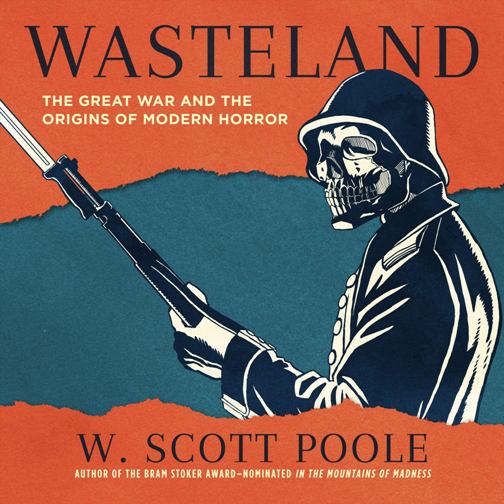
Many of the early classic horror films – from Nosferatu through Bride of Frankenstein – have connections that date back to the carnage of World War I. Wasteland does a good job of surveying the various developments in the arts as people began to process the industrial scale of death that the war brought, different in orders of magnitude from anything before. Plus, I had no idea Salvador Dali was such an asshole!
Reading Wasteland made me realize that, aside from some broad brush strokes I picked up in school, I really didn’t know much about World War I, so I decided to dive into some of the history of it. Where better to start than the beginning, right?
On June 28, 1914, a Serbian nationalist name Gavrilo Princip shot and killed Archduke Ferdinand of Austria (and his wife), heir to the throne of Austria-Hungary. Most people know that as the “start” of the war, but the truth is much more complex (and interesting). In fact it was a month before hostilities broke out, a month during which diplomatic wheels were constantly in motion. That month, the “July Crisis,” is the focus of July 1914: Countdown to War, which exhaustively covers the debates, maneuverings, and petty squabbles of parties all over Europe as the continent slouched towards war.

What was most amazing to me (aside from the fact that in a large number of states a hereditary autocrat was actually in charge – 100 year ago!) is how little emotional investment the various players had in Ferdinand’s death. Certain his own father didn’t seem all the broken up, as did most of the power brokers in Austria-Hungary, who saw him as a potential reformer and were happy to be rid of him. Only German Kaiser Wilhelm really seemed broken up about it. So what Ferdinand’s death just a cynical crisis used to give everybody an excuse to go to war? No, the roots of the war date back into the 19th century (who knew the integrity of an independent Belgium was so important?), but what is clear is that everybody involved had a plan if war was coming and once they committed to them, the die was pretty much cast.
Moving on from the start of the war, my next read was A World Undone: The Story of the Great War, 1914 to 1918.

Rather than getting bogged down in the details of a particular battle of campaign, the book provides a swift (if lengthy) overview of the war on all fronts. Sometimes it’s a little too much overview. For example, the chapter on Gallipoli mentions how a British force could have taken advantage of something had it moved quickly, but it took four weeks – we never learn why. Unfortunately for me, it spends the first section (of six) on the July Crisis, so it was a little redundant for me. More disappointing, it didn’t deal in similar detail with what happened after the war and during the various peace talks. In between, though, it’s a depressingly fascinating catalog of the various failures of the parties to figure out something to do other than grind millions of people through useless battle after useless battle. You’d think, for example, that generals and politicians could put aside petty personal differences in the face of existential threats to their country (one of the interesting recurring themes is how the propaganda of the war made pursuing peace settlements hard – who wants to make peace with the devil?), but, alas, people are people, even in the middle of the Great War.
Since A World Undone didn’t touch much on what happened after the war I decided that I needed one more book to finish things up. Rather than dive into a book about the peace conferences and treaties (of which the Treaty of Versailles was just one) I went with The Vanquished: Why the First World War Failed to End. Provocative title, no?

The point of The Vanquished is that the war destabilized Europe and the Middle East to such an extent that the “peace” actually constituted a lot of revolutionary violence and civil wars. Most of it was in Eastern Europe (don’t forget that Russia got out of the war once the czar was deposed) and the places that had been carved out of the late Ottoman Empire like new-fangled countries Iraq and Jordan. Of course, Germany didn’t escape unscathed by all this, setting the stage for the rise of Hitler. Even countries on the winning side, like Italy, fell to popular revolution.
On the one hand he First World War wrought huge changes in the world. It swept away the last vestiges of most European monarchies, at least as the people who actually ran their countries. It launched the United States into place as a major international player. And, technologically, it introduced a host or horrible things to modern warfare. But, in a lot of ways, it didn’t change much. Or, more accurately, it left so much unresolved that the Second World War was almost inevitable.
I’ve got a better handle on that now, thanks to all this reading. I can’t say it restored any of my faith in humanity, though. I recommend all these books – but maybe not to read all in one go.
You may remember last year when I finally got around to seeing Whiplash, the highly praised 2014 film about a young drummer and his abusive mentor, and that I didn’t much care for it. Based on that, when I saw a headline over at the AV Club about a “jazz musician who is not a fan of Whiplash” I smirked and decided to check it out. It actually led to a misconceptions about the nature of writing fiction that I wanted to highlight.
The review itself, which you can watch here, really isn’t as negative as the headline. In fact, the jazzer in question, Adam Neely, winds up by calling Whiplash “great,” so he doesn’t exactly take a dump on it. What he does is point out some things about modern jazz education that the movie gets wrong and laments that because Whiplash is about the only pop culture portrayal of that setting it’s likely to be what people think of it. I get it – I can similarly pick nits from just about any lawyer movie.
But before getting to that, Neely goes through a lot of stuff the movie gets right, highlighting a lot of inside details that ring true. He credits this to writer/director Damian Chazelle’s having been in a similar jazz ensemble in high school and goes so far as to say “these sorts of things could only come from playing in a jazz band.”
That’s where the writer in me started shaking his head.
It’s indisputable that Chazelle drew on his own experiences when writing Whiplash – he’s said so in interviews. However, the idea that only someone who had been through those experiences could write such a story fundamentally misunderstands what writers do. It’s a common mistake and one I blame on the one piece of advice about writing that just about everybody has heard – “write what you know.”
It’s not the worst advice, particularly for new writers. Learning the actual craft of writing fiction is easier when the story you’re telling is one you’re familiar with and takes place in the world you know. Having said that, it’s not an iron-clad piece of advice. After all, if all writers stuck to writing what they knew we’d have a lot fewer books and the genre of speculative fiction would shrink to near meaninglessness.
So writers spend a lot of time writing about what they don’t know. How? Research!

In much the same way that an actor who’s going to play a police officer, say, will learn about what police officers do and how they do it, a writer who wanted to write about cops could do the same thing. There’s an entire section of one of the writer forums I hang out on dedicated to research and people looking for answers to questions from people who have actual expertise in that area.
That’s even true when you’re writing fantasy. As I’ve said before, one of the great things about fantasy is that you can make up anything you want, but it’s still important to have some realism about the world you’re creating. In The Water Road I had a character take an arrow to the leg. Since it wasn’t meant to be a fatal wound, I needed to know how to get it out. I did some research, found out that it’s more complicated than I thought and that the kind of arrow used could say something about the character that loosed it in the first place. Reality informed my fantasy.
So kudos to Chazelle for getting those details right, but he’s not the only one who could have done so. Any good writer would have done their research before writing a story set in a particular world. It’s part of what we do.

I do have to say one thing about Neely’s overall impression of Whiplash. It’s interesting that he points out one of the flaws in the film I did – that nobody seems to really enjoy the music they’re abusing themselves to make – but that for him, the musician, it didn’t harm the movie. For me it did, which just goes to show that even when two people agree on what’s wrong with a movie (or book or song or . . .), it means different things to them. Such is art.
Unless you’ve been living under a rock recently – or perhaps on jury duty – you’re no doubt aware that infamous drug lord Joaquin Guzman (aka El Chapo) was convicted of charges in a New York federal court that will likely leave him in prison for the rest of his life. The US Attorney had a big press conference afterward in which he hinted that maybe this time, they’ll finally make some headway in the War on (Other People’s) Drugs.
That is, of course, horseshit. I’ve long said that the War is really a war on the human desire to escape our shitty world and no amount of law enforcement is really going to change that. Writing at The New Yorker, Patrick Radden Keefe sums this up more succinctly than I’ve ever seen before:
But there is a deeper sense in which the rhetoric we use when we talk about the border and the war on drugs is misguided and always has been. The real engine for the cross-border trade in marijuana, cocaine, methamphetamine, heroin, and fentanyl is not the clever salesmanship of Mexican crooks—it’s the rampant demand of American addicts and recreational users. This is a point that seldom impinges on our national dialogue about the border with Mexico: the drug trade is dynamic. What makes it unstoppable is not weak border protections or wily Mexicans but the insatiable American appetite for drugs. Where there is money and demand, trade will flourish, borders be damned. Years ago, I interviewed a former D.E.A. official who told me about a high-tech fence that was put up along the border in Arizona. ‘They erect this fence,’ he said, ‘only to go out there a few days later and discover that these guys have a catapult, and they’re flinging hundred-pound bales of marijuana over to the other side.’
Under, over, through: as long as there is an American demand for drugs, drugs will find their way into America.
I’m in the middle of a book about another long, pointless, costly war – World War I. One recurring theme of A World Undone: The Story of the Great War, 1914-1918 is that once the Western Front settled down into a stalemate, generals kept throwing offensives at the other side in spite of all the evidence that the only result was to get lots of men killed. It’s as if no one was capable of backing away and saying, “this isn’t working, we need to try something different.” The War on (Other People’s) Drugs is the same. It’s failed and it’s been failing for decades. When are we going to realize that one more offensive, one more big prosecution, isn’t going to change anything.
Over the weekend I reached a milestone on Gods of the Empire.

That’s right – I finally have a complete, full, and edited draft of this book! It’s now time to print out a hard copy (I do my own editing electronically) and let my beta reader have a crack at it. It felt really good to put the finishing touches on it, since this is the first book in a “new” universe I’ve finished since The Water Road back in October of 2015.
So what’s next for this project? Obviously, my beta reader gets to bleed all over it with that there red pen, so I’ll have to see what’s left after that. Probably another edit from me, then it’s off to figure out how to let loose this book upon the world. I might shop it around a bit or go directly to the DIY route like I’ve done in the past.
As for me? I’m taking the week off from worrying about words and world building and all that jazz.

After that, I’m not quite sure. I don’t want to dive right into the next book in this trilogy, Widows of the Empire, but I may plot it out and leave the actual writing for later this year. I’ve also got some stand-alone novel ideas I might work up, as well as the sequel to Moore Hollow. Finally, I’ve got some short story ideas kicking around that I might focus on.
Regardless, Gods of the Empire is well on its way to being finished!
Sometimes it’s interesting to see where creative types do their work, to get a feel for the environment that leads to their creativity. In the spirit of creative transparency, and the fact that it’s a new year and all, I thought I’d share mine.
This is where I work:

Ha! That’s actually where I work, but it’s not really what I’m on about (my office is on the back side, anyway). Here’s where I get my creative juices flowing:
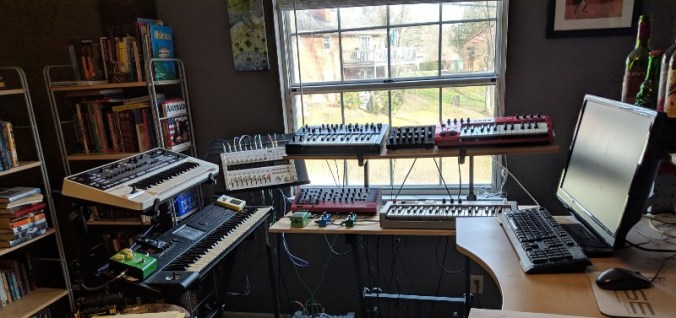
If you’re thinking “that’s a lot of musical equipment for a writer’s room” you’re not wrong. It just so happens that the PC on the right is what I use both to do most of my writing and where I weave bits of music together to make a final product (like this).
Here’s another, more atmospheric pic, with everything turned on:
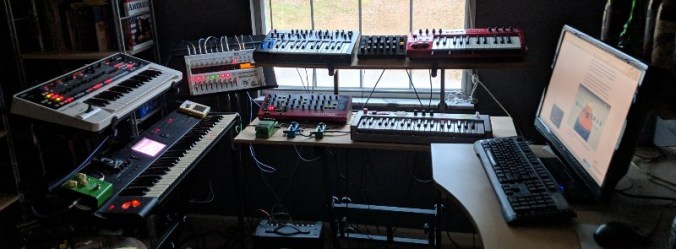
For the gear curious out there – on the left there’s a Korg M50 (bottom, with a Kaosilator on the far end) and a Roland Gaia (top), then in the middle there’s a Nord Rack 2X and Alesis Micron, which controls the Nord (bottom), and a Novation Bass Station II and Moog Minitaur with Behringer controller (top). Everything runs into the Zoom R16 mixer/recorder in between.
The words, by contrast, go straight from my brain to the PC, via the keyboard, although I occasionally knock out some words in other locales. Who knew you could write so much on your phone?
I suppose that’s the real lesson – where does the magic happen? Everywhere.
One person’s trash is another’s treasure, as the saying goes. I think the literary version of that might be that one person’s second book problem is another person’s interesting, deep dive into character lives.
Remember last year when I blogged about the second book problem – the tendency for middle books in trilogies to sag a little bit given their place in the middle of the overall narrative? At the time I was laboring under the assumption that most people would agree on when second books were problematic or not. A recent experience has convinced me otherwise.
A Gathering of Shadows is the second book in V.E. Schwab’s Shades of Magic trilogy.

It’s set in a kind of alternate history world during the 19th century where there are actually four Londons existing in parallel worlds with different levels of magic (ours is “grey” London, which about sums up the magical nature of it). The first book in the series, A Darker Shade of Magic, has a lot of hopping between worlds as it spirals towards a universe-altering conclusion.
The second book, by contrast, is a lot more sedate. It takes place mostly in red London, where magic is like air and just about everybody makes use of it in some way or another. A kind of World Cup of magic called the Element Games brings together the two main characters, Kel and Lilah, who were separated at the end of book one. We get deep into the tournament and what it means politically in the world of red London. All the while, occasionally, we pop over to black London (where a magical incident years before basically turned it into a burned over hellscape) and see that something bigger is brewing.
To be honest, the brewing seemed like it was part of another book. I was really grooving on the tournament, the way it allowed us to get more into the heads of Lilah and Kel (and his brother, Rhyl), not to mention a couple of new characters. It seemed like the perfect use of a second book, to deepen both the world in which the story takes place and the people in it whom we are supposed to care about. Then the tournament wraps up a little early and the black London stuff comes crashing down on our heroes. It all happens so fast that I think it would have worked better as an expanded second part of the book or as a short, brutal epilogue to setup the final book in the series. Still, overall, a good read and I’m definitely on board for the conclusion of the trilogy.
And, don’t get me wrong, lots of people love this book (and the series). But there were more than a few super pissed fans of the first book who thought A Gathering of Shadows was just boring filler – until the very end, when the black London stuff comes calling. In other words, they felt just the opposite of the way I did about it (one reader said it was “is majorly afflicted with the infamous 2nd book syndrome”). One person even suggested that all the important things that happen in this book could be collapsed into the first chapter of the final volume of the trilogy.
Are those folks wrong? Yes and no. I think they’re wrong because books (or stories of any kind) do more than simply push the major plot along and there’s a lot of other stuff going on for most of A Gathering of Shadows, stuff that I happen to enjoy (a lot of books, beginnings of them, get described as “slow,” but I love the time spent settling into a place or getting to know characters). On the other hand, it isn’t wrong to say that by the end of A Gathering of Shadows not a lot has happened on the grand “fate of the worlds” scale on which the first book operated. I can understand the frustration, even if I don’t share it.
While this is another in a long line of examples of why all are is personal, it’s also an example of people wanting different things from extended works. A trilogy or series, by definition, invites readers in and lets them spend more time in a world than a single story. It’s not surprising that a writer might take that time to do things other than move the plot along. But it’s also no surprise that fans brought back to the world by a quick-paced first book might find a second one slow if it can’t match that pace.
Neither set of readers is wrong in their expectations (or their permissions), but neither is a writer “wrong” for taking one path over the other. It’s worth thinking about what people said about the first book before deciding to slow things down in the second. Maybe that’s the best way to tell the entire story you mean to tell, or maybe it’s a second-book trap you’re falling into. As with most things about writing, a little forethought can head off some disappointment down the road.
Unless you were in a coma last weekend you’ve probably heard about the end of the NFC Championship game, where the Rams wound up beating the Saints on a field goal in overtime. It only got that far, largely, because of a horrible blown call by the officials near the end of the game:
Had pass interference been called on the Rams, the Saints likely could have just run out the clock or, at worst, pushed their lead to six with an easy field goal and left the Rams with little time to score a needed touchdown. Instead, the Rams tied it up, then won.
Many people are pissed about this, for good reason. This isn’t a “bad call” in the usual sense, where there’s some grey area as to whether the refs made the right call or not. The penalty in this instance was clear and unambiguous. Is there anything to be done about it? As Michael McCann over at Sports Illustrated explains, probably not. The only NFL recourse is for the commissioner to step in under authority to deal with “emergencies” and “extraordinarily unfair acts.” However, that rule explicitly exempts refereeing decisions from its scope, so there’s little hope for any kind of do over or make up. Nor are there likely to be options outside the NFL (ludicrous lawsuits like this don’t help).
However, as McCann points out, there have been examples in other sports of do overs. Those are clearly covered by the rules. One important one he didn’t mention, however, comes from the “other” football, the one they play in the rest of the world and is a little more wide ranging.
It’s February 1999 during the fifth round of the FA Cup, England’s all-comer knockout soccer competition. Arsenal, defending champions of not just the Cup but the Premier League, are playing Sheffield United, then in the First Division (now Championship). Tied 1-1 late, Sheffield’s goalkeeper kicks the ball out of play so an injured player can get treatment. A show of sportsmanship, the proper response to which is for Arsenal to then throw the ball back to the keeper when play restarts. Arsenal’s Ray Parlour tries to do just that, but recent singing Nwankwo Kanu (just on as a sub, if I remember correctly) sprints onto the ball. He passes it to a surprised Marc Overmars, who puts it into the net past a really surprised Sheffield keeper. Arsenal wins 2-1.
What happened next is what’s really relevant now. As The Guardian said way back then:
A Frenchman taught the English an extraordinary lesson in sporting etiquette last night. Arsène Wenger, the Arsenal football manager, graciously offered to stage a rematch after his side won an FA Cup-tie on a controversial winning goal.
In an unprecedented move, the Football Association gratefully accepted Wenger’s offer to make Arsenal replay their fifth-round match with Sheffield United, scrubbing out the London club’s 2-1 victory yesterday in the interests of fairness.
* * *
After offering a replay, Wenger said: ‘The second goal is a controversial goal and we feel that it is not right. We have the feeling that we didn’t win the game like we want to win our games.’
So the two teams played again, with Arsenal winning (again) by a score of 2-1 (again).
Now, there are vast differences between the Arsenal situation and the Rams. For one thing, replays are baked into the FA Cup. Outside of the last couple rounds, if a game ends tied the two teams play again in a week or so. Had Arsenal not scored that controversial second goal, the fixture would have gone to replay, anyway. There’s no similar method in the NFL, which only has two weeks between the conference championship games and the Super Bowl. For another, goals in soccer are precious things in the way points in American football just aren’t, so a questionable goal is a bigger deal than a single blown call.
But, finally, the Rams didn’t break any unwritten rule of sportsmanship. They played the game and let the refs enforce the rules, which is how the game is supposed to work. Teams work the officials the entire game trying to gain advantageous calls. Bad calls – close ones or just blown ones – are part of the game in a way that the Arsenal goal isn’t supposed to be.
So, no, I don’t really expect Rams coach Sean McVay to say, “hey let’s do this again,” even just the last 1:49 that remained (as McCann explains, that would raise a lot of interesting procedural questions). But wouldn’t it be cool if he did? Wouldn’t it be cool if in a land torn apart by tribalism and “us versus them” one team said “we don’t want to win the wrong way?”
I’ve never had so much to say about a book I decided not to finish.
I’d had 1632 on my “to read” list for quite a while. For one thing, it’s got a hell of a setup, an elevator pitch for the ages (more of that later). For another, the way author Eric Flint has let in other authors, and even fans, to help build and flesh out the world he created is a really interesting phenomenon. With that said, the book is clearly not for me, as I could only make it about a quarter of the way through before throwing in the towel.
As for that pitch – Begin with the fictional small town of Grantville, West Virginia, where a wedding reception is underway at the local high school. There is a literal blinding flash of light and, all of a sudden, the town – all the people in it, all its associated real estate and tech – is transported into rural Germany in the middle of the Thirty Years War. An explanation for this (alien art project gone awry!) is given in the prologue,* clearing that off the table. So what happens next?
There could be a struggle to survival and a town torn apart under the strain of such a weird event. Flint doesn’t go there, however. Instead, he focuses on how the Americans interact with their newfound neighbors. Some are hostile, of course – the Americans did land smack dab in the middle one of Europe’s bloodiest religious wars – but many are more than willing to join up with the Americans who are united in the idea to begin the American revolution just a little bit early.
I mention the unanimity because it highlights the biggest problem I had with 1632 – a lack of believable human tension. Put simply, the folks of Grantville, not to mention the folks who were just visiting for a wedding, adjust to their new reality way too easily. I can see not wanting to get bogged down in the nitty gritty of survival and Flint cleverly sidesteps this by allowing Grantville to have most of its modern technology remain workable.
That still leaves a lot of rich ground for drama with the relationships between the various characters, but there’s none of that in 1632. Since there’s very little stress about survival there’s really nothing to expose fissures that would already exist in such a community. I mean, in a rural West Virginia community right now there are people who would gladly persecute their neighbor for worshiping the same God in the wrong way so it’s unbelievable that none of the residents of Grantville succumb to the sectarian madness in which they’re dropped. In Grantville there are no old grudges, no low-level feuds that explode in a new context. People just get along too well. I know it’s a little stilly to complain about realism in a story based on time travel, but the lack of strife in this community just passes my flying snowman point.
The oddly low stakes were confirmed for me in a scene where the town gathers together in the high school to sort of take stock and elect leadership (without any serious challenge, naturally). One of the science folks (a teacher at the high school, IIRC) makes the obvious, but still devastating, point that they’re probably never going home. To this announcement there is pretty much no reaction. Nobody weeps. Nobody storms out, unable to face the truth. Even the few characters who we know came to Grantville from out of town to the wedding don’t seem bothered. This was, like the death of a semi-major character in Saturn Run, a scene that made me wonder why I should care about any of this. Ultimately, I decided that I didn’t.
In an afterward, Flint explains that he was sick of fiction, particularly of the speculative sort, that was negative and focused on the worst of humanity. He wanted to write a positive portrayal of common folk who, if mentioned at all in such stories, tend to get cast as ignorant hicks. I appreciate where he’s coming from and, as a native West Virginian, appreciate the fact that his characters don’t fall into traditional stereotypes about the state (except that lots of them are coal miners). But all that’s still possible while providing some tension and strife amongst the people. Flint swung too far the other way, making his Americans too good, noble, and respectable.
Not every story works for every reader. Flipping through the Goodreads comments on 1632 I see a lot of people who love the book (and its sequels) for the precisely reasons Flint set forth in the afterward. Good for them. But I also see a good number of people who feel about like I do. Such is life; such is art.

* Regardless of my other thoughts on the book, this is a brilliant gambit. Get it out of the way early and make it clear that’s not what the story is really about. It also makes me want to dive into just what genre this is – sci-fi because aliens or fantasy because, well, there’s no real science involved? Just one more thing to think about.
I’m not a big fan of New Year’s Resolutions. It’s not as if you file them with some official registry and, when you start to slip, government drones bust in to keep you on the straight and narrow.
I prefer to use the start of the year as a time to take stock, to think about what the coming year might hold. So let’s do that, shall we?
To start with, my initial goal for 2019 is to finish up Gods of the Empire, the first book in my new trilogy. As you’ll recall, this project was originally going to be a series of shorter books, but morphed into a trilogy of longer books. As a result, I basically wrote the first book in two separate parts. They’ve now been fused together for a complete manuscript. It’s a couple of edits away from “done” and, I hope, will see the light of day this year.
Beyond that, things are fairly wide open.
Obviously, at some point, I’ll need to get cracking on the second book in this trilogy, Widows of the Empire. It’s largely planned out (in broad strokes, at least), but I’m not sure whether I’ll want to jump right back into that world or get some distance before I get working on book two in earnest.
I’m also planning to go back and revive something I thought was a standalone novel – Moore Hollow. I’ve had more than one person ask about a sequel, which I’d never intended, but I’ve come around. It’s now going to be the first book in a series in which Ben Potter moves to West Virginia and investigates various weirdnesses. Getting cracking on the second book in that series is high on my list of priorities, too.
There are bound to be some shorter projects that pop up here and there, too. Last year, between rounds of Gods of the Empire, I actually wrote a novelette (I think) set in the expanded Moore Hollow universe because the idea lodged itself in my brain and wouldn’t go away. That same kind of thing is likely to happen again. Only time will tell.
So there you have it – no resolutions, but some plans and some goals. Now let’s get out there and take on 2019!


