Three (Very) Short Stories for Valentine’s Day

Last year Apex magazine announced that they were reviving their flash fiction contest. Each contest is set up around a particular holiday and for this one the holiday was Valentine’s Day. Each person could enter up to three stories, each no more than 250 words each. Since I’m not one of the winners (congrats to those who did – you can read their stories in February issue of Apex), I thought I’d share my stories here.

 Since I had three stories to play with, I decided to use them to deal with the beginning, middle, and end of a relationship. It’s not the same relationship, mind up – these stories are all set in different universes and involve different characters. I think they get at some universal ideas, however, so maybe they have more in common than I originally intended.

 Anyway, enough of my yakkin’ – enjoy!

vday1


The Spoils

“Is this necessary?” Elvin said.

“He could give in,” said Ilori, one eyebrow raised.

“She could,” Danforth said. Even sixty feet away he could seeIlori was striking. Twilight deepened her mocha skin and added definition to streaks of silver in her short black hair.

“Over this?” Elvin held up the Tyrolian orb.

Danforth nodded. But it was about so much more.

“Very well.” Elvin put the orb down. “Whoever brings it to hand wins.”

They nodded.

Danforth said the incantation quietly – crisp and sharp, honed from years of formal training. The orb began to roll toward him. He was a pillar of stone.

Ilori was anything but. Her home-taught hedge magic, learned from mother and grandmother, was loud, with complex hand movements. It was like she was possessed. The orb reversed course.

Danforth started another incantation, tapping into deeper, darker magic, but quickly stopped. Losing might be winning this time. There would be another Tyrolian orb, someday, but there was only one Ilori. He let go.

The orb sped up, flying to Ilori. She caught it in one hand like the laziest fly ball then cried out in victory.

“She’s the winner,” Elvin said, walking over to him.

“I know.” Danforth was unable to contain a silly grin

Ilori skipped over with a wide smile. “Told you.”

“Fair is fair.”

“Hope you brought your wallet,” she said, bounding off. “I’m not a cheap date!”

Danforth turned to Elvin. “Loser buys dinner.” He winked and walked after her.


The Thrill Is Gone

The apothecary shook his head. “Does your wife not already love you and you her?”

Eric the Simple sighed and leaned against the counter. “Love, yes. Alas, passion is something altogether different. Have you nothing that might help?”

The apothecary looked under the counter. “Perhaps, if you’re certain there is no other option.”

“I’ve tried everything,” Eric said in exasperation. “The woman’s desires are a mystery.”

“Aren’t they all.” The apothecary took out a piece of parchment, grabbed his quill, and began scratching something out. Finished, he carefully slid the paper across the counter.

Eric mouthed the words as he slowly scanned the page. “Spine of newt? Spleen of badger?” He looked up. “And this looks like Latin. A spell?”

The apothecary nodded.

“A love spell?” Eric waggled his eyebrows and grinned.

The apothecary shook his head. “Summoning spell, to bring forth a stink demon.”

“A what?” Eric threw the parchment down.

“It’s a minor inconvenience – smelly, ugly, and sinister looking, but actually harmless. Your wife will take a fright, you shall vanquish the foul beast, and she shall be in your arms.”

Eric stepped closer to the counter. “This is the best you can do?”

The apothecary closed his eyes and rubbed the side of his nose. “There is one other option.”

“Yes?”

“You could sit down with your wife and talk about this, find out how she feels.”

Eric paused for just a moment. “Stink demon it is then.”

The apothecary nodded. “I’ll get the badger spleen.”


The Last Night

The chalice shook in Sir Kavus’s hand as he slipped into her apartment. After months of sneaking around his nerves were still on edge.

What he shared with Lady Edana had been wild, hot, and passionate in ways he hadn’t thought possible. But it wasn’t true love, of the kindhe shared with Wyon, who tended his wounds and gave him sons and daughters.Wyon was home.

After one last night of pleasure,Edana would drink the potion mixed with the wine and all would be well. She wouldn’t even remember Kavus’s name.

He set the chalice on the table as Edana stepped from her bedchamber, naked body aglow in the candlelight. “My knight.”

“My queen.” He took her in his arms. They fell into bed for the last time.

Later he rolled over, throat dry, alone in bed. Edana was in the doorway, diaphanous gown clinging to her curves. “Thirsty?” She was carrying two chalices.

Kavus nodded and took the one she offered, gulping down the sweet wine. It seemed to go to his head, sending him to a deep sleep.

He awoke in a strange bed, although he couldn’t say it was not his. There was a woman standing next to it wearing only a smile.

“My name’s Edana,” she said, crawling in beside him.

The name wasn’t familiar, but he wasn’t about to object to her warmth next to him. There was no other place for him to be in the whole world, he was certain.

vday2

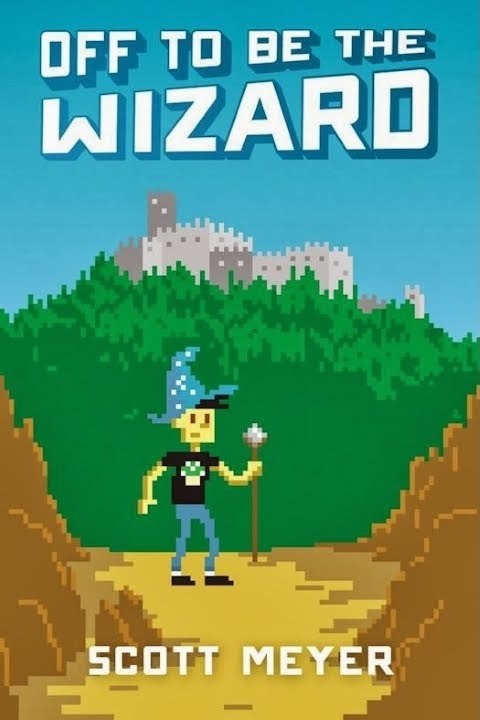
Weekly Read: Off to Be the Wizard

Off to Be the Wizard is a funny book. Very funny in some spots. It’s humor and general breeziness make it a quick read, but its charm can only carry it so far.

Martin is a computer geek. One night he discovers (on just about the very first page of the book – it works better than I expected) a text file, plays around with it, and discovers that chestnut sci-fi trope: that our world is really just a computer simulation, with parameters that can be endlessly modified. In short order he’s essentially practicing magic by summoning sums of money from thin air, teleporting, and travelling through time. It’s the first of those that gets him in trouble (damned Treasury agents) and cause him to flee not just to another place, but another time – medieval England.

At this point, I expected the story to turn into something like Doomsday Book, but with jokes, where Martin has to use his wits and “wizardry” to survive. Instead, Martin falls into a community of similar time travelers and spends most of the book interacting only with them. Aside from a few mentions here and there, the same story could have been told in the Old West, feudal Japan, or the prehistoric African plains. It’s a huge wasted opportunity and hints one of my main problems with the book.

That is, things are much too easy for Martin and his friends. Not only are they not subject to the vagaries of medieval life (aside from a wonderful running joke about stew), there isn’t even any real conflict happening until, about 3/4 of the way through the book, the author realizes there has to be. The resulting ending, with a big bad that comes out of nowhere and has a temporary menace that the rest of the book doesn’t justify, is too quick and perfunctory to mean much.

What that leaves is a bunch of Martin, mostly in the company of his older (and more interesting) mentor Phillip, learning how all the wizarding works. This provides some good chances for comedy, but the need to build up Martin’s need to pass “the trials” is undercut by there not actually being any. Aside from one run in with bullies, at no point does anything that might hint at a book-defining conflict pop up.

Along the way, anything that might complicate the wizards’ fairly easy life (typical time travel issues like changing the past/future, the ability to power computers in medieval England, etc.) get hand waved away. On the one hand, I like that – it’s a funny book, not a deeply thought out treatise on the potential hazards and difficulties of time travel. But still, having everything work out so easily almost renders the time travel pointless. No surprise, then, that Martin is never seriously pulled by a desire to return to his own time (to be fair, he’s never given a reason to be pulled).

That also keeps Martin from really interacting with the world he’s time travelled himself into. This is a particularly glaring missed opportunity because it really emphasizes the absence of women from the book. Martin’s mother gets a mention or two and there’s a crazy old woman with goat problems, but otherwise the only woman around is Gwen. She goes from a complete blank of a character (main defining feature – all the wizards want to do her) to,  magically, a big player when the plot finally cranks up. There’s no ground work laid for this and it comes completely out of the blue (deus ex vagina, perhaps?).

There are other women who have found the file and travelled back to this time, but they’ve all headed off to Atlantis, conveniently off screen (to be fair, the second book in the series goes there, so I’ve read). But that doesn’t explain why, in the day to day of living, Martin and his pals are able to avoid any contact with the opposite sex. It’s the kind of blind spot you’d expect in some of the foundational fantasy literature the book gently satirizes, but not something written in the second decade of the 21st Century.

That all sounds harsh, and maybe it is. But, like I said, being funny can take a book a long way and Off to Be the Wizard is funny. And in Philip, the wizard from a slightly older time who finds himself out of step with the more currently pop culturally savvy wizards (he knows not of The Simpsons, for instance), it has a really interesting, greatly drawn characters. Except for one thing – when, late in the book, he’s able to crank Genesis on his car stereo (yes, in medieval England – you’ll have to read the book), it’s completely out of character that it’s something from the poppy Phil Collins era (“That’s All,” to be specific – there’s a hilarious discussion of the video). I mean, come on! Surely “Watcher of the Skies” or the end of “Supper’s Ready” would have been more appropriate!

As I was saying – a fun book, a quick read with lots of laughs. However, its flaws stand out enough that I’m not interested in heading further into the series.

wizard

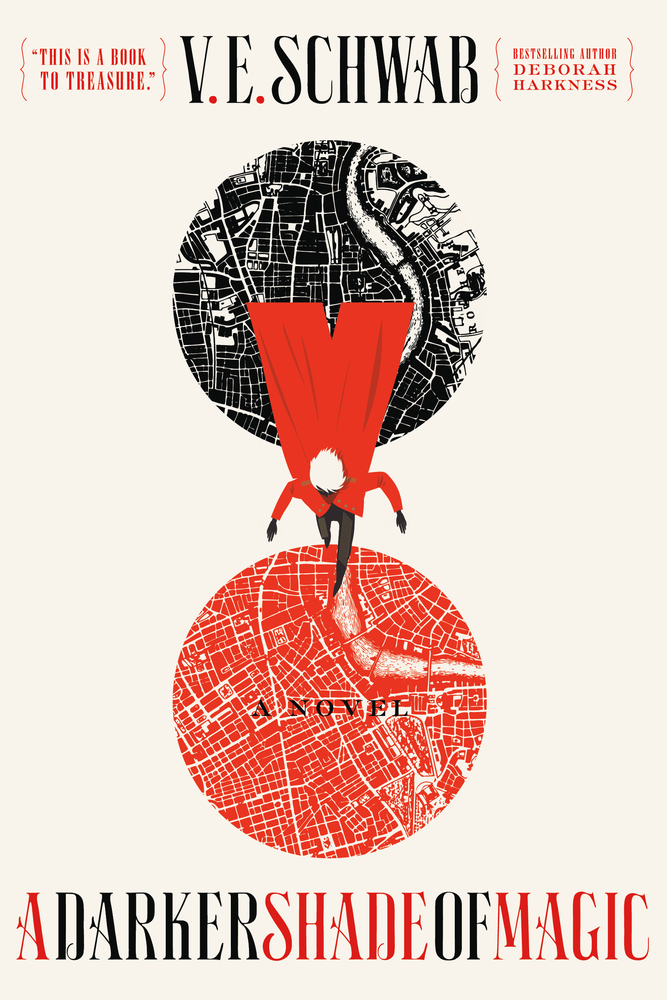
Weekly Read: A Darker Shade of Magic

According to Wikipedia there are over a dozen places (worth of note) across the globe called “London,” from Ontario to West Virginia to California to Kiribati, not to mention the big one in England. In spite of whatever differences those places have, they all share the fact that they are part of our world and bound by the laws of physics.

The Londons of A Darker Shade of Magic, not so much. They’re all in the same place as London, England, but all they really share in common is the name. Grey London (which is ours, I’m pretty sure) is dreary and dull, when it comes to magic. By contrast, magic thrives in Red London and is an important part of life there. It’s more of a power struggle in brutal White London. What magic did to Black London is, well, pretty awful.

A Darker Shade of Magic is the story of Kell, one of the few people with the ability to move back and forth between the various Londons. He serves as a courier, technically working for the king in Red London, but taking messages both ways. He also has a side gig, smuggling small objections from one London to the other. It’s in that capacity that he gets into trouble (isn’t that always the case?) and, in the process, threatens the safety of Red London and all those he cares about. Along the way he acquires a sidekick in Lilah, a pickpocket from Grey London with big dreams (she wants to be a pirate) and, we’re lead to believe, a bit of a secret when it comes to magic.

There are other characters, too, wonderfully drawn and (in some cases) downright frightening. Their interaction is the best thing about A Darker Shade of Magic, whether it’s slowly growing admiration of Lilah’s abilities by Kell, the attempts of Kell’s semi-brother Rhy to hit on her, or the way the king and queen of White London completely control a room (and a kingdom). It helps that the book takes the time to build these worlds up (the first third is, essentially, a travelogue as Kell moves from one London to the other) so that the characters seem like natural expressions of those places.

In fact, the scene setting is more interesting than the real plot, when it finally gets to it. Part of the issue is that there are dual threats that seem like they might be linked, but we never really find out if they are. They create a lot of havoc for our heroes, but it’s unclear to just what end. One thing I will note, however, is that while this is the first book of a series, it does tell a complete story, while managing to leave enough dangling to make you want to read more.

Where things go wonky is where magic plays a key role in the plot. That’s because the magic of A Darker Shade of Magic tends to morph to fit the needs of the plot. We’re initially told that what makes Kell (and his White London counterpart, Holland) special is that they alone can travel between the Londons, an increasingly rare skill. But by the end of the book Lilah and others are doing it, too, with no particularly good explanation. Also, at a critical moment near the climax of the book, game winning magic essentially becomes a Peter Pan “wish hard and it works” exercise. It’s kind of disappointing that for a story where magic is talked about so much and plays such a key role in things that it’s nature, scope, and impact doesn’t seem well thought out.

As big of a hole as that sounds for a book with the word “magic” in the title, it’s really not. The end destination may not live up to the hype, the journey is well worth it. As I said, this book tells a complete story and I could walk away from the series, satisfied, if a little disappointed. I’m not. Which should tell you something.

darkermagic

Weekly Read: The Liberation

It’s a good rule of thumb, although not an iron clad law, that the second part of a trilogy is never as good as the first part (Godfather Part Two, The Empire Strikes Back, and The Endless Hills are exceptions to the rule, of course). It’s hard to match the excitement of discovery you get from the first installment’s introduction of the characters and the world their moving around in. In addition, the second part is usually a bridge between the introduction and the climax. It’s a natural area for a bit of a letdown. The real issue is, how does the final installment stack up?

When I reviewed the first two parts of Ian Tregillis’s The Alchemy Wars last year, I noted that they followed the pattern. The Mechanical introduced us to a really cool world, a handful of interesting characters, and some big overarching questions about such minor things as free will and the nature of sentience. The Rising didn’t quite live up to that promise, focusing on some rousing action and pushing some of the more philosophical stuff to the side. Also, there was a whole section in the middle of the book that didn’t really seem to matter that much.

Well, remember what I said about middles and all that? Tregillis finishes up the trilogy with The Liberation, a rousing conclusion that, if anything, comes along just a little too quickly.

At the beginning of The Liberation, the Dutch Empire that has essentially conquered the world with its magically powered “clakkers” (clockwork people) has, to be kind, been put on its back foot. It’s not giving things away to say that The Liberation is about an oppressed people in revolt. What’s interesting is that it doesn’t present a simple good-guys-throw-off-their-yokes narrative. There are factions amongst the clakkers, deep philosophical divisions of the type that you’d find in most human uprisings. After spending most of The Rising in North America, the primary focus of The Liberation is the European mainland, particularly The Hague.

Having said that, there’s a key part of the story that plays out in North America (around the non-clakker enclave of New France). The stories in the New World and Old World play out in parallel, until, about two-thirds of the way in, we learn that one preceded the other. It’s a neat trick on Tregillis’s part, some temporal sleight of hand that allows the two stories to develop well on their own before the reader needs to know how they’re related.

It’s a bit of a shame, then, that when the end comes it comes very quickly. Not out of nowhere – the pieces are all moved into place quite well – but it doesn’t quite seem up to the task. I’m hesitant to complain because Tregillis has given us an ending, one that – just like the real world – wraps up most loose ends, but allows some questions to linger that will have to be answered in the future. It’s a fitting cap to an inventive and immersive read.

As far as I know, Tregillis doesn’t have any future plans for this universe. I hope I’m wrong, because I’d be really interested to see what’s happening in a generation or two.

tregillis_liberation-tp1

Over 70 Authors! 99-Cent Books! You Can’t Miss This!

janpromo4

To kick off the new year, I’ve joined with over 70 other writers of speculative fiction – fantasy, science fiction, horror, etc. – to spread the word about our 99-cent books.

For me that means The Water Road, of course, so if you haven’t checked it out yet this is the time. Be sure to look over the other offerings, too, because there’s bound to be something in there for just about everyone. The promo runs through January 14. See all the participating books here.

janpromo6

The Simple Power of “What If?”

Every work of fiction, or damned near every one, can been seen as an answer to a “what if?” question. What if a family has to uproot their entire existence because of climate change? What if most of a small town’s children are killed in a tragic accident? What if a young attorney’s cushy law firm is a front for the mob? On and on it goes.

The power of “what if?” is given particularly free reign in speculative fiction, since the question doesn’t have to conform itself to the real world. Stepping outside reality to ask the question can still lead to powerful insights into the real world, however.

Last week while putting laundry away I stumbled into a Twilight Zone marathon on TV. The episode I landed on, “I Am the Night – Color Me Black”, that takes a preposterously simple “what if?” question and uses it to drill down about the human condition. The opening narration lays it out:

Sheriff Charlie Koch on the morning of an execution. As a matter of fact, it’s seven-thirty in the morning. Logic and natural laws dictate that at this hour there should be daylight. It is a simple rule of physical science that the sun should rise at a certain moment and supersede the darkness. But at this given moment, Sheriff Charlie Koch, a deputy named Pierce, a condemned man named Jagger, and a small, inconsequential village will shortly find out that there are causes and effects that have no precedent. Such is usually the case—in the Twilight Zone.

In typical Twilight Zone fashion the supernatural event isn’t really the important part of the story. It’s how it throws everyone in the episode out of equilibrium and allows the filters of euphemism and manners to slip enough to see peoples’ true selves. Thus, not only do we have the deputy who’s certain (against the evidence) that Jagger is guilty, but we get the realization that Jagger is pretty much a douche, anyway. He may have been wronged, but that doesn’t make him right.

So the darkness lingers, until after the execution when we learn that it’s appearing all over the world, at locations like the Berlin Wall, Budapest, and a street in Dallas (keep in mind, the episode first aired four months after the Kennedy assassination). So, in less than half an hour, a simple question – “what if one morning the sun didn’t rise?” – leads us to, on the micro and macro scale, sober observations on human nature.

That’s the simple power of “what if?” when it comes to storytelling. It’s the prime mover, the thing that gets the ball rolling. It can upend the real world and give us a way to reflect on it all at the same time.

whatif1

Watch Me On TV (Actually YouTube)!

A few weeks ago I mentioned sitting down with author Eliot Parker for his interview show Chapters. The show’s been broadcast and has now been posted to YouTube. If you’re interested in what I had to say, check it out:

We talk about speculative fiction, The Water Road, a couple of stories from The Last Ereph and a few other things. Check it out, enjoy, and thanks again to Eliot for having me on.

Weekly Read: The Name of the Wind

Every book has highs and lows, pros and cons that lodge in your brain as you try and come to terms with it. Rarely do the two things break down as starkly for me as they did when I finished up Patrick Rothfuss’s The Name of the Wind.

First of the Kingkiller Chronicle, it’s the first day (of three – it’s a trilogy, you see) of Kvothe telling his life story. Including, presumably, how he turns into a killer of kings. Thus, the book isn’t just a story in itself, it’s a story of a story being told, which opens up a lot of interesting avenues for writing. There are also odd things happening in the “present” as the story is told (how’s about spider demons the size of wagon wheels!). In spite of all that, my thoughts are kind of black and white as to its flaws and strengths.

On the one hand, it’s really well written. I mean in the actually putting words on the page in a right order kind of way. Rothfuss’s prose is breezy and quick, but he slips in a lot of clever bits for the reader to catch (my favorite is the comparison of who lives in the high-dollar and low-dollar sections of the city of Tarbean). In other words, it makes for entertaining reading. In addition, Rothfuss takes an interesting approach to world building, avoiding large dumps of background info that the characters already know just to inform the reader about things. While this leaves some gaps in our understanding (These folks know about germ theory? How?), it allows Rothfuss to casually slip in details that don’t seem important to things but that show their relevance later on. See, for example, the whole issue of “dragons” and their dangerousness.

On the other hand, for a book that’s several hundred pages long (and more than a full day in Audible time) precious little of substance actually happens. In fact, main character and narrator Kvothe admits near the end that all that came before was “foundation” for the interesting stuff to come later (did I mention that the trilogy is, as yet, unfinished?). Naturally, that means there’s nothing like a self-contained narrative arc for this book, which is frustrating. In addition, along the way we’re treated to tale after tale of the hyper-competent Kvothe, the teenager (he’s only 16 when this book ends) who knows every useful skill under the sun and is never bested in any kind of competitive environment. To be fair, he suffers negative consequences as a result of all his success, but, still, a main character who always wins a series of largely meaningless things isn’t all that compelling.

What’s amazing is that, for those pretty substantial cons, The Name of the Wind was still an engaging read. I really enjoyed it. I didn’t mind that things had moved along so little by the end, although I was frustrated by the “and here’s the end” resolution (a final scene between Kvothe’s student and the person recording the tale helps a lot). It makes me hesitant to press on with the series (particularly given this review of book two), but only because I’m not certain Rothfuss can sustain the trick. Eventually all the spinning plates have to come down, either in a crashing cacophony or a controlled descent – whether that happens with Kvothe and his tale, we’ll have to wait and see. At the very least, I’ll wait until the third book comes out (I know – glass houses and all that).

The Name of the Wind seems to be a book that most people either love or hate, given the vacillating 5 and 1-star ratings at Goodreads. I can understand that. A lot of what the 1-star folks complain about I agree with, I just don’t think it overrides the good stuff. Highly recommended from me, even if with a bit of an asterisk.

POSTSCRIPT: Over dinner I came up with a good comparison for how I think of The Name of the Wind – like it was a concept album (Kvothe is a musician – he’d dig it). Something where the story doesn’t really hold together but the music’s so good you don’t care. So, maybe it’s like The Lamb? Or Subterranea? Either way, not bad company.

nameofthewind

Water Road Wednesday: Cover Reveal – The Bay of Sins

As we roll on towards the holidays, how about an early present? Or a slightly delayed treat, I suppose – it’s the cover for the third part of The Water Road trilogy, The Bay of Sins:

tbs-cover-900x1350

As with the first two volumes, The Water Road and The Endless Hills, this is another fabulous design from the folks at Deranged Doctor Designs.

Get caught up with the trilogy by picking up The Water Road and The Endless Hills now.

Water Road Wednesday: First Excerpt from The Bay of Sins

The Water Road Trilogy wraps up later this year with The Bay of Sins. The bay is where the Water Road empties into the sea and is home to the island city of Tolenor, home of the Triumvirate. In ancient times it was where pilgrims would come to wash away their sins. It’s always been a place of reckoning.

 In this scene, something happens in the new Neldathi city of Albandala that will require some reckoning.

It was overcast the next day, snow spitting from the slate grey sky. Weft made his rounds in the morning, speaking with members of various clans, chatting about nothing important. He was feeling things out, trying to get information without anyone knowing they were giving it to him. He usually had better luck, but today people seemed tight lipped. Something was in the air, something Weft couldn’t quite put his finger on.

The day began to achieve some focus when he saw an old Neldathi man emerge from the meeting hall in the center of the city. The long, low log building was where the clans met to discuss vital issues. It wasn’t clear what this meeting had been about or how many people had been involved, but the old man’s bearing and entourage suggested that he was important. Weft suspected he was one of the chiefs, a thek, but he couldn’t tell from which clan. He had no painted lines in the long black and grey braid that hung down his back.

Even if he couldn’t tell which clan the thek belonged to, Weft could make a guess as to which faction could claim him. It wasn’t a hard and fast rule, but generally an unpainted braid identified one as a unificationist. If a Neldathi still wore clan colors, most likely he was an independent. This was most likely one of Antrey Ranbren’s men, come to Albandala on a mission.

Weft watched as the man shuffled through the snow. There were four younger men with him, all of them also wearing black braids. Warriors, no doubt, although none of them had weapons to hand. One had a rifle slung across his back, another a short spear of some kind. The others no doubt had knives or swords on them, but Weft couldn’t see. Regardless, they were woefully unprepared for what came next.

The thek was greeting people as he shuffled. He must have been popular, at least among some portions of Neldathi society. People gave him what looked like warm hellos, meeting him with smiles and nods. The jumble of voices overtaxed Weft’s limited grip on the language. The numbers overwhelmed his guards, who looked reluctant to try and push back the well wishers anyway. Were they obeying the thek’s orders?

One Neldathi, smaller than the others and with black, blue, and red stripes in his braid, stepped forward with another group to greet the old man. Weft had a hard time keeping sight of him, with the press of tall bodies around him blocking the view. He worked his way through the crowd just in time to see the small Neldathi raise his right arm and charge at the thek. He yelled something, low and guttural and angry. Weft couldn’t begin to understand it, but he caught the gist. There was a pistol in his right hand.

It wasn’t as loud as he expected, but the shot rattled Weft’s bones all the same. The speed and violence of the maneuver took him by surprise. He knew something like this might happen, but had no idea when. In the blink of an eye there was a cloud of smoke surrounding the old chief as he fell, clutching his throat. The snow turned red underneath him.

The shooter held the useless pistol aloft and began to laugh, loudly, in a way that proved he was out of his mind. Before he could even try to run away another Neldathi, this one taller, wider, and altogether more in keeping with the stereotype of his people, tackled the shooter, driving him to the ground.

There was no need for Weft to see what happened next. His work was done. He needed to leave the city as quickly as he could.

Get caught up with the trilogy by picking up The Water Road and The Endless Hills now.