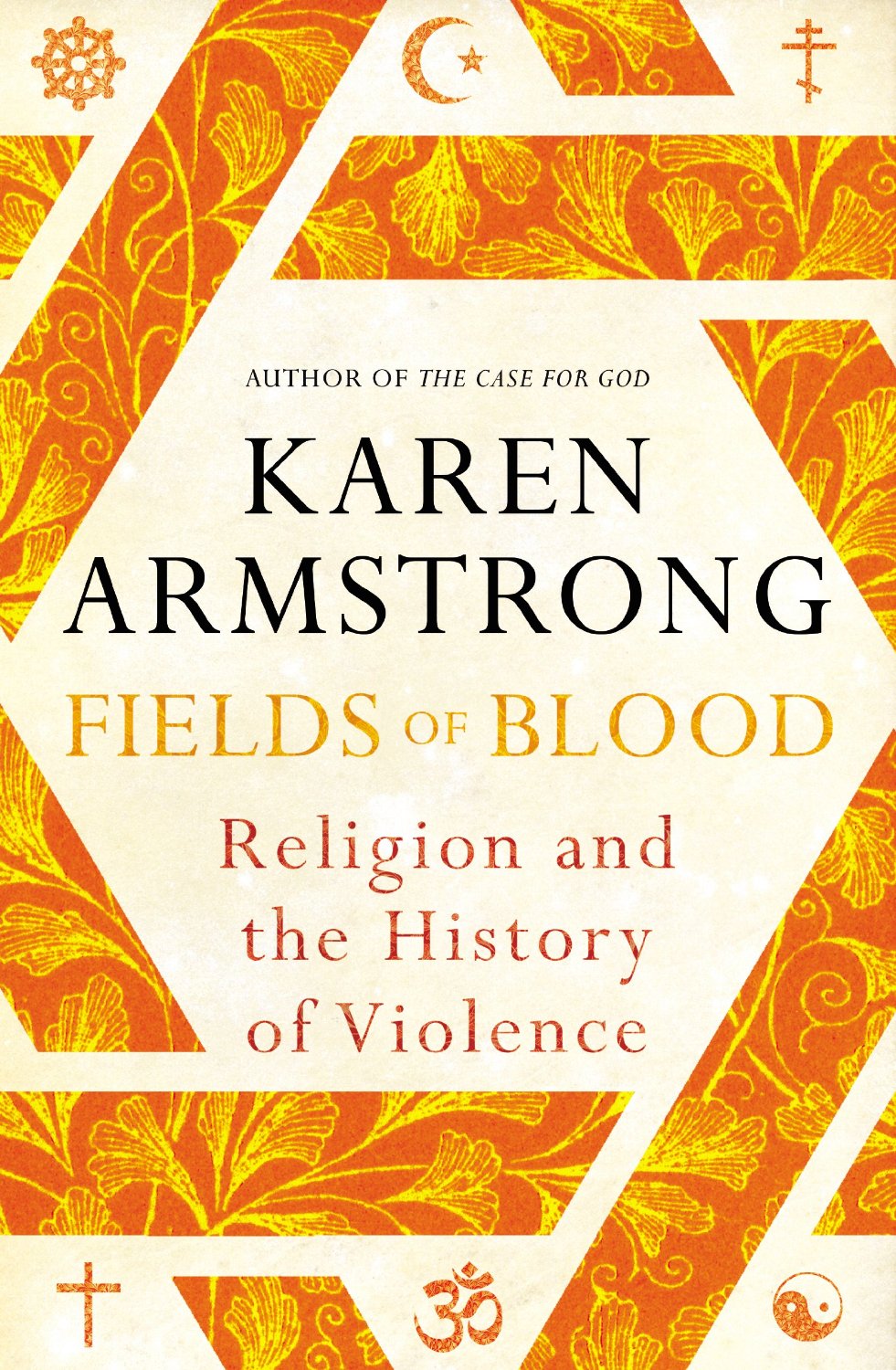
New Short Story – “The Destiny Engine”

A few months ago, someone announced a forthcoming anthology of reworked Grimm Brothers tales. I thought that sounded like a neat idea, so I started sorting through the stories for one I could transform a bit. I was struck by “The Aged Mother,” which I’d never heard before, and immediately thought of a way to play with it.

The anthology never materialized (to my knowledge, anyway), but the story did.  Behold “The Destiny Engine”:

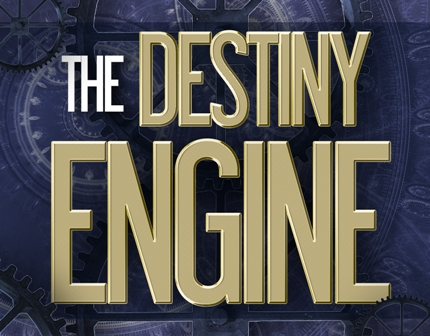
DE Cover

The Brothers Grimm meets steampunk.

Elizabeth Haden Smith is in need of a miracle. B. Pinkham James might be able to provide it. Word of the inventor’s destiny engine gives her hope for breaking her great aunt out from her stupor of grief. But James’s inventions have a habit of working too well. He was run out of New York and San Francisco before he came to the wilds of Wyoming. Will he be running again?

Sometimes it’s better to let the unknown remain that way.

Available now exclusively at Amazon, including Kindle Unlimited.

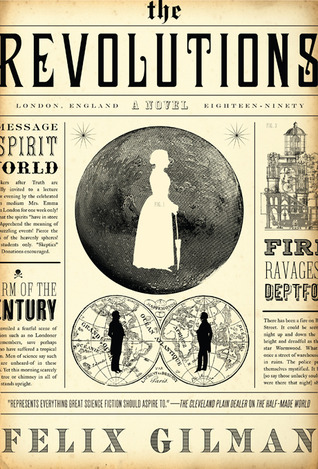
Weekly Read: The Revolutions

Arthur Shaw is not the most interesting man in the not-quite-historical Victorian London of Felix Gilman’s The Revolutions. That’s a problem, since he’s one of the main characters in the book. Thankfully, Shaw’s very mundanity – he needs a job and is willing to do just about anything for money – leads him into something very interesting indeed.

Oh, and there’s his fiancé, Josephine, who makes for a considerably more interesting companion.

This London is one where the kind of quasi-scientific spiritualism that was popular in our reality was not just popular, it was actually true. In particular, Arthur and Josephine find themselves bound up in a group trying to astral project to other planets, particularly Mars. Doing this requires not only the right people (sort of – the group gets less selective as things progress), but massive calculations produced by a massive machine with countless human parts. Babbage’s engine writ large.

The book takes a while to set all this up, which is either fascinating world building (for me) or dull sluggishness (for others). Things really kick into high gear when one of the astral flights is interrupted by Arthur, leaving Josephine trapped – in spiritual, if not physical form – on one of the moons of Mars.

What Gilman does next is a clever sleight of hand. The book focuses on Arthur for a bit and how he and the rest of the society plan to get Josephine back. Just when you think she might be nothing more than a damsel in need of rescue, the POV shifts and we’re treated to Josephine’s lengthy observation of (and, eventually, interactions with) the Martians and their society. This is the best part of the book, harkening back to the days of science fiction before science itself killed off the chance of finding life on Mars. Reminds me of some of the more esoteric parts of The Martian Chronicles.

Naturally, a rescue mission is mounted and while it has its own charms as an adventure story, it can’t match the peak that is Josephine’s experience with the truly alien. But all stories must end and I’d be lying if I said that the ending ruined all that came before.

So Arthur might be kind of dull. Don’t let that put you off. He’ll lead you into some very neat places.

Print

Come Say Hi This Saturday @ Tamarack

This weekend, Tamarack – the showplace for West Virginia arts and crafts located outside Beckley – is hosting a West Virginia Writers Weekend. It runs both Friday and Saturday.

I’ll be there on Saturday (June 27), from six in the morning until about six in the evening. I’ll be selling books, signing books, talking with readers about writing, and probably doing some actual writing (still working hard on the second draft of The Endless Hills).

In addition, at 11:45 – just before lunch! – I’ll be doing a reading of one of the stories from The Last Ereph and Other Stories.

It’s free to the public and should be a lot of fun. See you there!

WVWriterWeekend

State of Play – May 2015 Edition

After a long holiday weekend seems like as good a time as any to bring readers up to speed one what I’ve been up to.

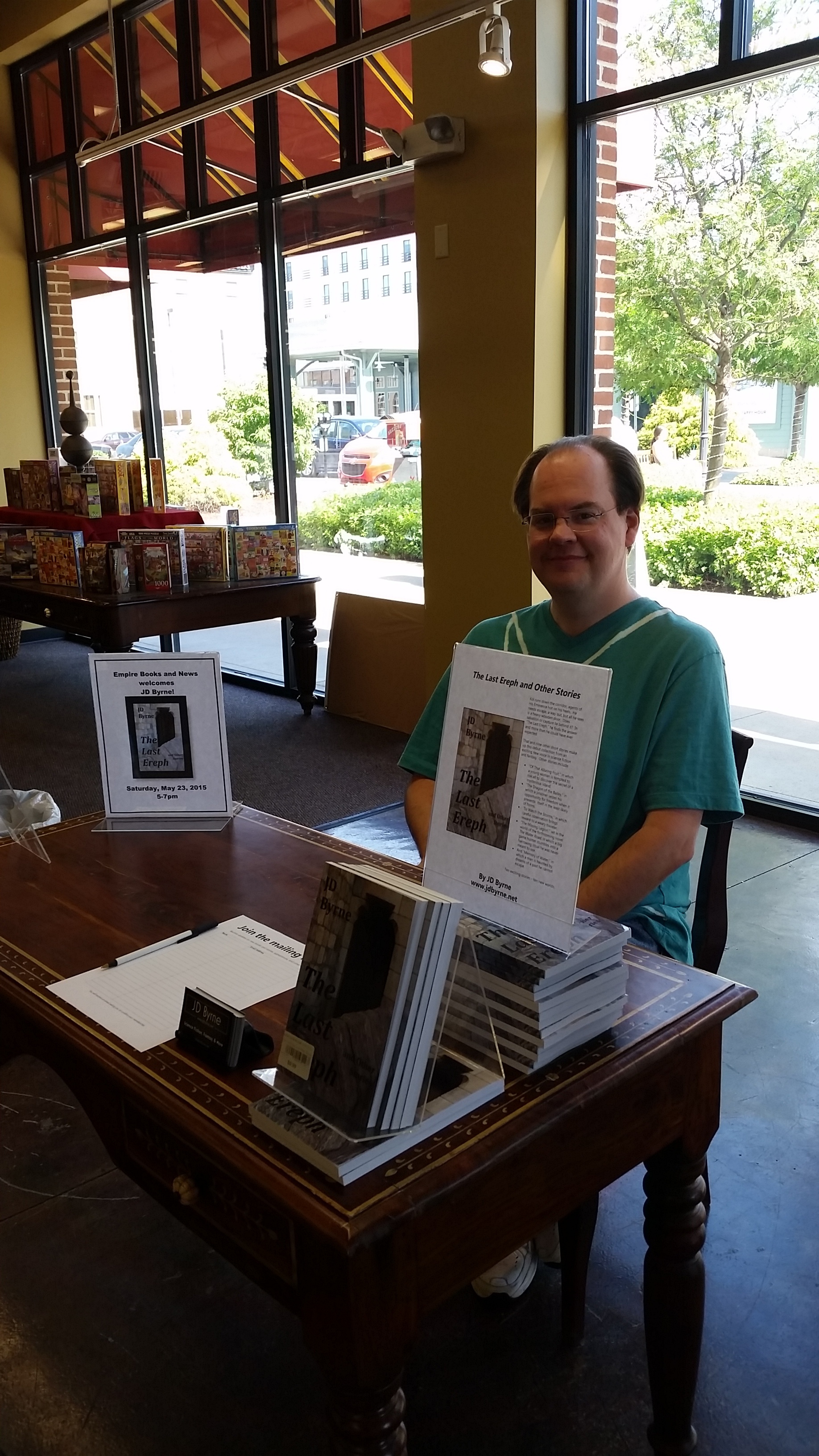
This past weekend I had my first chance to get out and meet the public as an author:

?

?

Big thanks to Empire Books & News for having me and to all the folks who stopped by. It’s a bit of a surreal experience, like sitting in a fish bowl watching the world go past, but also kind of fun.

I’ll be back out in world next month for the West Virginia Writer’s showcase at Tamarack in Beckley. That will include a reading, which should be different. I haven’t stood up and read something to crowd since, what, high school? Still haven’t figured out what to read, either. More details forthcoming or, as always, check the appearances link for that info.

“The Destiny Engine,” is now complete and is currently trying to find a home. It’s a steampunk-style reworking of a Grimm fairy tale, “The Aged Mother.” Once its finds its niche I’ll let you know where to find it.

Moore Hollow, a novel set in West Virginia about disgraced journalists, crooked politicians, and zombies (maybe), is still set for release this fall. I’m working on finding an editor right now, after which I can move on to getting a cover.

But right now, my main focus is on finishing the second draft of The Endless Hills, part two of a fantasy trilogy that will be out next year. For me, a second draft of a long work is a complete rewrite. Essentially, I imported a process I use sometimes at work when multiple attorneys contribute to a brief and everything has to be synthesized to make it read with a single coherent voice.

In the case of the novel, I take the first draft and retype it, paying more attention to the line-by-line details. A first draft, for me, is about getting the who did what to whom, where, and why down on the page. The second draft is where I can focus more on details and making sure the whole thing works as a coherent story. After that come more drafts produced by laborious close reading while wielding a red pen.

I’m about a sixth of the way through the first draft now, so there’s still much work to be done in The Endless Hills.

Until next month!

On Flying Cars and Flying Snowmen

Years ago John Scalzi wrote a post about how his wife, when it came to reading their daughter a favorite story, couldn’t get past the idea of a flying snowman. This didn’t make a whole lot of sense. As Scalzi pointed out she had no problem with a snowman who could come to life, wear clothes,
and talk with children, so why was flying a bridge too far?

The fact is, we all have a point beyond which we simply can’t suspend disbelief any longer. As a writer of fantasy and science fiction I’m doubly aware of that. Some people will happily turn their brains off to enjoy a good story, but if you trip that wire that goes beyond their comfort zone of disbelief, they’ll turn on you. There’s not much you can do about it, except recognize that we all do it and we all do it at different points. In other words, we all have our own flying snowman.

I bring this up not because of some great work of fantasy or science fiction, but because of the seventh movie in the Fast and Furious franchise, which has dominated the box office this year (up to this point). Although I’m a car guy (autocrossing them since 1999) I’ve never been a fan of the series. If I’m honest, I’m not a big fan of action flicks in general, so the automotive overlay does nothing for me. My wife, on the other hand, is a big fan, thanks to her action movie jones and an abiding longing for The Rock, so I took her to see the new one.

It’s not bad, for a big loud popcorn flick that doesn’t aspire to be much more than that. In particular there are some really amazing stunts and some good quips. Can’t ask much more than that. However, there are some points where I reached my flying snowman point. Ken Levine’s line is apparently in about the same place, although he got a bit more aggravated by it:

FURIOUS 7 is an absolute fucking mess! What the fuck was that?! No, seriously! There’s not a fucking frame of this stink burger that’s rooted in any reality. Roadrunner cartoons are more realistic. Is this what the action film genre has become? Mindless idiotic fucking stunts that defy all laws of gravity, physics, logic, and common sense? Hand-to-hand combat where the combatants beat the living shit out of each other and neither is even bruised? They crash through glass walls. No cuts. They hit each other with lead pipes. No blood. Their heads are smashed through concrete walls – not even a mild concussion. What the fuck was I watching? Nobody dies. Cars go over cliffs, roll over seventeen times, are twisted gnarled wrecks when they finally come to a rest 1,000 feet down the hill, and the passengers just wriggle out without so much as a scratch. At least Wile E. Coyote looks disheveled when he swallows a lit stick of dynamite that explodes in his stomach. Not Vin Diesel. Not Jason Stratham. Not the Rock. Creative license is one thing but this is fucking preposterous.

Now, to be fair, some of what Levine rages against as CGI fakery actually isn’t (see, for example, the flying cars of the title). But, he’s right. Furious 7 apparently doesn’t take place in the real world. My flying snowman moment came when Vin Diesel and Jason Statham not once but twice staged deliberate head-on collisions from which each walked away without even a bruise. There’s a fine line between “I can’t believe they did that!” and “I can’t believe they really did THAT?”

My wife concedes the point. She doesn’t argue for the reality of those things, but is more willing to set aside concerns and just enjoy the movie. She’s not wrong, but neither am I. I just can’t go that far. At least not for Fast & Furious.

Star Wars, on the other hand . . .

The defining image of the second trailer for The Force Awakens is the star destroyer crashed on the surface of what JJ Abrams swears is not Tatooine. When I saw that, there was a large part of my mind that immediately started into how impossible it was for a craft of that size to plummet through the atmosphere and crash land more or less intact. But another part thought it was about the coolest thing it had seen in years.

Guess which side wins? That’s because, when it comes to something I’ve loved since I was a kid, my flying snowman threshold is much higher. I’m willing to turn the more rational part of my brain off and just enjoy the awesomeness. Not every part, mind you.

Which is just to say, as a writer and a reader/viewer, you don’t necessarily need to know where the line is, but be aware that everybody has that line and you can’t hope to be certain you don’t cross it.

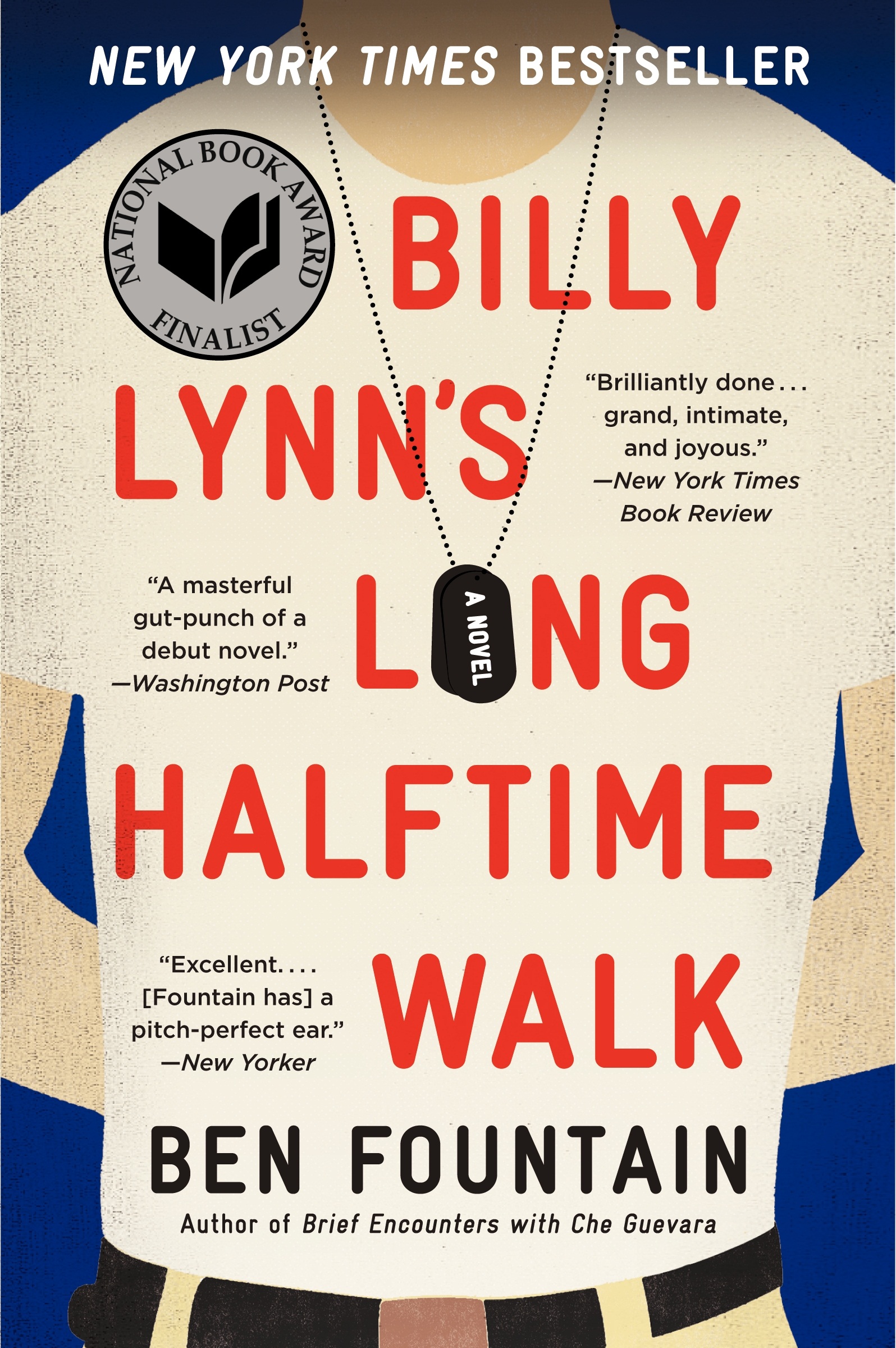
Weekly Read: Billy Lynn’s Long Halftime Walk

Billy Lynn is a soldier, 19 years old, and, thanks to an embedded Fox News camera crew, a big damn hero (to borrow a phrase). His long halftime walk isn’t his participation in a Thanksgiving Day football halftime show (starring Destiny’s Child), but rather the respite from the Iraq War that he and his squad, the Bravos, enjoy as a result of their celebrity. But
like all halftimes, it has to come to an end.

Although the action of Billy Lynn’s Halftime Walk takes place entirely on the day of said game (at old Texas Stadium – it’s a period piece, after all), its scope is a whole lot more ambitious. By dropping Billy and his mates in the middle of a charged up exhibition of pure Americana, Ben Fountain uses it to comment not just on the United States as a whole, but particularly on how the nation has interacted with the wars of the Bush administration. Or, more precisely, how we didn’t (and continue not to, really).

Everywhere he goes, Billy is confronted by people from all walks of life who want him to know how much they think of him and the work he’s doing. The platitudes have become so routine and meaningless they’re rendered in a kind of shower of buzz words devoid of any real meaning or context. It’s a brilliant device. More simply, the disconnect between the kind words and the lack of understanding is best symbolized by Billy’s simple quest for an aspirin – when confronted with the easy task of treating a headache, the home front fails miserably.

In fact, one of the failings of the book is that the people Billy interacts with are so monolithic in how they treat him that they lose any kind of individual identity. Aside from his sister, who begs him to go AWOL rather than return to Iraq, nobody at home has any real interest in what’s going on in Billy’s head. There is no conversation, for instance, with a veteran from Vietnam or what not who might better understand what Billy has gone through.

Which is disappointing, because not a whole lot happens during the day the book chronicles. Since the people Billy meets are all pretty much the same, the interactions become increasingly dull as Fountain’s main point gets beaten in again and again. Throughout there’s a tease of a film deal for the Bravos’ story, which is amusing enough (the best chance to have it made is to have Hillary Swank portray Billy), but is ultimately unresolved.

One of the interesting aspects of the book is how many real world people and places are referenced. That makes it all the more jarring when Billy and crew meet the owner of the Dallas Cowboys, who although he is clearly meant to be Jerry Jones cannot actually be Jerry Jones (for obvious reasons). It throws you off, as a reader, but you do get over it.

In the end, Billy Lynn’s Long Halftime Walk scores some points about modern American and our disconnect from the wars fought in our name (I came across it thanks to this article in The Atlantic, for example) and its dark undercurrent of humor makes it a quick read. But lacks the weight it might otherwise have carried.

BillyLynn-pb-cover

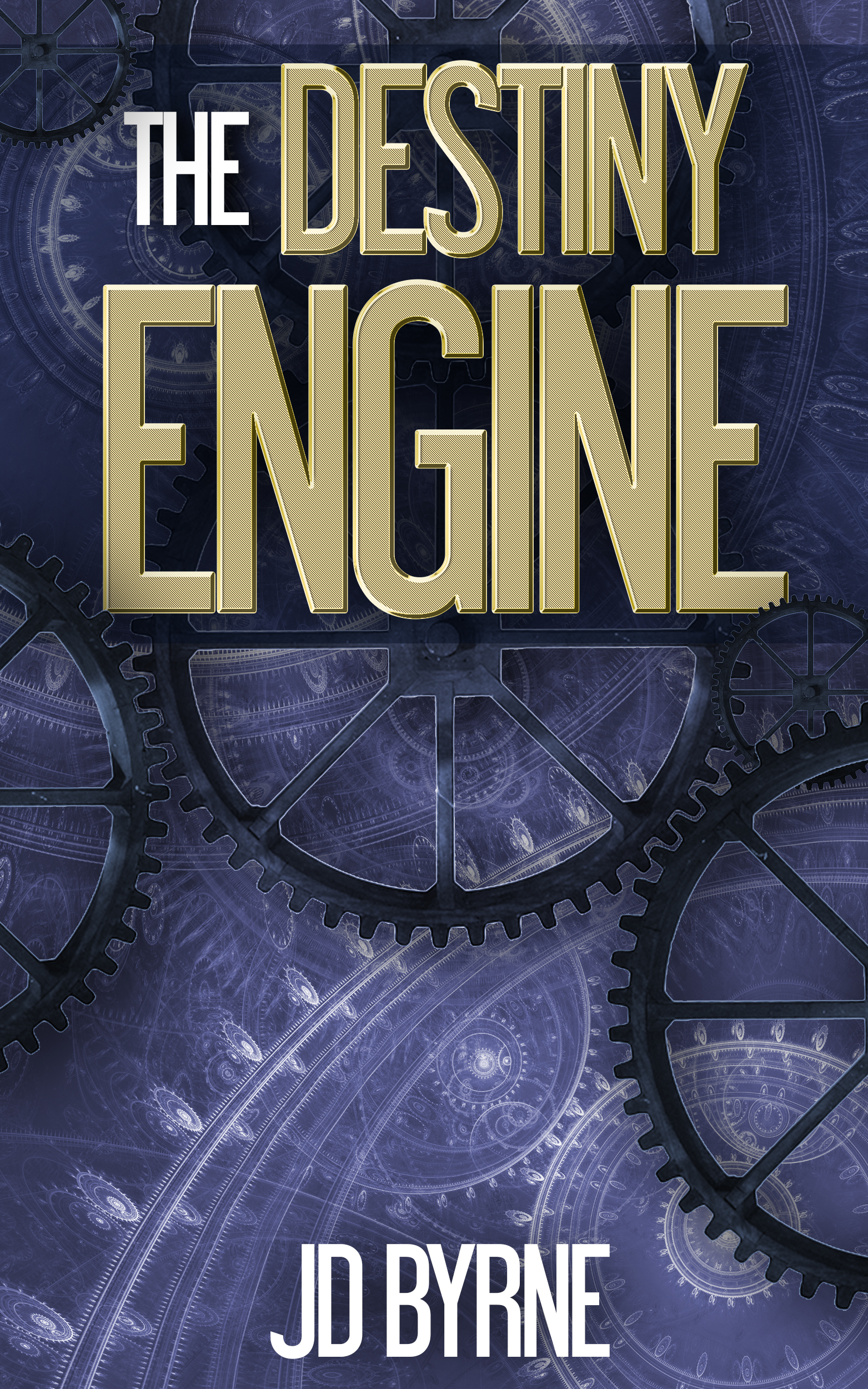
Weekly Read: Fields of Blood

I spent most of my time reading Fields of Blood, Karen Armstrong’s epic history of violence and religion, waiting for the other shoe to drop. Just what was Armstrong’s end game? She leads off repeating the straw man argument that religion is responsible for all wars on the planet (an argument she places on the lips of anonymous folks rather than actually quoting one). But surely, if that’s all she was up to, it wouldn’t take more than 500 pages and 5000 years of human history to debunk. That would be rhetorical overkill.

A secondary argument to counter – one I’ve actually seen in the wild, at least – appears in the afterword, identified by Armstrong as the idea that religion is responsible for more death than any other cause. It’s another pretty easily rebutted argument, but one that, curiously, Armstrong can’t defeat, due to the way she frames the entire book.

The frame, essentially, involves two foundations. First, civilization – not just modern civilization, but all civilization – is inherently violent. Coercive violence is inherent in civilization and its development because without the ability to take other people’s stuff no upper classes will ever develop that will then have time to do things like invent stuff, ponder the great questions, and write large tomes about the history of religion. Second, until a few hundred years ago (in Europe – other places caught up later) religion was intrinsically linked with the rest of life, including politics. The idea of “religion” as a separate thing just didn’t exist.

As a result of all this (and we’ll assume, for our purposes, that her foundations are accurate), we can’t single out “religion” as the cause of any nasty things because it’s just part of a society as a whole that’s doing them. Religion, Armstrong argues, is an attempt by humans to give meaning to their lives, including the horrible violent things they do. Sometimes, it might even reign in our worst impulses. Having said that, she admits near the end that those attempts usually fail.

The upshot of all this is that not just religion in general, but specific religions, are made up of various strains that are at odds with one another, even if they arise from the same holy text. Armstrong does a good job at showing how particular religions throughout history morph from one form to another in order to keep up with prevailing times.

One particular example comes from Judaism, in which the Talmudic stories of King David and the conquest of Palestine – written at a time when such conquering was going on and needed justification – were retconned by future rabbis after the Romans brutally put down a Jewish revolt and destroyed the temple in Jerusalem. In other words, presented with evidence that a more martial glaze on the old stories wasn’t working, they changed their meaning into one of metaphorical struggle of an oppressed people.

Now, here’s the thing – that’s actually good. People who change their minds when new evidence comes to light are rational, thoughtful, and should be applauded. But they weren’t just revising a political philosophy, they were recasting stories of an allegedly divine origin. This is something Armstrong never deals with that distinguishes religion from other schools of thought. Religious texts are (mostly) based on the idea that they are pipelines to a higher truth. If that’s true, they shouldn’t be so malleable in human hands. Otherwise, what’s the point?

Having said that, it’s hard to disagree with Armstrong, so far as her basic thesis goes. As an atheist, I certainly agree that religion is a human construct, not the product of revelation or supernatural spiritual insight. It’s a messy contradictory thing precisely because it’s rooted in humanity. But I’m not sure what that gets her, since she appears to be trying defend religion from unfair criticism.

Armstrong can’t win the second argument noted above with this conception of religion. If it has been, for millennia, an integral part of society, so much so that people didn’t have a separate concept of it, then it’s as responsible for past violence as society as a whole. So what is Armstrong’s goal in doing all this?

It winds up being a gargantuan No True Scotsman fallacy, in which Armstrong suggests that people who claim religious motivations for violent acts are, in essence, bad a religion. This is most clearly evident in her discussion of Al Qaeda and the September 11 attacks.

After a lengthy examination of how a lot of modern Islamic fundamentalism is a response to ham-handed colonial policies (on that theme I think she’s right), Armstrong notes how many of the 9/11 hijackers were fairly Westernized. Nor, she argues, were they particularly devout Muslims before becoming involved with Al Qaeda. This is not unusual, as she cites a study of more than 500 people involved in carrying out the attacks that shows only 25% fit the mold of holy warriors when they joined Al Qaeda.

However, she then struggles with the fact that, once a part of Al Qaeda, they did become holy warriors engaged in jihad, filled with tales of martyrdom. To her, the problem wasn’t religion itself, but not enough of it – had the hijackers really known what the Koran said, they would never have carried out the attacks. She specifically concedes that the hijackers themselves surely saw themselves as religiously motivated, but that’s only because they were bad at Islam. In Armstrong’s telling, religion never fails, it is only failed by the humans acting in its name.

Armstrong returns to this defense – “but the book says . . .” – over and over again, but it doesn’t do her any good. First, it presumes there is one correct way to read any holy text. As her own history extensively shows, different people read the same texts very differently. Second, it ignores the fact that actions matter more than words. In another example, she notes that a particular group of terrorists in the Middle East thought themselves bound by Islamic law to avoid violence against civilians. Nonetheless, she explains how they took civilians hostage, which is a violent act in anybody’s book. Actions, not words, are what counts.

Third, and most troubling for the entire book, is Armstrong wants to view religion’s role in violence as simply as the critics to which she is responding. If it’s not THE cause, she seems to argue, it is exonerated. She ignores (or breezes right past) the role religion can play in making killing of the other guy all right, even if the underlying cause isn’t religious. The American Civil War is an example of a war that was purely political, but both sides thought they were doing God’s work. Ever listened to the “Battle Hymn of the Republic”? It’s all about how righteous the Union cause was.

Another issue that pervades the book is Armstrong’s problems with actually deciding what “violence” is, as seen in her discussion of American fundamentalists. They, compared to their overseas counterparts, are not violent, Armstrong says, ignoring the various instances (Ku Klux Klan, Jim Crow, abortion-related murders and bombings, gay bashing, etc.) where they have been. But then she turns around and charts their rise partly to a reaction against “psychological violence,” which she defines as, essentially, modern secularists saying mean things about them. By stretching the term to meet an immediate rhetorical goal, it loses all relevance.

I think the biggest disappointment with Fields of Blood is that I actually agree with a lot of points Armstrong makes. She’s absolutely correct that the causes of conflict are numerous, complex, intersecting, and can’t be reduced to sound bite descriptions. Similarly, the irrationality that can be the hallmark of religion can be replaced with secular variants of irrationality, too, such as cults of personality or the aftermath of the French Revolution (not to mention the otters). Nor is she wrong that secular states – like the United States – have a record of violence that is nothing to be proud of.

In fact, I think Armstrong and I would agree a lot on what’s wrong in the world and how to fix it. On this issue, however, she’s just not able to get around the fact that some people do horrible things to other human beings (to quote Frank Zappa) “’cause they don’t go for what’s in the book / ‘n that makes ’em bad.” Until she confronts that, Armstrong has a massive blind spot that even a tome like Fields of Blood can’t fill.

Fields of Blood

On the Air! (After a Fashion)

A few weeks ago I had the pleasure to sit down with writer Eric Douglas for his show Writer’s Block on web radio station Voices of Appalachia. We talked about writing, West Virginia, The Last Ereph and Other Stories, and what’s coming up down the road for me. I had a great time and I think it came out well.

The interview airs tonight at 7pm on VoA, after which it’ll be available in the show archive.

Come on over and check it out.  Here’s some appropriate tuneage to get you pumped.

UPDATE: You can now listen to the interview any time you like here.

If You’re Worried About Rosebud, You’re Missing the Point

It’s his sled. It was his sled from when he was a kid. There, I just saved you two long boobless hours.

Peter Griffin, spoiling Citizen Kane

Saw Gone Girl last weekend.  It’s really good, particularly if you like the kind of movie that takes place in an air of dread that’s perfectly summoned by David Fincher (with able assists from Trent Reznor and Atticus Ross).  I say that even knowing the big twist of the film going into it.  Not because I had read the book on which it’s based, but because my wife blurted it out during a TV commercial. She didn’t know I wanted to see it.

Point is, she didn’t really “spoil” the movie for me, in the true sense of the word.  That’s because the flick is good enough that it doesn’t rise or fall on the big “twist” (which, for what it’s worth, happens about halfway through – this isn’t The Sixth Sense we’re talking about).  In my opinion, any movie/book/TV show that rises and falls on that twist isn’t really worth watching.

What’s more, people seem to enjoy things more once they know how it turns out.  At least that’s what some research says.

Back in 2011, as The Atlantic reports, a study was published that sounds pretty neat:

Scientists asked 900 college students from the University of California, San Diego, to read mysteries and other short stories by writers like John Updike, Roald Dahl, Agatha Christie, and Raymond Carver. Each student got three stories, some with “spoiler paragraphs” revealing the twist, and some without any spoilers. Finally, the students rated their stories on a 10-point scale.

The results?  Readers preferred the spoiled stories.  But why would we want to know how it ends ahead of time?

One theory is that our anticipation of surprises actually takes away from our appreciation for the 99 percent of the movie that isn’t a monster twist. ‘The second viewing is always more satisfying than the first,’ Sternbergh said, ‘because you notice all the things you missed while you were busy waiting for the twist.’ Psychologists have observed that when we consume movies and songs for a second (or third, or hundredth time), the stories become easier to process, and we associate this ease of processing with aesthetic pleasure.

Think about this for a second.  Most of us have some piece of culture that we go back to again and again.  I know that the big escape at the end of Brazil takes place all inside Sam’s head, but I still watch it.  I know that Arthur and Ford wind up on a primitive Earth populated by a bunch of idiots expelled from a better planet, but I’ll still consume Hitchhiker’s Guide . . . again (in its many forms).  And I know Tommy goes back to being blind, deaf, and dumb at the end, but that doesn’t make “Pinball Wizard” kick any less ass.

Of course, there might be other reasons why spoilers really aren’t, including the uncomfortable recognition that we really like predictability more than we let on.  But, in this area at least, I’d like to not be completely cynical and think that, deep down, we realize that works built on the big twist only are, as someone else put it in the Atlantic piece:

like artistic flash paper: It excites for a moment but offers little lasting wonder.

After all, we want to be better than Peter Griffin.  Right?

Note: This piece was originally posted on my old blog on October 20, 2014.