New Short Story – “The Nickel Tour”

I’m taking part in this year’s version of the NYC Midnight Short Story contest. The way it works is that for every round folks are divided into groups and each group is given a particular assignment in terms of genre, scenario, and a required character, along with a limited amount of time to write a story. As the competition goes on (there are four rounds in total) the time given to write the stories shrinks (as do the maximum word counts, thankfully).

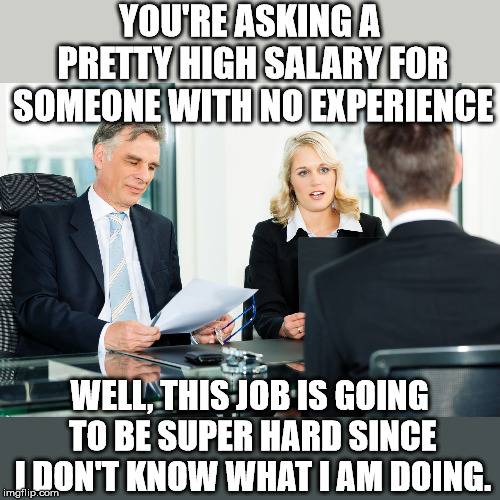
The first round stories were due back in January. I was drawn into a group where the required genre was sci-fi, the scenario was a job interview, and the character was a mercenary. The word limit was 2500 words. The results finally came in last week and I made it out of the first group! So along with about 800 others I had to write a new story last weekend for the second round. We’ll see how that goes.

Here’s the story from the first round, “The Nickel Tour.” I took the title from a phrase used in my office when we interview someone and then show them around the office. That definitely played into the story and the setting. Enjoy!

The Nickel Tour

Reynolds was having a hard time taking his eyes off the stun grenade sitting on of the table. It was inert, or so the mercenary sitting across from them had said. Ada – that was all, just Ada – had assured her interviewers that unless the lights along the centerline were flashing it was perfectly safe, a harmless lump about the size of an egg, shaped like a rugby ball. Nothing to worry about.

Nearly all the other mercenaries interviewed for this new security position had been caught at the building checkpoint trying to bring in some kind of weapon. Ada hadn’t, which made her all the more impressive. She didn’t even look like a merc. The others looked like they had all come from central casting, clad in leather and with enough scars to fill a plastic surgery convention. Ada sat calmly, in a tailored light grey suit, with short blond hair, and blouse buttoned up to her neck. If someone from outside walked in on this, she would look like just another lawyer trying to get a job. Yet, somehow, she got that grenade into the office.

“You’ve had experience with sudden, emergent, rapidly changing situations?” Tacey, one of the partners, asked.

“Yes, ma’am,” Ada said, shifting to look the attorney directly in the eyes. “I was part of the response team that dealt with the environmental collapse on Keneally Station out in The Ring. There was a sudden spike in CO2 levels, along with failing hydroponics and water regulators. Within a day the place was becoming toxic. Needless to say, people there were panicked and had to be contained.”

The way she said “contained” made Reynolds’ mouth dry. She made the violent control of desperate people sound like no more than a Saturday picnic.

“What about more long term problems? Something that you just can’t fix overnight?” Dipali, the senior partner, asked.

“Sir, I was on the Revenant when that mess went down,” she said, shifting again. “I can assure you, there was no short term solution there, but we managed to keep a lid on things.”

“What happened on the Revenant?” Reynolds asked. The others at the table looked at him like he’d asked them why water was wet.

“It was a long haul liner bound for Europa,” Ada explained. “There was some unpleasantness aboard.”

“On a cruise ship?” Reynolds asked, chuckling nervously.

“It wasn’t that kind of a liner, sir,” Ada continued. “It was full of refugees wanting to start a new life off-world. What the agents hadn’t realized is that they put a bunch of people in this ship who came from different clans that had been battling each other for generations – in business, arts, politics. Left with months of nothing to do other than stew on old grudges in close quarters, things turned . . . unpleasant.”

Everyone else around the table nodded, so Reynolds didn’t ask anything else. He returned his attention to the stun grenade and wondered how many of them she’d used during that “unpleasantness.”

“Your resume is impressive,” Tacey said, “but almost all of it is off-world.”

Ada nodded. “I’ve spent most of my career in The Ring, working for various mining co-ops. There was also a stint on Mars as part of a personal security detail. And I did a pair of deep space runs. I’m very comfortable in space. I’m very comfortable taking control of situations.”

“Then why come back to Earth? Why now?”

“Life in space can be very transitory, very unsettled,” she said. “I’ve reached the point in my life where I want more permanence. It sounds corny, but I just want to find a place to call home, maybe raise a family.”

“How long have you been off-world?” asked Dipali.

“Long enough that I need to make the choice before my body does it for me,” Ada said. “I’ve chosen Earth and I think this position would suit me very well.”

Tacey asked, “any experience with interdimensional beings?”

She squirmed in her seat. “Nothing professionally, ma’am. I’ve seen the vids, I’ve done some reading. I can assure you, however, that  I’m very good at getting up to speed in a new situation.”

The members of the hiring committee looked at each other and nodded.

“I think that’s all we need,” Dipali said, standing and extending his hand. “We’ll be in touch before the end of the week. For now, Reynolds here will give you the nickel tour. It was very nice to meet you.”

“You, too, sir.” Ada shook hands before everyone else left the room, leaving her and Reynolds alone. “Does every interviewee get to see the office?”

Reynolds shook his head. “You’re the first. I’d say that’s a good sign.” He nodded to the grenade. “Should you pick that up?”

“Leave it,” she said. “It’s a paperweight.”

“You’re the expert,” he said, opening the door into the back office.

The offices of Dipali, Tacey, and Waldroup were like one of those tunnel systems that prairie rodents dig. The outside world sees, at most, the reception area and one of the two conference rooms adjacent to it. Only employees, the odd repair person, and select interviewees get to see what lies beyond.

“Probably seems a little confusing,” Reynolds said as he led her back past a cube farm filled with busy legal assistants. “It will actually make perfect sense once we get back out front.”

“It’s a circle,” Ada said. “But lead on.”

They paused for some  introductions, then continued into the more secluded area of the attorneys’ offices.

“How many attorneys are there?” Ada asked after they’d met another pair of associates.

“A dozen,” Reynolds said. “The three partners on the front door, a couple of junior partners, and then the associates, like me.”

“How long have you worked here?”

“Couple of years. That’s why I was in on your interview, since I was the last hire. It’s kind of a tradition.”

“And what is it you do, exactly?” She was in earnest, information gathering mode, not just making idle chit chat.

“I specialize in cultural understandings, and misunderstandings, in interdimensional contract law. I was brought on when the firm started doing interdimensional work. It’s the same reason we’re hiring a security specialist.”

Ada nodded as they walked down the curved corridor. “Cultural understandings? You make sure nobody’s feelings get hurt?”

He shook his head. “A contract is a meeting of the minds between two parties, or more, to do particular things. You have to know the cultural background of each party to know how that meeting of the minds happens or if it happens at all. Think of it as a way to avoid any . . . unpleasantness.”

Ada nodded at the call back. “Like what?”

“You said you’ve never dealt with an interdimensional being before.”

She shook her head. “Only humans out in space.”

“Well, consider how contract terms might mean different things to a human from our world and, say, a human from Earth-13, where the sky is purple and the sun never really sets. Or if the other party to the contract is a being of pure energy, like the Sostu. Some of our clients are Tuv’O, which for all the world look just like orchids. But they’re sentient!” Reynolds couldn’t help getting excited when he talked about his work.

“And they need contracts?” Ada asked, tugging at her collar.

“Doesn’t everyone?”

“If they’re plants, then how do they,” she paused for a moment, swallowing hard, “how do they get around, much less to another dimension?”

“They’re carried around by a bonded pair of Ez’ak – think a Chihuahua crossed with a beetle – with whom they communicate telepathically. It’s really fascinating.”

“If you say so.”

“Now you’re in for a real treat,” Reynolds said. He knocked on a door, then opened it, letting Ada walk in before him. “Meet Frunobulax.”

Ada looked around the cramped room, jammed with sleek, black computer equipment. On top of one black box, near the door, was a small orb, pulsing with pale orange light. “Who?”

“It’s our office AI,” Reynolds said. “Say hi to Ada, Fru.”

The orb’s glow intensified and deepened into the color of a rich sunset. “Hello, Ada,” it said in a smooth, controlled voice that was clearly artificial without sounding like a computer.

“Had much experience with AI?” Reynolds asked.

Ada shook her head. “Just about every ship making runs out past Luna has some kind of AI, but nothing like this.”

“Fru is the cutting edge of AI and machine learning. He was given basic programming, then let loose on the entirety of human knowledge to develop a personality. That’s where he got the name.”

Ada looked at him, confused.

“Frunobulax has something to do with Frank Zappa,” Reynolds explained. “Fru fell deep into his discography during his learning phase and liked the name.”

“It is a very large poodle dog,” Fru threw in.

She nodded, still not getting it. “What does Fru do?”

“I handle most of the background office functions, from environmental controls to lighting,” Fru said.

“All of that’s out of human hands?” Ada asked, voice cracking slightly.

Reynolds nodded. “Those factors can be very important, depending on which clients are around,” Reynolds explained. “Fru is much better at handling them in real time than we’d ever be.”

“I can also analyze data at a much faster rate than the humans,” Fru continued. “And, of course, I manage the mathematics behind the rift generator.”

Her eyes went wide. “What did it say?”

Reynolds grinned. “Come on,” he said, leading her out of the room, closing the door behind him.

They walked past a few more doors, as the loop that was the inner office turned back toward reception, when they came to a black door without any visible handle. Ada looked around as they walked, like all of a sudden she was plotting an exit strategy.

“You’ll like this,” Reynolds said, grinning like a kid showing off his Christmas toys. He leaned in to a panel near the door while a laser scanned his eyes. Once a soft “bong” confirmed he’d passed that test, he exhaled on the panel. It turned green and the door whisked open. He stepped into the doorway to hold it open while Ada walked inside.

The room itself was about the size of a two-car garage. It was immaculately clean, with what appeared to be bare white walls, floor, and ceiling. At the far end was an arch of dull grey metal, studded with pulsing, purple emitters.

When Ada saw it, her hands shot too her mouth, like she’d seen a ghost.

“Pretty cool, huh?” Reynolds said, beaming.

“This law firm really has an interdimensional rift generator?” She said, mouth agape. “I hoped that computer was joking!”

Reynolds nodded. “I said we were on the cutting edge of interdimensional law. How else could we be? It’s a small one, but it gets the job done.”

She gave him a sharp look. “Is that legal?”

“It’s not illegal,” Reynolds said with a shrug. “There’s no law against it, if that’s what you mean. This is an office full of lawyers. You think they’d do something that might be against the law?”

Ada didn’t seem convinced. “But all the other rift generators are in space, either in Earth orbit or out in The Ring.”

“Because that’s where they were first built,” Reynolds said, strolling around the room. “There’s nothing about rift generation that requires vacuum or zero gravity. No reason why you shouldn’t have one on Earth.”

“No reason?” Her voice was rising. She undid the top button on her blouse with one hand and fanned herself with the other. “What about Field Station? That, that . . . thing they summoned?”

“An early calculation error,” Reynolds said, waving away her concern. “Fru would never let that happen here.”

“What about that entire mining colony in The Ring, the one that just disappeared?”

“Sabotage, of course” Reynolds said. “That’s why we’re hiring a security specialist. Are you all right?”

Ada was breathing fast, taking gulping breaths.

“Come on, let’s finish up the tour.” He repeated the process to open the door and Ada ran out ahead of him into the hallway. She was doubled over, gasping, hands on her knees.

Reynolds started to pat her on the back, but thought better of it. “Maybe should have saved that for another day. It’s probably a lot to take in.”

She stood and nodded. “That a device capable of ripping apart the fabric of space, and perhaps wiping out the Earth in the process, is in the hands of a boutique law firm? Yeah, that’s one way to put it.”

“We’re not James Bond villains,” Reynolds said, chuckling. “Come on, we’ll stop by Mr. Waldroup’s office, so you can meet him.”

“Actually, if it’s all right, I should be going,” Ada said. “I know you’ve got work to do and I need to get to the shuttle pad to catch my flight back to Luna.”

Reynolds stopped and was going to ask why she didn’t want to meet the one named partner she hadn’t seen yet, but decided against it. “Sure, Ada. Whatever you say.”

Walking back towards reception he had a hard time matching her pace without starting to trot. It was like she knew where she was going now and was intent on getting there as quickly as possible.

When they reached reception, Reynolds took a couple of longer strides just to make sure she couldn’t bolt straight through the door. He was certain she could brush him aside if need be, but he hoped she wouldn’t end a job interview like that.

Ada stopped, ran a hand through her hair, and took a deep breath. She held out her hand. “Thanks for the tour. It was . . . eye opening.”

“You’re welcome,” Reynolds said. “Like Mr. Dipali said, I’m sure you’ll hear something back by the end of the week.”

She nodded, stepped around him, and through the door.

“Safe travels,” Reynolds said, waving at the closed glass front door.

“What was that all about?” asked the receptionist.

Reynolds shrugged. “Beats me.”

The next morning, Reynolds was checking his email when a new message arrived. The subject line said “Sorry.” It was from Ada.

“Thanks for the tour yesterday,” she said. “I’ve decided that coming back to Earth isn’t the right decision for me, so I won’t be joining your firm.”

“I wanted to tell you to go grab that stun grenade, if you can,” the message continued. “You can activate it by twisting the narrow end three times to the right, then twice to the left. After that, all you have to do is compress it between your hands, throw it, and run like hell.”

“Memorize that, Reynolds,” she said in closing. “You’re going to need it.”

Reynolds locked his workstation and headed for the conference room.
JobInterview

On Fictional History and Fictional Places

Fiction is fake, by definition. Otherwise it would be nonfiction, right? Any character you create doesn’t exist in the real world if you’re writing fiction, even if you’re writing about a historical figure. Still, a lot of fiction takes place in what we think of as the “real” world. What happens when the real world isn’t enough and you decide to create enclaves of pure fiction within it? Well, then things get interesting.

I had a chance to ponder this recently thanks to a couple of things I consumed that leaned heavily into fictional history and fictional places. Neither quite worked and I’m not sure if all that non-existent history or fake places weren’t part of the problem.

As for fake history, I finally had a chance to see Once Upon a Time . . . in Hollywood, the latest Quentin Tarantino epic. I’m a fan of most of his stuff, and while I found a lot to admire about Once Upon a Time . . . (Brad Pitt, in particular, is as good as everybody said he was), there’s some interesting alternate history in it that didn’t really work for me.

Hollywood

Sitting alongside the story of a TV star on the downside of his career (Leo DiCaprio) and his buddy/stunt man (Pitt) in 1969 Los Angeles is the story of Sharon Tate. Tate, as you’ll recall, was married to Roman Polanski at the time (hilariously portrayed as looking almost exactly like Austin Powers and not yet a rapist) and would be brutally murdered by members of the Manson Family that August. Spoiler alert, I guess – in the world Tarantino builds, that doesn’t happen. Instead, the would-be murderers go to the house next door, where Dicaprio’s character lives and Pitt’s is on acid, and are violently dispatched with a combination of the world’s best pit bull and a flame thrower (which somehow makes sense). The movie ends with everybody else getting on with their lives, the spirit of the 1960s not yet brutally ended.

The odd thing about all this is that it seems backwards. Usually when we’re talking alternate history the pivot point – where it diverges from our reality – is at or near the beginning of the story. The rest of it is exploring the “what if this happened?” question. For a timely example, the HBO adaptation of Philip Roth’s The Plot Against America begins as Charles Lindberg runs for, and wins, the presidency in 1940 on an isolationist platform bolstered by anti-Semitism. What happens next is what we’re going to find out in the next few weeks.

The closer comparison with Once Upon a Time . . . is Tarantino’s prior bit of historical revisionism, Inglorious Basterds. In that one a group of Jewish American Army soldiers during World War II put Hitler down in a bloody, fiery way. It’s clearer wish fulfillment, in my opinion, since everybody knows Hitler was a monster. It also leans heavily on the speculative fiction trope of time travelling to kill Hitler, so it makes more intuitive sense. There’s certainly some wish fulfillment in Once Upon a Time . . . – of course it’s a better world where murder victims aren’t actually murdered and the would-be killers get instant justice – but the way it comes about makes less sense. There’s nothing explaining why the Manson kids go to the wrong house and neither the DiCaprio nor Pitt characters do anything other than react to a home invasion – they aren’t heroes who intentionally foil a plot. I just don’t get the point of the exercise.

It’s easier to see the point of using completely made up geography in fiction, but even that can be tricky. Full disclosure – I’ve done it myself (Moore Hollow is set in a fictional West Virginia county), so I’m not against the idea. It does honk me off a little bit when it comes out of nowhere, though.

One of my great finds of last year was Johannes Cabal the Necromancer, a darkly funny book about a guy trying to conquer death by bringing people back from it. In that book the titular hero (I use the term loosely) has to obtain 100 souls for Satan in order to win his own back, with the devil providing a nightmarish carnival train to aid in the process. As I said, it’s funny in a dark, sarcastic kind of way (in some ways it puts me in mind of a horror version of Hitchhiker’s Guide to the Galaxy) and, so far as I can remember, takes place entirely in our world. Not our real world, obviously (see, bringing people back from the dead, Satan, souls, etc.), but at least it looks like ours. It all happens in the UK, with Cabal’s family coming from Germany.

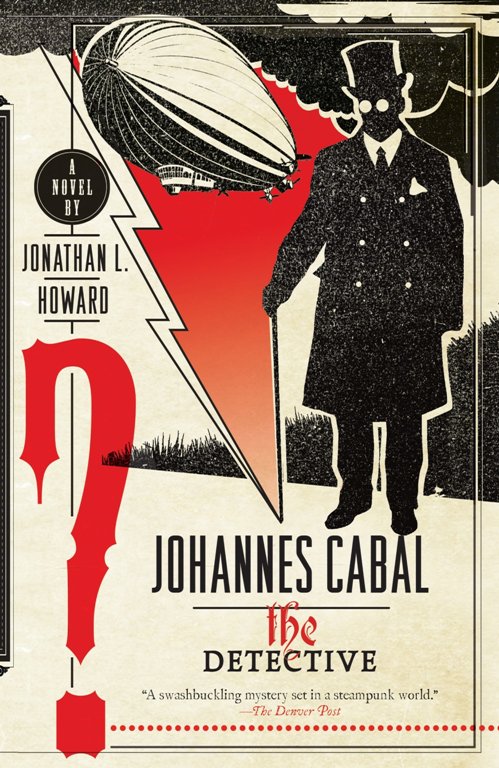
Imagine my surprise when I dove into the sequel, Johannes Cabal the Detective, and found out that it takes place entirely in a pair of made up countries somewhere in Europe (with a third thrown in for good political measure).

CabalDetective

I understand why the author did this – the story requires particular political and military maneuvers that don’t fit established history and it’s hard to manipulate real places to do your fictional building. Nonetheless, it’s kind of a shock to have these made up places thrown at you without warning. Had the first book mentioned them or been set in them it would have been different. That neither Cabal nor his sidekick have any connection to these places doesn’t help the story, but that’s a separate issue.

Of course, there are entire genres of fantasy that take place in worlds that have no relation to this one. The Water Road trilogy takes place on another world entirely (with no human beings!), as does Gods of the Empire and its sequels. But with those you know going in what you’re getting into. Changing the game midstream seems like a miscalculation to me. The question with everything, whether it’s fake history or made up locations, is what works best for the story? What best serves the character? Sometimes the answer to both is something completely new and unexpected. But sometimes it’s not.

Plus ca change . . .

There has always been controversial art. The reasons change – whether it’s the frank depiction of sex, or violence, or challenges to religious or political orthodoxy – but the fact that words or images piss people off is as old as time. We tend to think there’s more of it going around these days because social media tends to amplify controversies when they emerge. Just because the cacophony is louder doesn’t mean it’s any kind of major change in society.

This was driven home to me by a recent article in The Atlantic. Though the current title is “The First Novelist Accused of Cultural Appropriation,” the title that shows on the browser tab, which more accurately captures the theme of the piece, is “Could My Father Have Published ‘Nat Turner’ Today?” Bucking the usual rule of headline questions, the answer, from the story itself, appears to be yes.

Some background first. The literary controversy of the year so far has been American Dirt, a novel by Jeanine Cummins. With a major push from its publisher, and a spot on Oprah’s list, it was poised to be the breakout title of the year.

AmericanDirt

It’s about a woman and her son fleeing Mexico after a drug kingpin murders the rest of their family and, ultimately, their experiences as migrants heading to the United States. This article does a good job of highlight the resulting controversy, which ranged from questions of cultural appropriation (Cummins is neither Latina nor a migrant) to how writers of color are locked out of the publishing industry to the fact that, maybe, the book just isn’t that good at what it wants to be (this is an interesting takedown along those lines ).

The merits of the arguments about the book aren’t really important. What you need to know is that some people took issue with what was set to be a wildly popular book (there was a film deal before it was even published) and weren’t silent about it. Thanks to social media, blogs and what not their complaints reached a fairly wide audience.

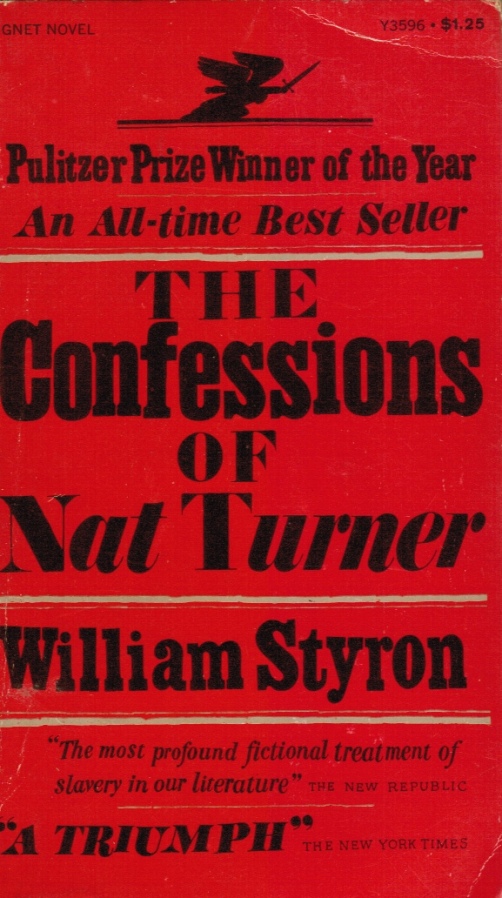
Back to the Atlantic piece. The subject is The Confessions of Nat Turner and the “My Father” in the title is William Styron – the author of the article is his daughter, Alexandra. The Confessions of Nat Turner came out in 1967. Turner, of course, was the leader of a slave revolt in antebellum Virginia. The book is a fictional narrative of Turner as told to a prosecutor who will try Turner after the revolt. It won the Pulitzer Prize, so it must be pretty good.

NatTurner

Nonetheless, it led to some controversy, driven largely by the fact that Styron wasn’t black, much less a slave. How could he write a narrative from the standpoint of one? If it’s a familiar objection, it’s worth looking at how familiar the arc of reaction to the book is to what happened with American Dirt.

First, there was a swell of praise from traditional sources:

Through much of 1967, he was at ease, enjoying the swell of prepublication buzz for Nat Turner. The Book-of-the-Month Club (the Oprah’s Book Club of its time) paid my father the highest price for a novel in the company’s history. The paperback, serial, and foreign rights sold in a frenzy. Hollywood came calling. That July, when riots erupted in Newark, New Jersey, and in Detroit, newspapers asked him to help white America understand what was happening. By October, when the first reviews appeared, Nat Turner was a juggernaut. ‘Magnificent,’ The New York Times declared. “A new peak in the literature of the South,’ Time wrote. ‘It will endure as one of the great novels by an American author in this century,’ the Los Angeles Times predicted. In November, my father was awarded an honorary degree by Wilberforce University, a historically black institution in Ohio.

At this point, as Styron’s daughter points out, with one exception “no black writers were invited to critique Nat Turner in any major national publication.” Slowly, however, those overlooked voices started rising:

The first signs of black dissent appeared by the new year. Articles in, among other publications, The New Leader, The Negro Digest, and Freedomways condemned the novel and the white media that endorsed it. Around the same time, an ugly spat erupted in The Nation between my father and the Marxist scholar of African-American history, Herbert Aptheker. (They both behaved like self-important assholes.) In February, The New York Times ran the first of several pieces exposing an angrier vein: ‘Styron’s Nat Turner, the house nigger,’ declared the professor Michael Thelwell, ‘is the spiritual ancestor of the contemporary middle-class Negro … [the] type with whom whites including Mr. Styron feel most comfortable.’ The writer William Strickland groused that the novel was ‘the worst thing that’s happened to Nat Turner since he was hanged.’ My father’s critics took issue with the book’s dialect and character development, with what he put in (a master who teaches Nat to read, motive for the rebellion separate from bondage) and what he left out (a black wife, unyielding conviction). But probably his greatest crime, as my father reflected 25 years later in an essay for American Heritage, was ‘apparent from the book’s first sentence: How dare a white man write so intimately of the black experience, even presuming to become Nat Turner by speaking in the first person?’ In June 1968, the backlash reached its zenith when Beacon Press published William Styron’s Nat Turner: Ten Black Writers Respond. The book generated its own front-page notices, and kept the Nat Turner dispute alive well into the summer.


The backlash led to the film (to star James Earl Jones) to be shelved.
None of this is to say that the detractors of American Dirt or Nat Turner had the right of it. Maybe they do, but I’ve never read either book, so I don’t know. My point is that the experience of Nat Turner that Styron’s daughter lays out sounds almost exactly like what happened with American Dirt. Maybe the controversy didn’t burn so brightly, since it didn’t have social media to fan the flames, but it still burned pretty good.

Which is only to observe, as the song says, the more things change, the more they stay the same. Anyone who writes a book (or makes a movie or paints a picture) risks blowback, whether the blowback is warranted or not. The arts are simultaneously vague and subject to so many interpretations, yet stir such deep passions. It will be a change when new books are written that don’t provoke any negative reaction. Human nature being what it is, I don’t see that happening any time soon.

What Censorship Isn’t

For a while, back when The Water Road was finished, I tried to shop is around to agents as a first step in trying to get it published. The entire process put me off (a topic for another day) and I decided to self publish, a decision I’ve been very happy with. Still, if I’d known I had some kind of Constitutional right to a publisher, maybe I would have stuck with it a little longer.

The big literary news last week involved a new memoir by Woody Allen. Allen is, of course, a legendary director of such classics as Annie Hall and Sleeper. He’s also been accused of sexually abusing his daughter, Dylan. It doesn’t help perception that he wound up marrying a woman who was practically, if not technically and legally, his step daughter. Oh, and Manhattan, too. Suffice to say, in a #MeToo world, Allen has become a bit of a pariah.

It’s not surprising, then, that when Hachette Book Group announced the release date for Allen’s memoir Ronan Farrow, Allen’s son and one of the leading #MeToo journalists, decided to cut ties with the publisher. More surprising was that, a few days later, there was a walkout by a bunch of Hachette employees over the memoir. As a result, late last week, Hatchette announced it would not be publishing Allen’s memoirs after all. The rights revert to Allen, who’s free to find another publisher or jump into the world of self publishing.

When the news broke last Friday it was the talk of Twitter. In particular, there were lots of people complaining that Allen was being “censored” by losing his publishing deal. Comments like this (screen capped from responses to this Tweet):

AllenTwit1AllenTwit2AllenTwit3

Putting to one side any breach of contract action Allen might make against Hatchette, let’s make one thing very clear – this is not an act of censorship.

Here’s the thing – so long as you’ve got some kind of outlet for the speech you want to make, you’re not being censored. Everyone has a right to speak, but nobody has a right to use any particular platform or amplification for your talk. If the government swoops down and shuts you up, that’s censorship. If private individuals decide they don’t want to be in business with you, that’s just business.

I’m open to being convinced that actual censorship can be exercised by private companies, but I’ve yet to see an example that really went beyond a private entity wanting to not do business with a particular speaker – which the private entity has a right to do as part of its own free speech. In fact, usually when people complain about companies like YouTube or Twitter taking action against hate speech or what have you and wrap themselves in the First Amendment, they’re the ones demanding state action to compel speech (as well as generally showing a poor grasp of the First Amendment).

The bottom line is this –if Woody Allen has some sort of right have his memoir published by a major publishing house, than there are thousands (if not more) of writers out there who are being repressed daily by not being given publishing deals. One cannot be true unless the other one is, which should make things pretty clear.

Repressed

On Killing Other People’s Darlings

I’ve never really understood fan fiction. That’s when people who aren’t the creators of a work – book, movie, TV series – write stories in that world using those characters. Occasionally it’s done with the permission of the original creator (such as Eric Flint’s 1632 series), but mostly it’s done in the literary equivalent of under the table.

I get the idea of wanting your favorite characters to have continuing adventures and to have such an attachment to a created world that you want to play around in it. I think if I found out people were writing fan fiction about Antrey or Aton or any of the other character’s I’ve created I’d be flattered. But it takes a lot of work to write good, interesting stories (and don’t get me wrong – some fan fiction is really good), so why not take the time and effort and direct into original characters and locations? It seems like a wasted opportunity to me.

Still, if it makes people happy to do it and they’re not making money off the work of others, have at it. As I said, I can understand wanting to continue the adventures of favorite characters and my understanding is that’s largely what most fan fiction is about.

Then I learned about deathfic.

Deathfic is fan fiction based around the death, sometimes gruesome and involved, of a character. I initially thought it involved dispatching bad guys who maybe escaped the ultimate punishment in the original work. It wouldn’t be too hard to imagine a gruesomely appropriate death for The Commander from The Handmaid’s Tale, for example. But, no, it’s something quite different:

deathfic, the kind of fan fiction in which a beloved character dies, typically in a way that is as painful for the reader as possible. ‘Sometimes I’m just in the mood to hole up and read the saddest thing I can find on the internet,’ Rachel says.

* * *

A baseline assumption of love is that a person you adore is not someone you would like to watch die. Presumably, you would also not like to be the sole architect of that person’s death. But to deathfic writers, the genre isn’t about having some kind of sick control over the life of someone else. It’s about a different kind of control entirely.


So, I guess that’s a thing? Again, seems like an odd thing to do to characters you care about, but whatever rocks your boat, I suppose. And I get, as the article points out, that sometimes writing fiction (even fan fiction) can be a way of working through issues happening in real life, including the deaths of loved ones.

Where things get a little creepy is when the people being killed off aren’t fictional characters at all:

There is deathfic for almost every fictional character and real-life celebrity you can imagine. You can find stories in which Rihanna dies and is reborn as a modern Messiah, and hundreds in which members of the K-pop supergroup BTS haunt one another as beautiful ghosts. These can be “crack” stories, in which writers are openly striving to make the strangest fictional reality they can imagine. BuzzFeed, for instance, has documented the rise of Justin Bieber deathfic, which includes freak accidents and maimings of all kinds.

That’s just fucked up. I mean the any celebrity “reborn as a modern Messiah” angle has some possibilities, but writing death scenes for famous people is just macabre as shit. Not saying you shouldn’t be allowed to do it, but if that’s your thing, maybe you want to get some help?

An old chestnut of writing advice is to “kill your darlings.” It doesn’t necessarily mean characters – it applies to any part of your writing not being so precious that it’s off limits from being cut – but it works that way, too. Killing someone else’s darlings, well, that may be a bridge too far. In the end, though, they’re only real on paper, so I guess there’s no harm.

KillEmAll

When The Gimmick Gets In the Way

Last year I wrote about some stories I’d come across that were told in a non-traditional that really worked well. I suppose turnabout is fair play – sometimes the gimmick just gets in the way of the story.

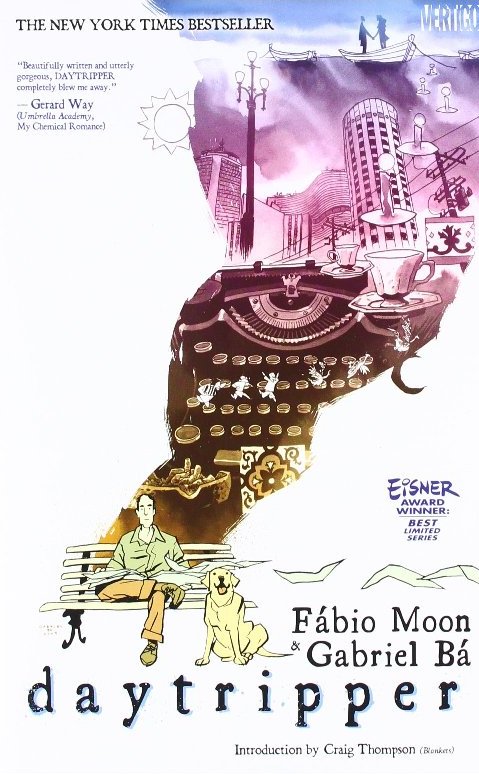
Daytripper is a beautifully put together graphic novel. In each chapter it tells the story of Bras, a writer (first of obituaries, later of novels), as he experiences certain turning point days in his life. It gets a little treacly and really hits you over the head with the “wonder of the everyday” stuff, but some of the individual pieces are good and the art is uniformly excellent.

Daytripper

Here’s the thing – at the end of every chapter, at the end of every vignette – Bras dies. Most of the time he does so in sudden, horrible ways, since they happen at all times of his life, from childhood on up. That’s an interesting way to structure a story, provided you do something with it. Creators Fabio Moon and Gabriel Bá don’t, however. There’s no overarching fantastic of magical realist element that gives the repeated deaths meaning. Everything just resets and we get another version of Bras – one blissfully unaware of his prior fates – to live out another last day.

Without that, the gimmick overwhelms the rest of the book. As readers, we know what’s coming at the end of every chapter. It becomes a macabre game, wondering just how Bras is going to snuff it this time, with methods ranging from the mundane (traffic accident) to the ridiculous (murdered by an old friend living in a shack in the desert). Meanwhile, frustration builds as you wonder just what the point of all this, beyond the hammering home of the tired old cliché about living every day as if it’s your last.* This is clearly a minority view when it comes to Daytripper, so take it with a gram of salt.

My point is this. It’s possible to tell perfectly good stories in the traditional, third-person POV, past tense, linear kind of way (at least I hope it is!). It’s also possible to deviate from the expected in order to throw your readers off, make them engage with the story in a different way, or what have you. But the gimmick has to serve something. Making readers struggle through a non-linear story just because you can isn’t clever, it’s just mean. If I, as a reader, am going to have to put together the puzzle pieces, the final picture better be worth it.

* I’ve never understood the wisdom of this. If it was really my last day on Earth, I wouldn’t worry about mundane shit like paying bills or going to work. But if I lived my ongoing life that way I’d quickly be homeless, unemployed, and (I suspect) divorced. Recognizing this isn’t likely to be your last day and you need to plan accordingly is part of being an adult.

I Won! I Won!

Hey, everybody. How was November? Everybody awakened from their turkey coma?

As I said earlier, I spent last month taking part in National Novel Writing Month, working on the sequel to my first novel, Moore Hollow. I’m pleased to say it was a very productive month:

NaNo-2019-Winner-Web-Badge.jpg

Of course, in this case “winner” means “reach the 50,000-word threshold,” not have a complete manuscript in a month. Still, I made a very good start and should finish up this first draft in the next few weeks. More importantly, this book now has a title! The second installment of what I’m going to call the Appalachian Paranormal series is The Triplets of Tennerton. I’m super excited to share it with you (in a while).

All in all, 2019 will have been a pretty productive writing year for me. I finished and published Gods of the Empire, first of my new Unari Empire trilogy. I also wrote a first draft of its sequel, Widows of the Empire. Now I’m about to wrap up a first draft of The Triplets of Tennerton. Not too shabby.

What of next year? My main focus will be on finishing Widows and writing the final book in that trilogy, Heroes of the Empire. Will Widows see the light of day in 2020? Too early to say, but it’s definitely a possibility. All I know is that I’m going to keep grinding at this thing called writing.

Funny-Writing-Meme-34

Fantasy Doesn’t Have to Be “Accurate,” It Just Has to Be Compelling

A while back I wrote about how research can be important, and idea-provoking, when it comes to writing fantasy. The gut reaction might be that writing fantasy means you can just make everything up as you go along. It’s not that simple, but one of the joys of writing fantasy is the freedom it gives you to mold the world your story is set in to the needs of the story itself. That’s why questions like this bug me:

AccuracyPostCap1

That’s from one of the fantasy author Facebook groups I’m in. I chimed in asking for more information about what kind of time period we’re talking about, since the kind of rigorous border regulation we know today is a fairly recent invention. But more than that, I asked what the writer’s story needed? After all, it’s fantasy, so why be bound to mundane reality?

I think that when it comes to worrying about research in fantasy it comes in two flavors. One is research for inspiration – you’re not looking to see how things are or were done in order to have your characters do the same thing, but you’re trying to spark your own creativity. The most obvious case of this is reading history, which is full of bizarre and compelling story fuel that can be molded to fit just about whatever world your telling your story in.

An example of this is one I’ve mentioned before – the basic arc of The Water Road trilogy was inspired by reading about Napoleon’s 100 Days and thinking about how he was handled – exiled only to return – sounded like something that would happen to the bad guy in a fantasy series. What actually takes place in The Water Road is very different, but the bones of it are still there.

The other situation is the one where I think people get hung up sometimes, that is doing research about the right or correct or “accurate” way to do something. That’s a situation where you need to have a character do something or have something happen to the character and you want to make sure it feels right. That kind of research is good and necessary – you can’t really write fantasy without any research (including as “research” here knowledge you’ve already obtained) – but it’s important not to let the reality overwhelm the story.

As an example, the world of Gods of the Empire includes steam-powered autocars (of course it does, it’s steampunk!), but they’re mostly toys of the rich. So as part of his travels Aton gets to ride in one and I wanted to have a scene where he observed the startup of one of these things, to capture the kind of Rube Goldberg beasts that they are. I did some scrounging and found a very good video of someone going through the startup for an restored Stanley Steamer, originally built around 1911:

Cool, huh? It provided some great details that I was able to put into that part of the book, but I didn’t just take down what the guy did in the video and transport it to the book. Why? For one, while providing a glimpse of the startup routine is a nice way of deepening the world building it’s a grace note on the overall story, not a subplot – I didn’t want to divert for that long. For another, the character in my book wasn’t starting a Stanley Steamer, but rather a similar vehicle in a different world with differing technologies. In other words, I was only concerned about being accurate to my world, not the real world.

Research while writing fantasy is kind of like the old saw about knowing the rules of writing (or any artistic endeavor). It’s not important to know the rules to slavishly follow them, but it is important to know them so that when you break them you can think of why you’re breaking them and to what effect.

Say, for example, you want to have a two-feet-tall sprite in your story wield a long steel broadsword. Physics tell you that in the real world (assume a real world with sprites, people) that wouldn’t work – the sword is too big and too heavy for the sprite to pick up, much less wield. Does that mean it can’t happen because it would not be “accurate.” No! This is fantasy – anything can happen, if you want it to, but you need to figure out how, in your world, such a thing is possible. Maybe the sword is enchanted and can be wielded by anyone who is worthy? Maybe sprites are supernaturally for some cool reason in your world? It doesn’t matter, so long as you realize that some fanstaticking is going to have to happen.

Which, after all, is the point, right? One different between science fiction and fantasy is that fantasy is really only limited by your imagination. Sci-fi, at least in theory, is tethered to the realities of the real world, however much one can extrapolate from them. Fantasy not only lets you think outside the box, but blow up the box completely. It’s a great power to have, being able to mold the world to fit your story – why shouldn’t you use it every chance you get?

Wonka

Gods of the Empire FAQ

As we get closer to the release of Gods of the Empire, I thought I’d take some time to answer some basic questions about it that might have popped into your heads.

Where did the idea for Gods of the Empire come from?

Oddly enough, the spark that led to Gods, and the rest of the Unari Empire Trilogy, is a character who doesn’t even make an appearance in this book (although he may show up in the next two). I had this idea of a character who was an exile who was growing increasingly tired of being sought out for his opinions on his former homeland. He fled the place then is put in the position of being its de facto defender.

That led to me thinking about what his homeland was like and what kind of world had grown up around it. The end product was a world with a single superpower, the Unari Empire, that has started to show signs of coming apart. The why of that was where the story for the entire trilogy began to take shape.

Where’s the center of the action for Gods of the Empire?

 A lot of the book takes place around the expanse of the Unari Empire and its client states, but the heart of the Empire itself, and the story, is the capital of Cye. It’s there that Emperor Chakat sits and where Lady Belwyn begins her story. It’s also Aton’s home town and a place he has some connection to.

If you’ve read any of The Water Road Trilogy, you may recognize that I named a lot of places after musicians. Cye continues that tradition, as the name comes from a obscure (even by progressive rock standards) band from Switzerland of that name. They released one album, called, appropriately enough, Tales.

CyeCover

There’s even a little story in the liner notes about a character called Cye, but it doesn’t have anything to do with Gods of the Empire. I always liked the name, though, and finally found a way to put it to use.

Who are these “gods” you’re talking about?

There are gods on Oiwa, the world where this trilogy takes place. Or, at least, there were. Thousands of years before the events of the trilogy an alien race visited to the planet, setting up shop and staying for a while. Eventually they left, leaving behind various artifacts, as well as deposits of the powerful element bosonium. Why the gods left, and whether they might come back, is one of the major theological questions facing the various religions that have sprung up since their departure.

Who is Aton?

Aton Askins is one of the main characters of Gods of the Empire. Aton grew up in Cye and works as a “finder” – sort of like a private eye, but he specializes in finding things and people. He has a daughter, Kaisia, who was born the day of the blast and, as a result, is generally bed-ridden and sickly. Her mother, Mara, the love of Aton’s life, died in childbirth. All Aton wants to do in the world is care for his daughter, but his line of work makes that difficult. So when someone comes to him with a job that pays really well and would be only the first of many, he can see a settled future opening up for him and his daughter. But at what cost?

Who is Lady Belwyn?

Lady Belwyn is the other main character of Gods of the Empire. She was born in the Knurian lakeside retreat of Annanais, but came to Cye when she married Oudrick, Crown Prince to the throne of the Unari Empire. He was killed in the blast and she was seriously injured, leading to the amputation of the lower part of her right leg. As a result, she’s spent the years since the blast as a recluse, interacting with the public only when absolutely required. When the book starts she’s just starting to break out of that funk, driven to find out why the investigation into the blast hasn’t found out, after all these years, who the perpetrators were who murdered her husband.

What is “blast” everyone keeps talking about?

The blast is a shorthand way of talking about the Port Ambs bombing. Port Ambs is to the Unari Empire what 9/11 was to the United States. The town itself is a port built near Cye. Seven years prior to the events of the trilogy, the port was being opened by the Emperor Hoban III, with the Crown Prince and other in attendance, when a huge explosion ripped through crowd, killing and wounding dozens. The blast put Chakat on the throne and, in a very real sense, is where the story started.

Chakat? Who’s Chakat?

That’s Emperor Chakat to you, buddy! Chakat was the second son of Emperor Hoban III, younger brother of Crown Prince Oudrick (and, therefore, brother-in-law of Belwyn). Since he was the second born he was never raised to be prepared to become the emperor. As a result, he doesn’t really have the skills to run the Empire. Nor does he have the temperament, as he’s got a paranoid streak that expresses itself in dangerous ways. His reign has noted mainly for his repeated fruitless military excursions in pursuit of the Port Ambs bombers and his failure to identify an heir (or produce one the regular way).

That’s the  basics – to find out more you’ll have to buy the book!

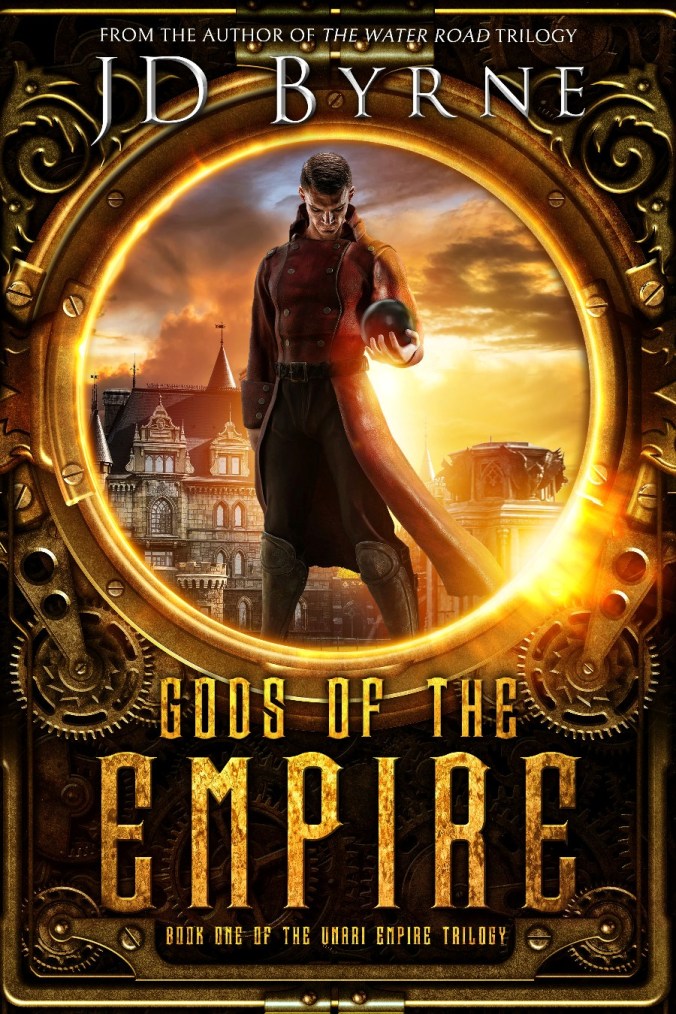
GodsOfTheEmpire (900x1350)

My New Book! Coming In October!

I’m a little excited.

Very happy to announce that my new book, Gods of the Empire, will be available everywhere fine eBooks are sold on October 1!

GodsOfTheEmpire (900x1350)

What’s this one about? Glad you asked:

Aton Askins finds things and people that don’t want to be found, but is barely making a living. Now if he takes a new mission for a mysterious, wealthy patron, to find lost artifacts of the gods who left Oiwa centuries ago, he could make a life for himself and his sick daughter.

Lady Belwyn lost much in the Port Ambs bombing seven years ago – her husband, her right leg, and her confidence. Fitted with a new mechanical leg and taking her first steps back into society, she begins to ask questions about Port Ambs and why the perpetrators have never been caught – questions others don’t want to be answered.

While the Unari Empire begins to pull itself apart, two people will search for their own truths and learn things about their world that will change their lives forever.

For links where you can preorder the eBook edition, click here.

As you can see from the cover (another stunner from the folks at Deranged Doctor Designs), this is the first book in the Unari Empire Trilogy. The first draft of book two is almost done!

If you’re interested in paperback versions, you can get signed copies (at very reasonable prices) at my two upcoming appearances. One is next month at the West Virginia Book Festival, the other is in November at the  West Virginia Pop Expo. More details about those in the coming weeks.