We All Need Some Light

The other day at work I was doing some research at a different end of the West Virginia Code that normal and came across a provision that made absolutely no sense to me. It’s WV Code §2-1-2, titled “Ancient Lights” for those playing at home:

The common law of England in regard to ancient lights is not in force in this state.

The background for this is that the prior section (WV Code §2-1-1) adopts English common law “except as altered by the general assembly of Virginia” before June 20, 1863. In other words, we adopted Virginia’s law as is when we left the commonwealth during the Civil War. But apparently it was important to exclude from that this law on “ancient lights.” So what are we missing here in the Mountain State?

Turns out it’s a right to light! In some places, at least. Specifically, it’s a kind of easement, which is a property interest that someone has in someone else’s property – think of someone who has the legal right to use a path across their next door neighbor’s property. In England, if a person has a building with windows that for 20 years have received daylight they can prevent someone else from building in a way as to obstruct the light.

Thus, you have things like this on some old English buildings:

Ancient_lights_signs_Clerkenwell FULL

Pic by Mike Newman via Wikimedia Commons

As it happens, West Virginia isn’t alone in not adopting this doctrine, so very few Americans actually have an enforceable right to light. Which is a shame, since, as the song says, we all need some light.

What Do Verdicts Mean?

Recently there was a small kerfuffle in parts of the atheist blogosphere over, of all things, the guilt of innocence of Jerry Sandusky. Sandusky, you’ll recall, is the long-time assistant to legendary Penn State football coach Joe Paterno who was convicted on dozens of counts of child sexual abuse related to his position there. I’m less interested in the specifics of this case than I am about one particular argument made that raises an interesting question about the criminal justice system.

Things kicked off with a review in Skeptic magazine of a book, The Most Hated Man in America: Jerry Sandusky and the Rush to Judgment, which argues that Sandusky’s trial was tainted by recovered memory therapies and led to a wrongful conviction. The book’s got favorable blurbs from memory expert Elizabeth Loftus and false confessions expert Richard Leo, two names that make my defense lawyer ears prick up. The review was then favorably discussed by some of the atheist heavyweights, including Jerry Coyne and Daniel Dennett.

Others in the atheist blogopshere pushed back, wondering how skeptics could defend Sandusky. While some offered take downs of the review itself, others simply argued that the issue was settled because of Sandusky’s convictions. The leading proponent of that position was PZ Myers who wrote (links removed):

They’ve published a defense of Jerry Sandusky! Look, Jerry Sandusky was found guilty of 45 counts of child sexual abuse. He’s a convicted pedophile. The prosecution brought in a long train of witnesses and evidence of criminal behavior spanning at least 15 years and 10 victims, and this case found him guilty in a community that was full of fanatical Paterno/Sandusky defenders. Anyone remember the riots and protests when the Paterno empire fell? You can’t have a witch hunt when the targets are regarded as holy saints — the evidence was just so overwhelming and undeniable that even angels by repute could be defrocked at last.

Myers may be right about the weight of the evidence, but what I’m more interested in is the idea that because Sandusky was convicted at trial that it’s somehow wrong to examine the evidence against him. After all, the jury has spoken, right?

Except we know that juries get it wrong. Not all the time, certainly (and an overwhelming number of cases never get to a jury anyway), but enough for it to be a concern:

In the past quarter-century, the work of dogged attorneys and advances in forensic science have exonerated more than 2,150 men and women, 161 of those from death row. The Innocence Project, a New York–based nonprofit founded by Barry Scheck and Peter Neufeld in 1992, has freed more than 200 people and spurred the creation of numerous smaller organizations around the country devoted to the same mission. (From 2012–2015, I was the director of the Loyola Law School Project for the Innocent in Los Angeles.) By some estimates there are tens of thousands more wrongfully convicted prisoners languishing behind bars.

Given that, what kind of deference should the public give to guilty jury verdicts?

A quick aside on non guilty verdicts. It’s hard to read anything at all into those, since there are so many reasons why such a verdict could be returned. Maybe the prosecution completely failed to prove its case, or maybe it couldn’t meet the final hurdle to of reasonable doubt. Or maybe the jury nullified in light of sufficient evidence. With a not guilty verdict it’s hard to say much beyond “that guy hasn’t been convicted of anything.”

Back to guilty verdicts – what kind of weight should the general public give them? I may lose some of my defense attorney cred for this, but I’m going to say a lot. The law likes to use lots of “rebuttable presumptions,” things that are taken as true, but can, with sufficient evidence, be shown to be false. For example, in Federal court if you’re arrested on just about any drug offense there’s a presumption that you should be held without bond. You can argue your way out, but it relieves the Government of the need to argue your way in.

I’d grant guilty verdicts that kind of presumption because it’s the one time when a group of people are given one job only – evaluate the evidence presented and, using the filter of the judge’s instructions, determine whether the defendant did it or not (whatever “it” is). Everybody else in the courtroom – the lawyers, the judge, the spectators, the press – all have other things competing for their time and attention. Only the jurors have the clear job of listening to every word of testimony, looking at every exhibit, and deciding what it means.

It’s not a full proof system, for sure. The jurors only hear the evidence presented in court, so if the defendant has a shitty lawyer or a prosecutor who is pushing the boundaries it could present a skewed view of the case. In addition, the rules of evidence pare down the universe of facts that a jury can consider, leading to situations where the “well informed” are “those outside the courtroom.” And, finally, the case itself might be tangential to whatever the defendant is really accused of doing. That Al Capone was convicted of tax evasion does little to show, one way or the other, that he was a mob boss.

Which is why I think a rebuttable presumption is the way to go. It’s perfectly right to say because he was convicted of dozens of sexual abuse counts against children, Sandusky probably actually molested them. But it’s not an ironclad guarantee, as Myers and others seem to suggest. Those who would rebut the presumption, however, have a lot of heavy lifting to do.

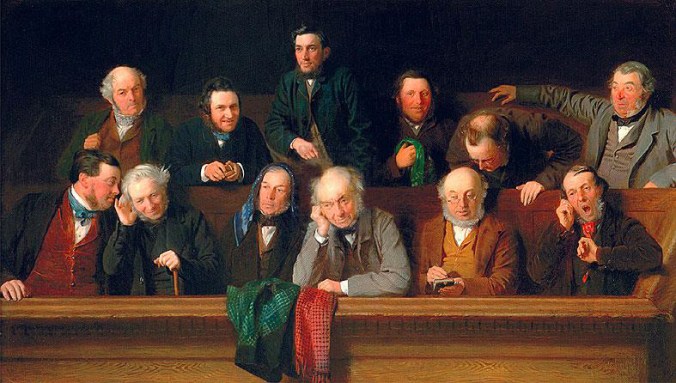
The_Jury_by_John_Morgan

The Jury (1861) by John Morgan, via Wikimedia Commons

Our Dogs Are Nudists

Last year was a transitional one when it came to canines in our house. In late summer we lost our one-eyed Chihuahua mix, Maia, when her constellation of medical conditions finally caught up to her. After a few weeks with an empty house, we worked with a rescue organization in Ohio and adopted a pair of fuzzy little people, Kalindi (l) and Zaria (r).

Pups

As you can see, they’re both Chihuahuas and both pretty tiny. To add to thing, Kalindi is short haired. It being winter and everything, the wife pushed almost immediately to get them each a sweater to help keep them warm when they went outside.

Now I should say I’ve never been a big fan of dressing dogs up. The dogs never really seem to like it and they tend to look silly. And, frankly, it makes it more difficult to rub their bellies. I mean, what’s the point in having dogs if there isn’t copious belly rubbing taking place? Still, our old Min Pin, Uzume, had a couple of sweaters that did seem to keep her warm, so I wasn’t completely opposed to the plan. That the vet suggested it might not be a bad idea certainly decreased my chances of successfully opposing it.

So for Christmas both dogs got sweaters (along with treats and toys – we’re not monsters). After they had been successfully deployed, my wife took a picture.

Pups3

As it stands, that will prove to be the only photographic evidence that Kalindi and Zaria once had sweaters. That’s because it’s become clear that they don’t particularly care for them. They didn’t protest initially and didn’t provide any resistance when the wife and I put them on. They even wore them around for a while and seemed to be enjoying the extra warmth.

Then the stripping started.

It wasn’t an immediate thing. Indeed, the little beasts seemed to enjoy their sweaters. Then, things started happening. Kalindi is fond of balling up under a blanket (ironically, purchased in Mexico years before I ever thought I’d have Chihuahuas to snuggled under it) and, lo and behold, when she emerged from her slumbers one day her sweater was about halfway off. She didn’t fight to get it the rest of the way off, but you could tell where she was headed.

I don’t even know where and how Zaria got hers off. It just . . . was, as some point.

Naturally, we put them back on. There was no fuss or protest, but a few hours later, both of them were off again. Even after we went outside without them during our recent frigid spell, neither pup seemed interested, although they’re very passive aggressive about it.

So I’ve come to the conclusion that our dogs are nudists and want nothing to do with civilization’s “clothes.” Fine my me – easier to rub bellies!

Pups4

Not Exactly The Thomas Crown Affair, Is It?

Art heists are great fodder for movies and books. The stakes are usually pretty high, involving unique, priceless works of art. Daring do is often required to pull them off. And it provides a good opportunity for suave characters to behave suavely.

This isn’t one of those stories.

In February 1965, Salvador Dalí painted a version of Christ on the cross – in an hour and a  quarter – and donated to Rikers Island, New York City’s notorious jail complex. Dalí was supposed to meet with some inmate artists, but wasn’t feeling well, so he sent the painting instead. It was hung in the cafeteria, where it proceeded to collect stains from various jailhouse food fights. In 1981, somebody realized what it was (and had it appraised for $250,000) and took it down.

After a short tour around the country and some time in storage, the painting was hung up again at Rikers – but not where the inmates could actually see it. Instead, it was put up in a lobby where jail employees went in and out. In 2003, a group of those employees (four guards) decided to steal it.

The plan was to create a couple of distractions and allow the leader of the scheme to take the Dalí while replacing it with a fake. It didn’t go well:

It was noticeably smaller than the original, an instant tip-off, but the reproduction was also one that, based on descriptions, not even a child would have wanted to claim. Plus, the reproduction of the cafeteria stains were an entirely different color. It was bad.

Then, of course, there was the painting’s presentation. Yes, the glass case had been locked back up with the copy safely inside. But where the original had been displayed in its gold frame, the fake was simply stapled to the back of the box, sans frame.

The whole plan was amateurish at best, but when you factor in the location—a prison teeming with law enforcement officials who spent their days gazing at that exact painting (there were two guard booths in direct view of the Dalí)—it was stupidity at its finest.

The very next day, several guards reported that there was something wrong with the Dalí.

They all got caught, of course, although the ringleader managed to get a not guilty verdict at trial (the others were convicted).  As for the Dalí itself? One of the thieves says that the ringleader got nervous and destroyed it.

On second thought, maybe there is a great story here, in the tradition of a Coen Brothers “heist gone wrong” kind of thing. I’d watch it. I’ll even suggest a theme song:

Dali

The High Price of Needing to Be Right

There are lots of things about the legal system that we lawyers take for granted that make lay people shake their heads or look at you like you’ve got a bamboo plant sprouting from your forehead. One thing that really confuses them are so-called Alford pleas, in which a person pleads guilty to a crime, all the while maintaining that they’re actually innocent. How the hell does that work?

It should be simple enough. You’re charged with a crime. This presents you with two choices – plead guilty or not guilty. Presumably, if you didn’t do it, you plead not guilty and go to trial. Guilty pleas only happen when the person is actually guilty right? Putting to one side for now the fact that that’s not right, let’s tweak the scenario a little. Let’s say you didn’t do it, but you’re afraid the prosecution can win a conviction, anyway. And they’re proposing a deal that would allow you to face considerably less prison time than if you lost at trial. What would you do?

That’s the situation that faced Henry Alford in North Carolina in 1963. He was charged with first-degree murder, but pleaded not guilty. However, the evidence was strong and the prosecution offered to let Alford plead guilty to second-degree murder instead. At the plea hearing, Alford testified that he didn’t kill anyone but didn’t want to risk the death penalty if convicted on first-degree murder. He was convicted and sentenced to 30 years in prison.

Alford went back to court later, claiming his guilty plea was coerced. The case wound its way to the Supreme Court, which upheld the conviction in North Carolina v. Alford, 400 US 25 (1970). After noting that lower courts were split on whether a guilty plea could be accepted when the defendant maintains his innocence, the Court ultimately concluded that:

while most pleas of guilty consist of both a waiver of trial and an express admission of guilt, the latter element is not a constitutional requisite to the imposition of criminal penalty. An individual accused of crime may voluntarily, knowingly, and understandingly consent to the imposition of a prison sentence even if he is unwilling or unable to admit his participation in the acts constituting the crime.

Or, as the West Virginia Supreme Court laid out in its decision approving such pleas, Kennedy v. Frazier, 357 SE2d 43 (1987):

a guilty plea that represents a voluntary and intelligent choice among the alternatives available to a defendant is not coerced within the meaning of the Fifth Amendment simply because it was entered into to avoid the possibility of a significantly higher penalty. . . . An accused may voluntarily, knowingly and understandingly consent to the imposition of a prison sentence even though he is unwilling to admit participation in the crime, if he intelligently concludes that his interests require a guilty plea and the record supports the conclusion that a jury could convict him.

How often do Alford pleas occur? Hard to say, but there is an alarming trend of their use in one particular area, as detailed by two recent articles by ProPublica – where DNA evidence appears to exonerate a convicted defendant, but prosecutors insist on retrying the case.

One article takes a look at a particular murder case in Baltimore from 1987 (fans of David Simon’s book Homicide: A Year On the Killing Streets will recognize the detectives involved). One man turned in what looked to be the murder weapon (it was laying in a yard) in hopes of getting a reward. When the police turned on him, he fingered a second man as the killer. Neither had anything to do with the murder, yet both were convicted for it after separate trials (the story details how this happened – it will turn your stomach).

Years later, DNA tests destroyed the evidence and arguments used to convict the two men. So they were released, right? Of course not – the prosecutors couldn’t admit they’d got the wrong guys. They insisted they would proceed to retry both men, but they did offer something – enter Alford pleas and walk out of prison with a time served sentence. One man took the deal, the other didn’t but was eventually acquitted. As you might expect, their lives since they’ve been released have been quite different.

But it’s not just prosecutors who are wrapped up in insisting they’re right. The entire criminal justice system is designed not to fix mistakes. As the article puts it:

Courts only assess guilt or innocence before a conviction. After that, appellate courts focus solely on fairness. Did everyone follow the rules and live up to their duties?

This is both right and wrong. Appellate courts and courts that review convictions otherwise (as via habeas corpus proceedings) are, generally, looking at procedural issues. As for factual ones, they will defer almost entirely to the jury’s verdict or the trial court’s original decision. Getting a reviewing court to disagree with the original court on a matter of fact is a herculean task. That’s why I say the quote is both right and wrong. It’s wrong is suggesting that appellate courts and others “focus solely on fairness.” In truth, they rarely give a shit about fairness, so long as all the “i”s are dotted and the “t”s crossed.

A second article catalogs numerous cases of similar case in Baltimore. But these scenarios aren’t limited to Charm City. One need only look to the final resolution of the West Memphis Three case to see it pops up all over the country (although, ironically, not in my part of the world – I don’t think I’ve ever seen an Alford plea taken in the Southern District of WV).

I think the Alford plea began as a kind of mercy. In a criminal justice system defined by plea bargains, how can you cut somebody out of their benefits just because they insist they didn’t do it? That it’s turning into a tool for blinkered prosecutors to keep their records intact (and those of the cops who did the investigation) is troubling. Does Alford need reformed or scrapped altogether? Only time will tell, I suppose.

The Simple Joys of Verisimilitude

My wife was born and grew up in Wyoming (she had stops in Hawaii and Pittsburgh before I lured her to West Virginia). She’s not big on “hometown pride” or anything, but it does make her cranky sometimes when Wyoming is depicted in popular culture and they get stuff wrong.

This weekend we saw Wind River, the new movie with Jeremy Renner and Elizabeth Olsen. It’s set in Wyoming, mostly on the Wind River Indian Reservation. It’s not quite the part of the state where my wife grew up, but she knows the area (the main town involved is one she knows) and it’s one of the reasons we wanted to see the flick. It’s also gotten really excellent reviews, and deservedly so. Definite recommendation from me.

Anyhow, about midway through the film the Renner character delivers some important back-story. The movie is tense and atmospheric and, so, for an hour or so we’ve been leading up to horrible things happening. The character’s soliloquy eventually comes to this line (approximately): “the autopsy couldn’t give a definitive cause of death because the coyotes had gotten to her pretty good.”

Coyotes. You know, like this:

Only Renner doesn’t say “Keye-oh-tay,” like most people would. Instead, he pronounces it “keye-oht.”

This is an emotional gut punch moment, so I wasn’t surprised when my wife grabs my arm and leans over. “He said keye-oht! He got it right!” she whispers excitedly. Here, in this moment of deep character development, my wife is connecting with the character using the right local vernacular. It was all I could do to keep from laughing during a very not funny scene.

Getting the little parts right like that will often go unnoticed. If I’d been watching it without a Wyoming native right beside me, I wouldn’t have given it a second thought. But sometimes it matters, if only to a few people. It’s worth getting that kind of stuff right for them.

Who Is Making These New Brown Cows?

It was big news this week that 7 percent of Americans think chocolate milk comes from brown cows. However, as Ilya Somin points out over at The Volokh Conspiracy, 7% really isn’t that bad. All surveys suffer from communication issues – people don’t understand the question, people fuck with the pollster, etc. – which is why they all have margins of error. Besides, check out the other dumb shit many more Americans believe:

Sadly, there are numerous far worse examples of public ignorance out there, including many about far more consequential issues. The 7 percent figure pales in comparison with the 25 percent who don’t know the earth orbits the sun, the 66 percent who can’t name the three branches of government, and – my personal favorite – the 80 percent who support mandatory labeling of food containing DNA. I cover these examples and many others like them in my book on political ignorance .

I particularly like the one about DNA. But how about these whoppers:

More than twice as many (18%) thought the sun revolved around the Earth (the numbers were similar in Germany and the UK)

Way more than that (42%) believe God created humans as they are today and the Earth is only around 10,000 years old – we’re not talking about “Genesis as metaphor” here, this is hard-core young-earth creationism.

Somin’s take on all this (as it is with so many things) is that people are rationally ignorant about them because either they don’t really matter (who cares where chocolate milk comes from so long as it keeps showing up on store shelves?) or there’s nothing to be gained from acting on them (one vote is a piss in a stiff wind, so why bother taking time to educate yourself before casting it?). I think there’s another possibility – that however far we think we progress as a species, we really haven’t improved all that much. As Frank Zappa said, we are “dumb all over, and maybe even a little ugly on the side).

Stupid

Apologies also to Zappa for riffing on a line from this for the title.

Scraping the Bottom of the Bucket(head)

One of my favorite Monty Python sketches – a “deep track,” if you will – is one where the whole crew (even Neil Innes) engage in suitably breathless election result reporting. Along the way we learn the fates of the Sensible party, the Silly party, and, eventually, the Very Silly party:

I’ve always assumed that was just satire about the pointlessness of politics. Little did I know that this was closer to a situation of art imitating life than I could imagine.

In the wake of the recent British elections, Christa over at Lawyers, Guns & Money tells us the tale of Lord Buckethead, occasional candidate for parliament. Lord Buckethead comes from a low-rent rip off of Star Wars and looks about like you’d expect a generic Darth Vader with a bucket on his head to look like. Freed from the service of that second-rate narrative, Lord Buckethead has run for Parliament three times since 1987 – all against Tory Prime Ministers.

Now, you might be thinking that even in the United States we have our share of nutty candidates who file papers. What’s different is that in this country we make sure nobody actually sees them during the process. By contrast, in the UK, Lord Buckethead (and whoever the Very Silly party is running) get to be on stage with the “real” candidates when the results are announced. As a result, things like this happen:

How would Lord Buckethead fare in American politics? Hard to say, but he’d at least have to find a different name. We’ve already got a strange guy with a bucket on his head – and he’ll shred all over that stove-pipe motherfucker’s ass:

When Aggregators Attack!

A couple of weeks ago a pair of generally reliable box office draws – Johnny Depp & Dwayne “The Rock” Johnson – opened big, summer, popcorn movies. Their offerings – Pirates of the Caribbean: Dead Men Tell No Tales and Baywatch – did not do great box office business (about $63 million on a $100 million budget and $28 million on $60 million, respectively). Perhaps that’s not surprising, if you look to the review aggregator site Rotten Tomatoes, which currently gives each film a “freshness” rating of 29% and 20%, respectively.

One might think this would lead to some serious analysis on the part of the studios involved, searching for what the problems were with these two movies. Well, they’ve analyzed and they’ve found the problem, all right:

RottenToms

At least that’s the way this Slate piece spins the spin coming out of Hollywood. It highlights the argument that those movies (and your other typical summer blockbusters) “aren’t built for critics but rather general audiences.”

This is almost certainly true. Critics see movies in bunches and absorb more cinema in a year than most people will in a lifetime. The tropes, story beats, and such that show up in lots of movies have to wear on someone who watches so many. By contrast, somebody who goes to the movies every now and then has different expectations. A couple of hours of entertainment, sealed away from the troubles of the world, is a fine enough thing. More than that, in the era of streaming where you can watch a movie at home for a lot less than going to the theater the reduced cost of entry might lower expectations (I’ll catch something on Netflix I’d never pay $10 to see in the theater).

What’s funny is that just a couple of years ago critics were the ones worrying about the disconnect between themselves and audiences.

While I agree with the Slate piece that it’s silly for studios to single out Rotten Tomatoes as the cause of their problems – and float the idea of doing away with advance critic screenings in the process – that article overlooks an important bit of context from the original Deadline story upon which it’s riffing:

In the case of Pirates 5, I hear that the movie had the highest test scores in the history of the series. Once audiences get into the movie, they seem to be enjoying it with an A- CinemaScore, higher than the B+ of On Stranger Tides and in line with the second title Dead Man’s Chest and At World’s End, and an 82% positive score. The franchise is still fresh abroad, and given its glorious overseas opening, the movie will certainly be profitable for Disney with an anticipated final global haul of $800M-$900M.

Meanwhile, Baywatch tested over a 91 three times.

In other words, it seems like the issue is the same thing critics worried about years ago – the disconnect between those writing the reviews and those watching the movies for fun. Which, although it’s a thing, isn’t an iron clad law. After all, the critics love Wonder Woman (93% fresh) and have previously shown love for such crowd-pleasing fare as Deadpool (84%), Rogue One (85%), Moana (96%), and Star Trek Beyond (84%). Furthermore, even movies that aren’t critically praised are rarely as panned as Baywatch and the new Pirates. So, maybe, if people stay away from big popcorn movies that are poorly reviewed it’s for a good reason.

Look, review aggregators aren’t the most subtle of instruments (I disagree with the Slate piece that they’re a “boring and ugly way to think about art,” however). At best they give you an idea of what the general critical consensus is about something, at least at the extremes. But they lack the nuance of actual reviews. It’s often more important to the ultimate decision (should I spend my time/money on this entertainment?) why a critic does or doesn’t like a movie than the simple thumbs up or down verdict. That’s why I recommend reading the same few critics regularly, even about movies you don’t think you’re interested in, to learn their likes and dislikes.

Like it or not, review aggregators are here to stay. They’re a fact of life in the modern world. Blaming Rotten Tomatoes (or Metacritic or whatever) is easy scapegoating. But it’s just that. Trying to keep the public at large from knowing what other people think of your movies before they buy a ticket is the height of arrogance.

Weekly Listen: ROSFest 2017

I’ve returned from my annual trek to Gettysburg for the Rites of Spring Festival – aka ROSFest. This was ROSFest number seven for me, which  is low compared to some folks, but it doesn’t seem like I’ve been going that long!. Kudos as always to George Roldan and the crew who keep things running smoothly year after year.

ROSFest Marquee

My thoughts on the bands:

Kyros – I liked them as Synathesia a couple years back and I think they’ve improved with (a little bit of) age. Their sound is heavy without being obnoxious and there’s lots of juicy keyboard work to go around (it’s a great ad for the Korg Kronos). Liked ‘em, bought the new album. Note – this was the first of three keyboardist/frontmen for the weekend – surely a record?

Moon Safari – I like, but don’t love, them (after about 90 minutes things just seem too sweet) but they delivered a good set, as expected based on their last appearance. The newer material didn’t thrill me. I continue to be amazed at their ability to harmonize after two hours.

Aaron Clift Experiment – I thought this was generally good, melodic stuff, although as somebody else pointed out it wasn’t particularly “proggy.” Only a few tunes really connected. I liked the fact that they brought a string quartet (once the sound guy saw they were there). But I disappointed that the keyboard player didn’t do more in a band with his name on it. Second keyboardist/frontman of the festival.

Unified Past –  These guys just didn’t work for me. Heavy prog with metal-style vocals with lots of instrumental pyrotechnics. Ephemeral Sun’s John Battema apparently stepped in at late notice to keep the band from having to cancel, so kudos to him – their material gave him quite a workout! I thought the Christ Squire “tribute” was odd, given that the bass player (with his Rick!) walked off stage for it.

dB Unit – The surprise of the fest for me. As other’s have mentioned, this was basically a few guys from Unitopia augmented by Steve Unruh (on violin, flute, and percussion). I only have one Unitopia album which is all right, so the idea of this collection of musicians didn’t thrill me. But the music was great and nice contrast from the metallic bombast of the rest of the day. Unruh is amazing. If they don’t make an album, I hope we get a recording of this set, at least. Slight demerit for using a bass backing track occasionally.

Neal Morse Band – Although I hadn’t heard much of Neal’s solo stuff going in, I knew what to expect musically from his days with Spock’s Beard, Transatlantic and, now, Flying Colors (whose second album I picked up). Aside from the prog-metal gloss on proceedings, it met expectations. Nothing stuck with me, but it was an enjoyable process as it went through. Neal and his band are all monster players and he’s a great frontman (number 3 in the . . . trinity of keyboard-based frontmen), so it was fun to watch.

The Fierce and the Dead – I suppose they were the “weird” band for the weekend, given the all-instrumental music. A great way to start Sunday. They reminded me of a heavier, more concise Forever Einstein (if that makes any sense). There were a few bits where they spaced out and kind of provided some breathing space. Great rapport with the audience. Pity they’re Arsenal fans!

Evership – This was another pleasant surprise. Young  band (they’ve been an actual band less than a year) cranking out adventurous (in terms of lyrical themes) symphonic prog with a heavy (but not overwhelming) edge. Lots of acoustic guitar work added a nice texture. Plus, they had cool toys on stage – a Theremin! a (pink) double-neck bass! a CP-80! Unfortunately, the lead guitar tone cut through my brain like a laser.

Edensong – Every year I skip out on one band (there’s only so much music a mind can handle) and I knew they’d be the one this year. I wanted to rest up for Anglagard and, having seen Edensong at 3RP long ago, knew their stuff really wasn’t for me. I hung around for a few tunes (all new, I think) and confirmed that thought. Major demerits for using obvious backing tracks (especially considering ACE’s string quartet from the day before).

Anglagard – This was my highest expectation of the weekend and they met it. They were a little looser (improvisational?) than I thought they’d be, but it worked. Loved bathing in the glow of real Melotron strings for the evening!

All in all another pretty good year.