Weekly Read: The Revolutions

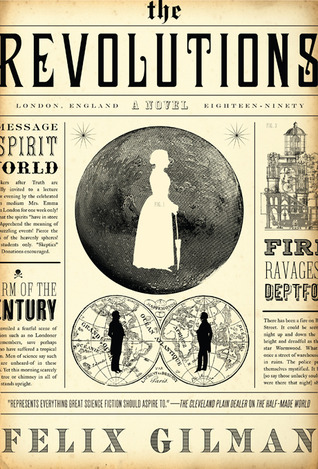
Arthur Shaw is not the most interesting man in the not-quite-historical Victorian London of Felix Gilman’s The Revolutions. That’s a problem, since he’s one of the main characters in the book. Thankfully, Shaw’s very mundanity – he needs a job and is willing to do just about anything for money – leads him into something very interesting indeed.

Oh, and there’s his fiancé, Josephine, who makes for a considerably more interesting companion.

This London is one where the kind of quasi-scientific spiritualism that was popular in our reality was not just popular, it was actually true. In particular, Arthur and Josephine find themselves bound up in a group trying to astral project to other planets, particularly Mars. Doing this requires not only the right people (sort of – the group gets less selective as things progress), but massive calculations produced by a massive machine with countless human parts. Babbage’s engine writ large.

The book takes a while to set all this up, which is either fascinating world building (for me) or dull sluggishness (for others). Things really kick into high gear when one of the astral flights is interrupted by Arthur, leaving Josephine trapped – in spiritual, if not physical form – on one of the moons of Mars.

What Gilman does next is a clever sleight of hand. The book focuses on Arthur for a bit and how he and the rest of the society plan to get Josephine back. Just when you think she might be nothing more than a damsel in need of rescue, the POV shifts and we’re treated to Josephine’s lengthy observation of (and, eventually, interactions with) the Martians and their society. This is the best part of the book, harkening back to the days of science fiction before science itself killed off the chance of finding life on Mars. Reminds me of some of the more esoteric parts of The Martian Chronicles.

Naturally, a rescue mission is mounted and while it has its own charms as an adventure story, it can’t match the peak that is Josephine’s experience with the truly alien. But all stories must end and I’d be lying if I said that the ending ruined all that came before.

So Arthur might be kind of dull. Don’t let that put you off. He’ll lead you into some very neat places.

Print

Weekly Watch: Breaking Bad

A little while back I confessed that, although I had enjoyed the first season of Better Call Saul I had not seen a minute of that show’s mothership, Breaking Bad. It wasn’t that I was unaware of it or avoiding it out of some hipsterish notion of cool. It just got past me (why must there be so much good TV on at the same time on the same night of the week?). But I read the hype and knew the show’s reputation. Now I’ve gone back and done my due diligence. Did it live up to the hype?

Abso-fucking-lutely.

I usually try to push back against the hype on things like this, at least a little bit, but, damn, I can’t really do it here. Breaking Bad is everything great storytelling should be, tightly plotted and filled with well drawn, memorable characters. Moreover, it uses the visual and audible aspects of television in ways that most shows never dream of.

If you’ve been under a rock for the past few years, Breaking Bad is the story of Walter White, a high school chemistry teacher who turns to cooking methamphetamine (with the help of a former student turned junkie and small-time dealer, Jesse Pinkman) for money after being diagnosed with cancer. What plays out is Walt’s fall into ego-driven evil, as he finally finds personal satisfaction in his nearly pristine blue meth. It’s a reverse of the typical redemption arc where the bad guy comes good. Walt begins good (sort of) and goes very very wrong. It’s not uplifting stuff, but it’s riveting.

It’s not perfect, of course. It drags at times (particularly when it involves the long but inevitable rehab of Walt’s DEA Agent brother-in-law). Walt is occasionally too much James Bond or McGyver. And the entire premise – that ultra-pure meth would be that much more valuable – is dubious. But those are minor quibbles and, in the case of the last one, a great dramatic device for springing Walt’s ego upon us.

I suspect Walt might agree with that other great thinker, Zaphod Beeblebrox, that if “there’s anything more important than my ego . . .I want it caught and shot right now.” Starved for personal reward and nagged by the staggering success of former business partners, Walt repeatedly passes up moderately safe ways out of his life to as to continue his ego stroking meth cooks.

Equally important as a character, although it’s not played by any particular actor, is the War on (Some People’s) Drugs. Not only do we see both sides at play, but we see how inevitable it is that the drug trade continues on all the time. One of Walt’s ego problems is that when he tries to get out he finds out that others are selling blue meth that’s not as pure as his. It’s a personal insult. But dealers are going to sell whatever they can to those that want to buy, of which there will always be a supply. A war on what is essentially the human desire to soothe their lives will always be bound to fail.

While I came late to Breaking Bad proper, I read a lot about it while it was on the air, or shortly after it wrapped up. I noticed how images, phrases, and other parts of the series were seaping in the culture. It’s a TV show, right? So, of course they did. When a parent freaked out at finding Breaking Bad action figures on a store shelf somewhere, I chuckled and rolled my eyes.

But now, having watched the whole thing, the impact of the show on the culture kind of disturbs me. People know that, whatever its dramatic qualities (which are substantial), the show is basically about horrible people doing progressively more horrible things. Given that, things like producing a Breaking Bad vodka or Aaron Paul’s repeated attempts to capitalize on being Jesse Pinkman or the plans to open up a real Los Pollos Hermanos really rubs me the wrong way. It says something about our popular culture and the nature of celebrity and I’m not sure it’s good.

None of which takes away from the achievement of Breaking Bad (including Paul – Pinkman is, perhaps, the most sympathetic character, who consistently struggles with what he’s done and has so little idea of a better life that he can’t take any chance to find one). It is one of the gems of the current Golden Age of TV.

breaking_bad_css3_svg_raw

Weekly Listen: A Spark In the Aether

The subtitle for The Tangent’s latest album – it’s eighth – is “The Music That Died Alone Volume 2,” referencing the title of the band’s debut. Of course, the music it’s talking about – progressive rock – has never died, even if it did (to paraphrase Frank Zappa) “smell funny” for a while. But it’s thriving today, if not commercially than artistically. That’s due, in no small part, to The Tangent.

As the name suggests, The Tangent grew out of what was supposed to be solo project by keyboardist Andy Tillison. It grew into a real band for a few albums and has since morphed into a kind of revolving cast of players carrying on the band’s proggy project. Tillison is the central character (duties having expanded at times to include lead vocals and guitar), driving The Tangent on with his desire to bring fresh slabs of classic prog to the 21st Century.

Tillison’s never been coy about this. The first album uses a Hatfield and the North song (incorrectly titled, but whatever) in the middle of an epic. A Place in the Queue has a liner notes directing unsuspecting young readers toward Tales from Topographic Oceans (the prog equivalent to luring children into your van with candy). Hell, he even wrote a novella to go along with Not As Good As the Book which involves a far flung future and, naturally, Yes. Tillison is prog down to his bones.

On A Spark In the Aether, he lets it all out. Not only musically, but lyrically as well. Witness the epic “Codpieces and Capes,” which takes on the general slagging that prog has taken from the music press, concluding that those who fobbed it off as pretension were “so wrong” (but, in a bit of humor, “they were probably right about the rug.”). That being said, the album covers lots of ground, from the rocking title track, to jazzy ambience, and even some funky bits here and there.

The centerpiece of this album, however, is “The Celluloid Road,” which is a view of modern American through the lens of someone who’s never actually set foot here (although that doesn’t accurately describe Tillison). In other words, it’s less about how we actually are than how we project ourselves to be to the rest of the world via film and TV. It’s always interesting to hear how the rest of the world views us. In this case, it’s how the rest of the world views the way we view ourselves. It’s both amusing and a little disheartening. Said funky bits show up here in the “San Francisco” section (which mostly deals with it being destroyed in various movies – and this was written before San Andreas!).

This isn’t a Tangent masterpiece, but I’m enjoying it a lot more than Le Sacre du Trevail, which I found to be really dire and depressing. There’s nothing wrong with a bit of fun. So come on in and prog your brains out. Don’t forget to bring your cape!

TTiStif

Weekly Watch: American Crime

With a name like American Crime you’d be forgiven for thinking that the ABC show, which just wrapped up its debut 11-episode season, was another in the long line of TV shows about heroic cops nabbing bad guys. They’re popular for good reason – even I, the criminal defense lawyer, am not immune to their pull – but we hardly need another one on TV.  Good thing, then, that American Crime isn’t like anything else on TV.

That’s down to its creator, writer/director John Ridley, last seen collecting an Oscar for the screenplay to 12 Years a Slave. Rather than focus on the crime itself and the “solving” of it, the show takes one crime – a murder (nearly a double murder) in a nondescript California town – and shows how it impacts those caught up in its wake. Not only is that the focus, but Ridley showed that he didn’t really care about any traditional resolution to the case at all.

As a result, the focus is on several families dealing with the impact of the crime – the victims’ parents, the sister of the main suspect, the foster family of his heroin addict girlfriend, and the would-be family of the state’s first main witness. Issues of race, class, ethnicity, and gender bubble through the season, spurred by the stress brought on by the murder and its prosecution.

Amongst all these, the most fascinating was the Gutiérrez family. Tony, the younger of two children, unknowingly gets caught up in the fringes of the murder – he lent a car to a guy who was involved, but had no idea of it at the time. At the urging of his father, he cooperates with the police. This leads to him being arrested, charged as an accessory (mostly as leverage, it appears), and sent to juvenile detention. What happens from there is as heartbreaking as it is inevitable – treated like a criminal, like a thug, Tony becomes one, committing his own heinous act once released.

American Crime doesn’t look like anything on TV, either. A lot of the editing and camera work is intentionally disorienting (often we focus on the person being spoken too, rather than the speaker) and keeps you on your toes. Breaking Bad (Which I’m working through now, finally) may have been cinematic, but not like this. The closest precedent I can think of is Homicide: Life On the Street, which introduced TV to the hand held cinema verite style. Given that the technical flair is done in service of a bunch of fantastic performances and American Crime was always a fascinating, if grim, watch.

All that being said, the show’s greatest asset was also its greatest weakness. By stubbornly refusing to deal with the facts of the case itself, it was difficult to fully comprehend why the various parties involved were behaving the way they were behaving. How are we to judge the initial suspect’s reaction to being imprisoned and being turned into a political prop without having some idea whether he actually did it? He knew, after all. The end result is a fascinating exercise, but it rings a little hollow.

Regardless, I know the show didn’t have wonderful ratings, so kudos to ABC renewing it for a second season. With a new case on the horizon and a second chance to tweak the formula, I expect something even better.

american-crime

Weekly Read: Billy Lynn’s Long Halftime Walk

Billy Lynn is a soldier, 19 years old, and, thanks to an embedded Fox News camera crew, a big damn hero (to borrow a phrase). His long halftime walk isn’t his participation in a Thanksgiving Day football halftime show (starring Destiny’s Child), but rather the respite from the Iraq War that he and his squad, the Bravos, enjoy as a result of their celebrity. But
like all halftimes, it has to come to an end.

Although the action of Billy Lynn’s Halftime Walk takes place entirely on the day of said game (at old Texas Stadium – it’s a period piece, after all), its scope is a whole lot more ambitious. By dropping Billy and his mates in the middle of a charged up exhibition of pure Americana, Ben Fountain uses it to comment not just on the United States as a whole, but particularly on how the nation has interacted with the wars of the Bush administration. Or, more precisely, how we didn’t (and continue not to, really).

Everywhere he goes, Billy is confronted by people from all walks of life who want him to know how much they think of him and the work he’s doing. The platitudes have become so routine and meaningless they’re rendered in a kind of shower of buzz words devoid of any real meaning or context. It’s a brilliant device. More simply, the disconnect between the kind words and the lack of understanding is best symbolized by Billy’s simple quest for an aspirin – when confronted with the easy task of treating a headache, the home front fails miserably.

In fact, one of the failings of the book is that the people Billy interacts with are so monolithic in how they treat him that they lose any kind of individual identity. Aside from his sister, who begs him to go AWOL rather than return to Iraq, nobody at home has any real interest in what’s going on in Billy’s head. There is no conversation, for instance, with a veteran from Vietnam or what not who might better understand what Billy has gone through.

Which is disappointing, because not a whole lot happens during the day the book chronicles. Since the people Billy meets are all pretty much the same, the interactions become increasingly dull as Fountain’s main point gets beaten in again and again. Throughout there’s a tease of a film deal for the Bravos’ story, which is amusing enough (the best chance to have it made is to have Hillary Swank portray Billy), but is ultimately unresolved.

One of the interesting aspects of the book is how many real world people and places are referenced. That makes it all the more jarring when Billy and crew meet the owner of the Dallas Cowboys, who although he is clearly meant to be Jerry Jones cannot actually be Jerry Jones (for obvious reasons). It throws you off, as a reader, but you do get over it.

In the end, Billy Lynn’s Long Halftime Walk scores some points about modern American and our disconnect from the wars fought in our name (I came across it thanks to this article in The Atlantic, for example) and its dark undercurrent of humor makes it a quick read. But lacks the weight it might otherwise have carried.

BillyLynn-pb-cover

Weekly Watch: Justified

I should not like Raylan Givens. He is precisely the kind of rogue cop trope that drives me so completely nuts, not only as a viewer or reader but as a criminal defense attorney. You know the type – he can’t play by the rules because he’s just so righteous for tracking down bad guys. In spite of repeated violations of the law in ways that should end his career (or at least torpedo many cases he’s worked on), everybody kind of shrugs and winks because, hey, in the end he got the bad guy.

Nonetheless, I like Raylan. And, therefore, I liked Justified, the FX series based on the stories of Elmore Leonard, who created Raylan. That DNA is a lot of the reason Raylan works. He’s interesting enough as a character, a man sort of out of time with the modern world, that his inability to follow the rules kind of makes sense. Plus, when you put dialogue of the quality that populated Justified for so many years in his mouth it absolves a number of sins.

Which is not to say that Justified was ever a one-man outfit. It never could have succeeded if the other characters weren’t as well drawn and executed as Raylan. That goes not only for the major recurring characters, such as the outlaw yin to Raylan’s yang, Boyd Crowder, a racist drug runner with occasional bouts of preaching and speechifying, but with all the supporting characters. Bad guys, too. Justified had the best, most interesting and complex bad guys this side of The Wire.

Another thing Justified had going for it, which it also shared with The Wire (and all of David Simon’s Baltimore stuff, really) is a setting that you don’t see anywhere else on TV. Harlan County was already etched onto the national consciousness as a hardscrabble coal mining region (thanks largely to this award-winning documentary) before Justified came along. But the show made the most of that setting (even though it was shot in California) and what it meant for the people who lived there. Maybe I just liked seeing it because it could have very easily been set across the border in West Virginia, with Raylan working out of my courthouse in Charleston.

Justified never quite got its due while it was on the air. Most critics loved it, but it was never quite able to break through to that top tier of awards. Part of that’s timing. This is a golden age of TV, after all, and it’s hardly Justified’s fault if it was lost in the shuffle to the likes of Breaking Bad, Mad Men, the HBO stuff, and it’s own stable mate The Americans.

Justified was not groundbreaking and maybe not all that deep, but it was damned entertaining. It seemed to take pride in being smartly entertaining, too. I think Elmore would be proud.

Justified

Weekly Read: Fields of Blood

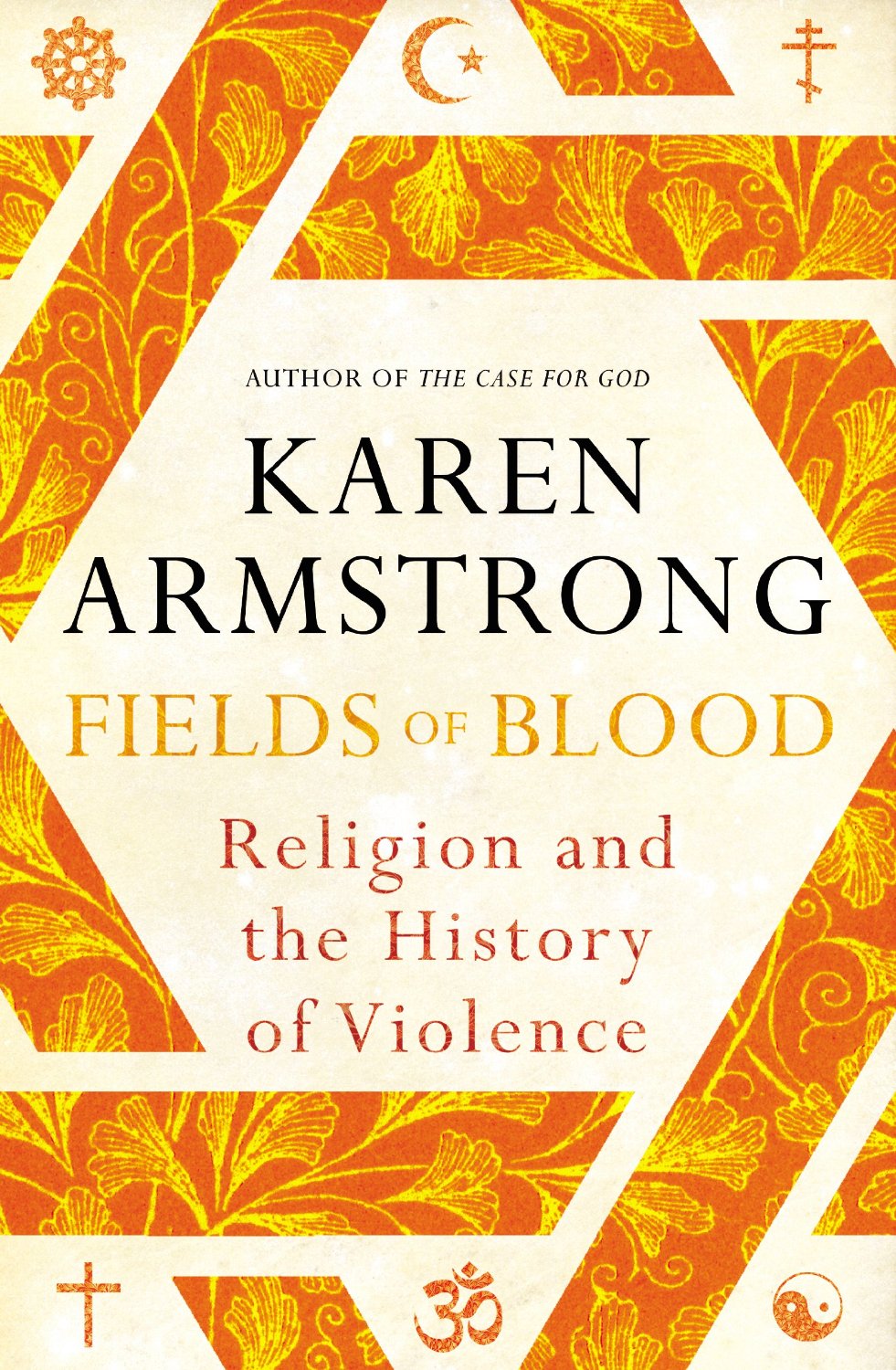
I spent most of my time reading Fields of Blood, Karen Armstrong’s epic history of violence and religion, waiting for the other shoe to drop. Just what was Armstrong’s end game? She leads off repeating the straw man argument that religion is responsible for all wars on the planet (an argument she places on the lips of anonymous folks rather than actually quoting one). But surely, if that’s all she was up to, it wouldn’t take more than 500 pages and 5000 years of human history to debunk. That would be rhetorical overkill.

A secondary argument to counter – one I’ve actually seen in the wild, at least – appears in the afterword, identified by Armstrong as the idea that religion is responsible for more death than any other cause. It’s another pretty easily rebutted argument, but one that, curiously, Armstrong can’t defeat, due to the way she frames the entire book.

The frame, essentially, involves two foundations. First, civilization – not just modern civilization, but all civilization – is inherently violent. Coercive violence is inherent in civilization and its development because without the ability to take other people’s stuff no upper classes will ever develop that will then have time to do things like invent stuff, ponder the great questions, and write large tomes about the history of religion. Second, until a few hundred years ago (in Europe – other places caught up later) religion was intrinsically linked with the rest of life, including politics. The idea of “religion” as a separate thing just didn’t exist.

As a result of all this (and we’ll assume, for our purposes, that her foundations are accurate), we can’t single out “religion” as the cause of any nasty things because it’s just part of a society as a whole that’s doing them. Religion, Armstrong argues, is an attempt by humans to give meaning to their lives, including the horrible violent things they do. Sometimes, it might even reign in our worst impulses. Having said that, she admits near the end that those attempts usually fail.

The upshot of all this is that not just religion in general, but specific religions, are made up of various strains that are at odds with one another, even if they arise from the same holy text. Armstrong does a good job at showing how particular religions throughout history morph from one form to another in order to keep up with prevailing times.

One particular example comes from Judaism, in which the Talmudic stories of King David and the conquest of Palestine – written at a time when such conquering was going on and needed justification – were retconned by future rabbis after the Romans brutally put down a Jewish revolt and destroyed the temple in Jerusalem. In other words, presented with evidence that a more martial glaze on the old stories wasn’t working, they changed their meaning into one of metaphorical struggle of an oppressed people.

Now, here’s the thing – that’s actually good. People who change their minds when new evidence comes to light are rational, thoughtful, and should be applauded. But they weren’t just revising a political philosophy, they were recasting stories of an allegedly divine origin. This is something Armstrong never deals with that distinguishes religion from other schools of thought. Religious texts are (mostly) based on the idea that they are pipelines to a higher truth. If that’s true, they shouldn’t be so malleable in human hands. Otherwise, what’s the point?

Having said that, it’s hard to disagree with Armstrong, so far as her basic thesis goes. As an atheist, I certainly agree that religion is a human construct, not the product of revelation or supernatural spiritual insight. It’s a messy contradictory thing precisely because it’s rooted in humanity. But I’m not sure what that gets her, since she appears to be trying defend religion from unfair criticism.

Armstrong can’t win the second argument noted above with this conception of religion. If it has been, for millennia, an integral part of society, so much so that people didn’t have a separate concept of it, then it’s as responsible for past violence as society as a whole. So what is Armstrong’s goal in doing all this?

It winds up being a gargantuan No True Scotsman fallacy, in which Armstrong suggests that people who claim religious motivations for violent acts are, in essence, bad a religion. This is most clearly evident in her discussion of Al Qaeda and the September 11 attacks.

After a lengthy examination of how a lot of modern Islamic fundamentalism is a response to ham-handed colonial policies (on that theme I think she’s right), Armstrong notes how many of the 9/11 hijackers were fairly Westernized. Nor, she argues, were they particularly devout Muslims before becoming involved with Al Qaeda. This is not unusual, as she cites a study of more than 500 people involved in carrying out the attacks that shows only 25% fit the mold of holy warriors when they joined Al Qaeda.

However, she then struggles with the fact that, once a part of Al Qaeda, they did become holy warriors engaged in jihad, filled with tales of martyrdom. To her, the problem wasn’t religion itself, but not enough of it – had the hijackers really known what the Koran said, they would never have carried out the attacks. She specifically concedes that the hijackers themselves surely saw themselves as religiously motivated, but that’s only because they were bad at Islam. In Armstrong’s telling, religion never fails, it is only failed by the humans acting in its name.

Armstrong returns to this defense – “but the book says . . .” – over and over again, but it doesn’t do her any good. First, it presumes there is one correct way to read any holy text. As her own history extensively shows, different people read the same texts very differently. Second, it ignores the fact that actions matter more than words. In another example, she notes that a particular group of terrorists in the Middle East thought themselves bound by Islamic law to avoid violence against civilians. Nonetheless, she explains how they took civilians hostage, which is a violent act in anybody’s book. Actions, not words, are what counts.

Third, and most troubling for the entire book, is Armstrong wants to view religion’s role in violence as simply as the critics to which she is responding. If it’s not THE cause, she seems to argue, it is exonerated. She ignores (or breezes right past) the role religion can play in making killing of the other guy all right, even if the underlying cause isn’t religious. The American Civil War is an example of a war that was purely political, but both sides thought they were doing God’s work. Ever listened to the “Battle Hymn of the Republic”? It’s all about how righteous the Union cause was.

Another issue that pervades the book is Armstrong’s problems with actually deciding what “violence” is, as seen in her discussion of American fundamentalists. They, compared to their overseas counterparts, are not violent, Armstrong says, ignoring the various instances (Ku Klux Klan, Jim Crow, abortion-related murders and bombings, gay bashing, etc.) where they have been. But then she turns around and charts their rise partly to a reaction against “psychological violence,” which she defines as, essentially, modern secularists saying mean things about them. By stretching the term to meet an immediate rhetorical goal, it loses all relevance.

I think the biggest disappointment with Fields of Blood is that I actually agree with a lot of points Armstrong makes. She’s absolutely correct that the causes of conflict are numerous, complex, intersecting, and can’t be reduced to sound bite descriptions. Similarly, the irrationality that can be the hallmark of religion can be replaced with secular variants of irrationality, too, such as cults of personality or the aftermath of the French Revolution (not to mention the otters). Nor is she wrong that secular states – like the United States – have a record of violence that is nothing to be proud of.

In fact, I think Armstrong and I would agree a lot on what’s wrong in the world and how to fix it. On this issue, however, she’s just not able to get around the fact that some people do horrible things to other human beings (to quote Frank Zappa) “’cause they don’t go for what’s in the book / ‘n that makes ’em bad.” Until she confronts that, Armstrong has a massive blind spot that even a tome like Fields of Blood can’t fill.

Fields of Blood

Weekly Watch: Better Call Saul

Confession time – I have never seen minute one of Breaking Bad. Not out of any critical motive, mind you. It just slipped past me until it was one of those “catch up with it on Netflix” someday things. On the other hand, when the prequel/spinoff featuring Walter White’s trusted attorney, Saul Goodman, premiered, I was on top of it. Aside from the glowing early reviews it’s a lawyer show, which I have a hard time ignoring. Thankfully, the early reviews proved accurate.

“Better Call Saul,” as I understand it, was the tagline in the TV ads Saul Goodman used to drum up business in Breaking Bad. But as this series starts, there is no Saul Goodman (except in a brief flash forward), only Jimmy McGill, struggling lawyer. Jimmy has a con artist past (when he was known as Slippin’ Jimmy) and brother, Chuck, who’s a partner in a big law firm. However, Chuck is now confined to his home by a psychosomatic illness involving an aversion to electrical devices. Nonetheless, Chuck is who Jimmy aspires to be, although without the mental issues.

Thus the first season is basically the tale of Jimmy trying to find his legal niche. He as some connection to Chuck’s law firm, but it’s unclear what that was until several episodes in. On his own, Jimmy resorts to some old trick to drum up business (a staged rescue in which he’s the hero). It works, somewhat, and he stumbles into the field of elder law and even appears to genuinely care about his elderly clients.

But things go wrong when a big case falls into his lap. He enlists Chuck who, quite rightly, argues to bring in his old firm because they have the resources to handle it. Jimmy agrees, assuming that this is his ticket into the firm legitimately – as a rainmaker. Only he learns that not only will he not be welcomed into the firm it’s because his brother has been blocking him at every turn.

This leads to the key scene of the season and the one most interesting to me as a lawyer. Chuck, basically stands up for the standards of the profession. Jimmy, who got his degree from an off shore diploma mill and has a criminal past, doesn’t make the cut. Law is a sacred trust, Chuck argues, ones that doesn’t have any place in it for people like Jimmy. Lawyers bear a particular responsibility, not just to their clients, but to society at large. Being a lawyer, as Chuck tells it, is just as we real world lawyers want it to be.

But the joke’s on us, because for the rest of the population, we look an awfully lot more like Jimmy. It’s perhaps no surprise that when Jimmy becomes Saul he manages to drop in social standing, from not-quite-reformed con man to criminal defense attorney. After all, what kind of person defends murdering drug dealers for a living? At least that’s what people think (and sometimes tell you!).

By the end of the season, Jimmy’s had one more chance at being “respectable” and turns it down. Does it mean that he’s completely turned the corner into the criminal shyster he becomes in Breaking Bad (so I’m told)? Who knows. Maybe he just decided that his idea of respectable and Chuck’s are far apart and the legal profession has room for the both.

BCS_Press_Release_Digi_2_Sheet_-_PREFERRED_FILE_SIZE-720x551

Weekly Read: Sex Criminals

I’m not a big fan of “high concept” art, the kind of thing that can be pitched in a single, mind blowing sentence.  In my experience, the quality of the execution rarely matches the quality of the pitch.  There are exceptions, however.  How about this for a one sentence pitch: “Two people meet who literally stop time when they have sex.” Kudos to whichever of Matt Fraction or Chip Zdarsky came up with that idea.  More kudos for pulling executing that idea in a way that makes it funnier, and more thoughtful, then it probably has a right to be.

Sex Criminals is not a comic book about purveyors of kiddy porn, flashers, or the skeevy guys who lure kids into their vans with the promise of candy.  It’s a love story, really, about two people who share a very uncommon trait – when they have an orgasm, time stops.  Literally and completely.  They’re able to walk around in this stuck time – in a wonderful encapsulation of their personalities Suzie refers to it as “The Quiet,” while Jon calls it “Cumworld” (and uses the time to take a shit in his boss’s potted plant).  So they start exploring together when they hook up.

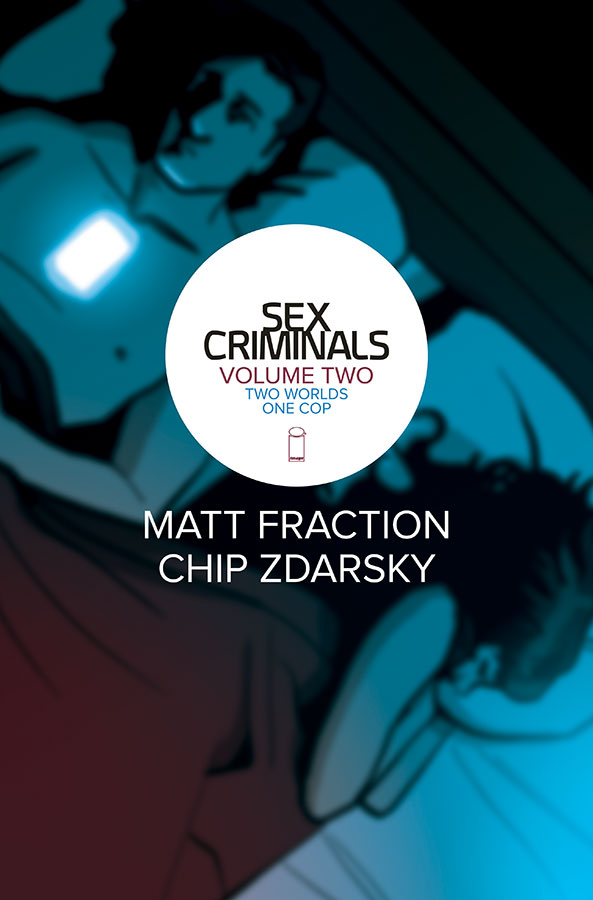
The first volume of Sex Criminals (One Weird Trick, collecting issues 1-5) is really funny, visually inventive, and unlike anything you’ve seen before. It ends with the arrival of a trio of self-appointed sex police who patrol The Quiet.*  The second volume (issues 6-10, dubbed Two Worlds, One Cop) expands the cast of characters and dives into some heavier relationship and personal issues, all the while exploring just what The Quiet is and who the cops are.

I admire Fraction and Zdarsky for taking that route.  Honestly, after the first volume their only other choice was to crank up the outrageousness and silliness of the whole thing, which probably would have spun out of control.  Making the whole thing more “real” (although that’s probably not the right word to use) sets things up better for a long term run.  It does mean, however, that the second volume isn’t quite as fun as the first, as the first blushing excitement of discovery is gone, for the reader as well as Jon and Suzie.

Nevertheless, they continue to tell their tale with style and wit, not to mention an astonishing frankness that you wouldn’t expect in a comic book.  Yeah, it’s smutty and explicit, but it’s fun and thoughtful and deeper that people might otherwise expect. Unless you’re a complete prude, it’s worth delving into Sex Criminals. Step into The Quiet.

* What, you think just because Jon and I share a first name I’m going to sling “Cumworld” all over the Internet? My parents read this!

sex-criminals-vol-01-releases

sexcriminals_tp_02

Weekly Listen: Hand. Cannot. Erase.

Without a doubt, Steven Wilson is the modern standard bearer for progressive rock.  Over the course of four solo albums since putting Porcupine Tree on hiatus, Wilson has reached a standard of success other proggers just dream of.  All right, he’s not Katy Perry, but his new album, Hand. Cannot. Erase., debut not just in the charts in Europe but near the top of several.  For a guy who’s spent the last few years channeling King Crimson, Yes, and a host of other terminally unfashionable bands (while remixing chunks of their back catalogs), that ain’t bad.

What’s more, Wilson’s done by producing four albums that are distinct from each other but still sound clearly like him.  Where The Raven That Refused to Sing (and Other Stories) fully embraced its 1970s proggy roots, Hand. Cannot. Erase. casts a wider net, harkening back not only to some of the more tuneful bits of Porcupine Tree (think Stupid Dream or Lightbulb Sun) but also other Wilson projects like Blackfield or even No-Man.  As a result, the album is more accessible, but no less interesting.  Each track, whether it’s an acoustic vocal piece or a frenzied prog workout, is deftly constructed and performed.

The performance comes largely from the band assembled to tour Grace for Drowning (and which made The Raven . . .), with some interesting additions, including a choir and some effective strings (arranged by the ever talented Dave Stewart).  Wilson does a lot of work himself, but he leaves the spotlight stuff to others, particularly guitarist Guthrie Govan, who has his usual shreddy self reigned in somewhat, to great effect.  There’s even a piece that’s basically spoken word, although I think it’s probably the weakest effort here.

Hand. Cannot. Erase. is a concept album, inspired by the story of Joyce Carol Vincent – a woman who died in her apartment and wasn’t found for three years.  She reportedly wasn’t a loner or recluse, had friends and family.  Wilson was drawn to the story by wondering how she got there.  As a result, this is kind of like Wilson’s run at Brave, the Marillion album inspired by a BBC report about a uncommunicative girl wandering on the Severn Bridge.  The album is Steve Hogarth’s attempt to figure out how the girl got there.

The comparison is inevitable and, unfortunately, Hand. Cannot. Erase. suffers for it.  Hogarth and company are expert at picking you up and wringing every bit of emotion out of you.  You feel for the girl in Brave, even if you never quite understand what went on in her head (there are also some broader swipes at the society in general that might have driven her there).  Wilson doesn’t work the same way, preferring a more detached observational approach.  He’s very Kubrickian in that way, which isn’t a bad thing (I loves me some Stanley), but it does make for a stark contrast.

All in all, Hand. Cannot. Erase. is another great effort from Wilson.  Highly recommended.

HCE-finalcover