Weekly Listen: The Race for Space

I’ve always had a soft spot for concept albums. There are such things as instrumental ones – Camel’s The Snow Goose comes to mind (along with every piece of orchestral program music ever) – but lyrics are usually a key part of playing out the concept. Words are important – but what if you use the words of others?

On the one hand, Public Service Broadcasting is an electronic (mostly) pop duo that makes interesting, textured, music. But what really makes them stand out for the crowd is what they do with the words of others.

Using samples of speech isn’t a new thing, particularly with electronic music. My favorite examples are the conspiracy theorist preacher in The Orb’s “Salt”, who punctuates every statement by yell “fact!” and the more subdued, but just as loony, guy in Mogwai’s “Repelish” who explains why Led Zeppelin really wants you to go to hell.

PSB goes beyond that. They use speech samples to tell a story, to weave a narrative through an album that reflects a particular concept. It’s more than a trick or a fascinating experiment. It takes the whole project, which would probably be pretty good in the first place, and pushes it into greatness.

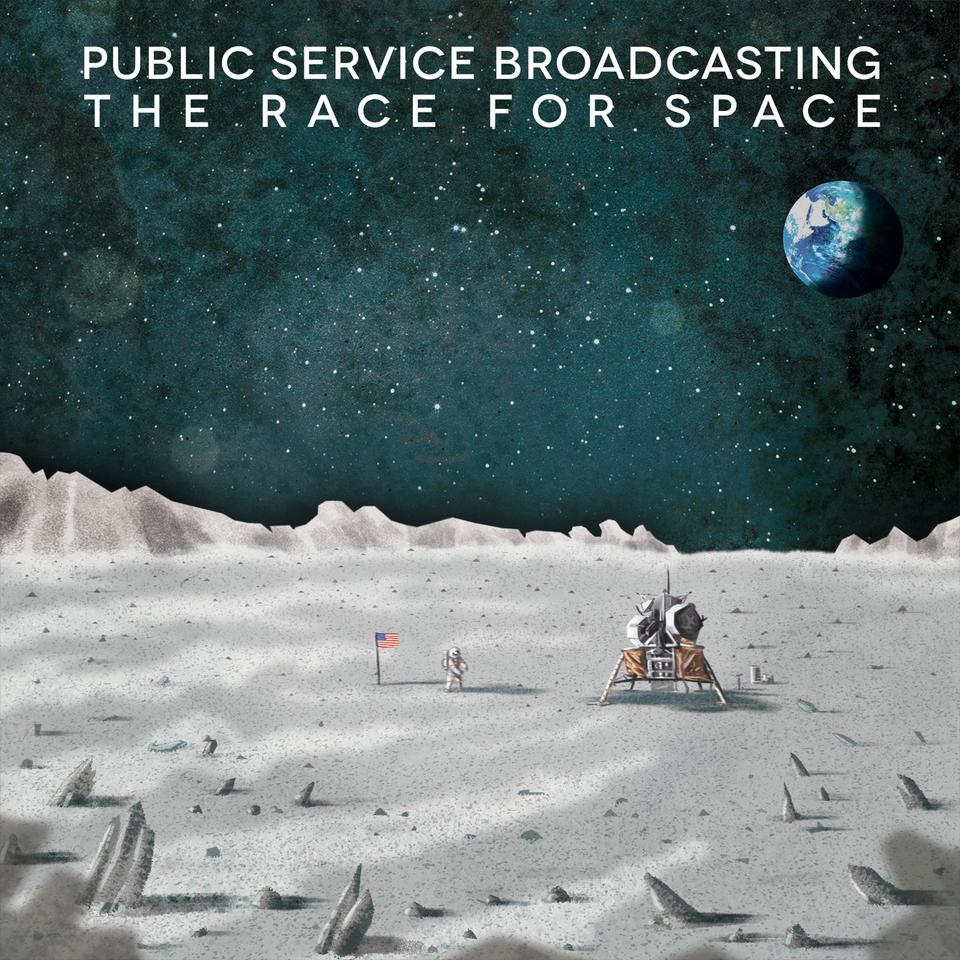
As you might have guessed from the title, The Race for Space is about the space race, in particular the glory years leading up to the moon landings. It starts with the title track, which is just John F. Kennedy’s famous speech (“we choose to go to the moon in this decade . . .” – you know the one) and some lush, slowly growing choral chords. But it serves as a statement of intent, of just what exactly you’re in for going forward.

From there on out, tunes jump from various space race milestones, both Soviet and American. The best of the bunch are “Sputnik,” which has a broad post-rock kind of feel, punctuated by lots of burbling synth goodness (mimicking the “bleep bleep” of the “new Russian moon,” as the narration says), and “Go!,” which takes the go/no go calls of the various departments checking in during the Apollo 11 landing. They way they’re edited together to work perfectly with the driving beat catches the excitement of one of humanity’s great achievements.

Of course, some of the milestones are a little less celebratory. Specifically, “Fire in the Cockpit,” which deals with the fire in the Apollo 1 capsule, is mostly a dirge with very serious explanations of what happened layered on top. Other tracks are more subdued and reflective, like “The Other Side” and “Valentina.” There’s even a bizarre change of pace horn-laden jam for “Gagarin.”

I learned about The Race for Space from Prog magazine. At first, it doesn’t seem like a natural fit. Aside from a bit of “E.V.A” where the rhythms get tricky, there’s nothing here that sounds “proggy.” But on the other hand, it’s a completely original and interesting album from start to finish, unafraid to head down whatever particular rabbit whole strikes its fancy. If that ain’t prog, I don’t know what is.
RaceforSpaceUS

RaceforSpaceCCCPjpg

Weekly Watch: Sicario

The War on (Other People’s) Drugs has always been great fodder for Hollywood. There are good guys, there are bad guys, and the violent nature of the drug trade means there’s lots of opportunities for shootouts and car chases and all the other action movie stuff that Americans love. Rarely do these movies ask if there might be something pointless about the whole exercise.

Sicario has a lot of those trappings, but they’re seen through a smudged lens. There are bad guys, all right. There are good guys, but from early on the question of just how good they are is in play. And there are plenty of well played action sequences, including the most tense road trip ever that didn’t involve your in-laws.

But there’s something else going on in Sicario, largely because the main character, played by Emily Blunt, has so little to do with the bigger picture into which she’s swept. She’s a tactical specialist brought into an operation that doesn’t have anything to do with her specialty (hostage rescue). That leaves her with lots of time to question the legality and morality of the entire operation. She never really comes around, but gets beaten down by what she sees.

It’s an interesting narrative choice. A more traditional approach would have made Benicio del Toro’s character the protagonist, which would fit comfortably into the ever popular revenge fantasy niche (del Toro, by the way is fantastic – Oscar, here he comes). But that would make us root for him in a way that making Blunt the main character doesn’t allow. We look at what she does with the same kind of (hopefully) disgusted detachment.

That being said, what does Sicario say about the War on (Other People’s) Drugs itself? Two things, both of which aren’t likely to come through in your typical action flick.

For one, the film implies that the high minded ideals of the war are actually just cover for much more personal motives. The head of all this covert fun, Josh Brolin’s character, first tries to convince Blunt that his strategy is about luring a big cartel’s main man in the US to go to Mexico, to the big boss, since they don’t know where he is. Blunt’s objection that they don’t have jurisdiction in Mexico is waved away. Next, he tries to justify the op with a kind of drug-fueled real politik – that the actual problem is the expanding number of cartels shipping drugs to the US and that the solution is to make sure there are fewer of them that can, at least, be more easily controlled.

All this is, to put it politely (oh, spoiler alert!), bullshit. At its heart, the story Sicario tells is a revenge story. Del Toro’s character, who’s position in the governmental hierarchy is never nailed down, is in it to avenge the death of his wife and child. Thus, all the issues about violating another nation’s sovereignty and the scope of a particular agency’s authority are pushed aside for the most personal of motives.

The other thing that comes through comes as a result of some scenes in Juarez, Mexico, that follow a Mexican state police officer (an important distinction from the Mexican federal officers). His son plays soccer, which is just a detail about his home life until the very end. His mother takes him to a game, played on a bare dirt lot in Juarez, around which the sounds of gunfire rattle off every few moments. At first it’s unsettling, but everyone goes on with their lives.

The point, it seems to me, is that even after a great blow has been struck against the bad guys, the problem continues to exist. My theory has long been that the reason the War on (Other People’s) Drugs is destined to fail is because it’s actually a war on human desire, a desire to escape the shitty world around us. Sicario seems to agree that it’s ultimately fruitless, but on other grounds.

Either way, it’s refreshing to see a movie that, on the one hand, is set up to be the conventional good guy v. bad guy story, then turns out to ask deeper questions. Throw in lots of great performances and some really tense set pieces and Sicario is an excellent, if unsettling, piece of work.

Sicario

Weekly Read: Machine Man

A few weeks ago I wrote a review of the new 3rDegree album, Ones and Zeroes Volume 1, which is about great leaps forward in life extension technology, overseen by a powerful corporation, that ultimate results in the uploading of human consciousness into a computer. I have no idea of the guys in the bad are familiar with Max Barry’s Machine Man, but they really ought to talk.

Two key refrains from Ones and Zeroes kept running through my head while reading Machine Man. One is the plea, “tell me what it means to be human?” The other is the observation that “life is needing more.” Good science fiction, of course, deals squarely with “what it means to be human” and Barry does just that in Machine Man.

Dr. Charles Neumann – Charlie to those lesser beings he allows to get within speaking distance – is a research engineer at Better Future, the kind of soulless, mega corporation that would have to have a name like that (it reminds me, over and over, of Veridian Dynamics from the all-too-short-lived series Better Off Ted). One day he loses a lower leg in an industrial accident. He gets a prosthetic leg, but isn’t much taken with it (he’s much more taken with the protheticist, Lola). As an engineer is apt to do he starts  tinkering, building a better fake leg. So good, in fact, that he decides he’s really being held back by his other “good” leg. So off it comes.

Rather than being locked away in an asylum or left penniless and unemployed because of his antics, Better Future sees Charlie as a visionary, someone who can open up a whole new market for them selling medical products to people who aren’t actually sick. It’s a neat setup, but one that only really works because of a decision Barry makes that is both fascinating and limiting.

Machine Man is told entirely from Charlie’s point of view. We are in his head (or whatever passes for his head) from beginning to end. This works really well in putting us  inside the mind of someone who comes up with a nice justification for a desperate act and follows that down the rabbit hole. On the other hand, it means we’re stuck with Charlie. In addition to being kind of a dick (we will tell you what’s wrong with everything, including you), Charlie is incredibly naive. He never thinks twice about the broader problems that Better Future’s plans may cause – indeed, he frequently protests that he only ever wanted to build parts for himself and fuck anybody else. That allows Better Future to have a hold over Charlie that a more thoughtful character would be able to shake. It’s not fatal to the book, but it is kind of aggravating.

To Barry’s credit, the devotion to Charlie’s POV means there are no bits of the narrative that devolve into a pro/con argument about Charlie’s augmentation. The argument is there, but it’s more subtle and comes from his interactions with Lola and the fact that we can’t get away from his very selfish and limited view of the world. It’s argument by example, rather than rhetoric, and works pretty well.

Which makes Machine Man seem like a dour trek. In fact, it’s very funny. Darkly funny, but still. The opening chapter, in which Charlie’s resolve to find his cell phone (without which he’d be lost) leads to the loss of his leg, is hilarious. It gets less so the further things go, but Barry never lets go of the fact that he’s telling a story that is absurd and getting more so the longer it goes on.

It’s not perfect. It’s just not believable that the goings on in Charlie’s lab – his army of assistants undergo quit the transformation – could have stayed contained within Better Future in the YouTube age. Someone would have talked or tweeted or Instagrammed and all hell would have broken loose. Barry gets away with a setting that’s almost hermetically sealed from the rest of the world. And it goes on a bit too long, with the emotional punch of a potential ending giving way to a happier conclusion.

Nevertheless, it’s a good read. One that’s bound to put music in your head, whether it’s this:

or this:

MachineMan

Weekly Read: A Consternation of Monsters

A group of crows is a murder. A bunch of lions hanging around is a pride. So what do you call a group of beastly, ghostly, ghoulish things all packed into one place? A consternation, of course.

In this short story collection Eric Fritzius introduces us to a whole host of supernatural creatures, some more monstrous than others. In fact, he does a really good job of weaving in stories full of humor and cleverness among the more serious and terrifying. It would be easy for a collection of monster stories to devolve into variations on the same them. Fritzius studiously avoids that.

In fact, my favorite story in the collection is a funny one, “. . . to a Flame,” which stars (although that’s not the right word) one of West Virginia’s native monsters, Mothman. Particularly, it involves a local who accidentally kills one. There are problems of disposal and the lurking possibility of a visit from Men In Black, but the heart of the story, for me, is the conversation between the shooter and the narrator in which the shooter goes to great lengths to explain his error.

My other favorite is less directly funny, but has a bit of comedic irony at its core. In “The Wise Ones” we meet an old woman and her dog who are, naturally, not quite what they seem. The story works so well because this mystical woman, when stripped of her powers, is still clever and ruthless (and, one suspects, has a killer sense of humor).

A pair of stories, “The Hocco Makes the Echo” and “Puppet Legacy” involve the same character in a different way. Aaron is a child in “The Hocco . . .” when the titular beastie makes its appearance. Then in “Puppet Legacy” we see an older Aaron who discovers a monster of an entirely different type in his own family. It’s interesting to see the two stories play off against each other.

Add to all that stories about the real fate of Elvis, the strangest boating disaster you’ve ever heard of, and a wolf with a view of some very human monsters and there’s a lot to sink your teeth into here. It being a short story collection some stories work better (as I’ve said before) and some just don’t land, but the ratio of what worked for me versus what didn’t was very high.

A Consternation of Monsters is well worth the time if you like weird tales filled with weird creatures. Just don’t read it alone with the lights off!

Consternation Cover

Weekly Read: The Water Knife

There’s a scene deep in Kevin Smith’s Dogma in which Rufus, the thirteenth apostle, explains to a credulous Bethany who she can be a descendant of Christ. “Mary,” she points out, “was a virgin.” Rufus explains that while it’s true Mary was a virgin when Christ was born, she was married to Joseph for an awful long time after that. Why assume she stayed a virgin? He concludes:

The nature of God and the Virgin birth, those are leaps of faith. But to believe a married couple never got down? Well, that’s just plain gullibility.

That scene popped into my head late in The Water Knife, the new novel by award winner Paolo Bacigalupi. It’s set in the American southwest, mostly Phoenix, Arizona, in a near future where climate change has displaced populations and fueled droughts that have made water the most precious commodity on earth. Life is pretty much lived to find water, either by scrambling with other refugees at a pump set up by the Red Cross or by being part of the upper crust that lives in high rise arcologies that are self contained recyclers of water.

It’s not the setup that’s the problem. Like any piece of science fiction there are certain things that are, to borrow Rufus’s term, “leaps of faith.” Bacigalupi isn’t leaping very far, to be honest. The world he creates is terrifyingly plausible, if not without its blind spots (the role of the federal government in all this, which still exists but allows states to war on each other, is never really explained). It’s rich, in a gritty, ugly sort of way and is fully convincing even if one might be able to pull at some of the details.

No the need for gullibility comes when the story requires us to believe that characters won’t behave like people or submit to the basic laws of biology.

There are three main characters in the book, united by a set of water rights with nearly mystical powers that could be a game changer for the whole Southwest. It’s pretty much a McGuffin, a genre appropriate version of Pulp Fiction’s glowing briefcase, but it does drive people to do some really awful things.

Before I go any further – this is really a brutal book. I’ve seen comments in various places from readers who just stopped and gave up at certain points. I don’t blame them. In addition to the horribles entailed in living in an arid, post-apocalyptic tableau choked with refugees and amoral operators, there are scenes upon scenes of pure savagery. In fact, each of the three main characters is brutalized pretty severely (and in detail). Yet they manage to shake it off, for the most part.

Said characters are Angel, the titular Water Knife, a local reporter named Lucy, and a teenaged Texas refugee named Maria. Angel is sent from Nevada to figure out what’s going down in Phoenix. Lucy is trying to do the same, hunting for a big story and trying to figure out what got a friend killed (and brutally tortured – detail we get second hand). Maria just wants to get out, constantly scrapping to figure out how to get north. They all orbit each other, though Angel and Lucy pair up about midway through the book for good.

And I mean “pair up” in the Biblical sense. The sexual activity between the two of them is so clichéd and obvious that it really disappointed me Bacigalupi went that route. Lucy has no reason to trust, much less desire, a man whose profession is strangling cities like Phoenix of their water (he has the book’s first scene, where he rides Apocalypse Now style in a chopper that attacks an Arizona city’s water plant). Nonetheless, she sleeps with him, because, why not?

She also betrays him, which sets up the true gullibility moment. As I said all three characters are brutalized (the women basically for fun, which says something). Angel’s turn comes when the car he’s sitting in is ambushed by his own people. He’s riddled with bullets and smacked in the head by an exploding airbag. Not only does that not knock him unconscious, he manages to crawl away, only to fall head-first into an empty swimming pool (an interesting recurring image of Phoenix). After all this, which should leave him bleeding profusely, concussed, and probably with a broken neck he’s miraculously saved by Lucy and some hand-waving med tech.

This is where, even in the oppressive Phoenix heat, my snowmen started flying. As I said, the other main characters also suffer horrible abuse and manage to shake it off, but not quite like this (a minor character is up and walking a few days after having his kneecap blown away!). Unless Angel is superman – and there’s been no suggestion he is – he shouldn’t survive. At the very least, he should be incapacitated for the rest of the book. After that, I simply couldn’t care what happened to these people.

That’s not true. I kind of didn’t care all that much about these people to begin with. Angel’s basically a gun for hire. Lucy wants a big story, but doesn’t seem all that motivated by anything else until the very end. Only Maria is really worth rooting for, which makes the rather abrupt ending work in a way that it probably shouldn’t have worked.

I loved The Windup Girl and have really enjoyed Bacigalupi’s short stories. Unfortunately, The Water Knife doesn’t measure up. That’s no crime, but it’s perhaps a missed opportunity. Worth a read, but not essential, and certainly not one to pick up if you’re looking to have your faith in humanity restored.

The Water Knife

Weekly Watch: The Fifth Estate

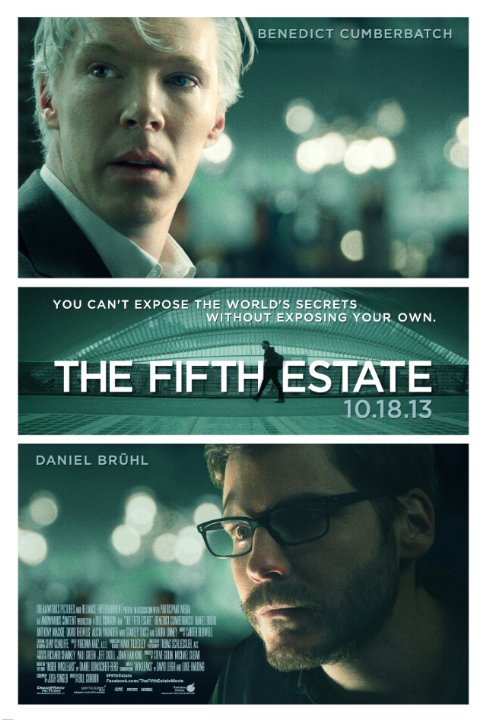
The Fifth Estate desperately wants to be a movie about Julian Assange, the enigmatic founder and leader of Wikileaks. Problem is, it’s not really a movie about Assange. Instead, it’s really about Daniel Domscheit-Berg, who worked with Assange for a few years. It’s based on his book (along with one other) and he’s clearly the audience surrogate – the one who lets us in on the story.

But since The Fifth Estate wants to be a movie about somebody else, we don’t really learn enough about Berg to care about him or his motivations. It’s unclear why he hooked up with Assange (they knew each other when the movie’s timeline starts, although they were just meeting in person for the first time) and whether their eventual rupture was inevitable or the result of Assange really going over a bridge too far.

The biggest problem with this isn’t that Berg’s story might have been more interesting – maybe it isn’t – but that without a good anchor into the broader story of Wikileaks the person the film wants to be the center of attention, Assange, isn’t that interesting, either. Benedict Cumberbach (sp?) does pretty well with what little he’s got to work with, styling Assange as an aloof egomaniac with a messiah complex who may, nonetheless, be doing the right thing.

The shallowness of all this is evidenced via a running joke, in which Assange will relate some harrowing experience and then quip that’s why he has white hair. Late in the film Berg offers the real secret – he dyes it (no shit!) because that’s what the cult in which he grew up did. Assange has already told us about the cult, so this really isn’t anything new. What’s set up as some kind of big reveal – I thought, perhaps, Assange’s whole back story had been a lie cooked up to enhance his image – really isn’t. You shrug and move on, just as with the rest of the film.

It doesn’t help that most of the action takes place on computers and Hollywood hasn’t really figured out yet how to make that interesting. The great achievement of The Social Network was making a story about computers about people instead, so the (very brief) bits of actual computing we see mean something. Too many of the characters in The Fifth Estate spend too much time tapping out stuff on keyboards that we, the viewers, can’t even read (seriously – when the climax is happening it’s nearly impossible to figure what people are saying to each other). At one point it looks like, in an accommodation for dramatic purposes, that folks might read what they’re typing in a voiceover, but that only happens once. Somebody should have stuck with that instinct.

Amidst all that I suppose it’s no surprise that the central conflict, brought into sharp relief by the release of documents leaked by American soldier Bradley (now Chelsea) Manning, almost comes out of nowhere. While there are earlier cites to the Wikileaks policy of never editing or redacting the documents they release, nobody really questions this policy or how it might run up against conflicting concerns (say, the safety of innocent third parties) until it actually happens. Some better philosophical and political groundwork would have made that climax more powerful and dramatic.

In the end, there are a couple of better movies waiting to escape The Fifth Estate, one about Assange and one about Berg. It’s a shame the creative team behind The Fifth Estate didn’t have the material to make the first one or the desire to make the second one. Don’t take my word for it – Assange didn’t like it either.

FifthEstate

Weekly Read: The Armageddon Rag

It’s hard to believe that, in an era when A Song of Ice and Fire and it’s TV variant, Game of Thrones, are such cultural icons that there was a time when George R.R. Martin was a failed novelist. Commercially speaking, at least. After a handful of short-story collections and novels (including the very good Dying of the Light), The Armageddon Rag was such a flop when it came out in 1983 that (in Martin’s words) it “essentially destroyed my career as a novelist at the time.” He went to work in television for the next several years before he returned to novels and began working on A Game of Thrones. Is The Armageddon Rag that bad? Should it have been commercial suicide? Those, of course, are very different questions.

Let’s take the second one first. It might not have been suicide, but The Armageddon Rag must have been a hard book to sell. It’s kind of a murder mystery, but it’s also a music soaked reflection on the lost dreams of the 1960s. Did I mention it involves raising the dead and a subtle kind of deep, dark blood magic? You can see the issue. It’s fantasy, but it doesn’t really have that feel, but it’s certainly not “realistic.” I can see why it sank, regardless of quality (which gives me pause, given my upcoming novel about zombies that really isn’t a zombie story – get me?).

Which is as shame, because it is pretty good.

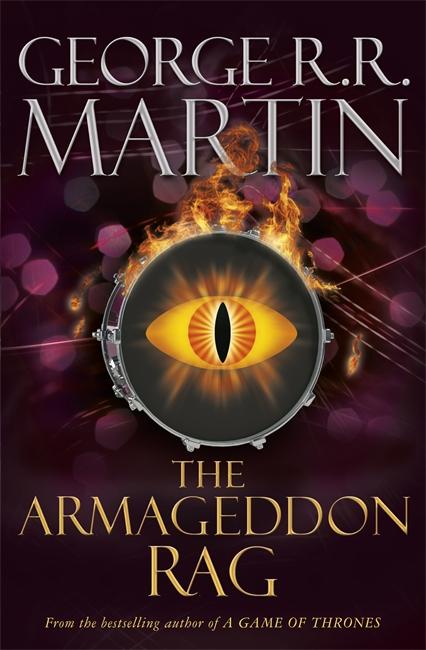
As I said, it starts with a murder mystery, in which our hero, Sandy, starts to investigate the grisly, ritualistic murder of the former manager of a band called The Nazgul (yes, it’s a Tolkien reference – check out the graphic on the bass drum on the cover below). They were a fast-rising proto-prog/hard rock band that’s career was cut short when, near the finale of a massive outdoor concert in New Mexico, their lead singer was shot and killed.

Sandy kicks off his investigation a dozen years later. But what starts as a mystery quickly swerves into a reverie for the 60s and the dreams of that era. Sandy puts from east coast to west (in his trusty RX-7), talking with the remaining members of the band as well as a group of his college friends, each of whom represents some version of the shattered hippie dream. There’s the sellout working in advertising, the burned out college professor, etc. The most poignant is a guy who’s controlling father (an Tom Clancy-type author referred to as Butcher Byrne *gulp*) basically drives him crazy and locks him away in the family mansion.

None of this has much to do with what appears to be the point of the story, which is why Martin deserves so much credit for making this bit fly by. Sandy’s road trip was probably my favorite part of the book.

Once Sandy hits the west coast, things take a turn. Sandy meets a guy who is planning a comeback for the resurrected Nazgul, one that is about more than just an 80s guy’s attempt to cash in on 60s nostalgia. This is where the blood magic starts to creep in. Sandy is wrapped up in this, of course, and, when push comes to shove and the band is raging through the title track one more time on that New Mexico mesa the fate of the world lies in Sandy’s hands.

Pity it takes so long to get there.

The first half of the book, which could have seemed too long and too untethered to the main story, flew by. Getting to know Sandy’s old friends was interesting, as was their different attempts to deal with the loss of their dreams and stick to their principles. It also contains a fantastic dream sequence while Sandy’s in Chicago that turns the 1968 protests into a real horror show.

The second half, by contrast, drags on as Sandy becomes the PR guy for the reborn Nazgul tour. We know early on this will all culminate with another concert in New Mexico and something is obviously going on, but we get length reports of multiple rehearsals and concerts that don’t really push things along all that much. Making things more frustrating is that as we grow closer to the climax we don’t get a much better idea of precisely why all of this is happening. It’s hard to see what new manager’s end game is. Perhaps that’s why, when the end finally comes, it sort of drops like a lump.

Having said all that, it’s still a pretty fun read. Martin obviously cares a great deal for the late 60s/early 70s music scene that the Nazgul would have inhabited and that shows through. The details of the band’s history, down to a discography and lots of song lyrics, are impressive, too. And it’s interesting to think about how even if music can change the world, whether it should.

The-Armageddon-Rag

Weekly Listen: Ones and Zeroes: Volume 1

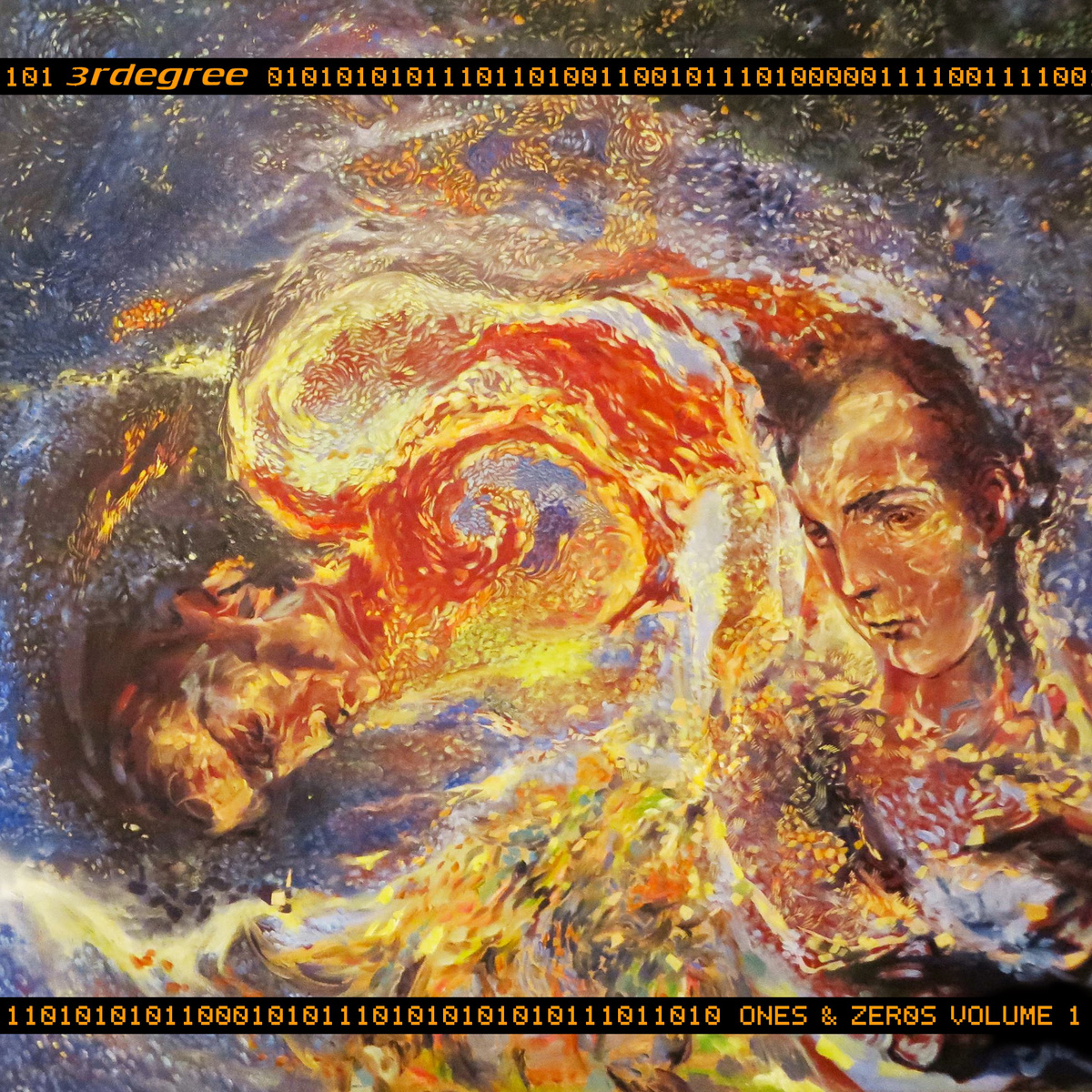
Since roaring back to life with 2008’s Narrow-Caster, 3rDegree has gone from strength to strength. Their 2012 effort, The Long Division, is one of my favorite albums. Does Ones and Zeroes: Volume 1 measure up and keep pushing the band forward? It’s too early to tell, but it keeps revealing great things on every listen.

The Long Division had a strong theme running through lots of it, but Ones and Zeroes goes a step further by being a full on concept album (part one of at least two, if I remember correctly). The concept revolves around a shady corporation, Valhalla Biotech, that sells a variety of life extension technology. As set forth in the band’s press release, the album “isn’t so much science fiction as it is a futurist album, expounding upon current trends in technology and leading them to their logical conclusion.” As regular readers know, just saying something isn’t science fiction doesn’t make it so. Ones and Zeroes is as sci-fi as they come, using advances in technology to explore our own humanity.

On the album that deals mostly with the question of what it means to be human? More particularly, what does it mean to be alive? If, as we hear over and over again, “life is needing more,” then the ultimate goal is to extend life forever. Along the way Valhalla goes from stocking “elixir centers” that extend “expiration dates” to realizing the dream of Ray Kurzweil – the uploading of the human mind into a computer where it could, theoretically, live forever.

Along the way, the band explores the various issues that would arise in this situation. There’s concern that this expensive tech will further class divides (there’s a voice over about the world’s oldest man watching his son die of old age) along with the idea that this might all be allowed under the theory that somebody will get there eventually (the Chinese, most likely), so “we” (whoever “we” are) might as well get there first. Most hilariously, the idea of a megacorp in charge of all this leads to the fact that, in “Life at All Cost,” the company tries to sell upgrades while peeling apart and scanning a client’s brain.

All in all, I get a strong Blade Runner vibe from Ones and Zeroes. Valhalla reminds me a bit of the Tyrell Corporation, whose motto, after all, was “More Human Than Human.” Is that where we are at the end of Volume 1? Seems that way. In addition, the need for more life echoes the demand of replicant Roy Batty that he “wants more life” as he kills his creator. So the concept has a lot of areas to explore and I’m sure I haven’t touched them all (I’m notoriously bad at sussing out album concepts).

But this is an album after all and none of that matters if the music is subpar.

Good thing that the music is up to 3rDegree’s usual high standards. The band has always walked a fine line between melodic accessibility and prog complexity, a mixture they’ve refined over the years. The result is a group of tunes that are instantly appealing but reveal depth and interesting details upon further listens. Believe me, once you’ve heard “This Is the Future” it will stick in your head (I dare you not to sing the backup vocals in the chorus!). Not to mention it makes the cheery yet disturbing voice overs of “We Regret to Inform You” go down easy!

If you look at the credits you’ll see no fewer than three guitarists were involved on this album. Lest you fear it’s an onslaught of power chords and shredding six strings, they’re actually fairly restrained. In fact, I’m not sure all three of them are brought to bear on any one track. There are some nice acoustic spots and George Dobbs gets plenty of room to lay out some nice synth solos.

There’s nothing on Ones and Zeroes that jumps out at me the way a few tracks did on The Long Division. But it works better as a whole, as befits a concept album. It’s a mess of awfully good music wrapped around an interesting idea. And the best thing? It’s only the first part!

OnesandZeroes

Weekly Read: Snuff

Snuff is a very funny book. On the one hand this should come as no surprise, given that it’s part of the late Terry Pratchett’s Discworld series, which is chock full of funny books. On the other hand it is kind of surprising because it is book 39 in the series (released only four years ago) and, at that point, one wouldn’t be surprised if Pratchett had shifted into coasting mode, resting on his laurels. Most long book series start off with a bang and slowly peter out. That Discworld didn’t is one of Pratchett’s many achievements.

Additionally, by this point Pratchett knew how not to play by the rules, if it suited his purpose. “Rules” tell writers that the inciting incident – the thing that drives the plot – should happen as early as possible in the book. It grabs the reader and focuses attention on what’s going on. But Snuff takes its leisurely time before things really get rolling, which allows Pratchett to do a lot of fun scene setting as his hero is transplanted from his familiar environment to something totally alien.

In this case, the hero is uber-cop Sam Vimes, head of the Ankh-Morpork city watch. Being a child of the Ankh-Morpork streets and a self-made man, Vimes is thrown into completely foreign territory when he and his family relocates to his wife’s family’s country home for a holiday. Awash in a world of rural oddities, rigid class barriers with matching rules of behavior, and the potential of not being a cop for a while, Vimes is completely, utterly, and hilariously at sea. In fact, I think I’d read a whole book of Vimes navigating this high society minefield.

But, this being a book about a cop on vacation, there is criminality afoot and it arrives in the form of the murder and mistreatment of goblins. Goblins are treated as vermin, killed or enslaved without thought, which rubs Vimes’s general egalitarian ideals the wrong way (in much the same way attitudes toward other non-humans did in Men At Arms). Vimes eventually gets his man, in rip snorting adventuring fashion, of course.

A large part of Vimes is that, regardless of where he is, mentally he’s always a cop. Similarly, just about wherever I am, I’m a public defender. That means that I can’t help but be troubled by Vimes as a cop. He’s given several chances to expound on law enforcement because he takes a young local constable under his wing and educates him. In particular, he excoriates the young constable for swearing allegiance to the local coven of magistrates who run the rural area rather than “the law.” It’s kind of inspiring, shot through with the idea that the law isn’t what men make it out of convenience and that all men are subject to it.

But Vimes then goes forth and makes the law whatever he wants it to be in order to get the bad guy. Most obviously, Vimes is a cop from Ankh-Morpork and has no jurisdiction outside the city walls. Several people mention this, but it doesn’t stop Vimes, who gets wishy washy about how some crimes are so horrible that jurisdiction is a technical issue to be dealt with later. He repeatedly uses threats of private violence (at the hands of his butler) to coerce information from people. He approves of vigilantes, noting that the law tends to deal with the lightly, if at all. He also shows no qualms about enforcing laws that aren’t even laws yet (involving goblin rights) – so much for ex post facto! To be fair, Lord Vetinari calls Vimes on this eventually, but it’s clear from the context that he’s throwing up a technical legalism (he cops to being the “local tyrant”) that the powerful hide behind.

To be fair, Vimes worries a bit about all this. Not a lot, but enough to recognize that his playing fast and loose with the law is something other people could do, too, and that might make it bad. But his wife shuts down those thoughts pretty quickly, countering that that it’s not so bad so long as it’s a good man doing it for a noble purpose.

Of course, that’s the problem. As I’ve noted before our culture loves stories about cops who work outside the confines of the law to get the bad guy. But bad cops do the same and – guess what? – they mostly think they’re doing it for the right reasons. Law places limits on behavior to prevent that from happening. Benevolent despots might not be that bad, but most despots aren’t benevolent, so that kind of unchecked power isn’t a good thing.

None of that should take away from the fact that Snuff is a fun, quick read. Pratchett was a master of language, puns, and quick jokes that land when you least expect them, yet manages deep sympathy with his characters. And Vimes really is a good guy, which makes his squishy relationship with the law so troubling. I wonder if characters like him contribute to the general idea that anything is OK in pursuit of the bad guy, whatever that might entail.

snuff

Weekly Read: Kindred

It was completely coincidental – honestly – that I started reading/listening to Kindred when the latest national debate about the Confederate battle flag sprang up. Still, the timing was auspicious. In a world where 12 Years a Slave can bring the brutality and savagery of slavery into your living room it’s worth remembering that reading is the best way to really get inside someone else’s experience.

Dana is a modern (the book is set in 1976) African-American woman living with her husband in Los Angeles. They’re both writers, she having just sold her first short story (to The Atlantic – ah, how nostalgic!). Everything’s great until, one day, Dana is pulled back to a Maryland plantation in 1819, drawn there by the peril of a boy named Rufus Weylin. He’s drowning. Dana saves his life. Dana is then repeatedly drawn back to save Rufus at various times in his life.

But here’s the thing – Rufus’s father is a slave owner who has numerous people in bondage to work the plantation. Oh, and also? Rufus is Dana’s distant relation. Meaning, if he dies before he produces the offspring that is also Dana’s ancestor, she may die, too. As a result of all this, Dana eventually spends months on the plantation experience life as a slave.

Thus, Kindred is much less a time travel adventure than it is an attempt to give a modern reader a means by which he or she can experience a historical period. Aside from the generalized concern that if Rufus dies Dana might cease to exist (Back to the Future style) there’s little emphasis on the time travel itself. Butler was much more concerned with the day to day life of slaves, which Dana is able to both comment on and experience.

The experience, needless to say, is brutal. There are beatings. Families are destroyed as sons and daughters are sold away, usually to slave caravans heading for the deep south. There is a constant treatment of human beings not only as lower than their masters, but not really human at all. Rufus and his father routinely justify their conduct as merely dealing with property. It sounds as bad as it is.

What makes the litany of abuse even more profound is that Dana isn’t, really, a slave. After all, she’s not bought from someone else and nobody ever tries to exercise legal authority of her as such. Still, her position as an African-American – and a woman, to boot – leaves her with little agency over her own life when she is sucked back into the past. But it lets Butler play with the idea of how slaves (and others in similar positions) can find some agency in their own survival.

All of this works on many levels (as you can see here), but one that occurred to me is that Kindred works as a metaphor for the way we as a nation talk about our birth. Early on Dana explains the story of her family line, born from the taboo relationship between a white man and a black woman in the antebellum south. It’s presented in an idealized fashion, a story of true love defying the system and triumphing over long odds.

The truth, as Dana learns, is much messier. The man, Rufus, owned the woman, Alice. Not only that, Alice was actually born free but was brought into slavery by Rufus after she was caught running away with her husband. She is, for the rest of her life, property. Rufus rapes her, repeatedly, producing multiple children (including, eventually, Dana’s direct ancestor). He beats her. Her only way out is to kill herself. Love doesn’t even get on the field of battle, much less conquer all.

So, too, our view of the country’s founding. We like to think of the American Revolution as a bold strike against tyranny, a fight for freedom. While there’s some truth to that, it’s a freedom that’s limited to a fairly narrow group of people. Only about a third of American colonists supported Revolution, after all. Furthermore, after the lofty rhetoric of the Revolution itself, the Founders enshrined slavery in the Constitution, along with a certain bit of dysfunction that hampers us more than two centuries later. History is complex and messy, on a national level no less than the familial one. I doubt it’s a coincidence that Dana’s ordeal ends on July 4, 1976.

Since I was waffling on about genre here the other day, I should say a word about where Kindred fits in. I’m a bit surprise to see it repeatedly referenced as “science fiction.” Sure, time travel is a beloved sci-fi trope, but Butler doesn’t make any attempt to “science up” Dana’s travel. That’s not her focus, so why bother? Jo Walton at Toris right that this is “fantasy time travel, not science-fictional.”

Not that it really matters in the end. Butler is doing what the best sci-fi and fantasy writers do – using the tools of the genre to explore humanity itself. In this case, it’s to hold a mirror up to a shameful part of our past that continues to resonate decades after Kindred was first published.

bc4c5-kindred2bbook2bcover