What Is Criminal Law, Chopped Liver?

Thanks to Orin Kerr over at Volokh, I saw this piece for a recent issue of Time magazine in which numerous scholars were asked to name the best and worst Supreme Court decisions since 1960. As with most such lists it’s only interesting in prompting discussion, not as a real normative exercise. It’s also interesting for what is completely absent from the discussion.

The cases mentioned, either good or bad, all tend to be cases involving interpretation of the Constitution, rather than statutory or regulatory cases. That makes sense – statutory or regulatory decisions that get it “wrong” can be effectively overruled by Congress or the executive branch. Constitutional rulings, for good or ill, hang around longer.

Nor am I as surprised as Kerr that the folks sampled focused more on the long-term impact of a particular case than the legal reasoning of it. While lawyers and academics may get caught up in the details of legal reasoning, in the real world a case’s impact is the only thing that really matters. A well-reasoned case that reaches a wrong or otherwise bad conclusion still strikes me as a “bad” decision.

But putting all that to one side, while the cases cited by the panel cover a wide range of topics – free speech, racial and LGBT equality, federalism, etc. – there’s one area that’s overlooked completely. Much to my surprise, nobody thought a decision involving criminal law was among the Court’s best or worst in the last seven and a half decades.

A caveat – I realize that some cases that deal with other issues are criminal cases. I’m thinking of Texas v. Johnson, which involved flag burning. It only got to the Court because someone got prosecuted, but it’s really a First Amendment case, not a criminal law case. On garden variety bread and butter criminal cases, the surveyed experts are oddly silent.

Consider some of the landmark criminal law decisions issued by the Supreme Court since 1960:

  • Miranda v. Arizona (1966): Of “You have the right to remain silent . . .” fame.
  • Gideon v. Wainwright (1963): Of “if you cannot afford an attorney, one will be provided to you at no charge” fame.
  • Terry v. Ohio (1968): The birth of “reasonable suspicion” as a part of Fourth Amendment jurisprudence and, arguably, the beginning of the end of the Fourth Amendment.
  • Whren v. United States (1996): Enshrining the “objective” analysis for Fourth Amendment issues, effectively allowing cops to make stops on pretextural grounds.
  • Ohio v. Roberts (1980) & Crawford v. Washington (2004): Two for the price of one – in Roberts, the Court largely eviscerated the Sixth Amendment’s right to confrontation, so long as the evidence in question was otherwise “reliable,” while in Crawford the Court reversed, and held that confrontation itself is the Constitutional engine of reliability.
  • Apprendi v. New Jersey (2000): Holding that the Sixth Amendment required any fact that enhances a sentence to be alleged in an indictment and proven to a jury beyond a reasonable doubt. The basis, eventually (in United States v. Booker [2005]), for the declaration that the United States Sentencing Guidelines were, as enacted, unconstitutional.

And that overlooks every death penalty case for the past several decades. Given that all these cases involve interpretation of the Constitution and have had far reaching impacts (for good or ill – pick you side), it seems strange that not one of the 15 people interviewed for the Time piece picked one. The question is why?

Maybe it’s just a matter of limited room. In any “best/worst” list there’s going to be worthy items that just miss making the cut. Maybe some (or all) of those cases were considered and rejected. A lot of second choices, perhaps.

But I can’t help shake the idea that, just maybe, not a lot of people give a shit about criminal law, unless they’re directly involved in it. It’s easy to see yourself involved with a First Amendment issue or concerned about equality under the law. Less so when it comes to criminal procedure. Most people don’t care about things like confrontation of witnesses or appointed lawyers until they need it themselves. That’s partly why only now, after decades of unprecedented incarceration, does the public at large seem concerned about it.

Perhaps I undersell the academics in the Time piece. I hope so. One of the things that legal scholars and those of us in the legal community need to do a better job of doing is impressing upon people how issues that don’t necessarily impact them directly still need their attention when it comes to politics and policy. One way to do that would be to acknowledge how important the Supreme Court’s criminal docket is.

The Incredible Shrinking Second Draft

I have a weird way of handling second drafts, maybe a unique way.

It grew out of my day job, in which I sometimes have to synthesize argument originally made by other lawyers into a final brief. I quickly decided that just dumping someone else’s words into a brief and doing a quick edit wouldn’t work – we all have a different voice, after all. Just dumping was inelegant at best and headache inducing at worst.

Instead, I take the section provided by someone else and rewrite it in my own voice. The final product includes the same information, the same argument. But it sounds of a piece with what came before and what comes after. That’s the theory, at least.

I imported that system into my fiction writing. I take the first draft, print it out (usually as a PDF these days), then work my way back through it, rewriting from word one. That allows me to do a couple of things. Most importantly, it allows me to focus on the words themselves, the really bottom level grunt work of writing. That’s because I already know what happens to whom and where, so I don’t have to worry about plot stuff.

The other thing it does is it lets me fill in gaps that occurred in the first draft. Sometimes they’re gaps I didn’t realize at the time but that, as I go through it again at a brisker pace, make themselves known. Other times it’s because I was stuck on the first draft and didn’t want things to grind to a halt completely and I left myself a note to add something or expand something.

Either way, the usual has been for the manuscript to grow in the second draft. Moore Hollow was just over 50,000 words in the first graft, but grew to about 65,000 in the end. The Water Road, the first volume of the trilogy I have schedule for next year, grew from about 110,000 words to 135,000 in the end.

Which is what makes my experience with The Endless Hills kind of odd. This is the second book of The Water Road trilogy, and it wound up with about 127,000 words in the first draft. But after the second draft (which I finished last weekend), it’s actually dipped a bit, to 123,000. And that’s including a couple of new scenes or chapters that I had left behind in the first draft.

What the heck happened? A couple of things, both of them good (I hope).

First, I’ve become very sensitive about using dialog tags and trying to clean them out of my writing. For those not in the know, dialog tags are those things like:

“This is a dialog tag,” JD said, to nobody whatsoever.

There’s frequently skirmishes on writers forums about the need for them at all and whether, if you use them, you should just stick to “said” and let that be that. Earlier on I went the John Scalzi route and tried to use “said” exclusively and all the time. I think it goes back to my legal writing where ambiguity about who is speaking could be lethal to a legal argument. But for fiction tags can sometimes get in the way, particularly if you’ve only got a two-way conversation going on. So I took a lot of that stuff out on the second draft.

Second, I’ve also been trying to pare down my writing as a I go forward. Trying to do more with less, I guess you’d say. I’ve never been the most verbose of writers, but I’m not exactly Hemmingway brief, either. I think I’m getting better about tightening things up without sacrificing what’s important.

One of the things more experienced writers will tell you (if you listen) is that writing is as much craft as art. Becoming a better writer is partly down to learning how to do things better, from a mechanical point of view. Sitting down and writing something ten years after you started writing completely should be easier and be a better product when it’s finished.

At least that’s what I’m hoping!

Chasing the Dragon (After a Fashion)

There’s a thing long distance runners experience, a euphoria that comes over when they are almost completely exhausted, when they push through “the wall.” It’s called a runner’s high. It’s something I’ve heard about but never experienced – long distance anything, much less running, isn’t really my thing. But I think writers go through something similar.

I first noticed this in my day job. Doing appellate work for criminal defendants takes a certain kind of mindset. You’re representing people who have already been convicted (in most cases pleaded guilty) and been sentenced. The entire criminal justice system is now designed to keep those results in place – only about three percent of criminal cases in my circuit are reversed in appeal in some fashion.

Sitting down to work on an appeal, then, comes with a lot of negative baggage. Sometimes you don’t have any good issues to raise, but the client wants the appeal and you have to do the best with what you have. Other times you have what you think are good issues, but in the back of your mind know that the chances of success are still between slim and none.

That means when you start writing, you’re mostly thinking “this is shit. It’s pointless and it’s not going to work.” But somewhere along the line, usually a few days out from the deadline when the brief is all you’ve been working on for a couple of days, something happens. You start to believe in what you’re arguing. That argument that seemed hopeless before now seems pretty damned clever. In the push to finish the damned thing you now figure you’ve got a shot at winning.

You don’t, not really, but you think you do. It’s a writer’s high. You get so deep into it that any trace of doubt you once had is gone. It’s a pretty good buzz (and it usually wears off by the time you drive home).

Writing fiction can work in the same way.

I’ve been working on the second draft of the second volume of The Water Road, trilogy, The Endless Hills. It can be a slog. A few paragraphs here, a couple of pages there. If I get an hour or so on a weekend or day off I can maybe make it through a chapter and it feels like real progress. But because I’m focusing on more mechanical things sometimes the actual story seems obscure. Throw in breaks to get Moore Hollow published and promoted and I wonder if I’m doing anything worthwhile.

A couple of weekends ago, a bunch of things coalesced to give me lots of time to write. For one thing I didn’t have any other functions that weekend. For another, it was grey and rainy most of the weekend, so there was hardly a desire to go out (or, even worse, a need to do yard work). So I cloistered myself away in my studio and got to work.

Over several hours, spread across two days, I cranked through more than fifty pages of manuscript, about 8000 words. It’s not a huge chunk of the book (the first draft was 127,000 words), but it was enough – it covered several chapters – to get me back into the story a bit. It helped that I was working through the climax of the book, a bloody engagement between two armies called the Battle of Tivol Market. The rubber, so to speak was meeting the road.

Around mid afternoon on Sunday I had about reached my limit. I had other things I wanted to do (the pull of the PS3 and a room full of synths can be strong), but I also knew I needed to keep going. But powered by interesting electronic burbles from Bandcamp, I pushed on. After too long, the writer’s high started to kick in.

Not only did the actual writing get easier, like I had crested a rise and started to run downhill, but it seemed better. Connections between characters, the flow of the action (spread across four different POVs), and the endgame all came into focus. Just like when I reach this point in a brief and I think I might win, I started to think this was pretty good!

Maybe it isn’t (more editing is needed, of course). But it feels good, regardless, to suddenly have something flowing from your fingers that seems to be working! It gives you confidence to keep going, to keep plugging away, word after word, even when it seems like drudgery.

That’s my dragon to chase. Gotta get back at it.

Weekly Watch: Sicario

The War on (Other People’s) Drugs has always been great fodder for Hollywood. There are good guys, there are bad guys, and the violent nature of the drug trade means there’s lots of opportunities for shootouts and car chases and all the other action movie stuff that Americans love. Rarely do these movies ask if there might be something pointless about the whole exercise.

Sicario has a lot of those trappings, but they’re seen through a smudged lens. There are bad guys, all right. There are good guys, but from early on the question of just how good they are is in play. And there are plenty of well played action sequences, including the most tense road trip ever that didn’t involve your in-laws.

But there’s something else going on in Sicario, largely because the main character, played by Emily Blunt, has so little to do with the bigger picture into which she’s swept. She’s a tactical specialist brought into an operation that doesn’t have anything to do with her specialty (hostage rescue). That leaves her with lots of time to question the legality and morality of the entire operation. She never really comes around, but gets beaten down by what she sees.

It’s an interesting narrative choice. A more traditional approach would have made Benicio del Toro’s character the protagonist, which would fit comfortably into the ever popular revenge fantasy niche (del Toro, by the way is fantastic – Oscar, here he comes). But that would make us root for him in a way that making Blunt the main character doesn’t allow. We look at what she does with the same kind of (hopefully) disgusted detachment.

That being said, what does Sicario say about the War on (Other People’s) Drugs itself? Two things, both of which aren’t likely to come through in your typical action flick.

For one, the film implies that the high minded ideals of the war are actually just cover for much more personal motives. The head of all this covert fun, Josh Brolin’s character, first tries to convince Blunt that his strategy is about luring a big cartel’s main man in the US to go to Mexico, to the big boss, since they don’t know where he is. Blunt’s objection that they don’t have jurisdiction in Mexico is waved away. Next, he tries to justify the op with a kind of drug-fueled real politik – that the actual problem is the expanding number of cartels shipping drugs to the US and that the solution is to make sure there are fewer of them that can, at least, be more easily controlled.

All this is, to put it politely (oh, spoiler alert!), bullshit. At its heart, the story Sicario tells is a revenge story. Del Toro’s character, who’s position in the governmental hierarchy is never nailed down, is in it to avenge the death of his wife and child. Thus, all the issues about violating another nation’s sovereignty and the scope of a particular agency’s authority are pushed aside for the most personal of motives.

The other thing that comes through comes as a result of some scenes in Juarez, Mexico, that follow a Mexican state police officer (an important distinction from the Mexican federal officers). His son plays soccer, which is just a detail about his home life until the very end. His mother takes him to a game, played on a bare dirt lot in Juarez, around which the sounds of gunfire rattle off every few moments. At first it’s unsettling, but everyone goes on with their lives.

The point, it seems to me, is that even after a great blow has been struck against the bad guys, the problem continues to exist. My theory has long been that the reason the War on (Other People’s) Drugs is destined to fail is because it’s actually a war on human desire, a desire to escape the shitty world around us. Sicario seems to agree that it’s ultimately fruitless, but on other grounds.

Either way, it’s refreshing to see a movie that, on the one hand, is set up to be the conventional good guy v. bad guy story, then turns out to ask deeper questions. Throw in lots of great performances and some really tense set pieces and Sicario is an excellent, if unsettling, piece of work.

Sicario

Why The Muppets Doesn’t Work For Me

Last week, I had a chance to watch the pilot of the newest version of the Muppets, this time a prime-time sitcom called (creatively) The Muppets. In many ways it’s a setup taken from the beloved Muppet Show of the 1970s – our gang gets together and puts on a show every week, with backstage wackiness providing grist for the comedy mill. But something didn’t sit quite right about it with me:

There were a few good jokes, and it’s always good to see Dr. Teeth and crew back on TV, but the whole thing just didn’t work for me. I thought about it for a bit and finally figured out why. There’s one important difference between the classic Muppet Show and the new one, one that kind of ruins the whole thing for me.

If you look closely at the old Muppet Show, you’ll notice that it doesn’t take place in our world. Obviously, that’s true of any TV show with talking puppets, but what I mean is that it’s a Muppet world there – we’re just invited in every week. Look at the audience – it’s all puppets! It’s truly a fantastic thing, something that exists outside of reality and the humdrum of the real world. Human guest stars were clearly playing along for the fun of it.

By contrast, The Muppets is set in our world, modified slightly by the presence of a late-night talk show hosted and run by felt creatures (sort of like the kiddy morning show in that puppetastic episode of Angel). We’re not visiting their madcap, zany, confusing world – they’re visiting ours. And ours, well, kind of sucks in comparison.

I agree with David Sims, writing in The Atlantic:

But entirely gone is the manic energy of The Muppet Show, the classic behind-the-scenes formula that gave Jim Henson’s creations their big break. In its place is sardonic drudgery that makes for very unenjoyable viewing.

Dan Caffrey at the AV Club kind of hits on the same thing, from a different direction, when discussing a scene from that first episode:

Sometime later, there’s a flashback to the demise of Kermit and Piggy’s relationship . . .. The breakup itself isn’t anything surprising—Kermit has, quite fairly, grown tired of dealing with the constant bouts of vanity, jealousy, and anger from his famous partner—but then something unexpected happens. After he delivers the bad news, the handheld camera hangs on Piggy, shaking ever so slightly. Her breathing gets labored, her snout scrunches up, the camera continues to wobble. It looks like she’s going to cry—not the dramatic sob she’s done plenty of times in the past to get what she wants, but a stoic, painful, honest-to-goodness cry. Suddenly, we’re viewing Miss Piggy in a sympathetic light, thanks to the use of a convention we’ve seen in so many mockumentary breakup scenes before. Her character expands into something much more complex and—I’ll just come out and say it—human.

I don’t disagree with the technical aspects of the scene – they’re well done, even moving. But I don’t care because I don’t want Muppets who have real world problems. That’s the whole fucking point of the Muppets in the first place, isn’t it? If you’re telling stories that could just as easily be told with live people in their place, it seems kind of useless.

Let me say, at this point, that I’m talking strictly on a subjective level of “quality” here. The calls in some quarters for ABC to cancel the show because it’s “indecent” or whatever are just silly. Muppets dealing with some real world situations does not equal smut. You want smut with puppets? I’ll give you smut with puppets:

I’m clearly in the minority on this, but that’s OK. Over the years I’ve concluded I’m very hard on reboots for jettisoning what I see as the essential elements of the property being revived. Don’t care for Daniel Craig’s Bond flicks because, to me, they seem like generic action flicks, without the charm of the Bond flicks I grew up with. Don’t care for JJ Abrams’s reboot of Star Trek, which takes a thoughtful sci-fi property and turns into yet another excuse to blow shit up while being cool (I have more hope for his take on Star Wars, however). Just chock this up as another example.

Moore Hollow Monday – A Little History

Let me be very clear – Moore Hollow is a complete work of fiction. It takes place in a town I made up, Jenkinsville, which is the county seat of the equally imaginary Vandalia County. Still, that doesn’t mean there isn’t a little truth tucked away in there.

There are stories – rumors, in most instances – around elections in which people say that the dead continue to vote. It’s so pervasive that it led one small investigator to proclaim:

Oh my God! The dead have risen and are voting Republican.

Seriously, the problem arises because voter rolls don’t get purged very often, or very well, resulting in people who have died remaining eligible to vote (in a very hyper technical ignore the stink of rotting flesh kind of way). A Pew study in 2012 found that as many as 1.8 million dead people were still on the voter rolls. Still, there’s a pretty good gap between dead people still on the rolls and dead people actually voting.

In the wake of the 2012 election lots of officials in South Carolina asserted that hundreds of dead people had voted, an assertion made mostly in the context of the GOP push for stricter voter ID laws. More than 900, they said. As one lawmaker quipped:

We must have certainty in South Carolina that zombies aren’t voting.

Only, as with most things involving voting, the truth was much less sensational. The 953 votes found to have been cast by the (un?)dead weren’t cast in 2012, but in 74 separate elections over the course of seven years. In fact, the dead voters could be traced to a much more mundane explanation:

The report confirms what the State Election Commission had found after preliminarily examining some of the allegations: The so-called votes by dead people were the result of clerical errors or mistaken identities.

For instance, sometimes a son had the same name as a deceased father, and poll workers mixed up a dead father with a living son. (This happened 92 times in the initial probe, and then further investigation found seven more examples.)

That being said, examples of dead people voting pop up every now and then, as this article relates. In one instance in Tennessee, two dead people voted in an election decided by 20 votes. Still, there’s little evidence that it’s a problem that either determines elections or is part of a ploy used by the unscrupulous to win elections.

Which is where Moore Hollow comes in. West Virginia, southern West Virginia in particular, has seen its share of electoral fraud over the years. I even remember people joking about the dead continuing to vote (“early and often,” as they say) long after they shuffled off their mortal coil.

So it was natural to take the two strands and use them to create Thomas Owen Gallagher, aka King Tommy, aka The Cheat. King Tommy was the kind of politician who would do anything to win. Would he resort to voodoo, to strange instructions in a foreign book, to raise the dead and order them to vote for him? Of course he was! It’s what happened after that’s the crux of Moore Hollow, as Ben Potter returns to his great grandfather’s old stomping grounds to root out the truth. But what to do with it once he knows it?

Cover (KDP)

The hardest part of a mystery is deciding what to do once you’ve solved it.

Available next Monday, October 5, from

Amazon, Barnes & Noble, iTunes, and Kobo

Weekly Read: Machine Man

A few weeks ago I wrote a review of the new 3rDegree album, Ones and Zeroes Volume 1, which is about great leaps forward in life extension technology, overseen by a powerful corporation, that ultimate results in the uploading of human consciousness into a computer. I have no idea of the guys in the bad are familiar with Max Barry’s Machine Man, but they really ought to talk.

Two key refrains from Ones and Zeroes kept running through my head while reading Machine Man. One is the plea, “tell me what it means to be human?” The other is the observation that “life is needing more.” Good science fiction, of course, deals squarely with “what it means to be human” and Barry does just that in Machine Man.

Dr. Charles Neumann – Charlie to those lesser beings he allows to get within speaking distance – is a research engineer at Better Future, the kind of soulless, mega corporation that would have to have a name like that (it reminds me, over and over, of Veridian Dynamics from the all-too-short-lived series Better Off Ted). One day he loses a lower leg in an industrial accident. He gets a prosthetic leg, but isn’t much taken with it (he’s much more taken with the protheticist, Lola). As an engineer is apt to do he starts  tinkering, building a better fake leg. So good, in fact, that he decides he’s really being held back by his other “good” leg. So off it comes.

Rather than being locked away in an asylum or left penniless and unemployed because of his antics, Better Future sees Charlie as a visionary, someone who can open up a whole new market for them selling medical products to people who aren’t actually sick. It’s a neat setup, but one that only really works because of a decision Barry makes that is both fascinating and limiting.

Machine Man is told entirely from Charlie’s point of view. We are in his head (or whatever passes for his head) from beginning to end. This works really well in putting us  inside the mind of someone who comes up with a nice justification for a desperate act and follows that down the rabbit hole. On the other hand, it means we’re stuck with Charlie. In addition to being kind of a dick (we will tell you what’s wrong with everything, including you), Charlie is incredibly naive. He never thinks twice about the broader problems that Better Future’s plans may cause – indeed, he frequently protests that he only ever wanted to build parts for himself and fuck anybody else. That allows Better Future to have a hold over Charlie that a more thoughtful character would be able to shake. It’s not fatal to the book, but it is kind of aggravating.

To Barry’s credit, the devotion to Charlie’s POV means there are no bits of the narrative that devolve into a pro/con argument about Charlie’s augmentation. The argument is there, but it’s more subtle and comes from his interactions with Lola and the fact that we can’t get away from his very selfish and limited view of the world. It’s argument by example, rather than rhetoric, and works pretty well.

Which makes Machine Man seem like a dour trek. In fact, it’s very funny. Darkly funny, but still. The opening chapter, in which Charlie’s resolve to find his cell phone (without which he’d be lost) leads to the loss of his leg, is hilarious. It gets less so the further things go, but Barry never lets go of the fact that he’s telling a story that is absurd and getting more so the longer it goes on.

It’s not perfect. It’s just not believable that the goings on in Charlie’s lab – his army of assistants undergo quit the transformation – could have stayed contained within Better Future in the YouTube age. Someone would have talked or tweeted or Instagrammed and all hell would have broken loose. Barry gets away with a setting that’s almost hermetically sealed from the rest of the world. And it goes on a bit too long, with the emotional punch of a potential ending giving way to a happier conclusion.

Nevertheless, it’s a good read. One that’s bound to put music in your head, whether it’s this:

or this:

MachineMan

Moore Hollow Monday – Another Free Excerpt!

Welcome to another edition of Moore Hollow Monday! It’s time for another excerpt from the book, which comes out October 5.

In this excerpt, Ben winds up the day by taking a drive near Jenkinsville and has an unsettling experience:

The road out of the town was a highway in only the loosest sense of the word. There were just two lanes which made sharing the road with the occasional huge coal truck that lumbered by a challenge. Regardless, it appeared like one of the Italian Autostrade they abused on Top Gear compared to the tributaries that branched away from it. Some began with several hundred feet of pavement but turned quickly into dirt roads. Others were little more than goat paths, winding back into the hills, into the hollows, until they disappeared, swallowed by the mountains. He toyed, briefly, with the idea of picking one at random and driving up it, but he quickly thought better of it. For one thing, this was probably not the time to arouse the ire of the locals by banging down private roads. For another, he wasn’t sure he could find his way out once it was dark.

Nightfall came about half an hour after Ben left town. He stopped at a small convenience store, fulfilled the tank’s enormous thirst for fuel, and grabbed a cup of coffee. It tasted like it had been made from the warmed-over remains of a small woodland creature, but it made him fully alert. He got back on the road and turned north, back to town and back to bed.

There had not been much traffic on the way down, nor was there much on the way back. At some point, however, Ben picked up someone following behind him. They weren’t close enough to be dangerous, but the other car’s headlights became a constant presence in his rearview mirror. Ben didn’t give much thought to it except when the undulations in the pavement shot the lights’ full brightness into his eyes.

A few miles from town, something caught Ben’s attention, something he didn’t expect to see on a road like this. It appeared to be a person walking slowly down the road on the right hand shoulder. Ben clicked on his high beams, then the ridiculously powerful fog lights to try to provide more light for the walker. At the very least, he didn’t want to run him over. Under the best of circumstances, anyone walking down this road was taking their life in their hands.

Ben lifted off the gas and slowed down, trying to get a good look at the walker. It was a man, but Ben couldn’t tell anything else about him—his age or whether he was black or white. His clothes looked rough and ragged, but beyond a general impression, Ben couldn’t tell much else. Then he noticed something odd about the man. It was his gait, the way he was moving. It wasn’t really walking in the strictest sense. It was more of a shuffle, a slow plodding step that fell somewhere between a limp and a gallop.

It hit Ben’s mind so fast he said it aloud. “Don’t zombies walk that way? Slowly shuffling along?” he asked himself. “At least they do in the films.”

He thought about stopping to try to talk to the man, who showed no interest in the presence of the tank near him, but that was impossible. The car that had been a constant companion behind Ben was now right on his bumper, brought near when Ben slowed down. He pulled around the shuffling figure on the side of the road and accelerated back to full speed. Immediately, he began to look for someplace to double back. About a quarter of a mile down the road was a small church with an equally small parking lot. It would do as a place to turn around, so Ben signaled, slowed, and turned into the church parking lot.

The car behind did the same.

Ben’s eyes fixed on the white headlights in the rearview mirror, which were quickly augmented by flashing blue and red.

“Fuck,” Ben said quietly. He brought the tank to a stop, put the transmission in park, and set the parking brake. The flashing lights stopped behind him at a rakish angle across the driveway as if to block any avenue of escape. Ben rolled down the window and heard the sound of a car door closing behind him, followed by the approach of slow, measured, solid footsteps.

“Good evening, sir,” said a controlled voice, one that oozed authority yet at the same time was calm and polite. Before Ben could see his face, a large, bright flashlight lit up the interior of the tank. It scanned Ben’s face, his hands as they rested on the steering wheel, and his lap before it moved slowly around the rest of the interior.

“Evening, officer,” Ben said. He did his best to get a glimpse of the man with the flashlight, but the glare made it difficult. He could make out an outline, one that matched his preconception of what an American lawman would look like. Large and barrel-chested, shoulders squared off as if he played American football, topped by a broad brimmed hat like one the Royal Canadian Mounted Police wore. When the light dipped from inside the car, Ben could see a tag on his chest underneath a badge that read “Rhodes, Sheriff,” in block letters.

“Do you know why I pulled you over?” he asked, as the flashlight beam settled on Ben’s face once again.

“No, sir,” Ben said. He honestly didn’t know.

“You crossed the center line back there,” he said, gesturing back up the road with the flashlight.

“I did?” Ben asked. “Must have been when I went around that guy along the side of the road.”

“I’m sorry, sir?” The tone of the sheriff’s voice made it clear he was not engaging in small talk.

“There was someone on the shoulder, back up the road,” Ben said, pointing. “He was walking along the side of the road, very slowly. If I crossed the line, it must have been when I drove around him. I didn’t see anyone coming the other direction, figured I should give him a wide berth.”

The sheriff was not convinced. “License and registration, please, sir,” he said, holding out his other hand.

Ben fished the rental agreement and his International Driving Permit out of the glove box, then took his UK driver’s license from his wallet and handed the collection to the sheriff.

“Please wait here, sir,” he said without commenting on the documentation. Or even Ben’s accent for a change. He walked back to the car.

Ben sat in the tank for what seemed like an eternity. All of the paperwork was in order, he was sure of that, but he wondered whether a sheriff in West Virginia had any experience with international travelers. Ben didn’t like the idea of spending the night in jail if something went wrong. He’d been in jail before but on home soil. For away games, he always tried to be on his best behavior.

The sheriff returned with the same measured steps and handed the papers back to Ben. “Would you mind turning on the inside lights, sir?”

“Sure,” Ben said. He took the papers, stuffed them back in the glove box and after groping around for a bit, flipped the switch that lit up the myriad of lights inside the tank’s cabin.

The sheriff leaned down and rested an elbow in the window frame. “All your paperwork checks out,” he said with a somewhat softer tone. “Never had to run down one those IDPs before.”

“Is that right?” Ben said.

The sheriff nodded. “I’m not gonna give you a ticket. I didn’t see this guy along the side of the road, but you seem like an honest type. Just try to not go around weaving like that again, all right?”

“Yes, sir,” Ben said, breathing a sigh of relief. “Thank you.”

The sheriff tipped his hat. “So, you’re English.”

“That’s right,” Ben said. Everybody seems to make that point, but coming from a man of the law it was a little unsettling. It was as if he knew that Ben should be sent back from whence he came.

“What brings you to Jenkinsville then?” the sheriff asked. “It’s a long way from London.”

That’s for certain, Ben thought. “Trying to track down something historical,” he said. “Family business.”

“You’re not a journalist, are you, Mr. Potter?” The question was not friendly.

“Yes, sir, after a fashion,” Ben said. Why did everybody pick up on that about him? “But this is more of a personal trip, really.” It was only then that Ben thought he should have punched the record button on the recorder in his jacket pocket. Too late now.

“You have family around here?” the sheriff asked, chuckling.

“No, not anymore,” Ben said, reciprocating the laughter. “My great-grandfather came here to work years and years ago. I’m trying to find something out about his time here, about this place where he worked.”

“That a fact?” the sheriff asked. “Small world. ’Bout how far back was that, you think?”

“Early part of the last century,” Ben said. “About 1905, 1906.” He decided to float the actual year out in the air and see how the sheriff reacted. It might give Ben some kind of idea about the game he was playing.

“That is a long time back,” the sheriff said. “There is a bit of history in this neck of the woods, though. How long have you been in town?”

“I just got here yesterday, late,” Ben said. He anticipated the next question. “I plan on heading home by the day after tomorrow.” He was regretting the hole in his research about American police procedures. Was he free to go? Could he tell this officer he was tired and just wanted to go back to his hotel? Of course, even if the law on paper said he could, would that mean anything out here, in the dark, along the side of a two-lane country highway?

“I see,” the sheriff said. He paused for a moment as if he might be finished. He wasn’t. “Find anything interesting yet?”

“A few things,” Ben said, trying to remain vague. “Nothing concrete, just some background. It’s all from the public record, let me assure you.”

“Let me ask you something, Mr. Potter,” the sheriff said, shifting his weight from one foot to the other. “Let’s say you find whatever it is you’re looking for. Then what?”

“I’m sorry?” Ben asked. He wanted to nail down precisely what was being asked of him.

“You say you’re looking for something,” he said, “something that your grandfather…”

“Great-grandfather,” Ben corrected him by habit.

“Great-grandfather saw or that happened to him, is that right?” the sheriff asked without skipping a beat.

Ben nodded.

“So if you find something about it, what your great-grandfather dealt with, what are you going to do with that information?”

Ben decided to lie. It was his best option at this point. “It’s mostly for my own piece of mind, really,” he said. “My father and I have a long-standing argument about our family history. To be honest, and I’m ashamed to admit this, I’ve been having this fight with my father for years. I’d like to win it.”

“I understand,” the sheriff said sympathetically. “So if you find what you’re looking for, you’re just going to share it with a few people, right?”

“I can’t think of anyone outside of my immediate family who’d care about our squabbles.” At least that much was true.

“All right,” the sheriff said as if satisfied. He shoved a large hand in through the window. “Well, enjoy your stay with us.” They shook hands. “And remember…,” he began.

“Don’t cross the center line,” Ben said. “Thank you, sir.”

“Have a good evening, Mr. Potter,” the sheriff said as he turned and walked back to his car.

Ben let out a large sigh of relief. He waited for the sheriff to move his car, then he pulled out of the parking lot and drove back to town. It looked like the sheriff headed back south, which allowed Ben to completely relax.

Moore Hollow – The hardest part of a mystery is deciding what to do once you’ve solved it.

Preorder now at Amazon, Barnes & Noble, iTunes, and Kobo

Cover (KDP)

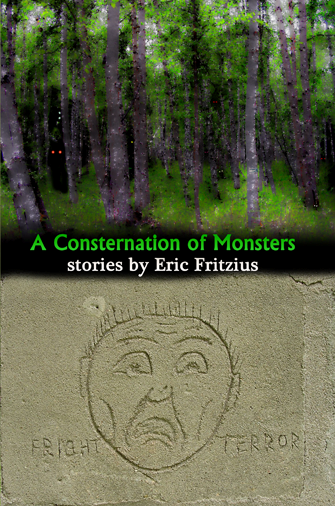
Weekly Read: A Consternation of Monsters

A group of crows is a murder. A bunch of lions hanging around is a pride. So what do you call a group of beastly, ghostly, ghoulish things all packed into one place? A consternation, of course.

In this short story collection Eric Fritzius introduces us to a whole host of supernatural creatures, some more monstrous than others. In fact, he does a really good job of weaving in stories full of humor and cleverness among the more serious and terrifying. It would be easy for a collection of monster stories to devolve into variations on the same them. Fritzius studiously avoids that.

In fact, my favorite story in the collection is a funny one, “. . . to a Flame,” which stars (although that’s not the right word) one of West Virginia’s native monsters, Mothman. Particularly, it involves a local who accidentally kills one. There are problems of disposal and the lurking possibility of a visit from Men In Black, but the heart of the story, for me, is the conversation between the shooter and the narrator in which the shooter goes to great lengths to explain his error.

My other favorite is less directly funny, but has a bit of comedic irony at its core. In “The Wise Ones” we meet an old woman and her dog who are, naturally, not quite what they seem. The story works so well because this mystical woman, when stripped of her powers, is still clever and ruthless (and, one suspects, has a killer sense of humor).

A pair of stories, “The Hocco Makes the Echo” and “Puppet Legacy” involve the same character in a different way. Aaron is a child in “The Hocco . . .” when the titular beastie makes its appearance. Then in “Puppet Legacy” we see an older Aaron who discovers a monster of an entirely different type in his own family. It’s interesting to see the two stories play off against each other.

Add to all that stories about the real fate of Elvis, the strangest boating disaster you’ve ever heard of, and a wolf with a view of some very human monsters and there’s a lot to sink your teeth into here. It being a short story collection some stories work better (as I’ve said before) and some just don’t land, but the ratio of what worked for me versus what didn’t was very high.

A Consternation of Monsters is well worth the time if you like weird tales filled with weird creatures. Just don’t read it alone with the lights off!

Consternation Cover