Why I Love The Knick

One of the side effects of living in the Golden Age of Television is that there’s so much good stuff out there it’s just a fact of life that some really good shows get overlooked. Take, for example, The Knick, which is two episodes into its second season run. Helmed by Steven Soderbergh (and created by Jack Amiel and Michael Begler), the show has all the hallmarks of being one of those everybody-talks-about it cable shows. Only it isn’t.

I can fathom a couple of reasons for this. For one thing, Friday nights have never been great for struggling TV series (ask Joss Whedon). For another, Cinemax has yet to have its critical and cultural breakout series like HBO and Showtime have. People might be forgiven for still thinking of it as Skinamax first and foremost, which probably doesn’t help the show’s profile.

Which is a shame, because The Knick‘s become one of my favorite shows on TV right now. Part of that’s down to the wonderful world building that’s inherent in a show that’s set in 1900-1901 (I discussed something similar in an old review of Mad Men). But part of it’s down to one element of the show that’s a complete and utter anachronism – the score.

Cliff Martinez – a long-time Soderbergh collaborator – could have taken the safe route and used music of the period (or new music styled to sound like the music of the period) as a means to deepen the world building. Instead, the score is entirely electronic, full of burbling sequencers and noises that weren’t even contemplated in 1901, much less actually heard. It shouldn’t work, but it does, and brilliantly.

I think that’s because the story of The Knick is one of cutting edge advancements in science, even if it’s science that’s more than 100 years old and sometimes hilariously wrong. Even though electronic music has been around in popular culture for decades it still sounds vaguely “futuristic.”

But it also allows Martinez to do things in service of the story telling that would be impossible with a more traditional score. Brandon Nowalk, writing about the latest episode at the AV Club, describes one example. It involves a regular character’s father, a preacher, who comes to visit from home (which is West Virginia, if I’m not mistaken). Naturally, he winds up preaching:

He talks about the diversity of New York City and how all its exotic peoples have as much to learn from them, good God-fearing Christians, as they do from the exotic peoples. Okay, he speaks in tongues a few times. It’s a ballsy move after calling actual Earth languages he’s overheard on his visit “strange tongues from Babel.” He claims it’s God speaking through him. And then composer Cliff Martinez, whose work is often beyond my ability to express, ramps up the theremin sounds like it’s a classic sci-fi horror scene. AD invites the congregation to sing, and we pan back to Lucy, joining in with everyone else without hesitation. Soon the spooky sounds drown out the singing so we’re watching a silent group move in unison to the oooh-OOOH of the theremins and thump-thump-thump of the beat. There’s no clue in Lucy’s performance as to what could be the matter, but maybe that mindless conformism is the point, a demonstration of AD’s power. It’s a thrilling scene that somehow remains essentially elusive.

You can see that scene for yourself here. It’s just one example, but it’s a really good one. And while that’s only one aspect of a show that’s really hitting on all cylinders, it’s the one that most clearly sets it apart from its peers.

Appearances, Both Virtual and In the Flesh

As we careen toward November and National Novel Writing Month, here are a couple of other places you can find me this week, on virtual, the other not so much.

First, head over to the Speculative Fiction Showcase and check out my interview with them. It’s a great site if you’re interested in fantasy, sci-fi, or the like (and if you’re not – why are you reading this, anyway?) and their questions were different and fun. Check it out.

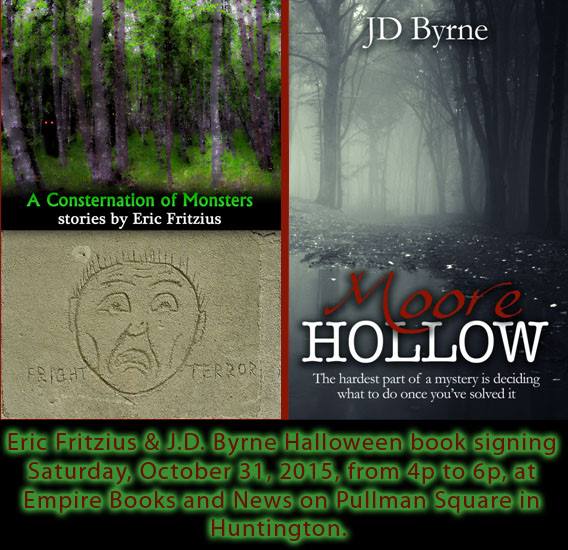
Second, this Saturday – yes, that would be Halloween – I’ll be appearing, along with Eric Fritzius (author of the excellent collection A Consternation of Monsters) at Empire Books in Huntington, West Virginia. We’ll be there from 4-6 pm signing and selling books, and even doing some readings from our books. I’ll try and find a suitably spooky portion of Moore Hollow to match whatever creepiness Eric will come up with.

SigningPoster

See you soon!

A Local Tradition Returns

I’m very happy that this weekend not only does a local Charleston tradition return, but that I’m going to be a part of it. After a couple of years’ absence, the West Virginia Book Festival is back!

2010_Bookfest_Logo

This year’s festival runs Friday and Saturday, October 23 & 24. It includes workshops on Friday, a huge used book sale from the Kanawha County Public Library on Saturday, and a lineup of presentations from some really great authors you might have even heard of:

  • Neil Gaiman
  • Jodi Picoult
  • Jeff Shaara
  • Jacqueline Woodson
  • Homer Hickam

Gaiman’s on Friday evening, everybody else is on Saturday. You can see the full schedule here.

In addition to all that, there will be a marketplace where numerous authors and publishers will be talking about books and selling them. That’s where I come in  – I’ll be in Booth 208 (over near the corner where the Books-a-Million area). I’ll have copies of both Moore Hollow and The Last Ereph and Other Stories for sale – including a super Book Festival Bundle deal where you can get both for a low low price.

Admission is free, so come check it out!

WV Book Festival

What Is Criminal Law, Chopped Liver?

Thanks to Orin Kerr over at Volokh, I saw this piece for a recent issue of Time magazine in which numerous scholars were asked to name the best and worst Supreme Court decisions since 1960. As with most such lists it’s only interesting in prompting discussion, not as a real normative exercise. It’s also interesting for what is completely absent from the discussion.

The cases mentioned, either good or bad, all tend to be cases involving interpretation of the Constitution, rather than statutory or regulatory cases. That makes sense – statutory or regulatory decisions that get it “wrong” can be effectively overruled by Congress or the executive branch. Constitutional rulings, for good or ill, hang around longer.

Nor am I as surprised as Kerr that the folks sampled focused more on the long-term impact of a particular case than the legal reasoning of it. While lawyers and academics may get caught up in the details of legal reasoning, in the real world a case’s impact is the only thing that really matters. A well-reasoned case that reaches a wrong or otherwise bad conclusion still strikes me as a “bad” decision.

But putting all that to one side, while the cases cited by the panel cover a wide range of topics – free speech, racial and LGBT equality, federalism, etc. – there’s one area that’s overlooked completely. Much to my surprise, nobody thought a decision involving criminal law was among the Court’s best or worst in the last seven and a half decades.

A caveat – I realize that some cases that deal with other issues are criminal cases. I’m thinking of Texas v. Johnson, which involved flag burning. It only got to the Court because someone got prosecuted, but it’s really a First Amendment case, not a criminal law case. On garden variety bread and butter criminal cases, the surveyed experts are oddly silent.

Consider some of the landmark criminal law decisions issued by the Supreme Court since 1960:

  • Miranda v. Arizona (1966): Of “You have the right to remain silent . . .” fame.
  • Gideon v. Wainwright (1963): Of “if you cannot afford an attorney, one will be provided to you at no charge” fame.
  • Terry v. Ohio (1968): The birth of “reasonable suspicion” as a part of Fourth Amendment jurisprudence and, arguably, the beginning of the end of the Fourth Amendment.
  • Whren v. United States (1996): Enshrining the “objective” analysis for Fourth Amendment issues, effectively allowing cops to make stops on pretextural grounds.
  • Ohio v. Roberts (1980) & Crawford v. Washington (2004): Two for the price of one – in Roberts, the Court largely eviscerated the Sixth Amendment’s right to confrontation, so long as the evidence in question was otherwise “reliable,” while in Crawford the Court reversed, and held that confrontation itself is the Constitutional engine of reliability.
  • Apprendi v. New Jersey (2000): Holding that the Sixth Amendment required any fact that enhances a sentence to be alleged in an indictment and proven to a jury beyond a reasonable doubt. The basis, eventually (in United States v. Booker [2005]), for the declaration that the United States Sentencing Guidelines were, as enacted, unconstitutional.

And that overlooks every death penalty case for the past several decades. Given that all these cases involve interpretation of the Constitution and have had far reaching impacts (for good or ill – pick you side), it seems strange that not one of the 15 people interviewed for the Time piece picked one. The question is why?

Maybe it’s just a matter of limited room. In any “best/worst” list there’s going to be worthy items that just miss making the cut. Maybe some (or all) of those cases were considered and rejected. A lot of second choices, perhaps.

But I can’t help shake the idea that, just maybe, not a lot of people give a shit about criminal law, unless they’re directly involved in it. It’s easy to see yourself involved with a First Amendment issue or concerned about equality under the law. Less so when it comes to criminal procedure. Most people don’t care about things like confrontation of witnesses or appointed lawyers until they need it themselves. That’s partly why only now, after decades of unprecedented incarceration, does the public at large seem concerned about it.

Perhaps I undersell the academics in the Time piece. I hope so. One of the things that legal scholars and those of us in the legal community need to do a better job of doing is impressing upon people how issues that don’t necessarily impact them directly still need their attention when it comes to politics and policy. One way to do that would be to acknowledge how important the Supreme Court’s criminal docket is.

The Incredible Shrinking Second Draft

I have a weird way of handling second drafts, maybe a unique way.

It grew out of my day job, in which I sometimes have to synthesize argument originally made by other lawyers into a final brief. I quickly decided that just dumping someone else’s words into a brief and doing a quick edit wouldn’t work – we all have a different voice, after all. Just dumping was inelegant at best and headache inducing at worst.

Instead, I take the section provided by someone else and rewrite it in my own voice. The final product includes the same information, the same argument. But it sounds of a piece with what came before and what comes after. That’s the theory, at least.

I imported that system into my fiction writing. I take the first draft, print it out (usually as a PDF these days), then work my way back through it, rewriting from word one. That allows me to do a couple of things. Most importantly, it allows me to focus on the words themselves, the really bottom level grunt work of writing. That’s because I already know what happens to whom and where, so I don’t have to worry about plot stuff.

The other thing it does is it lets me fill in gaps that occurred in the first draft. Sometimes they’re gaps I didn’t realize at the time but that, as I go through it again at a brisker pace, make themselves known. Other times it’s because I was stuck on the first draft and didn’t want things to grind to a halt completely and I left myself a note to add something or expand something.

Either way, the usual has been for the manuscript to grow in the second draft. Moore Hollow was just over 50,000 words in the first graft, but grew to about 65,000 in the end. The Water Road, the first volume of the trilogy I have schedule for next year, grew from about 110,000 words to 135,000 in the end.

Which is what makes my experience with The Endless Hills kind of odd. This is the second book of The Water Road trilogy, and it wound up with about 127,000 words in the first draft. But after the second draft (which I finished last weekend), it’s actually dipped a bit, to 123,000. And that’s including a couple of new scenes or chapters that I had left behind in the first draft.

What the heck happened? A couple of things, both of them good (I hope).

First, I’ve become very sensitive about using dialog tags and trying to clean them out of my writing. For those not in the know, dialog tags are those things like:

“This is a dialog tag,” JD said, to nobody whatsoever.

There’s frequently skirmishes on writers forums about the need for them at all and whether, if you use them, you should just stick to “said” and let that be that. Earlier on I went the John Scalzi route and tried to use “said” exclusively and all the time. I think it goes back to my legal writing where ambiguity about who is speaking could be lethal to a legal argument. But for fiction tags can sometimes get in the way, particularly if you’ve only got a two-way conversation going on. So I took a lot of that stuff out on the second draft.

Second, I’ve also been trying to pare down my writing as a I go forward. Trying to do more with less, I guess you’d say. I’ve never been the most verbose of writers, but I’m not exactly Hemmingway brief, either. I think I’m getting better about tightening things up without sacrificing what’s important.

One of the things more experienced writers will tell you (if you listen) is that writing is as much craft as art. Becoming a better writer is partly down to learning how to do things better, from a mechanical point of view. Sitting down and writing something ten years after you started writing completely should be easier and be a better product when it’s finished.

At least that’s what I’m hoping!

Chasing the Dragon (After a Fashion)

There’s a thing long distance runners experience, a euphoria that comes over when they are almost completely exhausted, when they push through “the wall.” It’s called a runner’s high. It’s something I’ve heard about but never experienced – long distance anything, much less running, isn’t really my thing. But I think writers go through something similar.

I first noticed this in my day job. Doing appellate work for criminal defendants takes a certain kind of mindset. You’re representing people who have already been convicted (in most cases pleaded guilty) and been sentenced. The entire criminal justice system is now designed to keep those results in place – only about three percent of criminal cases in my circuit are reversed in appeal in some fashion.

Sitting down to work on an appeal, then, comes with a lot of negative baggage. Sometimes you don’t have any good issues to raise, but the client wants the appeal and you have to do the best with what you have. Other times you have what you think are good issues, but in the back of your mind know that the chances of success are still between slim and none.

That means when you start writing, you’re mostly thinking “this is shit. It’s pointless and it’s not going to work.” But somewhere along the line, usually a few days out from the deadline when the brief is all you’ve been working on for a couple of days, something happens. You start to believe in what you’re arguing. That argument that seemed hopeless before now seems pretty damned clever. In the push to finish the damned thing you now figure you’ve got a shot at winning.

You don’t, not really, but you think you do. It’s a writer’s high. You get so deep into it that any trace of doubt you once had is gone. It’s a pretty good buzz (and it usually wears off by the time you drive home).

Writing fiction can work in the same way.

I’ve been working on the second draft of the second volume of The Water Road, trilogy, The Endless Hills. It can be a slog. A few paragraphs here, a couple of pages there. If I get an hour or so on a weekend or day off I can maybe make it through a chapter and it feels like real progress. But because I’m focusing on more mechanical things sometimes the actual story seems obscure. Throw in breaks to get Moore Hollow published and promoted and I wonder if I’m doing anything worthwhile.

A couple of weekends ago, a bunch of things coalesced to give me lots of time to write. For one thing I didn’t have any other functions that weekend. For another, it was grey and rainy most of the weekend, so there was hardly a desire to go out (or, even worse, a need to do yard work). So I cloistered myself away in my studio and got to work.

Over several hours, spread across two days, I cranked through more than fifty pages of manuscript, about 8000 words. It’s not a huge chunk of the book (the first draft was 127,000 words), but it was enough – it covered several chapters – to get me back into the story a bit. It helped that I was working through the climax of the book, a bloody engagement between two armies called the Battle of Tivol Market. The rubber, so to speak was meeting the road.

Around mid afternoon on Sunday I had about reached my limit. I had other things I wanted to do (the pull of the PS3 and a room full of synths can be strong), but I also knew I needed to keep going. But powered by interesting electronic burbles from Bandcamp, I pushed on. After too long, the writer’s high started to kick in.

Not only did the actual writing get easier, like I had crested a rise and started to run downhill, but it seemed better. Connections between characters, the flow of the action (spread across four different POVs), and the endgame all came into focus. Just like when I reach this point in a brief and I think I might win, I started to think this was pretty good!

Maybe it isn’t (more editing is needed, of course). But it feels good, regardless, to suddenly have something flowing from your fingers that seems to be working! It gives you confidence to keep going, to keep plugging away, word after word, even when it seems like drudgery.

That’s my dragon to chase. Gotta get back at it.

Weekly Watch: Sicario

The War on (Other People’s) Drugs has always been great fodder for Hollywood. There are good guys, there are bad guys, and the violent nature of the drug trade means there’s lots of opportunities for shootouts and car chases and all the other action movie stuff that Americans love. Rarely do these movies ask if there might be something pointless about the whole exercise.

Sicario has a lot of those trappings, but they’re seen through a smudged lens. There are bad guys, all right. There are good guys, but from early on the question of just how good they are is in play. And there are plenty of well played action sequences, including the most tense road trip ever that didn’t involve your in-laws.

But there’s something else going on in Sicario, largely because the main character, played by Emily Blunt, has so little to do with the bigger picture into which she’s swept. She’s a tactical specialist brought into an operation that doesn’t have anything to do with her specialty (hostage rescue). That leaves her with lots of time to question the legality and morality of the entire operation. She never really comes around, but gets beaten down by what she sees.

It’s an interesting narrative choice. A more traditional approach would have made Benicio del Toro’s character the protagonist, which would fit comfortably into the ever popular revenge fantasy niche (del Toro, by the way is fantastic – Oscar, here he comes). But that would make us root for him in a way that making Blunt the main character doesn’t allow. We look at what she does with the same kind of (hopefully) disgusted detachment.

That being said, what does Sicario say about the War on (Other People’s) Drugs itself? Two things, both of which aren’t likely to come through in your typical action flick.

For one, the film implies that the high minded ideals of the war are actually just cover for much more personal motives. The head of all this covert fun, Josh Brolin’s character, first tries to convince Blunt that his strategy is about luring a big cartel’s main man in the US to go to Mexico, to the big boss, since they don’t know where he is. Blunt’s objection that they don’t have jurisdiction in Mexico is waved away. Next, he tries to justify the op with a kind of drug-fueled real politik – that the actual problem is the expanding number of cartels shipping drugs to the US and that the solution is to make sure there are fewer of them that can, at least, be more easily controlled.

All this is, to put it politely (oh, spoiler alert!), bullshit. At its heart, the story Sicario tells is a revenge story. Del Toro’s character, who’s position in the governmental hierarchy is never nailed down, is in it to avenge the death of his wife and child. Thus, all the issues about violating another nation’s sovereignty and the scope of a particular agency’s authority are pushed aside for the most personal of motives.

The other thing that comes through comes as a result of some scenes in Juarez, Mexico, that follow a Mexican state police officer (an important distinction from the Mexican federal officers). His son plays soccer, which is just a detail about his home life until the very end. His mother takes him to a game, played on a bare dirt lot in Juarez, around which the sounds of gunfire rattle off every few moments. At first it’s unsettling, but everyone goes on with their lives.

The point, it seems to me, is that even after a great blow has been struck against the bad guys, the problem continues to exist. My theory has long been that the reason the War on (Other People’s) Drugs is destined to fail is because it’s actually a war on human desire, a desire to escape the shitty world around us. Sicario seems to agree that it’s ultimately fruitless, but on other grounds.

Either way, it’s refreshing to see a movie that, on the one hand, is set up to be the conventional good guy v. bad guy story, then turns out to ask deeper questions. Throw in lots of great performances and some really tense set pieces and Sicario is an excellent, if unsettling, piece of work.

Sicario

Why The Muppets Doesn’t Work For Me

Last week, I had a chance to watch the pilot of the newest version of the Muppets, this time a prime-time sitcom called (creatively) The Muppets. In many ways it’s a setup taken from the beloved Muppet Show of the 1970s – our gang gets together and puts on a show every week, with backstage wackiness providing grist for the comedy mill. But something didn’t sit quite right about it with me:

There were a few good jokes, and it’s always good to see Dr. Teeth and crew back on TV, but the whole thing just didn’t work for me. I thought about it for a bit and finally figured out why. There’s one important difference between the classic Muppet Show and the new one, one that kind of ruins the whole thing for me.

If you look closely at the old Muppet Show, you’ll notice that it doesn’t take place in our world. Obviously, that’s true of any TV show with talking puppets, but what I mean is that it’s a Muppet world there – we’re just invited in every week. Look at the audience – it’s all puppets! It’s truly a fantastic thing, something that exists outside of reality and the humdrum of the real world. Human guest stars were clearly playing along for the fun of it.

By contrast, The Muppets is set in our world, modified slightly by the presence of a late-night talk show hosted and run by felt creatures (sort of like the kiddy morning show in that puppetastic episode of Angel). We’re not visiting their madcap, zany, confusing world – they’re visiting ours. And ours, well, kind of sucks in comparison.

I agree with David Sims, writing in The Atlantic:

But entirely gone is the manic energy of The Muppet Show, the classic behind-the-scenes formula that gave Jim Henson’s creations their big break. In its place is sardonic drudgery that makes for very unenjoyable viewing.

Dan Caffrey at the AV Club kind of hits on the same thing, from a different direction, when discussing a scene from that first episode:

Sometime later, there’s a flashback to the demise of Kermit and Piggy’s relationship . . .. The breakup itself isn’t anything surprising—Kermit has, quite fairly, grown tired of dealing with the constant bouts of vanity, jealousy, and anger from his famous partner—but then something unexpected happens. After he delivers the bad news, the handheld camera hangs on Piggy, shaking ever so slightly. Her breathing gets labored, her snout scrunches up, the camera continues to wobble. It looks like she’s going to cry—not the dramatic sob she’s done plenty of times in the past to get what she wants, but a stoic, painful, honest-to-goodness cry. Suddenly, we’re viewing Miss Piggy in a sympathetic light, thanks to the use of a convention we’ve seen in so many mockumentary breakup scenes before. Her character expands into something much more complex and—I’ll just come out and say it—human.

I don’t disagree with the technical aspects of the scene – they’re well done, even moving. But I don’t care because I don’t want Muppets who have real world problems. That’s the whole fucking point of the Muppets in the first place, isn’t it? If you’re telling stories that could just as easily be told with live people in their place, it seems kind of useless.

Let me say, at this point, that I’m talking strictly on a subjective level of “quality” here. The calls in some quarters for ABC to cancel the show because it’s “indecent” or whatever are just silly. Muppets dealing with some real world situations does not equal smut. You want smut with puppets? I’ll give you smut with puppets:

I’m clearly in the minority on this, but that’s OK. Over the years I’ve concluded I’m very hard on reboots for jettisoning what I see as the essential elements of the property being revived. Don’t care for Daniel Craig’s Bond flicks because, to me, they seem like generic action flicks, without the charm of the Bond flicks I grew up with. Don’t care for JJ Abrams’s reboot of Star Trek, which takes a thoughtful sci-fi property and turns into yet another excuse to blow shit up while being cool (I have more hope for his take on Star Wars, however). Just chock this up as another example.

Moore Hollow Monday – A Little History

Let me be very clear – Moore Hollow is a complete work of fiction. It takes place in a town I made up, Jenkinsville, which is the county seat of the equally imaginary Vandalia County. Still, that doesn’t mean there isn’t a little truth tucked away in there.

There are stories – rumors, in most instances – around elections in which people say that the dead continue to vote. It’s so pervasive that it led one small investigator to proclaim:

Oh my God! The dead have risen and are voting Republican.

Seriously, the problem arises because voter rolls don’t get purged very often, or very well, resulting in people who have died remaining eligible to vote (in a very hyper technical ignore the stink of rotting flesh kind of way). A Pew study in 2012 found that as many as 1.8 million dead people were still on the voter rolls. Still, there’s a pretty good gap between dead people still on the rolls and dead people actually voting.

In the wake of the 2012 election lots of officials in South Carolina asserted that hundreds of dead people had voted, an assertion made mostly in the context of the GOP push for stricter voter ID laws. More than 900, they said. As one lawmaker quipped:

We must have certainty in South Carolina that zombies aren’t voting.

Only, as with most things involving voting, the truth was much less sensational. The 953 votes found to have been cast by the (un?)dead weren’t cast in 2012, but in 74 separate elections over the course of seven years. In fact, the dead voters could be traced to a much more mundane explanation:

The report confirms what the State Election Commission had found after preliminarily examining some of the allegations: The so-called votes by dead people were the result of clerical errors or mistaken identities.

For instance, sometimes a son had the same name as a deceased father, and poll workers mixed up a dead father with a living son. (This happened 92 times in the initial probe, and then further investigation found seven more examples.)

That being said, examples of dead people voting pop up every now and then, as this article relates. In one instance in Tennessee, two dead people voted in an election decided by 20 votes. Still, there’s little evidence that it’s a problem that either determines elections or is part of a ploy used by the unscrupulous to win elections.

Which is where Moore Hollow comes in. West Virginia, southern West Virginia in particular, has seen its share of electoral fraud over the years. I even remember people joking about the dead continuing to vote (“early and often,” as they say) long after they shuffled off their mortal coil.

So it was natural to take the two strands and use them to create Thomas Owen Gallagher, aka King Tommy, aka The Cheat. King Tommy was the kind of politician who would do anything to win. Would he resort to voodoo, to strange instructions in a foreign book, to raise the dead and order them to vote for him? Of course he was! It’s what happened after that’s the crux of Moore Hollow, as Ben Potter returns to his great grandfather’s old stomping grounds to root out the truth. But what to do with it once he knows it?

Cover (KDP)

The hardest part of a mystery is deciding what to do once you’ve solved it.

Available next Monday, October 5, from

Amazon, Barnes & Noble, iTunes, and Kobo