State of Play – May 2015 Edition

After a long holiday weekend seems like as good a time as any to bring readers up to speed one what I’ve been up to.

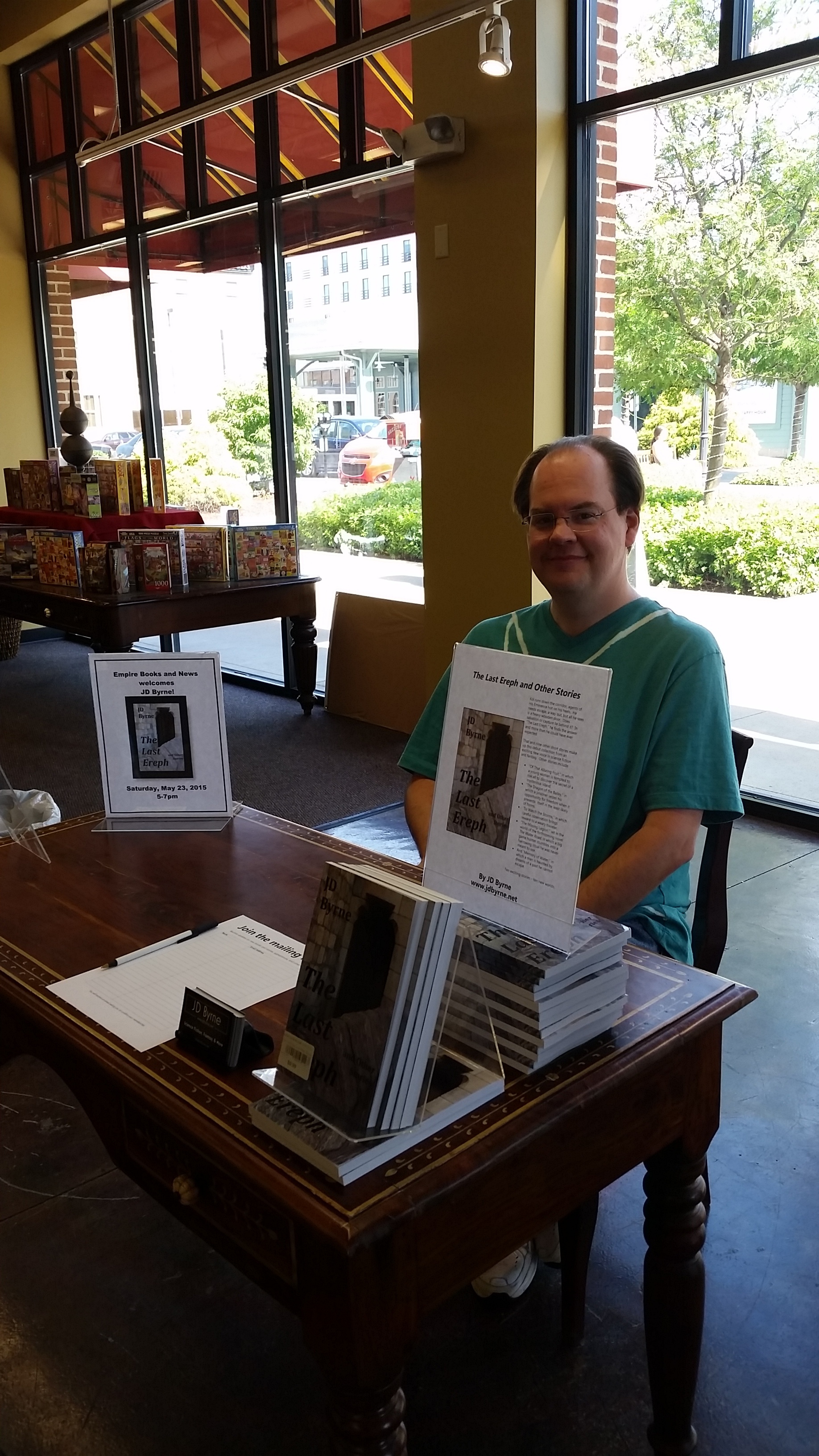
This past weekend I had my first chance to get out and meet the public as an author:
?

?

Big thanks to Empire Books & News for having me and to all the folks who stopped by. It’s a bit of a surreal experience, like sitting in a fish bowl watching the world go past, but also kind of fun.

I’ll be back out in world next month for the West Virginia Writer’s showcase at Tamarack in Beckley. That will include a reading, which should be different. I haven’t stood up and read something to crowd since, what, high school? Still haven’t figured out what to read, either. More details forthcoming or, as always, check the appearances link for that info.

“The Destiny Engine,” is now complete and is currently trying to find a home. It’s a steampunk-style reworking of a Grimm fairy tale, “The Aged Mother.” Once its finds its niche I’ll let you know where to find it.

Moore Hollow, a novel set in West Virginia about disgraced journalists, crooked politicians, and zombies (maybe), is still set for release this fall. I’m working on finding an editor right now, after which I can move on to getting a cover.

But right now, my main focus is on finishing the second draft of The Endless Hills, part two of a fantasy trilogy that will be out next year. For me, a second draft of a long work is a complete rewrite. Essentially, I imported a process I use sometimes at work when multiple attorneys contribute to a brief and everything has to be synthesized to make it read with a single coherent voice.

In the case of the novel, I take the first draft and retype it, paying more attention to the line-by-line details. A first draft, for me, is about getting the who did what to whom, where, and why down on the page. The second draft is where I can focus more on details and making sure the whole thing works as a coherent story. After that come more drafts produced by laborious close reading while wielding a red pen.

I’m about a sixth of the way through the first draft now, so there’s still much work to be done in The Endless Hills.

Until next month!

On Flying Cars and Flying Snowmen

Years ago John Scalzi wrote a post about how his wife, when it came to reading their daughter a favorite story, couldn’t get past the idea of a flying snowman. This didn’t make a whole lot of sense. As Scalzi pointed out she had no problem with a snowman who could come to life, wear clothes,
and talk with children, so why was flying a bridge too far?

The fact is, we all have a point beyond which we simply can’t suspend disbelief any longer. As a writer of fantasy and science fiction I’m doubly aware of that. Some people will happily turn their brains off to enjoy a good story, but if you trip that wire that goes beyond their comfort zone of disbelief, they’ll turn on you. There’s not much you can do about it, except recognize that we all do it and we all do it at different points. In other words, we all have our own flying snowman.

I bring this up not because of some great work of fantasy or science fiction, but because of the seventh movie in the Fast and Furious franchise, which has dominated the box office this year (up to this point). Although I’m a car guy (autocrossing them since 1999) I’ve never been a fan of the series. If I’m honest, I’m not a big fan of action flicks in general, so the automotive overlay does nothing for me. My wife, on the other hand, is a big fan, thanks to her action movie jones and an abiding longing for The Rock, so I took her to see the new one.

It’s not bad, for a big loud popcorn flick that doesn’t aspire to be much more than that. In particular there are some really amazing stunts and some good quips. Can’t ask much more than that. However, there are some points where I reached my flying snowman point. Ken Levine’s line is apparently in about the same place, although he got a bit more aggravated by it:

FURIOUS 7 is an absolute fucking mess! What the fuck was that?! No, seriously! There’s not a fucking frame of this stink burger that’s rooted in any reality. Roadrunner cartoons are more realistic. Is this what the action film genre has become? Mindless idiotic fucking stunts that defy all laws of gravity, physics, logic, and common sense? Hand-to-hand combat where the combatants beat the living shit out of each other and neither is even bruised? They crash through glass walls. No cuts. They hit each other with lead pipes. No blood. Their heads are smashed through concrete walls – not even a mild concussion. What the fuck was I watching? Nobody dies. Cars go over cliffs, roll over seventeen times, are twisted gnarled wrecks when they finally come to a rest 1,000 feet down the hill, and the passengers just wriggle out without so much as a scratch. At least Wile E. Coyote looks disheveled when he swallows a lit stick of dynamite that explodes in his stomach. Not Vin Diesel. Not Jason Stratham. Not the Rock. Creative license is one thing but this is fucking preposterous.

Now, to be fair, some of what Levine rages against as CGI fakery actually isn’t (see, for example, the flying cars of the title). But, he’s right. Furious 7 apparently doesn’t take place in the real world. My flying snowman moment came when Vin Diesel and Jason Statham not once but twice staged deliberate head-on collisions from which each walked away without even a bruise. There’s a fine line between “I can’t believe they did that!” and “I can’t believe they really did THAT?”

My wife concedes the point. She doesn’t argue for the reality of those things, but is more willing to set aside concerns and just enjoy the movie. She’s not wrong, but neither am I. I just can’t go that far. At least not for Fast & Furious.

Star Wars, on the other hand . . .

The defining image of the second trailer for The Force Awakens is the star destroyer crashed on the surface of what JJ Abrams swears is not Tatooine. When I saw that, there was a large part of my mind that immediately started into how impossible it was for a craft of that size to plummet through the atmosphere and crash land more or less intact. But another part thought it was about the coolest thing it had seen in years.

Guess which side wins? That’s because, when it comes to something I’ve loved since I was a kid, my flying snowman threshold is much higher. I’m willing to turn the more rational part of my brain off and just enjoy the awesomeness. Not every part, mind you.

Which is just to say, as a writer and a reader/viewer, you don’t necessarily need to know where the line is, but be aware that everybody has that line and you can’t hope to be certain you don’t cross it.

State of Play – April 2015 Edition

Thought now would be as a good a time as any to update folks on what I’m up to. Some of this I’ve discussed in interviews, but some not.

Naturally, The Last Ereph and Other Stories continues to be available at online vendors everywhere (well, most places) as well as select brick and mortar locations.

I recently finished a new short story, “The Destiny Engine,” that’s in the process of being revised. It’s a retelling of an obscure (to me, anyway) Grimm tale called “The Aged Mother”. I originally developed the idea when an anthology of retold Grimm tales was mentioned, but it never came to fruition. I liked the idea, though, so kept plugging along with it.

As I’ve mentioned in interviews, my next big project is Moore Hollow, a novel set in southern West Virginia. It’s about a disgraced British journalist who comes to the fictional town of Jenkinsville, where his great grandfather once worked, to try and track down the source of stranger rumors. About what? About zombies that are supposed to live up in the hills. It should be ready for release sometime this fall.

Beyond that is my most ambitious project yet, a fantasy trilogy called The Water Road. The title (which is shared by the first volume) refers to a river that runs the breadth of the land where the story is set and is navigable over its entire length. It separates the “civilized” nations of the north from the “barbarian” clans of the south. For a century there’s been peace, but at what cost? Two women blow the lid off society and change their world forever.

As I said, that’s a trilogy. Book one, The Water Road, is written and should be out in early 2016. The Endless Hills, book two, is just going through its second draft, but should be ready for 2016, too. The third volume, The Bay of Sins, might see the light of day next year, too, but I’m thinking probably more like early 2017 (I’ve got a day job, after all).

Beyond that? I’ll let you know.

On the Air! (After a Fashion)

A few weeks ago I had the pleasure to sit down with writer Eric Douglas for his show Writer’s Block on web radio station Voices of Appalachia. We talked about writing, West Virginia, The Last Ereph and Other Stories, and what’s coming up down the road for me. I had a great time and I think it came out well.

The interview airs tonight at 7pm on VoA, after which it’ll be available in the show archive.

Come on over and check it out.  Here’s some appropriate tuneage to get you pumped.

UPDATE: You can now listen to the interview any time you like here.

In Defense of “The Cold Equations”

My first exposure to “The Cold Equations,” a short story by Tom Godwin first published in Astounding magazine in 1954, was in a college sci-fi and fantasy class.  I didn’t take the class – my roommate did.  But he shared the story with me and we talked about it quite a bit.

The story, very briefly, is this: a pilot is guiding a small spacecraft to a distant colony carrying medicine to help stop a fatal disease outbreak.  The ship is lean and purposeful, with just enough fuel to do the job with the expected payload.  Problem is, there’s a stowaway – a teenage girl who wants to see her brother, one of the colonists.  After some agonizing, the pilot does what the rules – and the laws of physics, the nominal cold equations – require him to do: push her out an airlock.  For, you see, with the extra weight of the stowaway there isn’t sufficient fuel for a safe landing.  Save the girl, the ship crashes, and all the colonists die.

The ending of the story has caused arguments since it was first published, I imagine.  My roommate and I had a good one, with me taking the side of, “this is stupid, there should have been something done to prevent this from happening.”  It was one of those things that college arguments are built on.

This time last year Boing Boing maven and sci-fi writer Cory Doctorow wrote a piece for Locus Online essentially taking the same position I did all those years ago.  Doctorow is entirely correct, as I was years ago, that things could have been set up differently to allow for a happier ending – one where the stowaway survives and the colonists don’t die of a nasty disease.  But I disagree with him when he concludes that the absence of those things makes the story a failure. Two of his arguments don’t quite sit right with me.

First, after setting forth all the ways that the story sets up the pilot’s dilemma, he writes:

It is, then, a contrivance. A circumstance engineered for a justifiable murder. An elaborate shell game that makes the poor pilot – and the company he serves – into victims every bit as much as the dead girl is a victim, forced by circumstance and girlish naïveté to stain their souls with murder.

* * *

‘The Cold Equations’ is moral hazard in action. It is a story designed to excuse the ship’s operators – from the executives to ground control to the pilot – for standardizing on a spaceship with no margin of safety. A spaceship with no autopilot, no fuel reserves, and no contingency margin in its fuel calculations.

That’s an odd accusation for a fiction writer to make.  Fiction is the ultimate contrivance.  Writers move pieces around and put them together in particular ways to tell particular stories.  That’s why in a legal drama the hero isn’t just defending an innocent man charged with murder, but his brother, or why the cute girl the guy hooked up with the night before isn’t just in the same line of work, she’s the main rival for the new account.  It can be a cheap way of ramping up the conflict, but it’s hardly unheard of.

Obviously one can critique a story for being overly contrived and unrealistic, but we are talking about a short (10,000 words, about) tale set on a spaceship.  There’s not a whole lot of room to explore the facets of this universe that don’t focus on the central conflict.  It’s a story about the rather obvious, yet compelling, theme that space is a dangerous place and it doesn’t care about the humans caught up in it.

The second argument is more implicit than explicit, but it comes up when Doctorow cites the litany of means the story could have used to avoid the tragic ending, from better engineered spaceships to better medical care at the distant colony in the first place.  All of these are true, of course – something could have been done.  But that misses a key point – is it unreasonable to think that in the universe of “The Cold Equations” such things might not happen?

Assuming the story is set in a future period of our own history it certainly isn’t.  History is riddled with tragedies that occur when some entity cuts corners on safety.  I don’t even have to look beyond West Virginia to find plenty of examples – mine explosions, the Buffalo Creek flood, the Hawks Nest Tunnel disaster.  All caused because safety was sacrificed for something else, either profit or political expediency.  Or just plain dumb assery.  Is there any reason to think the powers that be in the universe of “The Cold Equations” are better human beings than we are now?

After all, there was a sign warning unauthorized personnel not to enter the ship.  Is it too harsh to say anybody who ignored that sign got what she deserved?  Yeah, but that wouldn’t stop people from saying so.  Scour any Internet comment section in the wake of some tragic accident and there are plenty of people willing to blame the injured for their predicament.  Again, there’s no reason to think citizens in the universe of “The Cold Equations” would look at the incident any differently.

In the end, Doctorow’s main criticism of “The Cold Equations” seems to be that it’s not set in the best of all possible worlds, one where everything possible to prevent such a tragic event from taking place would be done.  But that world is a fantasy, one harder to believe in that most of what’s on sale in the bookstore.  Perhaps one of the reasons it’s endured all these years is that as readers we know it’s all too plausible.

“The Last Ereph” – Excerpt

Another little taste, this time from the title story of the new collection, “The Last Ereph.”

It’s not about a dragon. Obviously.

The cobblestones that paved these byzantine back alleys were not as clean as they appeared. Kol discovered this when his left foot, rather than pivoting him crisply to the right towards the open alleyway, instead slid out from under him. He did not fall. He managed to catch himself with his right hand. It stung, but was not broken.

More pressing, the slip caused him to lose momentum and provided the chance for one of his pursuers to loose an arrow towards him. It missed, but not by much, flying close enough that Kol could hear it zip past his left ear. Too close.

Kol took just enough time to glance over his shoulder and count–only two of them now. Still enough to catch him. Still enough to kill him. He regained his footing and sprinted down the alley.

Why did he always let people talk him into these things? On the surface they were wrong, but his friends always managed to convince him. “It’s for the best,” they said. “It must be done,” they said. “It is the right thing to do,” they said. If that is all true, then why did the duty to act always fall on him? Why would none of his friends ever risk their own skin? No one could ever explain that, on the few occasions Kol was bold enough to ask.

And this time, doing the “right thing” had the Corps of Constables chasing him like hounds after a hare. Whoever this gem belonged to, they were close enough to the His Eminence to have all his power deployed to retrieve it.

He could not outrun them. Kol knew, as a petty thief, that most of his marks, if they pursued him all, had no stomach for a prolonged chase. They would give up in five minutes at the most. It had already been fifteen minutes since Kol snatched the gem and the hue and cry went up. Two of his immediate pursuers had fallen away, but others would no doubt appear from who knows where.

What he needed was to disappear into one of the locked doors of the shops that lined the alley. All were closed and empty, thanks to the feast day. And Kol had never been a lock picker, only a thief. Picking locks seemed so much worse to him than merely taking something that was already available. He would be angry if someone picked the lock of his small room by the wharf. If someone took something because he left the window open, however, he could hardly blame them.

He kept running. The alley jogged left then right, so Kol followed, deftly clipping the apexes of the corners. The next turn lay about two hundred feet in front of him, a sharp right around which the alley disappeared from sight.

Directly in front of him, sunken into the wall at the end of the alley, was a door. This would be Kol’s best chance. If it did not work, at least the attempt should not slow him down too much. The jog, about 150 feet behind him now, should provide him some cover if the door did give way. If it did work, he would disappear as if into thin air, for all his pursuers knew.

Kol took a deep breath as he reached the end of the alley and flung himself into the door. As if by a miracle, it gave way. The surprise of success caused Kol to fall face first onto the dark, cool, stone floor inside. He had just enough time to recognize his good fortune before leaping towards the door, back first, to slam it shut.

He sunk to the ground, back against the closed door and the street outside. He held his breath, even though his heart was pounding, listening. There were footsteps. They did not stop. Instead, Kol heard them come and go, taking the turn and continuing down the alley. He was safe.

Kol exhaled and closed his eyes. Only for a moment, he told himself. Just to catch his breath.

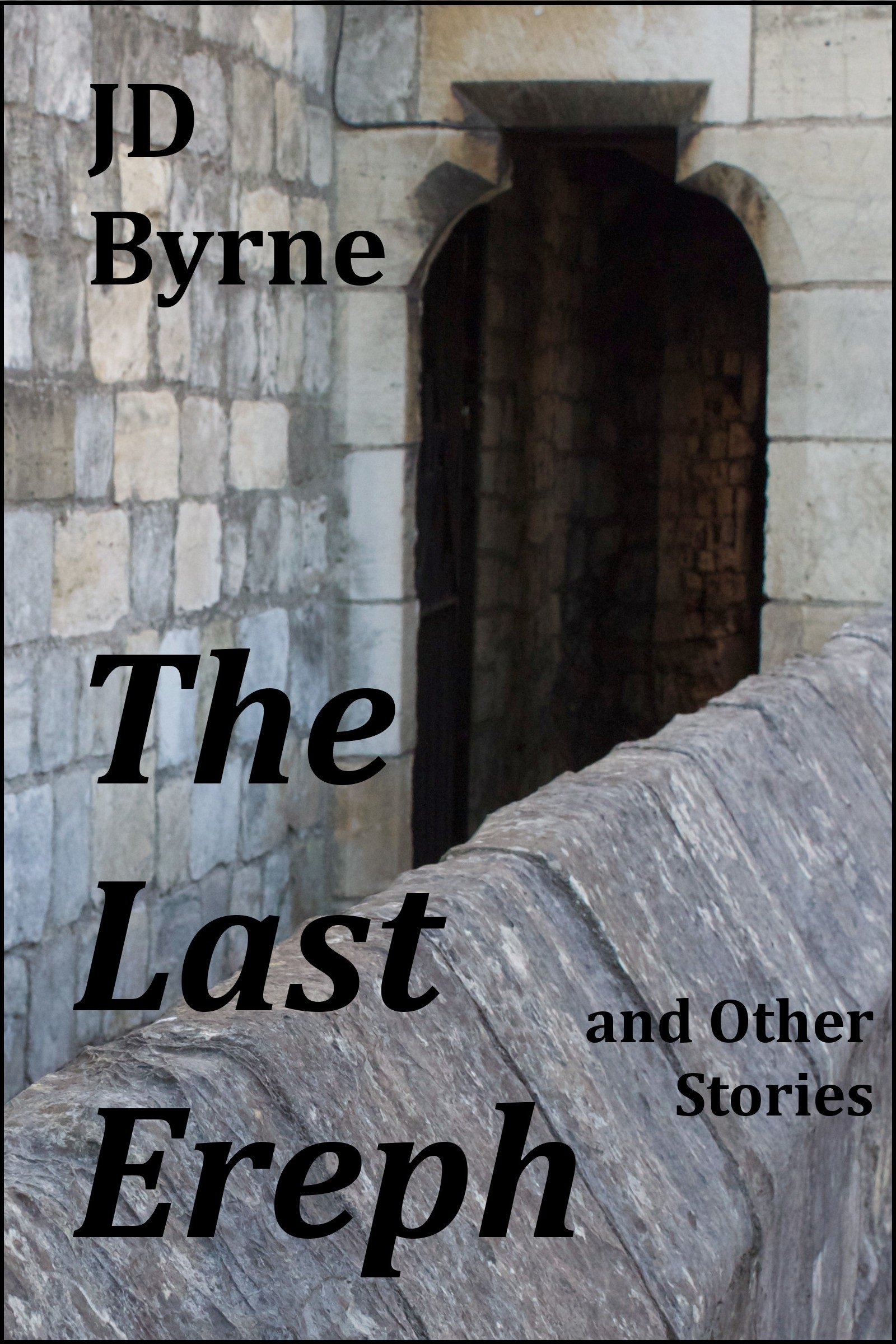
The Last Ereph and Other Stories – available March 2, 2015.

Final Cover Idea (KDP)

Preorder now!

On Influences

In the introduction of his new short story collection, Trigger Warning, Neil Gaiman writes that “We authors, who trade in fictions for a living, are a continuum of all that we have seen and heard, and most importantly, that we have read.”  This is undoubtedly true of everyone, not just authors, but is has a particular resonance for creative types.  For one thing, talking about influences is a good way to suggest to readers or listeners what your own stuff might be like.  Except it doesn’t always work that way.

Years ago, when I first started putting music online, I was filling out a profile on the website that included a place for “favorites” that had influenced me.  I dutifully laid out an array of my favorite musicians – Genesis, King Crimson, Mike Keneally, Frank Zappa – and then realized that the music I was making didn’t sound a damned thing like any of that.  Regardless, somewhere deep in my brain, the synapses triggered by “Firth of Fifth” or “Watermelon In Easter Hay” were leading to the electronic bloops and blips I was pooting forth.

And so it is with writing.  On the front page here I’ve got a list of links to favorite writers.  It includes old favorites, like Asimov and Adams, and more recent discoveries, like Atwood, Martin, and Banks.  I like to think that some of those folks, at least, have had a profound influence on me.  But does that mean what I write sounds like them?  I hope not.

Part of that is because I’m not sitting down trying to write like anybody else.  I suppose if I just wanted to make some quick cash I could try to whip out an imitation Scalzi or Le Guin. But, aside from whether or not I could actually do such a thing, I write because I want to tell my own stories with my own voice.  I don’t want to sound like anyone else. Yet, I freely admit that what I do is backed by the work of so many others.

More so, by this point in my 41-year old life, I realize that my brain is such a mush of influences that it would be hard to pinpoint any one of them when it came to a particular story. Everything I’ve read, heard, or seen goes into my stories. Don’t believe me? Check some of the titles in The Last Ereph and Other Stories. If you’re a progressive rock fan, a couple might ring a bell. It’s fruitless to try and figure out what the accurate mix of things is.

Which is only to say that if you look down the links of favorite writers and think, “I like those writers, too” and “I hope he sounds like them,” you’re probably setting yourself up for disappointment. Without those expectations, however, I hope you’ll find an enjoyable reading experience, anyway.