The Incredible Shrinking Second Draft

I have a weird way of handling second drafts, maybe a unique way.

It grew out of my day job, in which I sometimes have to synthesize argument originally made by other lawyers into a final brief. I quickly decided that just dumping someone else’s words into a brief and doing a quick edit wouldn’t work – we all have a different voice, after all. Just dumping was inelegant at best and headache inducing at worst.

Instead, I take the section provided by someone else and rewrite it in my own voice. The final product includes the same information, the same argument. But it sounds of a piece with what came before and what comes after. That’s the theory, at least.

I imported that system into my fiction writing. I take the first draft, print it out (usually as a PDF these days), then work my way back through it, rewriting from word one. That allows me to do a couple of things. Most importantly, it allows me to focus on the words themselves, the really bottom level grunt work of writing. That’s because I already know what happens to whom and where, so I don’t have to worry about plot stuff.

The other thing it does is it lets me fill in gaps that occurred in the first draft. Sometimes they’re gaps I didn’t realize at the time but that, as I go through it again at a brisker pace, make themselves known. Other times it’s because I was stuck on the first draft and didn’t want things to grind to a halt completely and I left myself a note to add something or expand something.

Either way, the usual has been for the manuscript to grow in the second draft. Moore Hollow was just over 50,000 words in the first graft, but grew to about 65,000 in the end. The Water Road, the first volume of the trilogy I have schedule for next year, grew from about 110,000 words to 135,000 in the end.

Which is what makes my experience with The Endless Hills kind of odd. This is the second book of The Water Road trilogy, and it wound up with about 127,000 words in the first draft. But after the second draft (which I finished last weekend), it’s actually dipped a bit, to 123,000. And that’s including a couple of new scenes or chapters that I had left behind in the first draft.

What the heck happened? A couple of things, both of them good (I hope).

First, I’ve become very sensitive about using dialog tags and trying to clean them out of my writing. For those not in the know, dialog tags are those things like:

“This is a dialog tag,” JD said, to nobody whatsoever.

There’s frequently skirmishes on writers forums about the need for them at all and whether, if you use them, you should just stick to “said” and let that be that. Earlier on I went the John Scalzi route and tried to use “said” exclusively and all the time. I think it goes back to my legal writing where ambiguity about who is speaking could be lethal to a legal argument. But for fiction tags can sometimes get in the way, particularly if you’ve only got a two-way conversation going on. So I took a lot of that stuff out on the second draft.

Second, I’ve also been trying to pare down my writing as a I go forward. Trying to do more with less, I guess you’d say. I’ve never been the most verbose of writers, but I’m not exactly Hemmingway brief, either. I think I’m getting better about tightening things up without sacrificing what’s important.

One of the things more experienced writers will tell you (if you listen) is that writing is as much craft as art. Becoming a better writer is partly down to learning how to do things better, from a mechanical point of view. Sitting down and writing something ten years after you started writing completely should be easier and be a better product when it’s finished.

At least that’s what I’m hoping!
Chasing the Dragon (After a Fashion)

There’s a thing long distance runners experience, a euphoria that comes over when they are almost completely exhausted, when they push through “the wall.” It’s called a runner’s high. It’s something I’ve heard about but never experienced – long distance anything, much less running, isn’t really my thing. But I think writers go through something similar.

I first noticed this in my day job. Doing appellate work for criminal defendants takes a certain kind of mindset. You’re representing people who have already been convicted (in most cases pleaded guilty) and been sentenced. The entire criminal justice system is now designed to keep those results in place – only about three percent of criminal cases in my circuit are reversed in appeal in some fashion.

Sitting down to work on an appeal, then, comes with a lot of negative baggage. Sometimes you don’t have any good issues to raise, but the client wants the appeal and you have to do the best with what you have. Other times you have what you think are good issues, but in the back of your mind know that the chances of success are still between slim and none.

That means when you start writing, you’re mostly thinking “this is shit. It’s pointless and it’s not going to work.” But somewhere along the line, usually a few days out from the deadline when the brief is all you’ve been working on for a couple of days, something happens. You start to believe in what you’re arguing. That argument that seemed hopeless before now seems pretty damned clever. In the push to finish the damned thing you now figure you’ve got a shot at winning.

You don’t, not really, but you think you do. It’s a writer’s high. You get so deep into it that any trace of doubt you once had is gone. It’s a pretty good buzz (and it usually wears off by the time you drive home).

Writing fiction can work in the same way.

I’ve been working on the second draft of the second volume of The Water Road, trilogy, The Endless Hills. It can be a slog. A few paragraphs here, a couple of pages there. If I get an hour or so on a weekend or day off I can maybe make it through a chapter and it feels like real progress. But because I’m focusing on more mechanical things sometimes the actual story seems obscure. Throw in breaks to get Moore Hollow published and promoted and I wonder if I’m doing anything worthwhile.

A couple of weekends ago, a bunch of things coalesced to give me lots of time to write. For one thing I didn’t have any other functions that weekend. For another, it was grey and rainy most of the weekend, so there was hardly a desire to go out (or, even worse, a need to do yard work). So I cloistered myself away in my studio and got to work.

Over several hours, spread across two days, I cranked through more than fifty pages of manuscript, about 8000 words. It’s not a huge chunk of the book (the first draft was 127,000 words), but it was enough – it covered several chapters – to get me back into the story a bit. It helped that I was working through the climax of the book, a bloody engagement between two armies called the Battle of Tivol Market. The rubber, so to speak was meeting the road.

Around mid afternoon on Sunday I had about reached my limit. I had other things I wanted to do (the pull of the PS3 and a room full of synths can be strong), but I also knew I needed to keep going. But powered by interesting electronic burbles from Bandcamp, I pushed on. After too long, the writer’s high started to kick in.

Not only did the actual writing get easier, like I had crested a rise and started to run downhill, but it seemed better. Connections between characters, the flow of the action (spread across four different POVs), and the endgame all came into focus. Just like when I reach this point in a brief and I think I might win, I started to think this was pretty good!

Maybe it isn’t (more editing is needed, of course). But it feels good, regardless, to suddenly have something flowing from your fingers that seems to be working! It gives you confidence to keep going, to keep plugging away, word after word, even when it seems like drudgery.

That’s my dragon to chase. Gotta get back at it.

The More the Merrier

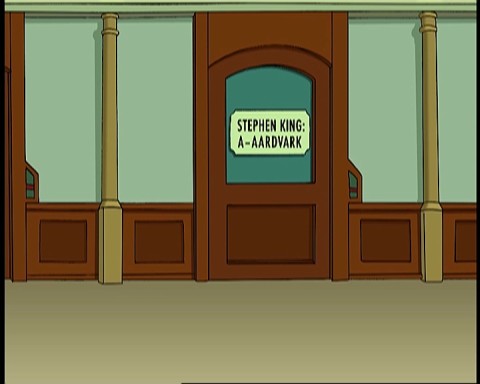
When I saw that Steven King had written a column in this weekend’s New York Times about profligate authors, my mind immediately went to this blink-and-you-miss-it joke from Futurama:

stephen-king-door

That was done in February 2001. He’s published 19 books since.

What I’m saying is that Steven King is amazingly productive when it comes to writing. He is also, of course, very very good at it. After all, here’s a guy who’s spent most of his life in the genre ghetto and had nonetheless won the National Book Award. He doesn’t need to do much more than point to that award to debunk the idea that quality is inversely proportional to quality.

So let’s ignore that – or rather take that point as given – and ask why the contrary holds true for so many people? Why do we tend to view people who put out lots of creative product – books, music, movies, you name it – aren’t as good?

One reason is that people figure that if you’re cranking out product at such a prodigious clip you must be scrimping on quality. It’s certainly possible that some creators would do that, releasing their stuff upon the world without a lot of editing or polishing. But it’s equally possible that whoever we’re talking about is just that prodigious. For some people writing is a hard slog, something that takes weeks and months to get right. Others are just able to pour forth things from the mind, tapping into a wellspring of creativity. We people in the first group aren’t fond of people in the second group, but that’s our petty problem.

The bigger issue, I think, is that the more someone produces the more their best stuff seems to get watered down, somehow. With only To Kill a Mockingbird on her resume Harper Lee was an undisputed master, a woman with a perfect batting average for writing classic American novels. Now that Go Set a Watchman has been released to less than thunderous applause, she’s batting 50 percent. Still really good, but somehow less impressive. Which is silly, because even if she followed up Mockingbird with a string of badly written shallow zombie mysteries Mockingbird itself is still what it is. But it takes some of the aura of inspiration off when somebody who hits a homerun their first time up at bat can only manage bloop singles (at best) for her other at bats.

Another issue is that the more product someone produces the more likely they are to experiment or move out of their comfort zone, potentially alienating existing fans. Steve Hackett’s had a pretty productive solo career (24 albums since 1975) that’s frequently jumped outside his progressive rock comfort zone to include a blues album and albums of orchestral material. As it happens, I’m not a huge fan of Hackett’s tangents, so I can see where someone’s overall opinion of an artist like him would dip at the perceived diminishing returns. But on the other hand, that’s silly because, no matter how many other albums he makes, Voyage of the Acolyte, Please Don’t Touch, Darktown, and several others will continue to be brilliant.

Which is to say that no matter how strange the creative mind may be, the minds of the people we create for can be even stranger. “Quality” is as much about perception as anything else and it’s nearly impossible to control how perfect strangers perceive you. If your muse only lets you grind out a new work every decade, don’t force it. But if your muse won’t shut up and helps you pop out something every month, don’t stifle it. Do what works for you.

Stephen King’s got your back – what more do you need?

State of Play – July 2015 Edition

When I started these posts I intended to do one every month, but events got the better of me in June. Thankfully, that was because I was finishing up and releasing “The Destiny Engine,” so I think that’s a fairly good excuse.

Also, I got to take part in the first ever West Virginia Writer’s event at Tamarack down in Beckley.

JDB@Tamarack

Big thanks to Elliot Parker for setting up the whole thing, to the folks who stopped by to talk and buy a book during the day, and the souls out in the hall who couldn’t help but overhear as I read “To Watch the Storms” just before lunchtime.

So what about the books then?

Available Now!

The Last Ereph and Other Stories – a collection of ten stories of fantasy and science fiction.

“The Destiny Engine” – a short story with a steampunk take on a classic Grimm Brothers tale.

Coming Soon!

Moore Hollow, my debut novel, is inching closer to being ready to be loosed upon the world. It’s been edited and formatted for both eBook and print versions. It still needs a cover, which may prove a bit of a challenge. Still, if all goes according to plan it should be out October 5.

In the Works!

As I mentioned the other day I had a new short story pop up in the last week or so. Don’t know when it will be finished or where it might go once it is.

The big project in the works continues to be the second volume of The Water Road trilogy, The Endless Hills. Still chugging through a second draft, making copious notes for a third. Everything’s still on schedule for 2016 to be the year of The Water Road.

Ideas Are Everywhere

One question that writers, and other creative types (I’m assuming), routinely get asked is “where do you get your ideas?” For some reason many writers find this frustrating. I suspect that’s not because the question itself is annoying, but because the answer so rarely satisfies the person asking it. The fact is that there are no muses who whisper in the ears of writers, nor do words generally flow out without effort. Writing, like most creative endeavors, is hard work. For laypersons, it takes a bit of a shine off the process, I imagine.

But in reality, it makes the question of inspiration all the more interesting, because it can come from anywhere. Allow me to provide a recent example.

My office is in the market for a new lawyer and we’ve interviewed several candidates over the past few weeks. One applicant who was in private practice was explaining the size and scope of their firm and mentioned that, in addition to offices in several large cities there was “one guy up in Alaska.” It was hyperbole, no doubt (and good for a laugh), but it put the idea in my head of a solitary lawyer toiling away in the wilds of Alaska. What sent them there? Was it where the firm misfits went? Was it the shit assignment you had to go through to make partner.

Of course, I write speculative fiction and don’t (generally) write about lawyers. I turned the idea over in my head for a few days and started writing. Alaska became a rock in space called Orsini and the law firm became “the company,” but the central question – what would send a person all the way out there? – remains (and gets answered). It’s got the working title “Retirement Party,” but the more I live with that the less I like it. Hopefully it’ll see the light of day in a little while.

That’s only one example. Inspiration really is everywhere – it’s up to you to do something with it when it tickles that part of your brain that makes you ask “what if?” or wonder “why?”

Like I said – the hard part’s taking the inspiration is doing something with the idea once you get it. So let me get back to it . . .

Genre Matters, If Only a Little

From time to time, I get a little riled up when it comes to issues of genre. I am, as you can tell, a genre writer. I am also, for the most part, a genre reader. Sci-fi and fantasy is what I like and I’ve got no problem admitting it. Nor do I have a problem with folks who don’t like it. Different strokes and all that.

However, it rubs me the wrong way when people use genre labels as a sign of inferiority. Particularly, it makes me grumpy when people see something that, in spite of all the genre trappings, is so elevated and wonderful that it cannot, under any circumstances, actually be a part of the genre itself. This all flared up back in March with the publication of Kazuo Ishiguro’s The Buried Giant.

Ishiguro is the Man Booker Prize winning author of (among other things) The Remains of the Day. He is “Literary” with a capital L. However, first with Never Let Me Go and now with his latest he’s come to play in what folks would generally recognize as the lands of science fiction and fantasy, respectively. But he really wishes they weren’t (I addressed this at my old blog after watching the film version of Never Let Me Go).

Ursula K. Le Guin fired the first shot, responding on an interview Ishiguro did with the New York Times. Here’s how she describes The Buried Giant:

[it] takes place in a non-historic just-post-Arthurian England. Everybody there has lost most of their longterm memory, due to the influence of the breath of a dragon named Querig.

Ogres and other monsters roam the land, but Querig just sleeps and exhales forgetfulness, until a pair of elderly Britons with the singularly unBriton names of Beatrice and Axl arrive with the knight Gawain and a poisoned goat to watch a Saxon named Wistan kill Gawain and then slice the head off the sleeping dragon.

Sounds pretty fantastic, right?

Ishiguro then says:

Will readers follow me into this? Will they understand what I’m trying to do, or will they be prejudiced against the surface elements? Are they going to say this is fantasy?

They probably will, Le Guin argues, with good reason and with no need of being ashamed. Yet Ishiguro, it seems, “takes the word for an insult.” More recently, in an interview with Neil Gaiman, Ishiguro expressed surprised at such a reaction, asking “why are people so preoccupied?” and wondering if genre labels were just something created by the publishing industry.

He’s certainly right that genres make things easier for the sellers of books – which includes authors, by the way. But they also make things easier for readers. If I read Book X and it falls into Genre 1, then maybe I might like to check out other things that fall into Genre 1, right? Sure, the genre definitions get fuzzy along the boundaries (go see any of the “what is progressive rock?” debates on the Web for proof!), but some guidance is better than none.

Admittedly, some genre signposts don’t tell you very much. Gaiman makes this point:

I think that there’s a huge difference between, for example, a novel with spies in it and a spy novel; or a novel with cowboys in it and a cowboy novel.

Can’t argue with that. The Big Lebowski isn’t a “cowboy movie” just because there’s a cowboy in it, after all. But it doesn’t really do much to tell you what it’s about. Likewise, a story with a detective as a main character could be lots of different things: mystery, police procedural, domestic drama, comedy, etc. But those two genres do have one thing in common – their stories exist in the real world.

Science fiction, fantasy, and (to a lesser extent) horror stories don’t take place in our world. That’s what makes them “speculative,” after all. Stories told in the real world have to confine to our world – if a key scene requires a character to get from one side of town to the other in 10 minutes she can’t just close her eyes, mumble some Latin, and teleport herself. But in the speculative genres anything is possible. The writer has to develop her world and its rules, but isn’t constrained by how the real world operates. It’s a Rubicon kind of thing – once you cross it, you can’t uncross it.

But genre has nothing to do with quality. There’s good science fiction and bad (cue Sturgeon), good fantasy and bad, good literary fiction and bad (keeping in mind the highly subjective nature of “good” or “bad”). If there’s a stigma about genre fiction it’s largely because writers like Ishiguro (and, at earlier times, Margaret Atwood) and his critics insist that his work is too good to be labeled as such.

That’s my great objection. I don’t care that Ishiguro or anyone else wants to come play with some of the trappings of genre fiction while not buying wholly into the genre’s tropes. It’s perfectly OK to come into our sandbox and play by yourself. That doesn’t obscure that you are, in fact, in the sandbox with us. Don’t insult our intelligence by arguing otherwise.

Come Say Hi This Saturday @ Tamarack

This weekend, Tamarack – the showplace for West Virginia arts and crafts located outside Beckley – is hosting a West Virginia Writers Weekend. It runs both Friday and Saturday.

I’ll be there on Saturday (June 27), from six in the morning until about six in the evening. I’ll be selling books, signing books, talking with readers about writing, and probably doing some actual writing (still working hard on the second draft of The Endless Hills).

In addition, at 11:45 – just before lunch! – I’ll be doing a reading of one of the stories from The Last Ereph and Other Stories.

It’s free to the public and should be a lot of fun. See you there!

WVWriterWeekend

Pulling a Town Out of Thin Air

Getting Moore Hollow ready for publication this fall made me think back to this piece from my old blog. Moore Hollow is set in West Virginia, but not in any place that actually exists on the map. Jenkinsville and Vandalia County were pulled straight from the ether. Maybe that’ll change someday.

One of the cool things about writing fiction is you get to make up stuff as you go along (it’s sort of the nature of the game).  Not just characters and what they do but, often just as important, where they do it.  You can build entire worlds and nations in your mind, not to mention cities.  I’ve even made some maps (crude, but effective – I’m not a cartographer, after all) of the world in which my Water Road books are set, as well as another world I’ve yet to write in.  It’s all quite fun.

But imagine that you could create a town out of thin air, as a fiction, only for it to pop up in real life?  Now that’s really cool!

Consider the strange case of Algoe, New York (not to be confused with the planet Algon, where an ordinary cup of drinking chocolate costs 4 million pounds).

Back in the 1930s, it wasn’t unusual for mapmakers to steal each other’s work.  After all, if a map reflects realty and someone copies the map, don’t they have a defense to plagiarism by arguing that both the original map and the alleged copy accurately reflect reality?  How can that lose?

Turns out, map makers got savvy and began including some fictional places to trap would be copyists:

That’s what Otto G. Lindberg, director of the General Drafting Co., and his assistant, Ernest Alpers, did in the 1930s. They were making a road map of New York state, and on that out-of-the-way dirt road, they created a totally fictitious place called ‘Agloe.’ The name was a mix of the first letters in their names, Otto G. Lindberg’s (OGL) and Ernest Alpers’ (EA).

The trap set, it appeared to work, when the town of Algoe appeared on a map made by none other than Rand McNally a few years later.  Case closed, right?  Big check from Rand McNally to Lindberg and Alpers.  Not so fast – Rand McNally offered a defense: there really was a town called Algoe.  In fact, the official county map showed an Algoe General Store in that location.  Checkmate, cartographic honey pot.

But how’d that happen?

Good question. Here’s the ironic answer. The owners had seen Agloe on a map distributed by Esso, which owned scores of gas stations. Esso had bought that map from Lindberg and Alpers. If Esso says this place is called Agloe, the store folks figured, well, that’s what we’ll call ourselves. So, a made-up name for a made-up place inadvertently created a real place that, for a time, really existed. Rand McNally, one presumes, was found not guilty.

Then the store closed. It isn’t there anymore.

Having said that, according to the NPR story, Algoe held on for years on Google Maps until it, again, vanished into thin air recently.

So, want to have an impact on the world?  Make a map and give it a fictional town.  It might come to life without you even knowing about it!

NOTE: This post originally appeared on my old blog on April 1, 2014.