Author Interview – Brhi Stokes

This time we head all the way down under to talk with urban fantasist Brhi Stokes.

Who are you? Where are you? What kind of stuff do you write?

My name is Brhi Stokes, I’m an Australian author with an upcoming novel to be released within the next month or two. I write short stories and novels, predominately.

Tell us about your most recent book, story, or other project.

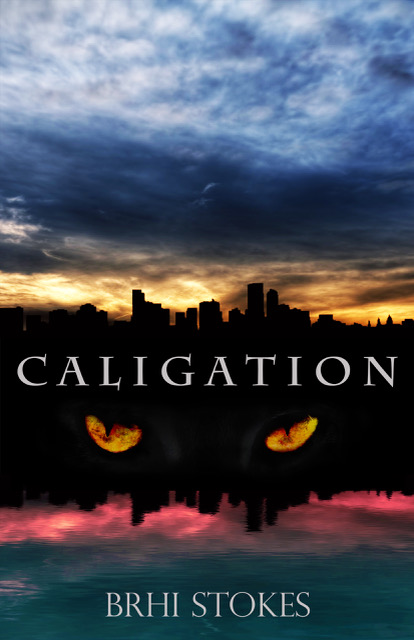
I am currently finalizing a novel for release, Caligation.

Caligation follows the story of Ripley Mason, university dropout and newly-fledged hitchhiker, as he travels north from his home. When he awakens after a car accident, he find himself in a strange city filled with horrific beasts and a population of people with strange abilities. In a desperate attempt to figure out where he is or how he can find his way home, he becomes embroiled in the dealings of the Cavanetti mob; an organization of dangerous men and women with preternatural powers. He quickly finds himself in over his head and his search for home becomes a race against time.
Cover

 In what genre do you primarily write? Why did you choose that one?

My favourite genres are sci-fi and fantasy, both modern and traditional, and I’ve written stories that fill both. I definitely have a soft spot for urban fantasy and thoroughly enjoy writing it; the idea that there’s something hidden away in our mundane world absolutely fascinates me. However, I have also been dabbling in young adult fantasy (a more traditional medieval-style fantasy setting) lately, as well.

Tell us briefly about your writing process, from once you’ve got an idea down to having a finished product ready for publication.

I’ve tried several different writing processes. My first novel-length work was written from scratch and I found it very difficult to go back through edits without a guide. Caligation was a setting I had in my head for years and had been struggling to find a proper narrative for. Eventually, I came up with the idea and made use of the Snowflake method, so that I had everything ready to go (including an excel spreadsheet of every ‘scene’ before I tried writing it). I found that I quite like this method as you start small (at one sentence) and work your way up so that, by the end of your process, you already have your summary and blurb.

For my latest endeavour, however, I used a combination (and I think this is my preferred method). I put pen to paper and wrote out the first few scenes, letting ideas form naturally as I wrote. Then, I began to jot down a few ideas I had for the world in a separate document. As I wrote, more ideas for plot came to me so I had, essentially, two documents to work on simultaneously: the story itself, and a separate file with information. In the information file, I wrote down a brief summary of every scene as I wrote it, along with the plan for the plot. That way, it was much easier to re-arrange scenes, figure out what was going on and generally be able to keep track of a plot outline.

I go through several editing phases, preferring them to take a year or longer as I find that taking long breaks from a finished work really helps my editing process. I usually do a general read-through for plot and consistency, then a line edit (for style and form), and then a copy edit (for grammar and spelling errors). Then I hold off for a bit, maybe a month or so. After that, I re-read and see if it’s still up to par and ensure every line sounds perfect. Then, I get other authors and readers to give it a read-through (ideally, one general read for cohesion and plot, and then a copy edit). There’s a few more of those edits (me, then other, then me, etc) until I’m completely satisfied.

That’s when I start organizing publication.

What is the “Snowflake method”? I’ve seen that referenced a couple of times here and there but never gotten a good explanation.

The snowflake method was developed by a man named Randy Ingermanson. The basic concept is that you write it out like a snowflake – you start with a very small idea and you grow and expand it out in each direction until you have a completed work. It consists of ten steps where you start very simply: step 1 tells you to write out a one-sentence summary of your book, for example. Then, as the steps progress, you add to that. You build on the sentence until you have a paragraph, that moves into three paragraphs with each detailing the classic “problem, characters make problem worse, characters resolve problem” dynamic as it suggests. I found it interesting because you really end up with a well-planned book – one of the steps involves making an excel file of every ‘scene’ in the book that you use when writing. It also suggests character-building exercises and so on. It’s a hard topic to delve into without me explaining the entire process, but I hope that helps clear it up a little.

I probably won’t use the entire method again, myself, and it definitely doesn’t work for everyone. However, it is a great place to start if you’re completely lost, and I will definitely incorporate some of its method in my future book-planning.
AuthorPic

You mention having the setting of Caligation for a while before you found a proper narrative for it. I think that’s a common issue with sci-fi/fantasy writers – you come up with a nifty idea for a world to set a story in but no actual story. Is the story you wound up writing for Caligation something that you decided to stick in that world or did it derive from the world itself that you had built?

I had to alter the setting a bit to work as a book, rather than a roleplay site, but I definitely ended up making a story for Caligation, rather than making a story to insert into Caligation. I actually struggled a little bit at times because I would use the main character, Ripley, too much as a vehicle for showing off the world, rather than engaging with his emotions and feelings. It took a lot of thought and editing of the first draft to remedy this, but I am definitely glad I recognized the problem early on.

It was a difficult task, trying to make a compelling story that fit into the world and interacted with it in a meaningful way. Originally, I was thinking of just having a story in the world, but then I didn’t get to explore some of the stranger aspects of the place, because a character in the world would be used to them. It was a lot of fun having someone unfamiliar with the world there and able to question it, and I think it serves to assist the reader in answering questions that never would have been answered if the main character was from Caligation.

Who is the favorite character you’ve created? Why?

This is tricky question. A lot of the characters I have in Caligation were based on an old role-playing site I created (and from where the idea formed) so a few of them have been sitting in my head for eight or nine years.

I’d say at the moment, though, I’m having the most fun with one of the characters in the YA fantasy I’m playing around with. The story follows a young woman who is placed in the tutelage of one of the five masters of the magical domains: Master Adimai. Adimai is a cold, stern and generally rather unfriendly man with a dark sense of humour. He fits into your general haughty, jerk mage trope and I’m very fond of writing him. The story is from the perspective of the young woman so I have a lot of fun writing their interactions because a lot of what Adimai says and does is not really very well understood by her. Having a bit more insight into his mind, for me, makes it very amusing when she gets the wrong idea, or is generally just confused or upset by him. Plus, writing jerks is fun.

I’m intrigued by the city of Caligation. Since you mention urban fantasy I’m assuming it’s a modern place? Or is it a kind of “lost city” in the middle of the outback? Or is it in some other place completely?

As the tagline on my site describes, Caligation is “…a city where spiraling gothic towers meet modern glass monoliths. Where the slums of the South are stalked by indescribable beasts.” Ripley notices that it seems to shift from being reminiscent of the 20s, to the Victorian era. It’s a wild mix of both, with technology not quite as advanced as ours and strange fashion. Modern towers mingle alongside old factories and gothic churches, while cars drive down cobbled streets and rotary phones hang in old street boxes.

It’s unclear to Ripley where the city is, but he seems to realize quite quickly that it’s not in his homeland. He actually considers it being some ancient, lost city in the outback (as you queried) but dismisses the thought.

What’s the weirdest subject you’ve had to research as a writer that you never would have otherwise?

Nothing too exciting, I don’t think. A lot of anatomy stuff for the things I wrote when younger. Nothing out of the ordinary, I’m afraid.

What’s the one thing you’ve learned, the hard way, as a writer that you’d share to help others avoid?

Don’t be afraid to put down a piece of writing you’ve spent years on and just let it go. It sucks, and it’s hard, but sometimes you just need to move on from it and start again with something new. I did that with my first novel, one I’d written as a teenager (and gotten halfway through the sequel). I tried very hard to beat that dead horse, to the extent that I rewrote the entire 100,000+ word book to try and fix it. It didn’t work and, in the end, I had to move on. I actually stopped writing for a few years after that, but I’m back into it, now. So, that: learn when to let go and don’t let it put you off writing.

If you won $1 million (tax free, to keep the numbers round and juicy), how would it change your writing life?

To be honest, I’d probably keep doing what I’m doing as far as work and writing amount goes. I’d get a little more experience in publishing then probably use the funds to set up an indie publishing company. I love editing other people’s work, so I’d probably offer those sorts of services, too.

What’s the last great book you read or new author you discovered?

I love anything by Neil Gaiman, and I recently finished Norse Mythology, which I would definitely recommend. But if you’re looking for an urban fantasy that’s not quite as well known, I would definitely recommend the Watch series by Sergei Lukyanenko. He’s a Russian author with a fantastically translated writing style and a great setting.

What do you think you’re next project will be?

I smashed out about 30,000 words at the end of last year in the space of about a month (the YA fantasy). It’s not my usual genre, and certainly not something I had expected to write, but I would love to be able to get back into it and finish it. If it does end up being published and becoming a series, it will focus on five young men and women who have recently graduated from the royal university of their kingdom and are placed in the tutelage of the five masters of the magical domains. Unfortunately for the young graduates, their plans are sent awry when the king decrees that they will be taught by the master of their weakest domain, instead. Neither masters nor students are particularly happy with the arrangement and the year of study will be both a trial and a great learning experience.

Ideally, each of the five books will focus on a different student, master and domain. So far, I’ve been  writing book one: The Element of Chaos which follows Seraphine as she struggles to hone her acuity with the chaotic domain, under the teachings of Master Adimai.

Visit Brhi online here.

In Defense of Worldbuilding

A while back over at Electric Lit, Lincoln Michel wrote a lengthy article called “Against Worldbuilding,”* in which he argues that authors and readers are so enamored by the details of literary worlds that they lose focus on the actual story being told. What he says isn’t wrong so much as it is a game of definitional Léger de main. Along the way, Michel engages in some low-key genre bashing.

Let’s get out of the way what Michel gets absolutely right – some writers get so wrapped up in the worlds they create, in the details and minutiae of them, that the story, characters, and all the other important stuff kind of disappear in a puff of imagination. This happens, no doubt (although I wonder how many writers follow the advice of one person Michel links to who thinks it’s important what shapes the tables are in a given world). The problem isn’t an overbuilt world per se, it’s the fact that, as Michel puts it, things turn out like “they were producing an encyclopedia instead of a story.”

Where Michel goes wrong is in deciding that such deep diving and navel gazing is what “worldbuilding” is. Also, that it’s something that’s limited to certain particularly pulpy genres like science fiction and fantasy.

But the fact is that every author – even writers of non-fiction – have to build worlds with their words. Hell, I have to do it when I write legal briefs, much less when I write fiction. That’s because unless you’re writing for the small subset of people who know exactly what you’re talking about you have to do some foundational work of explaining the place where your tale is taking place. As I said several years ago in a review of the first season of Mad Men:

What is more fascinating to me about Mad Men is the world these characters live in. When people talk about world building they usually are talking about sci-fi or fantasy writers, who build new universes and worlds from the ground up. But the truth is, every writer of fiction (whether on the page or screen) has to pay attention to world building. Thus, just because Mad Men is set in a real time and place from our recent past doesn’t mean the creators can shirk on the details that lend the world depth and credibility.

Another example that springs to mind is Karen Connelly’s The Lizard Cage. It’s a story about a political prisoner in Burma and what he has to do to survive. It’s not a translation – it was not originally written in Burmese. It was written in English, presumably for an audience in the English-speaking world. A world that, most likely, isn’t familiar with the horrors of a Burmese prison camp or the kind of Buddhist rituals that might help a person stay sane in such a place. There’s lots of worldbuilding going on there, there has to be if the story Connelly tells is going to have any kind of resonance. By contrast, I just started Liu Cixin’s The Three Body Problem and it drops you right in the middle of the Cultural Revolution without any worldbuilding at all – but it was originally written in Chinese, so I expect that audience didn’t need any of that heavy lifting.

Perhaps aware of this fact, Michel performs a little magic. He walls off “worldbuilding” in the genre ghetto and instead says what literary writers do is “worldconjuring.” That is:

Worldconjuring does not attempt to construct a scale model in the reader’s bedroom. Worldconjuring uses hints and literary magic to create the illusion of a world, with the reader working to fill in the gaps. Worldbuilding imposes, worldconjuring collaborates.

In other words, worldconjuring . . . builds worlds, it just does a better job of them. This is linguistic slipperiness not seen outside of Earthforce:

What Michel has done is taken something that is definitional and turned it into a qualitative judgment – it’s the same thing as people who say “rap isn’t really music” when what they really mean is “I don’t like rap.” Fair enough, but whether you like something or not doesn’t change what it actually is (see, also, the infamous Roger Ebert v. video games dust up or any endless circle jerk on what “prog” is). All Michel has done is give what he perceives as “good” worldbuilding a different name. It doesn’t change the fact that it’s the same damned thing.

As I said at the beginning, Michel’s real point is solid – for some writers (and readers), worldbuilding runs roughshod over everything else. That sucks. But when it doesn’t and it’s transporting and wondrous and visceral – it’s still worldbuilding. It’s just worldbuilding done write. Everybody who picks up a pen to tell a tale has to do it – here’s hoping we get it right more than we get it wrong.

* NOTE: Word really wants “worldbuilding” to be two words, but since that’s how Michel spelled it I’ll keep it that way.

Thoughts On a Con

Over Memorial Day weekend I got to participate in a con for the first time.

No, not this kind of con.

BusterKeaton_Convict_800

This kind.

Contraflow_steampunkersComicConWizardWorld_2014_Steampunk

Specifically, Vandalia-Con up in Parkersburg, which is specifically a steampunk-themed con.*

“But wait,” you say, “you don’t really do steampunk, do you?”

Well, actually: (1) I have; (2) I’m getting ready to do it again (details coming!); and (3) I figured that steampunk fans might be interested in gunpowder fantasy like The Water Road. At the very least, it would be an interesting fact finding mission. So what did I learn?

First, before I go any further, I want to say that everyone I interacted with at Vandalia-Con – from the organizers to the attendees to the other vendors – were great, friendly, fun people. As a clear outsider (a DC United jersey does not constitute steampunk cosplay) and newbie at all this I couldn’t have felt more at home.

To my eyes, this con was mostly about embracing the steampunk “lifestyle,” as opposed to the celebration of any particular work of steampunk fiction. Most of the other vendors were selling clothes, jewelry, and the like. Aside from a couple of presenters who also had some books for sale the only other person selling “content” was a small publisher of sci-fi and fantasy books.

And, oh, the fashion. I was impressed by the wide variety of detail applied to different costumes. Guys seem to have it easier than women. A vest and top hat will suffice for the fellas, while the ladies seem doomed to bustiers and bustles (and very tiny hats – for some reason). To each their own, I guess, but it looks very uncomfortable from where I’m sitting. But as I said – that was while in a not-at-all-chic DC United jersey (although it did get some love from one of the hotel staff, even if he is a Crew fan).

But the primary reason I was there was to try and sell some books and drive some people to my mailing list. On that front, the con didn’t really meet my expectations. As I said, I think most people there weren’t really interested in consuming content, but having fun dressing up and what not. Which is totally cool – but it’s not a great setup for an author trying to move some copies. I did sell a few (one woman – complete in bustier and bustle – bought a complete set of The Water Road trilogy) and got some mailing list sign ups, but not enough to offset the investment (hotel costs, mostly). But when considering what kind of event you’re going to, it’s worth trying to figure out what the audience of regular attendees is like – you may have brilliant widgets for sale, but if nobody’s really interested in widgets it won’t make much difference.

Unfortunately, that’s the kind of mercenary mentality I have to have these days. Which is a shame, because the weekend was a lot of (expensive) fun. Thanks for being my first, Vandalia-Con!

* Note that none of these photos – even the first one – were actually taken at Vandalia-Con. I can’t find any of those online and my phone pics didn’t turn out well enough to use. All images via Wikimedia Commons.

Author Interview – Lisa McCombs

Join me for a discussion with award winner (and superhero!) Lisa McCombs.

Who are you? Where are you? What kind of stuff do you write?

I have always been a writer and can prove that by the five unfinished Harlequin-type romance manuscripts in my closet. The YA genre really speaks to me, though, now more than ever. After teaching teens for years, I retired two years ago and miss my young people. By writing about them, they are still in my life and because of my past relationships with them, I feel that I know what they want/need to read.

Tell us about your most recent book, story, or other project.

Bombs Bursting in Air was published in the fall of 2016 after winning first place in novel length fiction at the West Virginia Writer’s conference. To this day I have no idea how this story evolved so effortlessly, but I finished a completed first draft in less than two months. My goal is to create a young adult Christian series set in the same (imaginary) town of Ellison. All stand-alone novels are told in first person but will alternate between female and male perspective and will share references to characters and events in previous stories.

Cover

In what genre do you primarily write? Why did you choose that one?

My main writing genre is young adult primarily due to the fact that I taught teenagers for 33 years and have a strong relationship with that age group. As a language arts teacher I had the opportunity to share my love for books with many reluctant readers who taught me how to write for them.

Tell us briefly about your writing process, from once you’ve got an idea down to having a finished product ready for publication.

I have kept a journal since diaries were the rage so my collection of ideas is never ending. When I latch on to a writing topic I am totally consumed and find myself looking at the world through my character’s eyes. The first thing I do is something Cheryl Ware (a successful WV children’s author) presented at a state conference years ago and which I continue to use in my own presentations. First I name my main character and assign the following attributes to that character: physical description, age and gender, at least one bad habit and/or fear, and an interest. I develop a setting to include geographic location, physical format, era, and time of year.  Next I make a list of possible conflicts faced by the main character as well as a complementary list of possible resolutions. Then I do a timed free write similar to what is done during NaNoWriMo (November is National Novel Writing Month and is an awesome way to jump start a writing project.) I am lucky to have several people in my life who usually agree to peruse my writing project(s) after I clean it up enough to share.

Who is the favorite character you’ve created? Why?

This is difficult because once I start writing about a character I pretty much become that character. I really relate strongly to Abby in my first YA novel by that same name. She attends the same schools as I and her life reflects a lot of my young years. Right now Lilah Rose is my favorite character. Probably because she is my newest character and we spend a great deal of time together.

What’s the weirdest subject you’ve had to research as a writer that you never would have otherwise?

Ironically, I was diagnosed with multiple sclerosis in 2001 and began a fourteen year quest to learn as much as possible about this disease. Since I never thought to be in the position of living with an incurable situation, I would never have thought to become as invested as I am in what I refer to as an alphabet disease: MS, MD, ASL. The more I read about my condition the more fascinated I became. I kept a journal of my daily life with relapsing-remitting multiple sclerosis. When a dear friend actually died with complications due to MS, I realized that I needed to share my knowledge with other folks suffering from the MonSter. This resulted in the publication of I Have MS. What’s Your Super Power?: A Common Sense Guide to Living With MS in 2016. As an advocate of the National Multiple Sclerosis Society, I continue my research daily.

Cover2

What’s the one thing you’ve learned, the hard way, as a writer that you’d share to help others avoid?

Proofread, proofread, and proofread. Ask someone you trust to look at your work and proofread again.

Do you have a proofreading strategy that you’ve honed over the years to catch most mistakes?

I always read my work out loud to myself. I have done this for years, even back in undergrad school. Drove my roommates crazy. Fortunately I have a couple of people I can trust to read over my work and be honest in their critique. Proofreading is monotonous, yes, but obviously necessary. After I have edited my own work several times and a second/third party have done their part, I read it again. Then…I put it down for a few days before reading it again.

[back to things you’ve learned – JDB]

Learn as much as you can about self-promoting. I am NOT a business person but writing is a business so this is an evil necessity in publishing. Even Stephen King self-promotes.

Okay, these are TWO things I have learned the hard way, but they are so, so important.

Promoting often seems like the hardest part of being a writer (the actual writing is easy by comparison) – have you learned any particularly effective way to promote yourself and your work?

You are absolutely correct in stating that the actual writing is the easy part. I am not and never have been a sales person. I don’t even like to shop! Retail is not my specialty in any form. The best promotion tip I can give is be relentless in sharing your work, but do not threaten your self-respect in doing so. Reading a chapter or favorite passage from your work when in a public setting is the most effective promo I have found of late. Know your audience and cater toward their needs.

If you won $1 million (tax free, to keep the numbers round and juicy), how would it change your writing life?

I would start my own writing retreat in the hills of Randolph County, West Virginia. I already have the location selected (It is for sale right now!).This would be a year round sanctuary for artists (writers, musicians, painters) seeking an inspirational setting for creating. I would hold writing camps and instructional opportunities for writers in the provided cabins. And, of course, I would reside there as well.

What’s the last great book you read or new author you discovered?

There are so many gifted hidden secrets in my little state of West by God Virginia. I am constantly discovering new writing talent. Danielle DeVoris probably my current interest. She lives and writes (long-handed!) in Morgantown. I love her character (defrocked -priest – turned exorcist) Jimmy Holiday.

I recently read Summer Haze by Michael J. Tucker and became totally infatuated with his story-telling prowess. Tucker is not from WV, but his story is definitely Appalachian. He isn’t really a new author, but new to me.

I could never recommend a favorite book, though. My favorite book is usually the last one I read. Fortunately I work closely with a West Virginia publishing house (Headline Books), so I get to rub elbows with many fantastic state authors.

What do you think you’re next project will be?

Right now I am working on what will be the third novel in my YA Christian series. This is kind of out of order, but the second book told in the male perspective is a very rough draft on hold because I have fallen in love with my new character, Lilah Rose, and cannot seem to get back in the head of that last character right now. But, he’s still there…and actually has been for years. I just want to get him right, so he is marinating for a while.

Did you envisage Lilah Rose as a major character when you created her? Or did she develop into one as she went along (to the point of taking over your next project)?

Lilah Rose has been the main character in my current project from the beginning, but as the story develops so does one other character. I like to bounce secondary characters off of the main one, experimenting with their dynamics, kind of testing their relationship. My plan is to develop my latest YA novel, Bombs Bursting in Air into a series of stand-alone installments that encompass an entire community. The characters will change, but they will also have a bond with familiar characters from other novels. For instance, Sacred Sanctuary (aka the Church of Go) has a HUGE role in all the books as the focal point of the town of Ellison. All of my characters attend the same schools and know the same town landmarks. The novels will alternate between female and male perspective in an attempt to attract all young readers, regardless of gender. (This means Lilah Rose is not the next book in the series. I am just stuck on her right now.)

Visit Lisa online at https://lisa-mccombs.blogspot.com/

Author Interview – S J Brown

This time I talk with an author who shoots first and writes stories later (mostly) – S J Brown.

Who are you? Where are you? What kind of stuff do you write?

I am S J Brown, a writer, wildlife photographer, grandma, wife, mother, spouse, and tree hugger. My home base is in West Virginia, but I tend to cross the state line constantly. I write about life, about me, and about critters.

Tell us about your most recent book, story, or other project.

I am currently in the finishing stages of a project my sister and I embarked on together. It is a memoir that covers 12 years of our lives. The working title is Sisters. It has been quite a journey that we can’t wait to share it.

How did you come to write a book with your sister? Were there any major squabbles you had along the way?

Our Mother wrote a book for family.  It accented the difference between her childhood and mine. So that got me thinking about writing a memoir.  Then at a Writers Conference I took a workshop on collaborative writing.  When I returned home I called my sister and learned that she had been thinking the same thing.

There weren’t any squabbles while we worked on the book.  We did most of our squabbling when we were younger. I admit from time to time I got impatient waiting for her to respond to my emails.  We live about 250 miles apart so much of the writing was done through e mail and over the phone.  We also spent a few weekends together just focusing on the book. There were times when we laughed until we cried.  There were serious discussions and agonizing about how much to share, where to end the book and if there would be another book to follow this one.

In what genre do you primarily write? Why did you choose that one?

I primarily write memoirs. Early in my writing career a trusted soul told me to write what I know and I took that to heart.

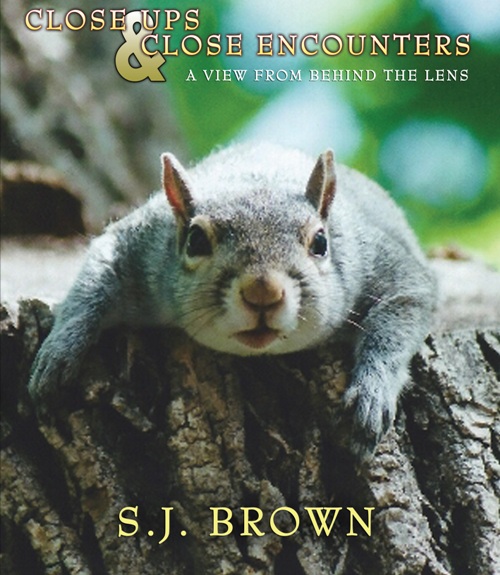
I was at an exhibit talking to a patron about the story behind getting one of my photos. After our conversation a fellow writer tapped me on the shoulder and whispered in my ear, “girl you have to write this shit down.” I went home that evening and put aside the manuscript I was working on and began Close Ups & Close Encounters, my first full length published manuscript.

Cover 3-26-23

So what, in brief, was the story behind that picture (and do you have a digital one you could share)?

As you can see it is a pretty close shot. I was using a 300 mm lens. I stood behind some bushes and snapped a picture of the bear. Normally I would take a shot and then take a step closer to the critter I am photographing.  However each time I clicked the shutter button this bear moved closer to me.  We did this several times before my spotter got nervous and whispered that we needed to back out of there.  Of course I took a few more shots including this one before I backed out of the area. I used film when photographing wildlife.  I think the bear could hear the camera advancing the film and he was curious about the sound.

Bear

Tell us briefly about your writing process, from once you’ve got an idea down to having a finished product ready for publication.

My writing process is a bit different than most writers. I begin with a photograph. My goal is to take the reader to that time and place. My first draft generally is just notes to myself. The second draft is actually sentences and paragraphs. The third draft I tweak the descriptions and emotions a bit. Then I set it aside for a few weeks before giving it one more read through before I place it into someone else’s hands. I always want a fresh set of eyes on the work. A fresh set of eyes will spot typos, and places where the story skips or lags a bit.

Since you start, generally, with a photograph, does that mean when you’re looking for good shots you try to get something that might make for good writing afterwards? Or do you just get lucky sometimes?

When I am in the field I’m not thinking about stories to write, I am concentrating on the critter in front of me. In the field the encounter is as important as the resulting photograph.    It is important to pay attention to the animal’s behavior so that I don’t get in trouble.  Wildlife photography involves skill, research, and a bit of luck  every time I go out in the field. To get the shot that I eventually used for the cover of “Close Ups and Close Encounters” I had to climb a tree and wait.  Sometimes I lay on the ground, other times I need to climb, or get into a boat to get a good shot. Since every picture tells a story the writing comes later.

Who is the favorite character you’ve created? Why?

I can’t really give you an answer to this question since I don’t create characters. I write about real people. Life truly can be stranger than fiction.

What’s the weirdest subject you’ve had to research as a writer that you never would have otherwise?

I haven’t really researched anything weird or strange for my writing. I do most of my research before photo trips. It helps to know as much as possible about my wild subjects before I encounter them in the field.

Before my first trip to Florida to photograph critters I researched alligators, manatees and a few other wild creatures. However when I was on the ground face to face with an alligator all that knowledge just disappeared when I knew I was too close to him.. I couldn’t remember how far he could lunge, how he would warn me to back off, or how fast he could move. So I took a few photos and began talking to him as I backed away.

Okay so I have gotten off topic here but your next question is probably what do you say to an alligator when you are close enough to hear him breathe. It doesn’t really matter he can’t understand what you are saying. You just have to keep your voice calm and pleasant so he knows you aren’t a threat.

Promo Shot Horizontal

How do you select the subjects you photograph?

My spotter often says I will photograph anything that moves.  What critters I photograph depends on where I am.  I have traveled from Maine to Florida and as far west as Colorado  to capture critters on film. The extreme northern United States have Moose, and Puffins can be found at certain times of the year.  The extreme south eastern states have alligators. When I head west I can find Big Horn Sheep, and Prairie Dogs. Then there are white tailed deer, wild horses, raccoons, and a huge variety of birds, so I guess he is right I will photograph almost anything that moves.

Photographing wildlife has led to doing things I never dreamed I would do.  I have flipped horseshoe crabs, tagged Monarch Butterflies, and banned ducks.  I have met some fascinating people and been to incredible places.  Every time I return home I am ready to go out and do it again.

What’s the one thing you’ve learned, the hard way, as a writer that you’d share to help others avoid?

Don’t let life get in the way. There is always something else you need to be doing, or somewhere you need to be. Make the time to write, write often, and get your thoughts down. I began writing in High School, had my first piece published when I was 18 and then life got in the way, my writing was put aside and it was decades before I got back to writing.

If you won $1 million (tax free, to keep the numbers round and juicy), how would it change your writing life?

I would get a laptop and write from the road.

What’s the last great book you read or new author you discovered?

The Glass Castle by Jeannette Walls. This book grabbed me from the first sentence and didn’t let me go. To me that is the true meaning of a great book. The words should put the reader in the scene and compel them to turn the page.

What do you think you’re next project will be?

My next project is already in progress. I am writing a follow up to Sisters. The working title is The Little Middle Sister. The select few that have read Sisters asked how I got from there to where I am now.  It has definitely been a journey I wouldn’t want to repeat, but I am happy to share the details.

This was fun. Thanks for having me here.

S J Brown on the Web

What I’ve Been Up To

With The Water Road trilogy wrapped up I figured this might be a good time to check in and let folks know what I’m doing, writer wise. The TLDR version – cranking through some short stories and trying to plan the next big project.

Short Stories

After the epic feel of The Water Road I decided to dig back into my bag o’ ideas and work up a couple of the shorter ones. This isn’t to suggest that returning to short stories is a way to “take it easy” or some such. Building worlds and characters in a few thousand words, versus hundreds of pages, can be a challenge in its own right. It’s a different discipline in the writing world, but one that’s very rewarding.

The first of the new stories is “To the Sound of Birds.” It was inspired by some very odd noises I heard during an autocross years ago. Animal noises, of a sort, coming from the woods across the street from the venue. The idea came to me then and I’d kicked it around for a while before I got a chance to sit down and finish it. I’m about to try and find it a home and let it loose upon the world.

The other isn’t quite finished, but should be in a week or so. It’s called “The Miracle at MarvoMart” and is about a guy who gets in over his head with a good thing that turns very bad. This one, too, came from an idea that occurred during an autocross – more precisely, during a bathroom break. I never set out to write a story set largely in a public men’s room, but that’s where I’ve ended up!

Aside from those two, I’ve also pulled out and polished a story I wrote a while ago in which the main character is this little girl:

MaiaTalkstoYou

Along with her two feline companions (at the time the story was written). It’s about what the animals get up to while their people aren’t around. It involves dragons and a whole unexplored world under the house. At one time it was going to be a series of stories, but I never got past the first one. An anthology popped up that I thought this story would be good for, so I sent it in. We’ll see if anything comes of it. Don’t worry, it’s for grownups – they curse and such.

I’m also working on one final story in The Water Road universe, set between The Endless Hills and The Bay of Sins. It would explain why, when two characters meet in The Bay of Sins, they are not particularly fond of one another.

The Next Big Thing

As I’ve said before I’m having a hard time figuring out what my next novel project will be. I have a lot of ideas, but none of them have roared up and demanded to be written right the fuck now (at least not yet).

One of the issues is that before I even think about ideas there’s a preliminary question to answer – should my next project be a standalone novel or the first in a new series? Some ideas lend themselves better to one or the other, but there are pros and cons to each choice. A stand alone novel probably sees the light of day sooner, but a series gives me the opportunity to really dig into a new world in detail. Until I make that decision, it’s hard to know where I’m headed.

As far as series ideas, the main one would be a several volume steampunkish fantasy set in a global superpower that’s slowly falling apart. I’ve done a lot of background work on it, so it’s probably the most “shovel ready.” Another series idea is to expand the universe of my short story “The Last Ereph” into a common setting for a bunch of unrelated stories. Finally, there’s a trilogy about the nature of magic I’ve been toying with.

The stand alone ideas are more wide ranging. For one thing, they include a couple of ideas that fall solidly into the science fiction category. I’ve written some short sci-fi, but my longer projects have all tended toward fantasy. I’d like to change that, so that might be a deciding factor. One of those idea is more serious, philosophical, and somewhat relevant to the current political climate. Another is more of a fun, planet-trotting adventure. As for fantasy ideas, one that I’m keen on doing (at some point) is my version of the standard fantasy quest, although it has a neat twist at the core of it (or so I think).

So that’s where I am. At least right now as I post this. From here on out – who knows?

Water Road Wednesday – Rand McNally Edition

Just when I thought I was done, then keep pulling me back in!

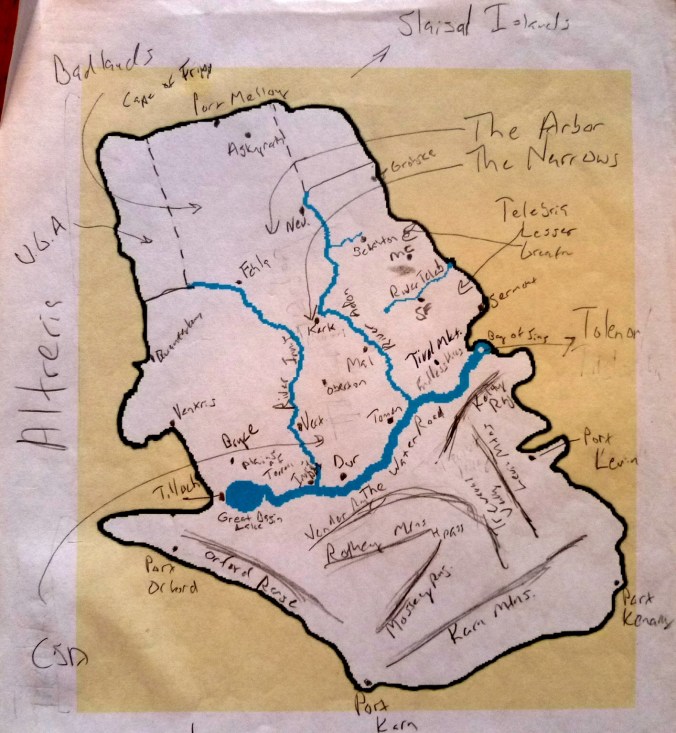
I’ve had more than one reader ask about whether there are any maps of Altreria, the land that’s the setting for The Water Road trilogy. Strictly speaking, in terms of something I’d be happy putting in the back of a published book – the answer is “no.”

However, in the spirit of sharing my work and showing how I do things – I’ve dug out a couple of hand-made maps from my notes. These are what I used to keep myself oriented in the world of The Water Road. At least at the beginning.

In the spirit of Michael Feldman, three disclaimers:

First, these are crude, hand drawn, and simply photographed. They’re not great quality, but I never expected anybody aside from me to see them. Judge accordingly.

Second, place names and such are noted in my horrific hand writing. Enter at your own risk (although I’ll be happy to translate, if asked).

Finally, I made these before I even started The Water Road and while I added to them on occasion afterwards, I didn’t change things on the map to match the text. As an example, “Port Keneally” became “Port Jaray” in the books (Keneally just didn’t feel right, when push came to shove – sorry, Mike).

With those disclaimers, here we go . . .

A map of the continent of Altreria itself:

AltreriaMap

A few highlights. The long blue ribbon running across the continent is, of course, The Water Road. The two north-south tributaries are the River Innis and the River Adon. The Guildlands are west of the Innis and the Kingdom of Telebria is to the east of the Adon. In between is the Confederation of the Arbor. North of the rivers are the Badlands. The little speck of land in the Bay of Sins is the island city of Tolenor. South of The Water Road, of course, are the Neldathi mountains.

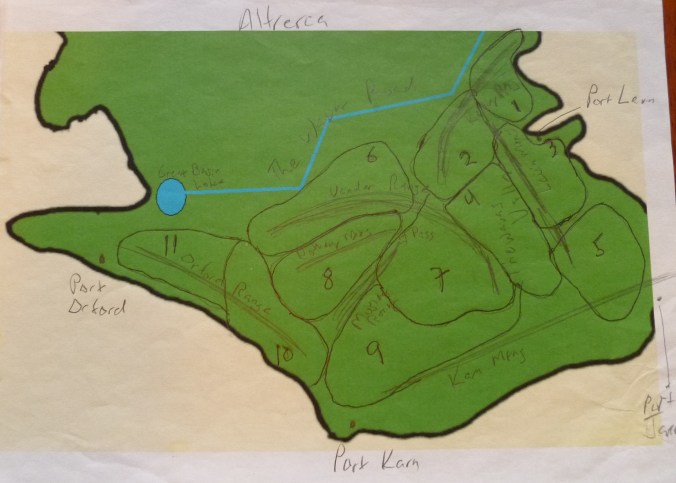
And here’s a different view of the Neldathi mountains, with the great circuit of each clan drawn in:

NeldathiMap

For those scoring at home, here’s how the numbers match up to the clan:

  1.  Dost
  2. Haglein
  3. Chellein
  4. Volakeyn
  5. Mughein
  6. Kohar
  7. Akan
  8. Uzkaheyn
  9. Elein
  10. Sheylan
  11. Paleyn

This one also gives you a better idea of the names of the mountain ranges and Islander cities. Yes, many of them are named after musicians. Albandala, the city Antrey founds in The Water Road is somewhere near the Hogarth Pass.

Let’s Play the Feud!

I’m currently reading Authors In Court: Scenes from the Theater of Copyright, which uses a handful of case studies to track the development of copyright law since its introduction in England via the Statute of Anne in 1710. I haven’t even gotten through the first case yet and already I’m entertained. To anyone who thinks folks way back when were more civilized than modern, crass, digital folks, think again.

That first case involves Alexander Pope, English author (and second most quoted writer in The Oxford Dictionary of Quotations, according to Wikipedia – behind only Shakespeare), and a contemporary publisher named Edmund Curll. They’re in the book because, eventually, Pope sued Curll for publishing some of his letters in which, Pope argued, he retained the copyright. But things got ugly long before that.

Curll and Pope were very different people. Pope was a country gentleman, an elite. He was a writer, but he didn’t do it for a living (heaven forefend!). Curll, by contrast, was a scrappy businessman, doing anything he could to make a buck. He developed a reputation as a low-rent publisher, becoming (among other things) the first publisher in England to be convicted of obscenity.

What set the feud alight was a book Curll published called Court Poems, which purported to contain works by Pope (among others). The poems were scandalous and Pope was upset, either because he or a friend was designated as the author of some of them. Rather than just send a nasty letter, Pope got even in a much more emphatic way:

shortly after the book appeared, Pop contrived to encounter Curll at a tavern in Fleet Street. There, under the pretense of sharing a glass of wine as a sign of reconciliation, Pope dosed Curll’s drink.

Said dose was an “emetic,” a word which sent me scrambling to the dictionary. Long story short – it’s something that makes you puke.

Poisoning a professional rival so that he puked is a pretty dick move. But Pope wasn’t done:

A few days later, adding insult to injury, Pope published a comic pamphlet couched in the sensationalist style of a Grub Street production, a style not entirely different from that of, say, a modern supermarket tabloid. Titled A Full and True Account of a Horrid and Barbarous Revenge by Poison on the Body of Mr. Edmund Curll, Bookseller, Pope’s undated pamphlet, identified only as “by an Eye Witness,” reports on the tavern episode and then veers off into malicious fantasy as the stricken Curll, convinced that he is dying, makes his last will and testament.

In the end he is spared from death by “a plentiful foetid Stool.” Pope still wasn’t done, writing two more pamphlets expanding the fantasy and, eventually , devolving into anti-Semitism.

Future chapters involve Harriet Beecher-Stowe and J.D. Salinger, among others. I wonder if they taunted their rivals with bodily fluids (and tales thereof), too?

They might, given that the Pope/Curll feud is just one of many in literary history that went beyond simple sniping at each other. For example, Gore Vidal once compared Norman Mailer to Charles Manson – so Mailer punched him at a party (leading to Vidal’s retort – “once again, words fail Norman Mailer). Hell, Mario Vargas Llosa punched Gabriel Garcia Marquez in 1976 and neither ever explained why (although this article suggests it was over a woman and, therefore, isn’t really a literary feud at all) .

Of course, writers being writers they’re more likely to lash out at each other with words rather than fists. Playwright Lillian Hellman sued critic Mary McCarthy after McCarthy said that “every word she writes is a lie, including ‘and’ and ‘the.’” Hellman got the last laugh, dying before the suit could be heard. Salman Rushdie responded to John Updike making fun of a name he used in one of his books by suggesting that Updike “stay in his parochial neighbourhood and write about wife-swapping, because it’s what he can do.” Finally, after Colson Whitehead gave a book by Richard Ford a particularly nasty review in the New York Times, Ford spit on Whitehead at a party. Whitehead shot back that this “wasn’t the first time some old coot had drooled on me” and that other critical reviewers (there were a bunch, apparently) best “get a rain poncho, in case of inclement Ford.”

If nothing else, feuds tend to be good for business. Pope and Curll, certainly, made hay out of their beef. Maybe what I need to do is go honk off some famous author and start a heated back and forth! Yeah, that’s the ticket!

pope-and-curll

On Storytelling and Stakes

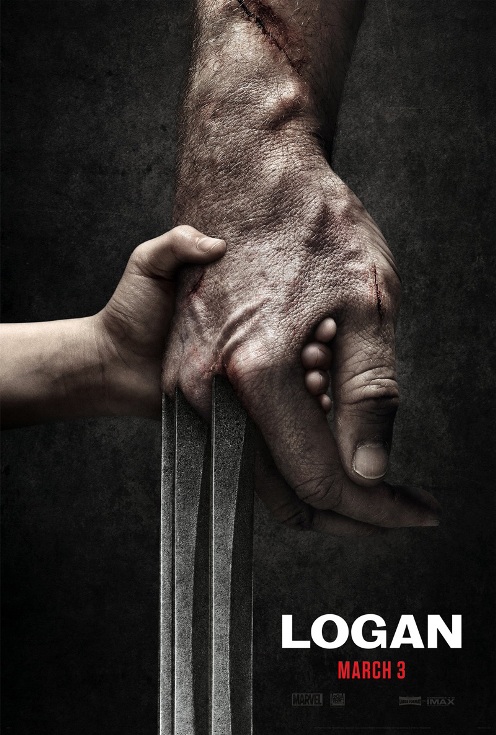
The wife and I went to see Logan, the last of Hugh Jackman’s Wolverine appearances, the weekend it came out. It’s really excellent and reminded me of how good the 2013 entry, The Wolverine, was (the original origin story in 2009, not so much). In fact, I’d go so far as to say that those two movies are among my favorites of all the modern era superhero movies. I tried to figure out what that was, if there was something about them that really set them apart from, say, something in the Avengers canon or one of Christopher Nolan’s Batman flicks. Turns out, I think it’s because they’re smaller movies. Or, at least, the stakes involved are small enough that you can actually care about them.

I first noticed this in connection with Star Trek. Think about it – in the original series the jeopardy in each episode was usually faced by either Kirk, Spock, or McCoy or some combination thereof. A few episodes extended to other crew members and, on a very rare occasion, to the entire Enterprise. But the show never really tasked our heroes with something so grand as saving Earth or the galaxy or whatnot. The only thing in that area that jumps to mind is “City on the Edge of Forever,” which did involve setting the universe right, but, critically, the real drama was all about the main trio and, specifically, whether Kirk can let his love interest die as she must to set things right.

When we get to the movies, though, the stakes became increasingly high. How many of them involve some Earth-shattering baddie that only the Enterprise crew can stop (where is the rest of Starfleet at these times, anyway?). Paradoxically, that actually ramps down the tension, because who really thinks our heroes aren’t going to literally save the universe? An example proves the point – what’s almost universally hailed as the best of the Trek flicks? The Wrath of Khan. Which is, at its heart, about Kirk and an old foe battling it out until the end (universe altering tech in the background to one side).

Returning to The Wolverine and Logan, in both those flicks the stakes are fairly low, in terms of superhero movies. They play more like short stories, side plots in a bigger novel wherein the fate of the world hangs in the balance. But when it’s just the fate of a few (including our hero), things hit a lot closer to home. In other words, it’s easier (for me, at least) to become emotionally invested in the fate of Logan and his young charge than it is to really care whether a gaggle of X-persons stop Apocalypse because, come one, of course they will.

Although it’s horrific, the old adage attributed to Stalin (who would know from horrifics) that “one death is a tragedy, a million is a statistic” is true. It’s easier for people to empathize with a single other human being rather than a large group defined by broad common traits. The same is true in fiction. Sometimes you make a bigger impact by telling a smaller story.

Logan