Another Reason Judicial Elections Are Dumb

This year, for the first time in West Virginia, our judicial elections will be “non-partisan,” meaning candidates won’t be designated as belonging to a political party. That’s a shame, because that’s at least a useful data point to consider, even if it’s not definitive.

I’ve never been a fan of electing judges. Judges are supposed to be impartial servants to the law, not popular opinion. There are times when they should do the exact opposite of what the Twitter-mob wants. Insulation from the political process (with the acknowledgment that complete insulation is impossible) is critical if we expect the “rule of law” to mean anything.

Beyond such philosophical issues, there’s another reason that judicial elections are just dumb, one that I’ve been particularly aware of here as we begin to see campaigns for the West Virginia Supreme Court of Appeals get into full swing. People generally vote for politicians based on what they promise to do, either for particular groups of voters or the nation/state/county as a whole. It’s crass sometimes, but that’s how democracy works.

Here’s the problem when it comes to judicial elections – judges can’t make promises like that. For one thing, while the hoary right-wing chestnut that “judges don’t make law” is as silly as ever, courts are limited to issues brought before them in actual disputes between parties. No court has the power to simply issue an opinion on its own. For another, rules of judicial ethics prohibit candidates from promising to rule in particular ways on issues that may come before them. No judge can say if they’re elected they’ll rule a particular way on an issue or in favor of a particular party.

But if a judicial candidate can’t say “vote for me so I can do X,” what can they do? It comes down to a choice between meaningless fluff and vague non-sequitors.

In the current WV Supreme Court race the fluff angle belongs to Bill Wooten. His ads that I’ve seen (can’t find them online – how can a candidate for office in 2016 not have a web page?!?) all star his grandkids and highlight his role as a grandfather. Which is great (the kids are cute), but what does that have to do with his ability to be a justice? I realize that a big part of politics, at least locally, is name recognition, so the fluff accomplishes that (see also gubernatorial candidate Booth Goodwin’s ad about his WV birthmark), but it’s awfully thin gruel if you’re trying to figure out who to vote for.

At least fluff doesn’t promise anything more than that. This ad, from Beth Walker, promises something she can’t deliver:

Since when do Supreme Court justices decide to increase penalties for crimes? Putting to one side the foolishness of her plan (Really? We haven’t tried locking people in cages for selling drugs yet?), it’s just empty rhetoric. The cynic in me says all political rhetoric is empty – promises made are rarely kept, after all – but at least they’re plausible. The get tough promise is particularly odd in West Virginia, where sentencing is purely statutory and tied in with a parole system. Unlike the federal system, judges don’t have an awful lot of say on how long someone stays in prison.

That’s not to lay the blame at the feet of these, or any other, candidates. It’s not their ads that are dumb (although I disagree with Walker’s policy position), it’s the game they’re playing that is. They’re doing their best to convince people to vote for them in an election where they can’t promise to do anything if elected. It’s bound to lead to meaningless drivel in commercials. Which is kind of the point – is this any way to select the men and women who preside over the justice system?

 

Same As It Ever Was

On my old blogs, where I discussed legal stuff more often, I talked about how conflicted defense attorneys are about defendants who “roll” on each other – that is, who testify against another defendant in return for either a reduced sentence or beneficial plea bargain from the prosecution. That conflict came to mind while reading about a similar situation that occurred on the other side of the planet.

The Master of Confessions is journalist Thierry Cruvellier’s account of the trial of “Duch” before the name, the international court currently trying former members of the Khmer Rouge for crimes against humanity. Duch was the lead interrogator at the Tuol Sleng prison I mentioned a while back, also known as S-21. Duch’s job was to get people to confess not only their crimes against the revolution, but to rat out others in their “line,” a process known as denunciation.

One of the interesting things about the book is that Cruvellier isn’t writing history. He’s writing about it, but he’s doing it from the vantage point of his own observation of the trials (and other similar trials around the world). Thus, it gives him room to make astute observations that might not be so well placed in a work a pure history.

On the subjection of denunciations, he writes (paragraph breaks added by me):

The court openly hates the very idea of denunciation. Given that at S-21 thousands were tortured and mercilessly killed, the court vehemently rejects the validity of the denunciations obtained there. But in other circumstances, the international legal establishment can be more accommodating.

Mandatory denunciation (though obtained without torture) is a crucial element in many confessions made before international tribunals and, in these circumstances, lawyers find that their consciences remain quite untroubled by it. On the contrary, they actively encourage it. A defendant who pleads guilty to a UN tribunal is told to denounce his accomplices if he wants to win over the prosecutor and earn the judges’ leniency. He isn’t forced to name names under torture, of course, but if he wants to make the most of his guilty plea and obtain a lighter sentence, then he has no real choice but to comply.

Rwanda’s community courts, known as Gacaca courts, which have been so misguidedly praised over the past ten years, feed off of mass denunciations. Though they don’t torture people, snitching is inextricably linked to confessions in Gacaca courts. The result is an all-consuming, rampant, and poisonous judicial operation that had produced more than a million suspects. Throughout Rwanda, the pressure to name one’s accomplices has given rise to slander so great it wouldn’t be out of place in the archives of S-21.

‘Denunciation is another form of lying,’ Francois Bizot, a survivor of imprisonment by the Khmer Rouge, says in court. International justice, it seems, only hates lying in certain circumstances.

This captures the essential issue when it comes to defense attorneys and rolling codefendants. On the one hand, their testimony is inherently suspect because it’s being given in return for something of value – more lenient treatment. Indeed, a federal court once recognized this for what it is – bribery – but swiftly backpedaled upon realization that banning the practice would bring the criminal justice system screeching to a halt. On the other hand, providing what the federal system calls “substantial assistance” is often the only way one of our clients can help reduce their sentence.

Which goes to show, I guess, that “justice” and what it looks like isn’t so different, whether you’re dealing with petty drug dealers in West Virginia or the architects of mass murder in Cambodia.

Weekly Watch: True Story

Truth, as they say, is stranger than fiction. It does not, however, necessarily make for a dramatic story, even if it’s an interesting one.

The true story behind True Story is plenty interesting. Mike Finkel was a reporter for the New York Times who had several big-deal pieces in the paper’s Sunday magazine. He pushes too far on one story, creating a composite central character for his narrative that doesn’t exist. As a result he’s fired and deported to the wilds of Montana (not deported – he actually lived there).

He’s trying to figure out how to get his life back when a reporter from Oregon calls about a murder suspect named Christian Longo. Wanted for killing his wife and three children, Longo flees to Mexico. What does this have to do with Finkel? When he’s arrested in Mexico, authorities learn that Longo has been posing as – Mike Finkel, reporter for the New York Times.

With that slenderest of connections (there’s no evidence Longo ever really did anything with Finkel’s identity, aside from get laid), Finkel heads to Oregon to meet the guy who pretended to be him. They wind up talking all through Longo’s trial. Their relationship is the heart of the movie.

Which is a shame, because it’s just not that interesting. For one thing, the movie largely consists of Finkel and Longo sitting across a table from each other talking. Some interesting topics are brought up, but nothing really lands all that hard. It comes across very staged, like it was once a stage play with only two characters that was adapted for the screen (which it wasn’t). It doesn’t help that the only other “main” character, Finkel’s then girlfriend (now wife), is given precious little to do, aside from a late confrontation with Longo where she is, hilariously, allowed to walk into a jail waiting room with a cell phone (cell phones are contraband in prisons).

That might have a potential to work, but it would need a better pair of sparring partners. Put bluntly, the version of Finkel in this movie is just a bad journalist. He’s entirely too naive about Longo and how he’s manipulating him. He doesn’t do any independent investigation of Longo’s alleged crime and doesn’t seem to care about whether he might be innocent or not. When the rug gets pulled out from underneath him, it’s less a shock and more like the inevitable result of his own foolishness, like when a puppy finally catches its tail and freaks itself the fuck out.

Outside of the conversations between Finkel and Longo, the movie exists in some kind of bizarre Neverland where the fact that Longo is on trial for capital murder is barely mentioned. There’s no mention of Longo’s lawyer and whether he or she approves of all these non-privileged conversations. In spite of the fact that inmate mail is routinely read and searched, nobody alerts the prosecution about Longo’s letters to Finkel. Then, once they do learn about it, they do nothing to get a hold of them.

This is another one of those situations where Finkel doesn’t seem like much of a journalist. When first confronted by a detective about his conversations and correspondence with Longo, he puts on a good front that suggests journalistic scruples are too important to allow him to cooperate with police. Then, once he realizes Longo is full of shit, he can’t run to them fast enough (even though they don’t want his stuff, in the end, for dubious reasons related to Finkel’s credibility). This is another potentially interesting issue that just never gets a full airing.

I may be griping about things that actually did (or didn’t) happen, so it seems a little shitty to possibly ding True Story for being too true. But as I said long ago, just because it’s real doesn’t mean it’s compelling drama. True Story may be all it claims to be, it just doesn’t add up to very much.

TrueStoryPoster

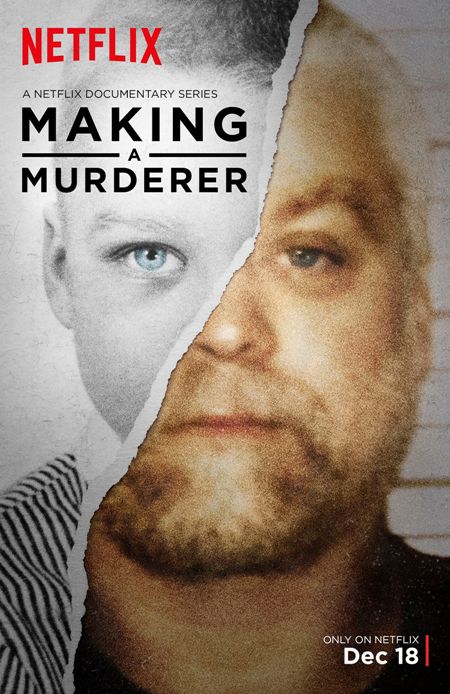
Weekly Watch: Making a Murderer

2015 was a good year for long-form documentaries about criminal justice, from the smashing success of the Serial podcast to HBO’s crime solving (?) The Jinx. But the cream of the crop has to be the Netflix series Making a Murderer. That’s partly because it’s infinitely bingeable, where the others weren’t, but that’s also because it’s got a hell of a story to tell

The story, writ broadly (it’s over 10 hours long, after all) is this – In 1985 Steven Avery is convicted of attempted rape in Manitowoc, Wisconsin. He maintained his innocence and, 18 years later, DNA proved him right (while identifying the real culprit to boot). Released from prison, Avery became a shining star in the exoneration world, a poster boy for needed reforms of the criminal justice system. Then, just when changes were about to be made, he was charged and convicted of an even more heinous crime – murder. As in 1985, Avery maintains his innocence, but so far, hasn’t been able to prove it.

But wait, there’s more. There’s a back story involving Avery’s relationship with the Manitowoc County Sheriff’s Office. It was responsible for putting him away in 1985, ignoring evidence pointing to the real perpetrator in the process. It ignored signs in the mid 1990s that suggested Avery was innocent. And, most important, the office and several of its officers were being deposed as part of a lawsuit about Avery’s conviction at the time the murder victim, Teresa Halbach, went missing.

Thus, rather than telling a story about how a man who was wrongly imprisoned for two decades might have been turned into a killer, the film makers (with a generous assist from Avery’s lawyers) instead tell a tale of a man who wrongfully convicted twice. The first time, via more negligence than malice, but the second time by a deliberate frame up.

There’s also the story of Brendan Dassey, Avery’s slow-witted teenage cousin, who was also convicted of participating in Halbach’s murder. The entire case against Dassey consisted of a “confession” given by Dassey that’s almost a paradigmatic example of how skilled interrogators can get the answers they want, regardless of how truthful they really are. The overriding sense at the end of things is that Brendan, at the very least, had nothing to do with the murder.

I’m not sure they can make the case that Avery was framed. But what the Making a Murderer does is to highlight a lot of troubling issues in the criminal justice system. They’re not things that are new to those of us who work there every day, but they’ll shock some lay people. At least I hope they do.

The first thing that pops up is investigative and prosecutorial tunnel vision. That is, once cops know they have the “right guy,” they focus entirely on convicting him, regardless of evidence that might point to another suspect. Case closed, stat achieved! That’s most obvious in those in the system who, even after DNA cleared Avery, refused to concede they’d gotten the wrong man. This is fairly common in exoneration cases. People are so wedded to the position that they were right that they can’t accept they were wrong. Confirmation bias can be a real monkey on one’s back.

Next there’s the way that the prosecutorial apparatus protects itself from accusations of wrongdoing. To its credit, the Wisconsin AG’s office did an investigation of Avery’s 1985 case after his exoneration. The investigators who were deposed in Avery’s civil case said some pretty damaging things, mostly about the kind of tunnel vision I mentioned above. The final report, however, was a whitewash, which is par for the course. Misbehaving prosecutors are rarely punished, or even called out by name when courts find they’ve misbehaved.

Brendan’s story combines two current tropes of criminal defense, a coerced confession and horrific defense lawyering. We see some of Brendan’s taped interview with police, but we also hear lots of phone calls with his mother while he was in jail. The upshot of all this is that he had no idea what he was doing, was trying to please the officers, and almost certainly didn’t have the role in the murder he ascribed to himself (if he had any at all). Again, this isn’t unusual – while all cases of DNA exoneration have a false confession rate somewhere around 20 percent, for juveniles that goes up to over 40 percent. Let that sink in for a moment – in almost half of juvenile exoneration cases, the juvenile confessed to a crime he didn’t commit.

What’s worse in Brendan’s case is that one of the his false confessions was obtained by his defense team! His second appointed lawyer declared his client guilty before he even met him and apparently was trying to make him the best guilty pleader and cooperator he could. That backfired, spectacularly, giving the prosecution extra ammunition to use against him at trial. You’ve heard of lawyers who are asleep during their client’s case? Maybe, sometimes, that’s the lesser of two evils.

Of course, to hear the prosecution tell it, there is no such thing as a “false” confession. During the closing argument in Brendan’s case the prosecutor told the jury that “innocent people don’t confess to crimes they didn’t commit.” As the numbers laid out above show, that’s clearly false. While a lay person might be forgiven for thinking that, a lawyer in the 21st century shouldn’t. If the prosecutor wasn’t outright lying, he was so out of touch with current research on false confessions that he should have his license pulled.

Avery’s trial had a whopper from the prosecutor in closing argument, too, in the form of the declaration that “the presumption of innocence applies to the innocent.” That’s wrong on a couple of levels. Theoretically, of course, everyone – innocent, guilty, and in between – is entitled to a presumption of innocence. It’s the prosecution’s job to rebut that. If it can’t, the defendant goes free – regardless of whether, factually, he’s guilty or not.

But he’s also wrong practically, for a very different reason. That’s because, practically (in my experience), there is no presumption of innocence. It’s a myth people buy into to make themselves feel better about how the world works, like Santa Claus or God. In truth, lots of people think if you’re charged with something, you must be guilty of something. Judges can instruct jurors otherwise, but it’s a hard bias to crack.

Speaking of bias, I certainly have one that I bring to Making a Murderer. Being a criminal defense lawyer for 16-plus years will do that. And make no mistake, the filmmakers have a viewpoint and are making an argument. This is not an even, balanced, tell all sides documentary. It’s a polemic, meant to stir passions. Whether it succeeds in convincing that Avery is the unluckiest man on the planet, being wrongfully convicted for two separate crimes, is unclear. But if it riles people up enough to pay attention to the issues the case raises, that’s good enough for me.

MakingaMurderer

When Law and Literature Collide

Let’s get one thing straight up front – any state that wants to throw someone in jail for criticizing its leader is repressive and not a friend to human rights. If free speech means anything, it means being able to say impolite things about those who wield power over you. Wherever the line is drawn when it comes to such things we should all be able to agree that, say, making fun of the king’s dog shouldn’t be a jailable offense.

Having said that, sometimes regimes that are so intent on maintaining their honor that they’ll lock citizens up for saying mean things about them at least make for interesting entertainment.

Consider the ludicrous prosecution of physician Bilgin Çiftçi in Turkey (via). His supposed crime? He shared a meme that compared president Tayyip Erdogan to Gollum from Lord of the Rings, particularly the Andy Sekris-inhabited version from the movies. Something like this:

o-RECEP-TAYYIP-ERDOGAN-GOLLUM-SMEAGOL-LORD-OF-THE-facebook

Stuck with a horribly oppressive law, Çiftçi is doing the only thing he could in his defense – he’s leaning in:

when he appeared in court, Çiftçi insisted that he hadn’t insulted anyone at all. For all his slimy skin and questionable syntactic habits, many say Gollum is not a villain. He may even be a hero. After all, it was he who freed Middle Earth from the tyranny of the ring by biting it off of Frodo’s finger and (albeit inadvertently) plunging with it into the lava roiling inside Mount Doom.

That might have been good enough – sure, it’s a post hoc justification most likely, but it’s plausible. We’re talking about art here, something open to multiple interpretations none of which are “wrong.” Alas, it wasn’t, leading to the court to summon an expert panel of five people (academics, psychologists, and a TV/movie expert) to weigh in on the merits. No word yet (that I can find) on the verdict.

Let’s hope Çiftçi’s ploy works, as he faces up to four years in prison if it doesn’t.

At least he’s not in Thailand, where the law prohibits anybody criticizing or making fun of the (largely ceremonial) king, even a king that’s been dead since 1605. The “lèse-majesté” even trips up unwary diplomats, such as US ambassador Glyn Davies (who, given his line of work, ought to know better). It even extends to making fun of the king’s dog, for which one unwary Facebook user is facing a potential 37(!) years in prison! He may not have as clever a defense:

‘I never imagined they would use the law for the royal dog,’ Siripaiboon’s lawyer told the Times. ‘It’s nonsense.’

It is nonsense, but not because it’s a law being stretched beyond its reasonable limits. It’s nonsense because such laws shouldn’t exist in the first place. They’re designed to be used unreasonably to stifle legitimate dissent and soothe hurt feelings. Being a president or a king (or even the king’s dogs) requires a little bit thicker skin.

When Law and Soccer Collide

In the United States, we generally think of sports team logos getting in trouble with modern law, bowing to the changing perceptions of a (hopefully) more inclusive population. However, that’s not always the case, particularly when you’ve got a legal foundation that goes back well beyond 1776.

Consider this Big Soccer article about Ayr United, currently playing in the third tier of Scottish soccer (confusingly called League One – just trust me). They’ve been on a roll on the field, but could run afoul of the law off of it, all due to their team crest, which is this:

AUFC Crest

Nice, huh? It’s been around since the 1950s, but is in danger of something that’ s been around much longer – a law about heraldry that dates back to 1592. England has a civil court to deal with heraldry, but Scotland’s body, the Lyon Court (presided over by Lord Lyon, King of Arms, naturally) is a little more hard core:

In Scotland however, infractions in heraldry are actually a criminal matter and nobody can legally use any sort of heraldic device without the approval of the Lord Lyon, who has the power to have any unapproved heraldic devices, and anything they are attached to, destroyed. This means that if Ayr make no changes to their emblem, the Lord Lyon could destroy all team kit and merchandise.

Another club in Ayr’s league, Airdire United, actually did the latter when their crest came under scrutiny.

Why Ayr and why now? The Lyon Court only investigates things brought to its attention, so somebody must have ratted (suspicion falls on fans from rivals Kilmarnock because, naturally, an Ayr fan ratted them out decades ago). Having said that, one Scottish attorney estimates that 25 of Scotland’s 42 professional soccer clubs might have similar issues.

I like the conclusion the article writer reaches:

It may seem as though Ayr United and the clubs before them are being unfairly treated, but I should point out that the Lyon Court is there to uphold the law. It may be a ridiculous anachronism of a law, but it’s still the law, and if the Lyon Court decide that a prosecution is in the public interest, then that’s what they’ll do.

That’s why it’s important for legislative bodies to go back through old laws and clear out those that are outdated and never enforced. Not only do they undermine confidence in the law, the provide troublemakers, whether of the elected or civilian variety, with tools to harass their rivals. The UK is currently in the middle of such a project, looking to strike old laws from things like wearing armor in Parliament to handling salmon “under suspicious circumstances.” Hard to say whether that would reach so far as the Lyon Court, however. I’m guessing not.

So loopholes it is for Ayr United.

What Is Criminal Law, Chopped Liver?

Thanks to Orin Kerr over at Volokh, I saw this piece for a recent issue of Time magazine in which numerous scholars were asked to name the best and worst Supreme Court decisions since 1960. As with most such lists it’s only interesting in prompting discussion, not as a real normative exercise. It’s also interesting for what is completely absent from the discussion.

The cases mentioned, either good or bad, all tend to be cases involving interpretation of the Constitution, rather than statutory or regulatory cases. That makes sense – statutory or regulatory decisions that get it “wrong” can be effectively overruled by Congress or the executive branch. Constitutional rulings, for good or ill, hang around longer.

Nor am I as surprised as Kerr that the folks sampled focused more on the long-term impact of a particular case than the legal reasoning of it. While lawyers and academics may get caught up in the details of legal reasoning, in the real world a case’s impact is the only thing that really matters. A well-reasoned case that reaches a wrong or otherwise bad conclusion still strikes me as a “bad” decision.

But putting all that to one side, while the cases cited by the panel cover a wide range of topics – free speech, racial and LGBT equality, federalism, etc. – there’s one area that’s overlooked completely. Much to my surprise, nobody thought a decision involving criminal law was among the Court’s best or worst in the last seven and a half decades.

A caveat – I realize that some cases that deal with other issues are criminal cases. I’m thinking of Texas v. Johnson, which involved flag burning. It only got to the Court because someone got prosecuted, but it’s really a First Amendment case, not a criminal law case. On garden variety bread and butter criminal cases, the surveyed experts are oddly silent.

Consider some of the landmark criminal law decisions issued by the Supreme Court since 1960:

  • Miranda v. Arizona (1966): Of “You have the right to remain silent . . .” fame.
  • Gideon v. Wainwright (1963): Of “if you cannot afford an attorney, one will be provided to you at no charge” fame.
  • Terry v. Ohio (1968): The birth of “reasonable suspicion” as a part of Fourth Amendment jurisprudence and, arguably, the beginning of the end of the Fourth Amendment.
  • Whren v. United States (1996): Enshrining the “objective” analysis for Fourth Amendment issues, effectively allowing cops to make stops on pretextural grounds.
  • Ohio v. Roberts (1980) & Crawford v. Washington (2004): Two for the price of one – in Roberts, the Court largely eviscerated the Sixth Amendment’s right to confrontation, so long as the evidence in question was otherwise “reliable,” while in Crawford the Court reversed, and held that confrontation itself is the Constitutional engine of reliability.
  • Apprendi v. New Jersey (2000): Holding that the Sixth Amendment required any fact that enhances a sentence to be alleged in an indictment and proven to a jury beyond a reasonable doubt. The basis, eventually (in United States v. Booker [2005]), for the declaration that the United States Sentencing Guidelines were, as enacted, unconstitutional.

And that overlooks every death penalty case for the past several decades. Given that all these cases involve interpretation of the Constitution and have had far reaching impacts (for good or ill – pick you side), it seems strange that not one of the 15 people interviewed for the Time piece picked one. The question is why?

Maybe it’s just a matter of limited room. In any “best/worst” list there’s going to be worthy items that just miss making the cut. Maybe some (or all) of those cases were considered and rejected. A lot of second choices, perhaps.

But I can’t help shake the idea that, just maybe, not a lot of people give a shit about criminal law, unless they’re directly involved in it. It’s easy to see yourself involved with a First Amendment issue or concerned about equality under the law. Less so when it comes to criminal procedure. Most people don’t care about things like confrontation of witnesses or appointed lawyers until they need it themselves. That’s partly why only now, after decades of unprecedented incarceration, does the public at large seem concerned about it.

Perhaps I undersell the academics in the Time piece. I hope so. One of the things that legal scholars and those of us in the legal community need to do a better job of doing is impressing upon people how issues that don’t necessarily impact them directly still need their attention when it comes to politics and policy. One way to do that would be to acknowledge how important the Supreme Court’s criminal docket is.