Rethinking The Room?

A few months ago I wrote a post where I explained why The Room – or, more particular, the fandom that’s grown up around it – drove me nuts. I wrote:

But from what I’ve read from people who have made The Room a cult favorite it’s not because they see it as an undervalued gem. Nor does it appear to fall into the “so bad its good” category, as everybody involved takes the thing completely seriously. No, it seems that people just really enjoy watching an artist fail, enjoy watching a horrible product because it’s horrible.

I’m not about to join the fan club, but I’ve had a rethink about it, thanks to this piece over at Electric Literature. Called “Why We Love Bad Art,” John Sherman, riffing on Susan Sontag, goes straight to The Room and makes an interesting case:

Not all failure is equal, and the nature of artistic failure depends on the nature of the attempt.

***

The Room is an awful movie, but it’s trying to be a great film, and this generates its basic charm. By extension, Wiseau is an awful filmmaker trying to be a great one, and his blindness to his own deficiencies is what allows him to be canonized in the so-bad-it’s-good tradition. Whether due to narcissism or a lack of taste, or both, pure Camp cannot fathom its own shortcomings.

I can see that. Art that fails, but does so nobly with great passion, has something in it to be admired. By contrast, something that’s a cold and calculated attempt to make something popular or financially lucrative that fails is just shit. I get that. I’m not sure I really get that vibe from most of the people I’ve heard talk (or read about) The Room.

Sherman mentions Mystery Science Theater 3000 and how it made a whole thing out of taking pot shots at bad movies. I’m not sure the analogy works, however, as most of what MST3K (in any variant) took on were only worth watching because of the jokes being made at its expense. Sure, in at least some instances the folks involved had a soft spot for one of those movies, but for the most part they savaged them because they sucked. There’s a difference between “so bad it’s good” and “so bad we can enjoy making fun of it.”

And so we return to the distinction I made in the original post, between loving something even though common opinion is that it’s bad versus not admitting you love it because it’s bad. Art doesn’t always find the audience the creator intended, but maybe it always, eventually, finds an audience of some kind? Perhaps people should just let themselves love it and not think too much about it.

Like I’ve been doing!

Fry

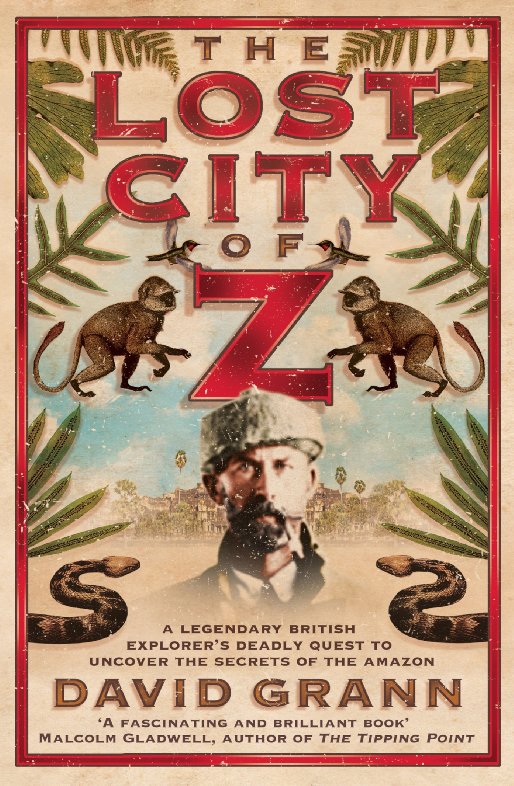
Weekly Read: The Lost City of Z

I generally roll my eyes at people who see a movie based on a book and then tut tut that “the book was better.” Even as a writer, it comes off as snobbish to me. The written word is a different medium than film, which makes adaptations their own things. One’s rarely “better,” even in a subjective sense, than the other. They’re just different.

The film, The Lost City of Z (released last year), got a good amount of praise when it was released. I’ve even seen people list it as being snubbed in the Oscar race. It’s the story of Percy Fawcett, who repeatedly search the Amazon jungle for evidence of a lost city in the early part of the last century. The wife and I put it on our list of flicks to see and, the other weekend, were able to pay per view it. My thoughts at the time was that it was a fine flick, but it suffered in comparison to such jungle fever dreams as Aguirre, The Wrath of God.

It did interest me enough to go read the book upon which the movie is based. Also called The Lost City of Z, it weaves the history of Fawcett’s expeditions in with the attempt of author David Grann to track down evidence of Fawcett’s final expedition (no spoiler alert – Fawcett’s disappearance in 1925 is one of the everlasting mysteries of the golden age of exploration). I’m glad I did, not just because the book provides more detail than any movie possibly could, but it makes clear that large hunks of the movie are complete and utter fiction.

Let me clarify that I’m not talking about whether the film itself, or the book, is “accurate” from an historical standpoint. There was a lively debate at the time the movie came out with historians arguing that it portrayed Fawcett in a much more positive, progressive light than the historical record supports (also, he sucked at exploring). Naturally, the director’s response to this was, in essence, “it’s art and you can’t talk like that about it.” That’s not what I’m really interested in. However, I will note this observation from one critique of the movie version of Fawcett:

The original book, by David Grann, was much more intelligent and nuanced, as one would expect from a staff writer on the New Yorker. But everything has gone wrong in its clumsy adaptation for the screen by director James Gray, who has written his own script and then filmed it with great reverence – almost always a mistake.

That sounds about right, although “clumsy” is perhaps too kind. It’s simply bizarre for a movie based on a particular non-fiction book – it even uses the title! – to break from the book in so many fundamental ways. I’m not talking about the inevitable compression that happens to turn a biography into a movie – that Fawcett had 8 Amazon expeditions, not 3, or that he and his son had a third person on their final voyage makes sense. I’m talking about things that get the character so wrong I don’t understand why the writer/director used the name of a real person.

For example, one of the most obvious diversions from the book is the in the film Fawcett is portrayed as having fallen into exploration after being tapped by the military and Royal Geographical Society to survey a river on the border of Brazil and Bolivia. In fact, Fawcett caught the exploration bug while stationed in Sri Lanka (then Ceylon) when he fell hard for a story of buried treasure (he didn’t find that, either). He’d already attended a 1-year course at the RGS before the surveying mission came up.

Or take the depiction of Fawcett’s relationship with his eldest son, Jack. In the film Jack is shown as an angry kid, raging against his father as a failure after an expedition collapses spectacularly (bonus point – the book never mentions that Fawcett resigned from the RGS in the aftermath, as the film portrays). They’re reconnection as they plan the last expedition is a moving part of the film. But, according to Grann’s book at least (the source material for the film!), the two were always close and Jack wanted to join his father in his explorations almost as soon as he could.

But the most egregious example involves World War I. Fawcett was well into his Amazon explorations when the war broke out. He went back to England and, eventually, to the Western Front. The film portrays Fawcett leading a Paths of Glory style assault over the top (after consulting with a Madame Blavatsky type – she died in 1891) during which he’s wounded by gas. No just wounded – blinded. A doctor even tells the blind Fawcett that he’ll never see the jungle again. This is utter fiction, unless Grann decided to skip the episode completely in his book. Fawcett wasn’t wounded, much less blinded, and didn’t sit around the English countryside recuperating for years until his son convinced him to give it one more go. Why the director (who also wrote the script) decided to put it in is anybody’s guess.

Somebody could have made a really interesting movie out of the Grann’s book. Even without the modern day overlay of Grann’s own expedition, the atmosphere of doom that clung to Fawcett’s final expedition could have really worked as the backbone of the movie (cover what else needs to be covered in flashbacks). Or, alternately, somebody could have used Fawcett as the basis for a truly fictional character and played around with the details as he saw fit. The Lost City of Z the movie isn’t either of those and it suffers for it. The Fawcett of the book is much more interesting than his celluloid counterpart.

But it did lead me to the book, for which I thank it. For, in this instance, the tutters would be right – the book really is better than the movie.

lost city z bookLost City of Z film

What’s a Director Worth?

It’s awards season, which means an annual tally of the talented in the world of movies. Among the most recognized are directors, who get recognized separately at awards like the Oscars and the Golden Globes. Often, but not always, the best director nominees track those for best picture, although that’s gotten a little muddy since we have more best picture nominees these days. That being said, what’s a director worth when it comes to the finished product? Is a great film always the result of great direction?

Mike D’Angelo, over at the AV Club, goes at the issue from the other direction and asks if there are situations where the “best-directed movie isn’t among the best of the year.” The example he provides from 2017 is A Ghost Story, which he calls “last year’s most stunning directorial achievement” but involves an “unexpected turn” in the story that is “enough of a deal-breaker” to keep it from being one of his best films of the year. From his description (I haven’t seen the movie) it sounds like a good argument.

GhostStory

Nor would it be unprecedented. It’s not unheard of for a director to be recognized for doing something really different technically or structurally without the final product also being recognized as superior. In 2013 Ang Lee won Best Director for Life of Pi, which involved a lot of technical wizardry that really pushed the bounds of film. It didn’t win best picture, however, losing out to Argo (which, ironically, didn’t even get a directing nod for Ben Affleck). One could make the same argument about Gravity the following year, for which Alfonso Cuaron took home Best Director, while 12 Years a Slave took home best picture (though Steve McQueen was nominated that year).

Where I think D’Angelo goes wrong is in trying to shift, and narrow, the focus of what makes a great director:

Rather than just give up and conclude that the best films must logically be the best-directed films, I instead try to determine, when voting for Best Director in year-end critics’ polls, which movies most impressed me from a purely visual standpoint. Admittedly, there’s plenty of crossover there with various technical categories—cinematography, editing, art direction, costume design—but I generally boil it down to a simple question: ‘Who knew exactly where to put the camera?’ When I come at it from that angle, Picture and Director diverge just enough to make things interesting.

It may make things interesting, but it gives short shrift to a lot of what a director does. You don’t have to be an auteur worshiper (D’Angelo labels himself a “softcore auteurist”) to recognize that a director is the one person most responsible for how a film winds up. Not the only one, certainly, but unless they are overrun by studio dipshits directors have what Bill Bruford, in listing his credits for a solo album, called “final say.” The buck ends with them.

To give one example where a film is shaped by the director’s “vision,” but not necessarily his camera techniques, consider Richard Linklater’s Boyhood. It’s a coming-of-age story shot, essentially in real time. Over the course of eleven years, Linklater filmed sequences with the same cast, including the central character, a boy who literally grew up on screen. The entire setup was his idea and he stewarded it through to completion.

Boyhood

Which is not to say identifying a talented director takes no more effort than finding a list of the best movies of a particular year. Sometimes they bring something so different to the table that the end result isn’t that important. More often than not, though, it is. It’s just really hard to quantify. It’s the Potter Stewart situation of the film world.

Weekly Watch: The Shape of Water

The other weekend my wife and I decided to go to the movies. It’s that time of year where all the stuff that was in limited release at the end of last year for Oscar consideration is starting to trickle out to our neck of the woods. We checked the listings and came down to seeing either The Post, the new Spielberg take on the Pentagon Papers, or The Shape of Water, Guillermo del Toro’s latest. The wife decided on the latter, figuring it was more the kind of movie that should be seen in the theater.

Boy was she ever right (as usual).

Mostly when I think of “see it in the theater” movies I’m thinking of the big, popcorn movies that dominate the box office most of the year – superheroes, big sci-fi/fantasy franchises, or action movies (the wife has a disturbing affection for the Fast and Furious movies). Things that really play into the “bigger is better” idea and make it worth dealing with the public to watch in super wide vision, rather than just on the TV.

The Shape of Water isn’t one of those movies. It looks beautiful, don’t get me wrong, and it has some praise worthy effects, but it’s not interested in them as an end, as so many big movies are. Rather, what makes The Shape of Water the kind of movie you want to see in the theater is that it’s the kind best experienced when you turn the lights off, shut out the real world, and give yourself over to it completely.

That’s because The Shape of Water is, essentially, a fairy tale. Voice overs at the beginning and end of the film make this about as explicitly as they could without just saying “this is a fairy tale.” It’s not a movie for your logical, rational mind; it’s for your heart or spirit or soul or whatever place it is where your feels live. That’s not for everybody – witness the low ratings from some IMDB commenters who ding the movie for not being “realistic.” Problem is, the movie never sets out to be realistic.

I mean, “realistic” isn’t a word that should be anywhere near a story about a mute woman who falls in love with The Creature from the Black Lagoon (or Abe Sapien – take your pick). Just so stories aren’t realistic – or else they wouldn’t be just-so stories – and that’s what this is. A collection of outsiders – mute woman, gay man, African-American woman, a communist – band together to save another odd outsider, battling all the way against forces of conformity.

By turning away from realism del Toro is able to give the film a lyrical, dreamlike quality. When a black and white musical number pops up in the second half of the film, it seems perfectly in place. Another scene, wherein the aquatic containment properties of the common apartment bathroom are pushed beyond all sense, works just as well. Del Toro, aided by an amazing cast, weaves a spell, but it has to be one you’re willing to fall for.

But don’t take it from me. The Shape of Water now had 13 Oscar nominations, including Best Picture and Best Director. You want to see it, and the best place to see it is in a large, dark room where you can let it completely absorb you.

ShapeofWater

Does The Room Piss You Off, Too?

If you’re any kind of movie nut you’ve heard of, if not seen, The Room. Released in 2003 it was written and directed by Tommy Wiseau, who also played the leading role. It is famously bad. I’ve seen it referred to as the “Citizen Cain of bad movies.” Its badness is so noteworthy that it’s the subject of a new (much better, by all accounts) movie, The Disaster Artist, directed by and starring James Franco as Wiseau.

I’ve seen The Room and it’s as bad as advertised. In spite of that, or really because of it, it’s become a cult favorite, so much so that it’s actually made back the initial money spent on it (north of $6 million, all from Wiseau). Not because people actually like it, but because they revel in its awfulness. Wiseau seems to have made his peace with this, but it kind of pisses me off.

Don’t get me wrong – I’ve said over and over again that a person’s response to art, what they like and don’t like, is deeply personal. In addition, I’m fond of enjoying stuff that consensus suggests sucks, what generally get called guilty pleasures (I hate the term). I, for example, have a deep affection for lots of movies people consider lousy that tend, for some reason, to involve Max Von Sydow (Victory, Dune, Flash Gordon). I like them because I like them, in spite of the fact that most people don’t. I’m cool with that kind of thing.

But from what I’ve read from people who have made The Room a cult favorite it’s not because they see it as an undervalued gem. Nor does it appear to fall into the “so bad its good” category, as everybody involved takes the thing completely seriously. No, it seems that people just really enjoy watching an artist fail, enjoy watching a horrible product because it’s horrible.

There’s a Seinfeld episode where Jerry’s dentist (a very pre-Breaking Bad Bryan Cranston) converts to Judaism and proceeds to tell lots of jokes of Jewish people. Jerry seeks out a priest to tell him of his problems with this.

As a mere consumer of pop culture I’ve got no problem with people interacting with The Room in any way they want. As a producer of it, as a writer, it kind of pisses me off that people take such enjoyment in something they know, and will admit, sucks. I know so many people – musicians, authors, visual artists – who put their heart and soul into their work and make good, but completely overlooked, stuff that it honks me off to see something celebrated because it’s bad.

My plea, I suppose, is this. If you love The Room because you really like it – which is a perfectly valid way to feel – then, by all means, go ahead and love it. But if you’re interest in it is merely to be part of the cool crowd that knows all about it because it’s horrible, spent your energies elsewhere. Try a new writer, stream a new musician, go to a local gallery. There’s good – even great – stuff out there waiting for you if you’re willing to look for it.

Not Exactly The Thomas Crown Affair, Is It?

Art heists are great fodder for movies and books. The stakes are usually pretty high, involving unique, priceless works of art. Daring do is often required to pull them off. And it provides a good opportunity for suave characters to behave suavely.

This isn’t one of those stories.

In February 1965, Salvador Dalí painted a version of Christ on the cross – in an hour and a  quarter – and donated to Rikers Island, New York City’s notorious jail complex. Dalí was supposed to meet with some inmate artists, but wasn’t feeling well, so he sent the painting instead. It was hung in the cafeteria, where it proceeded to collect stains from various jailhouse food fights. In 1981, somebody realized what it was (and had it appraised for $250,000) and took it down.

After a short tour around the country and some time in storage, the painting was hung up again at Rikers – but not where the inmates could actually see it. Instead, it was put up in a lobby where jail employees went in and out. In 2003, a group of those employees (four guards) decided to steal it.

The plan was to create a couple of distractions and allow the leader of the scheme to take the Dalí while replacing it with a fake. It didn’t go well:

It was noticeably smaller than the original, an instant tip-off, but the reproduction was also one that, based on descriptions, not even a child would have wanted to claim. Plus, the reproduction of the cafeteria stains were an entirely different color. It was bad.

Then, of course, there was the painting’s presentation. Yes, the glass case had been locked back up with the copy safely inside. But where the original had been displayed in its gold frame, the fake was simply stapled to the back of the box, sans frame.

The whole plan was amateurish at best, but when you factor in the location—a prison teeming with law enforcement officials who spent their days gazing at that exact painting (there were two guard booths in direct view of the Dalí)—it was stupidity at its finest.

The very next day, several guards reported that there was something wrong with the Dalí.

They all got caught, of course, although the ringleader managed to get a not guilty verdict at trial (the others were convicted).  As for the Dalí itself? One of the thieves says that the ringleader got nervous and destroyed it.

On second thought, maybe there is a great story here, in the tradition of a Coen Brothers “heist gone wrong” kind of thing. I’d watch it. I’ll even suggest a theme song:

Dali

The Simple Joys of Verisimilitude

My wife was born and grew up in Wyoming (she had stops in Hawaii and Pittsburgh before I lured her to West Virginia). She’s not big on “hometown pride” or anything, but it does make her cranky sometimes when Wyoming is depicted in popular culture and they get stuff wrong.

This weekend we saw Wind River, the new movie with Jeremy Renner and Elizabeth Olsen. It’s set in Wyoming, mostly on the Wind River Indian Reservation. It’s not quite the part of the state where my wife grew up, but she knows the area (the main town involved is one she knows) and it’s one of the reasons we wanted to see the flick. It’s also gotten really excellent reviews, and deservedly so. Definite recommendation from me.

Anyhow, about midway through the film the Renner character delivers some important back-story. The movie is tense and atmospheric and, so, for an hour or so we’ve been leading up to horrible things happening. The character’s soliloquy eventually comes to this line (approximately): “the autopsy couldn’t give a definitive cause of death because the coyotes had gotten to her pretty good.”

Coyotes. You know, like this:

Only Renner doesn’t say “Keye-oh-tay,” like most people would. Instead, he pronounces it “keye-oht.”

This is an emotional gut punch moment, so I wasn’t surprised when my wife grabs my arm and leans over. “He said keye-oht! He got it right!” she whispers excitedly. Here, in this moment of deep character development, my wife is connecting with the character using the right local vernacular. It was all I could do to keep from laughing during a very not funny scene.

Getting the little parts right like that will often go unnoticed. If I’d been watching it without a Wyoming native right beside me, I wouldn’t have given it a second thought. But sometimes it matters, if only to a few people. It’s worth getting that kind of stuff right for them.

The Exception That Proves the Rule

Years ago I wrote a review of an album by an obscure (even by prog standards) band. It was a middling album and I gave it a middling review. Fairly soon after I got a hateful email from one of the band members taking issue with the review. Aside from one factual thing I got wrong (which I changed) the rest was an odd mix of special pleading and attempts at sympathy. They put themselves out there, shouldn’t that count for something? Didn’t I care that another band member had just died and wasn’t it a shitty thing to do to write a less than positive review at that time (as if the obituary made it outside the band’s local area). It was an interesting experience.

And an understandable one. After all, once a creative person looses something on the world it’s inevitable that somebody, somewhere isn’t going to completely fall in love with it. Dealing with negative opinions of your work is just par for the course. If you can’t handle that, don’t publish books, release albums, or put your paintings on display for all to see.

Given that, the general wisdom in the writing world is that a writer absolutely, should not, never under any circumstances, respond to a review. Down that path lies madness. Even if there’s a clear error in there somewhere, it’s better to just let it go than be perceived as some thin-skinned artist whose feelings have been hurt. Because guess what? Nobody cares – unless they care enough to laugh at you.

Naturally, there’s an exception to that rule. At least if your Martin Scorsese.

Scorsese’s last film, Silence, wasn’t the critical darling and commercial success I’m sure he’d hoped for (full confession – haven’t seen the move, read the book a long time ago). In particular, a review in the Times Literary Supplement in the UK caught his eye. Scorsese decided to respond, both to correct a factual inaccuracy and to take issue with something the reviewer said.

“Bad move!” you cry! Not quite – as a result of Scorsese’s letter to the editor, he was invited to write an entire column unpacking the philosophical issue in the review he’d taken issue with. And, verily, there was no storm of shit produced by it. So how did he get away with violating this golden rule?

For one thing, he’s Martin Scorsese. He’s entitled to a little bit of leeway. Having said that, fame doesn’t prevent things going wrong, so there must be something else.

And it’s this – although Scorsese responded to a review, he didn’t complain about the review’s verdict of his work. He made two discreet points – one factual and irrelevant to the film’s merits, one philosophical that dealt with issues well beyond whether Silence was a good movie or not. In other words, he actually engaged, constructively, with what the critic said. He didn’t get defensive.

As I’ve said more than a few times – reaction to art is personal and nobody’s opinion of a piece of art can really be “wrong.” So it’s pointless to take negative reactions personally. Constructive engagement is one thing – hair-on-fire literary retaliation is entirely different.

Still, there’s a reason that the rule about responding to reviews is one that almost everyone can agree with. Think of it this way – if you’re tempted to write something about a negative review of your work, ask yourself, “am I Martin Scorsese?” Chances are, you aren’t. Act accordingly.

BookReview (Big)

When Aggregators Attack!

A couple of weeks ago a pair of generally reliable box office draws – Johnny Depp & Dwayne “The Rock” Johnson – opened big, summer, popcorn movies. Their offerings – Pirates of the Caribbean: Dead Men Tell No Tales and Baywatch – did not do great box office business (about $63 million on a $100 million budget and $28 million on $60 million, respectively). Perhaps that’s not surprising, if you look to the review aggregator site Rotten Tomatoes, which currently gives each film a “freshness” rating of 29% and 20%, respectively.

One might think this would lead to some serious analysis on the part of the studios involved, searching for what the problems were with these two movies. Well, they’ve analyzed and they’ve found the problem, all right:

RottenToms

At least that’s the way this Slate piece spins the spin coming out of Hollywood. It highlights the argument that those movies (and your other typical summer blockbusters) “aren’t built for critics but rather general audiences.”

This is almost certainly true. Critics see movies in bunches and absorb more cinema in a year than most people will in a lifetime. The tropes, story beats, and such that show up in lots of movies have to wear on someone who watches so many. By contrast, somebody who goes to the movies every now and then has different expectations. A couple of hours of entertainment, sealed away from the troubles of the world, is a fine enough thing. More than that, in the era of streaming where you can watch a movie at home for a lot less than going to the theater the reduced cost of entry might lower expectations (I’ll catch something on Netflix I’d never pay $10 to see in the theater).

What’s funny is that just a couple of years ago critics were the ones worrying about the disconnect between themselves and audiences.

While I agree with the Slate piece that it’s silly for studios to single out Rotten Tomatoes as the cause of their problems – and float the idea of doing away with advance critic screenings in the process – that article overlooks an important bit of context from the original Deadline story upon which it’s riffing:

In the case of Pirates 5, I hear that the movie had the highest test scores in the history of the series. Once audiences get into the movie, they seem to be enjoying it with an A- CinemaScore, higher than the B+ of On Stranger Tides and in line with the second title Dead Man’s Chest and At World’s End, and an 82% positive score. The franchise is still fresh abroad, and given its glorious overseas opening, the movie will certainly be profitable for Disney with an anticipated final global haul of $800M-$900M.

Meanwhile, Baywatch tested over a 91 three times.

In other words, it seems like the issue is the same thing critics worried about years ago – the disconnect between those writing the reviews and those watching the movies for fun. Which, although it’s a thing, isn’t an iron clad law. After all, the critics love Wonder Woman (93% fresh) and have previously shown love for such crowd-pleasing fare as Deadpool (84%), Rogue One (85%), Moana (96%), and Star Trek Beyond (84%). Furthermore, even movies that aren’t critically praised are rarely as panned as Baywatch and the new Pirates. So, maybe, if people stay away from big popcorn movies that are poorly reviewed it’s for a good reason.

Look, review aggregators aren’t the most subtle of instruments (I disagree with the Slate piece that they’re a “boring and ugly way to think about art,” however). At best they give you an idea of what the general critical consensus is about something, at least at the extremes. But they lack the nuance of actual reviews. It’s often more important to the ultimate decision (should I spend my time/money on this entertainment?) why a critic does or doesn’t like a movie than the simple thumbs up or down verdict. That’s why I recommend reading the same few critics regularly, even about movies you don’t think you’re interested in, to learn their likes and dislikes.

Like it or not, review aggregators are here to stay. They’re a fact of life in the modern world. Blaming Rotten Tomatoes (or Metacritic or whatever) is easy scapegoating. But it’s just that. Trying to keep the public at large from knowing what other people think of your movies before they buy a ticket is the height of arrogance.

On Storytelling and Stakes

The wife and I went to see Logan, the last of Hugh Jackman’s Wolverine appearances, the weekend it came out. It’s really excellent and reminded me of how good the 2013 entry, The Wolverine, was (the original origin story in 2009, not so much). In fact, I’d go so far as to say that those two movies are among my favorites of all the modern era superhero movies. I tried to figure out what that was, if there was something about them that really set them apart from, say, something in the Avengers canon or one of Christopher Nolan’s Batman flicks. Turns out, I think it’s because they’re smaller movies. Or, at least, the stakes involved are small enough that you can actually care about them.

I first noticed this in connection with Star Trek. Think about it – in the original series the jeopardy in each episode was usually faced by either Kirk, Spock, or McCoy or some combination thereof. A few episodes extended to other crew members and, on a very rare occasion, to the entire Enterprise. But the show never really tasked our heroes with something so grand as saving Earth or the galaxy or whatnot. The only thing in that area that jumps to mind is “City on the Edge of Forever,” which did involve setting the universe right, but, critically, the real drama was all about the main trio and, specifically, whether Kirk can let his love interest die as she must to set things right.

When we get to the movies, though, the stakes became increasingly high. How many of them involve some Earth-shattering baddie that only the Enterprise crew can stop (where is the rest of Starfleet at these times, anyway?). Paradoxically, that actually ramps down the tension, because who really thinks our heroes aren’t going to literally save the universe? An example proves the point – what’s almost universally hailed as the best of the Trek flicks? The Wrath of Khan. Which is, at its heart, about Kirk and an old foe battling it out until the end (universe altering tech in the background to one side).

Returning to The Wolverine and Logan, in both those flicks the stakes are fairly low, in terms of superhero movies. They play more like short stories, side plots in a bigger novel wherein the fate of the world hangs in the balance. But when it’s just the fate of a few (including our hero), things hit a lot closer to home. In other words, it’s easier (for me, at least) to become emotionally invested in the fate of Logan and his young charge than it is to really care whether a gaggle of X-persons stop Apocalypse because, come one, of course they will.

Although it’s horrific, the old adage attributed to Stalin (who would know from horrifics) that “one death is a tragedy, a million is a statistic” is true. It’s easier for people to empathize with a single other human being rather than a large group defined by broad common traits. The same is true in fiction. Sometimes you make a bigger impact by telling a smaller story.

Logan