This is it! After a month of talking about it, there’s little left to say:

This is it! After a month of talking about it, there’s little left to say:
Let me be very clear – Moore Hollow is a complete work of fiction. It takes place in a town I made up, Jenkinsville, which is the county seat of the equally imaginary Vandalia County. Still, that doesn’t mean there isn’t a little truth tucked away in there.
There are stories – rumors, in most instances – around elections in which people say that the dead continue to vote. It’s so pervasive that it led one small investigator to proclaim:
Oh my God! The dead have risen and are voting Republican.
Seriously, the problem arises because voter rolls don’t get purged very often, or very well, resulting in people who have died remaining eligible to vote (in a very hyper technical ignore the stink of rotting flesh kind of way). A Pew study in 2012 found that as many as 1.8 million dead people were still on the voter rolls. Still, there’s a pretty good gap between dead people still on the rolls and dead people actually voting.
In the wake of the 2012 election lots of officials in South Carolina asserted that hundreds of dead people had voted, an assertion made mostly in the context of the GOP push for stricter voter ID laws. More than 900, they said. As one lawmaker quipped:
We must have certainty in South Carolina that zombies aren’t voting.
Only, as with most things involving voting, the truth was much less sensational. The 953 votes found to have been cast by the (un?)dead weren’t cast in 2012, but in 74 separate elections over the course of seven years. In fact, the dead voters could be traced to a much more mundane explanation:
The report confirms what the State Election Commission had found after preliminarily examining some of the allegations: The so-called votes by dead people were the result of clerical errors or mistaken identities.
For instance, sometimes a son had the same name as a deceased father, and poll workers mixed up a dead father with a living son. (This happened 92 times in the initial probe, and then further investigation found seven more examples.)
That being said, examples of dead people voting pop up every now and then, as this article relates. In one instance in Tennessee, two dead people voted in an election decided by 20 votes. Still, there’s little evidence that it’s a problem that either determines elections or is part of a ploy used by the unscrupulous to win elections.
Which is where Moore Hollow comes in. West Virginia, southern West Virginia in particular, has seen its share of electoral fraud over the years. I even remember people joking about the dead continuing to vote (“early and often,” as they say) long after they shuffled off their mortal coil.
So it was natural to take the two strands and use them to create Thomas Owen Gallagher, aka King Tommy, aka The Cheat. King Tommy was the kind of politician who would do anything to win. Would he resort to voodoo, to strange instructions in a foreign book, to raise the dead and order them to vote for him? Of course he was! It’s what happened after that’s the crux of Moore Hollow, as Ben Potter returns to his great grandfather’s old stomping grounds to root out the truth. But what to do with it once he knows it?
Welcome to another edition of Moore Hollow Monday! It’s time for another excerpt from the book, which comes out October 5.
In this excerpt, Ben winds up the day by taking a drive near Jenkinsville and has an unsettling experience:
The road out of the town was a highway in only the loosest sense of the word. There were just two lanes which made sharing the road with the occasional huge coal truck that lumbered by a challenge. Regardless, it appeared like one of the Italian Autostrade they abused on Top Gear compared to the tributaries that branched away from it. Some began with several hundred feet of pavement but turned quickly into dirt roads. Others were little more than goat paths, winding back into the hills, into the hollows, until they disappeared, swallowed by the mountains. He toyed, briefly, with the idea of picking one at random and driving up it, but he quickly thought better of it. For one thing, this was probably not the time to arouse the ire of the locals by banging down private roads. For another, he wasn’t sure he could find his way out once it was dark.
Nightfall came about half an hour after Ben left town. He stopped at a small convenience store, fulfilled the tank’s enormous thirst for fuel, and grabbed a cup of coffee. It tasted like it had been made from the warmed-over remains of a small woodland creature, but it made him fully alert. He got back on the road and turned north, back to town and back to bed.
There had not been much traffic on the way down, nor was there much on the way back. At some point, however, Ben picked up someone following behind him. They weren’t close enough to be dangerous, but the other car’s headlights became a constant presence in his rearview mirror. Ben didn’t give much thought to it except when the undulations in the pavement shot the lights’ full brightness into his eyes.
A few miles from town, something caught Ben’s attention, something he didn’t expect to see on a road like this. It appeared to be a person walking slowly down the road on the right hand shoulder. Ben clicked on his high beams, then the ridiculously powerful fog lights to try to provide more light for the walker. At the very least, he didn’t want to run him over. Under the best of circumstances, anyone walking down this road was taking their life in their hands.
Ben lifted off the gas and slowed down, trying to get a good look at the walker. It was a man, but Ben couldn’t tell anything else about him—his age or whether he was black or white. His clothes looked rough and ragged, but beyond a general impression, Ben couldn’t tell much else. Then he noticed something odd about the man. It was his gait, the way he was moving. It wasn’t really walking in the strictest sense. It was more of a shuffle, a slow plodding step that fell somewhere between a limp and a gallop.
It hit Ben’s mind so fast he said it aloud. “Don’t zombies walk that way? Slowly shuffling along?” he asked himself. “At least they do in the films.”
He thought about stopping to try to talk to the man, who showed no interest in the presence of the tank near him, but that was impossible. The car that had been a constant companion behind Ben was now right on his bumper, brought near when Ben slowed down. He pulled around the shuffling figure on the side of the road and accelerated back to full speed. Immediately, he began to look for someplace to double back. About a quarter of a mile down the road was a small church with an equally small parking lot. It would do as a place to turn around, so Ben signaled, slowed, and turned into the church parking lot.
The car behind did the same.
Ben’s eyes fixed on the white headlights in the rearview mirror, which were quickly augmented by flashing blue and red.
“Fuck,” Ben said quietly. He brought the tank to a stop, put the transmission in park, and set the parking brake. The flashing lights stopped behind him at a rakish angle across the driveway as if to block any avenue of escape. Ben rolled down the window and heard the sound of a car door closing behind him, followed by the approach of slow, measured, solid footsteps.
“Good evening, sir,” said a controlled voice, one that oozed authority yet at the same time was calm and polite. Before Ben could see his face, a large, bright flashlight lit up the interior of the tank. It scanned Ben’s face, his hands as they rested on the steering wheel, and his lap before it moved slowly around the rest of the interior.
“Evening, officer,” Ben said. He did his best to get a glimpse of the man with the flashlight, but the glare made it difficult. He could make out an outline, one that matched his preconception of what an American lawman would look like. Large and barrel-chested, shoulders squared off as if he played American football, topped by a broad brimmed hat like one the Royal Canadian Mounted Police wore. When the light dipped from inside the car, Ben could see a tag on his chest underneath a badge that read “Rhodes, Sheriff,” in block letters.
“Do you know why I pulled you over?” he asked, as the flashlight beam settled on Ben’s face once again.
“No, sir,” Ben said. He honestly didn’t know.
“You crossed the center line back there,” he said, gesturing back up the road with the flashlight.
“I did?” Ben asked. “Must have been when I went around that guy along the side of the road.”
“I’m sorry, sir?” The tone of the sheriff’s voice made it clear he was not engaging in small talk.
“There was someone on the shoulder, back up the road,” Ben said, pointing. “He was walking along the side of the road, very slowly. If I crossed the line, it must have been when I drove around him. I didn’t see anyone coming the other direction, figured I should give him a wide berth.”
The sheriff was not convinced. “License and registration, please, sir,” he said, holding out his other hand.
Ben fished the rental agreement and his International Driving Permit out of the glove box, then took his UK driver’s license from his wallet and handed the collection to the sheriff.
“Please wait here, sir,” he said without commenting on the documentation. Or even Ben’s accent for a change. He walked back to the car.
Ben sat in the tank for what seemed like an eternity. All of the paperwork was in order, he was sure of that, but he wondered whether a sheriff in West Virginia had any experience with international travelers. Ben didn’t like the idea of spending the night in jail if something went wrong. He’d been in jail before but on home soil. For away games, he always tried to be on his best behavior.
The sheriff returned with the same measured steps and handed the papers back to Ben. “Would you mind turning on the inside lights, sir?”
“Sure,” Ben said. He took the papers, stuffed them back in the glove box and after groping around for a bit, flipped the switch that lit up the myriad of lights inside the tank’s cabin.
The sheriff leaned down and rested an elbow in the window frame. “All your paperwork checks out,” he said with a somewhat softer tone. “Never had to run down one those IDPs before.”
“Is that right?” Ben said.
The sheriff nodded. “I’m not gonna give you a ticket. I didn’t see this guy along the side of the road, but you seem like an honest type. Just try to not go around weaving like that again, all right?”
“Yes, sir,” Ben said, breathing a sigh of relief. “Thank you.”
The sheriff tipped his hat. “So, you’re English.”
“That’s right,” Ben said. Everybody seems to make that point, but coming from a man of the law it was a little unsettling. It was as if he knew that Ben should be sent back from whence he came.
“What brings you to Jenkinsville then?” the sheriff asked. “It’s a long way from London.”
That’s for certain, Ben thought. “Trying to track down something historical,” he said. “Family business.”
“You’re not a journalist, are you, Mr. Potter?” The question was not friendly.
“Yes, sir, after a fashion,” Ben said. Why did everybody pick up on that about him? “But this is more of a personal trip, really.” It was only then that Ben thought he should have punched the record button on the recorder in his jacket pocket. Too late now.
“You have family around here?” the sheriff asked, chuckling.
“No, not anymore,” Ben said, reciprocating the laughter. “My great-grandfather came here to work years and years ago. I’m trying to find something out about his time here, about this place where he worked.”
“That a fact?” the sheriff asked. “Small world. ’Bout how far back was that, you think?”
“Early part of the last century,” Ben said. “About 1905, 1906.” He decided to float the actual year out in the air and see how the sheriff reacted. It might give Ben some kind of idea about the game he was playing.
“That is a long time back,” the sheriff said. “There is a bit of history in this neck of the woods, though. How long have you been in town?”
“I just got here yesterday, late,” Ben said. He anticipated the next question. “I plan on heading home by the day after tomorrow.” He was regretting the hole in his research about American police procedures. Was he free to go? Could he tell this officer he was tired and just wanted to go back to his hotel? Of course, even if the law on paper said he could, would that mean anything out here, in the dark, along the side of a two-lane country highway?
“I see,” the sheriff said. He paused for a moment as if he might be finished. He wasn’t. “Find anything interesting yet?”
“A few things,” Ben said, trying to remain vague. “Nothing concrete, just some background. It’s all from the public record, let me assure you.”
“Let me ask you something, Mr. Potter,” the sheriff said, shifting his weight from one foot to the other. “Let’s say you find whatever it is you’re looking for. Then what?”
“I’m sorry?” Ben asked. He wanted to nail down precisely what was being asked of him.
“You say you’re looking for something,” he said, “something that your grandfather…”
“Great-grandfather,” Ben corrected him by habit.
“Great-grandfather saw or that happened to him, is that right?” the sheriff asked without skipping a beat.
Ben nodded.
“So if you find something about it, what your great-grandfather dealt with, what are you going to do with that information?”
Ben decided to lie. It was his best option at this point. “It’s mostly for my own piece of mind, really,” he said. “My father and I have a long-standing argument about our family history. To be honest, and I’m ashamed to admit this, I’ve been having this fight with my father for years. I’d like to win it.”
“I understand,” the sheriff said sympathetically. “So if you find what you’re looking for, you’re just going to share it with a few people, right?”
“I can’t think of anyone outside of my immediate family who’d care about our squabbles.” At least that much was true.
“All right,” the sheriff said as if satisfied. He shoved a large hand in through the window. “Well, enjoy your stay with us.” They shook hands. “And remember…,” he began.
“Don’t cross the center line,” Ben said. “Thank you, sir.”
“Have a good evening, Mr. Potter,” the sheriff said as he turned and walked back to his car.
Ben let out a large sigh of relief. He waited for the sheriff to move his car, then he pulled out of the parking lot and drove back to town. It looked like the sheriff headed back south, which allowed Ben to completely relax.
Moore Hollow – The hardest part of a mystery is deciding what to do once you’ve solved it.
Preorder now at Amazon, Barnes & Noble, iTunes, and Kobo
You’ve probably said, “JD, I really want to read Moore Hollow right now! Do I have to wait for October 5 to roll around?” As luck would have it, you’ve got not one but two chances to do just that – and do it for free!
Between now and September 21 go to LibraryThing or Goodreads and enter to win a free copy of Moore Hollow! Even better, you’ll get your book before it’s released on October 5!
If you’re one of the cool kids and want en eBook version of Moore Hollow, head on over to LibraryThing. Check their giveaway list and do a search for Moore Hollow (if it’s not near the top). I’ll be giving away up to 100 copies in various electronic forms (Kindle, ePub, and PDF). The giveaway runs for a week, which means you can have Moore Hollow in your hot little hands by September 22 or 23, depending on how long it takes to process the winners!
Or, if you’re more of the vintage type, head on over to Goodreads. There you can enter to win one of two paperback copies of Moore Hollow signed by yours truly! Just check their giveaways page or the Moore Hollow page itself, which will have a button where you can enter. This one also runs until next Monday, so it’ll take a bit longer to get your signed copy to you, but it should still hit your doorstep before October 5!
Until then, look forward to another excerpt and some of the history behind the book on the forthcoming Moore Hollow Mondays!
Welcome to the first Moore Hollow Monday! These posts will help you get excited about the release of my new novel, Moore Hollow, on October 5.
In this excerpt from the book, the main character Ben Potter meets with his sometime employer and editor Artith, about a potential job:
The book said nothing on the outside, its brown leather binding just barely holding up against years of abuse and neglect. It was about the size of a trade paperback with an afterimage of rough cowhide on the cover that had been worn smooth with age. He flipped open the cover and found the title page. The word “Journal” was printed across the top in barely legible gothic script. Underneath were a few black lines, spaces for the owner to write his name and the dates covered. The dates, written in neat, plain handwriting, were “July, 1905” and “February, 1907.” In the space where the journal owner’s name was written, it said, “Reginald Benjamin Potter.”
“Bloody hell,” Ben said.
“That’s you, isn’t it?” Artith asked, leaning back in her chair and looking extremely pleased.
Ben stared at the journal. “It’s my name, all right. But it’s not me. I’m the fourth poor soul to be saddled with it.” He closed the book and rubbed the rugged outer covering again. “Is this my great-grandfather’s?”
“You’ll have to tell me,” she said. I flipped through it, but I wasn’t really interested in the stuff he said about England. Did your namesake go to America?”
Ben nodded. “For a couple of years just after he left school. He went to some backwoods mountain town, coal mining country.” Ben shot her a dull look. “Only someone in my family would travel halfway around the world to wind up in a place that was just like home.”
Artith flashed him a confused look.
“Yorkshire,” Ben said, remembering that they had never really talked about his family before. “My family’s from just outside of Leeds. Been there for centuries. So leave it to my ancestor to go from English coal country to American coal country.”
“West Virginia,” she said.
Ben chuckled. “Where the bloody hell is that?”
“Somewhere west of Virginia, I suspect,” she fired back. “You know anything about what he did while he was over there?”
Ben shook his head. “Something with railroads, I think. The ones they used to haul coal out of the mines and to wherever it went before it got shipped off. He only spent a couple of years there before he came home and started the family business.”
“Which is not paranormal investigation or journalism, let me guess?” Artith said, chuckling.
“Much to my father’s chagrin,” Ben said, remaining stoic. “Civil engineering, actually.”
“How come you’re not an engineer then, Ben?” Artith asked, enjoying this little bit of torment. “Bad at maths?”
“No,” Ben said, more defensively than intended, “although that didn’t help. It just never did anything for me. To be a good engineer you have to be curious about how things work and why they sometimes don’t.”
“And you don’t care?” Artith continued.
Ben shook his head. “So long as whatever the damned thing is actually works, I’ve got no interest in the details.”
Artith thought for a moment like she had another prickly question ready but apparently passed on asking it. Instead, she shifted topics. “Did you know your great-grandfather then?”
“No, no,” Ben said, shaking his head. “He died before the Second World War. Granddad told me a lot about him, though.”
“He was an engineer too?” she asked.
Ben turned his head to one side, looked at the wall in thought, then said, “After a fashion.” Looking back to Artith’s confused face, he added, “He was a bit eccentric.”
She let that pass by unremarked. “Did your Granddad tell you anything about what his dad did in America then?”
“A little bit,” Ben answered without thinking. Then something tickled the back of his memory, something he hadn’t thought about for years. “Why?”
Artith leaned forward in her chair as if she might pounce. “I told you I skimmed that over the weekend,” she said, pointing to the book in Ben’s hands. “Your namesake tells quite a tale in there. As he lays it out, one of the local politicians was in a very tight race for his seat on whatever their little local council was called.”
Ben whistled. “A hundred-year-old political squabble is the kind of thing that gets you excited these days, Artith? Better find a job at Sky.”
She waved the joke away. “No, no, no. What’s interesting is what this desperate pol did about it. Or rather tried to do about it. According to your great-grandfather at least.”
“Which was?” Ben asked. The memory was coming into better focus now. He had some idea where this was going.
“This guy,”—she paused for a moment—“the name escapes me, but this guy, according to your forefather, actually raised the dead so that they could vote for him.”
Something clicked in his head. “Ah, yes,” he said. “The zombie voters.”
“You knew about this?” Artith asked, obviously hurt. “Why didn’t you tell me?”
“It’s not as if I was holding out on you, Artith,” Ben said. “Granddad told me a few stories. They were fun, but I never thought they were real. Seriously, why should I?”
“And nothing about working for the Journal made you think, perhaps, in a moment of reflection, that the time was ripe to revisit these stories?” she asked. It was clearly a rhetorical question.
Ben answered anyway. “I don’t work for the Journal, Artith, or for you unless some checks have gone missing in the post.”
She put up her hands in mock concession.
“Look, I loved my Granddad,” Ben explained. “But he was a little, what’s the word? Off, you know? When he’d talk about things his father saw in America I just took them for what they were—fun stories. Besides, Artith, you know me at least a bit. Do you think that working for places like the Journal have made me a believer in all this shit?” He gestured around the room, taking in all the paranormal exotica on display.
She shook her head. “Of course not,” she said, not altogether convinced. “That’s not why I showed you that, anyway.”
“It’s not?” Ben asked. “Then why? It’s kind of neat, I guess, but—”
“I want you to check it out,” she said, cutting him off with a devious look.
Moore Hollow – The hardest part of a mystery is deciding what to do once you’ve solved it.
Preorder now at Amazon, Barnes & Noble, iTunes, and Kobo
In which Maia, the One-Eyed Wonder Pup, speaks to you:
It’s August – the last hazy, sticky, hotter than heck days of summer. What better way to beat the heat than with a good book!

Better yet, how about a book full of stories that will take you anywhere but where you are! That’s The Last Ereph and Other Stories, a collection of ten tales of fantasy and science fiction. Go from mysterious verdant islands to a haunted lake in the woods and to eight other places. Well, OK, there is the one about the stifling heat and brownouts and a shady salesman, but still! It’s not where you are!
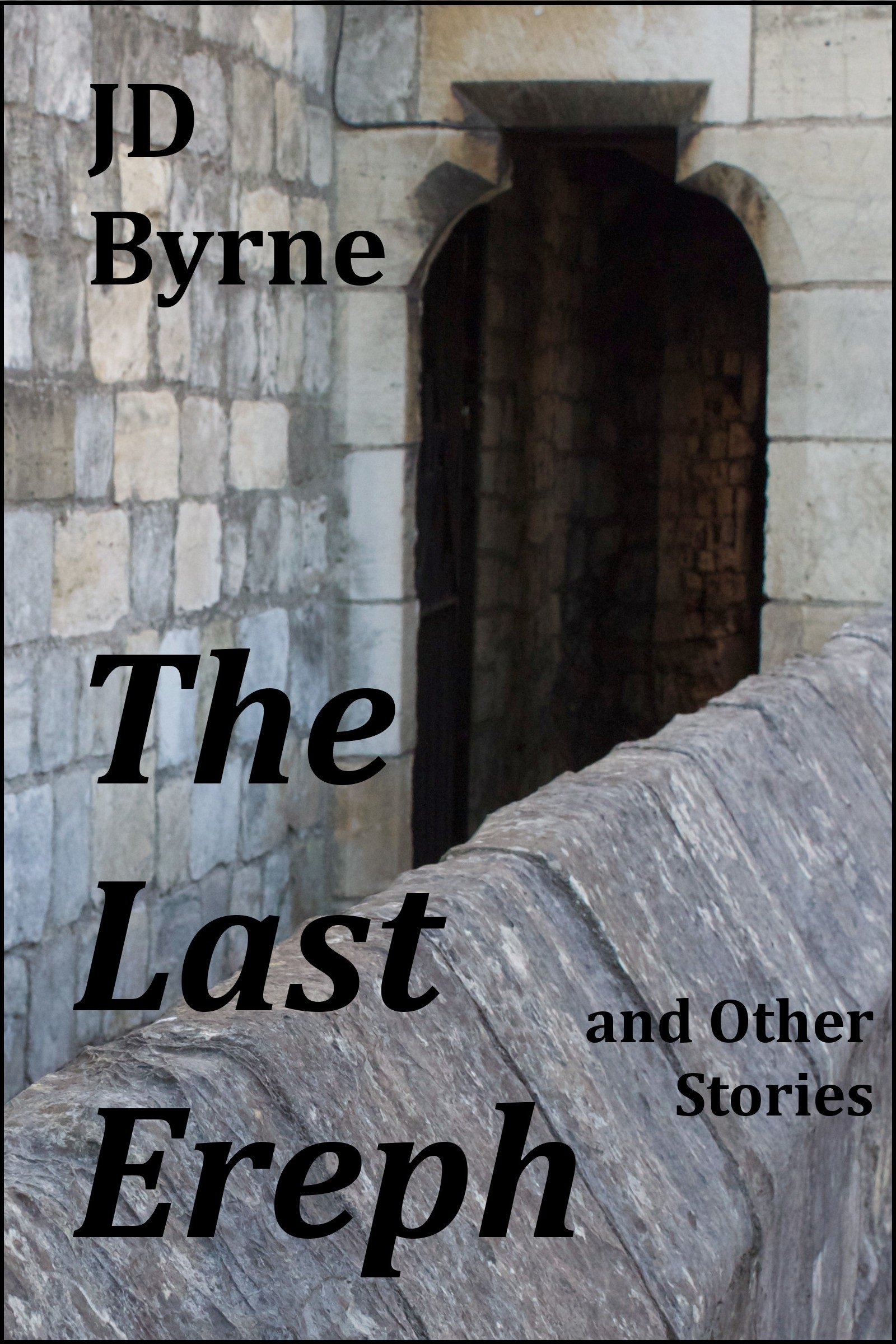
Only 99 cents on for Kindle, now until very early Monday morning. Tell ’em Maia sent ya’!
For more on The Last Ereph and Other Stories, including free samples, click here.
On October 5 my first novel, Moore Hollow, will drop. It’s a story of family strife, corrupt politicians, the undead, and one man’s shot at redemption. I’m giddy to be able to go ahead and reveal the cover:
Cover design by Rob Williams.
More details to come soon!
Snuff is a very funny book. On the one hand this should come as no surprise, given that it’s part of the late Terry Pratchett’s Discworld series, which is chock full of funny books. On the other hand it is kind of surprising because it is book 39 in the series (released only four years ago) and, at that point, one wouldn’t be surprised if Pratchett had shifted into coasting mode, resting on his laurels. Most long book series start off with a bang and slowly peter out. That Discworld didn’t is one of Pratchett’s many achievements.
Additionally, by this point Pratchett knew how not to play by the rules, if it suited his purpose. “Rules” tell writers that the inciting incident – the thing that drives the plot – should happen as early as possible in the book. It grabs the reader and focuses attention on what’s going on. But Snuff takes its leisurely time before things really get rolling, which allows Pratchett to do a lot of fun scene setting as his hero is transplanted from his familiar environment to something totally alien.
In this case, the hero is uber-cop Sam Vimes, head of the Ankh-Morpork city watch. Being a child of the Ankh-Morpork streets and a self-made man, Vimes is thrown into completely foreign territory when he and his family relocates to his wife’s family’s country home for a holiday. Awash in a world of rural oddities, rigid class barriers with matching rules of behavior, and the potential of not being a cop for a while, Vimes is completely, utterly, and hilariously at sea. In fact, I think I’d read a whole book of Vimes navigating this high society minefield.
But, this being a book about a cop on vacation, there is criminality afoot and it arrives in the form of the murder and mistreatment of goblins. Goblins are treated as vermin, killed or enslaved without thought, which rubs Vimes’s general egalitarian ideals the wrong way (in much the same way attitudes toward other non-humans did in Men At Arms). Vimes eventually gets his man, in rip snorting adventuring fashion, of course.
A large part of Vimes is that, regardless of where he is, mentally he’s always a cop. Similarly, just about wherever I am, I’m a public defender. That means that I can’t help but be troubled by Vimes as a cop. He’s given several chances to expound on law enforcement because he takes a young local constable under his wing and educates him. In particular, he excoriates the young constable for swearing allegiance to the local coven of magistrates who run the rural area rather than “the law.” It’s kind of inspiring, shot through with the idea that the law isn’t what men make it out of convenience and that all men are subject to it.
But Vimes then goes forth and makes the law whatever he wants it to be in order to get the bad guy. Most obviously, Vimes is a cop from Ankh-Morpork and has no jurisdiction outside the city walls. Several people mention this, but it doesn’t stop Vimes, who gets wishy washy about how some crimes are so horrible that jurisdiction is a technical issue to be dealt with later. He repeatedly uses threats of private violence (at the hands of his butler) to coerce information from people. He approves of vigilantes, noting that the law tends to deal with the lightly, if at all. He also shows no qualms about enforcing laws that aren’t even laws yet (involving goblin rights) – so much for ex post facto! To be fair, Lord Vetinari calls Vimes on this eventually, but it’s clear from the context that he’s throwing up a technical legalism (he cops to being the “local tyrant”) that the powerful hide behind.
To be fair, Vimes worries a bit about all this. Not a lot, but enough to recognize that his playing fast and loose with the law is something other people could do, too, and that might make it bad. But his wife shuts down those thoughts pretty quickly, countering that that it’s not so bad so long as it’s a good man doing it for a noble purpose.
Of course, that’s the problem. As I’ve noted before our culture loves stories about cops who work outside the confines of the law to get the bad guy. But bad cops do the same and – guess what? – they mostly think they’re doing it for the right reasons. Law places limits on behavior to prevent that from happening. Benevolent despots might not be that bad, but most despots aren’t benevolent, so that kind of unchecked power isn’t a good thing.
None of that should take away from the fact that Snuff is a fun, quick read. Pratchett was a master of language, puns, and quick jokes that land when you least expect them, yet manages deep sympathy with his characters. And Vimes really is a good guy, which makes his squishy relationship with the law so troubling. I wonder if characters like him contribute to the general idea that anything is OK in pursuit of the bad guy, whatever that might entail.

When I started these posts I intended to do one every month, but events got the better of me in June. Thankfully, that was because I was finishing up and releasing “The Destiny Engine,” so I think that’s a fairly good excuse.
Also, I got to take part in the first ever West Virginia Writer’s event at Tamarack down in Beckley.

Big thanks to Elliot Parker for setting up the whole thing, to the folks who stopped by to talk and buy a book during the day, and the souls out in the hall who couldn’t help but overhear as I read “To Watch the Storms” just before lunchtime.
So what about the books then?
The Last Ereph and Other Stories – a collection of ten stories of fantasy and science fiction.
“The Destiny Engine” – a short story with a steampunk take on a classic Grimm Brothers tale.
Moore Hollow, my debut novel, is inching closer to being ready to be loosed upon the world. It’s been edited and formatted for both eBook and print versions. It still needs a cover, which may prove a bit of a challenge. Still, if all goes according to plan it should be out October 5.
As I mentioned the other day I had a new short story pop up in the last week or so. Don’t know when it will be finished or where it might go once it is.
The big project in the works continues to be the second volume of The Water Road trilogy, The Endless Hills. Still chugging through a second draft, making copious notes for a third. Everything’s still on schedule for 2016 to be the year of The Water Road.
A scene from “The Destiny Engine” – available now at Amazon
Mister James insisted that Miss Smith be brought to dinner the next day, rather than for a more relaxed meeting over tea. It mattered not to him, but it greatly complicated my day. I was able to scrape together a suitable meal of braised elk, potatoes, and freshly picked greens. Miss Smith seemed pleased with the mixture of rustic and exotic and was too kind in her praise.
Over dinner Miss Smith explained how her family came west from the Carolinas during the War Between the States, settling in Denver near her great aunt. Mister James, in turn, regaled her with tales of his exploits in New York and San Francisco, carefully avoiding those that might touch on the reason he fled from both cities to the wilds of Wyoming.
As I began to gather the dishes, Mister James turned the conversation.
“Tell me, Miss Smith, what, exactly have you heard of my machine?” He leaned back in his chair, fussing with a fresh cigar.
“They say that it can tell the future,” she said, pausing, “or, rather, the future that might have been. Is that true?”
“They do?” Mister James chuckled. “And who are they?”
“Who are they?” She furrowed her brow. “I don’t see the relevance of that.”
Mister James leaned forward, resting his elbows on the table. “The relevance is that you have come seeking my help, Miss Smith, so it behooves you to answer my questions.”
She threw up her hands in halfhearted protest. “Very well. I believe I first heard about the mad inventor of Douglas during a salon in Denver. Very respectable. Before you ask, I do not remember the man’s name who spoke of you.”
Mister James grinned and puffed on his cigar. “They talk of me in Denver? How interesting.” He looked at me as if for me to share in his pride. I continued clearing the table without comment.
“Based on what I heard, I hired a professional to try and find out more,” Miss Smith continued. “He arranged a meeting with a man from Douglas, a man named Finn, who was quite specific about you and your machines.”
“And what did this Mister Finn say?”
“That you like to talk in the taverns,” she said. “Brag, really. About your machines. The ones that never work. He said it was not worth my time to try and meet you.”
“Did he?” Mister James said, laughing. “Finn was always the jealous one, wasn’t he, Whorle?”
“Yes, sir.”
“Regardless of that,” Miss Smith said, “was he telling the truth? Have I wasted my time coming here?”
Mister James thought for a moment, slowly drawing in and puffing out smoke. “That depends, madam, on why you came here. I mean, why did you need to come talk to me, about anything?”
She sighed and started down at her hands, folded in her lap, for a long moment. “I am here because of my great aunt, Mister James. Because she is in need of a miracle, and my intelligence suggests you just might be able to provide one.”
This provoked a grin. “A miracle, dear lady? I can promise no such thing. I am a man of science, not magic.”
“Miracles look different to different people, sir,” she said. “Whatever it may be called, are you capable of providing such?”
“Tell me about your great aunt,” Mister James said.
Miss Smith took a deep breath. “Great Aunt Odetta has led a long and hard life. In particular, she has lost everyone in her life who was dear to her. Her husband, you see, died, under,” she paused, then said, “let us say that he passed on prematurely.”
Mister James nodded.
“But also her children, sir, her dear boys,” she said. She removed a handkerchief and dabbed at her eyes.
“They are gone, too?” Mister James asked.
She nodded. “Drowned. Fell through the ice when they were nine and eleven, respectively. Solomon and Alistair, bless their souls.”
“A pity,” Mister James said, “but for them I can do nothing. I am not a necromancer. What do you think I might do for Odetta?”
“Since the boys died, all those years ago, she has shut out the rest of the world,” she explained. “She came to live with us, as she could not keep up the house. She sits in her room all the time, staring out the window. All she talks about is how she will never see the boys grow up, never see them become men. It is as if she is stuck in that terrible moment.”
“I am a scientist, Miss Smith, but my expertise is not of the mind,” Mister James said. “How do you think I can help you?”
She sat still for a moment, as if trying to figure out what to say, while looking back and forth between Mister James and myself.
“Have no worries about Whorle, Miss Smith,” Mister James said. “He and I are a team, aren’t we, Whorle? Anything you wish to say to me can be said in front of him.”
“Thank you, sir,” I said. Compliments were rare, so I thought it best to acknowledge one when it came.
“You can help me by using your device to allow my great aunt to see her family once again,” she said, finally, shaking her head as if she knew it was madness.
Mister James raised an eyebrow. “It is not that simple, madam. At best I can show what would have happened to them in another reality, had things turned out differently. Is that what your great aunt would want?”
She nodded. “Without doubt, sir. If she could see their lives, even if they are lives that never actually happened, it would ease her soul. I am certain of it.”
“Even if those other lives might not be particularly pleasant?”
“Have you children, Mister James?” she asked.
“No,” he said. “Never married.”
“Then you cannot know the pain that comes from a mother seeing her children die. Parents should precede their children in death, yes?”
When Mister James did not answer, Miss Smith added, “There will be, of course, a substantial fee. To help further your work.”
Mister James smiled. “I should hope so,” he said, standing and striding to the other end of the table. “For what I am willing to do for you and your great aunt, madam, is one of the glories of modern science.”
“You will do this?” Miss Smith beamed with satisfaction.
“I will. How long will it take to bring dear Odetta here?” he asked.
“Five days, perhaps six?”
“Then let us meet again, here, at dusk in a week’s time,” Mister James said. “It will be my honor to serve you.” He bowed, a gesture that did not appear to be so full of mockery as I would have imagined. “Whorle will see you out.”
Mister James retired to his library, while I assisted Miss Smith with her cloak and signaled her driver. While we waited, I noticed the broad smile on her face and the gleam of joy in her eyes.
“Miss Smith, may I speak?”
“Of course, Whorle.”
“Do not come back next week,” I said, lowering my voice to avoid any chance of detection. “If you do so, I am concerned you will not be pleased with the results.”
She frowned. “Mister James would not be trying to sell some snake oil, would he, Whorle?”
“No, madam,” I said, shaking my head. Perhaps her investigation turned up more of Mister James’s past than I imagined. “Just the opposite. I believe the device will work as promised. Which is why I beg you to stay away.”
She looked puzzled.
“There are things we are simply not meant to know, madam. The past cannot be changed, nor can the present.”
“I am surprised, Whorle,” she said, looking out the window as her carriage pulled into the driveway. “I would not think that a man who worked for someone like Mister James would be so prone to superstition. Is not everything we do tampering, in some way, with God’s creation?”
“This has nothing to do with God, madam,” I said, opening the door. “I fear for the wellbeing of your great aunt should you return next week.”
She stepped out the door, turned, and looked back at me. “Your request is duly noted, Whorle.” She turned and began to walk toward the carriage. “And rejected.”
Click here for more
 JD Byrne