Water Road Wednesday – Thank Yous

The first time I had something called The Water Road in my (virtual) hands was the fall of 2009. The book was my NaNoWriMo project that year, my second “winner” (the first is in the back of my closet, probably permanently). The process started some time before that, what with character sketches and some basic world building.

But the very first thing I remember writing was a Neldathi creation myth. It poured out in a very un-fantastic place.

Every year my office and our Federal Defender counterparts in the Northern District of West Virginia put on a two-day seminar for private attorneys who handle court appointed criminal cases. We alternate hosting and in 2009 the Northern District hosted up in Morgantown. Through the day and a half of the seminar (on breaks or during sessions that didn’t really apply to me), I sketched out this story about the Maker of Worlds and how she created this world in which I was going to tell this story.

Naturally, I had to account for the titular river, as fantastic a thing as there is in The Water Road universe. It was not born of a pleasant impulse:

Eons passed before the Maker of Worlds remembered her watery creation with the one continent upon it.  In the time that had passed, The Land had become full of life.  Not only animals and plants, but intelligent beings, who lived together in communities and created a society.  The Land was rich and plentiful, but its inhabitants still found things to fight about.  They constantly warred, on upon the other, seemingly without end.  When the Maker saw what had become of her world, she was depressed.  And she was angry.

In her anger, the Maker of Worlds lashed out at her creation.  She drove a single finger into the soil on the east side of The Land.  Then, she drug it across the entire breadth of The Land, changing it forever.  In the wake of the Maker’s finger came Great Basin Lake and The Water Road.  To the south of the river, great mountains heaved up from the soil, all the way south to the cold southern seas.  To the north, The Land cracked and two great rivers were formed as water rushed into the fissures.  The far north, beyond the reach of the waters, became barren, dry, and unhospitable.  The people of The Land were likewise shattered, north and south, divided by the The Water Road into Neldathi and Altrerian.  Many multitudes died.

Much as I enjoyed pulling that together, I knew it wasn’t part of the story itself. It was essentially a note to myself – something I didn’t intend anybody else to see. But it started something inside me, lit a fuse that wasn’t going to go out. It got so insistent that when the final session wound up I plopped myself down in a big chair in the hotel lobby, pen in hand and a legal pad, and scratched out:

It had been ten years since Gaven had been confronted by an angry Neldathi with a gun.

I didn’t get much further than that (I was months away from NaNo), but I’d crossed the Rubicon. There was no going back after that.

All of which is a roundabout way of saying that I never really thought I’d be here, looking back on eight years of work and being “done” with The Water Road. So I wanted to take care of one last piece of business, to acknowledge everybody who helped me get here. Thanks . . .

Firstly, to my family, friends, and coworkers who put up with a “writer” in their midst, who asked supportive questions and never made me feel like I was wasting my time chasing a silly dream.

To the members of West Virginia Writers, Inc., the Absolute Write Water Cooler, and KBoards who are quick with their advice, encouragement, and support. Great writing may be mostly about talent, but being a great writer means recognizing that those others out there who do what you do are allies and colleagues, not rivals.

To Empire Books & News in Huntington, West Virginia, who support local authors not because they’re some kind of odd curiosity that draws gawkers, but because they have great stories to tell, too.

To my copy editor, Claudette, who plowed through all three books of The Water Road, helping them be the best, most professional products they can be.

To the fine folks at Deranged Doctor Designs who did the covers for The Water Road trilogy. I get compliments on them almost everywhere they pop up.

And, of course, big thanks to readers who have told me how much they’ve enjoyed these books. That’s the greatest reward a writer could hope for.

Finally, to my wife, Kelly. When we met I was someone who had  a few ideas and thought, maybe, I could write something, sometime. Back by her voracious reading habit, she’s pushed and supported me through all this, providing valuable, honest feedback and sharing in my happiness at getting this all done. I love you, sweetie.

On to new things!

Water Road Wednesday – The Bay of Sins Is Here!

Today’s the big day – after several delays (sorry about that), the saga of The Water Road trilogy is complete:

tbs-cover-900x1350

The Bay of Sins is now available from Amazon in both eBook and paperback form! For just 99 cents!

In fact, for the next few days, in celebration of the trilogy being complete, you can get each volume for just 99 cents.

The one that started it all, The Water Road:

TWR Cover

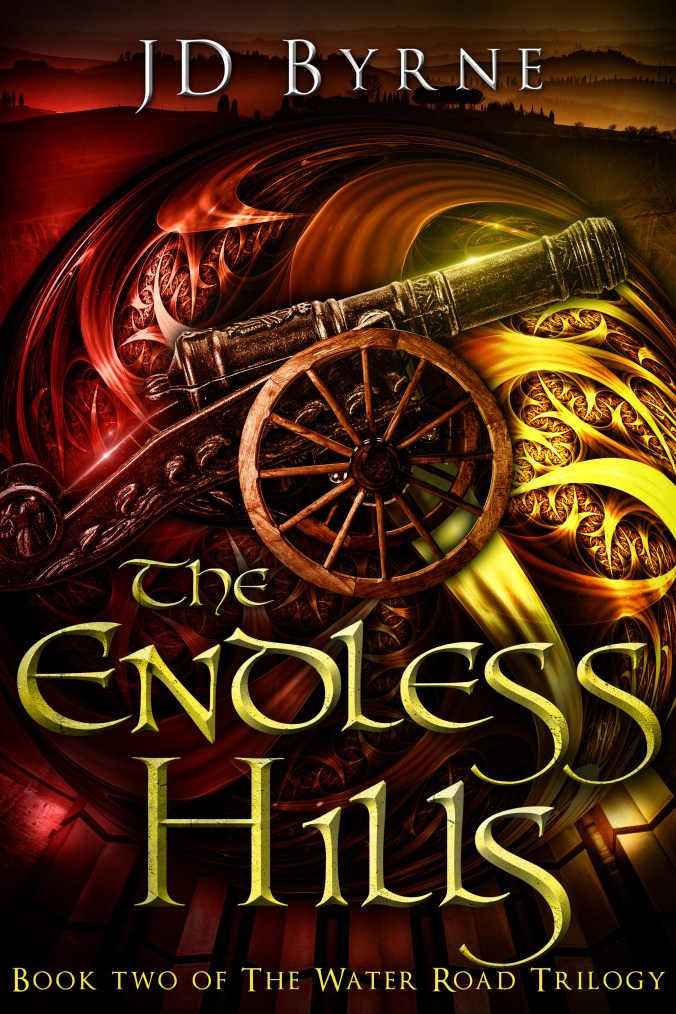
The follow up that tackles the costs of war, The Endless Hills:

TEH Cover (1800x2700)

Each just 99 cents!  They’re not likely to be this price again for a very long time.

Next week – final thoughts on an 8-year journey.

Water Road Wednesday – Final Excerpt from The Bay of Sins

In this final excerpt from The Bay of Sins, Hirrek scours the Neldathi city of Albandala for information about the murder of a thek. He needs to ask questions some people don’t want to hear. They’re happy to vent their displeasure toward him:

The continued celebration made the enclave louder than the others he had visited. It was nearly impossible for him to hear what people around him were saying as he passed by. The crowd was thick enough that just moving through it without running into people was a challenge. Without knowing it, his avoidance maneuvers eventually took him to the outskirts of the enclave, near the edge of the city itself. He breathed a bit more easily there, enjoying the open space. The din of the crowd rumbled in the background.

That was how they took him by surprise. The first blow knocked him to the ground, his face landing hard on dirty packed snow. He managed to roll over and see three people standing over him. All had the green and white Elein stripes in their braids.

“Keeps poking around,” one of them said. He was younger than Hirrek and not as big. “Like he’s got a right to know something.”

“You’d think he’d learned by now that nobody wants to talk with him,” said another. He was older and standing back from the other two a bit.

“People can talk to whomever they want,” Hirrek said, getting ready to stand up.

The third one, about Hirrek’s age and even bigger than he was, kicked him in the side. “How’s that for talking?”

The first one laughed. The older one didn’t. Hirrek made a note of that as he crumpled to the snow and tried to catch his breath.

“If you have nothing to say, that’s fine,” Hirrek said after a few moments, managing to make it to his hands and knees. “But you have no right to keep me from talking to others.”

“Who gave you the right to start asking?” asked the second man. The third one kicked Hirrek again, sending him back to the ground, face first.

Hirrek spat dirty snow from his mouth and did everything possible to hide the pain he’d endured so far. “The Maker gave me that right, as she did for all of you.” He didn’t expect that to work, but wanted to see what they said at the mention of the Maker of Worlds.

“A blasphemer as well,” said the first man.

“One goes along with the other,” said the third.

“You see?” said the older man. He looked to be the leader of this little group. “This is what you get when you give yourself over to the blasphemy of one god. This one’s from Clan Dost, not that you’d know it to look at him. He’s free to do whatever he wants, but what right does he have to tell us?”

“Yeah!” the other two said.

“He thinks just because his father pretends he’s jeyn now he can go anywhere he likes.”

“My father doesn’t think he’s jeyn, and doesn’t pretend to be,” Hirrek said, slowly getting back to his hands and knees.

“What does he think he is, then?” asked the second man.

“He thinks he’s doing his best for his people,” Hirrek said, speaking slowly and trying to get a good feeling for where his attackers were. The two younger ones were on either side of him now, while the older man stood a few feet in front of him. They weren’t thinking this through very well. “The best for the Neldathi people. All of them.”

“He’s not got the right,” the third man said, before he tried to kick Hirrek one more time.

This time he was ready. Hirrek lunged forward just as the kick came. The man’s foot glanced harmlessly off his lower leg while Hirrek sprang on the older man. He was taken completely by surprise and was driven to the ground by Hirrek’s charge. Hirrek wasted little time exploiting his advantage, punching him twice in the face and knocking him out.

He stood and readied himself for the others, but neither had come to the aid of their master. They stood with fists raised, poised on the balls of their feet, but neither moved.

“I don’t have any business with you,” Hirrek said, eyes flitting back and forth between the two men. “But him, I need to talk to.” He kicked at the foot of their master. “That means either you can leave or I can make you leave, since I don’t need either one of you to make it through the night. Understand?”

It was an empty threat. He was outnumbered and wasn’t carrying a weapon. He didn’t want to be known as walking through the city interrogating people with a knife in his hand, so he’d intentionally gone out without anything threatening in his possession. He’d give anything to have one secreted away in one of his furs. He just hoped that the others thought he was armed.

They looked at each other, then dropped their fists and took a few steps back.

“Don’t want to have nothing to do with you,” the first one said. “Right?”

“Right,” said the big one.

They turned and walked off together, hurrying but not running back to the crowd, the noise, and the fire.

Hirrek grabbed the other man, still thoroughly unconscious, under each arm and began to drag him through the snow toward the center of the city.

The Bay of Sins arrives March 22 – pre order now for the low launch price of 99 cents! Get The Water Road and The Endless Hills while you’re at it!

tbs-cover-900x1350

On Storytelling and Stakes

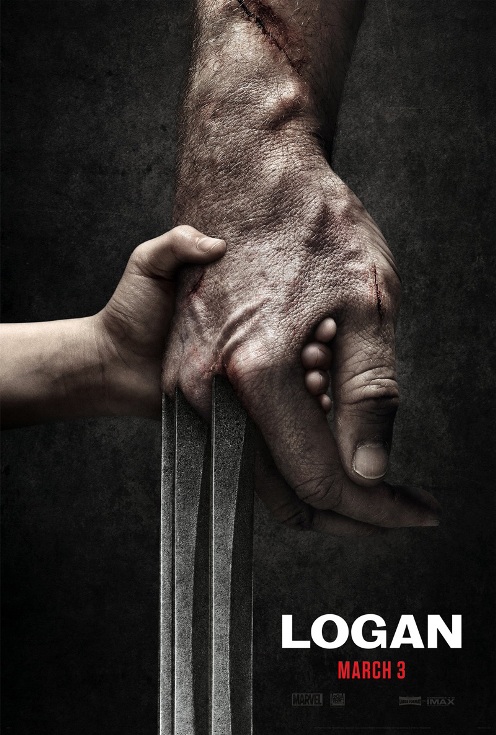
The wife and I went to see Logan, the last of Hugh Jackman’s Wolverine appearances, the weekend it came out. It’s really excellent and reminded me of how good the 2013 entry, The Wolverine, was (the original origin story in 2009, not so much). In fact, I’d go so far as to say that those two movies are among my favorites of all the modern era superhero movies. I tried to figure out what that was, if there was something about them that really set them apart from, say, something in the Avengers canon or one of Christopher Nolan’s Batman flicks. Turns out, I think it’s because they’re smaller movies. Or, at least, the stakes involved are small enough that you can actually care about them.

I first noticed this in connection with Star Trek. Think about it – in the original series the jeopardy in each episode was usually faced by either Kirk, Spock, or McCoy or some combination thereof. A few episodes extended to other crew members and, on a very rare occasion, to the entire Enterprise. But the show never really tasked our heroes with something so grand as saving Earth or the galaxy or whatnot. The only thing in that area that jumps to mind is “City on the Edge of Forever,” which did involve setting the universe right, but, critically, the real drama was all about the main trio and, specifically, whether Kirk can let his love interest die as she must to set things right.

When we get to the movies, though, the stakes became increasingly high. How many of them involve some Earth-shattering baddie that only the Enterprise crew can stop (where is the rest of Starfleet at these times, anyway?). Paradoxically, that actually ramps down the tension, because who really thinks our heroes aren’t going to literally save the universe? An example proves the point – what’s almost universally hailed as the best of the Trek flicks? The Wrath of Khan. Which is, at its heart, about Kirk and an old foe battling it out until the end (universe altering tech in the background to one side).

Returning to The Wolverine and Logan, in both those flicks the stakes are fairly low, in terms of superhero movies. They play more like short stories, side plots in a bigger novel wherein the fate of the world hangs in the balance. But when it’s just the fate of a few (including our hero), things hit a lot closer to home. In other words, it’s easier (for me, at least) to become emotionally invested in the fate of Logan and his young charge than it is to really care whether a gaggle of X-persons stop Apocalypse because, come one, of course they will.

Although it’s horrific, the old adage attributed to Stalin (who would know from horrifics) that “one death is a tragedy, a million is a statistic” is true. It’s easier for people to empathize with a single other human being rather than a large group defined by broad common traits. The same is true in fiction. Sometimes you make a bigger impact by telling a smaller story.

Logan

Water Road Wednesday – Second Excerpt from The Bay of Sins

In this excerpt from The Bay of Sins, Rurek arrives in Modrozon Crossing looking for someone. Not a friend, but a familiar face from readers of The Endless Hills – the thief turned soldier Martoh. In between, these two have developed a little bit of bad blood.

 Martoh sits down:

“Well, well, well,” he said, looking very satisfied with himself. “I believe the words were, ‘I’ll never come anywhere near this place again, you filthy criminal.’ Was that about right, Rurek?” While he spoke, he fiddled with the bracelet on his wrist.

Rurek cleared his throat. “Nice to see you too, Martoh. Believe me, when I said that I meant it. If circumstances were any different I wouldn’t be here.”

“Then I am truly touched that, in your hour of need, you found your way back here.” He signaled to someone, and a drink, some kind of deep-green alcohol, arrived within moments. “Have you had the ordem? It is a local specialty, requires a special kind of grain that grows wild around here. Very strong, but a wonderfully complex flavor, if you can handle it.” He took a long, slow sip and set the glass down on the table. “The girl is fine, by the way. I thought you might like to know.”

“I don’t care.” That was a lie. There wasn’t a night he didn’t think about the little girl and what her life was like in Wellston. He wasn’t about to let Martoh know that, however.

Martoh shrugged. “So be it. What, then, brings you so low that you would go back on your word and return to Modrozon Crossing, to this pub, and seek me out? I hope you did not gamble away all that money. It was so hard-earned.”

“After a fashion,” Rurek said, stifling a chuckle. “I got the money I needed to do what I needed to do. Problem is, now I’m not sure what to do with what I’ve got.”

“How cryptic. If you will not tell me what the problem is, I cannot help you.”

“Except I don’t really trust you.”

“You must trust me a little, Rurek, or you would have gone somewhere else. Did I cheat you? Did I tell you I would pay and then not pay, or pay less than we agreed?”

“No.” Rurek had to admit that.

“Did I lie to you about the nature of the work? And I mean lie, Rurek, really tell you something that was not true?”

“You didn’t tell me—”

Martoh raised a hand. “I told you what you needed to know to complete the task. Entirely accurate information. That you did not ask more questions, better questions, before taking my money is not my fault. You needed the money badly enough to keep you from asking those questions.”

“You’re being overly technical.”

“Overly technical is what put me in prison. Why should I not use it to my advantage now?”

Rurek knew Martoh had been in prison before the war and that he didn’t think he belonged there, but he didn’t know details. He didn’t want to know. “If that’s how you want to live your life.”

“It is.” Martoh sat back, looked out the window, and smiled. “Now that our reunion is out of the way, what is it that you think I might do for you?”

The Bay of Sins arrives March 22 – pre order now for the low launch price of 99 cents!. Get The Water Road and The Endless Hills while you’re at it!

tbs-cover-900x1350

A New Layer of Beta Readers

Here’s a dirty little secret – almost no writers sit down at the keyboard (or with pen in hand, if you’re a retro kind of person), open the channels to the muse, and let flow a stream of writing that becomes the final product. Between blank page and finished product there are a lot of stages, some of which include input from other people. Generally we call those people beta readers. They read a work in progress and provide feedback. What the writer does with that feedback varies from person to person and suggestion to suggestion.

While most beta readers are just that – readers – sometimes you might need a beta with a particular background to provide feedback on a story. Writing a sci-fi story set largely in a genetics lab? You might want to have someone who’s worked in one read through it, just to make sure the little detail ring true. Writing a fantasy story that involves a lot of swordplay? Might want to have someone who knows about such things give it a read to make sure characters aren’t treating broadswords like fencing foils (or vice versa).

So it’s not a surprise that, as writers start to concern themselves more with diversity in their work, that a new crop of betas is emerging – sensitivity readers:

These advising angels—part fact-checkers, part cultural ambassadors—are new additions to the book publishing ecosystem. Either hired by individual authors or by publishing houses, sensitivity readers are members of a minority group tasked specifically with examining manuscripts for hurtful, inaccurate, or inappropriate depictions of that group.


On the site Writing in the Margins, which launched in 2012, the author Justina Ireland articulates the goal of this new fleet of experts: to point out the “internalized bias and negatively charged language” that can arise when writers create ‘outside of [their] experiences.’

While critics may bemoan such a development as just another example of political correctness run amok, the Slate article points out that it’s really down to the oldest of Western motivations – the profit motive. Younger readers, in particular, desire more diversity in their fiction, so this is a way to provide a product they want to read.

Besides, the ultimate issue with any beta reader’s feedback isn’t the feedback itself, it’s what the author does with it. For example, one author in the article talks about how she changed some bits involving a black college student because the feedback from beta readers was that students at historically black colleges wouldn’t speak the way she had the character speaking. It’s not a matter of offense, it’s a matter of trying to portray something unfamiliar as accurately as possible.

Having said that, the very subjectivity of the undertaking makes it kind of hit or miss. That’s obvious from a distinction the author of the Slate story makes:

Some sensitivity readers draw distinctions between offensive descriptions and offensive descriptions that appear to enjoy the blessing of the author. If Lolita had been written from Dolores’ point of view, Ireland said, “it might be useful to have an advocate of children’s rights, a childhood sexual assault survivor, or a psychologist read the manuscript and give critique”; but since it was told from the perspective of a pedophile—not regarded as a marginalized group—that wasn’t necessary. Still, it’s a messy project for one reader to suss out authorial intent. While sensitivity remains a positive value in most literature, and perhaps one of the greatest priorities for young adult literature, enforcing it at the expense of other merits, including invention, humor, or shock, might come at a cost. Cultural sensitivities fluctuate over time. What will the readers of the future make of ours?

Buried in that interesting observation is the whopper that pedophiles are “not regarded as a marginalized group.” In an already marginalized bunch (criminals), pedophiles are at the bottom of the heap. Consider the ongoing registration requirements for people convicted of such offenses, the closest thing the 21st Century has to a scarlet letter. That all may be for the good (a discussion for a different time), but to say they’re not regarded as marginalized is so erroneous that it questions the entire endeavor.

Which is a shame, because I think the development of sensitivity readers is, in general, a good thing. At the very least, it’s a tool for writers who want to do their utmost to tell a story that doesn’t offend anyone. More likely, it lets writers who aren’t part of a particular socio-economic, ethic, or racial group bring more diversity to their work by providing valuable feedback about characters they might otherwise not be familiar with. Like anything else, a sensitivity beta reader is a tool for a writer to use. Whether it’s a tool wisely used is, in the end, up to the writer.

Water Road Wednesday – It Returns!

Hey, everybody – remember these? I know it’s been a while, but I am beyond pleased to announce that the final chapter of The Water Road trilogy, The Bay of Sins, is complete! It will be released on March 22, 2017.

tbs-cover-900x1350

What’s happening as the story roars to a conclusion? Glad you asked:

The war is over, but nothing is settled.

On the Neldathi side of the Water Road the clans are slowly pulling apart following a sudden murder. Hirrek is tasked with getting to the bottom of a mystery: was this killing the random act of a violent, unstable man? Or was it something more sinister, a hint of what the Neldathi thought they’d defeated during the war? The unity won in blood may be slipping away.

In the rebuilding city of Innisport, life is returning to something like normal. That’s largely due to Mida, given the task of rebuilding the city by Antrey Ranbren herself. After Mida hands power over to the Guild of Politicians, she finds herself on trial for her life, charged with treason and being a collaborator. Along the way she meets someone, a curious remnant of the war, who makes her rethink the way she sees those that destroyed her city.

In the meantime, Antrey returns from exile, escaping to the wilderness of Telebria. She gains new allies, including Rurek, and a new foe, the Sentinel Faerl. He’s best known among the other Sentinels as the man who let Antrey slip away once before, getting all his men killed in the process. Now he has a chance for redemption and revenge. But Antrey is willing to do anything to ensure that her legacy does not slip away.

The chase is on, as the saga of The Water Road barrels toward its explosive conclusion.

I’ll have more from The Bay of Sins in the next few weeks, all leading up to the big launch event on March 22.

Moore Hollow Is Free – Three Days Only!

For the first time, and possibly the last, my debut novel, Moore Hollow is absolutely free at Amazon, today through Wednesday.

Moore Hollow is about a guy, Ben Potter, whose life is a shambles. As a journalist he’s hit rock bottom, writing dreck about monsters and ghouls to make ends meet after a big story blew up in his face. As a son he’s a disappointment, unwilling to follow his father, grandfather, and great grandfather into the family business. As a father, he’s mostly just not there.

Now a new assignment could change all that. All he has to do is go from London to the hills of West Virginia to investigate the strangest of stories his great grandfather told. Did a sleazy politician really raise the dead to try and win an election? And if he did, what happened to the zombies? Could they still exist? Ben needs to find out, to solve the mystery and find a way to get his life back on track.

But once he finds the answer, Ben has to face a whole new batch of problems. Does he use what he learns to put his life back on track? Or is he compelled to do the right thing, even if it leaves his life a mess?

The hardest part of a mystery is deciding what to do once you’ve solved it.

Pageflex Persona [document: PRS0000030_00047]

Get your free copy here before time runs out!

Three (Very) Short Stories for Valentine’s Day

Last year Apex magazine announced that they were reviving their flash fiction contest. Each contest is set up around a particular holiday and for this one the holiday was Valentine’s Day. Each person could enter up to three stories, each no more than 250 words each. Since I’m not one of the winners (congrats to those who did – you can read their stories in February issue of Apex), I thought I’d share my stories here.

 Since I had three stories to play with, I decided to use them to deal with the beginning, middle, and end of a relationship. It’s not the same relationship, mind up – these stories are all set in different universes and involve different characters. I think they get at some universal ideas, however, so maybe they have more in common than I originally intended.

 Anyway, enough of my yakkin’ – enjoy!

vday1


The Spoils

“Is this necessary?” Elvin said.

“He could give in,” said Ilori, one eyebrow raised.

“She could,” Danforth said. Even sixty feet away he could seeIlori was striking. Twilight deepened her mocha skin and added definition to streaks of silver in her short black hair.

“Over this?” Elvin held up the Tyrolian orb.

Danforth nodded. But it was about so much more.

“Very well.” Elvin put the orb down. “Whoever brings it to hand wins.”

They nodded.

Danforth said the incantation quietly – crisp and sharp, honed from years of formal training. The orb began to roll toward him. He was a pillar of stone.

Ilori was anything but. Her home-taught hedge magic, learned from mother and grandmother, was loud, with complex hand movements. It was like she was possessed. The orb reversed course.

Danforth started another incantation, tapping into deeper, darker magic, but quickly stopped. Losing might be winning this time. There would be another Tyrolian orb, someday, but there was only one Ilori. He let go.

The orb sped up, flying to Ilori. She caught it in one hand like the laziest fly ball then cried out in victory.

“She’s the winner,” Elvin said, walking over to him.

“I know.” Danforth was unable to contain a silly grin

Ilori skipped over with a wide smile. “Told you.”

“Fair is fair.”

“Hope you brought your wallet,” she said, bounding off. “I’m not a cheap date!”

Danforth turned to Elvin. “Loser buys dinner.” He winked and walked after her.


The Thrill Is Gone

The apothecary shook his head. “Does your wife not already love you and you her?”

Eric the Simple sighed and leaned against the counter. “Love, yes. Alas, passion is something altogether different. Have you nothing that might help?”

The apothecary looked under the counter. “Perhaps, if you’re certain there is no other option.”

“I’ve tried everything,” Eric said in exasperation. “The woman’s desires are a mystery.”

“Aren’t they all.” The apothecary took out a piece of parchment, grabbed his quill, and began scratching something out. Finished, he carefully slid the paper across the counter.

Eric mouthed the words as he slowly scanned the page. “Spine of newt? Spleen of badger?” He looked up. “And this looks like Latin. A spell?”

The apothecary nodded.

“A love spell?” Eric waggled his eyebrows and grinned.

The apothecary shook his head. “Summoning spell, to bring forth a stink demon.”

“A what?” Eric threw the parchment down.

“It’s a minor inconvenience – smelly, ugly, and sinister looking, but actually harmless. Your wife will take a fright, you shall vanquish the foul beast, and she shall be in your arms.”

Eric stepped closer to the counter. “This is the best you can do?”

The apothecary closed his eyes and rubbed the side of his nose. “There is one other option.”

“Yes?”

“You could sit down with your wife and talk about this, find out how she feels.”

Eric paused for just a moment. “Stink demon it is then.”

The apothecary nodded. “I’ll get the badger spleen.”


The Last Night

The chalice shook in Sir Kavus’s hand as he slipped into her apartment. After months of sneaking around his nerves were still on edge.

What he shared with Lady Edana had been wild, hot, and passionate in ways he hadn’t thought possible. But it wasn’t true love, of the kindhe shared with Wyon, who tended his wounds and gave him sons and daughters.Wyon was home.

After one last night of pleasure,Edana would drink the potion mixed with the wine and all would be well. She wouldn’t even remember Kavus’s name.

He set the chalice on the table as Edana stepped from her bedchamber, naked body aglow in the candlelight. “My knight.”

“My queen.” He took her in his arms. They fell into bed for the last time.

Later he rolled over, throat dry, alone in bed. Edana was in the doorway, diaphanous gown clinging to her curves. “Thirsty?” She was carrying two chalices.

Kavus nodded and took the one she offered, gulping down the sweet wine. It seemed to go to his head, sending him to a deep sleep.

He awoke in a strange bed, although he couldn’t say it was not his. There was a woman standing next to it wearing only a smile.

“My name’s Edana,” she said, crawling in beside him.

The name wasn’t familiar, but he wasn’t about to object to her warmth next to him. There was no other place for him to be in the whole world, he was certain.


vday2

Where the Magic Happens

Recently one of the writers forums I’m on had people sharing pictures of their writing setups. It’s always interesting to see where everybody works, so I thought I’d share with the wider world.

studio2
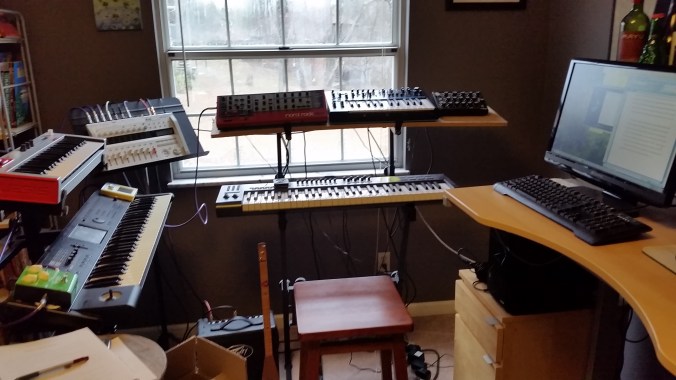
As you can see, my writing station also doubles as noise making station. Essentially, my wife and I each have a room for our creative toys (she has a loom!), so all my stuff lives together.

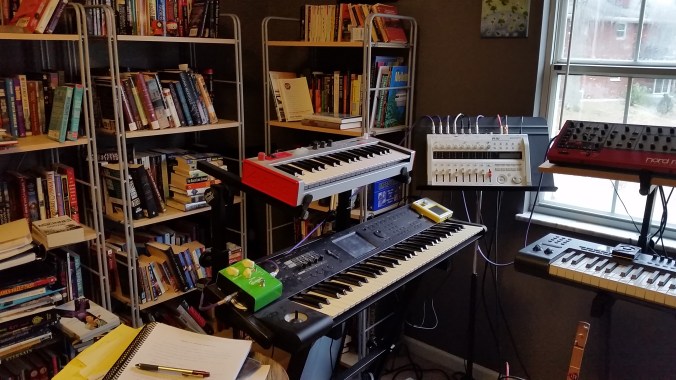
studio3
Note the books in the background, overwhelming their once well organized shelves (books are an essential part of any writer’s toolkit). As for the noise makers on the left there, that’s a Korg M50 workstation on the bottom (with fuzz box and Korg Kaosilator perched on top), with an Alesis Micron virtual analog synth on top. Both of those (and all the other hardware) runs into the Zoom R16 mixer/recorder there in the angle.

studio1
The PC there is where the writing happens and where the noises get collected and shaped into something interesting (hopefully). Yes, wine is sometimes involved – why do you ask? These noisemakers are, on top, a Nord Lead 2X virtual analog synth (in rack form), a Novation Bass Station II virtual analog synth, and a Moog Minitaur analog synth. On bottom is a M-Audio MIDI controller that I use for the Nord and the software synths on the PC. I use the Novation to control the Minitaur these days.

It’s not the most elegant setup, or the most efficient (notice I don’t really have a place to sit), but it works. For me, anyway.