Ten Books I Love

Remember that list of 10 albums that were particularly important to me I did? It evolved from a Facebook thing. Shortly thereafter, I started seeing other folks do the same for books. Sure enough, one of my friends tagged me and so I had to come up with a list of books (hers was seven, I bumped mine out to ten) that I “love.” Not necessarily meaningful or insightful, just favorites. With that in mind, let’s dive in (in no particular order) . . .

The Hitchhiker’s Guide to the Galaxy (1979)
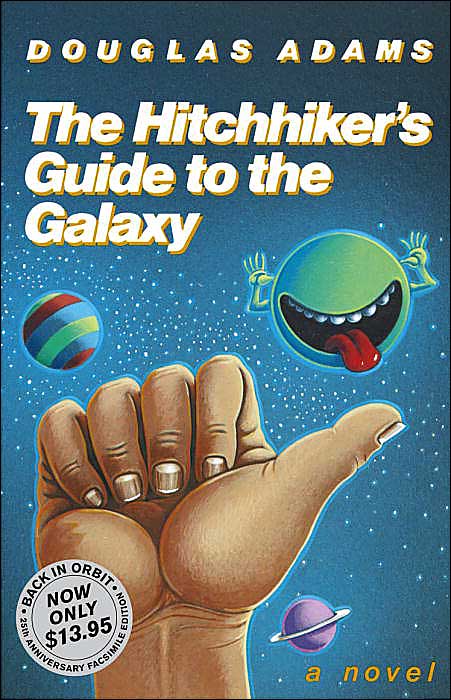
HHGttG

This is almost a cheat, as the Guide has so many iterations and my favorite will always be the BBC television version (cheepnis and all). Still, I remember pouring through the book (and the other two in the original trilogy) that my brother had. Funny, thoughtful, clever, and an entirely different way to approach science fiction. It stuck to the same part of my brain as Monty Python.

On Writing: A Memoir of the Craft (2000)
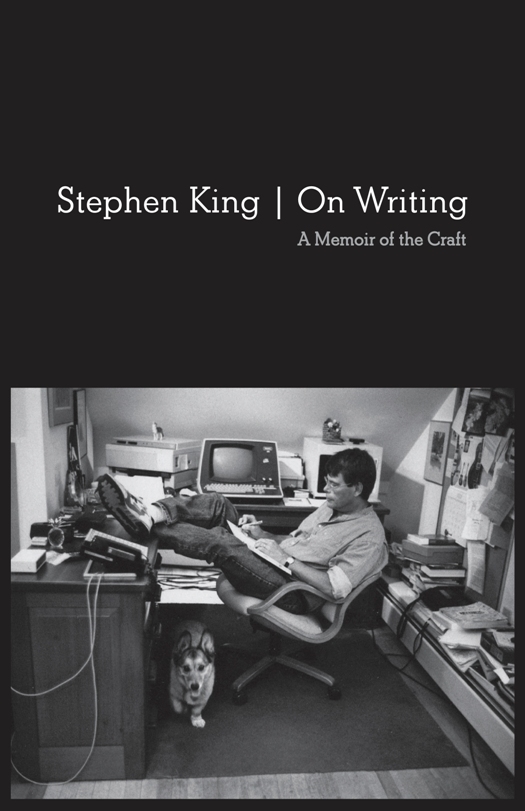
OnWriting

There are lots of books about writing (some of them actually written by writers!) and people will tell you not to rely on one of them if you’re trying to figure out how to be a writer yourself. As true as that is, the one that everyone seems to recommend is Stephen King’s memoir. For good reason – it’s a brutally honest, open exploration of what it means to be a writer. It doesn’t bury itself in inspirational bullshit, but it also doesn’t make writing seem like something that’s out of anyone’s reach. Reading about writing doesn’t end here, but it probably ought to start here.

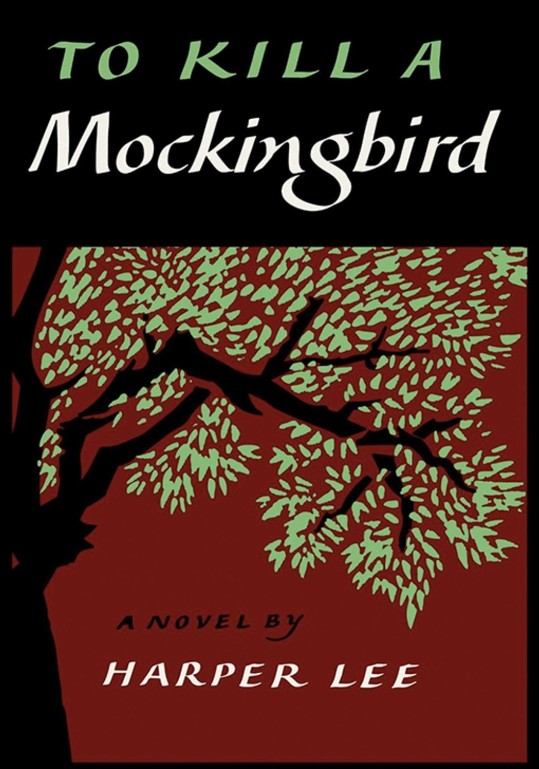
To Kill a Mockingbird (1960)
Mockingbird

Since I’m a defense lawyer by trade it’s practically required that I have great reverence for this one. I’d like to say I don’t, that I go against the cliché, but what would be the point? Atticus Finch is, in a lot of respects what lawyers aspire to be, particularly defense lawyers. He seems to resonate particularly with defenders since after a noble and capable defense, he still loses. That’s the life of a defense attorney, after all.

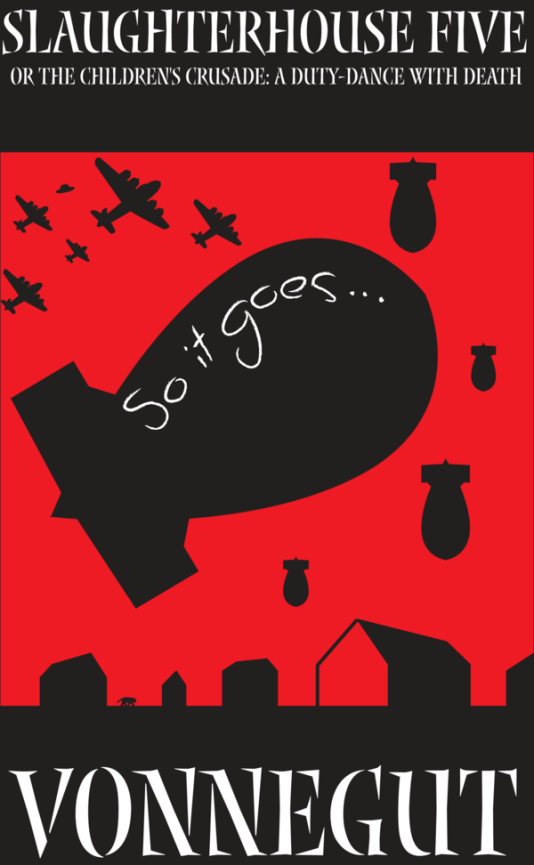
Slaughterhouse-Five, or The Children’s Crusade: A Duty-Dance With Death (1969)
 Slaughterhousefive

I’m not sure whether this was my introduction to Vonnegut (it might have been Galapagos or “Harrison Bergeron”), but it is the one that made me fall hard for his work. The dark humor and deep humanity that runs through his work speaks to me, I guess. Plus, he gave no fucks when it came to style and form – I mean, what kind of book is this anyway? Science fiction? Social commentary? Historical fiction? Who the fuck cares! It’s brilliant.

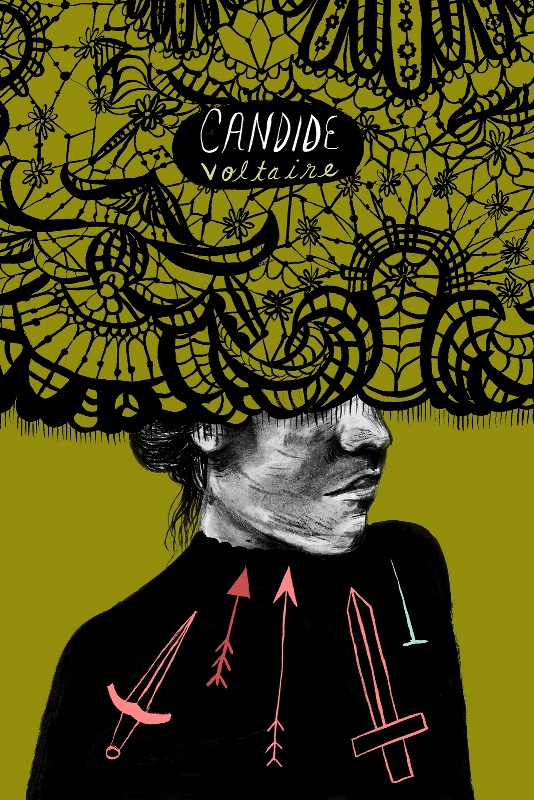
Candide: or, The Optimist (1759)
Candide

I am, at my core, a cynic. On my better days, I’d say I was a realist. Regardless, a bit reason why is Candide, which skewers the idea of this is the best of all possible worlds. Although the story is all about breaking down the titular character’s naiveté, it’s not depressing. It’s darkly comic (there that phrase is again) and liberating, as we see the scales fall from his eyes. While the ending isn’t one you’d call happy, it’s at least hopeful, in that it puts the power for our own happiness in our own hands. Besides, it’s inspired both a fabulous musical/operetta by Bernstein and a concept album by Rush!

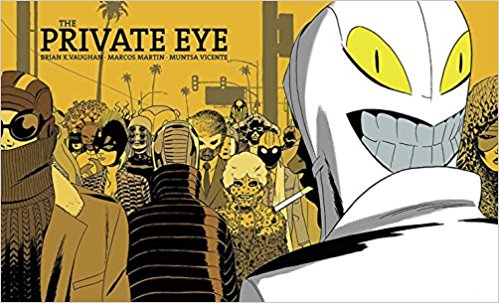
The Private Eye (2015)
PriavteEye

Usually when it comes to dystopias the world of the future is completely fucked. Some plague or aliens or nuclear war or whatever has returned life to a primitive state, with characters reduced to hunter gatherers as they try to rebuild society. The dystopia of The Private Eye, by contrast, looks pretty sweet. There’s technology, food is plentiful – it looks like what we think of as “the future.” So what’s the problem? The problem is that everyone stored their data in “the cloud” and one day, “the cloud broke.” From the simple idea that everybody’s data is loose in the world, Bryan K. Vaughn builds a stylish, neo-noir tale for the 21st century. And it looks amazing.

The Devil In the White City (2003)
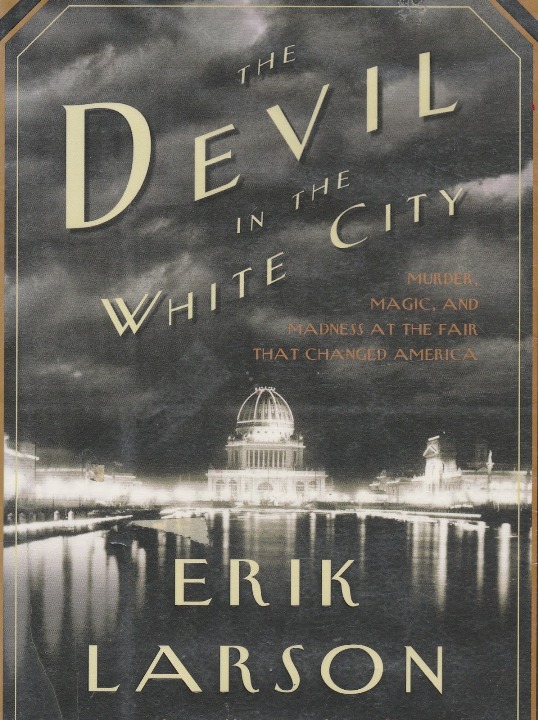
Devil

History is supposed to be dull, a lifeless parade of facts, dates, and names that it can be hard to care much about. It’s not, really (my undergrad degree is in history – trust me!), but that’s the rep. Thankfully, a generation of writers producing “narrative nonfiction” have done a good job bringing the past to life. None is better than Erik Larson and, while all his books are good, this one is my favorite. It’s the story of a grizzly serial killer who uses the 1893 World’s Fair in Chicago as cover to lure his victims. That story alone would be good enough, but woven with the story of the fair itself and how it was developed really makes things pop.

Jonathan Strange & Mr. Norrell (2004)
Strange

This is a horrible admission for a writer of fantasy, but I’m not a big fan of magic (hence the lack of any in The Water Road). There’s something random and unearned about it lots of times, where the people who wield magic do so by grace of birth or whatnot. What I deeply love about this book is that magic is all about knowledge and, more precisely, books. In fact, the way magic is learned and used in this book makes me think of how law was taught in the pre-modern age, when students apprenticed with members of the bar. Take all that, wrap it up in a magical history of England (and, oh by the way, the Napoleonic Wars), and it makes for an epic read.

Oryx and Crake (2003)
Oryx

There are many ways of imagining the future. Only Margaret Atwood has come up with one that includes revolting, genetically engineered “chickens” called ChickieNobs:

’This is the latest,’ said Crake.

What they were looking at was a large bulblike object that seemed to be covered with stippled whitish-yellow skin. Out of it came twenty thick fleshy tubes, and at the end of each tube another bulb was growing.

‘What the hell is it?’ said Jimmy.

‘Those are chickens,’ said Crake. “Chicken parts. Just the breasts, on this one. They’ve got ones that specialize in drumsticks too, twelve to a growth unit.

‘But there aren’t any heads…’

‘That’s the head in the middle,’ said the woman. ‘There’s a mouth opening at the top, they dump nutrients in there. No eyes or beak or anything, they don’t need those.’[quote]

That sort of captures the whole feel of this book – at the same time horrible and morbidly funny. It’s a great beginning to a wonderful sci-fi (sorry, Margaret) trilogy.

UPDATE: Eagle eyed readers, or just those with all their digits, will notice I’m one short. Not sure how that happened, since I have the cover and everything, but, alas, I left out one of my absolute all time favorites! Better late, a they say . . .

Good Omens (1990)
GoodOmens

Another bit of a cheat, as I get two favorite authors for the price of one – Neil Gaiman and Terry Pratchett. I think this was my first exposure to them on the printed page (I’d come across Gaiman via Babylon 5, of all places) and it melds their styles perfectly. It shouldn’t work, but it does. Hilariously funny and darkly compelling.
Why You Should Be Reading Saga

I didn’t grow up reading comic books. I can’t say why. They weren’t verboten in our house and their residence in the same ghetto as science fiction and fantasy, but for some reason I never really dove in. Maybe it was because I perceived comics as being about super heroes and they never interested me much. It wasn’t until I got to college and my roommate corrupted me with some Batman did I get a chance to read them.

Even then, I didn’t really get into comics or graphic novels (I prefer waiting for a bunch of issues to get collected – makes for a more satisfying reading experience) until I got exposed to a pair of the traditional gateway drugs for the genre – in other words, stuff so good that even people who don’t read comics read them. One was Alan Moore’s Watchmen, a deconstruction of the entire superhero genre; the other, Neil Gaiman’s Sandman series, which follows the exploits of Morpheus, the god of dreams, and his extended family.

While both of those are great ways for readers not familiar with comics to dip their toes into the graphic waters, they’re both “classics” by this point, held in such reverence that people might risk approaching them like you would Homer or Hemingway – things you should read because they’re important and exemplars of the form, but maybe not just for the enjoyment of it.

Thus, allow me to suggest another gateway, one that’s fresh, ongoing, and just released its 50th issue – Saga.

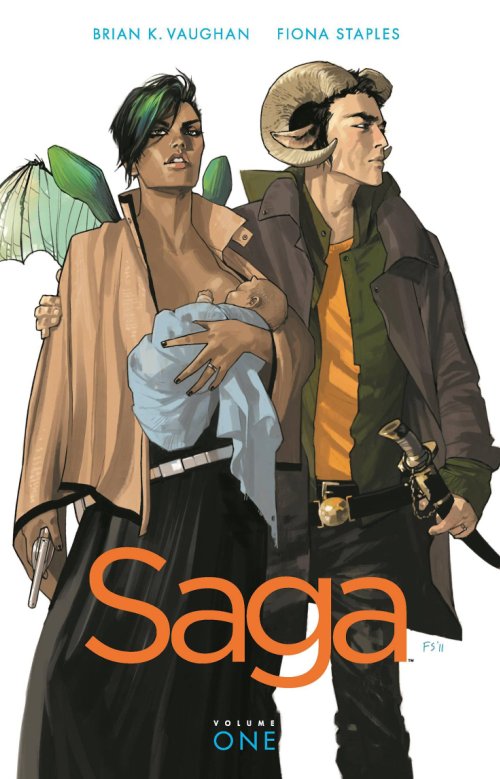
Created by Bryan K. Vaughn (words) and Fiona Staples (images), it’s a sprawling science fantasy saga with a heavy helping of just plain weirdness. Vaughn and Staples take full advantage of their chosen format to give the story a scope and a visual sense that would be impossible to pull off in another format. In the same way that 2001 epitomizes what a motion picture can be (an completely immersive audio-visual experience), Saga is the apex of what comics can be.

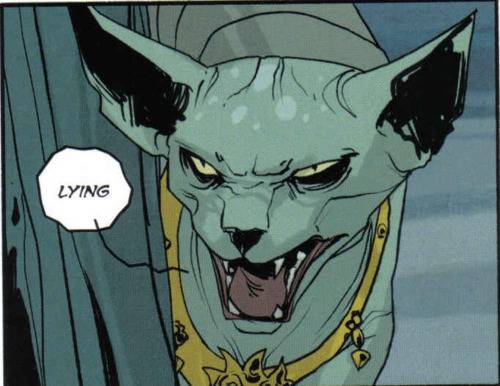
As amazing as Staples’s art is, Saga wouldn’t be worth reading without a compelling story and characters we care about. The basic setup is simple – a world, Landfall, has been at war with its moon, Wreath, for years. In the middle of the war, Alana (from Landfall) and Marko (from Wreath) fall in love and produce a kid, Hazel (who is the narrator), who really shouldn’t have been able to happen. They try and survive in a world where damned near everyone wants to hunt them down, from soldiers to bounty hunters with sentient lie-detecting cats.

Lying_Cat_Saga_001

Along the way, as they blast from world to world in a spaceship that is also a tree (did I mention this is science Fantasy? Definitely a capital “F”), collecting other outcasts to form a very bizarre, very fractured, but very sweet extended family (as this article points out, Saga is almost impossibly diverse in its characters). Vaughn has said that’s what Saga is really about:

I now have two kids. I first starting thinking about this while waiting for our first kid. And I always used writing as an outlet to talk about my fears, concerns, and passions. I really wanted to talk about creating new life. And I found talking to my friends who are strangers to the fatherhood experience—I would watch them start yawning or looking at their watch–difficult. If you’re outside of that world you don’t really give a shit. When you’re living in it, it’s really exciting. So I wanted to find a way to make people who don’t have kids or who never intend to have kids feel what it’s like to be a parent.

That’s where Saga was born.

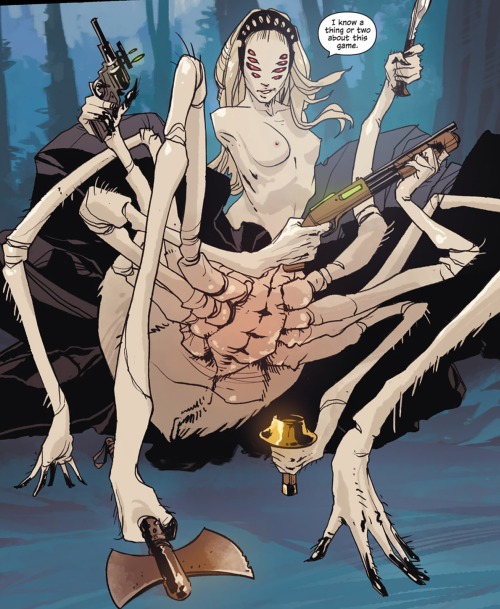
Not having kids I can’t say whether having them makes Saga more meaningful, but it does emphasize the foundation of the story. All the amazing art and “holy shit” concepts don’t add up to much if the characters aren’t ones we care about in the first place. That’s true of good fiction in general, but particularly good speculative fiction. At bottom, it’s a story about love, fear, and survival. The tree ships and arachnid bounty hunters are just gravy.

saga-the-stalk

What I’m trying say is that Saga isn’t something I recommend to comic newbies because it’s a classic (although it’s on its way to becoming that) or because it’s something, to channel one of my high school English teachers, “that well read people know.” It’s because it’s a great story, involving people you will care deeply about, told across a stunningly inventive backdrop. I mean, really, what else do you need?

SagaVol1

Weekly Read: Children of Time

One of the great things about speculative fiction is that you get to write about characters who aren’t human. One of the hard things, as a result, can be making readers care about characters who, at least on the surface, aren’t anything like them. To be able to pull that off is something special.

Children of Time starts off with human characters who seem all to relatable. A ship is in orbit around a planet that’s been freshly terraformed. A scientist is making ready to start a bold experiment – seeding the planet with a group of monkeys, followed by a spiffy nanovirus that will help jumpstart and guide their evolution. To “uplift” them, in the David Brin sense of the word.

Needless to say, things don’t go as planned. The experiment is disrupted before it’s really begun by a quasi-Luddite faction that things humanity going to the stars was a mistake. The monkeys burn up over the planet. The nanovirus . . . well, what becomes of the nanovirus is what Children of Time is all about.

You see, just because the monkeys didn’t make it to the planet doesn’t mean other life didn’t. Instead of finding its intended host, the nanovirus finds a species of spiders into which it can insert itself. It does and, for half the ensuing chapters in Children of Time, Adrian Tchaikovsky puts us in the brains of various spiders as their society develops over thousands of years. That society itself is a supreme feat of imagination on Tchaikovsky ‘s part, but what really matters is that you come to care for these non-human beings, creatures that are more likely to conjure nightmares than sympathy.

That’s certainly true for the crew of Gilgamesh, the humans who make up the other half of the chapters. After the experiment at the beginning of the book goes awry humanity itself follows suit. Eventually, the only humans left alive are the crew of Gilgamesh and its “cargo” – hundreds of thousands of people in suspended animation.

It’s no spoiler to say that the humans and spiders have a coming together (two of them, sort of) and while the ultimate confrontation is wonderfully done, the paths they take getting there are equally fascinating. While the spiders slowly develop a technologically advanced society (the things they do with webs), humanity on board Gilgamesh is slowly falling apart. As seen through the eyes of a “classicist,” who gets woken up every so often to observe another crisis, it’s like the entire universe is falling apart at the seams. By the time the end comes the desperation among the humans is palpable.

Along the way, Tchaikovsky uses his characters to explore lots of big issues in a classic sci-fi way – religion, politics, and the like. More than anything, however, it shows how two intelligent groups can nearly destroy each other based mostly on the fact that they don’t have accurate information about the other group. The ending keeps this from being completely depressing, but it is kind of bleak. The day is saved by something the real world doesn’t have, after all.

There’s a lot to unpack in Children of Time. It doesn’t shy away from the fairly bleak state of the human condition, while suggesting that it’s not something specific to humans. And it does offer some hope, for while the source of the ending isn’t real, the effects could be. Either way, this is one of the best books I’ve read in a while (and I don’t see any way to adapt it to film). I was completely blown away. Highest recommendation, of course.

ChildrenofTime

In Praise of Not Finishing Books

As a writer, the idea of people starting to read a book but not finishing it intuitively honks me off. After all, the author went through the trouble to create an entire package that, at least on some level, appealed to you – give them a chance to redeem whatever fault you’ve found in the end! But if I’m honest, as a reader, I’d push back against that – hard.

I wouldn’t be alone. A few years ago eBook platform Kobo (on which all my books are available, by the way), released some data that compared their best seller list with the list of books that readers most often finished. Not surprisingly, some of the best sellers were also some of the least finished. I love the cynical take on this from The Guardian, with respect to Donna Tart’s The Goldfinch (2014’s Pulitzer Prize winner: 37th best selling, only finished by 44% of readers):

Most-unfinished book of the year isn’t a title anyone would hope to win. But her core fans probably read the book to the end, as did a whole raft of new readers, which propelled her up the bestseller charts. And those readers who didn’t finish it still paid for it, so Donna Tartt can mop up those tears with crisp tenners, which will surely ease the pain.

Still, it’s a bit disheartening to know that so many people couldn’t even finish what you’ve written.

Alas, I occasionally find myself in that category as a reader. Even though I see every book I read (or listen to) as a learning experience when it comes to writing, sometimes I still can’t stick it out to the end (witness my “unfinished” shelf at Goodreads, to which I just had to add Jim Butcher’s The Aeronaut’s Windlass, alas). Thus I’m on board with this piece over at Electric Literature that, without shame, promotes non finishing books:

There are many factors that go into whether or when a reader finishes a book. I imagine many people’s reading habits are, like mine, scattered. I have at least a dozen in-progress books on my nightstand — and several more on my phone and e-reader. Readers stop reading a book they enjoy when they put it down and forget to come back. Readers finish books they hate when they are assigned it for book clubs or else they want to hate-read and laugh about with their friends. (Certainly a large percentage of Fifty Shades readers fall into that second category.) Just as a half-read book isn’t necessarily a failure, a completed book is not necessarily a success.

This makes a lot of sense. I said before, in other contexts, that reaction to art is inherently personal. What rocks one person to the core of the their soul will make another yawn. That’s neither right nor wrong, it’s just the way things work. So there’s really no reason to expect everybody to love a book so much that everyone who starts it finishes it. As the saying (attributed to James Joyce) goes:

LifeTooShort

Ultimately, the job of keeping a reader engaged with a book is the author’s. It’s a responsibility we should take seriously. But we shouldn’t forget that readers come to our works in all kinds of ways and for all sorts of reasons. No book is going to connect with all of them, just like some books you’ve read didn’t connect with you. We have to accept that sometimes saying “this isn’t for me” and moving on is best for everybody involved.

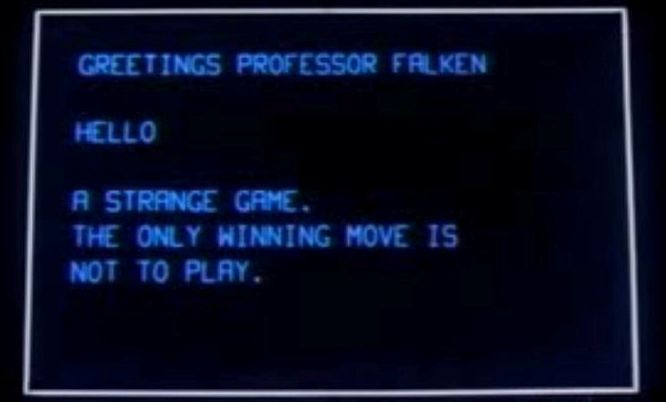
Remember the lesson of the WOPR:

WOPR

It applies to books, too.

Weekly Read: The Long Way to a Small Angry Planet

There are a lot of things to like about The Long Way to a Small Angry Planet. It’s set in an interesting universe where humans aren’t dominant and there are lots of interesting alien species to deal with. The characters, for the most part, are interesting and fun to spend time with. And the writing it pretty quippy and moves at a good clip. It should be a fun read and it is, but it doesn’t go much further than that.

I’ve read a lot of commentary about the book that it’s about characters and not plot. While that’s true it wouldn’t be correct to say “nothing happens” in the book. Several things – exciting things! – happen. It’s just that they’re resolved fairly easily and don’t really have any impact on things going forward.

Take, for example, an early crisis. The ship, Wayfarer, is off on the titular long trip in order to bore a new wormhole in space. Fairly early in this journey they’re set upon by pirates! A sticky enough situation, made all the more so by the fact that the ship’s captain is a pacifist and, thus, everyone on the ship is unarmed. That is a fantastic twist on a typical space opera trope. It’s not really a spoiler to say they talk themselves out of it. It’s a pretty exciting scene.

Yet it has almost no residual effect. One character has a brief bit of PTSD, but it goes away just as quickly. More annoying, our heroes escape the pirates by giving them some of their supplies – supplies which, apparently, were completely superfluous to the main mission. Thus, while there’s talk about getting reimbursed for them, there’s no complaint that it will make their job harder or require extra stops along the way. It’s a problem, it’s solved, and the book plows ahead.

The effect is kind of like an old-fashioned TV show from before the current golden age of serialized TV. Each episode is basically a standalone story, with little ongoing plot to drive things along. Thus, along The Long Way . . . we get “episodes” for just about all of the Wayfarer’s crew that all play out the same way – some crises appears, it’s resolved, and everyone goes on their merry way.

Consider Rosemary, who if not the main character of the book (it bounces POVs around a bunch), is at last our audience surrogate, the new person on the ship who has to learn how things work (our Tim Bayliss, if you will). We know from the beginning that she has a big secret in her past. If she’s not running from something, she’s at least in search of a new start in a new life. We find out why about halfway through (her father’s a war criminal, in essence) and she worries this will impact the life she’s made on the ship, cost her friends. It doesn’t, because everyone on board is so incredibly understanding – even the alien chef/doctor (another neat touch) whose species is about to be extinct due to the war Rosemary’s father fueled. A great potential for tension is completely squandered.

And so it goes. With the exception of the ship’s algae specialist (that’s what fuels the ship – don’t ask, it’s never explained) everybody gets along swimmingly through the voyage. When his “episode” comes it falls flat because we suddenly need to care about somebody nobody else does (particular shame given the issues it raises). The goal of the actual “long trip” basically disappears once they embark, only to rear its head at the very end.

I’ve seen lots of references to “imagination” in reviews praising The Long Way . . . and that’s a spot on description. Becky Chambers let her imagination run wild in creating the universe in which the book is set. It’s just a shame more interesting things don’t happen in it. In that way it reminds me a bit of The Goblin Emperor, another book with a fascinating setting and interesting characters that didn’t really amount to much.

There’s something to be said for an author who just takes her readers and drops them into a fascinating place filled with interesting characters. Ultimately, I want a little bit more than that. Others might not care so much and, so, your mileage may vary when it comes to The Long Way to a Small Angry Planet. Still recommended, if with a little hesitation.

LongWay Cover.png

Weekly Read: The Lost City of Z

I generally roll my eyes at people who see a movie based on a book and then tut tut that “the book was better.” Even as a writer, it comes off as snobbish to me. The written word is a different medium than film, which makes adaptations their own things. One’s rarely “better,” even in a subjective sense, than the other. They’re just different.

The film, The Lost City of Z (released last year), got a good amount of praise when it was released. I’ve even seen people list it as being snubbed in the Oscar race. It’s the story of Percy Fawcett, who repeatedly search the Amazon jungle for evidence of a lost city in the early part of the last century. The wife and I put it on our list of flicks to see and, the other weekend, were able to pay per view it. My thoughts at the time was that it was a fine flick, but it suffered in comparison to such jungle fever dreams as Aguirre, The Wrath of God.

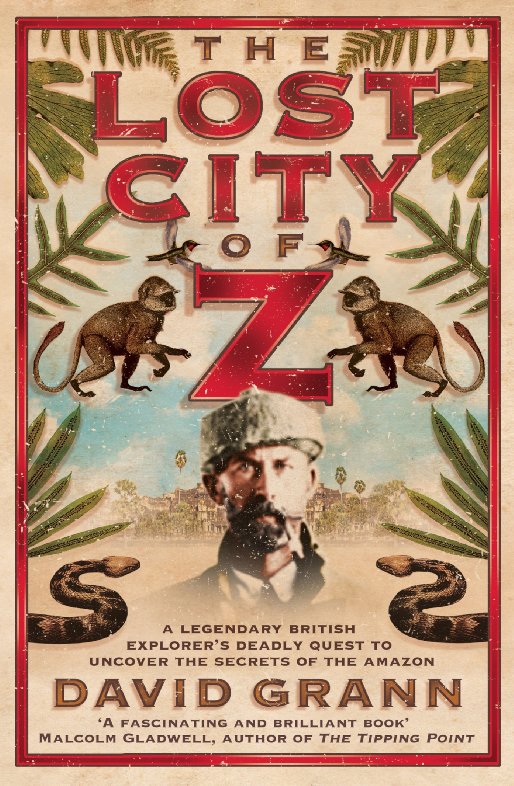
It did interest me enough to go read the book upon which the movie is based. Also called The Lost City of Z, it weaves the history of Fawcett’s expeditions in with the attempt of author David Grann to track down evidence of Fawcett’s final expedition (no spoiler alert – Fawcett’s disappearance in 1925 is one of the everlasting mysteries of the golden age of exploration). I’m glad I did, not just because the book provides more detail than any movie possibly could, but it makes clear that large hunks of the movie are complete and utter fiction.

Let me clarify that I’m not talking about whether the film itself, or the book, is “accurate” from an historical standpoint. There was a lively debate at the time the movie came out with historians arguing that it portrayed Fawcett in a much more positive, progressive light than the historical record supports (also, he sucked at exploring). Naturally, the director’s response to this was, in essence, “it’s art and you can’t talk like that about it.” That’s not what I’m really interested in. However, I will note this observation from one critique of the movie version of Fawcett:

The original book, by David Grann, was much more intelligent and nuanced, as one would expect from a staff writer on the New Yorker. But everything has gone wrong in its clumsy adaptation for the screen by director James Gray, who has written his own script and then filmed it with great reverence – almost always a mistake.

That sounds about right, although “clumsy” is perhaps too kind. It’s simply bizarre for a movie based on a particular non-fiction book – it even uses the title! – to break from the book in so many fundamental ways. I’m not talking about the inevitable compression that happens to turn a biography into a movie – that Fawcett had 8 Amazon expeditions, not 3, or that he and his son had a third person on their final voyage makes sense. I’m talking about things that get the character so wrong I don’t understand why the writer/director used the name of a real person.

For example, one of the most obvious diversions from the book is the in the film Fawcett is portrayed as having fallen into exploration after being tapped by the military and Royal Geographical Society to survey a river on the border of Brazil and Bolivia. In fact, Fawcett caught the exploration bug while stationed in Sri Lanka (then Ceylon) when he fell hard for a story of buried treasure (he didn’t find that, either). He’d already attended a 1-year course at the RGS before the surveying mission came up.

Or take the depiction of Fawcett’s relationship with his eldest son, Jack. In the film Jack is shown as an angry kid, raging against his father as a failure after an expedition collapses spectacularly (bonus point – the book never mentions that Fawcett resigned from the RGS in the aftermath, as the film portrays). They’re reconnection as they plan the last expedition is a moving part of the film. But, according to Grann’s book at least (the source material for the film!), the two were always close and Jack wanted to join his father in his explorations almost as soon as he could.

But the most egregious example involves World War I. Fawcett was well into his Amazon explorations when the war broke out. He went back to England and, eventually, to the Western Front. The film portrays Fawcett leading a Paths of Glory style assault over the top (after consulting with a Madame Blavatsky type – she died in 1891) during which he’s wounded by gas. No just wounded – blinded. A doctor even tells the blind Fawcett that he’ll never see the jungle again. This is utter fiction, unless Grann decided to skip the episode completely in his book. Fawcett wasn’t wounded, much less blinded, and didn’t sit around the English countryside recuperating for years until his son convinced him to give it one more go. Why the director (who also wrote the script) decided to put it in is anybody’s guess.

Somebody could have made a really interesting movie out of the Grann’s book. Even without the modern day overlay of Grann’s own expedition, the atmosphere of doom that clung to Fawcett’s final expedition could have really worked as the backbone of the movie (cover what else needs to be covered in flashbacks). Or, alternately, somebody could have used Fawcett as the basis for a truly fictional character and played around with the details as he saw fit. The Lost City of Z the movie isn’t either of those and it suffers for it. The Fawcett of the book is much more interesting than his celluloid counterpart.

But it did lead me to the book, for which I thank it. For, in this instance, the tutters would be right – the book really is better than the movie.

lost city z bookLost City of Z film

Is Originality an Illusion?

On their second album echolyn has a multipart suite that chronicles their struggle to make their kind of music in a world that doesn’t really appreciate it. An early section is called “Only Twelve,” a reference to the fact that the Western musical scales only has 12 tones. It’s not that diverse a palate to work with. A later section, however, suggests that’s not the right way to think about it. It’s called “Twelve’s Enough.”

But recent evidence suggests that 12 might not really be enough. As this article lays out, more and more pop artists are getting sued for lifting bits of music from other sources (Ed Sheeran, whose music I couldn’t pick out of a sonic lineup, appears to be a great transgressor). This is not likely to be a result purely of coincidence:

[quote]Bennett [a forensic musicologist – JDB] then goes very deep into the maths, proposing a scenario where he and I each decide to write a melody. ‘I might start on C and you might start on E – two of the seven notes in the major scale. The odds [against us choosing the same note] aren’t exactly one in seven, but you get the idea. Then you come to the second note: I might choose D, you might choose another E. So then we’ve got a seven to the power of two probability, and that’s just within two pitch choices.’[/quote]

The analysis goes much deeper but as you can see from just two notes, the probabilities don’t look good for coincidence. That shouldn’t be a huge surprise. We interact with art – music, literature, you name it – from the day we’re born. How could we not internalize things and, perhaps, come to think of them as our own? As Bennett admits, there’s a line between copying and plagiarizing.

Having said all that, artists have always copied from one another. There are entire traditions – folk music and the blues come to mind – that are based on taking work done by others making it your own. Hell, it’s been said (by Picasso, possibly) that good artists copy, but great artists steal (http://quoteinvestigator.com/2013/03/06/artists-steal/).

The issue of going too far with borrowing is where this all meshes with the law of copyright. We want to protect creators and incentivize creativity, but we don’t want to shut down the natural drift of ideas that occurs in culture. Is the list of court cases about pop plagiarism an indictment of our current copyright scheme?

That’s the idea behind what is surely the best piece of legal/regulatory speculative fiction ever written, Spider Robinson’s “Melancholy Elephants.” It’s about a word where copyright protection is eternal and, as a result, it becomes increasingly difficult for people to create new things because everything can be traced to something that came before.

We haven’t reached that point yet, although we might be close. Before we go too far, it’s worth thinking about whether we want to live in a world where every idea, every melody, every story is owned by a single person (or corporate entity) for all of time.

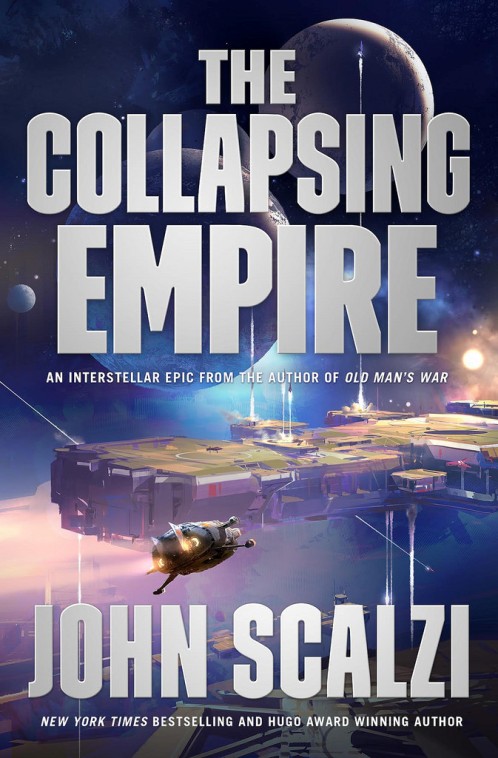
Weekly Read: The Collapsing Empire

I don’t think this is unique to me, but it’s at least unusual that my entry into the realm of John Scalzi fan began not with his books, but with his blog, Whatever. I was a regular reader there for a few years before I started working through his ever expanding bibliography.

What’s more unusual is that, for the most part, I don’t care for Scalzi’s most well developed universe, the Old Man’s War series. I read the first book and liked it well enough, but military sci-fi has never been my favorite corner of the genre. I’m much more into Scalzi’s stand alone work, from The Android’s Dream to Redshirts to Lock In. Which is to say I was stoked when I heard Scalzi was opening up another space opera series.

The Collapsing Empire has, at its core (or “Hub,” I suppose) a terrific idea. Humanity is spread across a multitude of worlds (Earth not being one of them, anymore), thanks to a faster-than-light McGuffin called “The Flow.” The Flow works . . . well, nobody is really sure why it works. But it does work, like a hyperspace equivalent of the jet stream or ocean currents, carrying spaceships along at post-light speed and making interstellar travel possible, if a pain in the ass.

Since people can only go where The Flow takes them, there are certain routes of travel. All lead to a planet called Hub, where the titular empire is headquartered. On the other end of the travelled galaxy is End, a sort of Australia (they send the troublemakers there) that, also, happens to be the only place where humans live under the open sky. The problem, as the book begins, is that The Flow is starting to fail. The bigger problem – most of the empire has no idea about it yet.

This is all background, against which a few stories play out. There’s a new emperox (not a typo – it’s a gender neutral imperial title) trying to figure out her new life. End is experiencing one of its periodic rebellions, although this one might actually stick. And someone is trying to inform the powers that be about the problem with the Flow. All of this is interesting, but none of it seems like a fully formed story.

That is The Collapsing Empire’s biggest problem – it’s not a complete story. Even in the context of a series (of which this is the first), it’s not too much to expect an individual volume to actually have some resolution. This doesn’t, really. In the end, it feels more like an extended, epic prologue or a backfill sequel than it does a novel of its own.

Which is a shame, because until you realize that the end is coming and there’s no way things are going to even try to wrap up, The Collapsing Empire is a fun read. Scalzi’s characters are well drawn and interesting. His great creation in this book is Lady Kiva, the “owner’s representative” on a ship that has to deal with The Flow and the rebellion on End.* She’s quick of wit, free with the word “fuck,” and willing to sleep with just about anything that moves. Think of her as Captain Jack Harkness’s long lost more vulgar cousin. The new emperox, Cardenia, isn’t developed quite as well, but her desire not to do the job sets up an interesting story going forward.**

Which brings me back to my complaint – this is all setup. It’s interesting setup. I’m definitely on board for the next book in the series, because I want to see how all this starts to shake out. But I’m left wanting more right now, something a little more solid and whole.

Still, I’m hooked. That counts for something.

* Bonus fun note – the ship names are great. A pair of sister ships are called the Yes Sir, That’s My Baby and No Sir, I Don’t Mean Maybe.

** Bonus fun note – the emperox has access to a “memory room,” in which she can summon the computer-generated simulacrum of any prior emperox. The discussions she has in there are all the better for the simulacra knowing just what they are.

CollapsingEmpire

Let’s Play the Feud!

I’m currently reading Authors In Court: Scenes from the Theater of Copyright, which uses a handful of case studies to track the development of copyright law since its introduction in England via the Statute of Anne in 1710. I haven’t even gotten through the first case yet and already I’m entertained. To anyone who thinks folks way back when were more civilized than modern, crass, digital folks, think again.

That first case involves Alexander Pope, English author (and second most quoted writer in The Oxford Dictionary of Quotations, according to Wikipedia – behind only Shakespeare), and a contemporary publisher named Edmund Curll. They’re in the book because, eventually, Pope sued Curll for publishing some of his letters in which, Pope argued, he retained the copyright. But things got ugly long before that.

Curll and Pope were very different people. Pope was a country gentleman, an elite. He was a writer, but he didn’t do it for a living (heaven forefend!). Curll, by contrast, was a scrappy businessman, doing anything he could to make a buck. He developed a reputation as a low-rent publisher, becoming (among other things) the first publisher in England to be convicted of obscenity.

What set the feud alight was a book Curll published called Court Poems, which purported to contain works by Pope (among others). The poems were scandalous and Pope was upset, either because he or a friend was designated as the author of some of them. Rather than just send a nasty letter, Pope got even in a much more emphatic way:

shortly after the book appeared, Pop contrived to encounter Curll at a tavern in Fleet Street. There, under the pretense of sharing a glass of wine as a sign of reconciliation, Pope dosed Curll’s drink.

Said dose was an “emetic,” a word which sent me scrambling to the dictionary. Long story short – it’s something that makes you puke.

Poisoning a professional rival so that he puked is a pretty dick move. But Pope wasn’t done:

A few days later, adding insult to injury, Pope published a comic pamphlet couched in the sensationalist style of a Grub Street production, a style not entirely different from that of, say, a modern supermarket tabloid. Titled A Full and True Account of a Horrid and Barbarous Revenge by Poison on the Body of Mr. Edmund Curll, Bookseller, Pope’s undated pamphlet, identified only as “by an Eye Witness,” reports on the tavern episode and then veers off into malicious fantasy as the stricken Curll, convinced that he is dying, makes his last will and testament.

In the end he is spared from death by “a plentiful foetid Stool.” Pope still wasn’t done, writing two more pamphlets expanding the fantasy and, eventually , devolving into anti-Semitism.

Future chapters involve Harriet Beecher-Stowe and J.D. Salinger, among others. I wonder if they taunted their rivals with bodily fluids (and tales thereof), too?

They might, given that the Pope/Curll feud is just one of many in literary history that went beyond simple sniping at each other. For example, Gore Vidal once compared Norman Mailer to Charles Manson – so Mailer punched him at a party (leading to Vidal’s retort – “once again, words fail Norman Mailer). Hell, Mario Vargas Llosa punched Gabriel Garcia Marquez in 1976 and neither ever explained why (although this article suggests it was over a woman and, therefore, isn’t really a literary feud at all) .

Of course, writers being writers they’re more likely to lash out at each other with words rather than fists. Playwright Lillian Hellman sued critic Mary McCarthy after McCarthy said that “every word she writes is a lie, including ‘and’ and ‘the.’” Hellman got the last laugh, dying before the suit could be heard. Salman Rushdie responded to John Updike making fun of a name he used in one of his books by suggesting that Updike “stay in his parochial neighbourhood and write about wife-swapping, because it’s what he can do.” Finally, after Colson Whitehead gave a book by Richard Ford a particularly nasty review in the New York Times, Ford spit on Whitehead at a party. Whitehead shot back that this “wasn’t the first time some old coot had drooled on me” and that other critical reviewers (there were a bunch, apparently) best “get a rain poncho, in case of inclement Ford.”

If nothing else, feuds tend to be good for business. Pope and Curll, certainly, made hay out of their beef. Maybe what I need to do is go honk off some famous author and start a heated back and forth! Yeah, that’s the ticket!

pope-and-curll

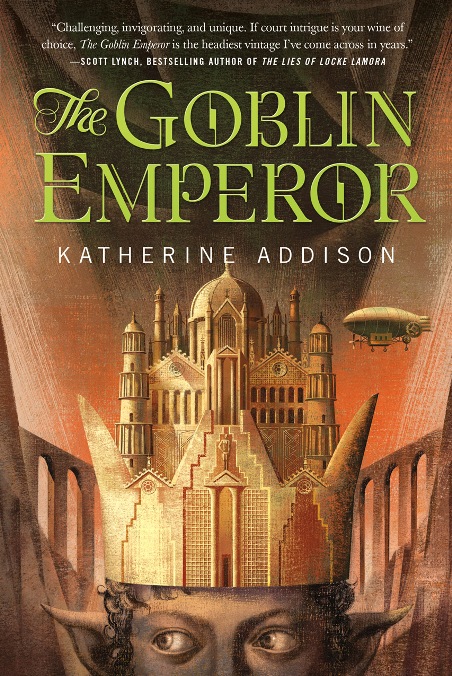
Weekly Read: The Goblin Emperor

I was really excited when I started The Goblin Emperor and found that the titular character was named Maia. After all, we’ve got one of those!

MaiaGoblin2.jpg
We’ve never figured out what the non-Chihuahua part of our Maia is, so I’ve taken to calling her Goblin Dog. Close enough.

The Maia of The Goblin Emperor is not part Chihuahua, but is part Goblin in an empire ruled by Elves. He’s the fifth (I think) son of the emperor, the result of a dalliance with a Goblin princess (who dies while Maia’s young). An assassination via airship crash (the tech level is one of the neat touches of The Goblin Emperor) eliminates not only the emperor but all his other heirs. The empire, thus, is forced to turn its eyes to Maia, who’s been raised in internal exile without any hint that he might one day wield power.

That’s the setup of The Goblin Emperor, but it’s a setup that never really pays off. You see, it’s not quite accurate to just say that the book is Maia’s story – he’s the title character, after all. No, the book is completely Maia’s story because his is the only point of view in the book. This is a serious problem because while some interesting things happen around Maia as emperor and even to him, he, himself, isn’t all that interesting.

As a for instance, the airship bombing that sets off the plot is investigated throughout the book and is resolved in the end. Rather than being on the ground with the person doing the investigating (an interesting character in his own right), we get the answers in a letter he writes to Maia explaining his findings. In other words, we aren’t shown the investigation – and all the interesting world building info that comes with it – we’re told about it. For a book with an assassination, a coup attempt, and a second attempted at regicide, it’s surprising dull.

That’s because the book is mostly about Maia easing into his role as emperor. What sets Maia apart from the traditional fantasy emperor is that he’s fundamentally a good guy and is trying to do the right thing, often in the face of traditional resistance (one review called him “one of the most lovable characters we’ve met in ages”). He treats his servants well (actually caring about their well being is a radical act) and he seems particularly tuned in to the desire of women to be something other than marriage fodder and breeding stock.

Having said that, Maia’s good nature is never given any real scope. Only near the end of the book does he finally realize that, as the emperor, he can do just about anything he fucking wants. He never tries to jump start any societal reform or really change things, even in light of the anti-tradition philosophy that powered the assassination. So, yes, Maia is good, but not very ambitious. Not for nothing but the major project he oversees during the book is the plan to build a bridge – not actually build it, mind you, just approve of its building.

The general lack of “oomph” in the story is a shame, because the world of The Goblin Emperor is interesting. For one thing it lacks humans, which is not very common in fantasy (I should know). For another while there are magical things that happen (the investigator of the airship explosion talks to the dead, in some fashion or another), there’s no capital M “Magic” involved (if you know what I mean). Finally, the folkways of the court that Maia has to navigate are interesting in their own right, they just don’t support much of an actual story. The writing is very lovely in spots, too.

Wikipedia slots this book under the heading of “fantasy of manners,” which I’m lead to believe is kind of like a “comedy of manners” but not necessarily with the comedy. I can see that. Such things are good background details for me, but ultimately I need more for a completely satisfying read. If you’re less in need of a driving plot, though, you’ll probably enjoy The Goblin Emperor much more than I did.

goblinemp_rev_comp_sm