Water Road Wednesday: First Excerpt from The Bay of Sins

The Water Road Trilogy wraps up later this year with The Bay of Sins. The bay is where the Water Road empties into the sea and is home to the island city of Tolenor, home of the Triumvirate. In ancient times it was where pilgrims would come to wash away their sins. It’s always been a place of reckoning.

 In this scene, something happens in the new Neldathi city of Albandala that will require some reckoning.

It was overcast the next day, snow spitting from the slate grey sky. Weft made his rounds in the morning, speaking with members of various clans, chatting about nothing important. He was feeling things out, trying to get information without anyone knowing they were giving it to him. He usually had better luck, but today people seemed tight lipped. Something was in the air, something Weft couldn’t quite put his finger on.

The day began to achieve some focus when he saw an old Neldathi man emerge from the meeting hall in the center of the city. The long, low log building was where the clans met to discuss vital issues. It wasn’t clear what this meeting had been about or how many people had been involved, but the old man’s bearing and entourage suggested that he was important. Weft suspected he was one of the chiefs, a thek, but he couldn’t tell from which clan. He had no painted lines in the long black and grey braid that hung down his back.

Even if he couldn’t tell which clan the thek belonged to, Weft could make a guess as to which faction could claim him. It wasn’t a hard and fast rule, but generally an unpainted braid identified one as a unificationist. If a Neldathi still wore clan colors, most likely he was an independent. This was most likely one of Antrey Ranbren’s men, come to Albandala on a mission.

Weft watched as the man shuffled through the snow. There were four younger men with him, all of them also wearing black braids. Warriors, no doubt, although none of them had weapons to hand. One had a rifle slung across his back, another a short spear of some kind. The others no doubt had knives or swords on them, but Weft couldn’t see. Regardless, they were woefully unprepared for what came next.

The thek was greeting people as he shuffled. He must have been popular, at least among some portions of Neldathi society. People gave him what looked like warm hellos, meeting him with smiles and nods. The jumble of voices overtaxed Weft’s limited grip on the language. The numbers overwhelmed his guards, who looked reluctant to try and push back the well wishers anyway. Were they obeying the thek’s orders?

One Neldathi, smaller than the others and with black, blue, and red stripes in his braid, stepped forward with another group to greet the old man. Weft had a hard time keeping sight of him, with the press of tall bodies around him blocking the view. He worked his way through the crowd just in time to see the small Neldathi raise his right arm and charge at the thek. He yelled something, low and guttural and angry. Weft couldn’t begin to understand it, but he caught the gist. There was a pistol in his right hand.

It wasn’t as loud as he expected, but the shot rattled Weft’s bones all the same. The speed and violence of the maneuver took him by surprise. He knew something like this might happen, but had no idea when. In the blink of an eye there was a cloud of smoke surrounding the old chief as he fell, clutching his throat. The snow turned red underneath him.

The shooter held the useless pistol aloft and began to laugh, loudly, in a way that proved he was out of his mind. Before he could even try to run away another Neldathi, this one taller, wider, and altogether more in keeping with the stereotype of his people, tackled the shooter, driving him to the ground.

There was no need for Weft to see what happened next. His work was done. He needed to leave the city as quickly as he could.

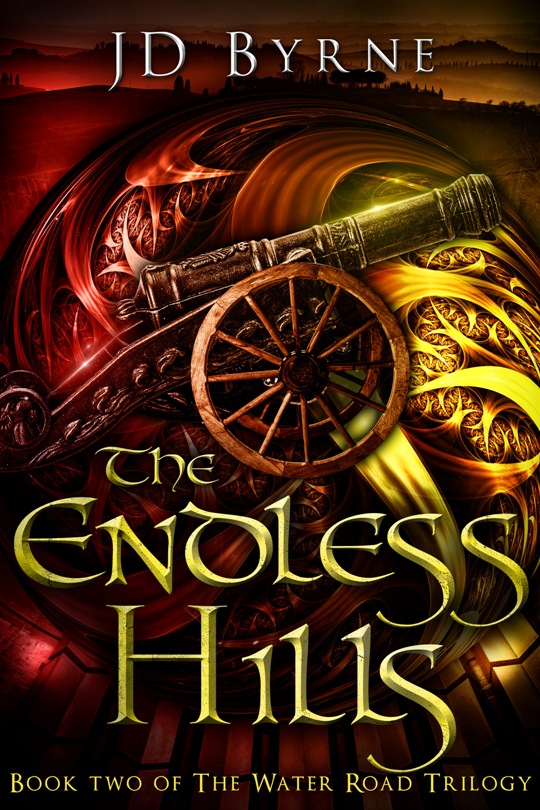
Get caught up with the trilogy by picking up The Water Road and The Endless Hills now.

Water Road Wednesday: Second Excerpt from The Endless Hills

The second excerpt from The Endless Hills brings us back to Antrey, who has now come north from the Neldathi mountains to come face to face with the war. In this excerpt she’s touring the bombed out shell of Innisport, one of the Truimvirate’s largest cities. It’s been an eye-opening experience.

There was a dull murmur that rose from the crowd. Not angry, but curious and agitated. It lacked energy and didn’t strike Antrey as threatening, although she noticed Effar and the other guards stiffen in alertness. The carriage came to a halt when the driver could no longer pick his way through the mass of people.

“You there! Clear the way!” Kajtan yelled to a group of Neldathi warriors who had congregated in front of a ruined building. They leapt into the street, pushing and shoving people out of the way. No one put up any real resistance, but the warriors used force all the same. When one woman stumbled and fell onto the street, a warrior raised his musket as if to smash her face with the butt of the gun.

“Don’t touch her!” Antrey yelled, jumping up. The warrior stopped, musket raised, and looked at her, dumbfounded.

“Jeyn, this is not wise,” Kajtan said under his breath. “Please, sit. You are far too exposed.”

“These people belong to this city,” she said in Altrerian, ignoring Kajtan and raising her voice. “They have a right not to be brutalized.”

“Aren’t you here to kill the rest of us?” someone, a woman, shouted from the crowd.

Antrey turned and saw an older woman with light green skin standing on a stoop outside a building. Her clothes were ragged and smeared with blood, although she didn’t appear to be injured. She stood straight and as tall as she could. “Why would you think that?”

“You’re the one who started all this,” the woman said. “The one they call jeyn.”

“I am Jeyn Antrey Ranbren, yes.”

“Then why ask if we think you might be here to kill the rest of us? Look around. See what your barbarians have done. Admire their handiwork.” The crowd buzzed, heads nodding in agreement. The mood caused two of the warriors to charge up and grab the woman by the arms.

“Stop that!” Antrey said in Neldathi. “She is not a threat.” They released her and walked slowly back to the street.

“You know my name,” Antrey said, switching back to Altrerian, “may I have the honor of knowing yours?”

“Mida Innis of the Guild of Healers. I’ve lived in this city all my life. It breaks my heart to see what your kind have done to it.”

“This is a war, Mida. Did you know that for a century your people had sown discord between the Neldathi clans, causing them to fight and kill each other in the name of your security? You are in no position to judge.”

“How can you say that? They say you only discovered this because you found a secret book locked in a Triumvirate vault. If that’s true, how does it convict me? The Sentinels and the Grand Council might have known, but not the common people, not these people. Why punish us?”

Antrey knew that Mida had a few details wrong, but on the whole she had a point. This wasn’t the time for a fight. “Are you hurt?”

“No.”

“What about the blood?” Antrey asked, pointing to the stains.

“That’s from my patients.”

“Are they close?”

“Of course.” She jerked her head toward the building behind her. “Why do you care?”

“I came here to see the progress of the war for myself, firsthand. That means seeing the damage done, which deeply saddens me. That also means seeing those that have been injured. Can I meet them?”

Mida stood, frozen, for a moment. “I don’t want all of them in here,” she said, pointing to Antrey’s guards.

Antrey pushed Effar aside and stepped down from the carriage. “Of course.”

“Don’t do this, Jeyn,” Kajtan said, following her out to the street.

“I have to,” she said. “Keep things orderly out here. I won’t be long.” She walked toward Mina. The buzz of the crowd was gone, replaced by a still, uneasy calm.

“Lead the way,” Antrey said to Mina.

The building was red brick that had been rubbed smooth over the years. It was four stories tall, but at least the upper floor appeared too damaged to be useful. Mida opened the front door and Antrey followed her inside.

Remember, The Water Road is now available at Amazon as well as in the real world at Empire Books & News. The Endless Hills will be released on August 31!

TEH Cover (540x810)

Water Road Wednesday: First Excerpt from The Endless Hills

For this initial dip into The Endless Hills, book two of The Water Road trilogy, I wanted to explore one of that book’s new characters a bit. Martoh is a crook, but he’s in the kind of prison he’s never been in before, the kind that’s landed him in the infirmary. Now, with a war on, there’s a chance for him to get out:

 A few seconds later a gentleman stepped behind the curtain as someone else held it for him. He carried small wooden stool in one hand and a black leather case in the other. His black suit was neat and fresh, implying he had some kind of official position. The fine grey dust from the stones out of which the prison had been built had yet to infest his clothing. “Martoh Isukar?” He put the stool down beside the bed.

“Who are you?” Martoh had long ago learned to be wary of men in clean suits.

“May I sit?”

“Help yourself.”

The man sat down and began pawing through his case. “It really was quite a journey to reach here, you know.”

“Why is that? And who are you?”

“I’m sorry.” The man sat up straight and pulled an official looking piece of paper from his case. “My name is Anea. I am from the Ministry of War.”

Martoh rolled his eyes. “Whatever it is they told you I did, you’ve got the wrong guy.”

Anea looked at him with a frozen expression that said he knew Martoh was the right man. “You are serving a term of life in prison, is that not correct, Martoh? May I call you that?”

Martoh gave silent consent.

“Due to your sentence, you will die behind these walls. Why would I have to think anything else about you?”

“I’m not a killer.”

“It says something very different here.” Anea held up a clutch of papers and began shuffling through them, for Martoh’s benefit, most likely. “It says here that you stole some small trinket from a shop, were caught in the act, and pursued by the shop keeper. As he gave chase in the street he tripped, fell, and upon landing broke his neck. Died instantly, sad to say.”

“My bad luck.”

“His bad luck, I would say. But the court has already decided this. You are guilty of causing death while in the commission of another offense. Same as if you put a blade in the poor man’s back. However, the circumstances of your crime did, at least, save your life.”

“Put me in this cage, you mean,” Martoh said. He tried not to get agitated as any movement caused a bolt of pain to rush through his body.

“Martoh, you have never lived a life in harmony with His Majesty’s law, have you?” Anea let the question be answered by silence. “Although I suspect you never thought it would take you this far.”

“Obviously. It’s one thing to get locked in here for shooting a man or stabbing him. It’s entirely different when you’re here because of a mark’s poor foot skills.”

Anea didn’t take issue with him.

“If you are not here to pin something else on me, why are you here?”

Anea grinned, ever so slightly. “I am here to give you a way out.”

Martoh turned away from him. “I’m in no mood for games.”

“This is no game, I assure you. I am here on behalf of the Ministry of War, looking for recruits. You do know that there is a war on?”

“I’ve heard. I’ve also heard that the Neldathi might have a right to be angry.”

Anea cleared his throat in a way that suggested he would take issue with that position. “I am not here to discuss politics. I am here only in search of recruits.”

“Conscripts, you mean,” Martoh said, turning back to face him. “Typical. Use prisoners to put down an uprising caused by your own damned fool policies.”

Anea sat for a few moments. “Is everyone that cynical in your world, Martoh?”

“In the world I came from, one steals because that’s the only way he has to feed himself or his family. In the world I live in now, any other random person might try to kill me, just to prove he can. Pardon me if I seem a bit cynical when a stranger comes preaching salvation.”

Anea heaved a deep sigh. “Cynical or no, Martoh, you are not a stupid man. If His Majesty was going to conscript prisoners to go fight the Neldathi, why would I be here?”

Martoh had to concede that, but he wouldn’t admit it. “So what’s the deal?”

“Deal? There is no deal,” he said in a way that made it clear such horse trading was beneath him. “There is only an opportunity to serve your King and defend your homeland from barbarian invasion.”

“In return for what? Look, you’ve given the game away admitting that there will be no conscriptions. I get to say no thanks and stay right here. So why shouldn’t I?

“Freedom.” Anea let the word hang in the air while he got another paper from his case. “If you agree to fight, you will be free.”

Remember, The Water Road is now available at Amazon as well as in the real world at Empire Books & News.

Water Road Wednesday: Final Excerpt from The Water Road

For the third and final excerpt from The Water Road, we return to Antrey. In this scene, she’s escaped Tolenor and made her way into the mountains south of the Water Road itself. For the first time since she was a child, she encounters Neldathi in the flesh.

She jumped across the stream and made her way to the rocks, which clustered near the upstream corner. She sat down, slipped the bottle from her satchel, and took a long drink. What was once snow was now ice-cold water. She gulped it eagerly, knowing that the pool would provide a means to refill it.

Just as she took the last drink of water, Antrey heard a noise behind her, downstream, that sounded like a violent displacement of limbs and leaves. She turned and saw an elk dive out of the trees on the other side of the stream. Its great antlers were a tangled mess of underbrush ripped from the forest as it ran. Her eyes met those of the elk, which had stopped at the edge of the stream, gasping hard, its breath frosting in the chilled air. After a moment’s pause, it dropped its head and began to lap water from the stream.

Antrey closed her eyes for just a moment and heard the elk make a terrible screaming sound, like it was crying out in pain. It made her shudder and sent a bolt of pain shooting down her own spine. She opened her eyes and saw the elk, reared up on its hind legs, thrashing its head back and forth. There was an arrow in its neck, just above the shoulder. Antrey had not heard anything to indicate that anyone was around.

A salvo of three more arrows thwacked into the elk’s flank. It screamed again and tried to move away, upstream back to the trees, but it took only a few faltering steps before it collapsed in the snow. As it gasped for air, the white ground turned red with blood. The beast was trying desperately to live or calling out to die. Antrey wasn’t sure which.

Antrey was so transfixed by the elk’s plight that she forgot for a moment that the arrows meant that, after all this time, she was no longer alone. She did not hear the further rustling of the trees, but did see first one, then two, then half a dozen Neldathi emerge from the forest and approach the elk.

They were tall, with just the faintest tint of blue in their white skin. Were they naked, they would nearly blend in with the snowy ground. Each wore multiple layers of animal skins that obscured, but could not hide, that they were strong, powerful men. All had long black hair, which grew from a fringe of scalp at the back of their heads. It twisted in braids that ran halfway down their backs. About halfway down, the black color gave way to a pattern of red, black, and white strips. Three of them carried ornately carved bows, while two others had similar devices slung over their backs. They either had not noticed her or ignored her and approached the elk.

The other Neldathi, Antrey had thought initially, was unarmed. The tallest of the group, he strode towards the elk, reached inside the layers of his clothing, and pulled out a knife, bigger than anything Antrey had ever seen that was not called a sword. In a maneuver that showed years of practice and an abundance of skill, he knelt beside the elk, placed the great blade to its throat, and drew the knife across, ending the beast’s misery. All the while, he said something quickly under his breath.

Antrey had never seen anything like it in her life. When she was young she had never experienced a hunt or a kill, only the end result. The sight of such a brutally efficient killing shook her to the core. The bottle slipped from her hands and splashed into the pool underneath her. At the noise, the hunters turned and saw her.

The one that had killed the elk crouched motionless next to it, knife still in hand. The others moved away from the kill and sprang across the stream swiftly, switching their focus. They began to converge on her slowly, two from upstream in the direction of the elk, two others having circled around to come at her from the other direction. She lost sight of the fifth, but within moments she knew she was surrounded. Before it ever occurred to her to try and get away, five well-armed and curious Neldathi had blocked any means of escape.

She ignored the ones on her side of the stream and tried to make eye contact with the one by the elk. He appeared to be the leader of this hunting party or its senior member. Regardless, he was someone who commanded respect. Maybe by making contact directly with him she might open some line of communication, although she had no idea how to do that. At the very least, maybe he would put the knife away. The way he crouched there, casually displaying the bloody blade, made her think he meant to tell her that it might be her neck that was sliced open next.

As the others inched slowly closer to her, Antrey could feel their eyes on her, covering every inch of her with their eyes. One of them was close enough that Antrey thought he might have sniffed her, but she quickly dismissed that as a work of her imagination. That was something the barbarian Neldathi of the Altrerian culture would do, but made little sense upon rational examination. They would use every sense available to them, just as she would.

With each footstep that brought them closer, the snow crunched underfoot. Antrey’s heart raced the closer they came. It was calmed only somewhat when the one across the stream stood up, wiped the bloody blade of his knife on the elk’s carcass, and returned it to its sheath. When she heard a voice behind her, she nearly exploded.

As I said, that’s it for the excerpts from The Water Road. That’s because it finally comes out next Wednesday! After all these weeks of reading about it, isn’t it time you just read it for yourself? Head over to Amazon and pre-order your copy today (only 99 cents until the end of the month!).

TWR Cover (540x810)

Water Road Wednesday: “The Missing Legion”

The Water Road is the first part of the trilogy, of course, and the first thing I wrote in this universe. It’s not the first to see the light of day, however.

At some point in the past, I decided I wanted to write a ghost story. October was coming up, it was something I hadn’t done before, and I thought it would be fun. I was in the middle of revising The Water Road at the time, so I decided to set it in that world. I quickly settled on a story about a hunter (in pursuit of one of the cryptid beasts that stalk Alteria) who gets lost in the woods and gets more than he bargained for.

I knew I didn’t want to set it during the time of The Water Road, so I set it much earlier, even before the First Neldathi Uprising and the forming of the Triumvirate. Indeed, it’s a time when two great cities in the Arbor are at war.

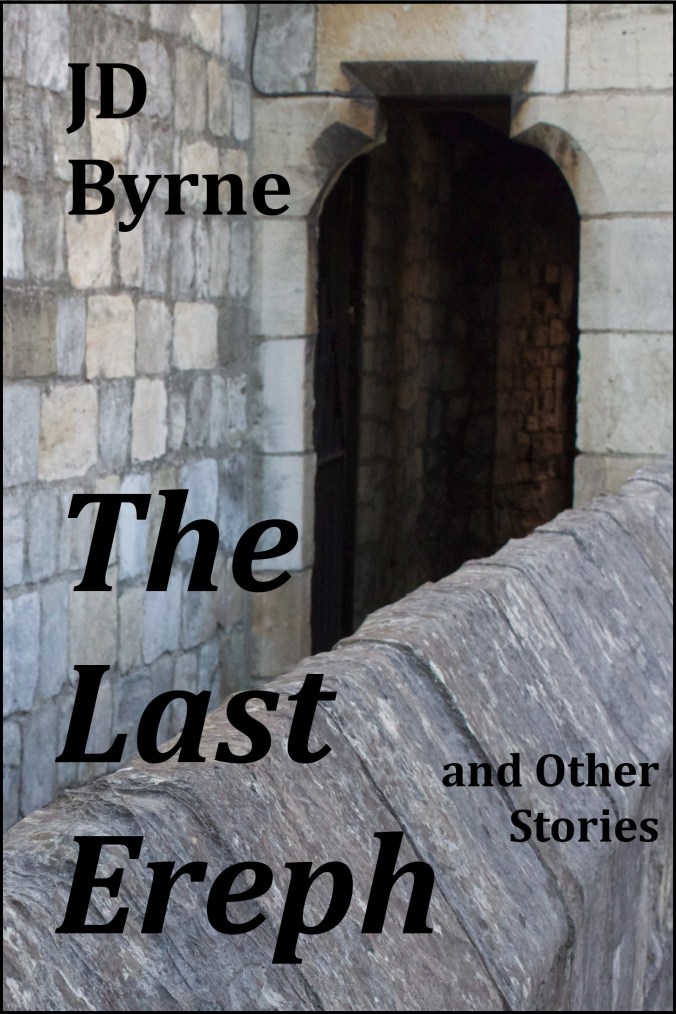
As for the ghost story itself, it’s influenced heavily by a section of Akira Kurosawa’s 1990 film Dreams that you can read about here. Or, you can just read “The Missing Legion,” which is part of my short story collection The Last Ereph and Other Stories. Here’s a snippet:

The corporal turned away and motioned for Taiman to get back on his horse. “You’re heading into the woods, you say?”

“Yes,” Taiman said.

“Are you sure you want to do that?”

“Absolutely,” Taiman said. “I’ve been chasing that beast for five days. If I can corner it in the woods, perhaps I can catch it alive.”

“Will that be worth it, you think?” the corporal asked.

“Of course,” Taiman said. “Why?  You’re not going to try and keep me from going, are you? Thought men in the Arbor valued free movement more than anything.”

“We will not stop you,” the corporal said. “But I would advise against going in, particularly if you don’t know the area. It’s very easy to get lost. Plus, they say things happen in those woods at night. Strange things, when the moons are full.”

Taiman chuckled and sighed. “Thank you for the warning.  Someday, the enlightenment that has come to the Guildlands will filter down to the Arbor as well. We no longer believe in superstitious nonsense. There are no strange things, only things that we do not understand. Besides, I am capable of handling any creature or person I might encounter. Now, if I may be on my way?”

The corporal told him how to best make his way around the camp and Taiman set off. He cursed the delay, but knew it had not spoiled his hunt. The beast had outrun him the day before, vanished from sight, but Taiman had held onto the trail. Barely.

His hopes rekindled when he spotted the beast through a telescope as it loped out of the trees in search of water. Once again he had a target to pursue. Taiman spurred his horse and charged off down river.

The Last Ereph and Other Stories is available at Amazon, including Kindle Unlimited, which means you can read it for free, essentially. Why wait?

Final Cover Idea (KDP)

Water Road Wednesday: Second Excerpt from The Water Road

In this scene, Strefer has run to the Triumvirate compound because of a buzz of rumors that something big has gone down there – very big. Sentinels are standing guard outside the Grand Council building as a crowd swells. She needs to get inside and find out what’s going on, but they’re not supposed to let anyone in.

Strefer stepped up and looked the Sentinel in the eyes.

“Who are you?” he asked, his voice a mixture of vigilance and weariness. He was tall and forceful, with fine light-green skin, most likely a Guilder. That was a stroke of luck, Strefer thought. His pikti was slung loosely across his back. The way he carried himself suggested he had been here a while.

Strefer opened the hand in which she had clutched her identifications and handed them to him. “My name is Strefer Quants. I’m with the Daily Register.”

He took the cards, gave them a quick glance, and handed them back to her. “Why should I care? You don’t think I’m going to let you in just because you work for some newspaper, do you?”

“Why not?” Strefer asked, slipping the cards back into her pouch. “Is there something in there you don’t want people to know about?”

The Sentinel shot back at her with a wry smile. “I am afraid I cannot comment,” he said, with affected formality.

“Do you see a notebook in my hand?” Strefer said, keeping the game going. It was one she would surely win. “I’m not asking you for any comment. I’m just asking if there is something going on up there that you’re trying to keep from the public.” She gestured towards the doors at the top of the marble steps.

“Perhaps I wasn’t clear, missus,” he said, the smile replaced by a glower as he stared down at her. “I have nothing to say about whether anything is happening inside here. Much less to the likes of you, notebook in hand or not.”

“Fair enough,” Strefer said in concession. She decided to try another approach. “But you’ll let me by so I can make my appointment, at least.”

“Appointment?” he asked, confusion sliding across his face like the shadow of clouds moving across the sky. “Appointment with who? And don’t say one of the Grand Council members. They would be in session now. And, at any rate, they don’t greet visitors.”

Score one for her, Strefer thought. She knew from talking with Tevis that interviews with members of the Grand Council were possible. Cutting them off completely meant something important had happened inside. “Of course it’s not with one of the Council members, who do I look like? No, it’s with,” she paused for a moment, grasping for a name. “Keretki,” she finally said, forced to pull a name out of thin air.

“Who?”

“Keretki,” Strefer said, knowing this was her hook. “You know, the policy coordinator for the Arborians? I have an appointment to meet with him to discuss some trade matters he has been dealing with during the session. I’m sure you’ve seen him around here.” She threw the last line in to dig a little at her adversary.

“No, missus, I don’t know him,” the Sentinel said. “But this isn’t my regular patrol.” Another useful bit of information. “Regardless, I can’t let you into the building right now.”

Strefer turned from amused to angry in a flash. “Now look here. My boss spent weeks setting up this interview, all right? The publisher back in Sermont even had to get involved. This interview will be the centerpiece of our coverage of the Council session for the next week or so. It’s very important. Not just to me, either, but Keretki, too. You know the Arborians, always sniping at each other over the smallest things. He has them all together on the same page for once and wants the public to know about it. Do you really want to be responsible for pissing off all those people?”

The Sentinel stood in silence, reaching for an answer that was not coming.

“It’ll be worth your trouble, I promise,” Strefer said. “Have you ever heard of Olrey, the publisher of the Daily Register? He has a reputation for airing his feuds in the press. He could make things very difficult for the Sentinels, the Grand Council, the…”

Exasperated, the Sentinel put up his hands. “All right, all right, fine. You win.”

“Thank you,” Strefer said, suddenly buoyant. “You’re a very reasonable man.”

But before Strefer could make it up the stairs, he put his hand on her chest to stop her. “Hold on a second. You get to go in, but there are two conditions. First, none of this conversation we’ve had here is going to show up in your paper, all right? I don’t…”

“Agreed,” she said, cutting him off. “Say no more. What’s the other one?”

“Second, the Grand Council chamber is off limits. Got it?”

“Absolutely,” she said. “Kerekti’s office is on the other side of the building, I think. I won’t be anywhere near the Grand Council chamber.”

With that, the Sentinel stood aside and let Strefer proceed up the stairs. There were another pair of Sentinels stationed by the front door, but they did nothing to halt her progress. Once inside, she made sure that neither of them were watching her, then she went to look for the Grand Council chamber.

Water Road Wednesday: Life In the Guilds

As I mentioned last week, Strefer Quants is from the United Guilds of Altreria, what’s commonly referred to as the Guildlands. The Guilders (as they’re known in The Water Road universe) live in a society that’s arranged completely differently from everywhere else in their world, even the Neldathi. Where family and kin create bonds in most places, Guild society is organized around the Guilds to which people belong. There are no families, as we traditionally think about it.

Here’s Strefer explaining to Rurek, her companion through The Water Road, a little bit of how that works:

“You talk about your mother and father, your siblings? We don’t really have concepts like that in the Guildlands. Sure, some woman gave birth to me and some man did his part so that I was conceived, but neither one of them raised me.”

Rurek shook his head. “You don’t even know who your parents are?”

“I told you, the concept of ‘parents’ really doesn’t exist where I come from. But to answer your question, yes, I do know who the two people who produced me were. I’ve met who you would call my mother once or twice. She is in the Guild of Musicians. I met her after seeing her sing at a concert once. She has a beautiful voice. Shame I didn’t inherit it,” Strefer said with a laugh. “The one you would call my father was from the Guild of Soldiers. He was killed fighting the Azkiri, from what I learned, before I could meet him.”

“I’m so sorry,” Rurek said with genuine compassion.

Strefer shook her head. “You still don’t get it. I’m not talking about someone like your father, who helped raise you, taught you things, protected you. To me he was never more than a name, and may have always been that way. I’m just answering your question about whether I knew who my biological ancestors were.”

“All right, then. No more sympathy from me,” Rurek said jokingly.

“I’ll take sympathy, thank you, but at the appropriate time and place.”

“Duly noted,” he said. “So, with that bridge crossed, who did raise you, then?”

“Not surprisingly,” Strefer said, starting on the final side of the pocket in which the pages had been hidden, “there’s a Guild for that. It’s called the Guild of Midwives, but it really includes a lot more people than that. Men and women, both, you know. Midwives, wet nurses, caregivers, you name it. They’re the ones that do the hard work of actually raising children.”

“But there’s more to it than that, surely,” Rurek said. “Parenting is more than just making sure your daughter gets fed and has a roof over her head at night.”

“It does in Kerkondala, because your society is structured around individual family units. Families just don’t exist like that in the Guildlands. Have you ever wondered about my last name?” she asked.

“Not really,” he said. “I know it sounds a lot like the city where you’re from, but that’s not uncommon in the Arbor or Telebria.”

“Except that, in the Arbor or Telebria, a similarity between a name and place is probably due to that person’s ancestors naming the town. Quants isn’t a family name, Rurek. It’s a short way of telling people I was born in Quantstown. My actual full, official name, as it appears on the rolls now, is Strefer of Quantstown of the Guild of Writers. Quite a mouthful, huh?”

He nodded. “I guess it is.”

“That Alban who got his head bashed in? His last name was Ventris, because that’s where he was from. Nothing more. My point is there is nothing about me that reaches back to some long line of ancestors, like you have.”

“Who named you, then?” Rurek asked.

Strefer stopped sewing for a moment, looked out over the water, and said, “You know, I’m not sure. Never occurred to me to ask. From as young as I can remember, I was Strefer. I could change it if I wanted to, but it works just as well as any other name, doesn’t it?”

“No argument here,” he said. “Rurek is an old family name, goes back generations. I hate it.”

“Why don’t you change it, then?” Strefer asked, returning to her task.

“Because,” Rurek said, stopping for a second to think about it, “it’s just not done where I come from. Like it or not, I do have some connection to my distant ancestors to worry about. Besides, we were talking about you and your childhood. So the Guild of Midwives did the care and feeding part, right? Then who taught you to read and write and how the world works and all that?”

“The Guild of Teachers,” she said. “I don’t know about Arborians, but I’ve heard Telebrians talk about the limited role teachers play in the education of their children. Makes no sense to me. The Guild of Teachers is where the experts are, in everything from how to cook a meal to how to mend your clothes to how to read and write.”

“So you went to school, then?”

“Of course,” she said. “But that’s not the only place you learn things. You know that. The members of the Guild of Teachers work in schools, but also in the dormitories where children live and all over. They teach adults, too, if they want or need to learn about something new.”

Rurek did not ask any more questions and they sat in silence for a few minutes. Finally, he said, “It just all seems so strange.”

“That’s because it’s not what you grew up with,” Strefer said, finishing her sewing and handing the coat back to Rurek. “We are most comfortable with what we know. That’s doubly true when you talk about things like how we grew up. To me, it sounds strange to hear people talking about their families and how much they despise a brother or cousin or whatnot, but will then turn around and defend them from attack by outsiders. It makes no sense to me.” She stood up and slung her satchel over her shoulder.

Guilders form bonds, but on their own terms and for their own reasons, rather than out of a sense of societal inertia. It’s a good example of how they interact with the world – rationally and practically, without an overlay of tradition or concerns about doing things differently. It’s a world view that others in the universe of The Water Road have a hard time grasping.

Water Road Wednesday: First Excerpt from The Water Road

In this scene, Antrey accompanies her mentor, Alban, to a reception being held in honor of the beginning of the new term of the Grand Council of the Triumvirate. It’s an uncomfortable evening for all involved.

The reception was being held in a large foyer on the second floor of one of the subsidiary buildings. Antrey remembered that it had once been the home for the Confederation’s trade delegation, but now served as overflow office space for the Grand Council itself. As a result of its heritage, the room was filled with deep rich wood textures, with fine carvings climbing the wall. Candles flew high overhead, providing an endless supply of light that reminded Antrey of dusk on the eastern shore. They arrived slightly behind schedule and the room was already a buzz of multiple conversations reverberating around the oaken hall.

“Come on,” Alban said, tugging gently on her elbow, “we’ll find some drinks.”

They walked over to the other side of the large circular room, to a table manned by a pair of young men. Sharply dressed, one held a wine bottle in his hand, the other some kind of fruit-based punch. Alban picked up an empty glass at the table and gave it to Antrey, before taking one for himself. “Try the wine,” he said. “It’s from Guild vineyards along the northern portion of the River Innis. Best in Altreria, in my opinion.” He held out his glass and it was filled a clear crisp white wine.

Antrey did the same. She looked at the man pouring the wine, studying him. He paid no attention to her, aside from dealing with the empty glass she held. It was impossible to say if that was particularly due to who she was or merely part of his job. She thanked him when the glass was full, but that prompted no response. She turned and faced the crowd while she took a sip of wine. Antrey had not had much experience with wine, beside the common table wines Alban would bring home every now and then. It was beyond her experience to call this the best in the land, but it was very good.

“All right,” Alban said, after they had observed the crowd and sipped their drinks for a moment. “Time to get this over with, yes?”

Antrey nodded and followed him as he plunged on into the crowd. Before they got very far, a voice called out in their direction.

“Alban!” the voice said, from off in the crowd to their right.

Alban stopped just long enough to turn that direction before he was confronted by a large man with dark green skin. A smaller, but similarly hued, woman, hung off his arm. “So good to see you again, old friend!” He wrapped his free arm around Alban in a brief hug. Alban returned the favor.

“Jamil,” Alban said, “it has been a while since you were in the city. What brings you back to Tolenor?”

“I was talked out of retirement by the mayor,” the other man said, with mock exasperation. “Once you come here, everyone insists on sending you back.” He laughed. “Where are my manners,” he said turning to the woman with him. “This is my wife, Utka. Utka, this is Alban Ventris, clerk to the Grand Council.”

The woman extended a hand to Alban, who took it and shook it politely. “My pleasure. And this is Antrey Ranbren,” he said, turning to her. “She is my assistant with the Grand Council. She’s been most vital to my work over the past few years.” Jamil ignored the introduction. Alban continued. “Jamil was a trade missionary from Kerkondala back when I was a Sentinel. We met more than a few times on the roads. Or what pass for roads in the Arbor.”

“We were much younger then, were we not?” Jamil said, with a jovial smile that quickly disappeared. “And perhaps less prone to eccentricity.”

Alban smiled and took a drink, as if thrown back on his heels. “We were younger, Jamil, certainly,” he said, after an awkward pause. “So what brings you back to Tolenor? What task has the mayor given you?”

Jamil launched into a discussion of his trade mission, about which Antrey knew nothing and cared little. She stood beside Alban and sipped her wine. As he spoke with Alban, Jamil kept his gaze fixed on him alone. It was as if Antrey was not even there. This was a new sensation for her. Usually her appearance caused strangers to gawk and follow her through a room. She had come to terms with that years ago. Being treated like a black hole, a non entity that could simply be ignored was more difficult. She did her best to keep a calm façade for Alban’s benefit, at least.

Rather than pay attention to Jamil’s story, Antrey studied Utka. She stood, silent, behind Jamil. Presumably, she knew all that Jamil was saying, yet she nodded as if hearing it for the first time. After a few moments, she turned her gaze to Antrey. They said nothing, but Antrey could sense some shared misery between them. Antrey was roused from her thoughts by Alban’s hand on her shoulder.

“It was good to see you again, Jamil,” he said, turning to walk away. “Perhaps we can talk in a few days.”

“That would be good. I might have to ask you for some help, depending on how things turn out,” Jamil said.

“Come by my office,” Alban said. Without any other parting words, he and Antrey began to walk away.

As they passed each other, Utka reached out and grabbed Antrey’s arm. The two women paused, exchanged glances, and then went their separate ways.

“I apologize for that,” Alban said as they wound their way around various clutches of people.

“For what?” Antrey asked.

“For Jamil. The way he treated you. Or didn’t treat you, as the case may be. I can’t go so far as to call him a good man, but he’s not a bad one. He isn’t the most enlightened of fellows, however. Even within the Arbor. Try not to let it bother you.”

“I really didn’t notice,” Antrey said, lying. She appreciated Alban’s attempt to smooth things over, even if it cost him little.

They had almost reached the other end of the room when Alban changed direction and intercepted a woman who had just broken away from a small group. “Galenna!” Alban called out after her. She stopped turned, began to walk towards them, and greeted him with a smile.

Antrey surveyed Galenna as she approached. She looked to be about Alban’s age, with some cracks and wrinkles evident on her face, which was dominated by bright black eyes that almost overpowered the pale green of her skin. She was dressed in a formal military uniform, pale yellow with hints of silver around the collar and cuffs. Although Antrey did not recognize the insignia, she must be from the Guild. Telebrian women were not part of the military. While some of the cities in the Confederation had women fighters, they were more organized as irregulars or ready militia. A professionally dressed military woman could only be from the Guild.

“Hello, Alban,” she said, greeting him with outstretched hands. “How does the evening find you?”

“It finds me well,” he said. “This is my assistant, Antrey Ranbren. Antrey, this is Galenna, Master of the Guild of Soldiers and the new member of the Grand Council from the Guilds.”

“Pleased to meet you, councilor,” Antrey said, with a courteous nod.

“Please, call me Galenna,” she said to Antrey, before quickly shifting attention to Alban. “We’ve known each other too long to rest on formalities, eh, Alban?”

Alban laughed. “I suppose that’s true.” He turned to Antrey. “Galenna was the first woman allowed into the Sentinel corps. They kept her isolated in an outpost on the shore of Great Basin Lake. They sent all the trouble makers there.”

Galenna’s eyes flitted quickly to Antrey, but then returned to Alban before she answered. “Which is why that is where they sent you too, of course.”

“Of course,” Alban said. They launched into a discussion about Galenna’s recent postings, how she found life in Tolenor, and a little about the trouble in the Badlands. All the while, Galenna continued to snatch glances at Antrey. It was if she was afraid to actually look directly at her and be caught by someone. Unlike Jamil, who was content to excise her from his reality, Galenna was concerned about Antrey’s presence. What was her concern? That the trained beast would break its chains and cause a scene. Antrey sipped her wine slowly and deliberately, breathing deeply. She was shaken from her observations when she heard her name pop up in the conversation.

“As Antrey can tell you,” Alban was saying about something, “the work of the Grand Council can often lose its focus on real issues and devolve into minutiae.” He paused, expecting either of the women to pick up the conversation. Galenna looked nervously at Alban and Antrey, but said nothing.

“Yes, that’s true,” Antrey said, finally, to fill the silence. “But, to be honest, even the minutiae can be fascinating.” It was only a partial lie, one designed to inject some levity into the conversation. It didn’t help.

“Well, I suppose I’ll see firsthand for myself tomorrow,” Galenna said to Alban. “If you’ll excuse me, old friend, I’ve had a long day and will have a longer one tomorrow. I must be going. Good evening.” She turned and walked off before Alban could return the courtesy.

“Wait here for a moment,” Alban said to Antrey before rushing off after her.

Antrey watched as Alban caught up with Galenna just as she was about to leave the rotunda. He grabbed by her arm and obviously surprised her. Alban promptly began to tell her something. Antrey couldn’t hear what was being said, but the tone was clear. He spoke quickly and gestured with his free hand more than usual. At one point, he shifted his feet to block Galenna’s view of Antrey, just as she tried to snatch another glance at her. When Galenna tried to get a word in, Alban cut her off. It was a tense exchange and it made Antrey nervous. She turned away, back toward the bulk of the crowd. Alban returned in a few moments, clearly upset.

“What’s wrong, sir?” Antrey asked.

He sighed. “I’m afraid that I must once again apologize for an acquaintance. And this time, I can make no excuses on her behalf. Galenna, given all she has accomplished in her life and the prejudice she has faced, should know better. I am truly sorry, Antrey. I trust that the entire evening won’t be like this.”

“You should stop apologizing for the acts of others, sir,” Antrey said. He started to say something else but closed his mouth without uttering a word. Perhaps Alban was surprised by her directness. “Neither you nor I can control how others behave or how they react to me. I am, like it or not, a curiosity, sir. It is enough to know that you are offended on my behalf.”

That seemed to please Alban. He looked about ready to start across the room to refill his drink when an elegant older man stepped in front of him. “Alban, it is a pleasure to make your acquaintance once more,” he said, extending his hands.

“The pleasure is all mine, president,” Alban said, bowing his head slightly.

Antrey knew at once that this was Atilleo, the current President of the Grand Council. He was also a member of the inner circle of the King of Telebria. Quite possibly, he was the most important person in the city.

“President, I don’t believe you have met my assistant, Antrey Ranbren,” Alban said, presenting her for inspection.

“Why, yes, of course, I have seen her in the chamber many times,” he said to Alban before turning to her. “Good evening, Antrey,” he said, in a slower cadence and at a slightly higher volume than he had been speaking to Alban. “Does it find you well?”

“Yes, president,” Antrey said, somewhat self consciously. “Thank you.”

The older man turned his attention back to Alban. “Are you ready for the start of the session?”

“Of course, president. Antrey has been hard at work making sure everything is in place while I finished my latest volume.”

“Ah, yes. You do us great honor with your work, Alban. It reflects very well on the Grand Council,” Atilleo said.

“Thank you, president,” Alban said, giving him a deferential nod.

“As does all your hard work, Antrey,” Atilleo said, turning to address her. Again, he spoke with a halting tone and talked to her as if she was deaf. “I know that Alban relies on all that you do.”

Antrey mimicked Alban’s nod. “Thank you, president. I have learned a great deal from working with Alban, both within and without the Grand Council chamber. I look forward to hearing the session tomorrow.” In spite of be treated like a dim-witted child, she did her best to match Alban’s eloquence.

The effort obviously threw Atilleo out of his comfort area. “Well, yes,” he said, before pausing awkwardly. Finally, he took Antrey’s hand in his and patted it, like one might pat the head of a small animal. “I am sure you will learn something.” He hastily turned back to Alban. “I beg your forgiveness, but I must go and say a few words. In the morning, then?”

“In the morning, president, absolutely,” Alban said.

Atilleo gave Antrey one last look, smiled nervously at her, and then bled into the crowd.

Alban stood for a moment, speechless. One of the wine servers started to walk past and Alban grabbed him, abruptly and without warning. He shoved his empty glass into the young man’s hand, then took Antrey’s from her and did the same.

“Come on,” he said, turning and walking away from the crowd that was gravitating towards where Atilleo was about to speak. “Galenna was right about one thing. We have an early morning tomorrow.”

Antrey said nothing and they walked back home in silence.

Moore Hollow Monday – Free Excerpt

Welcome to the first Moore Hollow Monday! These posts will help you get excited about the release of my new novel, Moore Hollow, on October 5.

In this excerpt from the book, the main character Ben Potter meets with his sometime employer and editor Artith, about a potential job:

The book said nothing on the outside, its brown leather binding just barely holding up against years of abuse and neglect. It was about the size of a trade paperback with an afterimage of rough cowhide on the cover that had been worn smooth with age. He flipped open the cover and found the title page. The word “Journal” was printed across the top in barely legible gothic script. Underneath were a few black lines, spaces for the owner to write his name and the dates covered. The dates, written in neat, plain handwriting, were “July, 1905” and “February, 1907.” In the space where the journal owner’s name was written, it said, “Reginald Benjamin Potter.”

“Bloody hell,” Ben said.

“That’s you, isn’t it?” Artith asked, leaning back in her chair and looking extremely pleased.

Ben stared at the journal. “It’s my name, all right. But it’s not me. I’m the fourth poor soul to be saddled with it.” He closed the book and rubbed the rugged outer covering again. “Is this my great-grandfather’s?”

“You’ll have to tell me,” she said. I flipped through it, but I wasn’t really interested in the stuff he said about England. Did your namesake go to America?”

Ben nodded. “For a couple of years just after he left school. He went to some backwoods mountain town, coal mining country.” Ben shot her a dull look. “Only someone in my family would travel halfway around the world to wind up in a place that was just like home.”

Artith flashed him a confused look.

“Yorkshire,” Ben said, remembering that they had never really talked about his family before. “My family’s from just outside of Leeds. Been there for centuries. So leave it to my ancestor to go from English coal country to American coal country.”

“West Virginia,” she said.

Ben chuckled. “Where the bloody hell is that?”

“Somewhere west of Virginia, I suspect,” she fired back. “You know anything about what he did while he was over there?”

Ben shook his head. “Something with railroads, I think. The ones they used to haul coal out of the mines and to wherever it went before it got shipped off. He only spent a couple of years there before he came home and started the family business.”

“Which is not paranormal investigation or journalism, let me guess?” Artith said, chuckling.

“Much to my father’s chagrin,” Ben said, remaining stoic. “Civil engineering, actually.”

“How come you’re not an engineer then, Ben?” Artith asked, enjoying this little bit of torment. “Bad at maths?”

“No,” Ben said, more defensively than intended, “although that didn’t help. It just never did anything for me. To be a good engineer you have to be curious about how things work and why they sometimes don’t.”

“And you don’t care?” Artith continued.

Ben shook his head. “So long as whatever the damned thing is actually works, I’ve got no interest in the details.”

Artith thought for a moment like she had another prickly question ready but apparently passed on asking it. Instead, she shifted topics. “Did you know your great-grandfather then?”

“No, no,” Ben said, shaking his head. “He died before the Second World War. Granddad told me a lot about him, though.”

“He was an engineer too?” she asked.

Ben turned his head to one side, looked at the wall in thought, then said, “After a fashion.” Looking back to Artith’s confused face, he added, “He was a bit eccentric.”

She let that pass by unremarked. “Did your Granddad tell you anything about what his dad did in America then?”

“A little bit,” Ben answered without thinking. Then something tickled the back of his memory, something he hadn’t thought about for years. “Why?”

Artith leaned forward in her chair as if she might pounce. “I told you I skimmed that over the weekend,” she said, pointing to the book in Ben’s hands. “Your namesake tells quite a tale in there. As he lays it out, one of the local politicians was in a very tight race for his seat on whatever their little local council was called.”

Ben whistled. “A hundred-year-old political squabble is the kind of thing that gets you excited these days, Artith? Better find a job at Sky.”

She waved the joke away. “No, no, no. What’s interesting is what this desperate pol did about it. Or rather tried to do about it. According to your great-grandfather at least.”

“Which was?” Ben asked. The memory was coming into better focus now. He had some idea where this was going.

“This guy,”—she paused for a moment—“the name escapes me, but this guy, according to your forefather, actually raised the dead so that they could vote for him.”

Something clicked in his head. “Ah, yes,” he said. “The zombie voters.”

“You knew about this?” Artith asked, obviously hurt. “Why didn’t you tell me?”

“It’s not as if I was holding out on you, Artith,” Ben said. “Granddad told me a few stories. They were fun, but I never thought they were real. Seriously, why should I?”

“And nothing about working for the Journal made you think, perhaps, in a moment of reflection, that the time was ripe to revisit these stories?” she asked. It was clearly a rhetorical question.

Ben answered anyway. “I don’t work for the Journal, Artith, or for you unless some checks have gone missing in the post.”

She put up her hands in mock concession.

“Look, I loved my Granddad,” Ben explained. “But he was a little, what’s the word? Off, you know? When he’d talk about things his father saw in America I just took them for what they were—fun stories. Besides, Artith, you know me at least a bit. Do you think that working for places like the Journal have made me a believer in all this shit?” He gestured around the room, taking in all the paranormal exotica on display.

She shook her head. “Of course not,” she said, not altogether convinced. “That’s not why I showed you that, anyway.”

“It’s not?” Ben asked. “Then why? It’s kind of neat, I guess, but—”

“I want you to check it out,” she said, cutting him off with a devious look.

Moore Hollow – The hardest part of a mystery is deciding what to do once you’ve solved it.

Preorder now at Amazon, Barnes & Noble, iTunes, and Kobo

Cover (KDP)

“The Destiny Engine” – An Excerpt

A scene from “The Destiny Engine” – available now at Amazon

Mister James insisted that Miss Smith be brought to dinner the next day, rather than for a more relaxed meeting over tea. It mattered not to him, but it greatly complicated my day. I was able to scrape together a suitable meal of braised elk, potatoes, and freshly picked greens. Miss Smith seemed pleased with the mixture of rustic and exotic and was too kind in her praise.

Over dinner Miss Smith explained how her family came west from the Carolinas during the War Between the States, settling in Denver near her great aunt. Mister James, in turn, regaled her with tales of his exploits in New York and San Francisco, carefully avoiding those that might touch on the reason he fled from both cities to the wilds of Wyoming.

As I began to gather the dishes, Mister James turned the conversation.

“Tell me, Miss Smith, what, exactly have you heard of my machine?” He leaned back in his chair, fussing with a fresh cigar.

“They say that it can tell the future,” she said, pausing, “or, rather, the future that might have been. Is that true?”

“They do?” Mister James chuckled. “And who are they?”

“Who are they?” She furrowed her brow. “I don’t see the relevance of that.”

Mister James leaned forward, resting his elbows on the table. “The relevance is that you have come seeking my help, Miss Smith, so it behooves you to answer my questions.”

She threw up her hands in halfhearted protest. “Very well. I believe I first heard about the mad inventor of Douglas during a salon in Denver. Very respectable. Before you ask, I do not remember the man’s name who spoke of you.”

Mister James grinned and puffed on his cigar. “They talk of me in Denver? How interesting.” He looked at me as if for me to share in his pride. I continued clearing the table without comment.

“Based on what I heard, I hired a professional to try and find out more,” Miss Smith continued. “He arranged a meeting with a man from Douglas, a man named Finn, who was quite specific about you and your machines.”

“And what did this Mister Finn say?”

“That you like to talk in the taverns,” she said. “Brag, really. About your machines. The ones that never work. He said it was not worth my time to try and meet you.”

“Did he?” Mister James said, laughing. “Finn was always the jealous one, wasn’t he, Whorle?”

“Yes, sir.”

“Regardless of that,” Miss Smith said, “was he telling the truth? Have I wasted my time coming here?”

Mister James thought for a moment, slowly drawing in and puffing out smoke. “That depends, madam, on why you came here. I mean, why did you need to come talk to me, about anything?”

She sighed and started down at her hands, folded in her lap, for a long moment. “I am here because of my great aunt, Mister James. Because she is in need of a miracle, and my intelligence suggests you just might be able to provide one.”

This provoked a grin. “A miracle, dear lady? I can promise no such thing. I am a man of science, not magic.”

“Miracles look different to different people, sir,” she said. “Whatever it may be called, are you capable of providing such?”

“Tell me about your great aunt,” Mister James said.

Miss Smith took a deep breath. “Great Aunt Odetta has led a long and hard life. In particular, she has lost everyone in her life who was dear to her. Her husband, you see, died, under,” she paused, then said, “let us say that he passed on prematurely.”

Mister James nodded.

“But also her children, sir, her dear boys,” she said. She removed a handkerchief and dabbed at her eyes.

“They are gone, too?” Mister James asked.

She nodded. “Drowned. Fell through the ice when they were nine and eleven, respectively. Solomon and Alistair, bless their souls.”

“A pity,” Mister James said, “but for them I can do nothing. I am not a necromancer. What do you think I might do for Odetta?”

“Since the boys died, all those years ago, she has shut out the rest of the world,” she explained. “She came to live with us, as she could not keep up the house. She sits in her room all the time, staring out the window. All she talks about is how she will never see the boys grow up, never see them become men. It is as if she is stuck in that terrible moment.”

“I am a scientist, Miss Smith, but my expertise is not of the mind,” Mister James said. “How do you think I can help you?”

She sat still for a moment, as if trying to figure out what to say, while looking back and forth between Mister James and myself.

“Have no worries about Whorle, Miss Smith,” Mister James said. “He and I are a team, aren’t we, Whorle? Anything you wish to say to me can be said in front of him.”

“Thank you, sir,” I said. Compliments were rare, so I thought it best to acknowledge one when it came.

“You can help me by using your device to allow my great aunt to see her family once again,” she said, finally, shaking her head as if she knew it was madness.

Mister James raised an eyebrow. “It is not that simple, madam. At best I can show what would have happened to them in another reality, had things turned out differently. Is that what your great aunt would want?”

She nodded. “Without doubt, sir. If she could see their lives, even if they are lives that never actually happened, it would ease her soul. I am certain of it.”

“Even if those other lives might not be particularly pleasant?”

“Have you children, Mister James?” she asked.

“No,” he said. “Never married.”

“Then you cannot know the pain that comes from a mother seeing her children die. Parents should precede their children in death, yes?”

When Mister James did not answer, Miss Smith added, “There will be, of course, a substantial fee. To help further your work.”

Mister James smiled. “I should hope so,” he said, standing and striding to the other end of the table. “For what I am willing to do for you and your great aunt, madam, is one of the glories of modern science.”

“You will do this?” Miss Smith beamed with satisfaction.

“I will. How long will it take to bring dear Odetta here?” he asked.

“Five days, perhaps six?”

“Then let us meet again, here, at dusk in a week’s time,” Mister James said. “It will be my honor to serve you.” He bowed, a gesture that did not appear to be so full of mockery as I would have imagined. “Whorle will see you out.”

Mister James retired to his library, while I assisted Miss Smith with her cloak and signaled her driver. While we waited, I noticed the broad smile on her face and the gleam of joy in her eyes.

“Miss Smith, may I speak?”

“Of course, Whorle.”

“Do not come back next week,” I said, lowering my voice to avoid any chance of detection. “If you do so, I am concerned you will not be pleased with the results.”

She frowned. “Mister James would not be trying to sell some snake oil, would he, Whorle?”

“No, madam,” I said, shaking my head. Perhaps her investigation turned up more of Mister James’s past than I imagined. “Just the opposite. I believe the device will work as promised. Which is why I beg you to stay away.”

She looked puzzled.

“There are things we are simply not meant to know, madam. The past cannot be changed, nor can the present.”

“I am surprised, Whorle,” she said, looking out the window as her carriage pulled into the driveway. “I would not think that a man who worked for someone like Mister James would be so prone to superstition. Is not everything we do tampering, in some way, with God’s creation?”

“This has nothing to do with God, madam,” I said, opening the door. “I fear for the wellbeing of your great aunt should you return next week.”

She stepped out the door, turned, and looked back at me. “Your request is duly noted, Whorle.” She turned and began to walk toward the carriage. “And rejected.”

Click here for more