Weekly Read: The Mechanical & The Rising

It’s 1926, but not the 1926 we remember. There is no Lost Generation following the First World War, no Jazz Age, no impending economic collapse. Instead, the world, or at least the largest part of it, is ruled over by the Dutch. How have the Dutch managed this feat? Magic, of course.

Well, they call it alchemy, but it’s essentially magic, a combination of mysticism and technology that creates a horde of “clakkers” – mechanical creatures designed to do the bidding of their creators. With this technological marvel in their pocket, the Dutch rule the world, with only a rump New France holding on in what we would call Canada.

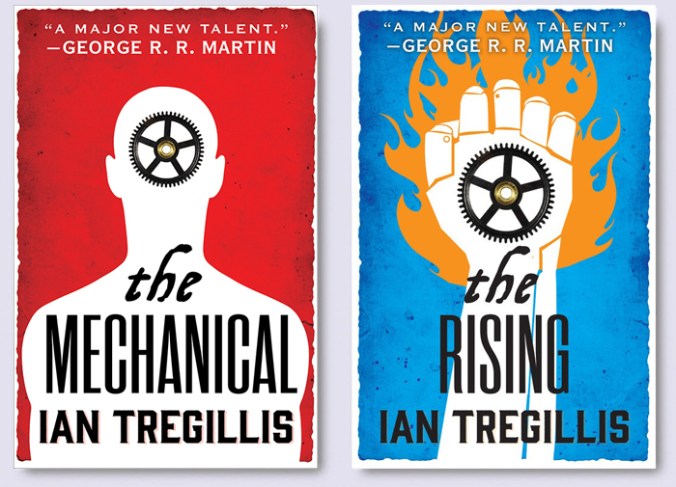
Regardless of the precise verbiage, Ian Tregillis has created a really interesting world with his Alchemy Wars trilogy, the third volume of which is due this fall or winter. It’s a world that allows readers to dive into to heady questions of philosophy and free will, all the while creating deed and interesting characters engaged in life or death struggles.

Depending on how you define “life,” of course. Or “death.” For one of the main characters in the series is Jax a clakker built to be a general servant and slave. When The Mechanical begins, Jax is present for the gruesome execution of a “rogue” clakker, one who has managed to slip the bounds of the “geas” that define his existence.

It’s not giving much away to say that Jax escapes all that, thanks to a sudden case of free will. At the same time, another character, a human, has his taken away. All the while the master of French spies (or former, as the case may be) is doing her best to try and understand the Dutch magic as a way of saving her kingdom. Their adventures aren’t for the faint of heart – Tregillis is a very descriptive writer and uses that skill to devastating effect when it comes to physical altercations – but they are exciting, occasionally funny, and ask some interesting questions.

Of the first two books in the trilogy, The Mechanical comes off slightly better. That’s largely down to the fact that it gets to introduce you to this new world and the sense of discovery is palpable. Furthermore, while both books are obviously parts of a larger whole, The Mechanical comes off as a better stand alone story than The Rising, which is clearly just setting up the pieces for the big finale in the third book.

Aside from that, there are couple of things that hold The Rising back. The Mechanical essentially has three main characters – Jax, the French spymaster, and one of her spies. All of them carry their weight (although the last one disappears once he gets “treated”) for the length of the book.

Jax and the spymaster return in The Rising, where the third leg of the stool is taken over by Longchamp, the captain of the guard in the last redoubt of New France. He was a minor character in The Mechanical, fleshed out briefly but well, and a world class blasphemer. He fit that role well. He doesn’t do so well with the promotion to main character, however. Oddly enough, with more time on the page he becomes less interesting and the blasphemous motivational speeches become tiring. Part of that is because his part of the story – a defense of the French capital from attacking clakkers – takes up entirely too much of the book.

The other disappointment about The Rising is that it pushes some of the philosophizing to the background in place of action. Nowhere is that more evident than when Jax finds a community of other rogue clakkers. There’s a great chance there to explore what free will really means – particularly in terms of evil and/or unethical behavior – because you have the community of beings who weren’t able to exercise it for so long. Unfortunately, it becomes little more than a side trip to allow Jax to grab a McGuffin and get back to the main plot. I really wish this had been stretched out some more.

While I have more nits to pick with The Rising than The Mechanical, that’s all they are. Tregillis has created a fascinating world populated by interesting people (and non-people) doing daring things. Can’t wait to see how he wraps things up later this year!
Tregillis-AlchemyWars-Blog

Weekly Read: Dead Wake

On May 7, 1915, a torpedo struck the liner Lusitania off the coast of Ireland. It sank in less than 20 minutes, taking almost 1200 lives. It was a cause célèbre during World War I, a conflict that was just settling down into a lengthy stalemate of trench warfare. Not for nothing did those lost include dozens of American citizens. The United States had not yet entered the war.

That the sinking of the Lusitania is tragic is without question. That the people killed were innocents who had nothing really to do with the war being fought around them is equally without question. One would think their story might make for a gripping read. Maybe it is, but Dead Wake isn’t it.

Erik Larson is one of the stars of popular history. In books like The Devil in the White City (about the 1898 Chicago World’s Fair and the serial killer who stalked it) and Thunderstruck (about Marconi’s development of wireless technology, and its relation to a grisly murder), he weaves multiple story lines together in a way that sheds light and provides dramatic structure for whatever historical event is the main focus. He does the same in Dead Wake, but it just doesn’t work as well.

Part of that, sad to say, is because he spends an awful lot of time aboard Lusitania before it sinks. To be blunt – the people he introduces us to just aren’t very interesting. To be more specific, the only thing interesting about their journey – their story in this book – is that the boat sinks. But we already know that, so where’s the dramatic interest? Much as I hate to say it, perhaps a fictional story is the better way to do this, ala Cameron’s Titanic.

That compounded by the fact that, looking back with a hundred extra years of history between now and then, the sinking of Lusitania doesn’t seem like the great crime it once was. After all, we’ve seen the incineration of entire cities and indiscriminate terrorist attacks since then. Lusitania being sunk was a horror, but (1) it wasn’t a neutral ship, however much time Larson spends on how the Germans dealt with such; (2) it was carrying armaments; and (3) it sailed into a declared war zone after specific warnings about the danger of doing so.

Also, for all the furor that the sinking caused, it didn’t really change anything. We spend a lot of wasted time in Dead Wake with a love-struck Woodrow Wilson, presumably because of the impact Lusitania’s sinking had on the American entry into the war. But that didn’t come until two years later and, at any rate, was part of the (arguably more interesting) aftermath of the sinking which Larson sails past (pun intended).

In addition to the strands of the Lusitania and Wilson, there’s a third bit where the book is at its best – on the U-boat that sunk the ship. Larson does great work in describing the nature of submarine life at that time. Not only does he cover the technical aspects, but his descriptions of the innards of the boat (and the sweaty guys aboard it) really come to life. He touches on the issues submarines brought to the rules of war, but only briefly. I wish he had spent more time diving deep into the philosophical depths on that one.

As I mentioned above, what’s arguably most interesting about the sinking of the Lusitania is what happened after the ship disappeared beneath the sea. The UK, in the middle of a war, had good information about what exactly happened, but tried to frame up the ship’s captain anyway (for reasons that are unclear). Americans were outraged, but did nothing about it – hard to imagine such restraint prevailing now. And there are so many unanswered questions about the sinking that conspiracy theories have sprouted up, fed by the continued secrecy of various sources of information. This would have been a fertile area for exploration, more so than the dull daily lives of passengers on board the ship.

One thing that Larson does through the book is highlight the power of coincidence and, for lack of a better word, “luck.” Lusitania was delayed about two hours on its way out of New York because it had to stop and get passengers from another liner. Had it not, it would have passed by the U-boat in the fog, preventing any attack. The ship’s captain, unaware of the U-boat lurking nearby, unwittingly turned the ship in a way that made it the perfect target. Things like that reinforce the randomness that often helps produce momentous events.

Dead Wake isn’t a bad read. It’s quite informative in spots and well written (as always). But it pales in comparison to Larson’s earlier work.

DeadWake

Weekly Watch: True Story

Truth, as they say, is stranger than fiction. It does not, however, necessarily make for a dramatic story, even if it’s an interesting one.

The true story behind True Story is plenty interesting. Mike Finkel was a reporter for the New York Times who had several big-deal pieces in the paper’s Sunday magazine. He pushes too far on one story, creating a composite central character for his narrative that doesn’t exist. As a result he’s fired and deported to the wilds of Montana (not deported – he actually lived there).

He’s trying to figure out how to get his life back when a reporter from Oregon calls about a murder suspect named Christian Longo. Wanted for killing his wife and three children, Longo flees to Mexico. What does this have to do with Finkel? When he’s arrested in Mexico, authorities learn that Longo has been posing as – Mike Finkel, reporter for the New York Times.

With that slenderest of connections (there’s no evidence Longo ever really did anything with Finkel’s identity, aside from get laid), Finkel heads to Oregon to meet the guy who pretended to be him. They wind up talking all through Longo’s trial. Their relationship is the heart of the movie.

Which is a shame, because it’s just not that interesting. For one thing, the movie largely consists of Finkel and Longo sitting across a table from each other talking. Some interesting topics are brought up, but nothing really lands all that hard. It comes across very staged, like it was once a stage play with only two characters that was adapted for the screen (which it wasn’t). It doesn’t help that the only other “main” character, Finkel’s then girlfriend (now wife), is given precious little to do, aside from a late confrontation with Longo where she is, hilariously, allowed to walk into a jail waiting room with a cell phone (cell phones are contraband in prisons).

That might have a potential to work, but it would need a better pair of sparring partners. Put bluntly, the version of Finkel in this movie is just a bad journalist. He’s entirely too naive about Longo and how he’s manipulating him. He doesn’t do any independent investigation of Longo’s alleged crime and doesn’t seem to care about whether he might be innocent or not. When the rug gets pulled out from underneath him, it’s less a shock and more like the inevitable result of his own foolishness, like when a puppy finally catches its tail and freaks itself the fuck out.

Outside of the conversations between Finkel and Longo, the movie exists in some kind of bizarre Neverland where the fact that Longo is on trial for capital murder is barely mentioned. There’s no mention of Longo’s lawyer and whether he or she approves of all these non-privileged conversations. In spite of the fact that inmate mail is routinely read and searched, nobody alerts the prosecution about Longo’s letters to Finkel. Then, once they do learn about it, they do nothing to get a hold of them.

This is another one of those situations where Finkel doesn’t seem like much of a journalist. When first confronted by a detective about his conversations and correspondence with Longo, he puts on a good front that suggests journalistic scruples are too important to allow him to cooperate with police. Then, once he realizes Longo is full of shit, he can’t run to them fast enough (even though they don’t want his stuff, in the end, for dubious reasons related to Finkel’s credibility). This is another potentially interesting issue that just never gets a full airing.

I may be griping about things that actually did (or didn’t) happen, so it seems a little shitty to possibly ding True Story for being too true. But as I said long ago, just because it’s real doesn’t mean it’s compelling drama. True Story may be all it claims to be, it just doesn’t add up to very much.

TrueStoryPoster

Weekly Read: The Final Empire

As I said the other day, I’ve finally gotten around to discovering the work of Brandon Sanderson. He’s perhaps best known as the guy drafted in to finish the Wheel of Time series after Robert Jordan died. But he’s a prolific author in his own right and one of the hottest fantasy writers going (I swear there was one of those “a bunch of fantasy series that should be adapted for TV” lists that was made up mostly of his stuff).

Mistborn appears to be Sanderson’s magnum opus, comprising two trilogies and some other associated works. The Final Empire (or simply Mistborn, in some quarters) is where it all began. It’s a pretty fun read that does a good job of setting up the world in which Sanderson is playing, but it’s not without its faults.

The most intriguing feature of Mistborn is it’s system of magic (if that’s what it is), which is tied to the use of metals by particular people. The main branch is called allomancy and allows a person to “burn” a particular metal (already ingested) in order to enhance physical and mental abilities. A few people can use one particular metal with skill (although, naturally, the book is full with characters who can). But a very select few, the Mistborn, can burn all of them, turning them into, essentially, superheroes. There’s a less developed system, feruchemy, that also allows people to use metals in interesting ways.

Sadly, this system is dropped into a world that plies fairly common waters, with a black-hearted despot ruling a country full of put-upon subjects. To be fair, said subjects aren’t really bucking for rebellion (at least at first), which is a change. But the overall arc of the story is pretty clichéd. I thought, for a while, the big bad, the Lord Ruler, might be a more complex character than it appeared, but that didn’t come to fruition.

Allomancy also suffers from what I find to be a common fault in fantasy – it’s not very democratic. That is, you’re either born an allomancer (and of noble blood) or you’re not. And while it’s certainly up to each person to develop their inborn talents, there’s no question of someone really upsetting the magical applecart. Compare, for instance, the magic system in Jonathan Strange & Mr. Norrell, which implies that anyone with sufficient knowledge can perform magic, regardless of birth or station.

Taking us through this world, naturally, is the young allomancer just coming into her powers, Vin, and her swashbuckling mentor with a dark past, Kelsier. At least they each have some interesting things to work through. Vin, in addition to being a budding allomancer, gets thrown into the deep end as an undercover agent in the halls of the aristocracy, while Kelsier has to deal with the growing quasi-religious reputation arising from his cheating death well before the book begins.

Kelsier’s main problem, however, is that he’s too damned competent. That’s particularly apparent once he’s dead (you read that right). There’s a point where it appears the grand plan to which our heroes have been striving is in tatters, almost a complete failure. It’s a setback that, nonetheless, presents some opportunities, if seized. Turns out, this was all part of Kel’s grand plan, which means it wasn’t in tatters at all. It comes across as trick on the reader and, worst of all, doesn’t even serve as a good basis for what Vin eventually does to win the day.

There’s also one technical issue, an odd choice from Sanderson that I can’t quite figure. For almost all of the novel the two point-of-view characters are Kel and Vin. We see everything through their (allomantically enhanced) eyes. Yet, as the book winds toward a conclusion, a couple other POVs pop up. These aren’t new characters, but ones who have been around all along. The new, scattered, POVs don’t really add to proceedings and threw me on my back foot because of the switch. A head scratcher, that.

One funny thing about The First Empire. As I read comments on Goodreads and whatnot, the more negative comments focus on how “slow” the beginning is and how exciting the climax is. I’m just the opposite. I loved the early world building and thought the ending felt rushed too by-the-numbers. To Sanderson’s credit, the book actually ends, while easily setting up the next volume in the series. That’s too rare a find these days.

The Final Empire isn’t without its flaws. But Sanderson’s built and interesting world, one I’m interested in revisiting. Hence, I already have the next two volumes downloaded, ready to consume – the ultimate endorsement!

Mistborn-cover

Weekly Watch: Roxy: The Movie

If there was a holy grail for Frank Zappa fans, it was this.

For several days in December 1973, Zappa and the Mothers as they existed at that time – a group some consider his best ever and included George Duke and Chester Thompson (the drummer one) – hit the stage at LA’s Roxy Theater for a set of shows where not only the sound but the pictures were all recorded. Thus Zappa’s explanation in the intro for “Penguin In Bondage” that he’s “circumlocuting” a particular topic “in order to get this text on television.” The shows served as the basis for Roxy and Elsewhere, a partly live album that many (including yours truly) consider Frank’s best.

But there was supposed to be a movie, too, filmic evidence of Zappa and crew at the height of the their powers. As it happens, it was doomed from the start:

Unbeknownst to anyone on the crew, the audio recording device suffered an internal malfunction within two minutes of the very first show. There was no way for anyone to know about it until the film had been shot, processed, and delivered to the editor. Since the production schedule was so short, they didn’t process any of the film until all of the shows were ‘in the can.’ When the editor went to align the picture and sound . . . it became apparent that the program stayed in sync for all of five seconds.

That’s from the liner notes from Roxy: The Movie, which has, for years, been just out of reach for Zappa fans. Now it’s has finally seen the light of day after being a tantalizing mirage for my entire lifetime. Is it worth the wait?

Yes and no. In all honesty, it would be impossible for the movie to live up to the expectations that decades have piled upon it.

For one thing, it’s not just a video document of Roxy and Elsewhere. If anything, it shows just how much of that album is studio work, versus live. That’s not a bad thing – Zappa never held closely to the distinction between “live” albums and “studio” albums (even his 1988 tour releases that preach about there being no overdubs have tracks cobbled together ex post from multiple sources). But it does lend the sense that something’s missing, that there’s a stripped down feeling to some of the material.

For another thing, Zappa being Zappa there are some things that just don’t work on the night and are much better elsewhere. Primarily that’s “Inca Roads,” which gets a low-energy lounge version here that pales beside the one recorded later in Helsinki (memorialized on You Can’t Do That On Stage Anymore, Volume 2). And the marvelous side-long suite from Roxy and Elsewhere feels truncated without “Village of the Sun” leading into the other two parts.

If that sounds awfully negative, it shouldn’t. This is still a great document of a Zappa concert with the man in his prime. He rules not just the stage but the entire venue, directing musicians and audience alike. You get to experience the entirety of “The Be-Bop Tango (Of the Old Jazzman’s Church)” in its entirety, complete with what can barely be referred to as “dancing.” And the other two parts of that side following “Village”? Brilliant. Napoleon Murphy Brock getting sexed up during “Dummy Up”? A little more disturbing!

Another thing that’s fascinating to watch is the multitude of percussion on display. The band for this gig had eight members (Frank included), of which three were full time bangers of things – Ruth Underwood, Chester Thompson, and Ralph Humphrey. Hell, Zappa even through in with the pounding at one point. What’s amazing is that by seeing who’s doing what, as opposed to just hearing the end product, you’re able to see how the parts play off one another and what they each bring to the table. So many times you see a band with two drummers and wonder what’s the point. Not so here.

So if you’re new to Zappa and coming to things with an open mind, that mind will be blown by Roxy: The Movie. It’s a document of man at the height of his powers, leading what’s considered to be one of his best collections of musicians, and having a hell of a good time to boot. That it can’t quite live up to what people like me had hoped it could be is on us, not Frank.

RoxyCover

Weekly Watch: Making a Murderer

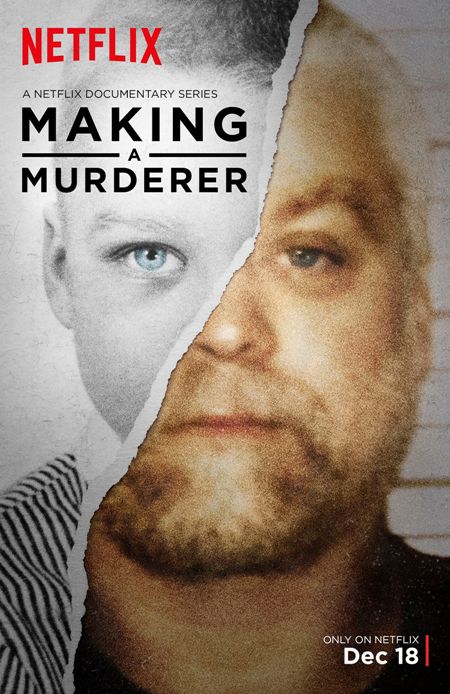
2015 was a good year for long-form documentaries about criminal justice, from the smashing success of the Serial podcast to HBO’s crime solving (?) The Jinx. But the cream of the crop has to be the Netflix series Making a Murderer. That’s partly because it’s infinitely bingeable, where the others weren’t, but that’s also because it’s got a hell of a story to tell

The story, writ broadly (it’s over 10 hours long, after all) is this – In 1985 Steven Avery is convicted of attempted rape in Manitowoc, Wisconsin. He maintained his innocence and, 18 years later, DNA proved him right (while identifying the real culprit to boot). Released from prison, Avery became a shining star in the exoneration world, a poster boy for needed reforms of the criminal justice system. Then, just when changes were about to be made, he was charged and convicted of an even more heinous crime – murder. As in 1985, Avery maintains his innocence, but so far, hasn’t been able to prove it.

But wait, there’s more. There’s a back story involving Avery’s relationship with the Manitowoc County Sheriff’s Office. It was responsible for putting him away in 1985, ignoring evidence pointing to the real perpetrator in the process. It ignored signs in the mid 1990s that suggested Avery was innocent. And, most important, the office and several of its officers were being deposed as part of a lawsuit about Avery’s conviction at the time the murder victim, Teresa Halbach, went missing.

Thus, rather than telling a story about how a man who was wrongly imprisoned for two decades might have been turned into a killer, the film makers (with a generous assist from Avery’s lawyers) instead tell a tale of a man who wrongfully convicted twice. The first time, via more negligence than malice, but the second time by a deliberate frame up.

There’s also the story of Brendan Dassey, Avery’s slow-witted teenage cousin, who was also convicted of participating in Halbach’s murder. The entire case against Dassey consisted of a “confession” given by Dassey that’s almost a paradigmatic example of how skilled interrogators can get the answers they want, regardless of how truthful they really are. The overriding sense at the end of things is that Brendan, at the very least, had nothing to do with the murder.

I’m not sure they can make the case that Avery was framed. But what the Making a Murderer does is to highlight a lot of troubling issues in the criminal justice system. They’re not things that are new to those of us who work there every day, but they’ll shock some lay people. At least I hope they do.

The first thing that pops up is investigative and prosecutorial tunnel vision. That is, once cops know they have the “right guy,” they focus entirely on convicting him, regardless of evidence that might point to another suspect. Case closed, stat achieved! That’s most obvious in those in the system who, even after DNA cleared Avery, refused to concede they’d gotten the wrong man. This is fairly common in exoneration cases. People are so wedded to the position that they were right that they can’t accept they were wrong. Confirmation bias can be a real monkey on one’s back.

Next there’s the way that the prosecutorial apparatus protects itself from accusations of wrongdoing. To its credit, the Wisconsin AG’s office did an investigation of Avery’s 1985 case after his exoneration. The investigators who were deposed in Avery’s civil case said some pretty damaging things, mostly about the kind of tunnel vision I mentioned above. The final report, however, was a whitewash, which is par for the course. Misbehaving prosecutors are rarely punished, or even called out by name when courts find they’ve misbehaved.

Brendan’s story combines two current tropes of criminal defense, a coerced confession and horrific defense lawyering. We see some of Brendan’s taped interview with police, but we also hear lots of phone calls with his mother while he was in jail. The upshot of all this is that he had no idea what he was doing, was trying to please the officers, and almost certainly didn’t have the role in the murder he ascribed to himself (if he had any at all). Again, this isn’t unusual – while all cases of DNA exoneration have a false confession rate somewhere around 20 percent, for juveniles that goes up to over 40 percent. Let that sink in for a moment – in almost half of juvenile exoneration cases, the juvenile confessed to a crime he didn’t commit.

What’s worse in Brendan’s case is that one of the his false confessions was obtained by his defense team! His second appointed lawyer declared his client guilty before he even met him and apparently was trying to make him the best guilty pleader and cooperator he could. That backfired, spectacularly, giving the prosecution extra ammunition to use against him at trial. You’ve heard of lawyers who are asleep during their client’s case? Maybe, sometimes, that’s the lesser of two evils.

Of course, to hear the prosecution tell it, there is no such thing as a “false” confession. During the closing argument in Brendan’s case the prosecutor told the jury that “innocent people don’t confess to crimes they didn’t commit.” As the numbers laid out above show, that’s clearly false. While a lay person might be forgiven for thinking that, a lawyer in the 21st century shouldn’t. If the prosecutor wasn’t outright lying, he was so out of touch with current research on false confessions that he should have his license pulled.

Avery’s trial had a whopper from the prosecutor in closing argument, too, in the form of the declaration that “the presumption of innocence applies to the innocent.” That’s wrong on a couple of levels. Theoretically, of course, everyone – innocent, guilty, and in between – is entitled to a presumption of innocence. It’s the prosecution’s job to rebut that. If it can’t, the defendant goes free – regardless of whether, factually, he’s guilty or not.

But he’s also wrong practically, for a very different reason. That’s because, practically (in my experience), there is no presumption of innocence. It’s a myth people buy into to make themselves feel better about how the world works, like Santa Claus or God. In truth, lots of people think if you’re charged with something, you must be guilty of something. Judges can instruct jurors otherwise, but it’s a hard bias to crack.

Speaking of bias, I certainly have one that I bring to Making a Murderer. Being a criminal defense lawyer for 16-plus years will do that. And make no mistake, the filmmakers have a viewpoint and are making an argument. This is not an even, balanced, tell all sides documentary. It’s a polemic, meant to stir passions. Whether it succeeds in convincing that Avery is the unluckiest man on the planet, being wrongfully convicted for two separate crimes, is unclear. But if it riles people up enough to pay attention to the issues the case raises, that’s good enough for me.

MakingaMurderer

Weekly Read: Darkness at Noon

An awful lot has been written about Darkness At Noon, Arthur Koestler’s searing portrayal of a Communist revolutionary brought down by the inevitable logic of his own ideology. Hell, this review in the New York Times when it initially came out in 1941 sums things up pretty well. It’s fascinating, thoughtful, and ultimately tragic. On that most people agree, so I’m not going to waste time going on about its strengths here.

I’m more interested on a couple of things that popped into my head while reading it about Rubashov, the doomed protagonist. The TLDR version of the plot is that Rubashov was one of the leaders of the Russian Revolution (the country isn’t specifically named, but it’s identity is hardly concealed) who, during the pre-World War II purges by Stalin was caught up in the machine he helped create. It’s not much of a spoiler to say that it costs Rubashov his life, as it did Nikolai Bukharin and the other Old Bolsheviks upon whom the character is based.

Rubashov spends the entire book in prison, although we learn about his earlier life through flashbacks. What we see is someone who is an experienced, if not practiced, prisoner. He knows to calmly pace around his cell as a means of exercise and as a way to keep his mind clear. He has no problem using code to talk with the prisoners on either side of him through the walls of their cells. More than anything else, he doesn’t freak out.

In fact, that’s what is most interesting about Rubashov as a character. The typical person thrown in prison by a tyrannical state, mentally tortured, and force to confess to ridiculous crimes is a fighter, a person in constant resistance. We see how he spits in the face of authority, struggles to retain any control over his life that he can. In other words, he goes down fighting. Rubashov doesn’t do any of that. It would be wrong to say he accepts his fate. He does spend most of the book trying to talk his way out of execution, after all. But he does it with the knowledge that it will most likely be futile.

The futility is due to the system itself, in which he played a major role. Not only was he an early loyal fighter for the Revolution, he was a philosopher of sorts, particularly good at spreading the message to others. But when you’re fighting for the Revolution, everything gets viewed through the prism of whether it’s revolutionary or anti-revolutionary. Not only is there no middle ground, there are no topics that are immune from its grip. To paraphrase Christopher Hitchens, ideology poisons everything.

That’s best exemplified by a fellow prisoner, Bogrov, who was convinced that the nation should build fewer, bigger submarines (with a better range), as opposed to building more, but smaller, submarines. As Rubashov’s interrogator explains, both positions were valid from an engineering and economic point of view, but they had radically different impacts on Revolutionary theory. Larger submarines with more offensive capability meant prioritizing a global Revolution, while the smaller and more numerous submarines signaled self defense and strengthening the Revolution at home. Number 1 (Stalin) favored the later course, so poor Bogrov was branded counter revolutionary and dealt with in the only way such things can be dealt with – “liquidation.”

What’s amazing is how much this part of Darkness At Noon still resonates today. In modern American politics there are very few issues where there is a reasonable middle ground, at least when it comes to pundits and shouting on social media platforms. The other side isn’t just loyal opposition, it’s the enemy. Their policies aren’t just wrong, their evil, immoral, and (in the terms of the novel) anti-revolutionary. Regardless if you’re on the left or right, you think you’re the revolutionary one, of course. Not only does such simple minded mudslinging make it difficult for anything of importance to be done, it leads to reductive thinking about the other side. If they’re evil, if they’re immoral, if they’re leading the nation to ruin, then liquidation really isn’t that farfetched as a solution is it?

That’s why I’m a little disappointed to see some readers (in Goodreads commentary and whatnot) dismiss Darkness At Noon as a product of its time, an interesting historical curiosity, but not much more. While it’s true that the specific ideology on offer in the book is largely a thing of the past, the risk of what unchecked loyalty to an abstract ideology can become is very much a lesson that transcends the specifics of the Russian Revolution. Ideologues become obsessed with purity, an obsession that will inevitably turn on fellow ideologues once the people who everybody agrees are impure are purged at the beginning. Nobody is ever pure enough.

The snake will always eat its tail, unless its tempered by some contrary vision and some humanity. That’s a lesson worth learning, regardless of the specifics of how it’s taught.

1995darknessnoon-cover-400

Weekly Watch: The Force Awakens

I’m a sci-fi/fantasy geek writer – you thought I was going to pass this one up?

Unless you’ve been under a rock for the past two years, you know that last week brought the rebirth of the Star Wars franchise with The Force Awakens, the biggest movie event in – well, in ever, I think (I’ve never stood in line for a movie in my 42 years, much less for a mid afternoon Saturday matinee). This was the first of a new trilogy, the first since Disney bought the franchise, and the first to be made without the input of George Lucas. Could it bear the weight fandom has put upon it?

Short answer – very much yes.

Longer answer . . . well, read on (trying to be as non-spoilery as possible).

The good news is that the scripted, penned by (among others) West Virginia native and Empire Strikes Back scribe Lawrence Kasdan is strong where it counts most, which is in the actual interaction of people (well, “beings,” I guess) on screen. Not only are the characters, be they new or old, given interesting things to say and do, but J.J. Abrams manages to do something that Lucas has lost all talent for – getting good performances out of actors. You care about what happens to the people on screen, which goes an awful long way.

The effects, as promised, harken back to the first trilogy rather than the “throw all the CGI things on screen!” approach of the prequels. In fact, it’s quite fun to see the sleek, modern interior of the First Order TIE fighters contrasted with the decidedly retro (dare I say analog?) controls of the Millennium Falcon. When there are battles (and there are!), they’re refreshingly gritty and small enough that we can keep track of what’s going on (there’s one scene in particular where the camera keeps ground action in frame while tracking what a particular pilot’s doing in the air – great stuff).

As for the overall story, it’s a bit of a letdown. If you’re a fan of the series – hell, even if you’ve only seen Star Wars itself, it will seem awfully familiar. It’s not a carbon copy, which is best seen in the contrast between the two characters who begin things on a backwater desert planet, Luke and Rey. Luke wants nothing more than to get his ass off Tatooine in the beginning of Star Wars. Rey, on the other hand, wants nothing more to hang around on Jakku. But the beats are largely the same and as things wind to the big finale, the voice of Peter Griffin might pop into your head.

That’s not entirely a bad thing. The big ask of The Force Awakens was to wash the stench out of our mouths from the prequels, as well as set up two more movies (at least). It succeeds in that, partly by reassuring fans that it’s going back to its roots, that everything’s in good hands. It’s not the greatest movie ever made. It’s not the best Star Wars movie ever made. But it’s damned good and makes me look forward to whatever comes next.

Merry Xmas, everybody – Star Wars is back!

star-wars-force-awakens-official-poster

Weekly Read: Calculating God

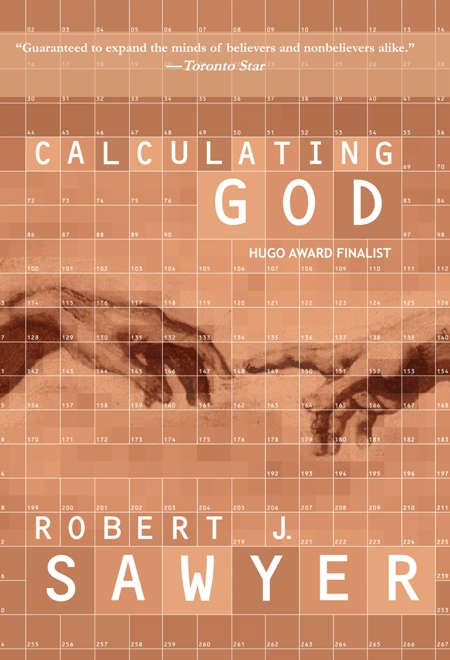
It’s a hell of an opening for a book. A six-legged alien lands on earth. He doesn’t land in Washington, DC in front of the White House. No, he lands in Toronto in front of a museum. And he doesn’t ask the nearest passerby to “take me to you your leader,” he goes to the front desk and inquires of the security guard if he might speak to a paleontologist.

So begins Calculating God, Robert Sawyer’s twist of one of the most beloved tropes in science fiction.

That trope is the alien who comes to earth to share the advanced knowledge of his species with humanity, often for good, though sometimes for ill. Think Klatuu from The Day the Earth Stood Still or the Overlords of Arthur C. Clark’s (and SyFy’s!) Childhood’s End. Hollus, the alien in question for Sawyer does the same, but with a twist – she’s come to share the Good News.

Well, not quite. But she’s looking for God. Actually, she’s a believer, certain that there was an intelligent designer. Her cancer-riddled human counterpart, Tom Jerrico, is not. Thus the usual frame of received wisdom from aliens is flipped. Thus ensues a lot of talking, of the vaguely scientific and philosophical variety, about the possibility of an intelligently designed universe.

To be certain, this is not a serious exploration of the issue. That’s because Sawyer stacks the deck, adding in a few additional “facts” known to the aliens but not us that pushes well beyond the basis for modern intelligence design or “Goldilocks” theorists. Rhetorically it’s a cheat, but dramatically it’s quite interesting. Tom, after all, is a man of science as well as an atheist and skeptic. If anyone should be open to new evidence about a feature like the existence of God, it would be him (contrary to popular belief, most of we atheists don’t claim to know for certain God doesn’t exist, just that we haven’t seen proof of his/her existence). Given that, it’s silly for people to get upset about the arguments presented and Tom’s eventual “conversion,” given that, to paraphrase MST3K (talk about resurrections!), it’s just a book and folks should really just relax.

In this sense, Sawyer’s book hasn’t aged well. In 2000, when the book came out, it might have been possible to give the benefit of the doubt to those arguing “intelligent design.” However, just five years later in a landmark court decision, it was revealed that intelligent design purveyors are simply religious folks trying repackage creationism into a “science” they can shove into public schools. The hilarious find and replace evidence in that case speaks for itself.

Not that those people are interested in the same kind of designer as the aliens Sawyer constructs. Their designer is just another advanced alien intelligence, one so far ahead of the rest of us as to appear magical (kind of like the Vorlons from Babylon 5, now that I think of it). The aliens aren’t interested in saving souls, condemning sinners to hellfire, or purging heretical ideas. That the book ignores that this is true for so long is one of its primary faults.

But far from its only one.

For one thing, the book is awfully talky. Which makes sense, as the main interest is in Hollus learning about Earth’s history and how that plays into her theories about a created universe. But it can be kind of dull and doesn’t have any real tension to it. In addition, Tom is a pretty bad foil for Hollus (he turns Occam’s Razor from a guidepost into dogma) – more stacking of the deck. For most of the book the only breaks are Tom’s maudlin asides about his cancer, which don’t add much to things.

Sawyer does something about this in the last third of the book, but in incredibly ham-handed fashion. He introduces to Arkansas Christian terrorists – one is even named Cooter (the other is JD – thanks Robert!) – who bomb abortion clinics and, eventually, shoot up a bunch of priceless fossils at the museum. Putting to one side how these rednecks ex machina manage to get into Canada after first blowing up a clinic in Buffalo (but, remember, this was before 9/11), their stories end when they’re both killed at the museum, so they come and go so quickly and without any real impact that you’re left wondering just what the point was.

The second attempt at action fares better, but makes you wonder why it hadn’t come earlier. A celestial event that should destroy life on Earth (and the other alien worlds) is blocked, literally, by the hand of God, leading the aliens to pick up and head to that part of space. Naturally, cancer-ridden Tom comes with them – who wants to spend your last days with your loving prop family, anyway? What plays out frantically in the last bit of the book might have been interesting with some more room to breathe, but it’s so rushed that you just don’t care.

The jaunt to the stars also highlights how the alien technology conveniently moves at the speed of plot. Yes, they’re advanced enough to travel at near light speeds from star to star. No, sorry Tom, they’re not any more advanced than late 20th century Canada when it comes to treating cancer – not only do they not have a cure, they don’t even have a better way of treating it. But, good news! In spite of the fact that you’re lurching toward your death bed, they can put you in suspended animation (twice!) for the space trip! It just doesn’t make much sense.

All this makes the book sound worse than it is. It’s a fairly quick read, has a fun premise, and raises a couple of interesting ideas. It could have been a lot more engaging and epic, however.

CalculatingGod

Weekly Watch: American Sniper

I’ve said, for a long time, that all art is subjective. Beyond the fact that art impacts different people in different ways, that’s because different people bring different perspectives and experiences to art in the first place. Two people looking at the same artistic work (or reading it or listening to it) can come to very different opinions about it based on the individual lens through which they’re doing the viewing. In that sense, art can become a Rorschach test, saying more about the person reacting to it than the art itself. A good recent example of that was American Sniper.

It’s a fictionalized account of the life of Chris Kyle, credited as the most prolific sniper in American military history. He racked up that total during the Iraq war. Ironically, given that he made his reputation with a gun, Kyle’s life was ended by another veteran at a shooting range in 2013. I have no doubt that the perceptions and values I brought to the movie colored the way I saw it.

It’s an interesting, if muddled, film. After a quick flashback intro, it alternates between harrowing battle scenes based in Iraq (the last one, which involves an all engulfing sandstorm, is really impressive) and home front scenes in Texas that shows how much impact the experiences are having on Kyle. The problem is that it never commits to either venue. It’s neither an all out war movie, nor is it a deep examination of the problems faced when vets come home.

Nowhere is that more obvious than in the way it glosses over Kyle’s life once he left Iraq behind. I don’t mean his death – that’s not shown on screen. I mean his transformation from brooding, seriously messed up soldier to a loving father and husband who was putting his experiences to use helping other veterans. All that’s covered with such brevity that it might as well have been a musical montage.

As I said, American Sniper turned into a kind of Rorschach test, with reviews saying more about the person talking about it than the film itself. That was true whether it was a professional pundit or some random person popping up on the Internet.

On the pundit side, check out Matt Taibbi’s review. I like Taibbi and agree with him on a lot of things, but I have to wonder if he actually watched the moving before writing that. It’s much more about what it isn’t – a catalog of the sins of the Bush administration and the Iraq War – than what it is. Instead, it’s very personal story about one man in the middle of something bigger. In fact, the plot makes it a mano y mano battle between Kyle and his Iraqi counterpart suggesting (as the recent Sicario did for the drug war) that everything, even war, in the end, is personal.

If liberal pundits were quick to slam the film for its perceived politics, conservatives were quick to praise it for the same reasons – because they found their politics positively reflected in it. Personally, if I thought American Sniper was validation of my politics, I would be very frightened. But I come to it with my own baggage, right?

See what I mean about a Rorschach test?

And it goes beyond politics. Take, for instance, this discussion in IMDB about how Eastwood ruined a perfectly good “war movie” by having scenes with a “whining wife” in them. Ignoring the fact that Eastwood wasn’t interested in making a “war movie” or that movies with scenes of warfare in them can be about more than killing bad guys.

American Sniper isn’t unique in this, although the effect is amplified because it deals with recent history, politics, and overseas adventures that are still causing us all kinds of problems. It might have cut across that divide with a little more commitment to being one thing or the other.

american-sniper-poster