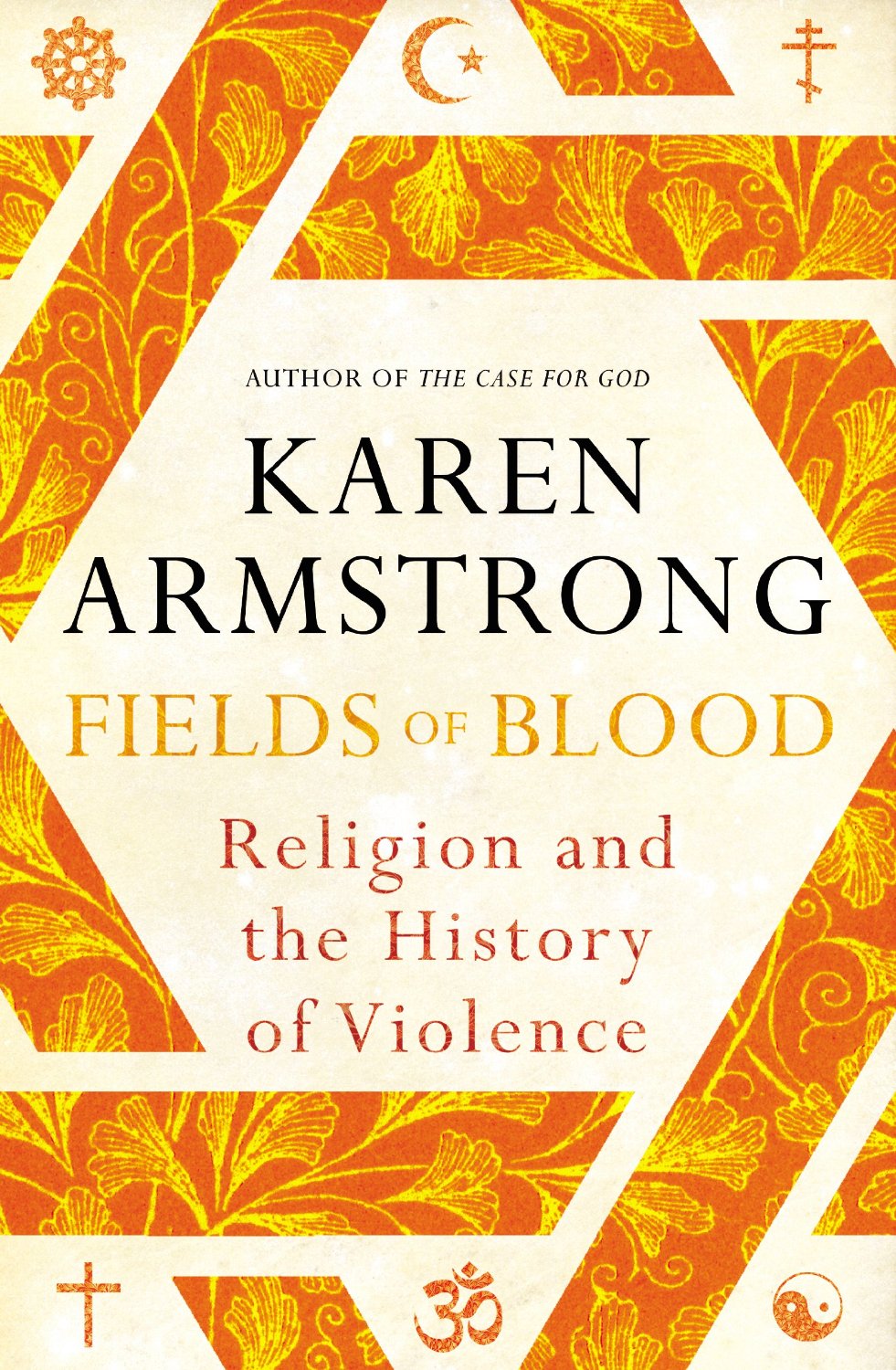
Weekly Read: Fields of Blood

I spent most of my time reading Fields of Blood, Karen Armstrong’s epic history of violence and religion, waiting for the other shoe to drop. Just what was Armstrong’s end game? She leads off repeating the straw man argument that religion is responsible for all wars on the planet (an argument she places on the lips of anonymous folks rather than actually quoting one). But surely, if that’s all she was up to, it wouldn’t take more than 500 pages and 5000 years of human history to debunk. That would be rhetorical overkill.

A secondary argument to counter – one I’ve actually seen in the wild, at least – appears in the afterword, identified by Armstrong as the idea that religion is responsible for more death than any other cause. It’s another pretty easily rebutted argument, but one that, curiously, Armstrong can’t defeat, due to the way she frames the entire book.

The frame, essentially, involves two foundations. First, civilization – not just modern civilization, but all civilization – is inherently violent. Coercive violence is inherent in civilization and its development because without the ability to take other people’s stuff no upper classes will ever develop that will then have time to do things like invent stuff, ponder the great questions, and write large tomes about the history of religion. Second, until a few hundred years ago (in Europe – other places caught up later) religion was intrinsically linked with the rest of life, including politics. The idea of “religion” as a separate thing just didn’t exist.

As a result of all this (and we’ll assume, for our purposes, that her foundations are accurate), we can’t single out “religion” as the cause of any nasty things because it’s just part of a society as a whole that’s doing them. Religion, Armstrong argues, is an attempt by humans to give meaning to their lives, including the horrible violent things they do. Sometimes, it might even reign in our worst impulses. Having said that, she admits near the end that those attempts usually fail.

The upshot of all this is that not just religion in general, but specific religions, are made up of various strains that are at odds with one another, even if they arise from the same holy text. Armstrong does a good job at showing how particular religions throughout history morph from one form to another in order to keep up with prevailing times.

One particular example comes from Judaism, in which the Talmudic stories of King David and the conquest of Palestine – written at a time when such conquering was going on and needed justification – were retconned by future rabbis after the Romans brutally put down a Jewish revolt and destroyed the temple in Jerusalem. In other words, presented with evidence that a more martial glaze on the old stories wasn’t working, they changed their meaning into one of metaphorical struggle of an oppressed people.

Now, here’s the thing – that’s actually good. People who change their minds when new evidence comes to light are rational, thoughtful, and should be applauded. But they weren’t just revising a political philosophy, they were recasting stories of an allegedly divine origin. This is something Armstrong never deals with that distinguishes religion from other schools of thought. Religious texts are (mostly) based on the idea that they are pipelines to a higher truth. If that’s true, they shouldn’t be so malleable in human hands. Otherwise, what’s the point?

Having said that, it’s hard to disagree with Armstrong, so far as her basic thesis goes. As an atheist, I certainly agree that religion is a human construct, not the product of revelation or supernatural spiritual insight. It’s a messy contradictory thing precisely because it’s rooted in humanity. But I’m not sure what that gets her, since she appears to be trying defend religion from unfair criticism.

Armstrong can’t win the second argument noted above with this conception of religion. If it has been, for millennia, an integral part of society, so much so that people didn’t have a separate concept of it, then it’s as responsible for past violence as society as a whole. So what is Armstrong’s goal in doing all this?

It winds up being a gargantuan No True Scotsman fallacy, in which Armstrong suggests that people who claim religious motivations for violent acts are, in essence, bad a religion. This is most clearly evident in her discussion of Al Qaeda and the September 11 attacks.

After a lengthy examination of how a lot of modern Islamic fundamentalism is a response to ham-handed colonial policies (on that theme I think she’s right), Armstrong notes how many of the 9/11 hijackers were fairly Westernized. Nor, she argues, were they particularly devout Muslims before becoming involved with Al Qaeda. This is not unusual, as she cites a study of more than 500 people involved in carrying out the attacks that shows only 25% fit the mold of holy warriors when they joined Al Qaeda.

However, she then struggles with the fact that, once a part of Al Qaeda, they did become holy warriors engaged in jihad, filled with tales of martyrdom. To her, the problem wasn’t religion itself, but not enough of it – had the hijackers really known what the Koran said, they would never have carried out the attacks. She specifically concedes that the hijackers themselves surely saw themselves as religiously motivated, but that’s only because they were bad at Islam. In Armstrong’s telling, religion never fails, it is only failed by the humans acting in its name.

Armstrong returns to this defense – “but the book says . . .” – over and over again, but it doesn’t do her any good. First, it presumes there is one correct way to read any holy text. As her own history extensively shows, different people read the same texts very differently. Second, it ignores the fact that actions matter more than words. In another example, she notes that a particular group of terrorists in the Middle East thought themselves bound by Islamic law to avoid violence against civilians. Nonetheless, she explains how they took civilians hostage, which is a violent act in anybody’s book. Actions, not words, are what counts.

Third, and most troubling for the entire book, is Armstrong wants to view religion’s role in violence as simply as the critics to which she is responding. If it’s not THE cause, she seems to argue, it is exonerated. She ignores (or breezes right past) the role religion can play in making killing of the other guy all right, even if the underlying cause isn’t religious. The American Civil War is an example of a war that was purely political, but both sides thought they were doing God’s work. Ever listened to the “Battle Hymn of the Republic”? It’s all about how righteous the Union cause was.

Another issue that pervades the book is Armstrong’s problems with actually deciding what “violence” is, as seen in her discussion of American fundamentalists. They, compared to their overseas counterparts, are not violent, Armstrong says, ignoring the various instances (Ku Klux Klan, Jim Crow, abortion-related murders and bombings, gay bashing, etc.) where they have been. But then she turns around and charts their rise partly to a reaction against “psychological violence,” which she defines as, essentially, modern secularists saying mean things about them. By stretching the term to meet an immediate rhetorical goal, it loses all relevance.

I think the biggest disappointment with Fields of Blood is that I actually agree with a lot of points Armstrong makes. She’s absolutely correct that the causes of conflict are numerous, complex, intersecting, and can’t be reduced to sound bite descriptions. Similarly, the irrationality that can be the hallmark of religion can be replaced with secular variants of irrationality, too, such as cults of personality or the aftermath of the French Revolution (not to mention the otters). Nor is she wrong that secular states – like the United States – have a record of violence that is nothing to be proud of.

In fact, I think Armstrong and I would agree a lot on what’s wrong in the world and how to fix it. On this issue, however, she’s just not able to get around the fact that some people do horrible things to other human beings (to quote Frank Zappa) “’cause they don’t go for what’s in the book / ‘n that makes ’em bad.” Until she confronts that, Armstrong has a massive blind spot that even a tome like Fields of Blood can’t fill.

Fields of Blood

On the Air! (After a Fashion)

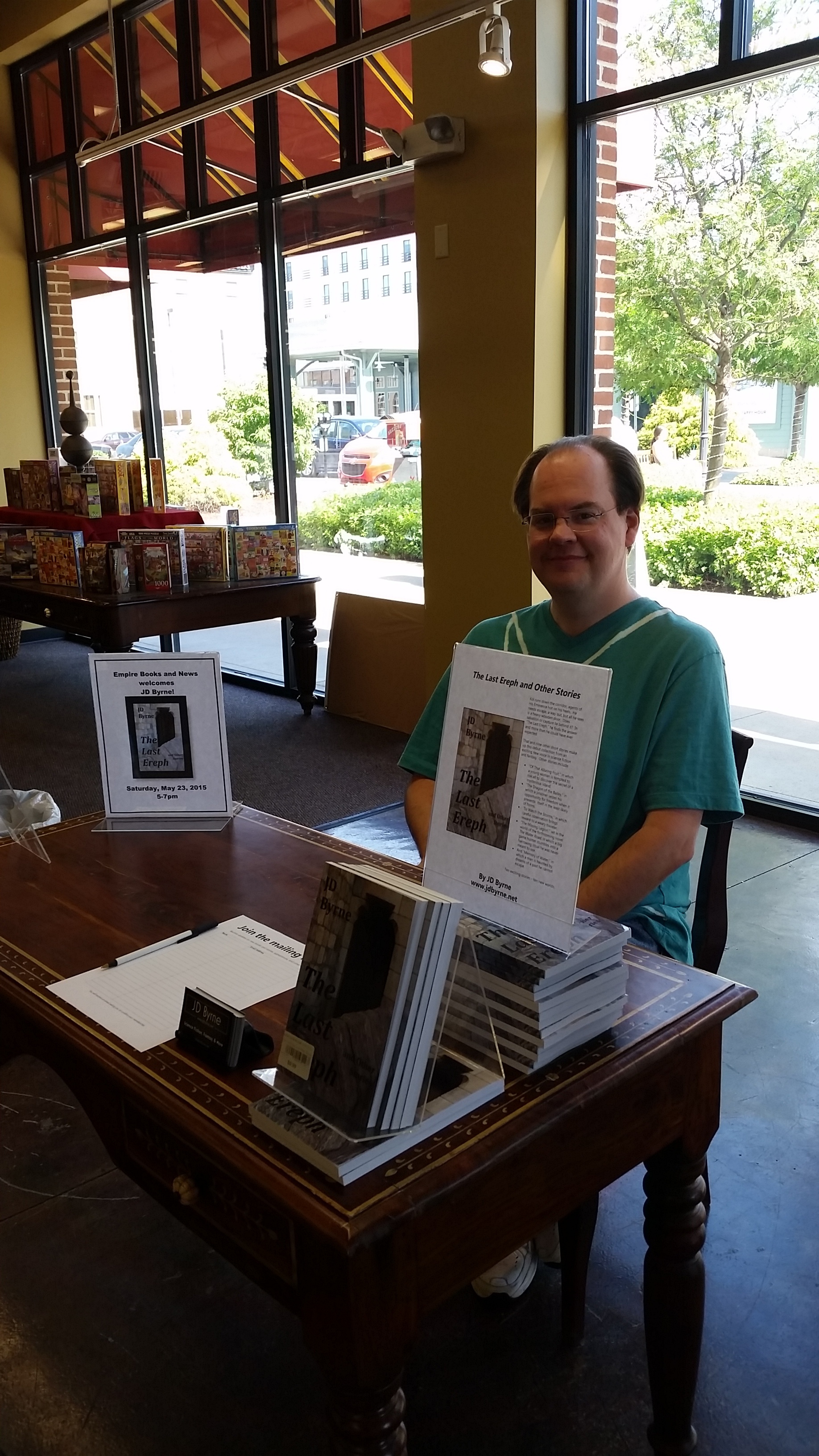
A few weeks ago I had the pleasure to sit down with writer Eric Douglas for his show Writer’s Block on web radio station Voices of Appalachia. We talked about writing, West Virginia, The Last Ereph and Other Stories, and what’s coming up down the road for me. I had a great time and I think it came out well.

The interview airs tonight at 7pm on VoA, after which it’ll be available in the show archive.

Come on over and check it out.  Here’s some appropriate tuneage to get you pumped.

UPDATE: You can now listen to the interview any time you like here.

Weekly Watch: Better Call Saul

Confession time – I have never seen minute one of Breaking Bad. Not out of any critical motive, mind you. It just slipped past me until it was one of those “catch up with it on Netflix” someday things. On the other hand, when the prequel/spinoff featuring Walter White’s trusted attorney, Saul Goodman, premiered, I was on top of it. Aside from the glowing early reviews it’s a lawyer show, which I have a hard time ignoring. Thankfully, the early reviews proved accurate.

“Better Call Saul,” as I understand it, was the tagline in the TV ads Saul Goodman used to drum up business in Breaking Bad. But as this series starts, there is no Saul Goodman (except in a brief flash forward), only Jimmy McGill, struggling lawyer. Jimmy has a con artist past (when he was known as Slippin’ Jimmy) and brother, Chuck, who’s a partner in a big law firm. However, Chuck is now confined to his home by a psychosomatic illness involving an aversion to electrical devices. Nonetheless, Chuck is who Jimmy aspires to be, although without the mental issues.

Thus the first season is basically the tale of Jimmy trying to find his legal niche. He as some connection to Chuck’s law firm, but it’s unclear what that was until several episodes in. On his own, Jimmy resorts to some old trick to drum up business (a staged rescue in which he’s the hero). It works, somewhat, and he stumbles into the field of elder law and even appears to genuinely care about his elderly clients.

But things go wrong when a big case falls into his lap. He enlists Chuck who, quite rightly, argues to bring in his old firm because they have the resources to handle it. Jimmy agrees, assuming that this is his ticket into the firm legitimately – as a rainmaker. Only he learns that not only will he not be welcomed into the firm it’s because his brother has been blocking him at every turn.

This leads to the key scene of the season and the one most interesting to me as a lawyer. Chuck, basically stands up for the standards of the profession. Jimmy, who got his degree from an off shore diploma mill and has a criminal past, doesn’t make the cut. Law is a sacred trust, Chuck argues, ones that doesn’t have any place in it for people like Jimmy. Lawyers bear a particular responsibility, not just to their clients, but to society at large. Being a lawyer, as Chuck tells it, is just as we real world lawyers want it to be.

But the joke’s on us, because for the rest of the population, we look an awfully lot more like Jimmy. It’s perhaps no surprise that when Jimmy becomes Saul he manages to drop in social standing, from not-quite-reformed con man to criminal defense attorney. After all, what kind of person defends murdering drug dealers for a living? At least that’s what people think (and sometimes tell you!).

By the end of the season, Jimmy’s had one more chance at being “respectable” and turns it down. Does it mean that he’s completely turned the corner into the criminal shyster he becomes in Breaking Bad (so I’m told)? Who knows. Maybe he just decided that his idea of respectable and Chuck’s are far apart and the legal profession has room for the both.

BCS_Press_Release_Digi_2_Sheet_-_PREFERRED_FILE_SIZE-720x551

If You’re Worried About Rosebud, You’re Missing the Point

It’s his sled. It was his sled from when he was a kid. There, I just saved you two long boobless hours.

Peter Griffin, spoiling Citizen Kane

Saw Gone Girl last weekend.  It’s really good, particularly if you like the kind of movie that takes place in an air of dread that’s perfectly summoned by David Fincher (with able assists from Trent Reznor and Atticus Ross).  I say that even knowing the big twist of the film going into it.  Not because I had read the book on which it’s based, but because my wife blurted it out during a TV commercial. She didn’t know I wanted to see it.

Point is, she didn’t really “spoil” the movie for me, in the true sense of the word.  That’s because the flick is good enough that it doesn’t rise or fall on the big “twist” (which, for what it’s worth, happens about halfway through – this isn’t The Sixth Sense we’re talking about).  In my opinion, any movie/book/TV show that rises and falls on that twist isn’t really worth watching.

What’s more, people seem to enjoy things more once they know how it turns out.  At least that’s what some research says.

Back in 2011, as The Atlantic reports, a study was published that sounds pretty neat:

Scientists asked 900 college students from the University of California, San Diego, to read mysteries and other short stories by writers like John Updike, Roald Dahl, Agatha Christie, and Raymond Carver. Each student got three stories, some with “spoiler paragraphs” revealing the twist, and some without any spoilers. Finally, the students rated their stories on a 10-point scale.

The results?  Readers preferred the spoiled stories.  But why would we want to know how it ends ahead of time?

One theory is that our anticipation of surprises actually takes away from our appreciation for the 99 percent of the movie that isn’t a monster twist. ‘The second viewing is always more satisfying than the first,’ Sternbergh said, ‘because you notice all the things you missed while you were busy waiting for the twist.’ Psychologists have observed that when we consume movies and songs for a second (or third, or hundredth time), the stories become easier to process, and we associate this ease of processing with aesthetic pleasure.

Think about this for a second.  Most of us have some piece of culture that we go back to again and again.  I know that the big escape at the end of Brazil takes place all inside Sam’s head, but I still watch it.  I know that Arthur and Ford wind up on a primitive Earth populated by a bunch of idiots expelled from a better planet, but I’ll still consume Hitchhiker’s Guide . . . again (in its many forms).  And I know Tommy goes back to being blind, deaf, and dumb at the end, but that doesn’t make “Pinball Wizard” kick any less ass.

Of course, there might be other reasons why spoilers really aren’t, including the uncomfortable recognition that we really like predictability more than we let on.  But, in this area at least, I’d like to not be completely cynical and think that, deep down, we realize that works built on the big twist only are, as someone else put it in the Atlantic piece:

like artistic flash paper: It excites for a moment but offers little lasting wonder.

After all, we want to be better than Peter Griffin.  Right?

Note: This piece was originally posted on my old blog on October 20, 2014.

Weekly Read: Sex Criminals

I’m not a big fan of “high concept” art, the kind of thing that can be pitched in a single, mind blowing sentence.  In my experience, the quality of the execution rarely matches the quality of the pitch.  There are exceptions, however.  How about this for a one sentence pitch: “Two people meet who literally stop time when they have sex.” Kudos to whichever of Matt Fraction or Chip Zdarsky came up with that idea.  More kudos for pulling executing that idea in a way that makes it funnier, and more thoughtful, then it probably has a right to be.

Sex Criminals is not a comic book about purveyors of kiddy porn, flashers, or the skeevy guys who lure kids into their vans with the promise of candy.  It’s a love story, really, about two people who share a very uncommon trait – when they have an orgasm, time stops.  Literally and completely.  They’re able to walk around in this stuck time – in a wonderful encapsulation of their personalities Suzie refers to it as “The Quiet,” while Jon calls it “Cumworld” (and uses the time to take a shit in his boss’s potted plant).  So they start exploring together when they hook up.

The first volume of Sex Criminals (One Weird Trick, collecting issues 1-5) is really funny, visually inventive, and unlike anything you’ve seen before. It ends with the arrival of a trio of self-appointed sex police who patrol The Quiet.*  The second volume (issues 6-10, dubbed Two Worlds, One Cop) expands the cast of characters and dives into some heavier relationship and personal issues, all the while exploring just what The Quiet is and who the cops are.

I admire Fraction and Zdarsky for taking that route.  Honestly, after the first volume their only other choice was to crank up the outrageousness and silliness of the whole thing, which probably would have spun out of control.  Making the whole thing more “real” (although that’s probably not the right word to use) sets things up better for a long term run.  It does mean, however, that the second volume isn’t quite as fun as the first, as the first blushing excitement of discovery is gone, for the reader as well as Jon and Suzie.

Nevertheless, they continue to tell their tale with style and wit, not to mention an astonishing frankness that you wouldn’t expect in a comic book.  Yeah, it’s smutty and explicit, but it’s fun and thoughtful and deeper that people might otherwise expect. Unless you’re a complete prude, it’s worth delving into Sex Criminals. Step into The Quiet.

* What, you think just because Jon and I share a first name I’m going to sling “Cumworld” all over the Internet? My parents read this!

sex-criminals-vol-01-releases

sexcriminals_tp_02

Giveaway Update

As mentioned in my interview with Eleanor, I’m currently running two giveaways where you can win a free copy of The Last Ereph and Other Stories.

For paperbacks, head on over to Goodreads to enter.  There will be two winners there and each will receive an autographed copy of the book.  It only runs until Monday (March 30) so hurry on over!

For eBooks, head on over to Librarything to enter.  More copies available there although, alas, I can’t autograph an electronic file.  Sorry, folks.  This one runs until next Monday (April 6).

Weekly Listen: Hand. Cannot. Erase.

Without a doubt, Steven Wilson is the modern standard bearer for progressive rock.  Over the course of four solo albums since putting Porcupine Tree on hiatus, Wilson has reached a standard of success other proggers just dream of.  All right, he’s not Katy Perry, but his new album, Hand. Cannot. Erase., debut not just in the charts in Europe but near the top of several.  For a guy who’s spent the last few years channeling King Crimson, Yes, and a host of other terminally unfashionable bands (while remixing chunks of their back catalogs), that ain’t bad.

What’s more, Wilson’s done by producing four albums that are distinct from each other but still sound clearly like him.  Where The Raven That Refused to Sing (and Other Stories) fully embraced its 1970s proggy roots, Hand. Cannot. Erase. casts a wider net, harkening back not only to some of the more tuneful bits of Porcupine Tree (think Stupid Dream or Lightbulb Sun) but also other Wilson projects like Blackfield or even No-Man.  As a result, the album is more accessible, but no less interesting.  Each track, whether it’s an acoustic vocal piece or a frenzied prog workout, is deftly constructed and performed.

The performance comes largely from the band assembled to tour Grace for Drowning (and which made The Raven . . .), with some interesting additions, including a choir and some effective strings (arranged by the ever talented Dave Stewart).  Wilson does a lot of work himself, but he leaves the spotlight stuff to others, particularly guitarist Guthrie Govan, who has his usual shreddy self reigned in somewhat, to great effect.  There’s even a piece that’s basically spoken word, although I think it’s probably the weakest effort here.

Hand. Cannot. Erase. is a concept album, inspired by the story of Joyce Carol Vincent – a woman who died in her apartment and wasn’t found for three years.  She reportedly wasn’t a loner or recluse, had friends and family.  Wilson was drawn to the story by wondering how she got there.  As a result, this is kind of like Wilson’s run at Brave, the Marillion album inspired by a BBC report about a uncommunicative girl wandering on the Severn Bridge.  The album is Steve Hogarth’s attempt to figure out how the girl got there.

The comparison is inevitable and, unfortunately, Hand. Cannot. Erase. suffers for it.  Hogarth and company are expert at picking you up and wringing every bit of emotion out of you.  You feel for the girl in Brave, even if you never quite understand what went on in her head (there are also some broader swipes at the society in general that might have driven her there).  Wilson doesn’t work the same way, preferring a more detached observational approach.  He’s very Kubrickian in that way, which isn’t a bad thing (I loves me some Stanley), but it does make for a stark contrast.

All in all, Hand. Cannot. Erase. is another great effort from Wilson.  Highly recommended.

HCE-finalcover