Weekly Read: Wasp

Ready an older book can be tricky – and I’m not even talking about Chaucer or Voltaire here. On the one hand, a recognition of the fact that the book arose from a different time, a different social context, is necessary to give it a benefit of the doubt sometimes, to explain why it doesn’t quite fit with modern expectations. On the other hand, sometimes you can defer too much and paper over that a book just isn’t very good with the explanation that, at one time, people must have thought it was.

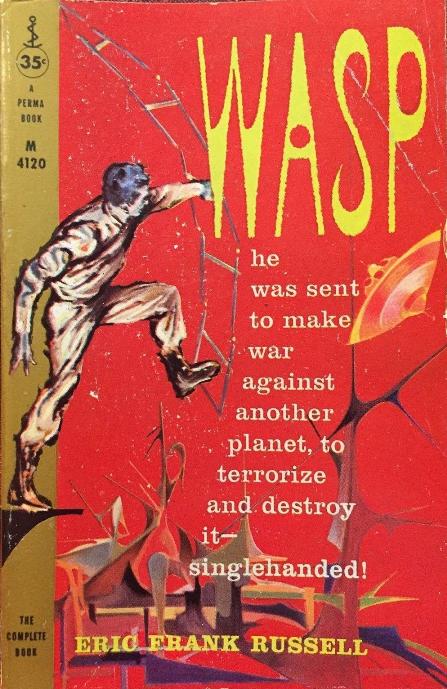
Wasp, which was first published in 1957, has a brilliant idea at its core – a single operative is dropped behind enemy lines with instructions to wreak havoc among the populace, drawing resources and attention away from the front lines. The analogy the title makes is to when a wasp gets into a car, freaks out the driver, and kills all on board in an accident. It could have easily been written as a Cold War thriller, a James Bond kind of thing, but one side in Wasp is on Earth and the other on Jaimec, near Sirius, and the war is an interstellar one.

The wasp in this case is James Mowry, who had the good fortune to have been born on the enemy planet and raised there until he was a teenager. As a result he gets drafted for this dangerous assignment (he’s not a career spy). After some montage-like training, he’s dumped on an outlying planet, given lots of resources, and let loose. He does precisely what he’s supposed to do, with the expected results.

Which is the biggest problem with Wasp, something that doesn’t really have anything to do with when it was written. Mowry is just too good at what he does, particularly considering his lack of espionage background. Yes, he gets into scrapes with the secret police, but there’s never really much danger. There’s no real antagonist, no dogged cop trying to hunt Mowry down that makes it seem like he’s really at risk.

Nothing goes wrong until almost the very end when his cache of goods is found and he’s effectively cut off from communicating with Earth (don’t whine about spoilers – did I mention 1957?). Had this happened in the middle of the book, throwing Mowry out of his comfort zone and forcing him to deal with some serious problems, it would have been a welcome twist. As it is, he survives what’s left of the book in quick fashion before he’s picked up (in an admittedly twisted coda) by Earth forces.

That wouldn’t be too problematic if there was something interesting going on inside Mowry. Given his background, one might think he would have some sympathy from the Sirians. In spite of their secret police, they don’t seem all that different from what we know of the Terrans (Mowry, after all, is impressed against his will and sent to indiscriminately blow up stuff – hardly noble) and surely Mowry made a friend while he was growing up? More immediate, he doesn’t forge any kind of connection with the people he uses in his scheme. Everybody is a pawn being moved around the board, even Mowry.

The lack of depth draws sharper focus to the anachronisms of the story. For one thing, there are no women involved. I don’t mean there are no notable female characters, I mean there are no women anywhere at all (As Jo Walton put it, “[t]his is an old fashioned book, written before women were invented.”). Par for the course in 1957, but glaringly unrealistic to modern eyes. For another, there isn’t any attempt to extrapolate future tech, aside from space travel and communications, such that Jaimec looks and sounds almost exactly like 1950s America. A typewriter features prominently at one point. With a better story and deeper, more interesting characters, it would be easy to overlook.

Lots of people make a lot of Mowry being a “terrorist.” No less a luminary than Terry Pratchet said of Wasp he “can’t imagine a funnier terrorists’ handbook.” Neil Gaiman, at one point, owned the film rights. He was working on a script when 9/11 happened and he abandoned it because audiences wouldn’t be ready for a movie where the terrorist is the good guy (although, given his lack of depth, he functions more as a psychopath than a good guy).

I’m not sure that’s an accurate characterization of Mowry and what he does. For one thing, he’s an agent of a state at war inflicting damage on the other state with which is at war (presumably openly declared). That’s straight up warfare, even if carried out in a slightly unconventional way. For another, most of Mowry’s targets are military or government related, even if there’s some collateral damage. Compared to carpet bombing, lacing the countryside with landmines, and atomic weapons, however, it’s damned precise. If Mowry had  brain in his head I’d think that perhaps the author was trying to make a larger point.

There’s something to be said for quick dumb fun. Wasp is certainly quick and, in spots, it’s kind of un in a subversive kind of way. But it’s pretty dumb and doesn’t think very highly of its characters. It’s intriguing central idea deserved a better execution.

Wasp-1959

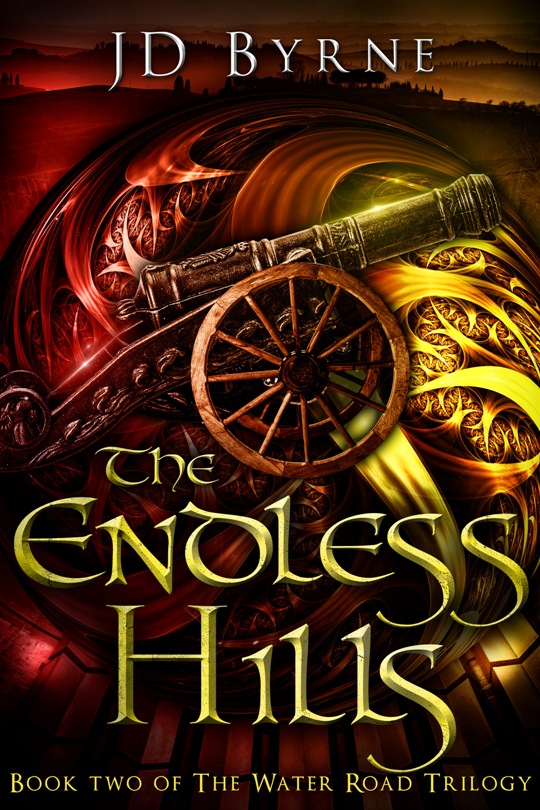
Water Road Wednesday: First Excerpt from The Endless Hills

For this initial dip into The Endless Hills, book two of The Water Road trilogy, I wanted to explore one of that book’s new characters a bit. Martoh is a crook, but he’s in the kind of prison he’s never been in before, the kind that’s landed him in the infirmary. Now, with a war on, there’s a chance for him to get out:

 A few seconds later a gentleman stepped behind the curtain as someone else held it for him. He carried small wooden stool in one hand and a black leather case in the other. His black suit was neat and fresh, implying he had some kind of official position. The fine grey dust from the stones out of which the prison had been built had yet to infest his clothing. “Martoh Isukar?” He put the stool down beside the bed.

“Who are you?” Martoh had long ago learned to be wary of men in clean suits.

“May I sit?”

“Help yourself.”

The man sat down and began pawing through his case. “It really was quite a journey to reach here, you know.”

“Why is that? And who are you?”

“I’m sorry.” The man sat up straight and pulled an official looking piece of paper from his case. “My name is Anea. I am from the Ministry of War.”

Martoh rolled his eyes. “Whatever it is they told you I did, you’ve got the wrong guy.”

Anea looked at him with a frozen expression that said he knew Martoh was the right man. “You are serving a term of life in prison, is that not correct, Martoh? May I call you that?”

Martoh gave silent consent.

“Due to your sentence, you will die behind these walls. Why would I have to think anything else about you?”

“I’m not a killer.”

“It says something very different here.” Anea held up a clutch of papers and began shuffling through them, for Martoh’s benefit, most likely. “It says here that you stole some small trinket from a shop, were caught in the act, and pursued by the shop keeper. As he gave chase in the street he tripped, fell, and upon landing broke his neck. Died instantly, sad to say.”

“My bad luck.”

“His bad luck, I would say. But the court has already decided this. You are guilty of causing death while in the commission of another offense. Same as if you put a blade in the poor man’s back. However, the circumstances of your crime did, at least, save your life.”

“Put me in this cage, you mean,” Martoh said. He tried not to get agitated as any movement caused a bolt of pain to rush through his body.

“Martoh, you have never lived a life in harmony with His Majesty’s law, have you?” Anea let the question be answered by silence. “Although I suspect you never thought it would take you this far.”

“Obviously. It’s one thing to get locked in here for shooting a man or stabbing him. It’s entirely different when you’re here because of a mark’s poor foot skills.”

Anea didn’t take issue with him.

“If you are not here to pin something else on me, why are you here?”

Anea grinned, ever so slightly. “I am here to give you a way out.”

Martoh turned away from him. “I’m in no mood for games.”

“This is no game, I assure you. I am here on behalf of the Ministry of War, looking for recruits. You do know that there is a war on?”

“I’ve heard. I’ve also heard that the Neldathi might have a right to be angry.”

Anea cleared his throat in a way that suggested he would take issue with that position. “I am not here to discuss politics. I am here only in search of recruits.”

“Conscripts, you mean,” Martoh said, turning back to face him. “Typical. Use prisoners to put down an uprising caused by your own damned fool policies.”

Anea sat for a few moments. “Is everyone that cynical in your world, Martoh?”

“In the world I came from, one steals because that’s the only way he has to feed himself or his family. In the world I live in now, any other random person might try to kill me, just to prove he can. Pardon me if I seem a bit cynical when a stranger comes preaching salvation.”

Anea heaved a deep sigh. “Cynical or no, Martoh, you are not a stupid man. If His Majesty was going to conscript prisoners to go fight the Neldathi, why would I be here?”

Martoh had to concede that, but he wouldn’t admit it. “So what’s the deal?”

“Deal? There is no deal,” he said in a way that made it clear such horse trading was beneath him. “There is only an opportunity to serve your King and defend your homeland from barbarian invasion.”

“In return for what? Look, you’ve given the game away admitting that there will be no conscriptions. I get to say no thanks and stay right here. So why shouldn’t I?

“Freedom.” Anea let the word hang in the air while he got another paper from his case. “If you agree to fight, you will be free.”

Remember, The Water Road is now available at Amazon as well as in the real world at Empire Books & News.

Water Road Wednesday: All Around the World

I don’t really have anything substantive to say about The Water Road trilogy this week. Not because I’ve run out of things to talk about – far from it! But because I’m buried deep right now trying to get copies of The Water Road to all the folks who participated in my LibraryThing giveaway.

It’s always cool to see where people who request the book are from and this batch is the most diverse I’ve ever had, with winners as close as Ohio and Kentucky and as far away as Tunisia and Malaysia! In fact, I think I’ve hit every one of the soccer confederations (much more important than continents) this time except for Oceania. Over the course of three books, I’ve had winners from 24 states and 9 other countries (10, if you separate out Scotland).

Speaking of next time – tune in next week for more Water Road Wednesday! Upcoming weeks will have some excerpts from the second book, The Endless Hills, as well as a cover reveal. See you then!

Until then, some appropriate Paul Simon:

On Not Finishing Books

Last week I did something about which I’m not proud. I created a new bookshelf in my Goodreads profile, one for “unfinished” books. And I put two books on it.

Generally, when I start something, I like to finish it. That’s particularly true of artistic things, which can sometimes change radically as they go along. When I get a new album I listen to is all the way through, several times, even if it’s not clicking with me. I want to give it a fair chance. I don’t think I’ve ever walked out on a movie, even while watching at home. It’s only a couple of hours, after all.

But books can be different. After all, they take more time and (in some cases) effort than albums or movies. That’s particularly true for me because I do a lot of my “reading” in the car, via audiobooks. It can take me weeks (if not a month) to get through a decent length novel. Given that, is it OK to bail on a book before I reach the end?

Maybe the better comparison is with TV shows. Most of them involve a considerably larger investment of time than a movie, if we’re talking about shows that go on for seasons. Given that, I don’t think I’ve ever felt bad deciding, after watching a couple of episodes, that a show’s not for me. After all, if two or three hours of (to pick a random example) Orange Is the New Black doesn’t really do much for me, why should I sit through 48 more hours of it?

But books are different, right? I’m a writer for fuck’s sake! Shouldn’t I be more dogged in my determination to finish a book I start? Shouldn’t I be willing to take one for the team, to do what I’d hope any reader would do with one of my books?

I don’t think so. It comes down to time, really. It’s not quite like this:

FinishBooks

But it’s close. The thing is, the books I’ve decided to give up on aren’t “bad.” I don’t (to borrow a phrase from an Absolute Write forum thread) throw them across the room with great force. I want to finish them, but my heart just isn’t in it. I read for pleasure, just like I write because I enjoy it. If it starts to feel like work, something’s wrong. I already work in my life without literature adding to the load.

That the books I don’t finish can’t be labeled as “bad” (if any art can ever be so labeled) is obvious just by looking at them.

The first, the one that prompted the shelf construction, is The Grace of Kings by Ken Liu.

Grace_of_Kings_cover

Liu is decorated with sci-fi and fantasy awards for his short fiction and he recently translated the Hugo-winning The Three Body Problem from Chinese, the first novel in a non-English language to win the award. Plus, he’s a lawyer and I always like reading books by lawyers who don’t write legal thrillers.

The Grace of Kings is Liu’s first novel at it’s a neat setup. It’s an epic fantasy with an Asian background, rather than European, complete with the steampunk touch of airships (Liu calls it “silkpunk”). It involved a ruthless empire and the unlikely heroes who bring it down and the aftermath of their revolution. Should be right up my alley, but it just didn’t work for me. The last straw was the interesting back story of a minor character that came across like a Wikipedia entry – all the facts, none of the drama of the story. Others love it, so I’m sure I’m missing out, but I thought it was time to move on.

The other book on that shelf really pains me, as it’s To Say Nothing of the Dog by Connie Willis.

nothingdog

I first experienced Willis’s world of Oxford historians who do field research via time travel in “Fire Watch,” which I thought was great. I moved on to Doomsday Book which I truly love. In both the entire process of time travel was dangerous and subject to cock ups that could put the traveler’s life in danger. It was, as the kids say, serious bizness.

To Say Nothing of the Dog is set in the same world and involves the same kind of travel. Except it’s a comedy and, in the part I read, makes hay with an historian using the machine to travel back in time to escape a particularly annoying donor to the college. It just seemed . . . wrong. It would be like if the first book in the Hitchhiker’s Guide to the Galaxy series was a serious, violent space opera about rampaging Vogons. Bad poetry, towels, and mice running the universe after that just wouldn’t seem right. So it was my own dissonance that caused me to give up on To Say Nothing of the Dog.

Thus, to those two books, and the others that will inevitably wind up on my “unfinished” shelf, I say – it’s not you, it’s me. Really, truly. But life’s short and I just have to move on. At least I still feel kind of bad about it.

On the Current State of Formula 1

Let me start by saying that I’ve been watching Formula 1 for a long time. Back before my family had a VCR, I was up early on Sundays attending the only church I’ve ever known – the Church of the Holy Horsepower. In college I’d get up way too early on Sunday and go down the common room to watch a race. More recently, I’ve regularly recorded races and watched them later the same day.

Not so much this year or last. Not out of any real decision, just out of inertia (or the lack thereof, I suppose). But I managed to record the British Grand Prix this weekend. Having watched it, I’m reminded why I’m not making such an effort any more. There’s just too many things wrong with the sport right now for me to care a great deal about it.

Mercedes Dominance. F1 right now belongs to Mercedes. Everyone else is fighting for third place (at best). To make things worse,  Lewis Hamilton seems so much better than Nico Rosberg that it’s rarely a race between them, barring some outside force intervening. At least they’re just as likely to bang into each other when the share real estate as not.

One-team domination is nothing new to F1 – I remember 1988, when McLaren won every race but one. But in years past the cars looked and sounded better and things seemed more open. Oh, and cars used to blow up for no good reason, too – modern F1 cars are incredibly reliable. The regulations are so tight that there’s little room for other teams to find interesting ways to make up speed.

Plus, I’ll just say it – I’m a Ferrari fan and they suck right now. So there’s that.

Being Overly Protective. I understand the drive to make the sport as safety as possible. Racing in the rain is, by definition, dangerous and the death of Jules Bianchi in a downpour in Japan in 2014 is still fresh in the memory. But, still, there was no reason for the first five laps of the British GP to be run behind the safety car. It wasn’t even raining anymore. I’ve seen F1, Indycar, and top-level sports car racing all run in worse conditions.

Rain, of course, upsets the usual order, which should be a welcome thing in a top-heavy sport. I suspect that the powers that be are concerned that too many modern drivers can’t really handle the rain (or will be further left in the wake of Hamilton, who cleared almost four seconds from his closest pursuer on the first green flag lap) and they don’t want too much upset to the regular order. It’s a shame – Senna would have had no problem in that rain.

Dumb Rules Dumbly Enforced. A pair of dumb rules, and their odd enforcement, reared their heads this weekend. Neither has any real place in top flight motorsports and seem to be examples of the powers that be trying too hard to control things.

The first showed up in qualifying. Rule one of racing is keep the car on track, right? But the modern F1 track, with low curbs and paved run off areas, invites overdriving. Cars routinely run wide  as drivers try to grab an ounce more speed, shave another thousandth of a second off their lap. Now the stewards keep eyes peeled to see if the “track limits” are violated and . . .  sometimes call penalties about it. And sometimes don’t. If the track rewards drivers for going off of it, that’s the track’s fault, not the drivers’. It’s a layer of bureaucracy no sport needs.

The second popped up in the race itself, near the end. Drivers are able to communicate with their teams by radio (and vice versa), which, in years past, has allowed teams to tell drivers how hard to push and change strategy on the fly. Now, however, communications are severely limited and, for instance, Mercedes violated the rules by telling Rosberg how to keep his car from stopping on course as the race ended. It appears that the rule was applied correctly, but it’d terminally dumb. Either have radio communications or don’t, but thinly slicing what can and can’t be said adds another layer that’s about anything but racing.

At its best, Formula 1 is the pinnacle of motorsport, a kill or be killed dog fight among not only drivers but teams and manufacturers. The modern era won’t allow for free spending and a completely open set of regulations, I get that. But regulations need to be smarter and answer one question: does this make the racing better?


Rosberg_Bahrain_2016_1

Nico Rosberg this year at Bahrain. Photo by Dave Jeffreys, courtesy of Wikimedia Commons.

West Virginia Writers Showcase

Last year, Huntington-area author Eliot Parker organized the first annual West Virginia Writers Showcase at Tamarack in Beckley.

I was happy to be a part of it, hanging out for the day talking with people and doing a reading from one of the stories in The Last Ereph. I’m equally happy to say I’m going to be taking part in the event again this weekend.

Writers will be on hand at Tamarack both Friday and Saturday. I’ll be there on Saturday (from 10-5) with a box full of The Water Road and Moore Hollow (which you can also get directly from Tamarack). I even have a few copies of The Last Ereph left, if short stories are more your thing. No readings this time, unfortunately.

Stop by and see me and check out the other interesting local authors that will be there!


Water Road Wednesday: Solamo Renzi

As we continue on here with Water Road Wednesdays, we’ve moved on to characters who don’t actually appear in the first book, starting with Solamo Renzi. That wasn’t always the plan – I initially conceived of The Water Road as having four main characters, but Antrey and Strefer kind of muscled in and took over the joint. The other got shuttled off, but do make an appearance later.

Renzi is one of those. In fact, his story that would have been in The Water Road forms a novella that will be released next year called The Badlands War. As you’ll know if you’ve read The Water Road, the subject of the Azkiri nomads who roam the red wastes up north was a topic of conversation before the Grand Council. The Badlands War takes up that tale. In the process, it gives some background on Renzi.

He comes from a wealthy Telebrian family, although it’s new money, which means they don’t have the pedigree of the rest of the upper crust. Renzi’s father got rich in business and, naturally, intended that his son would follow in his footsteps. Renzi had other ideas and chose what he thought would be a suitable alternative career – the military. Although he wanted to make his own way and work his way up through the ranks, Renzi’s father used his influence to get his son a prime posting as an aide to the general in command in the Badlands.

Renzi stepped right in as a captain, but found himself hamstrung by his superior’s traditional thinking. While he was part of the Telebrian high society, Renzi wasn’t beyond noticing that the Telebrian strategy against the Azkiri continued to fail, over and over again. When he got the chance to see how a Guilder unit faced the same foe, he jumped at the chance.

The end result, as The Endless Hills begins, is that Renzi is now a colonel and in command of his own unit. Funded by other wealth Telebrians, Renzi’s Rangers (he hates the name) is a unit unknown to the Telebrian army – a unit that moves quickly on horseback, but dismounts to fight on foot. He leaves his new wife behind to fight in a war where he may never get to show off all he’s learned.

Thinking on it, Renzi is unique in The Water Road trilogy, as he plays a large role in The Endless Hills (he’s one of several point of view characters), but he doesn’t appear at all in The Water Road and only very briefly in The Bay of Sins. Most other folks tend to hang around a little longer. Make of that what you will.

Remember, The Water Road is now available at Amazon!

Weekly Read: The Relic Master

As it happens, the afternoon after I finished Christopher Buckley’s The Relic Master I stumbled across Blazing Saddles on TV. While watching it for the umpteenth time, I had an epiphany about comedy and violence.

Trust me, these two things go together.

The Relic Master is the story of Dismas, who works for a pair of high placed Germans in the 16th century, scouring the world for holy relics. These baubles – from a piece of a saint’s fingernail to the boat of St. Peter – are supposed to cure the sick and help the sinful atone for being, well, basically for being human.

Dismas tries to scam one of his patrons (with an assist from Albrecht Durer – yes, that one), but gets caught. As penance, he (and Durer) are tasked with stealing another holy relic, the Shroud of Chambery – better known today as the Shroud of Turin. A road trip ensues, terminating in an extended stay in Chambery that, let’s just say, doesn’t go as planned.

It’s a heist story, and a fairly amusing one. It’s never quite as funny as it wants to be (aside from a version of the Last Supper that’s beautifully farcical), but it’s generally fun, quick moving, and interesting. Dismas (who may or may not have been a real person) lived in interesting times (see Luther, Martin – relics play large role in the indulgence trade) and intersects with several interesting historical figures, none of which actually changes history as we know it.

Where does Blazing Saddles come in? Early in the movie there’s a scene where the railroad company sends a gang of thugs to Rock Ridge to scare off the population. Violence, rape, and murder are all on offer and, if presented in any way realistically, would be horrible. But it’s not. There’s no blood, nobody dies, and the attack ends with a nearly pantomime attack on a little old lady who still manages to crack a one liner. A subsequent church bombing is, literally, all smoke.

Why is that important? Because it means the movie never loses sight of what it is, of its tone. It’s a comedy first and foremost. One that’s got something to say about serious stuff, but in terms of action, it’s profoundly silly.

The Relic Master, by contrast, wants to be light and funny most of the time, but twice it dips into serious violence that just ruins the mood. The first is when Dismas’s initial caper goes bad and he’s tortured by his wronged patron. This is all off stage, thankfully, although that results in a heretofore unutilized POV shift. Torture is rarely funny (Vogon poetry should be involved), and the kind the Dismas experiences certainly isn’t It leaves him physically altered (a plot point of which Buckley makes good use later), although doesn’t appear to do that much emotional damage. Regardless, it’s a downer.

The second is near the end, when the other scheme starts to go to shit, with bloody consequences. At one point Dismas references eleven dead bodies in a room. And someone gets their throat cut on stage. None of this is particularly necessary and, again, it’s a real downer. There’s something to be said for dark comedy (think Tarrantino), but that doesn’t seem to be what The Relic Master is going for the other 85% of the time.

The sudden shifts in tone keep The Relic Master from being a completely satisfying read. Whether that’s an outgrowth of making Dismas a former mercenary, and thus possessed of certain skills, I don’t know. Protagonists of capers often work better if they’re talkers, not fighter. While Dismas is clever in his own right, he does fall back on old habits.

Still, a mostly fun, quick read, set during an interesting time. You could do worse.

the-relic-master

A Bit of Perspective

Another year down and the United States national team finds itself doing the major tournament post mortem, this time following the Copa America Centenario. The 100-year anniversary of the South American championship was expanded to 16 teams, shipped north, and enjoyed record-breaking attendance. How’d the US do?

Not bad, if we’re being perfectly honest, going out in the semifinal to Argentina and losing to Colombia (for the second time) in the consolation match. Along the way we won our group, held off Ecuador (currently second in South America’s brutal World Cup Qualifying proceeding), and reached the goal that manager Jurgen Klinsman set for us.

Are we completely happy? Of course not, these are US soccer fans we’re talking about!  We’re a notoriously fickle bunch. I, myself, still think Klinsman isn’t very good at the actual game managing stuff (which is, you know, important). The lineup he chose for the Argentina game was like waving a white flag (or a red flag in front of a bull – take your choice) and had not even the slimmest chances of winning. But do I think the right lineup would have beaten Messi and company? Almost certainly not. Still, might as well go down fighting.

More importantly, let’s keep the whole thing in perspective. The FIFA rankings (flawed as they are) of the Copa semifinalists was 1 (Argentina), 3 (Chile), 8 (Colombia), and . . . 32 (United States). We were punching above our weight. Maybe we could have done it better, but at the end of the say, it seems like things fell about where they should.

Besides, it could have been worse. Mexico was humiliated by Chile, 7-1:

Yeah, we got bounced 4-0 by Argentina, but that’s still kind of reasonable. And it was in the semifinal, not the quarterfinal. And, for all our faults that night, we never gave up.

Beyond that, consider what befell the birthplace of the game, England, yesterday in the European Championships:

Iceland has a total population of about 330,000 people – that’s one-sixth the size of West Virginia, not to mention England.

And that’s not even considering a power like Brazil and Uruguay, who failed to make it out of their groups at the Copa, or the Dutch who didn’t even qualify for the expanded 24-team Euros!

I’m not saying I think the US is better than we actually are. But we’re not that bad, either. We pretty consistently do well in tournaments like this, even if we want to do better. It’s important not to lose that drive to improve. In the process, we shouldn’t give short shrift to what we actually achieve.

USSoccer Logo

Weekly Read: The State of Jones

With the movie Free State of Jones opening this weekend, I thought it was a good chance to highlight this review of one of the books on which it’s based, from my old blog.

A title is a promise, at least for a work of nonfiction. It’s what draws you in, after all, and convinces you to give a book more attention. The full title of this book by Washington Post reporter Sally Jenkins and Harvard professor John Stauffer is The State of Jones: The Small Southern County That Seceded From the Confederacy. It’s a case that Jenkins and Stauffer don’t make.

Which is a shame, because the story they have to tell is fairly fascinating in its own right and something that a lot of Americans don’t know about. Revolving around a backwoods Mississippi “dirt farmer” named Newton Knight, it’s a tale of racial and class divisions before, during, and after the Civil War. Poor farmers from areas of Mississippi like Jones County had little interest in defending the ability of wealthy elites elsewhere to own slaves. Faced with the horrors of war in places like Corinth and Vicksburg and with families starving back at home due to shitty wartime economics, Knight and a group of others deserted from the Confederate army and headed back home.

Back in the Mississippi countryside, Knight and company organized an armed group that basically made life impossible for the Confederacy in Jones and surrounding counties. In addition to skirmishing with soldiers dispatched to arrest them for desertion, Knight’s group raided Confederate supply lines and tax collectors. It’s fair to say, based on the evidence presented in the book, that Jones County was effectively outside the sphere of Confederate power well before the end of the war.

But that’s not the same as secession. Maybe it’s because I’m a West Virginian and familiar with our unique history when it comes to the birth of the state and kind of sensitive about it, but secession is a formal, political act, not the de facto result of guerrilla military activity. Jenkins and Stauffer never provide evidence of such an act and, in fact, don’t really show whether Knight and his company were more pro-Union insurgents or simply a group of outlaws who gathered together to protect themselves and, as a side effect, cleared the Confederates from Jones.

It’s an important distinction because there was a hot debate when The State of Jones came out about its quality as work of history. Detractors argued that Jenkins and Stauffer massaged the historical record (and filled in gaps with imaginative extrapolations) to make Knight more of a modern progressive figure than he actually was (see, e.g., here and here). As for the question of secession itself, in part two of her three part review, professor Victoria Bynum (author of another book on Jones County) writes:

The old tale that Newt Knight and his band of renegades drew up a Constitution during the Civil War that declared Jones County, Mississippi, to have seceded from the Confederacy has been a favorite of journalists, folklorists, and even a few historians, since the late nineteenth century. Until historians finally shattered this myth, its effect was to paint the men of the Knight Company as hyper-secessionists rather than Unionists; i.e. as good old Southern white boys on a tear against any and all authority—rebels against the Rebellion, if you will.Stauffer’s defense is, in my opinion, weak:

From Newton Knight’s perspective, neither he nor his fellow Unionists seceded from the Union, which means they were never part of the Confederacy. Knight insisted that since Jones County had voted against secession, it ‘never seceded from the Union into the Confederacy.’

But from the perspective of the Confederacy, Knight and his fellow Unionists did secede. Confederate officers wrote that Jones County was in ‘rebellion’ against the Confederacy, and they referred to Knight and his men as ‘traitors.’ These were the same terms Republicans used to describe Confederates.It simply doesn’t work that way. Whatever irregularities existed with Jones County’s delegate to the Mississippi secession convention (the book alleges that he switched his position and voted for secession, even though the county had voted overwhelmingly against it), the convention voted to secede and the state as a whole was along for the ride. As was Virginia, of course, except for the counties west of the Alleghenies that stood up, said “bullshit to this,” and created, eventually, the state of West Virginia. Statewide votes are binding on the entire state. Individual disaffected voters don’t get to ignore results they don’t like.

Aside from the whole secession issue, The State of Jones has some other flaws that keep it from being easily recommended. For one thing, it’s focus shifts without any good reason from the more personal story of Knight and his family to broad depictions of several major engagements during the war (one of which, Bynum argues, Knight wasn’t present for). Those get tedious, mostly because they drive home the same point each time – war is hell, the Confederate foot soldier’s life was one of near constant starvation and disease, and it’s easy to see why anyone would want to escape it. Once we’ve gotten that point, do we really need it made over and over again?

Another problem with the book is, as noted above, its use of speculation and conjecture to fill in the blanks of Knight’s life and the lives of those around him. To be completely fair, Jenkins and Stauffer don’t hide it when they do it. To the contrary, many times they discuss a particular event, then transition into something along the lines of “we don’t know what Knight thought about this, but it might have been . . ..” Nonetheless, it’s frustrating to have the actual history whither down such dead ends.

I’m glad I read The State of Jones, if only because I knew nothing about this particular part of the Civil War before. But, after reading it and much of the discussion about it around the Web, I wouldn’t recommend it. There are other, more scholarly (if drier, perhaps), accounts out there. But The State of Jones is the one most likely to be encountered by the general public. That’s OK, if it serves as a jumping off point, rather than a comprehensive education.

Originally published March 15, 2013.

The New York Times had an interesting article on the movie and the director’s engagement with the issue of historical accuracy.