Water Road Wednesday: The Endless Hills Is Here!
Guess what today is? It’s release day for The Endless Hills, book two of The Water Road Trilogy!

“But wait, JD” you’re saying to yourself, “I still haven’t read the first book yet!” Never fear. To celebrate the release of The Endless Hills I’m running a special until Sunday (September 4) where you can get The Water Road absolutely free at Amazon! Then you can go ahead and pick up your copy of The Endless Hills for just 99 cents!
For more information on The Water Road and The Endless Hills check out the trilogy page here, which includes links to all my Water Road Wednesday posts this year.
Practicing Law Can Be Frustrating
There’s a scene in Clerks when Randle explains, “this job would be great, if it wasn’t for all the fucking customers.” Practicing law is a wonderful job (I think so, anyway) that allows you to do interesting work that has real impact in peoples’ lives. It can also be frustrating, particularly when you’re working with a difficult client. Indeed, sometimes it seems like a great job, but for the clients. Rigid procedural rules don’t help, either. Sometimes they make the perfect storm
Imagine you represent a client charged with a federal crime. You manage to get him out a bond but, in a flash, he takes off. Disappears. Neither you nor law enforcement has any idea where he is. Nonetheless, the world moves on and the codefendant in your case makes a routine motion to continue the trial date. Local rules require that you inform the court of whether your client objects to this or not – your client who is currently on the lamb. How do you deal with this impossible task? By deploying some weapons grade snark:
’As this Court is well aware, Mr. Jeffs is currently not available to inform his counsel whether or not he agrees to the Continuance. Whether his absence is based on absconding, as oft alleged by the Government in their filings, or whether he was taken and secreted against his will, or whether he experienced the miracle of rapture is unknown to counsel,’ Kathryn Nester wrote. ‘However, his absence prevents counsel from obtaining his approval and thus further prevents counsel from filing a joinder with the Motion to Continue Current Trial Date in compliance with the local rules.’
Now, I don’t think I’d get quite that snarky in a legal pleading, but Kathy Nester is the Federal Public Defender in Utah. If she’s done it, she’s probably earned the right to do it through her years of work before that court. Must have felt good to type that, though.
Here’s the funny thing – I didn’t hear about this on a legal blog or through the Federal Defender grapevine. I found it over at PZ Myers’s blog, where he plays up the silliness of someone “arguing” that their client was raptured in court. Problem is, it’s pretty clear she’s joking. That someone or something has been “raptured” is a running joke in my house, after all (my wife and I lose things constantly – maybe it’s gnomes? *).
Neither Myers, nor the immediate post he linked to at RawStory, use the full quote. Specifically, they don’t have the last line about “compliance with the local rules.” Nester was required, by an inflexible rule, to answer a question she cannot answer – what does her client think about continuing the case? It’s an absurd situation that calls for a similarly absurd response.
I think we can safely say that she’s not going to try and spin this into a alibi defense, you know?
* That’s a joke, too. Seriously.
Water Road Wednesday: Third Excerpt from The Endless Hills
The final excerpt from The Endless Hills. In this scene, Forlahn and Strefer discuss their futures on a rainy day in Oberton. It’s gotten a bit tense.
He stiffened, like the question was some kind of insult. “I’ve been living my life since the day we met. Nothing’s going to change.”
“That’s bunk and you know it. I’ve talked to people around here. They say you came by regularly, but not very often, maybe once a year. You’ve been back every month, at least, to check on us.”
He looked out the window again. “Don’t you ever stop being a journalist?”
“It’s in my blood, I guess. I’d say the Guild put it in me, but I think it was there all along. Now, answer the question – you won’t keep coming back if I leave, will you?”
“What do you want me to say? That you’ve changed my life, the pattern in which I existed for years? Fine, that’s true. But it’s not the whole truth.” He paused for a moment. “I had to keep an eye on Rurek while he recovered. You see, I had been trailing you two for a couple of days. I could have made contact and gotten you off that path before you had your run-in with Spider. But I didn’t and, as a result, Rurek wound up with an arrow in his leg. What was it you were just saying about feeling responsible for people you make connections with? There you go.” He huffed and crossed his arms.
Strefer couldn’t help but laugh. “Don’t be angry, tough guy. I was just asking a question. Which you still haven’t really answered, by the way. I know they pay you for information here, but not as much as you make for bounties handed out by the other cities.”
He stood up fast, like he wanted to leave, but the pouring rain kept him planted. “Which is why this was going to be my last visit here, at least for a while.”
“Oh?” Strefer shifted onto the edge of the bed.
“Rurek’s healthy. You sound like you’re ready to move on. It’s time I moved on, too. There’s a new bounty that’s been announced, a big one. It could really change things.”
“I know I’m valuable, Forlahn, but really, you wouldn’t cash in a bounty on me, would you?” She was fairly certain she knew the answer, but couldn’t be sure.
He reached into his jacket and pulled out a folded piece of paper, yellowed and wrinkled. He handed it to her.
She unfolded it and a surge of anger rushed through her. It was a wanted poster, very much like the one Spider had once shown Strefer with her own name on it. She looked up at Forlahn. “This is a bounty to kill Antrey Ranbren.”
He avoided her gaze. “It’s a wonder it took them this long to issue it. They must have intelligence that she’s come north.”
“So you’re going to track her down and kill her?” It was all she could do not to jump off the bed at him.
“We’re at war, Strefer,” he said as he snatched the paper back. “That presents opportunities that I can’t ignore.”
“Of course you can! You’ve told me over and over about how there are people out there who think the war needs to end, that there needs to be a peace between the Triumvirate and the Neldathi. They’ve made the decision not to get involved in all this.”
“They do it from the safety of their salons or newspaper offices in Greater Telebria or Ventris or Nevskondala. Ask the citizens of Innisport – the ones who are left – whether they think a negotiated peace is possible.”
She sat, stunned, and unable to figure out what to say next. It didn’t take long. “Didn’t you listen to me? Didn’t you hear me tell you what I saw? What I told you about that red notebook? Do you not believe any word of it?”
“This isn’t about you, Strefer.”
“Of course it is! You think I helped unleash all this, don’t you?”
“That’s preposterous. You reported about the past, things that were already done. You didn’t take action because of them. But you’ve gotten too close to things, too close to this woman you’ve never met. You’ve got nothing in common with Antrey, yet you feel the need to defend her.”
“I can still think the war is a bad idea and that she will have to answer for that someday without thinking she needs to have a bullet put through her head some random morning.”
“Why?” he asked, pausing briefly for an answer. “If I could end this war tomorrow with one shot, why shouldn’t I? Why should hundreds, thousands more, have to die instead?”
She didn’t say aloud what she thought of that argument. This was no use, and she had lost any patience for it. “Get out.”
“What?”
“The rain’s let up,” she said, pointing out the window. “Best leave now while there’s a break.”
He looked at her, mouth open, but said nothing. He put his coat on and opened the door. He stopped as he left, as if he might have one more word to say. Whatever it was, he decided not to say it.
Preorder The Endless Hills now and get it when it’s released on August 31!

Water Road Wednesday: Martoh & Wahat
I think it’s a law of nature that as you go forward in a series you have to introduce new characters. Not just ancillary people in new places your old characters go, but new folks that bring something to the story in their own right. The trick is making sure they have a purpose in the narrative, rather than just being there to be shiny and new.
The Water Road has, essentially, two points of view (putting prologue and epilogue aside for now). The Endless Hills, by contrast, has eight point of view characters (again, putting prologue and epilogue aside). Some of them were bound to be newbies, so I wanted to use a couple of them to get a different perspective on the world-shattering events taking place in these books. A perspective from lower down the food chain, if you will.
One of these was Martoh, who you’ve already met through the first excerpt from The Endless Hills. When we meet him Martoh is definitely a thief, but he draws the line at any worse. How did he wind up in a Telebrian prison scrapping with psychopaths, then? Here’s how he explains it in a passage in The Bay of Sins:
Not long before the war, I robbed a small shop in Rearson, in Lesser Telebria. Nothing major, just a couple of small silver objects, enough to sell and keep me going for a week or so. For some reason, the proprietor of the shop decided to give chase. They rarely did, you know. This one, he was not cut out for it. Fat man with failing health, you could tell by looking. He did not catch me, of course, but the hue and cry he raised got others involved and I was caught. More to the point, the stress of the pursuit caused the old man’s heart to go out. He died right there on the street.
Martoh’s place in the war is won out of necessity – he needs it to escape his probable death in prison.
His Neldathi counterpart, Wahat, comes from a completely different perspective. He’s young, head filled with tales of bravery and horror from the Speakers of Time. But he hasn’t experienced any of that when we meet him in The Endless Hills. Instead, he’s engaged in combat of a different kind – pasro, an ancient Neldathi game Antrey rejuvenates as a means to let the clans batter each other somewhere other than the battlefield. Wahat wants nothing more than to go to war and fight for his people.
In a story that’s mainly about a woman leading an uprising, I wanted to include two people who were doing the dirty work, a pair who might face each other on the battlefield. Martoh and Wahat have a meeting of sorts, at a crossroads town called Tivol Market – where everything comes to a frightening, bloody climax.
Remember, The Water Road is now available at Amazon as well as in the real world at Empire Books & News. The Endless Hills will be released on August 31!

Water Road Wednesday: Second Excerpt from The Endless Hills
The second excerpt from The Endless Hills brings us back to Antrey, who has now come north from the Neldathi mountains to come face to face with the war. In this excerpt she’s touring the bombed out shell of Innisport, one of the Truimvirate’s largest cities. It’s been an eye-opening experience.
There was a dull murmur that rose from the crowd. Not angry, but curious and agitated. It lacked energy and didn’t strike Antrey as threatening, although she noticed Effar and the other guards stiffen in alertness. The carriage came to a halt when the driver could no longer pick his way through the mass of people.
“You there! Clear the way!” Kajtan yelled to a group of Neldathi warriors who had congregated in front of a ruined building. They leapt into the street, pushing and shoving people out of the way. No one put up any real resistance, but the warriors used force all the same. When one woman stumbled and fell onto the street, a warrior raised his musket as if to smash her face with the butt of the gun.
“Don’t touch her!” Antrey yelled, jumping up. The warrior stopped, musket raised, and looked at her, dumbfounded.
“Jeyn, this is not wise,” Kajtan said under his breath. “Please, sit. You are far too exposed.”
“These people belong to this city,” she said in Altrerian, ignoring Kajtan and raising her voice. “They have a right not to be brutalized.”
“Aren’t you here to kill the rest of us?” someone, a woman, shouted from the crowd.
Antrey turned and saw an older woman with light green skin standing on a stoop outside a building. Her clothes were ragged and smeared with blood, although she didn’t appear to be injured. She stood straight and as tall as she could. “Why would you think that?”
“You’re the one who started all this,” the woman said. “The one they call jeyn.”
“I am Jeyn Antrey Ranbren, yes.”
“Then why ask if we think you might be here to kill the rest of us? Look around. See what your barbarians have done. Admire their handiwork.” The crowd buzzed, heads nodding in agreement. The mood caused two of the warriors to charge up and grab the woman by the arms.
“Stop that!” Antrey said in Neldathi. “She is not a threat.” They released her and walked slowly back to the street.
“You know my name,” Antrey said, switching back to Altrerian, “may I have the honor of knowing yours?”
“Mida Innis of the Guild of Healers. I’ve lived in this city all my life. It breaks my heart to see what your kind have done to it.”
“This is a war, Mida. Did you know that for a century your people had sown discord between the Neldathi clans, causing them to fight and kill each other in the name of your security? You are in no position to judge.”
“How can you say that? They say you only discovered this because you found a secret book locked in a Triumvirate vault. If that’s true, how does it convict me? The Sentinels and the Grand Council might have known, but not the common people, not these people. Why punish us?”
Antrey knew that Mida had a few details wrong, but on the whole she had a point. This wasn’t the time for a fight. “Are you hurt?”
“No.”
“What about the blood?” Antrey asked, pointing to the stains.
“That’s from my patients.”
“Are they close?”
“Of course.” She jerked her head toward the building behind her. “Why do you care?”
“I came here to see the progress of the war for myself, firsthand. That means seeing the damage done, which deeply saddens me. That also means seeing those that have been injured. Can I meet them?”
Mida stood, frozen, for a moment. “I don’t want all of them in here,” she said, pointing to Antrey’s guards.
Antrey pushed Effar aside and stepped down from the carriage. “Of course.”
“Don’t do this, Jeyn,” Kajtan said, following her out to the street.
“I have to,” she said. “Keep things orderly out here. I won’t be long.” She walked toward Mina. The buzz of the crowd was gone, replaced by a still, uneasy calm.
“Lead the way,” Antrey said to Mina.
The building was red brick that had been rubbed smooth over the years. It was four stories tall, but at least the upper floor appeared too damaged to be useful. Mida opened the front door and Antrey followed her inside.
Remember, The Water Road is now available at Amazon as well as in the real world at Empire Books & News. The Endless Hills will be released on August 31!

Water Road Wednesday: The Endless Hills Cover Reveal & Release Date!
Has everybody had time to digest The Water Road? If not, better get cracking, since before you know it it’ll be time to grab hold of The Endless Hills, the second volume of The Water Road trilogy.
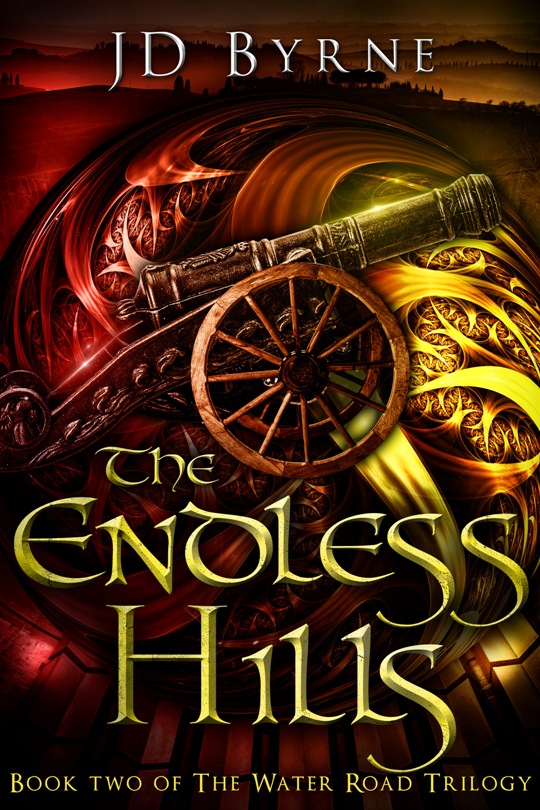
Just so you know what to look for, here’s the cover for The Endless Hills:

Once again, this cover is by Deranged Doctor Design.
When will you, dear readers, be able to get your hot little hands on The Endless Hills? It will be released in eBook form on August 31, with the paperback to follow a few days later.
Remember, The Water Road is now available at Amazon as well as in the real world at Empire Books & News.
Weekly Read: How Music Works
Usually I write a review just after I finish a book, when it’s fresh in my memory and I’m inspired to say something about it. I finished this book two months ago and instantly wrote most of below. Then things happened and it kind of got away from me. I’ve returned to it several times, but can’t really muster up the enthusiasm to put the finishing touches on it. But it’s got some value, I think, so I present it here with this disclaimer. Given the book at issue, think of it as a demo version of a song that never got finished.
Book titles can be tricky things. We fictions writers have it easy, since we can do almost anything and it works, more or less (I lean towards using locations that are important to the story, hence Moore Hollow and The Water Road). Nonfiction writers have to be careful, though, because a title of a nonfiction book is almost a promise, a declaration of what kind of book the reader is getting into.
How Music Works is not a very good title for the book to which it’s attached. The title promises something like a pop science treatment on sound, how it’s produced and how it rattles around in our brains. Instead, as written by musician David Byrne (no relation, although I sometimes refer to him as “Uncle David” in an attempt to sound cool) of Talking Heads fame, it’s much more wide ranging and, yet, more personal overview of what shapes music that you listen to. It’s often interesting on its own terms, even if its terms it doesn’t want to recognize.
In the introduction, Cousin David says that the book isn’t about him, but he does use experiences from his own career to illuminate certain subjects. And while it’s true that this isn’t just a rock star bio, Byrne nonetheless spends an awful lot of time canvassing his lengthy career. That’s not necessarily a bad thing – he knows of what he speaks. But it limits the discussion in a lot of places. He could have dived deeper into certain issues by seeking out interviews with others. For example, he talks about how technology has changed the way music is recorded and that lots of professional recording is now done in home studios. He admits that some folks still prefer the big studio treatment, but doesn’t go into why and whether it’s something that’s going to live on.
Byrne’s probably at his best when he’s discussing the ways in which technology has changed the way music is consumed. It’s not a new theory – that music was once mostly consumed as live performance, either by professionals or amateurs in the home, whereas now it’s mostly consumed in recorded form – but he gives it a comprehensive airing. It’s an interesting thing to ponder, to wonder how different music is when it’s something you do, rather than just something you experience.
In fact, my favorite part of the book is a chapter titled “Amateurism.” It’s less a celebration of mediocrity than it is celebrating the idea of people making art for themselves. It’s not an either or thing – Cousin David wouldn’t suggest nobody buy music from “professionals” anymore. But actually making music, even if you know it’s nowhere near “perfect” or worth sharing with a wide audience, can be very rewarding. Speaking for myself, I love actually making music (insert shameless plug), even if hardly anybody actually listens to it.
Having said that, it’s in this chapter that Byrne says something that’s gotten him in trouble. In talking about “high” art versus “low,” he writes:
I never got Bach, Mozart or Beethoven – and don’t feel any worse for it.
A lot of people, exemplified by this guy in the Amazon reviews, read this as Byrne shitting on classical music, deriding it as a means to lift up popular music. I don’t read it the same way.
Instead, I think he’s calling into question the idea of segregating music (and other forms of art) into “high” and “low,” which then tends to inform society’s ideas of what is worthy of support and what isn’t. He’s not wrong that lots of popular forms of music tend to have subversive elements (or at least are believed to be). It’s also true that the newly rich look to institutions of “high” art as a means of buying their way into high society. Notably, he doesn’t call for such things to stop or be illegal or anything like that. He just wonders what it might be like if a newly minted billionaire might decide to support a rock or hip-hop club that developed new acts, rather than sign up as a symphony patron.
I’ve never been a fan of tagging some music as “serious,” which, by definition, means the rest of it isn’t. Tell me Robert Fripp, perched on a stool near the back of a King Crimson stage barely visible, isn’t being serious about the music. Tell me that that a blues player, like the late BB King, who sweats his very soul into what he plays, wasn’t serious about his music. Hell, tell me that Frank Zappa, in the middle of some kind of stage buffoonery that looks like pure silliness, wasn’t deadly serious about his music. You can’t. Music, like most art, is as serious as you want to make it, but that doesn’t have a damned thing to do with whether you’re playing in a symphony hall or a greasy dive.
More than anything else, I just don’t see the great sin in saying “I never got” a piece of art or music and refusing to feel bad for it.

Water Road Wednesday: Law & Order In Altreria
I’m a lawyer who writes fiction, but that doesn’t mean I write legal fiction. I’ve got nothing against it, but I’ve got a special place in my heart for lawyers who become writers and don’t fall into that genre (think Felix Gilman or Stephan Pastis). That being said, “the law” does tend to rear its head in my stories more often than not.
Obviously, when it comes to The Water Road Trilogy, there’s a lot of lawlessness involved. Insurrection, war, and the like tends to upset the regular business of things, after all. But that doesn’t mean that the law, criminal law in particular disappears.
As we saw last week, one of the new characters for The Endless Hills, Martoh, is, in fact, a criminal. We meet him in prison, fighting for his life. He gets the opportunity to wipe his legal slate clean by volunteering to go fight the Neldathi. That’s not a new idea – for generations people have been given the chance to improve their social status by serving in the military (it’s a path to citizen ship for immigrants in the United States, if I’m not mistaken). And it’s got antecedents in speculative fiction. I wanted to use it to have a low-level soldier’s point of view, a soldier who chose to be there, but didn’t really have much of a choice.
We spent relatively little time in prison with Martoh, however. In the third book, The Bay of Sins, one of the plot threads involves a trial in Innisport for one of the viewpoint characters (a new one, essentially, although she makes a brief appearance in The Endless Hills). For most of the book she’s incarcerated in a prison of fairly recent vintage built on the edge of Innisport. Putting a character in a cell for a whole book meant I had to have a good idea of what the place looked and felt like.
One of the cool things about writing fantasy is that you get to make up whatever you want. Still, it’s interesting to use the real world as a jumping off point sometimes. Several years ago my wife and I were in Philadelphia. On our way out we stopped at the Eastern State Penitentiary. The place was ahead of its time. As I wrote on my old blog:
It was called a penitentiary because the core of its approach was to force prisoners to be penitent, or humble and regretful, about their sins . . . er, crimes, rather. To accomplish that task, prisoners were kept in isolation from one another at were required to remain silent at all times.
* * *
The system employed at Eastern State didn’t catch on in the United States very much (a similar system that emphasized work over penitence won out in Gilded Age America), but it was popular overseas. That being said, the general look and vibe of the place is similar to a lot of American prisons built not too long after, including the old West Virginia Penitentiary at Moundsville.
It was also technically innovative:
It had a system of steam heat and running water (sort of – guards flushed the toilets twice a week, IIRC) long before most of the young United States did. The design itself, with its central control hub and cellblocks spiraling out from there. It allowed for maximum visibility with the fewest number of watchers.
Now it’s a semi-ruin and creepy as hell:


It’s also great fodder for the imagination. So when it came time to imagine where this character might be doing her time, a modified version of Eastern State leapt to mind. It was fun to run with it, tweak it as need it, and see how the characters in my world dealt with it.
World building is the foundation of writing fantasy and science fiction. Law (or its explicit absence) is as important to any world as any other part of society, even if it doesn’t drive your story. You don’t have to be a lawyer/writer to realize that.
Remember, The Water Road is now available at Amazon as well as in the real world at Empire Books & News.
Come See Me!
Last Monday I was down at Empire Books and News in Huntington, West Virginia, taking part in a cool monthly event called Writers Can Read.

It’s pretty simple – gather some writers together and have them read some from their work. Each month has a couple of featured writers, then a kind of open-mic section for anyone who wants to join in. After hearing from poets Ace Boggess and Neil Carpathios and a few other folks, I had a good time reading a scene from The Water Road.
I’ll be back at Empire this Saturday, July 30, for not one but two signing events! But I won’t be alone. From 11am to 1pm and then again from 6 to 8pm, I’ll be there along with several other local writers of the fantastical:
Michele Zirkle Marcum
Wayne Ferguson
Charles Romans
Dr. William Grimes (11am only)
Stewart Lucas (6pm only)
Michael Knost (6pm only)
The second signing session leads right into Empire’s event for the rollout of Harry Potter and the Cursed Child that will be available starting at midnight.
I’ll be there with copies of all three of my books, including The Water Road. Stop by, say hi, get a signed copy of a book (or three!). See you then!