Weekly Read: Blood in the Water: The Attica Prison Uprising of 1971 and Its Legacy

On September 9, 1971, inmates at the Attica Correctional Facility in upstate New York (not too far from Buffalo) took control of part of the prison. For the next four days they negotiated with authorities over a list of grievances, at times with the help of notable civilians such as attorneys and journalists. After reaching an impasse, authorities stormed the prison on September 13, killing 43 people – including 10 correctional officers who had been taken hostage. It’s no wonder that the events at Attica galvanized the nation and quickly worked their way into pop culture:

What’s interesting is how different people refer to those events. Some call them a riot, with all the connotations that word brings – senseless violence, brute force, unfocused rage. Others, such as historian Heather Ann Thompson in her Pulitzer-winning book, Blood in the Water, refers to the events as an uprising – an event where a repressed group of men sought change in the only manner available to them. Which camp you fall into probably says a lot about your politics in general.

Which is appropriate because politics is a driving force in Thompson’s book, beginning with the political aspirations of New York’s governor at the time of the uprising, Nelson Rockefeller. He wanted to be president and couldn’t afford to be seen as “soft” on crime or criminals (it’s no surprise that Nixon backed his play at Attica). In addition, he viewed the uprising as the tail end of leftist activism from the 1960s and worried that if the Attica uprising wasn’t suppressed it could spawn an actual revolution.

The inmates didn’t do the most they could to dissuade Rockefeller from this position. Although their long list of demands dealt mostly with conditions at Attica or within the criminal justice system in general, there were (at least at some points) demands for a plan to take anyone who wanted to go to Africa and other broadly political requests.

Having said that, the negotiations made progress. The sticking point turned out to be amnesty for those involved in the uprising. Rockefeller insisted he didn’t have the power to do it (doubtful) and all rested with the local prosecutor. The inmates, for their part, didn’t seem to realize that once one of the correctional officers who had been attacked in the early stage of the uprising had died there was little chance of a blanket amnesty, anyway.

That authorities eventually stormed the prison to regain control wasn’t a surprise. What was surprising was how it was done, with a collection of state troopers, correctional officers, and National Guard troops armed to the teeth. Similar, if smaller, uprisings in other New York facilities (including New York City’s infamous Rikers Island jail) had been put down without the use of firearms and the associated loss of life. Authorities went into Attica with guns blazing, however, and left a horrific toll in their wake.

Thompson’s great achievement in Blood in the Water is taking those four days of the uprising and laying out what happened in serious detail. She also provides a great deal of context for the uprising, placing it as one of a series of such things around the country, not just a sudden, confusing spasm of violence. It’s an important portrait of a watershed event in American history painstakingly pieced together.

Once the uprising is put down, however, the book begins to lag. Initially the response of the state is familiar to anyone in 2017 watching the news when an unarmed black man is gunned down by police. First, authorities lie – in this case, by claiming that the 10 hostages who died during the retaking where killed by inmates, often in ways that involved mutilation. Second, authorities dehumanize the inmates – everyone involved at Attica was a murderer or rapist or similar kind of thug. In truth, many were there for minor parole violations and other non-violent offenses. Third, when the truth comes out – medical examiners refused to be silenced about what actually killed the hostages – the authorities downplay, obfuscate, and at no point apologize or formally correct the record.

It’s no surprise, then, that litigation about Attica – criminal and civil – dragged out for decades. Thompson deploys the same attention to detail to that litigation, but to less effect. There are so many trials with so many different players that the narrative becomes scattered. Also, there are things that jumped out to my lawyer eye that deserved further detail. For example, there were mutual defense groups set up to help defend the Attica inmates during their criminal trials. Such a setup is rife with ethical issues (conflicts of interest, primarily), but Thompson never addresses them. Another example is when there’s a ruling by the judge in one inmate’s case that, we’re told, profoundly impacted several others, but there’s no discussion of the ruling itself.

What Thompson’s exhaustive stroll through the litigation does is drive home just how much the apparatus of the “state” – meaning both the New York and federal governments – were determined not to really find out what went down at Attica. Most obviously that’s borne out by how the New York players obfuscated when it came to the facts, but it’s smaller things, too. There’s the fact about how the state tried to lock the families of the guards who had been injured and held hostage into taking small workers’ compensation payouts rather than actually suing anybody. Or there’s the ultimate brush off – the federal judge handling one of the civil cases went on vacation while the jury was deliberating. It doesn’t paint a good picture of a society coming to grips with a horrific event.

For all its cachet as a touchstone in the culture, it’s amazing that it took until last year for a definitive history of the Attica uprising to be written. For that Thompson deserves all the praise she’s gotten. That the entire story isn’t as gripping as those four days in September of 1991 isn’t her fault. For that part alone, I highly recommend Blood in the Water.

Attica

Author Interview – Holly Evans

This time we head to the Emerald Isle for some words with fantasist Holly Evans.

Who are you? Where are you? What kind of stuff do you write?

 I’m Holly Evans, an English expat with a love of blades, fae, and predators that hide in the shadows. I’m currently living in the Republic of Ireland. I write Urban Fantasy, mostly with LGBT+ casts, and mostly set in a huge fantasy kitchen sink world that I refer to as my Ink World.

Do your Ink World books tell an ongoing story or is it a shared universe with lots of separate stories going on?

I’m careful to keep the Ink World series separate so none of them spoil any of the others. If you look closely and read all of the books you’ll see there’s a larger arc there, but it’s kept far in the background. So really it’s more the latter, a shared universe with some overlapping locales and characters.

Tell us about your most recent book, story, or other project.

Seers Stone is book one in a new series. It follows treasure-hunting alchemist Kaitlyn Felis. It’s something I’ve wanted to write for years. It’s a quick-paced, adventure-focused Urban Fantasy set in my Ink World. Kaitlyn’s a vibrant character who has such a lust for life, she’s amazing fun to play with.

In Seers Stone she takes a new job in Prague and is sent to retrieve the mythical Seers Stone for her new boss. That takes her across Europe and sees her in a lot of fun situations along the way.

Cover

In what genre do you primarily write? Why did you choose that one?

 Urban Fantasy. It’s what I naturally write, I can’t imagine writing anything else. I love the mix of myth, magic, and mayhem, all set in the modern world. The idea that magic and adventure could be hiding just around the corner is too good to ignore. If you know which shadow to slip into, or which door to knock on, you can be transported into this amazing new world. How can I not love that?

 Tell us briefly about your writing process, from once you’ve got an idea down to having a finished product ready for publication.

 I don’t really have a set process. The idea gets written in my planning book. I’ll jot down broad strokes, scenes that pop into my head, and everything I can about the protagonist. That will involve lots of colour, my brain loves colour. That will sit and percolate in the back of my mind for a while, while I work on other things. When it’s time to write it I’ll return to my planning book and make more notes. They’re not usually too organized at that point, it’s lots of colour and notes on scenes that call to me. From there I’ll start pulling together an outline and then writing.

I tend to write roughly the first 10k pretty quickly, then I’ll pause, update my outline, and carry on. Once I hit the 20k mark I start wailing about how much I hate writing middles. I’ve started writing the endings before the middles as my ADD means I get bored and frustrated which leads to rushing the ending. So I’ll write the opening as much as I can, then the ending, then go back and gnash my teeth through writing the middle!

From there it goes over to my editor. I have a language-based learning disability, so my books require *a lot* of copy editing. My editor gives the draft a copy editing pass then a developmental pass. It’s rare that the developmental will call for anything more than tweaking a few sentences and expanding on a couple of scenes. Once I’ve done that (usually that takes me about 48 hours) it’ll go back to my editor for two more copy editing passes. I’ll then format it, and it goes on Amazon.

Have you ever had a situation where you wrote the beginning, wrote the ending, then in filling in the middle part decide that the ending you wrote doesn’t work anymore?

I came really close to needing to rewrite the end of one of my Infernal Hunt books. I wrote the book completely out of order from four different points. Fortunately the end only needed tweaking not a complete rewrite but it was a close call for a moment.

What’s your strategy for publishing a series (i.e., do you release each book as it comes, hold them all until the series is done, etc.)?

I release each book as they come in a series. I held onto the first three books of my first series so I could release them quickly, but after that I just release them when they’re done. I’d rather have regular releases than hold books back.

Who is the favorite character you’ve created? Why?

 I’m so hopeless about picking favourites! I think that’s a tossup between Tyn and Kaitlyn. Tyn’s a secondary character in both my Ink Born and Hidden Alchemy series. He’s my broken little kitten. He’s a Cait Sidhe (a fae cat) with a really tragic backstory, he’s so snarky, and broken, but also sweet, fierce, and incredibly loyal.

Kaitlyn’s amazing fun. She has such a lust for life. She lives to have adventures, and she’s just so vibrant, so incredibly alive.

What’s the weirdest subject you’ve had to research as a writer that you never would have otherwise?

 I don’t do much research for my writing. I have a pretty good knowledge-base of myths and such from spending my childhood and teenage years devouring everything I could find on that. I can’t think of anything to be honest.

What’s the one thing you’ve learned, the hard way, as a writer that you’d share to help others avoid?

 If you want to make readers happy, you have to keep them in mind. I wrote some books that were for me under another name, and they didn’t make readers happy. Looking back, I can absolutely see why. It’s so easy to go, ‘well I’m an avid reader, of course I know what readers want!’ and then it turns out that well, actually…

I suppose that really comes down to why you write. I’m a storyteller, I write for my readers, so I want to make sure that I write books readers love. If you’re writing more for the pure love of writing, then do what makes you happy.

What’s the best way to find out what makes readers happy?

Ask them 😛 I survey my newsletter subscribers on a semi-regular basis and ask what they enjoy, what they want, etc. I try to offer as many methods for engagement and reader feedback as I can. Reading reviews, your own and those of bestsellers also helps a lot. You can look down the top 100 in your genre and read the reviews, positive and negative. You’ll see some trends.

If you won $1 million (tax free, to keep the numbers round and juicy), how would it change your writing life?

 My husband and I want to become digital nomads, if I won that money we’d pack our bags and start travelling the next day. I’d visit all these wonderful places I want to visit, and I’d put them all in my books.

What’s the last great book you read or new author you discovered?

 I’m not normally an eRom reader, but a friend had a new book out that people were raving about so I picked up a copy. It was fantastic. Finn by Liz Meldon is exquisitely put together. I’m really impressed with how much character development she managed to pack into a little space.

What do you think your next project will be?

 I’m bouncing back and forth between the Ink Born series and the Hidden Alchemy series, so it’ll be whatever sequel is due along those lines. Right this very second that’s Ritual Ink (Ink Born 4). That being said I’m really tempted to start a third series in my Ink world, I’m weighing up the pros and cons right now.

Check out Holly’s blog here.

All 99-cents All Month!

To celebrate the successful end of NaNoWriMo, and in an attempt to spread a little bit of holiday cheer, I’ve lowered prices on all my books to 99 cents across all platorms for the entire month of December!

That includes Moore Hollow, the entire The Water Road trilogy, and even my short story collection, The Last Ereph and Other Stories.

Get ‘em for a friend, get ‘em for yourself!

Thoughts From an Experimental NaNoWriMo

Right – so where were we?

Oh, yeah, National Novel Writing Month, also known as NaNoWriMo. Did I have a good month? I’d say I did.

NaNo-2017-Winner-Twitter-Header

The book I started for NaNo, The Messenger, is different for me in a lot of ways. For one thing, it’s pure space-based science fiction. While I’ve written some near-future sci-fi short stories, I’ve not done anything this long or, well, spacey. For another, I started the project having done very little prep work. So to be past 50k words and looking at another month’s writing (at least) to finish it is making me a little giddy.

HappyPuppy

Not an actual picture of the author. Think metaphorically, people!

Let me explain why.

Writers generally like to divide themselves into two groups – plotters and pantsers (putting to one side the ones who don’t accept either label). Plotters, as you might imagine, are people who do a lot of work before they actually start writing a first draft. They outline, develop characters, build worlds and all that kind of stuff before ever sitting down to write “it was a dark and stormy night.” (LINK). Pantsers are the complete opposite – they do little prep before writing and are, as the name implies, flying by the seat of their pants. In truth, I think most people are a little of both. Anybody who writes exactly the same book they planned to write or really sits down with a completely empty noggin and pours out a book are few and far between.

I tend to be a plotter. Lots of that is down to writing fantasy and the heavy lifting of world building. I like to get that stuff out of the way so I can let the story develop against a fairly fixed backdrop. Still, things never go precisely as planned, even when (as with The Bay of Sins, my last NaNo project) you lay out all the chapters you think you’ll need from the beginning. I suspect it’s something like attorneys say about oral arguments – there’s the one you plan to make, the one you actually make, and the one you wished you’d made after the fact.

So The Messenger was a very different experience for me. I had about a page of notes, compiled from thinking about the story over the years, but it was lacking lots of important things. Like, for instance, the names of the main characters or any of the names of the planets or alien races they’d encounter along their way. As for the way? I had an idea of how things began, but after that? I decided to let it see where it went. I’m glad I did, because I don’t think I would have come up with some of these things ahead of time.

It’s particularly interesting to do this one right after finishing the first draft of The Orb of Triska. That has a lot of work done on it before I started writing and I always felt like I knew where I was going. I think that first draft is a much better, more coherent final product, but, of course, neither one of them are “finished” after a first draft. It will be interesting to see how the final products compare once they’ve been polished up.

So that’s how I spent my November.

Also, we got new puppies:

ZariaKalindi

Zaria (L) and Kalindi (R) are ready for their album cover.

How you all been?

Author Interview – J.J. Green

Breaking cover during NaNoWriMo to bring you this conversation with J.J. Green.

Who are you? Where are you? What kind of stuff do you write?

I write under the name J.J. Green, but that’s only because I think it sounds cooler than Jenny Green. I’m British/Australian but I’ve been living in Taiwan for six years and plan on being here for another two at least. I’ve also lived in Laos. I write space opera and humorous sci-fi, and I’m hoping to begin writing thrillers under a pseudonym later in 2018.

How has living abroad impacted your writing? 

The simpler, cheaper lifestyle has made it easier to find time to write compared to living in the UK when I needed to work a full time job to support myself and my family. On the other hand, I find it much harder to go to conventions and conferences so my networking is confined mostly to the internet. I recently went to the 20 Books to 50 K writers’ conferences and it was great to finally meet some fellow writers face to face.

Tell us about your most recent book, story, or other project.

I recently finished my second sci-fi series! Called Shadows of the Void, it’s a ten-book space opera that progresses from a mysterious life form discovered on a remote planet to an all-out galactic war. The protagonists are a Martian security officer and an Australian starship pilot. The two characters are made for each other but it takes them a while to realize it.

Now that Shadows of the Void is complete, I’ve begun a new series, a space colonization saga. The prequel to the new series appears in an anthology called The Expanding Universe 2 under the title, Space Colony One: Night of Flames.

Generation Ebook1400x933

In what genre do you primarily write? Why did you choose that one?

Science fiction has been my favourite genre since I first encountered it when I was around eleven. I love everything sci-fi from H.G. Wells to Neal Stephenson, so it was the obvious choice when I decided I was going to take the plunge and write novels. I also love mysteries and thrillers, though, so I’m kind of torn. I like to include some elements of both of them in my science fiction.

Tell us briefly about your writing process, from once you’ve got an idea down to having a finished product ready for publication.

I try to have a plan but often the ideas don’t flesh out until I begin to write, and then they may change shape. Sometimes I re-read my plan after I’ve finished a book and think, oh, so that’s what I wanted to write.

I generally try to write as much as I can as often as I can. I aim for 3000 words a day as a minimum, but if something breaks my routine I usually miss that target.

After finishing the first draft, I go over the story again, correcting mistakes, filling out thin parts, checking for consistency, adding items I needed to research and improving the flow of the language. Then the manuscript goes to my editor, who finds more mistakes and gives me her gut-feel feedback as a reader. I fix the extra mistakes and tweak things according to how she’s seen them, then I publish.

How did you go about finding an editor that you trust and could develop a good working relationship with?

I’m very lucky in that I got to know a very good editor through my writers’ group. I knew from firsthand experience that she has an eagle eye for writing errors and because she’s a writer herself she has a good feel for what works and doesn’t work at sentence level. What’s more, she reads science fiction and fantasy, so she’s my target audience.

Who is the favorite character you’ve created? Why?

My favourite character is in my first series. Her name is Carrie Hatchett, and she’s a Transgalactic Intercultural Community Crisis Liaison Officer. What she lacks in smarts she makes up for in enthusiasm and effort and she usually saves the day, though she manages to get herself into quite a few scrapes along the way.

Carrie’s like a female Doctor Who in what she does, but she isn’t anywhere near as intelligent as the Doctor and she has only one—very big—heart.

Mission Improbable ecover (3)1000x1500

What’s the weirdest subject you’ve had to research as a writer that you never would have otherwise?

That’s a hard one to answer as I love to read about strange things that have no bearing on my life whatsoever, so I can’t honestly say that I wouldn’t have researched something if it weren’t for the fact I was writing about it.

Having said that, probably the most esoteric subject I’ve ever researched for writing purposes was Ediacaran life forms. They were organisms that evolved very early on in Earth’s history and they were soft-bodied, so little information about them has been gleaned from their fossils. The reason I was researching them was because I polled my readers on what animals to include in my Shadows of the Void series, and that was one of the suggestions. The Ediacarans went on to become the alien creatures called Paths (due to their telepathic/empathic abilities).

How did you poll your readers? Are there any other ideas you might leave up to their whims?

I’m afraid my polling skills are very amateurish. I simply ask my readers questions and ask them to reply on Facebook, Tweet me or write me an email. My method isn’t very scientific, but it helps me build a rapport with my readers, which I love.

What’s the one thing you’ve learned, the hard way, as a writer that you’d share to help others avoid?

There are so many to choose from! I would say, understand book covers before you shell out hundreds of dollars. I paid a couple of hundred for a nice, well-made cover that didn’t fit my genre at all. As a result, I received some negative reviews from readers whose expectations hadn’t been met. After that experience, I spent hours looking at covers in my genre and learning what elements were similar and what made a cover look good. I also learned the names of famous designers in the genre.

If you won $1 million (tax free, to keep the numbers round and juicy), how would it change your writing life?

It wouldn’t stop me from writing, that’s for sure, but I would finally be able to invest seriously in my self-publishing business. A little extra cash to pay for amazing covers and promotion might give me the kick start I need to progress to the next level. Bootstrapping is hard sometimes.

What’s the last great book you read or new author you discovered?

I recently began reading M.D. Cooper’s Aeon 14 series, which is pretty awesome and very useful for me because it’s full of hard sci-fi tidbits.

What do you think you’re next project will be?

As well as the space colonization series I mentioned above I’ve also begun work on a space fantasy series. I’m not so sure on the format that will take yet, but it involves a star mage who’s searching for the rest of her clan and the origin of humankind. The magic is based on the Chinese Wu Xing system, which describes interactions and relationships between objects through classification according to five planets or elements. I’ve written the prequel but the rest will have to wait until I’ve wrapped up the space colonization series.

Get in touch with J.J. on the Web, Facebook, and Twitter.

November Plans

Folks may know that November is National Novel Writing Month or NaNoWriMo. The idea is to write 50,000 words in a month, which is technically long enough to be classified as a novel (although most modern novels are much longer). I’ve done it several times, the last time being 2015 when I used it to start The Bay of Sins. After being otherwise involved last year, I’ve decided to jump back in for NaNoWriMo 2017.

NaNo2017

That means a couple of things.

First, it means that the first book of my new steampunk series, Empire Falls, is done! Well, the first draft is, at any rate. The Orb of Triska was fun to write and came fairly quickly, clearing the decks to let me jump into something fresh for NaNo. So I’ll put it to the side and get cracking on something different for me – a space opera adventure! It’s based on an idea I’ve had for a while, so I’m excited to get working on it. You can track my progress here:

Second, it means that traffic on the blog will be very light this month. I’ll have a couple of interviews, but other than that I don’t plan for much to be happening ‘round these parts until December. You’ll have to entertain yourselves.

Wish me luck!

WriteAllTheThings

“The Invited Guest” – A Short Story

It’s that time of year again. Author Eric Douglas has invited other writers to do some short fiction for Halloween. In years past he’s put a 100-word requirement (not a limit, a requirement) on the stories, but this year he didn’t put any shackles. You can read my entries from the past two years here and here. I set out to write something about 1000 words.

Enjoy – “The Invited Guest”

“How could this happen?” Sarah Jane said, head in hands.  She was sitting in a high backed chair next to the fire. Across from her, on the love seat, was the Devil.

He looked like a man of nondescript middle age, with a perfectly tailored black suit. Only his tie contained the faintest hint of red. She knew something was up because of his walking stick, black with an ever shifting pattern of flames. Then he removed his hat, a black fedora. The small horns were a dead giveaway.

Sarah Jane slumped back in her chair. “Why? How?”

“Could have something to do with that,” the Devil said, pointing to the crumpled paper bag next to Sarah Jane’s chair.

“My sandwich?” She’d just finished a supreme club sub from Tony’s down the street.

He nodded, eyes twinkling. “Did you, by chance, toss a portion of it in the fire?”

“Yeah, just the heel,” she said, then paused. “Wait a second.”

The Devil’s eyebrows rose.

She dug through her memories, deep into her youth. “My grandmother.”

“Was she was from the ‘old country’?” The Devil made air quotes.

Sarah Jane nodded. “When I was really young she would always hand out this crazy advice. ‘It’s bad luck if you spill salt and then don’t throw it over your shoulder. You’ll have good luck if you eat grapes after midnight.’ That kind of thing.” She thought some more, then started nodding. “And she said something about throwing bread into the fire.”

The Devil clapped his hands together. “There you have it.”

“But I didn’t want to summon you.”

“Makes no difference,” the Devil said. “I did not make the rules, believe it or not.”

“Well, I’m sorry to have wasted your time. You can go now.”

A slow, slippery grin stretched across the Devil’s face. “That is not how this works.”

A sudden chill ran from Sarah Jane’s feet to her head and back again.

“You see, once I have been summoned, there is only one way to make me leave.”

“Which is?” she asked, slowly enunciating each word.

“We need to come to an arrangement,” the Devil said, sounding very reasonable.

“Arrangement?”

“Yes.” He flicked some dust of his hat with his fingers. “Typically when someone summons me they want something big, bold, possibly dangerous. For that they are willing to trade their soul.”

“Whoa, back up, Scratch,” she said, hands raised. “I like my life as it is. I certainly don’t want something so much as to trade you my soul for it.”

The Devil raised a hand, palm open. “Like I said, I did not make the rules. I have to get something from you.”

“But I don’t want anything.”

“Yes you do.” The Devil sat back in his chair and examined his nails.

Sarah Jane chose her words carefully, “I need to pay you to go away?”

The Devil nodded.

“That’s insane! You can’t just show up in someone’s home and then not leave until they give you something!”

He raised a finger. “I did not just show up, woman. I was summoned. That it was without intent is irrelevant. If you want me to leave, you will pay.”

Sarah Jane wracked her brain. “But it shouldn’t cost me much, right?”

“What?” The Devil was caught by surprise.

“I mean, all I want is you gone and, let’s face it, you’re going to need to be somewhere else sooner or later.”

“I suppose that’s right, but . . .” he started.

Sarah Jane ignored him and kept going. “So it’s not really fair to take my entire soul just to get you to do something you’re going to do anyway.”

The Devil sat, mouth open for a moment. “I can play this game longer than you. You’ve got a boyfriend? What will you do if he comes over?”

She shrugged, not concerned that the Devil knew that. “I think Phil would enjoy this. He’s seen all the almost every movie about you, even Crossroads.”

The Devil rolled his eyes, then leaned forward, elbows on knees. “Look, you’ve got to give me something. A part of your soul, just a small bit.”

“Like what?” Sarah Jane asked. “Ten minutes ago if somebody had told me I had a soul I’d have said they were full of shit, but I’d have said the same thing about you, too. No offense.”

“None taken.” He leaned back and looked at the ceiling, deep in thought for a few seconds. Finally, he said, “do you like movies as much as Phil?”

“Sure,” she said, lying just a bit. This was the Devil, after all. “I’m more of a book girl, but I like movies.”

“Very well,” the Devil said. He rose and suddenly was twice as tall, glowering down at her. “I take from your soul the ability to react emotionally to motion pictures,” his voice deepened, “for the rest of your life!” The last phrase boomed around the room.

“Does that mean you’ll go away?” she asked.

The Devil shrank back to regular size. “I keep my bargains.”

“All right, then,” she said, standing and shooing him away with her hands. “Off with you, then.”

The Devil turned and began walking back into the next room. “You think this is a joke. It’s not,” he said over his shoulder.

“Whatever,” she said as she watched him disappear into the darkness.

~~~~~

They walked out into the chill evening. The marquee above them glowed in slow, shallow pulses.

Phil was sniffling. “How can you not be crying? It’s so sad! The way their village was destroyed? How the twins got separated, but only the girl found her mother in the end?”

“It’s just a movie,” Sarah Jane said. She cursed the Devil in her mind.”

“Just a movie,” Phil said, looking at her through bleary eyes. “What are you, some kind of soulless monster?”

“Something like that,” she said, looking up the block. “Let’s go get a sub.”

And remember, any invited guest is better than the other kind:

Be sure to check out Eric’s website for links to all the other stories.

Happy Halloween!

Soul

Come See Me – Twice!

The next couple of weekends I’ll be out and about, taking part in a couple of events in the Charleston area.

First up, this weekend, is the third year (after its revival) of the West Virginia Book Festival.

2010_Bookfest_Logo

In addition to a terrific list of speakers (including R.L. Stine and Joe Hill) and workshops, there will be an entire marketplace full of writers hawking their wares – including me! It runs Friday and Saturday (October 27 & 28) at the Civic Center in Charleston, with the marketplace open 11-7 on Friday and 9-5 on Saturday (admission is free). Also, don’t miss out on the Kanawha County Public Library’s annual sale – it’s always full of neat finds!

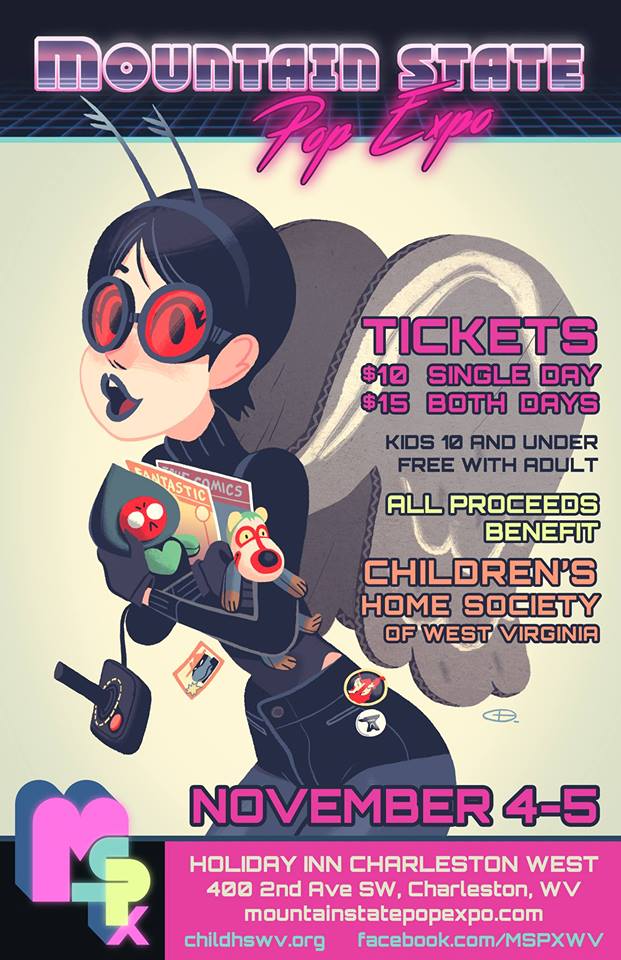
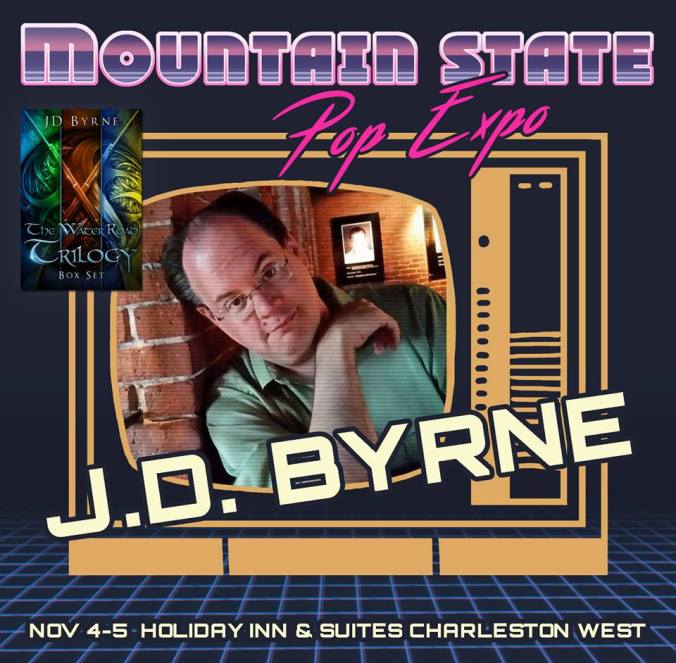
Then next weekend, I’ll be taking part (for the first time) in the Mountain State Pop Expo.

PopExpoPoster

The Expo is a celebration of all things pop culture and looks like it should have something that appeals to just about everybody – including fans of fantasy fiction. The Expo is Saturday and Sunday (November 4 & 5), from 10 to 6 at the Holiday Inns & Suites in South Charleston (admission $10 – all proceeds go to Children’s Home Society of West Virginia).

PopExpoMe

Come to either, come to both – but be sure to stop by and say hi!

Author Interview – Timothy Ellis

For this interview we go (back) down under to talk with space opera writer Timothy Ellis.

Who are you? Where are you? What kind of stuff do you write?

Timothy Ellis. I live on the Gold Coast, in Queensland, Australia. I write Space Opera, with a spiritual underscore, a love of cats, and dabbling mix of other genres.

Tell us about your most recent book, story, or other project.

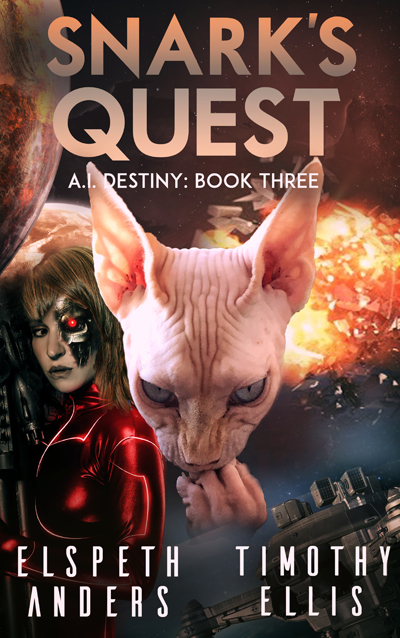
My current project is the A.I. Destiny series, which is a spin off from The Hunter Legacy series. Book 3 was Snark’s Quest, co-authored with Elspeth Anders. Snark is a centaur like Cat, in my Gaia galaxy, introduced in the previous book Queen Jane. While the series is called AI Destiny, Snark takes on a journey through a galaxy coming to grips with humans suddenly appearing, and being the strongest species around. Book 4 is Destiny Stone, continuing the quest. Book 5, Talisman of Tomorrow is currently in editing as I write this. All 3 are co-authored.

The series is a reversal for most Space Opera where humans are the underdog, and must save the universe. Here, humans, unknowingly led by AI’s have what everyone else wants, and Snark’s Quest begins a 3 book arc about the consequences of being top dog, instead of underdog. Especially on a cat world.
Snarks Quest 2nd cover-400

 In what genre do you primarily write? Why did you choose that one?

Space Opera is my first love. I didn’t actually choose what to write. It had been haunting my mind for twenty years before I first sat down and attempted to extract it. The first few books wrote themselves.

Spirituality, (without religion) has become my way of life, and so I decided to mix Space Opera with a spiritual main character. This introduces an aspect missing from many space military stories, where mine has a main character struggling to cope with a death toll he can’t avoid, and doesn’t want to be part of.

I also added in cats in space, since I love cats. Some of my funniest moments are cats doing in space what cats do naturally.

The last aspect of my writing is the Artificial Intelligence, and what happens when one is side kick to an eccentric human, and a group who accept who she without any need to justify anything. I took this is another level in the spin off series, where the AI goes from side kick to Queen.

In your mind, what sets space opera apart from other science fiction that’s set in space? Later on you mention a “spectrum” of space opera – what is that?

To my way of thinking, Space Opera is about people. It’s character driven, and is about them being put into situations, somewhere in space. Military science fiction on the other hand tends to be event driven story, populated by people doing things. Characters who get thrust into events, verses events where people have to deal with them. You can still have military based Space Opera, but the characters come first. In Military Sci-Fi, the events come first. For example, in Space Opera you meet Joe Bloggs having an ordinary day on his ship, and things go pear shaped. In Military Sci-Fi, your star system is invaded, and Joe Bloggs is the nearest who/whatever to deal with it. It may sound like the same thing, but remember, you’re in my mind here, a most dangerous place to be I assure you, and just about everyone has a different perspective on the distinction.

On one end of the Space Opera spectrum is pure life in space. There are no galaxy wide problems, no save the universe as we know it situations, and definitely no hero to the rescue. It’s about living in space, and the day to day events which make up real life. The best of this end can still be compelling reading, even if nothing actually blows up.

On the other end is the more traditional expectation of Space Opera. The system/political entity/galaxy/universe has been invaded or is about to end, and some hero type has to save everyone. The stakes are big, the problems seem insurmountable, and there is a great deal of handwavium, and pulling rabbits out of orifices at the last second. The movies get made at this end of the spectrum because of all the high stakes jeopardy for the characters, and everything going boom.

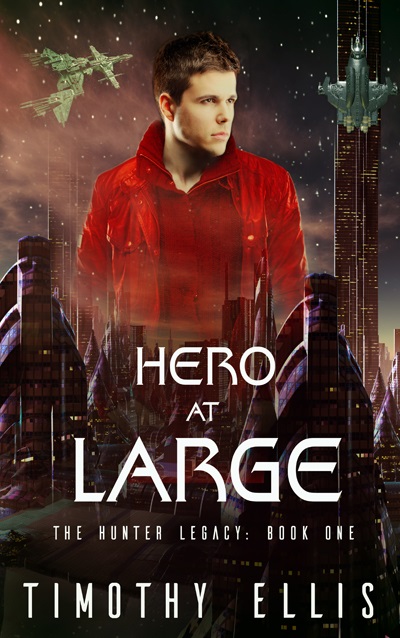
In the middle are series like my own, where life in space is the core, but there is a steady building, ebb and flow, and rebuilding towards the end of humanity situation. I have gone with the hero theme, but my hero has a daily life, and it’s not always about saving anything or anyone. He goes shopping, eats dinner in restaurants, throws up in the bathroom, gets drunk, showers, and goes naked in the spa. Sometimes alone, sometimes not. Most of my books cover somewhere between one and three weeks in time, and you live those weeks with the main character. The Christmas story for example, is one day in space, where the main character is losing his grip on the day, while everyone else thinks it’s all his doing. It could be anywhere, but it’s on a ship, and things happen which can only happen on a ship. This is Space Opera at its best for me. Life in Space. It’s not about where they’re going. It’s about what happens on the journey.
Hero-at-large-new-cover-400

Tell us briefly about your writing process, from once you’ve got an idea down to having a finished product ready for publication.

 I’m a ‘pantser’, so I start with an idea, usually knowing where the end is, and simply begin. The characters talk to me as we go, and I write about what they want to say, where they want to go, and what they want to do.

In some books I’ve need to meticulously plot time against multiple actions, so everything happens in the right order.

I edit what I write the day before first, and continue on writing.

Once complete, aiming for 85k words, I do a reading pass on the computer looking for anything wrong, and tidying things up. I usually add more than I delete.

Once the story is there, I throw it to my Kindle app, and start reading it as if it was someone else’s book, editing as I go. Rinse and repeat until I can’t find any errors.

Blurbs tend to write themselves during the editing process, and the cover is defined, commissioned, and completed by the time the editing process is complete.

I release as soon as I consider the book is polished well enough.

Who is the favorite character you’ve created? Why?

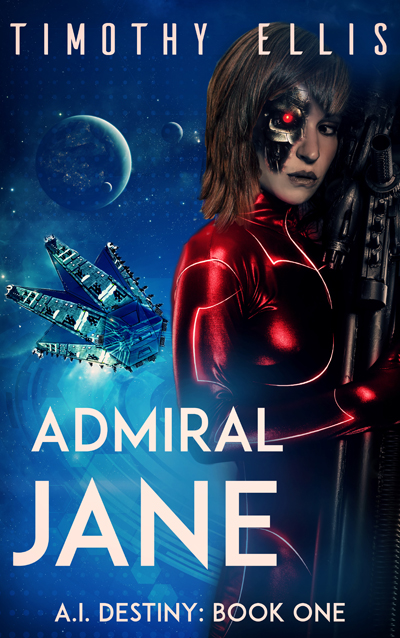
Jane is my first AI character. She starts out as a ship computer AI, gains a robot body, uses tech to appear human, and learns how to be so human, no-one can tell she’s not. She’s a fiercely protective side-kick, but has a sense of humour which produces some very funny dialog. She’s done disco dancing, fleet control, bait for a serial killer, killed the bad guy when the main character decided not to, and eventually becomes a Queen of her own Kingdom.
Admiral Jane cover-400

What’s the weirdest subject you’ve had to research as a writer that you never would have otherwise?

 Dismembering a corpse, within a combat suit, in the vacuum of a space hulk, using something resembling a Japanese Katana sword.

What’s the one thing you’ve learned, the hard way, as a writer that you’d share to help others avoid?

As distasteful as getting editors to cover your first novel in red is, it’s really necessary. I’ve seen too many authors release their first book with so much ego involved, having not had a good editor, or even a proof-reader look at it. They crash and burn, and that first book haunts them ever after.

All first time authors have blinkers on as far as their writing is concerned. Successful authors fall into 2 groups. Those who had their first books edited and learned how to do it themselves to a higher level, and those who still get their books edited by professionals. No matter how good you are, your first book needs a professional editor, and multiple proofreading passes, in order to polish it to a good enough standard to be acceptable to readers.

The process is hard to go through, since an editor will most likely gut what you think is your ‘voice’. But that is what they’re supposed to do. The first book is a learning journey on a steep slope. But it is necessary.

The other part of this is letting go of ego. Too many first time authors think they are the second coming, and their work is perfect as it is. They fail to listen to experienced authors trying to help them improve the book, blurb, and cover before they launch it, and crash and burn spectacularly. Help is out there on author forums and groups, and the authors who utilize the experience of successful authors who help new ones, do a lot better out of the gate.

The first launch is a matter of parking your ego, getting the best advise you can, using professional services to polish your story as much as you can, and producing the best possible story, presented in the best possible way, before you present it to readers. What happens then depends on how well people like the story, not on what was wrong with the presentation.

You mention the need for a professional editor for a first book, which implies you’ve moved past using one. What did you learn from initially using an editor that you’re able to use now and avoid going that route?

The first thing everyone learns is to hate the red which comes back. It’s a good motivator for learning how to edit yourself. What I did was looked hard at what the red was about, and I set down on paper all the common corrections. When my editor wasn’t available for book 3, I methodically used the find function in word, to check a long list of things I usually had wrong. These included two words where a contracted word is better, a list of words I over used badly and could easily be replaced by a better one with just a little thought, and typical spelling mistakes I make all the time, which the spell checker won’t pick up because they are real words.

There are two parts to editing. Looking at the story itself, and proofreading the words used. I tend to write fairly clean first drafts, so I don’t rewrite very much on the first editing pass. If anything, I add in new ideas, and clarification. While writing, I keep notes on what needs to be covered later on, so I rarely miss anything important, and pick these up on the first full read pass.

Proofreading is where most authors fail, as far as the final product is concerned. But learning to proofread is first a matter of learning about yourself. What do you always do wrong? Where are your blind spots? These are where editors and proofreaders will show you what you need to concentrate on when self-editing.

One of the tricks to proofreading is putting it on your reading device, and reading it like it’s someone else’s book. So much becomes obvious this way, which you never saw on the PC, no matter how many times you read there. I do most of my editing from my device, reading like a reader, and changing on the PC version as I go.

It’s a skill. You will either learn it or not. Editing and proofreading are separate skills, but they can be combined with writing. You just need to change hats a lot.

If you won $1 million (tax free, to keep the numbers round and juicy), how would it change your writing life?

Not much. 1 Mill isn’t all that much these days in the scheme of things. It won’t buy me a decent sized apartment on the beach, which is where I’d like to be living.

It would allow me to travel without needing to worry about those months where you don’t release, and so your income drops like a stone. I’d do the American Comic-con circuit for a while.

What’s the last great book you read or new author you discovered?

 The two authors I wait impatiently for the next book are Nathan Lowell and Glynn Stewart. Both have series on the go where the end of each book is always way too soon. Both write Space Opera, but on opposite ends of the spectrum.

I can’t say I’ve discovered a new author in recent times. One of the disadvantages of being in editing mode so often, is reading other people’s books is difficult, because you also edit them as you read. Hence, I only go looking for something really new, between releasing a book, and beginning writing the next one. Sometimes there is no gap, so I don’t even look.

What do you think you’re next project will be?

I have 4 on the go at the moment.

Editing the next A.I.Destiny/Snark based book is the primary focus right now. The fifth is in editing for release in the second week of October. The series finale is in planning.

I’m also developing a sequel to my original series, setting it up to be a core for more books in the original galaxy.

I’ve already begun something completely new as well. Crossing genres much more than I already have. For now, I’m not sure if it’s a standalone book, or the first of a new trilogy.

As well, with a co-author on the current project, I’m working towards co-authoring in my universe with other authors. I’ll soon have a universe with 2 galaxies, and separate characters and species, sharing technology with Humans and AI’s at the center of them. A second co-author is currently working on a backstory to one of my characters.

How do you keep track of your many ongoing projects? Do you try and prioritize one at a time or do you just work on whatever strikes your fancy on a given day?

I’m a fairly methodical person, so I work mainly on one thing at a time. Ideas come and go, I take time out to make notes, but I keep going on what the current book is. This doesn’t stop my head from going off track, but deadlines help keep you focused. Once a book in a series is released, you need to focus on 4 to 6 weeks later being the release date for the work in progress. You can deviate a bit, but too much makes your release date slip.

I do allocate some time each day to working on other projects, but come writing time, you work on only the current book.
AuthorPic

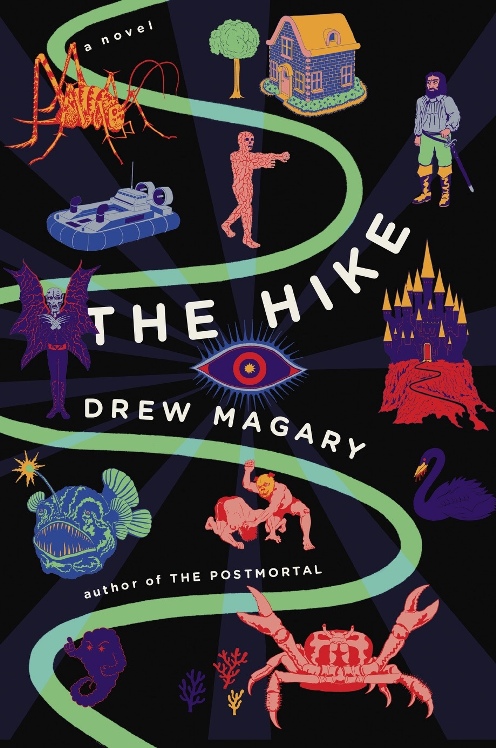
Weekly Read: The Hike

There’s a long tradition of stories were a regular person is thrown into some weird alternate world, one where the rules of real life don’t apply. The person has to battle through this world without understanding what’s really going on until, hopefully, they find their way out again. A problem with this evergreen template is that, eventually, the storyteller has to explain what’s going on. Rarely do the explanations match what happened along the way.

The Hike falls into that trap. It plunges its main character head first into a bizarre, alien, and frightening world that throws challenges at him apparently at random. It’s no spoiler to say that we eventually find out who’s doing this, but not really why. It’s an awfully soft landing after such a long journey.

But, oh, what a journey it is.

Ben is a businessman of some kind (it’s not really important) on a business trip. He checks into a third-rate hotel in the Pennsylvania wilderness and, with some time to kill before a meeting, decides to take a hike. From there things get – interesting. Almost immediately there’s a dead girl and killers chasing Ben while weaning the torn off faces of Rottweilers. Ben evades them, but finds he can’t get back to anything that looks familiar. With that, the saga is on.

It’s hard to describe what follows, and the surprise of it is part of the joy, so I won’t bother. Safe to say that Ben faces a series of trials that play out like an early role playing video game – success at each “level” is often dependent on figuring out what to do with objects that mysteriously appear when necessary. The struggles get harder as the journey goes along, while Ben occasionally has to deal with frightening episodes from his past.

Ben goes at this mostly alone, although he meets a wide variety of beings as he progresses along his path. At times he gets some companionship, in the form of a talking crab (who refuses to give his name and addresses Ben as “Shithead”) and a 15th-century Spanish explorer (who hates anybody who isn’t Spanish, particularly the English). That these relationships actually pays off in ways beyond being purely entertaining (the crab is really funny) is a testament to how good The Hike is.

Which is not to say it’s perfect. The book falls foul of the regular problem with stories of this sort in that the explanation of this weird world doesn’t hold a candle to the world itself. I’m not saying it doesn’t make sense, it’s just not very satisfying (admittedly, I’m not sure what would be). Also, while the final twist gives a little bit of sting to the tale, I don’t buy the reading that so many people have that Ben learned a great lesson through all this. He never really got into the world as an escape from real life, was never seduced by the promise of something different and exciting. He always wanted to go home to his wife and kids.

Then again, doesn’t everybody (well, maybe not the kids part)?. Which is why it’s hard to fault The Hike for not wowing you at the end, given all the wow you get out of the journey.

Untitled-4.indd