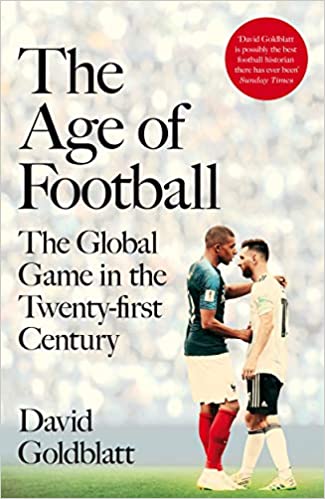
Weekly Read: The Ball Is Round and The Age of Football

Does anyone really need to read more than 1500 pages about soccer? Or, in my case, listen to more than 63 hours of it? Probably not, but if you’re at all interested in the beautiful game beyond watching games, you could do worse. These two volumes – both written by journalist David Goldblatt – explore why the game developed as it has as well as the challenges facing it in the 21st century.

I should say, right at the top, that I’m going to call the game “soccer” throughout. As the history in these books points out, soccer is a derivation of “Association Football,” the actual name of the sport, and is a British phenomenon (in several quoted period sources the game is called “soccer”). It’s not just a heathen American thing – it’s a it’s-called-different-things-around-the-world thing.

The Ball Is Round is the more essential (and longer) of the two because it covers the history of the game, rather than the state of its current form (it was written about the time of the 2006 World Cup in Germany). And it starts with the beginning – surveying the games of ancient cultures to try, without real success, to find the ancestor to soccer.

As an aside, let me say that one thing both of these books have going for them is their scope. They deal with the game on a global level and while Europe (and South America, to a lesser extent) command the most attention, Africa, Asia, and the unholy alliance known as CONCACAF (North and Central American and the Caribbean) are examined pretty closely.

Getting back to the history of the game, more interesting than the nitty gritty origins of the sport and the codification of its rules (sorry, “laws” – soccer is serious business) is how the game spread around the globe. Given its origins in the UK and its spread while the British Empire was at its height, you’d think it was a simple question of imperial imposition, but it really wasn’t. Indeed, large countries with close ties to the British Empire have largely rejected soccer in favor of other pastimes, including the United States, Canada, India, and Australia. What really did it was the soft power of British industry and financing, the tendrils of which reached well beyond the formal boundaries of the Empire.

Thus, in lots of places, the game arrived with expat British workers and grew from there. It’s why so many big named clubs around the world actually have British origins, including Barcelona, AC Milan, and a host of South American clubs. Ever wonder why AC Milan’s big rivals are Inter? It’s because Internazionale was formed in response to the closed up Britishness of AC Milan!

Another interesting part of the development of the game is how tied it was to the Industrial Revolution and the emergence of more affluent working and middle classes (there’s an interesting intersection with the nascent labor movement, which was providing folks with more free time). This helps partially explain why Brazil, for example, has robust state championships based around big cities, in addition to a national league, as the big clubs grew up in cities, without a lot of development in the hinterlands.

Things get less compelling after the Second World War and the book focuses on what Goldblatt calls “industrial football.” That is, the rise of big money in the game, particularly with the increased profile of international competitions like the European Cup (now Champions League), the Copa Libertadores in South America, and, of course, the World Cup. The history is interesting, but Goldblatt slips into a style that is more a string of anecdotes than a compelling central thesis with supporting evidence. The result, as he checks in all over the globe, is a little numbing and overwhelming.

It also highlights some flaws in the book, such as some of the chapters that end with “you are there!” style descriptions of particular matches. Listening to the audiobook it was unclear whether these were taken from actual reports of the game, but it appears that they were Goldblatt’s creation. They’re fine, so far as they go, but it seems to me that writing about a soccer game is a little bit like Frank Zappa’s turn of phrase that “writing about music is like dancing about architecture” – it just doesn’t capture the essence of what you’re writing about.

Speaking of the audiobook – the narrator of The Ball Is Round has some odd blind spots when it comes to pronunciation. My heart died a little bit every time he referred to Juventus as “Jewv” (as opposed to “Juve” – aka “you vey”). He gets some other Latin names wrong, too, just often enough for it to be an issue. Thankfully, Goldblatt himself narrates the sequel and it doesn’t have the same problem.

As for The Age of Football, it basically picks up where The Ball Is Round leaves off in terms of chronology – starting with the 2014 World Cup in Brazil and ending with the 2018 World Cup in Russia. Rather than just updating the history, however, this book focuses more on how soccer is intertwined with other aspects of politics and economics around the world. As such, it suffers from the same checking of boxes as we go all around the world seeing the same pathologies play out over and over.

In that sense, The Age of Football is pretty depressing. It shows how the game is used by regimes, authoritarian and otherwise, for legitimacy and national unity. It shows how money had become the primary driver of the global game, with little regard for what that means in places that are left behind.

Goldblatt notes how, for example, interest in local African leagues has plummeted since the advent of satellite TV and smart phones, which allow people all over the continent to watch top leagues in Europe instead. What’s funny is that the same is true, somewhat, in the United States, where diehard fans of English or German teams don’t give Major League Soccer the time of day.

Amidst the gloomy underbelly of the modern game, there is the damned near universal nature of its allure. All those places I mentioned above where soccer didn’t take root initially are starting to come along. China, where the game’s never had much of an impact, is ramping things up. The World Cup is one of the few moments of unity the world gets, which is worth celebrating. And the game is, as they say, the beautiful one, whether it’s played in a gleaming stadium in front of a worldwide audience of billions or in a bare field in the middle of nowhere.

Be Write Back

This year I’m again taking part in the NYC Midnight Short Story Challenge. As it happens, this week is when I have to write my first story, so nothing substantive for the blog. If you like, you can check out the two stories I wrote for the competition last year.

Back in a bit!

In Praise of “Minor” Epics

If there’s one characteristic of progressive rock that stands out above the others it’s song length. From the get go, bands weren’t afraid to push the envelope well beyond your typical three-minute rock/pop song. “Epic” became a kind of watchword for prog (even though it’s clearly not required), to the extent that side-long epics (or even beyond!) became common place.

I love me some epics, but I’ve found over the years that the real sweet spot for prog seems to be in what I’d call the “mini-epic” range – songs that took up most of an album side, but not the entire thing. Some of my favorite songs fall into this range, so I thought I’d highlight and praise some of these mini-epics.

First, a note on precisely what we’re talking about. For the “classic” era (mostly the 1970s), we’re talking about songs, as I said, that didn’t take up an entire side of an album. For the “modern” era (everything else), I’m talking about songs of about the same stature, so between 10 and 15 minutes. Long enough to do lots of things, but short enough for the end-of-the-side palate cleanser to come after.

With that said, here’s ten of my favorites, five “classics” and six  more “modern” ones (‘cause I couldn’t decide which one to sacrifice).

“The Grand Wazoo” by Frank Zappa, from The Grand Wazoo (1972)

Zappa wasn’t know for epics (he tended to string together shorter songs that all segued together on a side), but his two “big band” albums had a few. The title track from The Grand Wazoo is my favorite of the lot (aside from the first 90 seconds or so of “Big Swifty”). Love the horns, love the slinky synth solo.

“And You and I” by Yes, from Close to the Edge (1972)

This barely passes the 10-minute mark (the live version is a bit quicker and doesn’t), but it still fits the bill, packing in so much, from Howe’s harmonics in the opening through Wakeman’s Minimoog solos, Anderson’s lilting vocal, and the supreme tightness of the Squire/Bruford rhythm section. Yes often went bigger, but rarely better.

 “Cinema Show” by Genesis, from Selling England by the Pound (1973)

Quite possibly my favorite hunk of Genesis ever, particularly the long instrumental second half. The vocal first part, with typically obscure mythological lyrics, is great, too, but the lengthy keyboard solo in the second half really sells it. Notably, the instrumental section is just the three piece – Banks, Collins, and Rutherford. A sign of things to come.

That said, the live version from Seconds Out is heads and shoulder better than the studio version.

“Starless” by King Crimson, from Red (1974)

King Crimson has covered so much stylistic ground that it’s hard to pick one favorite track, but if I was forced to pick one favorite Crim track, this would be it. Somewhat like “Cinema Show” it’s got a vocal intro followed by a lengthy instrumental coda, one that builds layers slowly until it finally explodes in aural widescreen. Love the Mellotron all over it, too.

“Squarer for Maud” by National Health, from Of Queues and Cures (1978)

National Health are my favorite of the bands that emerged from the “Canterbury scene,” mixing a loose, jazzy style of prog with lyrics that were often absurd or completely baffling. The only words here are a spoken-word musing on the word “luminous,” which leads into the lengthy instrumental coda. Are you noticing a theme here?

“Go the Way You Go” by Spock’s Beard, from The Light (1995)

A milestone for me, as it was the first bit of music I listened to over the Internet and the first album I bought over the Web. The listening was of a 30-second clip that (the guitar breakdown about halfway through) took gods know how long to download over dialup and the actual purchase only came after a phone call with guitarist Al Morse (he sang a chorus of “Country Roads” when he found out I was in WV), but that’s what the early days were like, kids!

“Russia On Ice” by Porcupine Tree, from Lightbulb Sun (2000)

Steven Wilson has always been great at playing with dynamics and mood. He uses both to maximum effect here, with the sluggish, barely there verses giving way to the lush, explosive choruses. Not my favorite of his work, but a great tune nonetheless.

“The Seventh House” by IQ, from The Seventh House (2000)

Even clunker albums have gems. The title track to The Seventh House stands heads and shoulders above the rest of what is a pretty weak IQ effort. The story of two WWI survivors coming to grips with their memories, it’s cinematic and emotional. I wish I understood what the whole “houses one through six” thing was about.

 “The Invisible Man” by Marillion, from Marbles (2004)

Just brilliant from start to finish. Atmospheric, brooding, and creepy song that manages to actually tell a tale worth telling. I think they’ve done this track every time I’ve seen them live since Marbles came out and I never get tired of it.

“The Island” by The Decemberists, from The Crane Wife (2006)

You don’t have to be hard-core proggers to dabble in the epic. On this album and the next The Decemberists really leaned into their prog influences, though – this even has a keyboard solo that’s very Keith Emmersony! Still, it works best because Colin Melloy works such great narratives in his songs and here, with a little more room to roam, makes full use of it.

“Microdeath Softstar” by Phideaux, from Doomsday Afternoon (2007)

I really wish an album about environmental disaster and mankind’s inability to do anything about it wasn’t becoming more and more relevant with each passing year. At least the music’s good, full of Phideaux’s trademark churn (I can’t think of a better way to describe it) and lots of tasty playing. At least the end times will have a good soundtrack.

Let’s Talk Spoilers

It’s been a long time since I wrote something specifically about spoilers. After coming across this article at Tor by Sarah Kozloff about “spoilerphobia” I got to thinking about them some more. I still maintain that any story that can really be “spoiled” by knowing what happens probably isn’t that great, anyway.

A good point that Kozloff makes is that spoilers are more than just what happens in a particular story. They can be signifiers of social standing:

Knowing about the hot new book or movie can embody a certain cultural “one-upmanship” and indicate class privilege. Those with the money, time, freedom, and motivation to stay on top of current releases or buy new hardcovers may obtain an experience denied to those who have to wait for library copies or cheaper venues. So, the power to “spoil” lies disproportionately in the hands of those with elite access—like the critic—while anxiety about being deprived of an “untainted” experience affects people with less access.

I think my attitude toward spoilers is what it is because I first experienced them in the context of sports.

That said, I tend to agree with Kozloff’s ultimate conclusion:

I understand that revelations and endings do matter. I just don’t think they matter as much as people think they do or for every story. What I object to most about admonitions never to reveal plot is the implicit evaluation that surprise is everything, vastly more important than every other element of the work.

I think it’s important to think of spoilers as being linked to good manners. There’s a comment to the Tor piece about someone reading an Agatha Christie book on a plane:

Imagine reading an Agatha Christie novel on a plane and the guy next to you saying ‘That’s an awesome novel – I never would have guessed that she faked her death and burned her maid in her stead.’ (example made up, of course!). I don’t know how you would feel but I would be livid.

I’d be livid, too! Now, from a technical standpoint, whatever book that person’s reading has been out for decades and, really, they can’t expect it to be unspoiled. On the other, more relevant, hand, however, this person is obviously reading it, probably for the first time (people reread books, of course, but one has to think that of all the “book reading” going on in the world right now an overwhelmingly high percentage is people reading something for the first time) and there’s no reason to spoil it for them right now! That’s just assholery.

But the opposite situation is a different kind of assholery. Over the Xmas break my wife and I watched a couple of older movies – not ancient, but old enough to drive. As I often do, I went over to MovieChat to see what people were saying about it. On one of the forums, someone was complaining about the discussion spoiling the movie – a movie that had been out for 15 or so years. This person had come to a place where people talk about movies they’ve seen and bitched about spoilers. That’s assholery, too.

Thus, I think worrying about spoilers should be more about policing your own behavior rather than demanding what others do. I recently wrote a post inspired by watching Wonder Woman 1984 that, uncharacteristically, I put a spoiler warning on. Not because I think spoilers should be off limits, but because I knew the movie had just come out and people were still flocking to see it in the first rush. Six months later I might not have done the same thing, but who knows?

“Don’t be a jerk” is solid life advice. It applies to spoilers just as well.

What Does It Mean to “Sell Out”?

“Sell out!” Is there any worse insult to hurl at a creative person?

After all, writing or making music or whatever is supposed to come from the soul, right, and nothing good can come of creating art just to profit off of it. But what does it really mean to sell out and are most examples of “selling out” just really people getting lucky while doing something different?

I started thinking about this a while back when I stumbled across a list of “7 rock bands that were open about being sellouts.” The article doesn’t fulfill its promise – none of the artists listed are shown to have been “open” about selling out and, in at least one example with which I’m very familiar, there was no selling out, unless “selling out” is defined as only becoming hugely successful after years of not being so.

That example is Genesis.

Formed in the late 1960s at the English “public” school Charterhouse, Genesis was one of the leading lights of the progressive rock scene in the 1970s. Even after vocalist Peter Gabriel departed, they made two great prog albums. After guitarist Steve Hackett left in 1977, the band soldiered on as a trio and their sound started to change to something more streamlined and modern. It was that lineup that became absolutely huge in the 1980s, to the point where they were damned near everywhere.

This, naturally, led to some fans of the band’s 70s style walking away huffing about selling out. As the original article put it, after Gabriel left:

Phil Collins took over the vocal duties and over the course of a couple of subsequent Genesis albums changed the style of the band to a much more commercially viable one. He didn’t hide the fact that monetary gains influenced the decision to stray away from long progressive compositions and into simpler pop-rock arrangements.

There’s no link or reference for the “monetary gains influenced to decision to stray away from long progressive compositions” and most interviews I’ve seen suggest otherwise. For one thing, this narrative that Collins drove the stylistic change overlooks the contributions of keyboardist Tony Banks and guitarist/bassist Mike Rutherford. Most of the band’s big 80s hits were co-written by all three of them and there’s no evidence to suggest Banks and Rutherford were pulled in that direction by Collins against their will. Their solo projects show serious pop leanings and, arguably, the band’s first attempts at something more mainstream were written by Rutherford (“Your Own Special Way” from Wind and Wuthering) or all three of them (“Follow You, Follow Me”). Point is – the entire band was in on it.

And was this really selling out? “Selling out” implies some calculation on the part of the artist, of doing something for commercial gain that they wouldn’t otherwise do. Is that what happened with Genesis? It doesn’t look that way. By all indications, the band’s direction shifted because they wanted to do something different. They’d done all they wanted in the prog world, so why not explore some different areas? Banks in one interview explained that they’d “always did long and short songs, we just got better at the short ones” (he also denies that Collins’ solo success had an impact on the band’s music direction). At any rate, there doesn’t appear to be good evidence that the band stuck their collective fingers in the wind and said, “right, let’s go make some cash.” They did what they wanted to and it worked.

Yes is also on the list of “sellouts,” which makes even less sense, in context. Indeed, 90125 and the big single off of it, “Owner of a Lonely Heart,” sound radically different than Yes during its prog heyday, but there’s no indication that was done for coldly calculated economic reasons. The song wasn’t even a Yes song to start, as it was written by Trevor Rabin on his own, then brought into a band that wasn’t intended to be Yes. Hell, according this write up, Rabin was told it was “too weird to be a hit in America” – a hell of a way to sell out!

It appears to me that “sell out” is more an insult than an accurate description. It’s the kind of thing “real” fans scream when their favorite band changes course in a way they don’t like, a means of coping, I guess.

Which, you know, is okay. I can find great stuff throughout the Genesis catalog, but if you made me pick three of their albums to listen to for the rest of my life none of the trio stuff would make the cut. Others would choose differently, including my former boss (and Patrick Bateman), which is why music and art is so much fun. But there’s a difference between changing directions and making art that turns out to be popular and selling “to those who want buy.”

I’m not saying people don’t sell out, but I suspect it happens mostly in a losing effort. Big Generator looks much more like an attempt to cash in on the success of 90125 and “Owner,” but it wasn’t as huge so it kind of gets overlooked. Or it happens because of label pressures more than an artist’s desires (see Marillion’s Holidays In Eden). Mostly I think it’s a lazy epithet. The writer of that piece on “Owner,” even recognizing it was “too weird” to be a hit, still labels it selling out (even though he praises the song itself).

Besides, what’s wrong with shipping some units? Pop stars have kids (and ex wives) that need fed, too.

When “It’s Fantasy” Isn’t Good Enough

A few weeks ago I was extolling the freedom that fantasy as a genre provides – the answer to almost any “can I do this?” question is “it depends,” so long as you can make it work. That said, you do still have to make it work and some things are beyond the ability of fantasy to change. This was driven home over the holidays watching Wonder Woman 1984.

I don’t normally do this, but the rest of this post contains big spoilers for WW84. If you want to go into it fresh and not knowing what’s going on, bookmark this and come back later. Otherwise, let’s press on . . .

The main plot-driving MacGuffin in WW84 is an ancient stone that grants the bearer any wish. It’s a classic fantasy/horror trope (think the monkey’s paw) and fits well within your basic superhero universe. Two things happen with this trope that are great examples of what “hey, it’s fantasy” can’t whitewash bad writing.

The first is how the MacGuffin is used to bring back Diana’s love interest from the first movie (that happened decades before, remember), Steve Trevor. That she wishes him back is fine – you’d have thought maybe she’d moved on in the ensuing years, but it’s believable – but they way they do it is so odd that it causes problems. Rather than have Trevor just materialize in 1984 D.C., he winds up taking over the body of a person who’s already there, to the point that only Diana actually sees him as Trevor.

This way of doing it raises all sorts of issues, both practical and moral. The guy Trevor takes over presumably has a life – a job, family, maybe a significant other – how do they play into this? Is he missed at all? Are there things he normally has to do in a day that aren’t getting done, causing problems? Beyond those complications are serious questions about consent and what not, given that Diana and Trevor sleep together and Trevor puts this guy’s body at risk while chasing bad guys. What would have happened if he died or was seriously injured? All and all, it’s pretty fucked up.

All this is rich fodder for the movie to explore, but it doesn’t even nod at it. This is fantasy done poorly. There’s nothing that says you can’t have someone come back from the dead like this, but what are the consequences? If you don’t want to explore the consequences, then why bring him back in a way that creates so many questions? It’s sloppy and not very thoughtfully done.

An aside on the topic of Trevor – it annoyed me greatly that he’s overwhelmed by seeing an escalator and a subway, both of which existed during his lifetime, but he has no trouble whatsoever jumping into a (conveniently unlocked, unguarded, and fully fueled) jet and flying it to the other side of the planet. Hey, he was a World War I pilot, right? Planes hadn’t changed in six decades! He can be either a wide-eyed dope or a man ahead of his time, but not both.

WW84 goes big when the bad guy basically allows people all over the world to tap into the wish-making power. This causes lots of problems and leads to the film’s biggest issue, in my book. To save the day, either the MacGuffin has to be destroyed (which it sort of already has) or everyone who was granted a wish needs to recant it. This works well for Diana’s arc – she has to let go of Trevor – but simply doesn’t work as the big finale. Why?

20-Fucking-20, that’s why. Actually, it’s not even that. I’ll show my cards, here, and admit that I generally loathe the “manufacture a happy ending by believing hard enough” trope, so I would not be on board with the way WW84 ends, anyway. But after a year full of selfish political idiots who buck at the idea of wearing a mask to help contain a global pandemic, the idea that everyone who made a wish would take it back for the greater good is just laughable. It doesn’t help that lots of the wish examples we see in the movie are fairly petty and nasty. These people would suddenly do the right thing?

What does this have to do with writing fantasy? With some fantasy the world you’re dealing with isn’t our own, even hugely modified. The world of The Dark Crystal does not include human beings, for instance. Neither does The Water Road, for that matter. But if your fantasy is set in our world – with regular people, for the most part – then you can’t just hand-waive issues with them with the notice that “it’s fantasy.” Human beings have to behave like human beings, at least to the extent they haven’t been magically made something else. See also, this scene from Dogma. That the world can be saved just by everybody being nice for a change just doesn’t work.

So, there, is perhaps a pair of caveats to my prior advice on how you can use fantasy to do pretty much anything. First, you have to think about the consequences of your fantastic world. Second, humans still have to behave like actual human beings. Still leaves a lot of room to have fun, right?

Weekly Read: Blue In Green

I have a weird relationship with jazz, in that I can appreciate it a lot more than I can love it. I can easily wrap my head around the awesome amount of talent it takes to improvise with any kind of skill, yet I mostly find myself left cold by a lot of that improvisation, too. It’s not just a jazz thing – a lot more of King Crimson’s improvs leave me wanting than strike me in any particular way, too.

I say all that because Blue In Green is very much “jazz” on the page, as much as any graphic novel can be. As it turns out, that’s not a happy coincidence. As this interview with writer Ram V and artist Anand RK explains, this book gave new meaning to the term “pantsing,” as Ram says:

It was literally us getting together each morning, going, “Okay, this is the previous page. I have looked at it. And now I think this is what the next page needs to be.” So every ensuing page is in reaction to whatever he drew on the previous page.

Later, Ram V makes clear that this was a one pass thing:

No, no, there was no going back to pages, because I mean, you can’t go back when you’re improvising in music either. So if you’re playing and you hit a sequence of notes, that’s it, it’s there and you can’t go back.

One the one hand, this is profoundly cool and a brave way to create a graphic novel. On the other hand, I think within that lies the reason I didn’t like it very much.

The story is of Erik, a sax player who has been relegated to teaching kids who want to know if they’ll be able to figure out when they’re great (it’s a fantastic opening scene). When he finds out his mother has died, Erik goes home for the funeral (although where home is happens to be . . . an issue). There he winds up getting sucked into a mystery about a strange, long dead player and how he relates to Erik’s late mother. Along the way, we get a fairly standard riff on the idea that to be great an artist has to sacrifice himself to some higher power, deal with the devil, etc. It ends fairly bluntly, but it’s earned, to be fair.

The best part of the book is the artwork. It’s very impressionistic and flows through different styles lyrically. That said, sometimes the art is a little too abstract and it becomes hard to figure out just who is doing what to whom at critical moments. Still, you could get a lot of enjoyment out of the book just by flipping through it and soaking in the images.

The writing is a different story. My previous experience with Ram was These Savage Shores, which used a lot of letters and journal entries to push things along. Here, almost everything is conveyed through Erik’s monologues and there is precious little dialog. It’s like a film where nobody talks to each other and  it’s all voice over. Eventually, it just got to be too much for me. It didn’t help that the monologue was overwritten in places.

I mentioned where Erik’s mother lived and this is where I think the whole improvisation thing caught up with Ram and his collaborators. I’m pretty sure Erik lives in New York City. When he goes to his mother’s funeral he gets on a plane (where he ponders the meaning of death), so she must live somewhere else, right? But the rest of the story takes place in NYC and Erik goes back to the house multiple times. On the one hand it’s not very important, but on the other it really niggled the back of my mind.

I’ve read a lot of praise for Blue In Green and I wouldn’t be surprised to see it on “best of” lists as the year draws to a close. It makes me think of Kind of Blue, the Mile Davis album (“Blue In Green” is one of the tracks on that album) that’s generally regarded as the best jazz album ever. You know what? It does nothing for me. It’s all laid back and cool and whatever, but it leaves me cold. It’s just not my thing. Seems like Blue In Green is in the same boat.

The Correct Answer Is Always “It Depends”

Law school is all about answering questions – usually when randomly questioned by a professor in front of the entire class. It can be intimidating, to say the least. So, imagine my relief/horror when one of my first-year professors explained that the correct answer to any legal question is “it depends.”

That’s not a cop out, at least for actual live legal issues (dumb stuff like this, not so much), since they turn on factual details unique to particular cases and the application of established law that is almost, but not quite, determinative. Angels may dance on the head of a pin, but lawyers play the tune.

Turns out that writing fantasy is a lot like that.

I’ve been thinking of “it depends” a lot in the discussions I see on one of the fantasy writers groups I’m on at Facebook. It’s a very helpful group of people, tightly moderated to keep it from being flooded with “buy my book!” posts. Generally, people ask good questions about writing problems, publishing options, and that kind of thing.

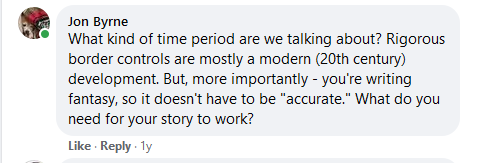
Lately, however, there’s been a few questions that have really rubbed me the wrong way. Not because they’re bad questions in general, but they’re odd questions to ask when you’re writing fantasy. Here’s an example:

Now, I’ve written before about research in fantasy and how helpful it can be and wondering about how border controls have worked through history is right in line with that advice. History is stranger than you might imagine and can provide great fodder for world building. The problem I have is the word “accurate.” After all, what does “accurate” mean when you’re writing fantasy? Not much. Hence, my bottom line advice:

Similarly, someone asked a question about a fundamental background piece of their world:

And, likewise, my answer:

But the one that really got me, and made me want to throw things across the room, was this one:

I didn’t answer this one, as I feared I’d be entirely too snarky. The question is just . . . odd. “Immortals” are not real. Everyone, and everything, dies. The only limit on an immortal character in a story – a classic trope for a reason – is (to quote Frank Zappa) “the imagination of the imaginer.” What possible answer could there be to a question like “can immortals have children?” Why the fuck not? Or, if you want it to be so, why not that instead?

All of this is to say that the great thing about fantasy – what really distinguishes it from its cousin science fiction – is that there are literally no limits. Whatever universe you build should make sense internally and not seem like a giant game of world building Calvinball (unless that’s the point!), but outside of that, go nuts! You don’t need for it to follow the real world or be a logical extrapolation of reality. That’s the entire point and joy of writing fantasy – the rules are yours to make.

So, next time someone asks whether they can do something particular in their fantasy story, remember there are no “yes” or “no” answers – as with the law, the right answer is always “it depends.”

Weekly Read: The Humans

The beginning of Matt Haig’s The Humans is great. After a quick intro that implies the following narrative will tell a tale of a mission gone wrong, we’re thrown into the main character’s point of view as he arrives on Earth. An alien, he takes over the body of an Oxford scientist who’s just made a breakthrough humanity hasn’t earned. It’s the alien’s job to squelch all knowledge of the breakthrough, by any means necessary.

That could be the setup for a very heavy book, but instead Haig plays it mostly light, invoking the vibe of Douglas Adams. The alien spends quite a while learning about life on Earth and, in the process, giving Haig the chance to point out all the weirdness of modern human life, from coffee to soccer to TV news (which the alien observes should be rechristened “The War and Money Show”). This portion of the book is generally funny (in a “because it’s true” way) and a quick, breezy read.

It’s once the alien has learned about the world a bit where things go downhill. Not far, and not very fast, but enough to make me wish things had turned out differently. The plot is predictable, as the alien – who comes from a species that views everything as math (perhaps not wrong) and humans as murderous, greedy beasts – learns to love the place and that complicates his mission, particularly the parts that might require him to kill the wife and son of the man whose body he adopted (who is already dead, of course). Complications ensue, although they’re dealt with pretty easily.

I will say this for Haig’s alien – I love where he finds his breakthrough for loving humanity. What does it for the alien is music. Not just high-falutin’ classical music either, being entranced by not just Le Mer but also the Beach Boys and Air (among others). He even makes a reference to how fun it is to count music, which warmed the cockles of my progressive rock loving heart. The turn isn’t something unexpected, but it’s done pretty well.

Once the turn happens, however, the alien goes from being a sharp, amusing observer of the human condition to a mawkish purveyor of chicken soup for the soul. One chapter is entirely given over to a list of 40 pieces of “advice for a human” that he writes for his sort-of-son. A lot of this is pleasant, if not good, advice (“be alive” – who could argue!), but it includes those kinds of “live for today!” things that fall apart with any thought. Like, “don’t worry about your abilities, you have the ability to love – that’s enough,” which is a nice idea, but love doesn’t pay the bills or put a roof over your head. I’m not anti-love, far from it, but reliance on it as a life plan isn’t exactly solid. Or, “in your mind change the name of every day to Saturday, change the name of work to play.” Putting to one side how you’re going to figure out when anything happens in your new world of Saturdays (maybe there’s a book for that), but the thing about work is just insulting to anyone who does what they have to do (probably out of . . . .love!) to feed their family. Not everyone can lead a fulfilling professional life (I’ve been lucky in this regard) – some folks just have to scratch out a living. Or, “failure is a trick of the light.” No, it fucking isn’t! Sometimes you try something and fail at it – dealing with that is as much a part of life as anything. To see the supremely rational, mathematical main character fall so headlong into that kind of dreck is disappointing.

The other Haig book I’ve read, How to Stop Time, I thought wrapped up way too quickly. The same is true for The Humans. The alien eventually walks away from his semi-family, moving to California to teach and continue to live life. But, of course, he comes back and there’s a hopeful note of reconciliation in the end. This isn’t bad, necessarily, but it plays out over a chapter or two, whereas some detail of the alien’s life alone and what he does would have made the semi-happy ending feel more earned.

I don’t want to sound too harsh about The Humans. It’s a fun read, for the most part, and has some really funny bits, but it kind of peters out after a while. I understand that Haig wrote it after his own battle with depression and, through that lens, I can see the kind of zealousness of a convert coming through in the alien’s transformation into a lover of humanity. Maybe this is just one of those instances of the book ultimately disappointing me because it wasn’t what I wanted it to be which, after all, is my problem, not Haig’s.

One of my favorite current comics is Pearls Before Swine, in which the two main characters are a rat, cleverly named Rat, and a pig, cleverly named Pig. Rat is cynical, generally hates people, and finds fault with everything. Pig is open hearted, kind of lovingly dumb, and generally doesn’t let the foolishness of others get him down. I like to think that they reflect the two parts of my personality, constantly battling it out in my head (or think of it as killers and angels, if you like). This book, in the end, drove the Rat side of me nuts. The Pig side of me really liked it.

Make of that what you will.

On Pardons and Admissions of Guilt

I’ve almost written this post several times, but I’m only just getting around to it. I’ve gotten plenty of opportunities, at least.

Over the years, every time Trump has pardoned one of his cronies – as he recently did with Michael Flynn – one of the reactions (mostly on the left) has been that by accepting the pardon the recipient admits his guilt to whatever offense he is being pardoned for. I think this rests on a misreading of the relevant Supreme Court case. More than that, any quick thought about how pardons normally work show that one doesn’t really have anything to do with admissions of guilt at all.

The Supreme Court case at issue is Burdick v. United States, 236 U.S. 79 (1915). And to be fair, in Burdick the Court did say this, in distinguishing between pardons and legislative immunity:

This brings us to the differences between legislative immunity and a pardon. They are substantial. The latter carries an imputation of guilt; acceptance a confession of it. The former has no such imputation or confession. It is tantamount to the silence of the witness. It is noncommittal. It is the unobtrusive act of the law given protection against a sinister use of his testimony, not like a pardon, requiring him to confess his guilt in order to avoid a conviction of it.

Case closed? No quite, for two reasons. First, there is absolutely no citation to any other case or source to support the idea that accepting a pardon means confessing guilt. Second, no court, even the Supreme Court, proclaims on law in a vacuum. So what was it that was the actual issue in that case?

Burdick was the editor of a New York City newspaper that had published leaks from inside the Treasury Department. The local US Attorney convened a grand jury to investigate and called Burdick, hoping he would name his sources. Instead, Burdick invoked the Fifth Amendment and his right to remain silent. To get him to talk, the US Attorney went to President Woodrow Wilson and obtained a pardon, which would extinguish the ability of Burdick to plead the Fifth (which, coincidentally, is where Flynn is now). Burdick refused to accept the pardon, continued to refuse to testify, and was eventually convicted of contempt for doing so.

When the case reached the Supreme Court the issue was, in the Court’s words, a “narrow question, is the acceptance of a pardon necessary?” Ultimately, the Court held that it was and that the person to whom the President wants to give a pardon doesn’t have to accept it (this is one hook upon which hangs the theory that Trump cannot pardon himself). It was in discussing why someone might not accept a pardon that the Court noted that it can be perceived as an admission of guilt. Thus, what a pardon means to the person accepting it wasn’t the issue before the Court – it was whether the person could reject the pardon in the first place. To my reading, that doesn’t to a clear legal basis for saying that the acceptance of a pardon is an admission of guilt.

But beyond what Burdick actually says (and about what), the idea that parsons require admissions of guilt just doesn’t make sense in a lot of cases and would create some real perversity in other cases.

For one thing, posthumous pardons exist, though they’re rare. In 1999, Bill Clinton entered the first federal one for Henry Flipper, the first African-American to graduate from West Point. It came 118 years after Flipper’s court martial and almost 60 years after he died. Trump did something similar with heavyweight champion Jack Johnson, granting a pardon in 2018 for a bogus Mann Act conviction that occurred in 1913 – Johnson died in 1946. There are countless other examples of posthumous pardons at the state level. Needless to say, the dead cannot admit to anything (they can’t accept anything, raising questions of whether these pardons actually mean anything) or confess to a crime in order to receive pardons. Whether posthumous pardons make any kind of sense, they are a thing, and they argue against the act of pardoning involving any kind of admission of guilt.

For another thing, some pardons are issued in anticipation of prosecution, not after a conviction. The most notable example is Gerald Ford’s pardon of Richard Nixon after his resignation, not for specific crimes for which he’s already been convicted, but for any crime for which he could have been charged. Notably, while Ford apparently carried hunk of Burdick around with him as proof that an acceptance of a pardon was a confession of guilt, Nixon’s own statement accepting the pardon didn’t confess to any particular crime (although he apologized for the “anguish” his actions had caused – the prototypical “I’m sorry because you’re sad” nonpology). What would the recipient of such a pardon confess to without having been convicted of something?

A related concern is mass pardons, which cover entire classes of people and aren’t concerned with the particular facts of any one case. Such pardons include Andrew Johnson’s mass pardon of ex Confederates after the Civil War (notably, the oath required to get one was all about allegiance going forward, not confessing to past crimes) and Jimmy Carter’s pardon of Vietnam War draft evaders.

Finally, requiring those who are offered pardons to admit guilt in order to receive them would lead to perverse results. Convicted people who are actually innocent may be loath admit to something they don’t believe – that they’re guilty of a crime – in order to get a pardon. This is the same dynamic that sometimes plays out with parole boards – they want some sign that the inmate at issue is remorseful and reformed, but if you’re wrongfully convicted how can you provide that? Furthermore, the use of the pardon power to spare the innocent is, arguably, it’s primary function. Thus, when the Governor of Illinois issue a pardon to Oscar Neebe and his codefendants (convicted in 1886 for taking part in the Haymarket bombing) in 1893, because they were innocent. In 2011, the Governor of Colorado posthumously pardoned a man who had been executed in 1939 because his conviction was based on “a false and coerced confession.” Other examples of similar pardons abound. If, as we’re often told, pardons are supposed to be a kind of safety valve in the criminal justice system, to allow executives to give relief to those who did not commit the crimes of which they were convicted, reading the acceptance of a pardon to mean a confession of guilt makes no sense. Pardons, as well as commutations of sentences, are acts of executive grace, the last vestige of the absolute power once granted to kings. They can be granted for good reasons, bad reasons, or no reason at all. That’s the point – this is the one area where the executive gets to make that decision themselves. Maybe that’s an idea whose time has passed, but it would require Constitutional amendments to change. The very nature of pardons is that they don’t come with strings attached (unless they specifically do), certainly not the requirement of admitting guilt from the one being granted the relief.