Weekly Watch: The Beatles: Get Back

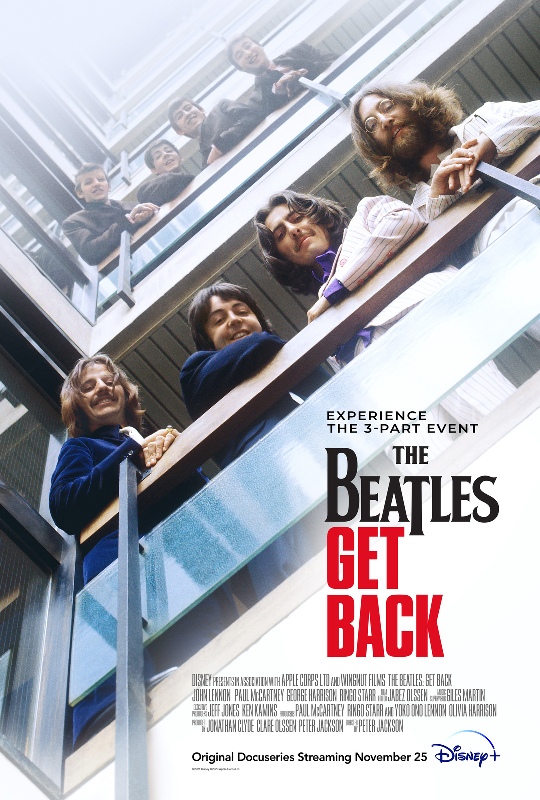
I am not the biggest fan of The Beatles in the world. Sure, I have every album from Rubber Soul on, but if push came to shove and was forced to save my favorite albums from a fire or something I doubt they’d make the cut. Still, when it was announced that Peter Jackson had cobbled together a multi-part documentary from the infamous Let It Be sessions, I was excited. With a long Thanksgiving weekend, it only made sense to dive in whole hog (or turkey, as it were). I’m glad I did, but I can see where other folks might not be able to push through it all.

It’s a Lot

“Multi-part” doesn’t quite do justice to just how much there is to digest in TB:GB. Each of the three parts is feature-length in its own right and they clock in at almost eight hours altogether. There are reasons for that – there was nearly 50 hours of footage to work with (and three times the amount of audio). In addition, I’ve read that Jackson added some footage once Disney decided the Blu-Ray release wouldn’t have any bonus features and he didn’t want the footage to disappear back into a vault for another few decades. All fine and good, but is it worth it?

It depends on whether you one of two kinds of people – or a third kind with a foot in both camps. The first is diehard fans of The Beatles who will absolutely want to spend all the time picking up on the minutiae of proceedings. The second are people who are interested in the creative process and seeing how the musical sausage gets made. I’m in the third group – I’m most interested in the sausage making and like The Beatles enough to wade through all the music they make in the process (I’d watch a similar, but much more brief, doc on, say Taylor Swift, even though I don’t really like her stuff).

If you’re not in one of those groups, you’ve probably got a better way to spend eight hours. That’s partly because given the fly-on-the-wall approach of this you really have to pay attention to what’s going on. Occasionally there’s text on screen to transition between scenes, but there’s no narration, no talking heads to guide you through what’s going on. You either jump in with both feet or don’t, in other words.

George On an Island

The dynamics of the band as they work are the most fascinating part of TB:GB. For all their troubles at this point, Paul and John and still a unit and tend to drive things (Paul, in particular). They’re not really the songwriting team they once were, but they help shape each other’s material in any case. The other two, well, they’re kind of odd men out. Ringo copes with all this by being Ringo, the most laid back man on the planet. It’s not for nothing that initially at the movie studio in Twickenham he’s on a riser, up and apart from the other three, and then at Apple studios he’s behind a sound barrier with his drums. His ability to let the bullshit pass him by while doing his job really well definitely says something.

George, sadly, doesn’t have the same personality make up, or whatever, that allows Ringo to go along and get along. He seems to be having a serious crisis of confidence through most of the sessions. Early on he brings up Eric Clapton and admiringly talks of his work with Cream, clearly feeling insufficient as a player by comparison (almost anybody would, right?). Later on he has trouble generating enthusiasm from the others for some of his songs, including “All Things Must Pass,” which would wind up as the title track on his first solo album.

It may have ever been thus, but by the time these sessions start the various stresses of the band clearly leave George out on his own most of the time. Which leads to . . .

George Quits

As I said, I’m not the biggest fan, but I did know that Ringo quit for a bit during the making of The White Album. I had no idea George did the same during these sessions. I can’t say I blame him, but two things really stood out about that.

First, it happened without any of the kind of drama or hysterics you might expect. He did not fling his guitar down. He didn’t kick over an amp. He didn’t curse anybody out, yell, scream, or otherwise make an ass of himself. George simply announced that he was leaving and then did. If you were writing drama I don’t know that you’d have a character do it that way, but it almost hits harder for being so low key.

Second, what happens next is, dare I say it, very Spinal Tappish? In that classic mockumentary, lead guitarist and founding member Nigel Tufnel storms off stage and quits the band. Asked the next day about his leaving, co-founder David St. Hubbins downplays it, noting just how many people have been in the band over the years (all those hapless drummers!). When confronted that surely Nigel leaving is different, David eventually admits that he might feel different if he wasn’t sedated.

Part two of TB:GB begins with the band dealing with George’s absence and, at least initially, it’s no big deal. There’s no talk of the band being over. There’s no real talk, even, of stopping the sessions. Things are paused, somewhat, while George is talked back into the fold, but that’s about it. There’s talk of potential replacements, even! No wonder George walked out.

Sparks of Genius

One thing that really comes out of TB:GB is that, even for some of the most lauded songwriters of their generation, writing songs is hard work. There’s slog, there’s false starts, there’s struggle (as a recently departed genius wrote, “art isn’t easy”). As a creative person who often struggles with writing (and music making) it’s encouraging to see that even these guys have a hard time with it.

That said, there are some amazing moments where sparks of genius emerge from almost nothing. Most notably is the genesis of “Get Back” itself. A recurring theme of the Twickenham sessions is that John (with Yoko in tow) is almost always late, leaving the others to fart around waiting. On one of those mornings Paul is absent-mindedly strumming his bass when all of a sudden the opening riff of “Get Back” emerges. It takes hours of work (in documentary time) to actually get the final song out (at one point it takes a diversion into being a protest song about racism and xenophobia in the UK), but the nugget of it comes out of nowhere. It’s very cool to see those things happen.

The Life, Death, and Rebirth of the Live Show

The original plan for what became Let It Be was for the band to get together to write and rehearse new material (while being filmed for a documentary) which would be the basis for a new album and a live concert. The band hadn’t played live in a few years, so anticipation was high for that, at least outside the band. The band never seemed on board and one of the more amusing themes of TB:GB is how the live concert element continues to morph until it winds up with the famous concert on top of the Apple Corps building.

The plan that made the most sense was to build a set at the film studio and bring a live audience in, but nobody is really that interested in that (they’d done it before). One of the band’s handlers suggests doing the concert in an ancient amphitheater in Libya, but it would take a few more years for Pink Floyd to get there (basically). A sub idea of that was to bring the audience with them on cruise ships to that venue, which nobody in the band is up for. Apparently the only thing worse than being cooped up with their fellow Beatles would be being stuck on a boat with loads of fans. Given that various music cruises are a thing these days (or were, before COVID) I wonder what the artists involve really think of those.

What a Live Show!

Of course they did wind up putting on a show, on the roof of the Apple Corps building in downtown London. If I remember correctly, Paul actual floats this idea early on, but it’s waved away while they consider more traditional alternatives (Paul, in general, is the driving force to have all this wind up being something other than just an another album). We get all of it, which is both great and a little bit of a grind – they only do a few tracks and take multiple takes of most. That said, several of those takes are what make it onto Let It Be in the end, so it’s cool to get them in all their glory.

The dynamic of the band through the sessions really comes into sharp relief up on the roof. John and Paul come alive on stage and are having a blast. George is more subdued, like rocking out on a cold, windy rooftop isn’t the best idea. Ringo just does what he does, unflappable behind the drums.

A word here about the fifth Beatle for this show, keyboardist Billy Preston. He’d met the band way back in their Hamburg days and dropped in the sessions in London just to say “hi.” He wound up drafted in to playing electric piano and organ (and goofing around with a Stylophone!), fleshing out the band’s sound, dedicated as they were to doing it all live. It’s after he arrives that things really get more focused and it’s not beyond the realm of possibility to suggest that he’s the real hero here.

Another word about the baddies of the piece – the cops who come to shut everything down. If, like me, you’ve ever wondered if Monty Python sketches were too hard on British cops and authority figures, exaggerating for comedic effect, this footage convinced me they weren’t. The cops couldn’t have been more wet blankets if they had been played by John Cleese and Graham Chapman. There’s even a pepper pot who complains on the street! Life imitating art (or vice versa) and all that.

It Just Ends

This is an odd thing to say about an eight-hour long documentary, but it really just ends, without wrapping up stuff very well. After the concert on the roof there’s some brief footage of folks listening back to the recordings the film rolls credits, over which some more footage of the last of the studio recording takes place. It’s an odd choice that, among other things, leaves us without a full take of “Let It Be.”

Beyond that, given that the film is about the creation of these songs, it’s odd not to have a post-script about the actual release of the album. Or about how they went back into the studio almost immediately to work on what became Abbey Road (several songs from that album pop up during these sessions). Or about how Phil Spector got a hold of Let It Be and glooped his production onto it. Or . . ..

I get it – you got to stop sometime and that’s when the footage ran out. Still, given that there’s a little “how we got here” prologue for the band’s history a similar epilogue would have made sense.

Get Back, Jo

As I said, if you’re a Beatles fan or interested in seeing music get made, from the ground up, this is well worth your time. Otherwise, probably not. I’m glad it’s here and I’m glad I had the time to work through it. I don’t think I’ll add the Blu-Ray to my collection, though.
Widows of the Empire: A Second Excerpt

One more week until Widows of the Empire comes out! Here’s a second excerpt, in which Belwyn, stuck in exile in Annanais, finally receives a particularly stubborn caller.

That the Temple of Rend meant something to Belwyn didn’t mean she had an idea of what this particular acolyte wanted with her. She’d made the gesture to rebuild the temple in Cye after the explosion that led her to Cotber and started her examination of Port Ambs. Hagan had made all the arrangements and Belwyn hadn’t given it much thought. It had been a spur-of-the-moment thing, a decision made in the wake of sorrow washing over her for people who had lost a place where they could worship. Just because she didn’t need such a space didn’t mean she couldn’t appreciate the loss.

She wracked her brain, trying to remember if the temple had reached out to her. Maybe they had contact with Hagan, but she couldn’t conjure any memory of meeting with them. She hadn’t expected to, but why not? It would have been impolite not to acknowledge their benefactor. What if they didn’t know? Belwyn couldn’t remember telling Hagan to make the donation anonymously, but she might have. If that was the case, how would any acolyte know about her role?

She was sitting in the courtyard, after lunch, when Neven approached.

“It’s time, Lady,” Neven said, gesturing toward the formal receiving room.

Belwyn followed, pushing down a lump in her throat. A guard, one of Brixton’s men, opened the door for them. Neven waved Belwyn through, then followed behind her.

There were three people waiting for them in the room. Two were Brixton’s guards, who were making a display of their rifles, holding them in their hands, ready for action. They looked menacing, not the generally easygoing men who rarely did anything with their guns but sling them over their shoulders. In between them stood a man in a long, grey robe, complete with a hood that partially hid his face. Belwyn could see just a scrap of a beard poking out from underneath. He was hunched and looked frail, particularly between the two guards.

“Is this necessary?” she asked Neven, while gesturing toward the guards. “This is a man of the gods, after all. Can we not treat him with some dignity?”

Neven gave a signal and the two guards shouldered their rifles and left the room. “It was merely a precaution, Lady.”

After the guards left, Belwyn gestured for the man to sit on one of the stuffed chairs by the window, which he did slowly, shuffling with short steps. Belwyn sat down across from him while Neven took up her place a few feet away. Either she, or one of her underlings, had to be close enough during meetings to make sure no one told Belwyn something inappropriate.

“Lady Belwyn,” the acolyte said with a slight bow, his voice rough and low.

“You have me at a disadvantage, sir, since I do not know your name,” she said.

“You may call me Gendil, Lady, if it pleases.”

She smiled. “I once had a horse named Gendil. I was very fond of him.”

“A favorable coincidence, Lady.”

The was an uncomfortable silence. “What is it I can do for you, Gendil? I understand you come from the Temple of Rend in Cye. Is that right?”

“That is why I am here, Lady,” he said, “but I am not from the temple in Cye.” He paused, glancing over at Neven.

Belwyn followed his gaze, sensing an opportunity. “Is there a problem with Neven?”

“I’ve spoken with her many times,” Gendil said, “but what I have to say is only for your ears, Lady.”

Belwyn turned to Neven. “I think you can see that there is no risk or danger here, Neven. Can you leave us alone for five minutes?”

“You know I can’t, Lady,” Neven said.

“Your people have made exceptions before,” Belwyn said. It wasn’t strictly true. She’d managed to get her handlers out of the room for moments here and there, but never this blatantly. She hoped the thought would throw Neven off her guard just enough.

“Not with my permission,” she said.

Belwyn shrugged. “Regardless, nothing untoward has come of it. You can keep Britxon’s men on the other side of the door, for all I care, but surely five minutes to indulge this gentleman isn’t too much to ask.”

Gendil shifted in his seat toward Neven, like the effort of doing so was almost too much for him to bear. “Madam, if I may. What I wish to discuss with Lady Belwyn is of a sacred nature. The rules of my order emphasize confidentiality in personal interactions. I understand if you must be present, but do know that it will be an imposition upon my faith.”

Belwyn looked at Neven with pleading eyes. Gendil’s evocation of religious dogma made her skin crawl, but the idea that he wanted to talk to her alone was intriguing. Not to mention, the sooner Neven left the room, the sooner she could be done with this. After all, the man had appeared for two weeks straight and was unlikely to take “no” for an answer. “Five minutes?”

Neven looked like she was going to fire off a cable to Chakat about this, to try and get out of this assignment. But Belwyn had seen that look before, a look of resignation. “Very well. I wouldn’t want to interfere with a religious exercise. I’ll be back in three minutes.”

Belwyn waited for the door to be securely shut behind Neven before saying, “Thank you for coming to see me, Gendil, but I have to warn you, I’ve never had much use for the gods.”

Gendil straightened and pulled back the hood of his robe. “How could I ever forget that, Lady.”

It took her a moment, but once she studied the eyes, she knew. Belwyn put her hands over her mouth to contain the scream of excitement that welled inside her. She took a deep breath, then whispered, “Hagan!”

He nodded. “Yes, Lady.”

Widows of the Empire
Out November 10
Preorder now for Kindle or other eBook formats

Happy Halloween! Have Some Free Stories!

For several of the past few years I’ve written some spooky short fiction for Halloween (originally at the urging of fellow West Virginia author Eric Douglas). I was planning to do the same this year, but preparing Widows of the Empire for release on November 10 has really kept me from getting it started. So, here in once place, are links to the stories I’ve written before. Grab a drink, turn off the lights and set a candle ablaze and (in the words of Count Floyd) prepare to have the pants scared right off of your legs . . . or wherever you wear them!

“Shift Change” (2020)

Last year, the year of the plague, was hard on everybody, demons included. Picture something like the opening of an episode of Hill Street Blues, but not quite, and you’ll have the right idea. Everybody’s got a job to do.

“The Invited Guest” (2017)

Devil summoning is a an old trope, but I thought I’d have some fun with it. This arose, if I’m remembering it right, from a factoid I learned about raising the devil by tossing a heel of bread over your shoulder into a fire. Probably won’t work (playing a tri-tone while you do won’t help). The title is a riff on a Marillion song, naturally.

“All the Wishes” (2016)

This is the second of two stories that Eric mandated be precisely 100 words long – not up to 100, exactly 100. It’s a fun, if frustrating, exercise. This story is about wishing well (or not).

“Quotas” (2015)

The first of the 100-word stories, it shares some thematic connection with “Shift Change.” Apparently I’m interested in how demons make a living.

Happy Halloween everybody!

Have some Rush in your plastic jack-o-lantern for the walk home.

Widows of the Empire: The Southern Islands

As we continue hurtling toward release day for Widows of the Empire, I wanted to return to the issue of geography that we touched on a couple of weeks ago. In that post I talked about the geography of the Unari Empire itself, but this time I want to journey a little further afield.

Gods of the Empire all took place on the single, large continent that dominates much of Oiwa’s northern hemisphere. Aside from that one, across which the Empire sprawls, there are two other smaller continents to the west, sort of Australia sized. The nations there have formed the Western Alliance in the years since the Port Ambs bombing and Chakat’s becoming Emperor, as a way to check his global reach.

The southern hemisphere of Oiwa is an entirely different kettle of fish, as it’s composed entirely of islands. A couple of them are largish, but nothing so grand as to earn the label “continent.” As a result, the Southern Islands (as they’re generally referred to when lumped together) are wildly diverse and independent, without any of the kind of trans-national alliances you find up north. That’s allowed Chakat to roll in with ships and Imperial Marines and cause more than a little havoc in these islands without any real consequences.

Like Ruttara Key, not much more than a speck on the map in the far southern part of the hemisphere. Sure, it would be a perfect place for some of the Port Ambs plotters to hide out, but it was also home to hundreds of ordinary people just trying to live their lives. They saw their fishing boats sunk, their villages burned, and people indiscriminately shot for doing nothing at all. At one point no one on Oiwa had heard of the place. Not so any more.

The closest you get to an alliance to rival the Western Alliances is the Relevan League, based around the city of Releva. A commercial and shipping up in the northeastern part of the islands, it’s kind of the jumping off point for travelers from the north. It’s as large as Cye, but spread up and down the coastline instead of packed into a grid of urban streets and with clear skies, given the lack of industries. Of course, everything smells of fish which, as one observer notes, is “overwhelming.”

The Southern Islands are also full of small islands, not much more than rocks jutting out of the water, that hold unknown treasures, such as ancient lost cities. Or places like the Grim Islands, so named because there’s nary any vegetation or life on them, but they do provide a good hiding place for pirates and other rabble rousers.

Given that there are thousands of islands in the south, it’s not possible to chart all of them. That’s created a fertile territory for explorers, seeking to make their name and their fortune. One of the most famous is Stanley Glass, who has won renown for several discoveries in the Southern Islands. His finds are so spectacular that they let most people overlook the horrible toll his expeditions typically take on his crew. Long-term employment isn’t in the cards when you sail with Glass – so why is Aton so willing to sign on?

Widows of the Empire
Out November 10
Wherever fine ebooks are sold

Widows of the Empire: Excerpt

Continuing on with some posts about the upcoming Widows of the Empire, here’s an excerpt from the book in which Aton goes to meet a persistent potential new client and gets quite the shock:

Aton realized that he never really liked The Ferry. It was conveniently located in Cye, a good place to get business or meet someone, but it wasn’t the kind of place he liked to hang out. Aside from slamming down a drink after a job was over, he rarely came here just for the sake of it. Now, finally, he knew why.

The place was crowded. Not because there were so many people here, but because of how the room was laid out. The long, curving bar was enormous. Tables in the middle of the room were arranged haphazardly. In addition, the bare wood interior amplified every voice in the place. Even though there were only a handful of people here, the din was distracting. He was amazed he was ever able to conduct business here. He maneuvered the obstacle course of tables and chairs to make it to his old spot in the back corner.

While he didn’t miss The Ferry, Aton could admit to himself that he missed being downtown. The new house was lovely and bucolic, but it was also quiet and isolated. He’d grown up in Cye and was used to the noise, the crowds, and the occasional stench. It’s why he’d toyed with the idea of finding a small office somewhere nearby in case he needed to handle anything that came up in the city. Truth was, however, the only business he would do was with Laffargue, and that happened at the Voisine. An empty office was an expense that didn’t make any sense.

He had arrived half an hour early, supposing that Vesper wouldn’t show until their arranged meeting time. Whatever his talents, Vesper didn’t strike Aton as one who thought of worst-case scenarios and alternatives. Like a dog with a bone, he was relentless and driven, but not particularly creative. Being early allowed Aton to control the terrain, like a general pushing his troops to secure high ground before a battle. Maybe he was overthinking it, but better to be over prepared.

He passed the time scanning the crowd. It was like any skill, one he had to practice for it to be sharp when it was needed. There was part of him that wanted to find Okun there, although he had no idea what he’d say to him. He was here for work, after all, and maybe Okun would be, too. There would be no reason for them to just have a drink together. The issue never came up, as the big, bald man never made an appearance.

Aton was just about to start clock watching when he saw Vesper slip in the front door. He looked around a few times, less like he was trying to find Aton than like he was getting the lay of the land. After a moment he held the door open and a person walked in the door. Shorter than Vesper, shorter even that Aton, the individual was wearing a deep blue floor-length cloak with the hood drawn up around the face. Aton thought it was a tad dramatic, but everyone had their quirks.

Vesper led his client through the room, slamming his leg into a chair about halfway through.

Aton suppressed a laugh.

He reached Aton’s table and tipped his cap. “Mr. Askins, glad to see you here.”

“I made a deal, didn’t I?” Aton said. He waved at Vesper to stand aside. “So who is this mystery client?”The figure behind Vesper stepped forward and lowered the hood of the cloak.

“Oh, shit,” Aton said, deflating. “Ethyna.”

Widows of the Empire
Out November 10
Wherever fine ebooks are sold

Widows of the Empire: The Unaru & the Knuria

In the run-up to the release of Widows of the Empire, I wanted to highlight a few things about the world of the Unari Trilogy (for more background on the trilogy, the setting, and the characters, see this post I did before Gods of the Empire came out). Today, we look at the two largest and most important parts of the Unari Empire – the Unaru itself and the Knuria.

Being an empire, of course, the Unari Empire is composed of several disparate regions, all brought under Imperial rule. That said, there are two main ones that occupy a lot of the history of the Empire and the books in the trilogy.

The Unaru is, essentially, the original Unari Kingdom, composed of the areas around the Imperial capital of Cye. If we’re going to analogize to the Roman Empire, then Cye is Rome and the Unaru is the Italian peninsula. It’s made up of a fairly homogenous people in terms of culture and ethnicity with historical ties to the area and to the rulers who have sat in Cye for centuries.

The Knuria, by contrast, is a vast expanse of rolling farmland and rugged hills, without any real coherent cultural identity. Conquered during the expansion of the Empire, it has had second-class status ever since. If you remember when our heroes (well, some of them) wound up near a mined out bosonimum pit in Gods of the Empire, with its crumbling mining town nearby, you can get a sense of what I mean. Likewise, if you detect a bit of West Virginia in the Knuria you’re not wrong. It’s a breadbasket and extractive resource region of the Empire. Going back to the Roman Empire comparison, the Knuria is like the other parts of Europe that the Romans eventually conquered – culturally and ethnically diverse, brought to heel by force.

An aside here to say that, when I was conjuring up the Unari Empire, I was less inspired by Rome than I was by the Soviet Union. In a way, the Unaru is like Russia proper, the Knuria like the other Soviet republics – part of the USSR, but arguably separate states – and then there are other states that are within the sphere of influence. For the Empire that includes the states north of the Knuria, where some of our heroes found themselves in the second part of Gods of the Empire.

The Unaru and the Knuria are separated by two major mountain ranges. The smaller of the two, the Rampart Mountains, is north of Cye and forms the northern border of the Unaru (along with the related Rampart River). The much larger of the two, the Granite Curtain, is a huge range that runs most of the rest of the border between the Unaru and the Knuria. They’re basically impassable, a favorite hangout for outcasts and, once upon a time, gods.

Given all that, people from the Unaru look down on those from the Knuria a bit. It’s less an active discrimination than a deep-seated belief that the Knurians are just a little less developed, less civilized. It’s the urban/rural divide writ large, as there’s no place in the Knuria that can come close to Cye.

We see that a little bit with the contrast between Aton and Belwyn, our two main characters. Aton is a Cye native, an Unaru, who really hasn’t travelled outside the city (and the surrounding area) before his current work hunting down ancient artifacts of the gods. He’s “worldly” in the sense that he grew up in a large, bustling city. Belwyn, on the other hand, is Knurian, having grown up in the small lakeside town where, at the start of Widows of the Empire, she is imprisoned. That said, they both start their stories as a little bit sheltered to the realities of the wider world. They both get an education during Widows of the Empire in a way that, I hope, broadens and deepens the world they’re moving around in.

The bottom line is that the Unaru needs the Knuria and the Knuria needs the Unaru. They may not quite realize it yet.

Widows of the Empire

Out November 10

Wherever fine ebooks are sold

September Siesta

Not really, but I am going to be taking a break from the blog for this month. I’ve got some traveling to do, a couple of big work things, and the next draft of the final book of the Unari Empire Trilogy that all need attention this month.

When regular programming resumes in October it’ll be focused primarily on Widows of the Empire as we move closer to the November 10 release date. What do you want to know about the new book before it’s released? Let me know!

Weekly Read & Watch: Eight Men Out

I’m not a baseball fan. I don’t hate it – life’s too short to get worked up about other peoples’ pastimes – but it doesn’t engage me. It might be odd, then, that one of my favorite movies is Eight Men Out, John Sayles’ exploration of the infamous “Black Sox” scandal, when a group of Chicago White Sox players threw the 1919 World Series.

Of course, what makes the movie work so well is that it isn’t really a baseball movie. It’s a movie about labor relations, in which the ballplayers are exploited at first by the club’s owner, Charles Comiskey, and then by unscrupulous gamblers who don’t even pay the players what they’re supposed to. I won’t say the baseball stuff is secondary (there’s a good deal of on-field action), but it’s definitely used in service to something other than your traditional sports movie narrative.

The film is based on a book of the same name by Eliot Asinof that was first published in 1963.

I only just got around to reading the book itself, which is an interesting contrast to the movie. They tell the same story, but there are some interesting differences that arise from Sayles really driving home the political point of view he’s coming from.

What the book does better than the film, since it has more time to cover the story, is provide more context to what happened in 1919. For one thing, while the movie presents the Black Sox scandal as almost sui generis – a huge breach of sporting life – it turns out the gambling-related scandals were pretty common in baseball at the time. Granted, they hadn’t gotten up to the level of the World Series, but in truth this was the straw that broke the camel’s back rather than a singular incident. Indeed, one of the earlier scandals involved the Sox’s opponents in the World Series – the Cincinnati Reds.

The book also provides more context for what is alleged to be the prime driver of the players’ interest in the fix – that Comiskey was a particularly miserly owner. The movie moves a couple of incidents (involving avoiding paying bonuses) from 1917 to 1919 to help drive this home. While the book argues that Comiskey was a tight wad, it also shows that the rest of the owners weren’t much better. In the days of the reserve clause, where free agency didn’t exist and players were forced to play for basically whatever wages the owners offered, it was easy to be a tightwad. There’s also attention given to contract terms that allowed players to be fired with 10-days notice for just about anything (including getting injured), but they had no similar right to walk away. It’s not as if your best player could fuck off to another team when their contract was up. More than that, given that the country was just coming out of World War I there was a rational (if not completely honest) basis for owners to worry more about money. Being a professional baseball player then wasn’t much better than being a professional women’s soccer player is these days, complete with the side hustles. The movie focusing on salaries makes that easier to convey in a dramatic narrative of just about two hours.

For all that context there’s one area where I wish the book would have provided a little bit more. Having read the book I’m still not sure where gambling fit into society at the time of the 1919 World Series. The gamblers involved in this story are all pretty sleazy characters with connections to organized crime, but gambling itself seemed to be much more open and notorious than it would be in later years. There’s a recurring motif of entertainer George M. Cohan being close to the fix (although not involved) due to gambling that makes it seem not quite illegal – but maybe not quite legal, either? I’d be interested to know what society thought of gambling back then as a way to help explain the reaction to the fix.

The book also dives deeper into the aftermath of the series and the eventual exposure of the fix. The movie keeps a tight point of view on the players, while the book follows the journalists and lawyers who probed the series and the gambling that surrounded it (Sayles compresses most of this into a jazz-fueled montage). In particular, I appreciated the details on how journalist Hugh Fullerton (played by Studs Terkel who, along with Sayles himself as Ring Lardner, act as kind of a Greek chorus throughout) was roundly vilified for daring to suggest that something wasn’t on the level. History proved him right, of course, but that might have been cold consolation.

As for the lawyers – well, if baseball came out of the entire scandal with a damaged reputation, my profession didn’t exactly cover itself in glory. Some of the more melodramatic parts of the movie – grand jury testimony being stolen, outbursts in the courtroom – weren’t added for dramatic effect, it seems. At the eventual criminal trial (where everyone, players and gamblers both, were acquitted) the players were represented by lawyers paid by Comiskey who were more interested in letting baseball (with its new, all powerful, commissioner) deal with the matter than the courts. But my favorite bit of lawyerdom in the movie is when Kennesaw Mountain Landis, a federal judge named the first baseball commissioner, takes the job for significantly more pay than being a judge – but keeps his seat on the bench, anyway.

Where the book and movie differ most importantly is when it comes to the genesis of the fix itself. In the book it’s clear that the fix began with the players, who reached out to gamblers about the possibility of fixing the series. The film is a bit more vague. The conversation where it’s first broached by Chick Gandil and gambler Sport Sullivan starts kind of in medias res, with no real indication of who made the first pitch (so to speak). I think it lets Sayles maintain his exploitation narrative without sullying the players too much.

Ultimately, though, it’s important to consider that the Sayles movie is a narrative work of fiction, not history, and the Asinof book is now nearly six decades old. As compiled by the Society for Baseball Research, more recent evidence has emerged that cast some doubts over the story told in Eight Men Out. In particular, maybe Comiskey wasn’t the miser he’s been portrayed as being, although that doesn’t much matter in the end. The book, to a lesser extent than the film, is telling this story from the players’ perspectives and whether their complaints with Comiskey were valid in a wider context doesn’t mean they still weren’t motivated by them.

None of this makes the any less engrossing or means it can’t get at broader truths about America and its economic life. There’s truthiness to it, if not absolute truth. Just means it’s history, which is ever changing upon further evaluation.

Timing Isn’t Everything, But It’s Something

The Godfather came out in 1972, its sequel in 1974. I was born right in between, in 1973, which is to say I had no chance to experience these Coppola epics when they were fresh. In fact, it wasn’t until sometime 15 years ago or so that I actually managed to watch them. By that time I’d already consumed a good amount of mob stories, from Goodfellas to (most of) The Sopranos and many others.

It sort of makes sense, then, that I wasn’t exactly overwhelmed by the first two Godfather movies (I’ve never seen the third). They’re really good, don’t get me wrong, but by the time I saw them a lot of what made them exceptional had bled through into popular culture. The idea of morally conflicted mobsters was certainly a trope by 2005 or so. Likewise, the stress of familial obligations in the mob operation had been done and done by then. This is no fault of the original films – it’s just that by the time I experienced them they weren’t as timely as they once were.

I thought about The Godfather while I was reading Soon I Will Be Invincible by Austin Grossman.

As you might guess from the cover, it’s a superhero story. Why did it make me think of The Godfather? Because it came out in 2007 and I was reading it fourteen years later.

To give some context, the first MCU installment, Iron Man, came out in 2008. That same year is when The Dark Knight, the second of Nolan’s Batman movies came out (to be fair, we’d also had a few X-men movies). In other words, this book came out just as a huge chunk of the movie and TV landscape shifted to super hero stories. By the time I got around to reading it I’d consumed most (although not all) of them. And as a result, the book very much had a “been there, seen that” feeling to it.

Invincible plays out across two related points of view. One is Fatale, a fairly new cybernetic superhero who joins The Champions, a group of superheroes who have their own dysfunctional baggage (including a failed marriage between two members). That side of the story leans into that dysfunction and highlights the personal toll that being superheroes takes on each of them (from OCD to drug use and the like). It’s more personal and intimate than, say, The Avengers in the MCU, but it’s in the same league. There’s even a corporate element that reminds me of The Boys, although it’s not so cynical.

The other point of view is that of Doctor Impossible, who, conveniently enough, breaks out of prison for the dozenth or so time just as the book starts. He embarks on another scheme to take over the world, along the way diving into his own history as well as those of the heroes who have crossed his path over the years. What we get is a narrative in which the villain is fairly sympathetic, in that he’s a put-upon smart guy who channels his frustrations into evil. Again, this is pretty common these days in super hero properties. The era of the mustache-twiddling bad guys is a thing of the past, thankfully.

None of this has anything to say about Invincible as a book. It’s pretty good and darkly funny in parts (naturally, Doctor Impossible has all the best lines), but I can’t help but thinking that it might have felt really fresh in 2007 or a few years later. Today, sadly, it comes off as a bit tired. Is there anything Grossman could have done to prevent my reaction to his book? Not at all.

Is being timely something writers should worry about? Probably not. Certainly, if you were thinking of writing a book like Invincible today, you’d have to take into account how prevalent super hero stories are these days. One more similar story probably won’t attract a lot of attention. That’s a different discussion than trying to figure out how well something might age in the future. Unless you can predict what’s going to happen in years to come – in which case, why are you writing books? – it’s just not something worth worrying about.

Sometimes I see authors wondering about whether particular references – to pop culture things or news events – will “date” their work down the road. That always seemed very presumptuous to me, since it assumes anybody will be reading your work in years (or decades) to come. This issue is more of the flip side – how do you keep you work from being swallowed by general trends? You can’t – write what moves you and let the broader market sort itself out.

You can’t fight time – you can only hope to survive it.