Can’t Talk – Writing

Hey, gang. Guess what time of year it is?

I mean, yeah, there’s an election that’s probably not going to be over with for a while, but beyond that, it’s November which means . . .

It’s National Novel Writing Month!

That’s when folks, including yours truly, take the month of November to focus on writing the first draft of a novel – well, at least 50,000 words of it. I’ve done this several times and it’s a great way to jump start a new project. So, this year, I’m going to be writing the third book in the Unari Empire trilogy, Heroes of the Empire (yes, yes, I know, Widows of the Empire isn’t out yet – it’s with beta readers, so it is coming), thus bringing the whole thing to a thrilling (?) conclusion.

Which means – it’s blog silence for me for the rest of the month (at the least). Stay safe and I’ll see you on the other side.

“Shift Change” – A Short Story

“Shift Change” – A Short Story

Finally! Something about 2020 that feels normal. As he’s done in years past, author Eric Douglas has invited other writers to do some short fiction for Halloween. It’s always been fun, so I was happy to chip in another entry. You can read my prior Halloween short story here, as well as my two prior 100-word entries here and here. And, as always, head over to Eric’s place to check out stories from all the other folks.

Now, without ado – “Shift Change”


Vuzzaz sat at the end of the hall of the Amalgamated Union of Transdimensional Frighteners, Demons, and Purveyors of Dread building and watched the shift change turnover. He pretended to be engrossed in paperwork, but really he was just trying to get comfortable in his chair, watching beings. It was one of those hard plastic things designed to make you uncomfortable, but at least this one had an opening in the back so he didn’t have to sit on his tail. It swished back and forth slowly behind him.

He’d chosen this location carefully, after years of trial and error. It was far enough away that he couldn’t really overhear what anyone else was saying, but not so far away as to draw notice. Kothol demons aren’t known for keen hearing, anyway, but not every monster knew that. From here he could blend in and watch the low-slung shoulders, the puffy eyes, and other indicia of feelings even if he couldn’t hear the words.

The beings from the A shift shuffled out of the shift room, heads and tentacles down, with an air of defeat. One big red demon with four arms and a pair of swooping black horns was actually crying. Behind him, Munol, Vuzzaz’s counterpart for the A shift, put a tentacle on his shoulder in an effort at consolation. It clearly wasn’t working, leading Munol to turn and lock eye stalks with Vuzzaz.

As the A shift slid down the corridor and the B shift started to trickle in, Munol squeaked down toward Vuzzaz, his pungent slime trail dripping through the grated floor.

“Is it really that bad?” Vuzzaz asked.

 Munol did the closest thing to a shrug a being with no shoulders and six flopping tentacles could. “I’ve never seen it like this. You have bad days, we all have bad days, but you don’t lose the love for the work.”

Vuzzaz looked through Munol as the rest of his shift shuffled in. “It can’t go on like this.”

“What are you going to do?” Munol’s dozen eyes all blinked at once.

Vuzzaz stood. “Go find every old timer you can find. I don’t care what they’re doing or how far up the chain they are. Tell them to come to the shift room as soon as they can.” As Munol began to ooze away, Vuzzaz grabbed a tentacle. “I mean every one.”

As Munol slithered down the hallway behind him, Vuzzaz watched as the stragglers of his shift filed into the room. Last, as always, was Bagrozoth, who looked like a pale three-foot-tall sprite or fairy, until her performance began and she tripled in size and turned coal black.

“Sorry, boss,” she said, voice squeaking.

“Get in there,” Vuzzaz said, following her in and closing the door.

The shift room was like a classroom that had seen better days. There was a lectern at the front from which Vuzzaz or his colleagues could speak to their charges. The members of the shift itself – normally an even dozen but Zongriruk was out sick today – sat in folding chairs barely big enough to hold most of them. There was room for, maybe, three or four beings to come and stand along the wall near the door.

The din of conversation among the shift quieted when Vuzzaz stepped behind the lectern. He took a deep breath, even puffing up his auxiliary swim bladder for effect. The room was very quiet for a long while.

“I understand,” Vuzzaz finally said, “that things are hard out there. But that is no excuse for not trying to do the best job we can. The Earth relies on us.”

“Then maybe the humans should cut us some slack.” It was Var’ath, a Kosmar demon who haunted dreams. “It’s a nightmare down there, even before I clock in.”

A rumble of agreement from their coworkers, including the low rumble that meant the mountain of rock named Billy, showed that they shared their opinion.

Vuzzaz held up his hands to quiet the crowd. “Tough times come and go when you’re an eternal purveyor of dread. Things will get better.”

“When?” Mizrolas stood up. She was a slender reed of a demon, pulsing blue green with three piercing yellow eyes and a mouthful of sharp, dagger-like teeth. “I was sneaking up on a girl, a teenager, someone I should scare the pants right off of. What’s she reading about on her phone? This pandemic that’s closing cities down, killing hundreds of thousands, impoverishing millions. How am I supposed to compete with that?”

Numerous others chimed in with nods of heads, stalks, or whatever appendage they had handy.

“I was nestled in the corner of a TV room,” said Jegexath, who for the moment had taken the form of a humanoid made entirely of chimney smoke, “just waiting for the right moment to seep out over the floor and imbue the family with dread. Do you know what they start talking about on TV?”

“Tell us!” cried out Gorkazod, like they were in their unholy church.

“Murder hornets!” Jegexath said.

Another dissonant din erupted from the room as some of the others called out the parade of horribles they had heard about, too.

“Wild fires!,” someone called out. “Australia was literally on fire!”

Another added, “so many hurricanes they’re running out of names!”

“Shortages of toilet paper! And yeast!”

They were so riled up that they didn’t even notice when Munol opened the door and walked in, along with one other old timer. Vuzzaz had hoped for more, but he’d have to work with what he had.

Vuzzaz put up his hands again, but with limited effect. “Now, now, let’s settle down.” That didn’t have much effect either. He didn’t want to go harder, but they were short on time and he had a point to make.

“KNOCK IT OFF!” Vuzzaz roared, eyes turning a shade of flaming orange while his knuckles went black as he clutched the lectern.

That quieted the crowd.

Vuzzaz took a few deep breaths to regain his composure. “Thank you. As I was saying, I know this year has been harder than most, but it’s nothing we haven’t dealt with before.” He looked to Gorkazod, a Muisto with a knack for dates and names. “When did I start trying to scare people?”

Its eyes rolled into its head for a second, then it answered, “1918.”

“That’s right. 1918.” Vuzzaz nodded, waiting to see if the date sank in. These young demons were so ignorant of history. “I first went to work while the Earth was convulsed in a terrible war, upon which a pandemic more deadly than the current one developed. Do you think I complained? No. I put my head down and did the job, because it needed to be done.”

“Due respect,” Gorkazod said, sheepishly raising a tentacle, “people were different then. They didn’t have all the horrors of the world beamed into their homes 24 hours a day.”

Silent nods greeted this, but at least they all kept quiet this time.

Vuzzaz hung his head, then turned to Munol. “Would you like to tell them when you first started?”

“1349,” it said, surveying the room. “That mean anything to anyone here?”

A silence fell over the room, punctuated only by the rolling gurgle that Xanuth did when he got nervous and couldn’t control his fluid sacs.

“The Black Death,” Vuzzaz said. “Killed half of Europe. People thought they were living in the last days, but did that keep Munol from doing his job?”

“You know it didn’t,” Munol said, folding his tentacles defiantly.

Sogthoz was just starting to explain his first years working during the era of the Mongol hordes when the door opened and Rilgaxoth walked into the room. Everyone froze – Sogthoz even stopped at mid sentence – when the boss entered. It took a moment for the shift to remember protocol before they leapt to their appropriate appendages.

Vuzzaz did his best to conceal a grin and made a mental note to buy Munol a couple of buckets of fish guts later.

“Good morning, First Supervisor,” Vuzzaz said, bowing slightly.

“Deputy,” Rilgaxoth said, with barely a notice. “Carry on.”

It took a moment for Sogthoz to get back up to speed, and Vuzzaz felt as though his hearts really weren’t in it at this point. Still, he at least made clear to Rilgaxoth why he’d been summoned here.

Before Vuzzaz had to think of where to go next, Rilgaxoth stepped next to him at the lectern, sulfur clouds billowing in his wake. “May I?”

Vuzzaz stepped to the side without a word.

“August 26, 1883,” Rilgaxoth said, barking like he was upset he had to be here. “A volcano called Krakatoa erupted, blowing most of an island off Southern Asia to hell. Killed tens of thousands. Was felt thousands of miles away. Affected the climate of the planet Earth for weeks.”

Rilgaxoth snapped his fingers and an image appeared in the aether beside him – a strange, malformed man with his hands to his face, mouth agape, under a blood red sky. “That’s what Norway – fucking Norway – looked like because of this. People thought the world was coming to an end.” He paused to let that sink in.

“And I started my work here on August 28, 1883. The Earth looked like it was on fire and I got out there and did my job. Now,” he barked again, before saying almost in a whisper, “get out there and do yours.”

Vuzzaz wasn’t sure if he actually shot out the door or just vanished, but all that was left at the lectern was a slowly dissipating cloud of sulfur. Vuzzaz stepped up and waved some of the fumes away. “Any questions?”

Xanuth, who had to double over just to fit through the door, sheepishly raised his hand.

“Yes?” Vuzzaz asked, glancing at the clock on the wall. He needed to wrap this up.

“If the humans are already so scared,” Xanuth said, “if their world is so terrifying, then why do we have to frighten them even more?”

Only then did Vuzzaz grasp how bad things were. His charges weren’t lazy or trying to get out of doing a hard job. They’d forgotten what their job was.

“What we do is so important,” he said, “regardless of what reality the humans are dealing with. The truth is, if the humans ever really sat and considered their situation, they’d never be able to leave the homes. They lead brief lives of survival and desperation on a rock hurtling through space with no purpose, no plan.”

He took a deep breath. “Our . . . competitors,” he said with a shudder, “think the way to help them deal with their situation is to give them hope, false hope, that it all really means something, that there is some ultimate reward. We know better. We know that humans can do it, they can face their fears and improve their lot. That’s why we frighten. That’s why we scare. We give their minds a place to confront darkness and vanquish evil so that in their waking lives they can get on with the business of surviving. After all, Xanuth, what’s another jammed commute or a terrorist attack or even a global pandemic once they’ve dealt with you?”

“Fair point,” Xanuth said, shaking what passed for his head.

“You’re damned right!” Vuzzaz was starting to warm up now. “Same for you and you and you,” he went around the room looking every last one of them in the eye. “You all make that world a better place, by giving them a chance to confront some fears they can conquer!”

“Yeah!” A ragged chorus responded.

“So what are we going to do?” Vuzzaz asked stepping from behind the lectern.

“Scare people!”

“And are we going to do it the best we damned well can?”

“Yes!”

He yanked open the door. “Then let’s get going!”

The shift jumped to their feet and tentacles and stumps and started pouring through the door.

Vuzzaz waited until they were all out and striding down the hall with purpose.

“Hey, all of you!”

They turned at his call.

“Let’s be scary out there, all right?”

They nodded, whooped and gave each other high regards in various numerals. Before Vuzzaz knew it, they were out the door.

Munol was standing just behind him. “Good speech. I’ll have to remember that next time.”

“Won’t work next time,” Vuzzaz said. “Sad fact is, if that world down there doesn’t start to improve, our jobs are going to suck for the foreseeable future. I think I owe you some fish heads.” Munol licked his lips. All five of them.


HAPPY HALLOWEEN!

On Changing the World

There are generally two kinds of speculative fiction in terms of where those stories take place. One kind takes place in a world that is wholly divorced from our own. In fantasy that means the typical kind of second world story (like, say, The Water Road), but it applies to a lot of science fiction, too. Even if a sci-fi story is told in our reality, if it does so hundreds of years in the future it’s hardly “our world” it’s taking place in.

The second type, of course, takes place in what is basically our current world and universe – at the very least, it looks like what we think our world looks like (before The Year of the Plague, at any rate). Think urban fantasy or any of the numerous examples of near-future sci-fi that dot our pop culture landscape. There’s a particular issue with this, however, something that pops up more often in fantasy and something I first thought about because of a bunch of law professors.

The Volokh Conspiracy is a blog collective of most libertarian law profs and scholars. A few of them are also sci-fi/fantasy geeks, and so talk about that occasionally in and among lengthy posts on the Fourth Amendment and what have you. Several years ago, one blogger talked about having read Lev Grossman’s The Magicians trilogy.

For those not familiar with the books (or the excellent SyFy series that was based on them), the elevator pitch is “Harry Potter, but at college.” With that in mind, the blogger highlights an important difference:

Like the Harry Potter series, Grossman’s world features a hidden society of magicians who wield enormous power yet are unknown to normal humans, whose history they have little effect on. In the Potter series, however, there is a very powerful wizard government that prevents wizards from revealing their powers to Muggles and trying to dominate the world. The magical authorities in Grossman’s world are a lot weaker. It therefore strains credulity to believe that powerful sorcerers have been around for centuries, yet have never revealed themselves to normal humans, seized political power, or had any impact on history.

In other words, the world of The Magicians is different from ours not just in the general sense that “magic exists,” but that people have been trained to use it for generations and are living among us and . . . so what? What major historical catastrophe was averted? What major political movement played out a different way? The answer is nothing, and it’s a bit disappointing.

As I said, the issue has stuck with me. When I read Jonathan Strange and Mister Norrell I really loved the way that magic worked in that book – it was about knowledge, it was about books, not bloodlines and destinies and all that. The relationship between Strange and Norrell reminded me of the apprentice system that trained new lawyers before law schools rose to prominence in the 20th Century. My mind whirred and I came up with an idea for a world, like ours, where magicians organized into firms and did contract work for clients, just like lawyers do, complete with oversight by the state (my main character was going to be the equivalent of a State Bar investigator). “Okay, cool,” I thought, “but how is this world different from ours? After all, if magicians have been operating like this for decades, things should be different, yes?” I’ve foundered on the shoals of that question for years.

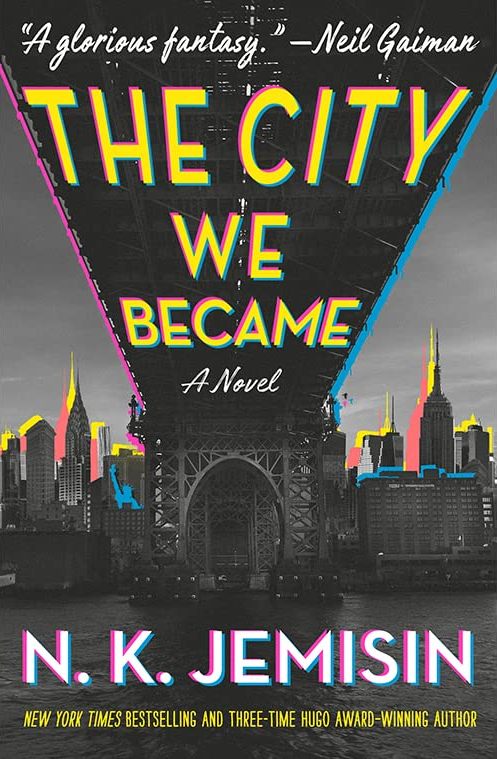
This issue raised its head again recently while I was reading N.K. Jemisin’s new novel, The City We Became.

If you’ve read her short story collection you’ll recognize the basic idea from the story “The City Born Great,” which effectively serves as the prologue for this book. Essentially, for reasons that aren’t really all that clear, at some point certain cities are “born” into actual, living entities. Some of these births go well – London, Hong Kong, and Sao Paolo are all living breathing cities at this point – while others don’t make it, or don’t make it for very long – think Atlantis and Pompeii, and New Orleans is having troubles, too. In the book it’s New York City’s turn and its difficult birth in the prologue leads to the avatars of the city (one per borough and an additional one overall) fighting to keep it living.

The book overall is pretty good. Jemisin can lay words on the page like just about nobody else going right now and the individual scenes and chapters are great as set pieces. The broader plot doesn’t quite work, however, and the book winds up feeling like less than the sum of its parts (props here to the audiobook production which, aside from one minor quibble – longer pauses between scenes please! –is brilliant both in production and performance). One reason that’s true is that we’re not given any idea why any of this matters. I mean, there’s a villain to vanquish (in the next book, apparently – grumble, grumble) and a city to save, but as to what makes London and Hong Kong and Sao Paolo different from what New York was prior to its birth we never learn.

On the one hand, this doesn’t necessarily mean the main story suffers. After all, it’s likely that The City We Became didn’t address this issue because it wasn’t really applicable to the story Jemisin set out to tell. Still, one of the great pleasures of speculative fiction is digging into a fully developed world that’s not ours and glossing over such things can leave the experience a little hollow. In other words, if you’re writing modern-world fantasy, or near future sci-fi, it’s worth thinking about what’s going on in the world beyond the discrete story you’re telling. Maybe it’s not that important, but it introduces some interesting possibilities for how to deepen the world you’re building and provide some extra details for readers who are interested in sinking their mental teeth into that kind of thing.

Serious Fantasy Revisited

A few weeks ago I put up a post wondering whether people are inclined to treat science fiction more seriously than fantasy – that is, more likely to capably deal with “big” issues – to the point that it shades peoples’ perceptions of what is and isn’t fantasy. The very same day I posted that I came across another head-scratching example that I wanted to share.

Over at Tor, James Davis Nicoll posted an article about six books that “defy easy categorization” and straddle the sci-fi fantasy divide. I’ll admit that I wasn’t familiar with most of these (several went on my “to read” list). The one I was familiar with, however, left me shaking my head. That was Octavia Butler’s Kindred.

As Nicoll explains, Kindred is about a black woman from modern American (it was written in ??) who, inexplicably, is ripped back in time to before the Civil War where she is exposed, brutally and graphically, to the horrors of slavery. It’s a tough read, to be sure, but it’s brilliant. As for its classification, Nicoll writes:

But is it science fiction or fantasy? While I will grant that the physical mechanism is never explained, Dana is caught up in a stable time loop whose logic dictates much of what happens to her. . . .. Butler thought Kindred was fantasy, but it also seems perfectly reasonable to call it science fiction.

It really doesn’t, any more that it seems perfectly reasonable to give Donald Trump the benefit of the doubt on any factual dispute at this point. As Nicoll says, there’s no explanation or mechanism given for the main character’s time travel. It just happens. It’s certainly not the result of some kind of deep tech or scientific advancement. It’s more one of those Twilight Zone setups you just accept as existing, without wondering why. That, to me, is the defining feature of fantasy – here’s a world that’s different than ours, accept it (or don’t) and move on.

So why try and turn Kindred into science fiction? Could it be that it deals with deeply serious and traumatic topics that most people don’t associate with fantasy? I don’t buy the “it’s magic, but it’s magic that follow rules, therefore it’s sci-fi” logic. Brandon Sanderson’s Mistborn series (to pick an example) has a very regimented, logical, magic system (it sometimes feel like video game controls), but nobody would call it sci-fi, would they? Fun as those are, they don’t deal with the kind of issues that Kindred does, however.

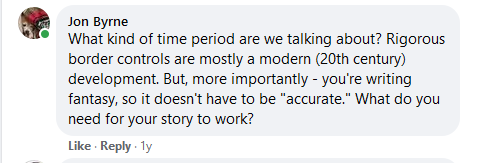
I shared my original post with a group of sci-fi and fantasy writers on Facebook and got some interesting answers (and some amusing ones – to the question of “is sci-fi more ‘serious’ than fantasy,” one person just answered “yes”). The one that really caught me was this one:

Now, being a prog fan, I should have come up with this one myself. Nonetheless, I think bringing musical genres into this might help shed some light on the question. I think this is something that happens to new fans of all musical genres, but I’ve seen it repeatedly with prog fans (I may have even gone through it a bit myself): Fan of a particular bands discovers they’re generally classified as “progressive rock,” finds out that there’s more groups out there with similar characteristics, falls madly in love with “prog” as a thing and . . . starts to expand its boundaries exponentially. In other words, they go from “prog = good” to “good = prog” and try to define every band they like into their new favorite genre. No matter how great XTC are (and they are great!), they aren’t a progressive rock band – nor do they need to be categorized as such!

Is the same thing going on here? Are people who are normally drawn to sci-fi reading fantasy novels and feeling the need to reclassify them accordingly? I know sometimes there’s a rift between fans who only dig one or the other (I still remember the howls when the then-Sci-Fi Channel dares to show something that might actually be fantasy!), so maybe there’s some desire to cleave off the stuff at the margins and claim it one way or the other.

Maybe that’s what I’m doing. As I said in the original post, my beef is less about erecting boundaries around genres erasing grey areas and more the desire to see people treat fantasy (or crime fiction or romance or . . .) as just as able to raise serious issues as other genres. But maybe, in the end, it’s a lot of sound a fury and all that.

Is Sci-Fi More “Serious” Than Fantasy?

Fantasy has a reputation for taking itself pretty seriously. Outside of some outliers like Terry Pratchet’s Discworld books, the prevailing image of fantasy is that it’s about big deal themes of good against evil, fulfilling destinies, and such like that. The Lord of the Rings is not a “day in the life” story with no big stakes, after all. Indeed, in a lot of ways fantasy can seem – to use an epithet thrown at progressive rock all the time – “pretentious.” But for all that, when it comes to dealing with the big questions, the ones that probe the nature of reality and humanity, do people take science fiction more seriously than fantasy? Even to the point of letting that reflect how they categorize a story?

This occurred to me after I’d finished up The First Fifteen Lives of Harry August, by Claire North.

HarryAugust

The setup is this – the title character is one of a few select people in the world who live their lives over and over again. When they die, they basically go back to the beginning and are reborn, but with the collected memories of their prior lives still intact. Thus these are some seriously “ahead of their time” children roaming around, as you might guess. The story follows Harry as he lives a bunch of his lives and tries to stop another of his kind that is seeking a revelation will destroy the world. It’s pretty good, and has some really excellent bits. I recommend it.

When I finished the book I do what I usually do and seek out reviews to see what others thought about it. To my surprise, I saw a lot of people file The First Fifteen Lives of Harry August under “science fiction,” which made little sense to me. Sure, there’s some discussion of quantum mechanics and parallel worlds (at i09, Charlie Jane Anders lists all this as reasons why “it’s a real science fiction book,” so what do I know?), but what makes the story go is the completely fantastic bit where these people live their lives over and over again. It’s never explained, much less with some kind of semi-plausible scientific reason. For all we know a genie thousands of years ago granted somebody’s wish and it got out of hand.

The mechanics don’t matter much because North uses them to deal with issues of free will, destiny, and the price of the pursuit of ultimate knowledge. These are the kinds of big issues that science fiction sometimes tackles, but that doesn’t mean that every story that does that is science fiction. Could it just be that people expect sci-fi to be more thoughtful about this stuff than fantasy?

Regular readers know one of my pet peeves is when people who write “Literature,” rather than just tell stories, write something that’s unambiguously fantasy or sci-fi but refuse to label it as such because of genre snobbery. This feels kind of the same way. Sure, fantasy is fine for satisfying tales of good vanquishing evil or ass-kicking vampire slayers, but if you want to ponder the big questions, well, it’s not for that. But why not?

Any story can plumb the depths of the big questions that have plagued humanity since we started walking upright. Genre doesn’t limit the stories you can tell, only change the way that they’re told. Embrace the idea that deep thoughts can come from anywhere in the library.

Serious

Summer Hiatus

Holy hell, is it July already? I suppose pandemic time really has done a number on us. Anyway, I’ve been busy on Widows of the Empire, just about to finish the third draft. Just one more and . . . well, y’all get to read it. So, I’m giving myself a bit of a break and stepping away from the blog for the rest of the month. I’ll see you in August.

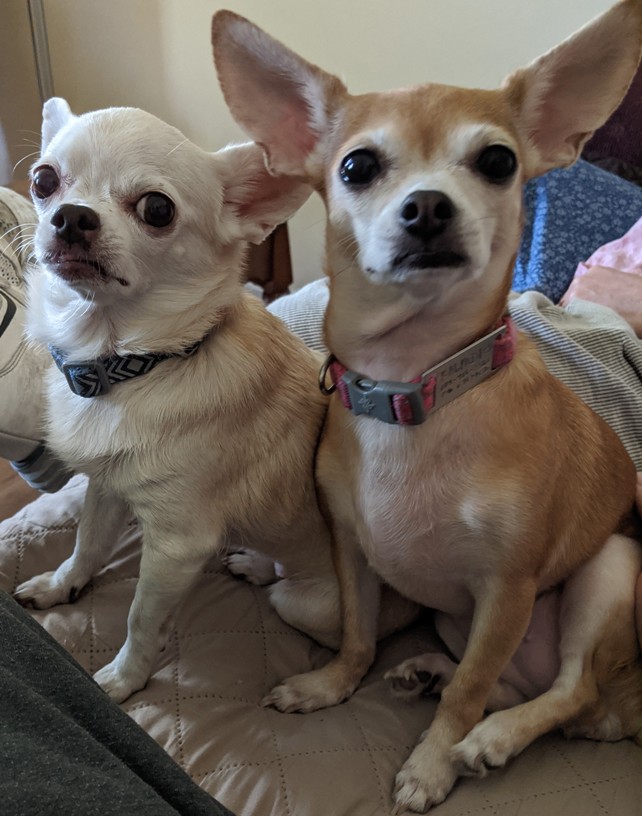
Until then, I’ll leave these two in charge.

BlogMonitorDogs

Zaria already looks very skeptical, doesn’t she?

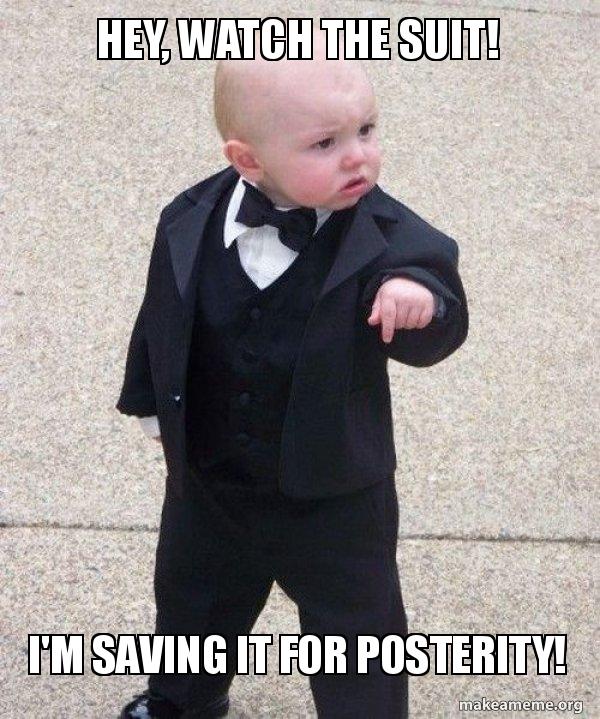
On Writing For Posterity

One of the interesting things about life on an Internet forum is how cyclical it is. Since new people are always joining, and few of them think to do deep searches when they first arrive in the happy flush of finding the forum, some evergreen topics show up again and again. If you log in to the Progressive Ears forums tonight for the first time and think, “I’ll ask everybody what they really think ‘prog’ is!”, rest assured you’re not the first one. See also, “why are fantasy and science fiction lumped together” on any genre-related space.

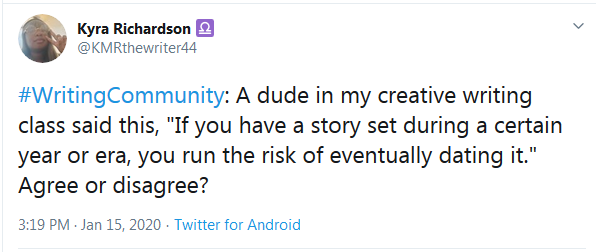
Writers’ forums are no different. New writers are a combination of boundless enthusiams and depths of doubt that lead them to ask a lot of questions. Naturally, most of them have been asked and answered before. A favorite one of those, perhaps second only to worries about other writers stealing ideas, is a concern about writing something that feels “dated.” This tweet from Kyra Richardson earlier this year lays it out as good as any:

PosterityTweet

I’ve always thought that was an odd question to ask, but could never figure out why until just recently when it hit me like a two-by-four: it’s incredibly presumptuous.

Let’s be clear, when people talk about their writing feeling dated, they’re not talking about a current or modern audience. Few people worry that between the time they write the book and it’s published that the references will become dated. Instead, they’re talking about readers in the future, people who are going to turn to the book many years down the road, perhaps when the author is dead. They’re talking about writing for posterity, the kind of impact and success that every artist dreams about, but a vanishingly few actually obtain. It’s like a teenaged laptop musician working on his first track worrying about what he’s going to wear to the Grammys.

Lots of people write books. Even though lots of people also read them, the chances of any particular book being read by more than a handful of people is pretty slim. As a result, unless you already have an audience and think they might carry on for a while, worrying about posterity while writing a book is super presumptuous.

Write the best book you can. Tell the story you want to tell. Is it full of sly jokes about things that are popular right now? Don’t worry. Make it compelling. Give readers characters to care about. If you do all that, they’ll handle the references. If they care about the people involved, they’ll learn. It’s why I’ve learned a lot of very particular British references over the years – to fully understand Marillion (and others) lyrics.

Don’t worry about posterity. If you connect with readers in the here and now, you’re ahead of the game. Posterity will take care of itself.

Posterity

Which Details Matter?

World building is typically something we think is the concern of sci-fi and fantasy writers. If you’re going to tell a story set in a world that is either not ours or significantly different from it, you need to define those differences. But the truth is that all writers should be concerned with world building. Writers of all kinds of fiction need to flesh out the world in which their characters exist. Even if it’s the real world, it’s likely a part of it that the reader isn’t familiar with. Even non-fiction writers need to do the same – to build a place for their story to take place in order for it to make sense.

Of course, not everything about the world you’re working in is important for a reader to know. Finding the right level of detail can be hard, since you might send signals to readers that you never intend and actually mess up the world building you’re trying to do.

If you’ve read Gods of the Empire you know that Lady Belwyn has a music room. In an early draft I mentioned in one scene, as Hagan entered the room, that she was playing a “Colebeck etude.” I could have just said “etude” or even just named the instrument she was playing, but I thought throwing a composer’s name in would make it feel more like something from a lived-in world. Plus, it let me give a shoutout to the progressive rock world and name check Julian Colebeck, longtime keyboard player with Steve Hackett. To my knowledge, he’s never written an etude.

“But wait,” you’re saying. “I’ve read Gods of the Empire and I don’t remember anything about Colebeck in it.” You’re right, because I wound up taking it out. To a person, everyone in my writers group seized on the fact that there was a new name thrown at them when they read that scene. They wondered if this Colebeck person was important to the story. Would he come up again? Is this something important to remember for later down the road? Since the answer to all of those questions was “no,” I just decided to take it out. It’s at the point of the book where readers are still finding their feet on Oiwa and in the Unari Empire, so it was more important to remove a distraction.

My mistake, I think, was in introducing a variable that’s completely unknown without definition. If I was writing something in the real world – say, a sequel to Moore Hollow – and I had a similar character, I might have her playing a piece by Mozart or Liszt or Stravinsky. That would provide a nice little detail, but only because those names aren’t variables – they’re real composers who exist in this world. So long as the name is familiar enough for a reader to nod at it, that’s all you need. If you know those three names you can figure out what it’s saying about the character that she plays Stravinsky instead of Mozart.

But sometimes you need a reference to be just as fictional as your characters, even if your story takes place in the real world. In my opinion, it’s more distracting to try and avoid this than it is to take a sentence or two and define your fictional reference. This jumped out at me listening to The Getaway, an Audible Original by Greer Hendricks and Sarah Pekkanen.

Giveaway

It’s about a woman, a press secretary in the wake of a losing campaign, who goes on a yoga retreat where bad things happen. She does so partly because of how this retreat was praised by an unnamed actress she follows on social media.

The first time this person came up the main character just called her “an actress she follows,” which I thought was weird. It’s important enough to mention that this influencer’s praise was part of the reason to go on the retreat, but she doesn’t have a name? All right, it’s a throw away. But the second time it came up it really annoyed me. And the third. And the fourth. This really does seem to be an important detail – nay, it’s critical to the fairly dubious setup! (needless to say I’m not recommending The Getaway) – yet the story doesn’t define it. It could be as simple as a name and that she’s the star of some TV series or movie. No need for more than that, but just something to suggest that this actress is a real person in this world.

As always, it’s a question of balance and where to draw the line. There are no hard and fast rules when it comes to building your world, except maybe one: Does this detail serve the story? Does it deepen the reader’s understanding of the world or the characters? Okay, so that’s two questions, but you get the point.

Details

New Short Story – “Puffery”

Remember last month when I said I was doing the NYC Midnight Short Story Contest? My first story, “The Nickel Tour,” was good enough to get me through to the second round. Now the results are in for that one and, well, I won’t make it to the third round. “Puffery” garnered an honorable mention, but didn’t place in the top 5 (out of 25 in the group). Given that it was outside my usual genre and style, I’m still pretty pleased with it.

For this round, my group was assigned to write a political satire on the subject of medical tourism, with a warlord character in it. After a false start I slipped into the right mode and wrote something that is definitely influenced by the time and place in which I wrote it. It also allowed me to create a character that I think I want do more with in the future.

Until then, enjoy!

Puffery

Milo slipped into the Trapezoidal Office just as the Generalissimo said, “what’s in the bay?”

Advisors were arrayed around the room, each clutching papers and trying to hide behind one another. Milo didn’t even recognize some of the faces. He’d made the right decision not bothering to learn names. What was the point? They’d be gone soon enough.

“A plague ship, sir,” the Minister of Defense said.

“From America,” threw in Kevefe, the Generalissimo’s son-in-law. Educated in America, married to the Generalissimo’s beloved eldest daughter, he was the one the man always tasked with doing anything important, from managing the Generalissimo’s properties to trying to negotiate treaties. His title should have been Minister of Everything. “They’re having a plague. It’s whipping through the south right now, like Sherman a generation ago.”

The American south was the closest large land mass to Oflana, the small island the Generalissimo had made his stronghold. It wasn’t even at large as Charleston, the nearest American city.

“And why are they here?” the Generalissimo asked, putting his elbows on his desk. It was enormous, made of dark walnut with ornate carvings of mythical sea creatures on each leg. He  told people it was made from the beams of the British frigate that Sadont, the national hero of Oflana, boarded and captured when the island won its independence. He would take any opportunity to tie himself to that legend. The truth of the desk, so far as anybody could tell all, is that the Generalissimo had found it in an estate sale in Savannah during one of his “diplomatic” missions.

“Because we are a day’s steamship voyage from Charleston,” Defense said. “Perhaps two, depending on weather.”

The Generalissimo looked as confused as ever. “But why now?”

Milo knew how this dance worked. The Generalissimo worked through the problem in his own time and in his own peculiar way. Everyone would have their say, but he had to make the final decision, even if everyone else knew it was the wrong one. Milo decided he had to goose the process along.

“Sir?” He raised his hand like a grade school child.

“Yes, Minister of Information?” the Generalissimo said, slightly slurring his words.

“Sir, that ship is here because of what you said on the radio last week.” Every week the Generalissimo took over the island’s five radio stations for his Voice of Oflana broadcasts. Ranging from five minutes to five hours, depending on his mood that particular day, it was his chance to talk to his people, who had little choice but to listen.

“Last week?” The Generalissimo looked at Kevefe, squinting, like he was trying to dredge the memory from the depths of his mind.

“You talked about the plague in America, how their hospitals and doctors couldn’t cope,” Kevefe said. “Things of that nature.”

“Due respect, sir,” Milo said before the Generalissimo could move on, “it was much more than that.”

The Generalissimo looked at him, slumped in his seat, hands outstretched. “How much more?”

Milo took a deep breath. “You also discussed the medical system here on Oflana. You called it the best in the world.”

“Of course,” the Generalissimo said. “We only have the best things here in Oflana.”

Milo knew that might be true for the Generalissimo and his family, but that for the rest of them modern medical treatment was more hope than reality. He pushed on anyway, leaving truth bloodied in a ditch yet again. “You also said the plague would not strike Oflana,” Milo closed his eyes and quoted verbatim, “because it knows in its heart that we have the medicine to kill it.” It was times like this that Milo cursed his eidetic memory.

“So?”

The Minister of Health sheepishly raised his hand. “Sir, that pronouncement may have been premature.”

“Are you suggesting I lied?” the Generalissimo said, slowly rising from his chair, his ever expanding girth straining the medal-covered white uniform he was wearing.

Health’s eyes went wide, but before he could defend himself the hammer came down.

“You’re fired!” the Generalissimo boomed, pointing to the door with great emphasis. “Get out!”

“Sir, I,” Health began to say.

“Do I need to call for Boze?” the Generalissimo said, invoking the name of his security chief, a massive islander who could snap Health, or anyone else in the room, in two.

Faced with a fate worse than termination, Health scurried out the door.

“If I even said that, about having a cure for the plague,” the Generalissimo said, returning to his seat. “I don’t think I said that.”

The advisors all exchanged wary glances. Milo just managed to avoid rolling his eyes. Not only had he heard the Generalissimo say those exact words, now the man had gone and fired the person who should be put in charge of dealing with that plague ship slipping into the dock.

“Rest assured, sir,” the Minister of the Interior jumped in, “our physicians will deal with this pestilence with care, skill, and strength.”

“We’re about to find out,” Milo said. There was a clock tick-tocking in his brain, knowing that the American ship was going to reach the dock in any moment. “Sir, that’s why they’ve come. They think there’s a cure here, and they’ve come to get it.”

Milo could tell that the Generalissimo was still missing some links in the chain. “Your broadcasts sometimes reach the American mainland. It depends on weather conditions, if I’m correct.”

Across the room the Minister of Technology nodded vigorously.

“In addition, although you expelled a number of American journalists last month, there are still a few foreign reporters here. I’m sure they heard your broadcast.”

The Generalissimo shook his head. “Deadbeat losers. Why do I let them come here and cause trouble?”

“They’ll be gone by morning,” Kevefe said with a wave of his hand.

“Er,” Milo said, lump in his throat, “that won’t solve the problem, sir.”

“Why not?” Kevefe glared at him.

Milo tugged at his collar. “They surely know that this plague ship is arriving. Anyone can see down into the bay from the city. And the ship is quite large.”

The Generalissimo leaned forward. “Larger than the Dominator?”

Dominator was the pride of the Oflan navy. For all intents and purposes it was the Oflan navy.

Milo chose his words carefully. “I’m no expert, sir, but I can say that it is not nearly as impressive as Dominator. Nonetheless, it’s carrying hundreds of people.”

“All infected?” At least something was getting through to him.

Milo shrugged. “It could be healthy people trying to escape from the plague. Or it could be sick people looking for a cure. We’ll only know for certain once they dock.”

The Generalissimo furled his brow. “Don’t we have radios? To talk to the ship?”

Milo wasn’t in the mood to handle this question, so he did what he had to do. “I believe that the Minister of Technology could best answer that question, sir.”

Technology shot Milo a look that said he would pay for this in the coming days. “Recall, sir, that the land-to-sea radios were damaged in the storm two years ago.”

“Ah, yes,” the Generalissimo said, “the great hurricane I turned away from the island.”

Hurricane Robert took dead aim on Oflana, turning off to the east and out to sea at the last moment. While it spared the island and the city the worst of the winds, the bay at the bottom of the hill had still been swamped by the storm surge. Hundreds lost their lives.

“Yes,” Technology continued, “well, sir, those systems have never been repaired.”

“Why not?” The Generalissimo said.

The truth was that the money went to rebuilding the swimming pool in the Generalissimo’s palace, but Milo certainly wasn’t going to say that.

“It went,” Technology started. He apparently thought better of it, too, the firing of Health still fresh in everyone’s memory. “I don’t recall specifically, sir. Regardless, there’s no way to contact that ship until it docks.”

Milo checked his watch. They had, at most, five more minutes to make a decision.

“Then how do we deal with this?” the Generalissimo asked, relaxing again. “Why not just send them back? I’ll defend my people against any threat. Keep that infected ship off our land.”

“That would look very bad,” Milo said. “This plague is fast acting. If there are sick people on that ship and they don’t get any kind of treatment they may die before they get back to Charleston. The press would have a field day.”

“The press hate me,” the Generalissimo said. “Even if we don’t send the ship back, they’ll say bad things. Lies and slander over and over again.”

Milo wasn’t about to get into this now, so he dodged the barb. “Is there another option?”

“We let them dock,” Interior said. “If they’re healthy refugees, we take them while stating this is a onetime situation. Any other ship will be turned back. If they’re sick, they go to the hospital and we’ll treat them the best we can.”

That was a bad option, too, Milo knew. It would lay bare the Generalissimo’s claims that the plague could be treated here. These people, if sick, would overwhelm the island’s small hospital and most likely die horrible deaths, but at least their ends might come with some dignity and care. “Sir, we really have to make a decision. That ship is about to dock.”

The room fell silent. Milo held his breath, bouncing up and down on the balls of his feet, waiting.

“Let them in,” the Generalissimo said, after what seemed like an eternity. “We are a generous people, are we not?”

“Yes, sir,” everyone else muttered without real conviction.

“Thank you, sir,” Milo said, bolting from the room. He couldn’t believe the man did the right thing, even if it was probably for the wrong reason. Milo ran to his office, rang the dock, and told them the news.

Shortly after he hung up, Kevefe knocked on his open door. “How are you going to sell this to the press? Before you’ve expelled the foreign reporters, of course.”

With the foreign press gone that would only leave the handful of Oflan reporters, none of whom were interested in doing anything but regurgitating whatever Milo told them.“I hadn’t thought of that yet,” he admitted.

Kevefe raised a finger and said, “I have one word for you.”

“One word?”

Kevefe nodded. “Puffery.”

Milo raised an eyebrow. “Puffery?”

“It’s a legal term,” Kevefe said, lapsing into his typical condescending explanation mode. “When someone makes a promise, say in a contract, and can’t keep it, that can be because they lied about the promise or they, let’s say, promised more than they could actually deliver. They puffed up their capabilities.”

“In other words, they lied to get the contract,” Milo said.

Kevefe stepped into his office and glowered down at him. “No, they innocently exaggerated their abilities. Are you suggesting that our physicians aren’t capable of dealing with this plague?”

“The best doctors in America aren’t,” Milo said, deciding not to answer directly.

Kevefe shifted forward, hands on Milo’s desk so that he was almost on top of him. “Are you calling my father-in-law, the Generalissimo of Oflana a liar?”

Milo wanted to, but knew he couldn’t. “Of course not,” he said, doing his best to back away from Kevefe. “Puffery. Yeah, I think I can sell that to the press.”

“You’ll prepare a statement?” Kevefe said, stepping back and composing himself.

Milo nodded. “And, of course, I’ll share it with you before it’s released.”

Kevefe stepped back into the hallway and smiled. “You’re a good man, Milo. Don’t know what we’d do without you.”

Milo took a moment once Kevefe disappeared to compose himself. He needed to prepare a statement for the press. And he needed to expel those foreign reporters. If he was lucky, maybe they would take him with them.

Cartman

My Characters Don’t Speak to Me

Creativity is a weird thing. A book is a book or a song is a song, but different writers can get to that finished product in lots of different ways. That’s made clear to me whenever writers talk about being pantsers instead of plotters. Pantsers, generally speaking, make it all up as they go along, without any great amount of planning, notes, and the like. Plotters, by contrast, do all that stuff before they start writing. I’ve learned, the hard way, than I’m more plotter than pantser. I admire pantsers for the way they write, but to me it’s as foreign an experience as it would be if I tried to write the last part of the Unari Empire trilogy in Tagalog.

There’s another group of authors of which I am not a part when it comes to the creative process. That’s the group who talk about the characters in their stories like they are independent, sentient beings. Some talk about how they don’t write dialog, they just transcribe conversations their characters have on their own. Others give their characters agency and talk about how they can’t control what they do. As at least one well-known writer put it:

Philip Pullman, author of the His Dark Materials trilogy, reports negotiating a deal with his character Mrs. Coulter to get her to spend time in a cave in one of his books. Some authors have reported that their characters give them unsolicited advice about the writer’s own life!

I just don’t get this. One of the amazing things about writing fiction is that I, as the author, am God, in a big G omniscient and omnipotent sense. Characters only exist because I create them and they only do what I tell them to. Their words are my words. Does it means they always develop the way I first intend them to? No, but that’s me changing my mind, not them rebelling.

Maybe I look at it this way because I started writing seriously as a lawyer and in legal writing you’re at the whim of so many other things – the law, the facts, your clients. In fact, it’s my clients who behave the way some writers talk about their characters – with complete free will and a dazzling inability to control themselves.

I always figure that when writers talked about characters talking to them or doing things against the writer’s will it was a way for writers to deal with the vagaries of the creative act, with a heaping helping of metaphor baked in (we’re talking about writers, after all). But I’m apparently wrong and in the minority on this, according to recent research with authors from the Edinburgh book festival:

Researchers at Durham University teamed up with the Guardian and the Edinburgh international book festival to survey 181 authors appearing at the 2014 and 2018 festivals. Sixty-three per cent said they heard their characters speak while writing, with 61% reporting characters were capable of acting independently.

‘I hear them in my mind. They have distinct voice patterns and tones, and I can make them carry on conversations with each other in which I can always tell who is ‘talking’,’ said one anonymous writer. ‘They sometimes tell me that what I have in mind for them isn’t right – that they would never behave or speak that way. I don’t usually answer back,’ said another.

Beyond that, 15% of writers surveyed say even talked back to their characters. So, what, are they crazy? Not so much:

Even though some authors reported that their characters had a life of their own, the researchers were keen to stress that there was no question of writers confusing fiction with reality. When the academics rated the writers on how prone they were to hallucinations, they did not score differently to other samples of the population. ‘Hearing voices and other unusual experiences are not in themselves a symptom of a mental health problem,’ they wrote. ‘This shows that vivid imaginative states – including losing control of one’s own imagination – [are] a healthy and safe thing which is important for how some people create fiction.’

Then what’s going on here? Researchers think that these writers aren’t sharing a singular experience, but it’s more that they’re describing a myriad of experiences that occur during the writing process. In other words, to say “they hear their characters talk to them” really flattens the nuance of the issue.

There’s part of me who thinks like this guy, like I’m missing out on something:

CharactersTalk

I get what he’s saying. There’s something transcendent and beyond the realm of grinding craft when characters talk to you. You’re not just writing, at that point, your communing with the muse, you’re tapping into the essential forces of the universe.

But I don’t think that can be right. Neither he nor I are missing out on anything – we just work differently. Truth is, while there may be a wrong way to write a book, there are probably an infinite number of “right” ways, because what works best for one writer might not work at all for others.

So, I guess I’m fine with the idea that my characters don’t talk to me. In place of the psychic connection that others have with their creations, I’ll happily sit back and make mine do whatever the hell I want while theirs are wreaking havoc!

Raplh