Who Does Your Main Character Work For?

A little white back, my wife and I saw The East, a 2013 film starring and co-written by Brit Marling:

Marling’s character infiltrates an off-the-grid terrorist organization that’s been striking out at corporations that have gotten out of hand. One is responsible for an oil spill, another for despoiling a town’s water supply, and a third for releasing a drug onto the market that has horrible side effects. Part of what makes the movie interesting is that Marling isn’t a cop or a crusading journalist, but rather an agent for a private security firm. It made me think about the importance of who your main character works for in a story and what it means for their development (or lack thereof) as a character.

A lot of stories are about main characters solving some kind of mystery, figuring out the solution to some problem. It’s no surprise, then, that lots of stories have main characters whose jobs require them to solve those mysteries – cops, private detectives, journalists. It gives them not just a motivation for getting into the problem in the first place but a destination as well – an arrest, the confirmation of a dark secret, an expose article. But it can also give them interesting limitations, blinders, or obstacles to overcome.

The natural job for a character like Marling’s in The East would be a cop of some variety – a person tasked by society with taking down bad guys. A person who should, at least in theory, be motivated to serve justice and help people. We’ve seen that story before, however, so making Marling’s character a private security operative boxes her in interesting ways since she’s not working for society in general, but for specific clients.

There is a scene, for instance, where she winds up in a middle of a plot the group is pulling that will poison dozens of people at a drug exec’s party. When she realizes that and calls her boss for guidance, she’s gently reminded that the drug company is not their client, so she shouldn’t try to stop what’s happening, just keep gathering info for the client that actually hired her. It creates an extra amount of tension over what she’s going to do and why, which I thought worked pretty well.

I’ve been thinking about this as I work on the sequel to Moore Hollow.

Yeah, so, I’m doing a sequel to Moore Hollow, the first of many, I think (currently now being worked on around the final volume of the Unari Empire trilogy, Heroes of the Empire).

For the books going forward, Ben Potter, the disgraced journalist who is the main character of Moore Hollow, permanently relocates to West Virginia and throws himself into investigating the area’s rich tradition of beasties, legends, and general weirdness. In the second book, though, he hooks up with a lawyer to help represent a particular client. That will give him different motivations and restrictions than his normal work as a paranormal journalist. I hope to explore how those roles are different as the series goes forward and Ben sometimes does and sometimes doesn’t work with that attorney.

Of course, those choices don’t always work for every reader/viewer. Consider this view, from a review of The East:

Yet the biggest issue with The East is that Batmanglij and Marling so thoroughly rig the script in the environmentalists’ favor. By casting Marling as a corporate spy instead of a government agent, it sets up a fatally compromised situation where her bosses have the same profit motive as the companies being jammed. So choices that might be made in the name of justice are instead a matter of loyalty to one set of values that’s clearly more compromised than the other. Environmental activists like the ones in “The East” live by a code, but the same can’t be said of Sarah’s employer. Going native is easy when you don’t have to follow the letter of the law.

But for me, it’s precisely that lack of direction that makes the character (and her journey) interesting. In the end, I think she finds a lot of commonality between her employer and the would-be do-gooders.

What I’m saying is that, oftentimes, our main characters born out of what they’re going to do in our story. Still, it’s useful to think about the context in which they’re going to do it, which includes how they’re making a living. It can open up some interesting storytelling avenues.

The Book-to-TV Pipeline

Coming late to this, but last June there was an interesting article in The Atlantic about the rise in literary adaptations on television (broadly defined to include streaming services). It’s fascinating because there’s some evidence that there is so much adaptation going on that it’s actually impacting the publishing process.

Why is that? Part of it is just because there’s so much TV content being generated these days that producers are turning to extant products to fill the demand (per another, more recent article, the same demand is also creating a new boom in work for “older” actresses). But there are also certain features that are prevalent in titles that are optioned for adaptation (although not present in all), including “episodic plots, ensemble cases, and intricate world-building.” While, certainly, there are books (or short stories) that lend themselves more easily to adaptation, I think the story overlooks one important thing and gets another wrong, both of which are important in thinking about the current TV landscape.

What the article overlooks is that the definition of “television,” and what a TV show is these days, has changed radically with the rise of streaming services. Not only are there more TV shows than ever before, but they’ve gotten more compressed compared to the sprawling network series of the past. Where a new series once had to produce two dozen episodes per season (for multiple seasons), TV is now awash with series with only eight or ten or twelve episodes per season. Beyond that, the limited series – one season and done – has gained popularity, too. Those shorter seasons (and series) fit book adaptations particularly well, giving creators enough time to cover all the events of the book without the need to create ongoing stories to feed additional episodes/seasons.

Beyond that, the TV audience is so fractured at this point that bringing already-established fans from a book to the TV show is a solid way to build some viewership. To give some perspective, the 1993-1994 season of Seinfeld (the show’s fifth season) averaged about 30 million viewers, while the top episode of scripted TV last year (from NCIS) couldn’t even manage half that. Game of Thrones, on the other hand, pulled more than five million viewers for its first episode (across multiple showings), demonstrating the value of a built-in base audience. Even if the book being adapted isn’t a huge, sprawling series, it can bring a certain bit of gravitas to TV just by being a book!

What the article gets wrong, I think, is that “episodic” books are more likely to be snapped up for adaptation. This is presumably based on the idea that such stories lend themselves to the episodic nature of TV, but that overlooks the fact that TV is getting less and less episodic as we go along. Not only do lots of current short-season TV shows tell single, ongoing stories, they often don’t really bother making the individual episodes work on their own. To go back to Game of Thrones, episode breaks there were often purely down to time restraints, more than anything else. It would be hard to take most episodes of that show, pull them out of sequence, and show them to someone with any hope they’d know what’s going on or be hooked enough to watch more.

Truly episodic TV has a better chance to do that, at the risk of losing the overarching narrative drive. I’m thinking of two long-running series that I got into in the middle, because of episodes that told complete stories.

One was Babylon 5, famous for being designed to tell a five-season story in novelistic fashion. That said, each episode could generally be consumed as a discrete chunk (occasional multi-part episodes to one side), such as “No Surrender, No Retreat,” the first episode I saw. Now, there’s an awful lot of backstory in that season four episode that I didn’t learn until later, but the basics – who the good guys were, who the bad guys were, and who might be neither – were clear. There was an objective that could be obtained or not, within the space of the episode. It wasn’t merely a set of events playing out from the prior episode and into the next one.

The other was Doctor Who, for which my entry episode was “The Unicorn and the Wasp,” which involves Agatha Christie and explains her famous disappearance. Now, Doctor Who isn’t nearly as tightly serialized as Babylon 5, but there was, again, a lot of lore, backstory, and character development about which I had no idea. But the episode told its own story, with a beginning, middle, and end. It was a great hook.

None of which is to say the super-serialized series that are so popular these days are doing it wrong (although maybe they sometimes do). But it does suggest that what’s drawing TV developers to literary titles is not their “episodic nature.”

Ultimately, I think it’s great that more and more books are being developed for TV series. There’s lots of great stuff out there and it beats pointless reboots of series from decades ago. The series usually bumps the popularity of the books, too, so authors get a couple of benefits from it! I’m all for more of that.

On Time Jumps

As it happens, I wound up reading Leviathan Wakes, the first book of The Expanse series not too long before the TV show began. As a result, as the TV series went on I read the next book in the series just before the new season dropped. Now that the TV show has finished, after six seasons, and the book series has wrapped up, after nine volumes, I decided to plow through and finish the books in one go.

The first of the last three (The Expanse is sort of three linked trilogies, really), Persepolis Rising¸ starts with a pretty audacious gambit – it skips the story forward three decades.

Before we dive in further, let me specify just what I mean when I say “time jump.” I’m talking about a narrative (either within a single work or across multiple ones) where there are large breaks during which a large period of time passes. I’m not talking about the usual passage of time – most sequels or new seasons don’t pick up right after the prior one, after all. Nor am I talking about flashbacks or flashforwards or stories about characters who, to borrow a phrase, have come “unstuck in time.” I’m talking about situations where the main narrative is still driving forward, but it’s like somebody’s picked up the needle and we’ve skipped some tracks.

It’s a bold gambit because, presumably, the world of the story continues to exist during the time that’s skipped over. Things change, just as they do in regular life over years. Picking up months or years in the future should be a means of exploring how those changes impact the characters.

A good example of this I recently read is Middlegame by  Seanan McGuire.

In the world of Middlegame, an alchemist in the modern United States is using semi-fraternal twins as a means to bring about the presence of a great power he wants to tap into. The book is the story of two twins, Roger and Dodger (the rhyming names are quite intentional) who, in spite of attempts to keep them apart, keep finding themselves over the years. The book proceeds in hunks (while also skipping around in time), first when the two are young kids, then when they’re college students, and then grown adults. Between hunks, years pass and it matters. Not only do the characters change, but their relationship to each other does, too, partly because of the passage of time.

Another good somewhat recent example is the jump in time between seasons two and three of the Battlestar Galactica reboot. At the end of one season Gaius Baltar is installed as president. At the beginning of the next a year has passed and we can see what “President Baltar” really means – everything goes to shit and the Cylons return! The time skip moves the plot along while providing the writers a good way to show what went on in the interim and the impact it’s had on the characters.

Sadly, Persepolis Rising doesn’t handle the time jump nearly as well. I understand the bind  James S.A. Corey (actually Daniel Abraham and Ty Franck working in collaboration) was in – the story needed to jump ahead decades in order to play out, but what to do with the characters you’ve spent six books lovingly developing? The answer here is mention a few extra aches and pains and leave it at that. For the crew on the Rocinante, thirty years passing was just like thirty minutes.

Which is supremely disappointing! The five folks on the ship are in exactly the same shape they were in at the end of Babylon’s Ashes: Holden and Naomi are still together, Amos and Clarissa have their weird connection, and Bobbie and Alex have whatever they’ve got. Alex has, in the intervening decades, been married and divorced again, but the only outgrowth of that is a son off screen he occasionally worries about. There’s no aggravation/shifting of loyalties that have occurred over three decades of doing the same damned thing in the same damned (small) place.

All of this violates what I’m officially dubbing Rufus’ Rule of Gullibility, which I discussed in a book review many years ago:

There’s a scene deep in Kevin Smith’s Dogma in which Rufus, the thirteenth apostle, explains to a credulous Bethany who she can be a descendant of Christ. ‘Mary,’ she points out, ‘was a virgin.’ Rufus explains that while it’s true Mary was a virgin when Christ was born, she was married to Joseph for an awful long time after that. Why assume she stayed a virgin? He concludes: ‘The nature of God and the Virgin birth, those are leaps of faith. But to believe a married couple never got down? Well, that’s just plain gullibility.’

I just can’t believe that five people could live in such close quarters for three decades and nothing changes. This fall I’ll will have been in my current job for just twenty years and there has been a consistent churn of turnover among my coworkers the entire time. And we don’t have to worry about the rigors of space travel! It’s just not plausible that things stay the same all those years (after all, as the song says, things change).

Which is a shame, because where the crew ends up by the finale works really well and changes the game up significantly. That’s not to say that the book doesn’t have other flaws – the bad guys aren’t nearly as interesting as those in prior books and the POV bad guy, particularly, is a dweeb – but it’s still a really good read about characters we’ve come to care about.

Time jumps can be a valuable tool when writing, but you have to ask yourself two questions if you’re going to play around with them. First, why do you think the story needs to jump ahead so much? Second, what are the effects on the characters moving that far forward? If you don’t have good answers to both of those questions, probably start rethinking.

My Fantasy Confession

If you’re reading this, you probably know that as an author I primarily write fantasy stories. As I’ve said before, I love that fantasy basically has no rules and, so long as the world you build makes sense on the page, you can do anything you want. Given that, I figure it’s time that I came clean about my deep, dark secret as a fantasy writer:

I have never read a word by J.R.R. Tolkein.

It’s not that I have anything personal against ol’ JRR. I’ve seen all the movies! Not the super-extended versions that take entire years to watch, but all the ones as released in theaters. I enjoyed them, too (well, the actual Lord of the Rings ones). But if I’m honest, the Tolkien link that has the most meaning to me is the fact that Marillion was originally called Silmarillion, before changing their name early on to avoid any legal problems.

Nor was this a case of conscious avoidance of Tolkien’s work as a reader. I just never really was that interested in diving into it. When I was young and first encountered traditional fantasy books it was the first couple of Narnia books and, particularly, Lloyd Alexander’s The Chronicles of Prydain, which I really enjoyed. But once I finished those my tastes turned more towards science fiction.

I wasn’t until I was in my thirties that I really dug back into reading fantasy, thanks mostly to my wife, who introduced me to Neil Gaiman and George R.R. Martin. While both of them would, assuredly, note the influence of Tolkien on their work, their stuff (or at least the stuff that appealed to me) isn’t very Tolkienesque. Gaiman’s work like American Gods and the Sandman series showed me that “fantasy” was a much broader thing than stories about wizards and goblins and the like. A Song of Ice and Fire draws deep on Tolkien-style world building, but does so in the service of a story that’s more about political maneuvers and human failings than it is about grand quests.

That part of the fantasy world hasn’t appealed to me that much lately. I’ve got nothing against a good quest – I’ve got a quest story percolating I hope to write one day – but I was more drawn to weird worlds and things that didn’t require the explanation/technobabble of science fiction. That’s where I found my inspiration to tell stories in worlds that aren’t our own, but aren’t necessarily filled with magic.

Am I missing out on something? Possibly. Am I going to try and rectify that situation? Not necessarily. I read for pleasure and so I’m not likely to decide to read something as homework just because most others might. Hell, I write for pleasure, too (that others enjoy the end product is a bonus), so I can’t see taking the time to force feed any particular author’s work.

The bottom line is I know enough about Tolkien to understand the memes and spot the references in progressive rock songs. Right now, that’s all I need. Plus I got to play the first movement of this in high school:

Doesn’t that count for something?

September Siesta

Not really, but I am going to be taking a break from the blog for this month. I’ve got some traveling to do, a couple of big work things, and the next draft of the final book of the Unari Empire Trilogy that all need attention this month.

When regular programming resumes in October it’ll be focused primarily on Widows of the Empire as we move closer to the November 10 release date. What do you want to know about the new book before it’s released? Let me know!

Timing Isn’t Everything, But It’s Something

The Godfather came out in 1972, its sequel in 1974. I was born right in between, in 1973, which is to say I had no chance to experience these Coppola epics when they were fresh. In fact, it wasn’t until sometime 15 years ago or so that I actually managed to watch them. By that time I’d already consumed a good amount of mob stories, from Goodfellas to (most of) The Sopranos and many others.

It sort of makes sense, then, that I wasn’t exactly overwhelmed by the first two Godfather movies (I’ve never seen the third). They’re really good, don’t get me wrong, but by the time I saw them a lot of what made them exceptional had bled through into popular culture. The idea of morally conflicted mobsters was certainly a trope by 2005 or so. Likewise, the stress of familial obligations in the mob operation had been done and done by then. This is no fault of the original films – it’s just that by the time I experienced them they weren’t as timely as they once were.

I thought about The Godfather while I was reading Soon I Will Be Invincible by Austin Grossman.

As you might guess from the cover, it’s a superhero story. Why did it make me think of The Godfather? Because it came out in 2007 and I was reading it fourteen years later.

To give some context, the first MCU installment, Iron Man, came out in 2008. That same year is when The Dark Knight, the second of Nolan’s Batman movies came out (to be fair, we’d also had a few X-men movies). In other words, this book came out just as a huge chunk of the movie and TV landscape shifted to super hero stories. By the time I got around to reading it I’d consumed most (although not all) of them. And as a result, the book very much had a “been there, seen that” feeling to it.

Invincible plays out across two related points of view. One is Fatale, a fairly new cybernetic superhero who joins The Champions, a group of superheroes who have their own dysfunctional baggage (including a failed marriage between two members). That side of the story leans into that dysfunction and highlights the personal toll that being superheroes takes on each of them (from OCD to drug use and the like). It’s more personal and intimate than, say, The Avengers in the MCU, but it’s in the same league. There’s even a corporate element that reminds me of The Boys, although it’s not so cynical.

The other point of view is that of Doctor Impossible, who, conveniently enough, breaks out of prison for the dozenth or so time just as the book starts. He embarks on another scheme to take over the world, along the way diving into his own history as well as those of the heroes who have crossed his path over the years. What we get is a narrative in which the villain is fairly sympathetic, in that he’s a put-upon smart guy who channels his frustrations into evil. Again, this is pretty common these days in super hero properties. The era of the mustache-twiddling bad guys is a thing of the past, thankfully.

None of this has anything to say about Invincible as a book. It’s pretty good and darkly funny in parts (naturally, Doctor Impossible has all the best lines), but I can’t help but thinking that it might have felt really fresh in 2007 or a few years later. Today, sadly, it comes off as a bit tired. Is there anything Grossman could have done to prevent my reaction to his book? Not at all.

Is being timely something writers should worry about? Probably not. Certainly, if you were thinking of writing a book like Invincible today, you’d have to take into account how prevalent super hero stories are these days. One more similar story probably won’t attract a lot of attention. That’s a different discussion than trying to figure out how well something might age in the future. Unless you can predict what’s going to happen in years to come – in which case, why are you writing books? – it’s just not something worth worrying about.

Sometimes I see authors wondering about whether particular references – to pop culture things or news events – will “date” their work down the road. That always seemed very presumptuous to me, since it assumes anybody will be reading your work in years (or decades) to come. This issue is more of the flip side – how do you keep you work from being swallowed by general trends? You can’t – write what moves you and let the broader market sort itself out.

You can’t fight time – you can only hope to survive it.

Weekly Watch: The Suicide Squad

Fair warning – I’ve never been much of a superhero comic book reader. I read other kinds of stories in that graphic novel format, but something about the endless nature of most superhero titles – they go on forever, double back upon themselves, have alternate versions – makes them impenetrable. Aside from a few Batman titles I read in college, thanks to my roommate, I’ve not really dug into them. Comic book movies, on the other hand, I’ve consumed quite a bit and enjoy. That’s largely due to my wife, who, shortly after we started dating, informed me I had to be up to date on the X-Men movies so we could see the new one the weekend it came out.

Which is to say that all I know of the Suicide Squad (as opposed to The Suicide Squad – the article is important, just like that university in Columbus) is what I’ve seen on screen. What I’ve seen so far isn’t that great.

The first movie (from all the way back in 2016), simply called Suicide Squad, was a mess, going down in flames financially and getting destroyed by critics. I didn’t think it was horrible, but it wasn’t that good. It did get the basic point across, though – the Suicide Squad are a collection of super villains who do special, super dangerous missions for the US government on the promise of getting their sentences cut. Makes sense as the basis for a story about a group of bad guys, right?

The Suicide Squad kind of picks up where Suicide Squad left off, but only enough to get by. There are a handful of carryover characters, but lots of new ones and a new creative team to bring it all to life. Or death, really, since there is an awful lot of blood and gore in this movie. It’s of the “so awful it’s funny” type – kind of like Sam Peckinpah as filtered through Monty Python – but it wears thin pretty fast.

Aside from the gore, there’s lots of crass humor. That’s not necessarily a bad thing – some of it works really well. There’s a discussion between Idris Elba’s Bloodsport and John Cena’s Peacemaker about a particular juvenile insult that spirals into the absurdity of it so far it’s funny. Likewise, when another character says he can only kill if he pictures the target as his mother, that becomes a callback that goes from funny, to not funny, to funny again through sheer repetition.

But there’s not enough of that to go around, particularly for a movie that’s over two hours long. There are other quibbles, too. There’s a kind of bait and switch that happens at the beginning that is apparently hilarious if you’re familiar with the Suicide Squad comics, but if you’re not doesn’t make a lot of sense. Harley Quinn, who’s the most interesting character here (the only one with her own movie to build on), seems like an afterthought, off on her own for most of the time. And while there are some stabs at character development here and there, they’re pretty weak (the motivation for Bloodsport to do all this is laughably badly done).

But where things really go wrong is when the Big Bad shows up. The Squad’s mission is to take out a Nazi-spawned research facility in a fictional South American country. Run by Peter Capaldi’s The Thinker (picture his The Thick of It character sprouting vacuum tubes from his head – at least he gets to keep the cursing!) it actually holds a deep dark secret that the US doesn’t want the world to know about. Fine – it’s not like there isn’t some basis for that in the real world.

But the Big Bad secret is . . . a giant alien starfish? That kills people and controls their bodies by slapping tiny versions of itself over its face? Maybe that works in the pages of a comic, but on the big(ish) screen, it looks ludicrous. It would be a low-level Dr. Who baddie, at best. As the existential threat in a movie it just doesn’t work.

I’d be willing to look past that (I think) if the way the movie ended made any sense for the characters involved. Remember, these are super villains – largely killers – who are so dangerous they’re expendable. Yet, when the oversized aquarium dweller toddles off to destroy this imaginary country and the boss (Viola Davis, who is probably the scariest of them all) calls them home – they all turn into big damned heroes! That’s right, a movie about super VILLAINS ends just the same way as one about super HEROES! What’s so frustrating is they could have reached the same end (a big CGI-fueled battle with lots of collateral damage) and dealt with the “aren’t we the baddies?” issue quite easily, but instead it’s just lazy writing to get to the big finale. The great promise of something like the Suicide Squad in general or The Suicide Squad specifically is that it’s a great chance to take the superhero story conventions and turn them on their heads. These characters aren’t self-sacrificing do-gooders, after all. They’re not out to uphold truth, justice, and the American way (well, the first two, at least). They’re killers, they’re criminals, they’re immoral (or at least amoral) psychopaths. So why fit them into the heroic straight jacket? Have the confidence of you convictions and make them the sleazeballs they’re supposed to be. That’d be more interesting, at least.

Can Anybody Write a Book?

A couple of weekends ago, scouring Twitter, I came across an interesting Tweet by a fantasy writer named Sara Scarlett:

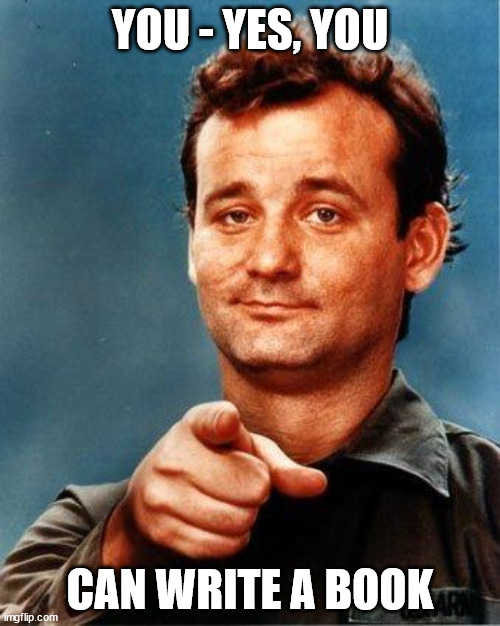
I’m going to both agree and disagree with her here. I think that if somebody’s response to your news that you finished a book is “anybody can do that,” they’re an asshole and they are downplaying your achievement. That said, I think the truth of the matter actually is that anybody can write a book and it does writers well to embrace that fact.

First, we need to define some terms. When I say “anybody can write a book,” I don’t really mean any particular human on the planet. Some people, due to physical or mental limitations or educational deficiencies, won’t be able to read a book, much less write one. So, for “anybody” in this discussion, read “anybody who wants to and has a minimum skill set to do it.” That said, the “book” we’re talking about is defined pretty expansively – it doesn’t mean “good,” it doesn’t mean “best seller,” and it doesn’t mean “beloved by a small but passionate fan base.” It means a book – a collection of tens of thousands of words that tells a story. Leave quality judgments out of it.

With that said, it should be pretty clear that anybody can write a book. There’s nothing about writing a book that is inherently difficult – you put words on a page, you do that some more, and, eventually, you have a book. What matters most when it comes to writing is that you actually sit down and write. Orders of magnitude more people will start to write a book than will finish it, but there’s nothing mystical about the ones who finish – they just keep working. The same is true for any art, really – for most folks, it’s more perspiration than inspiration.

There’s another question, somewhat related, that I’ve seen elsewhere on the Internet, which is “can writing be taught?” This seems like a question with an obvious “yes” answer, but it hints at something deeper about creative endeavors. You can learn the skills necessary to do just about anything, but you still need the creativity to be able to do something interesting with it.

One time, my wife and I did one of those “drink wine and paint a picture” things, which we really enjoyed. I immediately analogized the blending of paints to create certain colors and effects with the way you blend and sculpt sounds on a synthesizer. I was enthusiastic that I could add this creative element to my arsenal – my wife even got me some painting supplies for Christmas. I never did anything with them. Not because I wasn’t excited by the process, but because the creative spark never came. I couldn’t figure out anything to do visually, the way I get ideas for stories or rhythms and melodies pop into my head. But could I bear down and crank out a painting? Sure, but would anybody care about it?

Ultimately, that’s why someone saying, “oh, anybody can write a book” can sound so hurtful. It’s usually said by someone who’s never even tried to do it, much less accomplished it, to someone whose passion, creative drive, and tenacity resulted in a work they’re proud of. They probably gave up time with friends and loved ones while working on it. They bled for it (metaphorically – I hope) and this is the reaction they get?

You know what? Fuck those people. It’s probably true that anybody can write a book. It’s also true that most people won’t even try. You did and you succeeded. Take pride in that and move on to the next one. Keep on working.

Getting Creative In Court

Lawyers, in general, write a lot in their work. I write even more, given that I specialize in appeals and other sorts of post-conviction cases. Over the two-plus decades I’ve been doing this, I like to think I’ve developed a good skill with words, with creation of sentences and paragraphs that convey meaning and argument while still being a pleasant read. The days of legal writing filled with “heretofore”s and meaningless Latin phrases (seriously, if you see any sentence with “inter alia” in it, cross it out and tell me how that sentence is any different) are long gone, thankfully.

Still, there’s only so much creativity you can squeeze into legal writing. For one thing, you’re limited by the realities of the facts in your case (particularly in an appeal) and you can’t really beef up the plot or characters of you brief to make them more persuasive. For another, you have to consider the audience. The truth of the matter is that judges (and their clerks) are busy, have countless things to read on a daily basis, and are interested in being persuaded as quickly and clearly as possible. An appellate brief is no place to play with the form of words and sentences, to be coy about meanings, or to roll out mysteries for readers to ponder.

That’s one of the reasons I started writing fiction, especially fantasy. What better escape from the horrible facts of real life cases than worlds where I get to make up anything I wanted to? Strange new worlds! Interesting creatures! Cultures and histories never before imagined! This is where my creativity gets to thrive, not in court.

Right? Maybe not, if I could draw anything beyond a stick figure.

Third Planet Sci-Fi and Fantasy Superstore is a comic book and related merchandise business in Houston. From the Google Street View image you can see that it’s a wide, one-story building next to a busy street. You may also notice that it’s next-door neighbor is a high-rise Crowne Plaza hotel that towers over the place.

Third Planet is suing its neighbors because . . . well, because there tend to be a lot of assholes staying there. According to a third (!) amended petition filed in state court, hotel guests frequently make use of the hotel’s open-air balconies and fire escape to “throw all manner of projectiles off those landings and onto Third Planet’s roof and parking lot. It goes on to describe one particular day:

On or about March 3, 2019, matters escalated to a new level of destruction. Hotel guests, residents, tenants, patrons, customers, or visitors launched at minimum fourteen large metal-canister fire extinguishers from the Hotel onto Third Planet’s roof and parking lot. The canisters landed on the roof with explosive impact. This caused significant compromise to the structural integrity of the roof. In sum, the roof was irreparably damaged.

The next paragraph simply says: “Then came the rain.”

Pretty compelling stuff, right? Nonetheless, according to the petition, the defense “has previously filed special exceptions, complaining that it could not sufficiently understand the claims and allegations against it.” So what does Third Planet’s counsel do? They write a comic book to lay out everything.

Over the next 13 pages, the comic tells the story of Third Planet, its bowling champion owner TJ Johnson, and the store’s history in Houston. As for those flying fire extinguishers? Well . . .

The whole complaint is here, with the comic part starting at page 6. It’s a bold brilliant move and, without knowing anything about the actual legal merits (property law is not my specialty), I hope Third Planet wins and wins big.

Bold as it is, Third Planet’s resort to visual aids in a pleading is not unprecedented.

A comment to the Volokh Conspiracy post that brought this to my attention pointed to an article from the ABA Journal in 2012 where a lawyer did something similar in federal court.

The case involved the United States’ antitrust complaint against numerous publishers for fixing ebook prices and an attorney wanted to file an amicus (friend of the court) brief taking issue with some of the Department of Justice’s positions. He originally filed a 24-page motion with a 29-page proposed amicus brief attached. The court said he could file an amicus brief, but it could be no longer than five pages.

Which he did, taking a more comic strip approach:

The comic complied with all the usual formatting rules for pleadings in that district (font size, margins, etc.), but that didn’t keep the US Attorneys working on the case from dealing with it without a lot of effort (and the settlement they were seeking was eventually approved). Still, it was pretty clever (you can read the whole five pages here).

Like I said, making your argument in pictures is a pretty bold gambit (easier to do when you’re not actually representing a client). If it works, it’s brilliant. If the judge takes offense, thinks somebody’s diminishing the process, it can be a disaster. Come to think of it, probably for the best that I steer my wilder impulses into fiction.

Gone Editin’

 Since it’s now summer and time for a break anyway, I’m going to step away from the blog this month to concentrate on getting Widows of the Empire in nearly-final form. Got beta-reader feeback to work through so hopefully, come July, I’ll be able to see the end of this particular tunnel. Also there’s, like, a shit ton of soccer coming this month, including the start of the delayed Euros and the conclusion of the CONCACAF Nations League. So, you know, I have obligations.

Until then, these two will be keeping an eye on the shop.

Don’t take advantage, ‘kay?