Decision Made (Finally!)

The more I write the more I realize that coming up with ideas isn’t the hard part. What’s hard is figuring out which ideas have legs and can become stories or books. Sometimes it takes some hard work to separate the wheat from the chaff, so to speak.

When Heroes of the Empire came out in June  it brought to a close a long period of focusing on one world and one project. Since 2018, at least, when I started the first draft of Gods of the Empire, I’d basically lived in the world of the Unari Empire, building it out and telling the stories of my characters in it. The only reason I felt able to work on the sequel to Moore Hollow in the spaces between those books was that it meant returning to a world I already knew.

At the same time, I was gathering ideas like some thieving magpie, putting them away in various Word documents for a later date. I knew from the time I collected them that some had more substance than others, but I wasn’t quite prepared for how long it would take me to figure out which ones were which.

See, the thing with trilogies, at least for me, is that they are an implicit promise to the reader – I know how this ends and I’m going to finish it in good time. If I say “here’s my new book, it’s the first part of a trilogy,” rest assured that, barring some unforeseen circumstance, I’m working on those books for the next few years.

Which means, back in June, I got really excited about the idea of diving into a new world. Part of what makes writing fantasy so fun is you get to let your imagination wander and come up with strange new places, things, and people. Writing a trilogy means that you have to put that wandering on hold and I was happy to get my walking shoes back on (so to speak).

And I had a target – I wanted to start my next book during National Novel Writing Month. I’ve done that for several of my books. NaNoWriMo provides a great way to focus on writing for a month, even if what you’re left with on December 1 is only two-thirds or even one-half of a finished manuscript. That would give me a couple of months to build the world, flesh out the characters, and then figure out what was going to happen to them.

Easy, right? If only.

I actually had to go through my idea files pretty brutally, with virtual red pen and everything, and just get rid of stuff that didn’t really strike my fancy. Some of those were mere ideas (“surely there’s a fantasy story in the Scapa Flow incident, right? What about High Noon but with wizards!”) that were never going to become a real story. Others were things that I’d hung on to so long without developing that I figured their time had passed. Ultimately, they were ideas that I just didn’t see sprouting stories and I hadn’t faced up to that fact yet.

In the end I had about three dozen ideas that could become my next project, so I decided to so what my anal retentive self always does – start dividing and conquering them. I put each idea into one of four groups – Sci-Fi, Older Fantasy, Newer Fantasy, and Non-SF/Fantasy (yes, I’ve got a couple of those). The goal was to produce a “winner” in each group and then compare those four to each other. I almost worked – I wound up with five finalists because I couldn’t decide between the top to Newer Fantasy ideas.

I worked through each idea. I took a week and spent one day thinking through all the angles I could for every one. I did a PowerPoint presentation for my wife to get her feedback on the ideas. Good ideas that I at first thought were front runners fell by the wayside either because they weren’t as deep as I’d hoped or they just weren’t singing to me.

Finally, last week, I was in Richmond for court and had some time the night before to work through the final three (don’t worry, my colleague was doing the argument the next morning). I walked around my hotel room, talking to myself, arguing the pros of a particular idea then playing devil’s advocate and tearing it apart. After a couple of hours, and a really enormous calzone, I finally made a decision.

My next project has the working title The Fall. It’s inspired by the sad tale of Franz Reichelt, a Parisian tailor who met an infamous fate:

To use an awful pun, that’s the jumping off point for this project. It’ll be set in a similar kind of world, timeline wise, but include what I think is a really nifty magical element. This is my first time building a magic system for one of my novels, so I’m both anxious and excited about the prospect. Structurally I’m leaning toward doing something like Citizen Kane, where the main character is investigating someone’s life and we see it play out in flashbacks.

All in all, I’m really looking forward to diving into this.

And, yes, it is the one my wife liked best.

The Prequel Problem

Ending stories is hard – trust me. But figuring out the right place to start them can be just as hard. That’s true for all kinds of stories, but particularly fantasy or sci-fi stories where you have to build the whole world around the story you’re telling and the characters involved. By definition their world existed before their story did and will continue to do so once it’s over (barring apocalypse, of course).

Which explains the popularity of prequels. There’s so much backstory to dig through, most of it only hinted at, that there appears to be a rich environment to exploit. It must also seem like a fairly safe investment, since you’re dealing with, if not familiar and fan-favorite characters, at least events and histories in which the fans are already invested.

But there’s an inherent problem with prequels – they’re playing in a universe in which the future is already known to us. That can box writers in and sometimes make it difficult for the prequel to stand on its own as a piece of compelling drama, something we should care about for its own merits.

I thought a lot about this problem over the weekend as the wife and I (at her suggestion!) finally caught up with the Obi-Wan Kenobi series.

The six-episode series is set in the time between Rise of the Sith, with its culling of the Jedi, and the original Star Wars (aka A New Hope), a time during which, for all we knew, Obi-Wan was living off the grid on Tatooine keeping tabs on Luke Skywalker. Years pass, of course, so the idea that he didn’t get into anything worthy of telling a story about is pretty sad, but do the writers use that freedom to do something really interesting?

No, not really.

The inciting incident of the series is when Princess Leia is kidnapped on Alderaan (nice planet – too bad it goes boom) by, of all people, Flea. This is part of a plan to draw out Obi-Wan so some Jedi hunters can get him. Those Inquisitors are kind of interesting and could have been explored in some depth, but they have a boss and his name is Darth Vader. And so, the series largely revolves around maneuvering Vader and Obi-Wan into the same space.

As a result, we get two solid confrontations between them, the second of which would have felt like a pretty epic duel if it had any kind of stakes. It couldn’t, however, because of the prequel problem: both Vader and Obi-Wan survive to fight again in Star Wars, so neither can be killed or even seriously injured in ways that conflict with the “future.” Likewise, young Leia (who, as you might expect, is quite the scamp) is never in any real danger, as we know she survives unscathed. Indeed, the series punts her offscreen for the final episode mostly, as it rushes back to Tatooine for a confrontation between one of the Inquisitors and Luke’s family – which, again, we know will ultimately come to nothing.

It didn’t have to be that way. Using Leia’s kidnapping to lure Obi-Wan out of hiding was a solid idea. Imagine if she’d mostly stayed off screen (a MacGuffin, if you will) while he scrapped with and evaded Inquisitors and grew into his status as a hero. There’s actually a good character arc in the series, as Obi-Wan goes from trying to lay low and hide to being more engaged with the Rebellion. Isn’t that a cool enough story to tell? Do we need the Vader stuff? Do we need any suggestion that Leia or Luke will be harmed?

Star Wars knows how to do this. Rogue One is regarded by a lot of people as the best Star Wars movie since the original trilogy, even though we knew precisely how it was going to end. What made it work was that existing characters were largely absent and we got to know and care about a whole new cast so that when they made the necessary sacrifices to complete their mission it landed with some heft.

Ultimately, I think the prequel problem is a matter of characters rather than universes. After all, we read historical fiction all the time that involves real events. It’s not what happens to characters, it how it effects them, changes them, that matters. But when your prequel ties itself to characters who can’t change, that becomes a problem. I’ve dinged Star Trek – Strange New Worlds for tying itself too closely to characters steeped in Trek lore, rather than freely exploring people we know nothing about.

I’ve never really been interested in the idea of writing prequels. I had a prequel story, of a sort, for one of the characters in the Unari Empire trilogy that I almost wrote, but ultimately decided that all that was important about him was in one of the books already. Generally speaking, I’d rather go on and dive into a new world with new characters than revisit old ground.

But if you asked nicely . . .

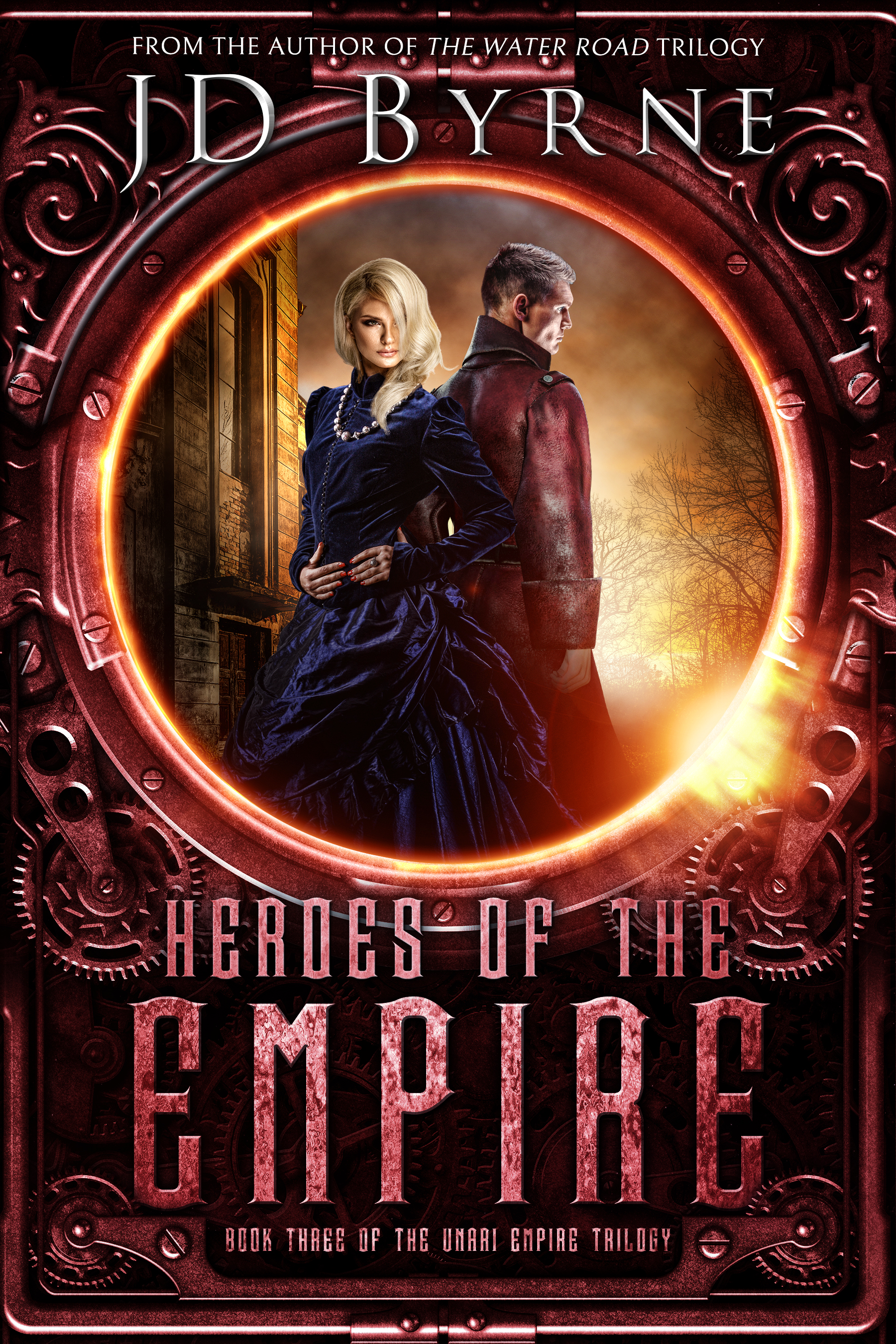
Coming June 7 – Heroes of the Empire

I’m very happy to announce that Heroes of the Empire, the final installment of the Unari Empire trilogy will release on June 7 on Kindle and other eBook formats and then in paperback shortly thereafter.

The world is falling apart around Aton Askins. His childhood friend is rotting in a cell for a crime she didn’t commit. There are soldiers in the streets of Cye and an army of angry widows waiting outside the city. His mystery employer might be using him to gather artifacts of the ancient gods to build some kind of weapon. Now he’s been given one last job, one last artifact to find, supposedly on a mythical floating island halfway around the world. He needs to stay in Cye to help his friend, but he needs to finish his work so he has the money to take his family away from the city. Most of all, he needs to keep those he loves safe from what’s coming.

The Widows Army is restless and may be slipping away from Belwyn of Annanais. Stuck outside of Cye, unsure of what to do next, she needs to do something, anything, to make sure the promise she made to these women to find answers about their loved ones doesn’t go unmet. When an unlikely ally presents himself, she uses the opportunity to enter the city and finally find the evidence she needs to show the world the truth of the Port Ambs bombing. All the while, the currents of protestors and revolutionaries are threatening to overtake her.

Lives collide and the fate of an empire hangs in the balance in this thrilling conclusion to the Unari Empire Trilogy.

Inspiration Strikes at Odd Times

So, you know how I’ve released two volumes of the Unari Empire Trilogy, right? That would be Gods of the Empire and Widows of the Empire.

What about the final volume, you might ask, Heroes of the Empire? Any update on it? Yes, friends, and it’s good news!

But first, some context.

Although Widows just came out last fall, I’ve been working on Heroes since about a year before that. It was my NaNoWriMo project in 2020, so I started writing it in November of that year. I “won” that year, but the book was nowhere near finished, so I kept working on it into the new year. By June of 2021, according to a timestamp on the Word file, I had something saved as “First Draft.” Except it really wasn’t.

What had happened is that I got about 80% through the draft and my creativity came to a complete halt. I didn’t have a good idea of how to bring things in for a landing, so rather than try to push through the end, I took a different approach.

In my day job, sometimes I take pieces of legal writing from others in my office and synthesize them into a single brief. It’s safe to say that each of the attorneys in my office has a different voice and just cutting and pasting won’t work to produce a clear, readable final product. So I have lots of experience rewriting the words of others to produce a smoother end product.

When I wrote Moore Hollow and The Water Road I did the same thing – I took my first draft of each book and rewrote them completely, filling in any shallow bits and using the quicker pace to connect up things better. It worked well, but I hadn’t felt a need to write that way for the other books that followed.

Until Heroes. Since I was stuck I decided to pull a Bruford and go back to the beginning again and rewrite the first draft. According to yWriter I started that process last April and everything went swimmingly for a while, until things bogged down again. In particular, when I got to that ending, I just completely lost momentum. It wasn’t that I didn’t know where the story was going to end up, I just didn’t quite know how it was going to happen.

Last week I was bogged down (again) in what I thought was the next-to-last chapter. It shifts POVs a lot as the climax happens and that made it hard to write, anyway. Otherwise, I was just kind of drifting.

Then I got up to take a piss one night.

I was up in the middle of the night to go to the bathroom, my mind barely functioning, when it hit me. This was out of the blue inspiration of the kind I don’t generally have. The solution was simple – a short time skip to move straight to the consequences of what we’re seeing, rather than the details of the incident itself. I was so stoked I couldn’t really get back to sleep (which made work the next day quite a drag).

This is a long way of saying, this past weekend, I finally put the final words of the first draft of Heroes of the Empire into yWriter! It’s finished! Well, I mean, it tells a complete story. Now comes the fun part, the several rounds of edits, but at least I can see the end of the process at this point.

Thus, coming late this year or (more likely) early next, the final, gripping part of the Unari Empire story, Heroes of the Empire.

My Black Pages

One of the little bits of world building for the Unari Empire books that I had fun with was thinking through the newspaper situation in Cye. Given the steampunk(ish) setting, it’s the most plausible form of mass media and how it’s regulated says interesting things about the world. Hence, the “real” newspapers are known by how closely aligned they are with the Imperial regime, since to officially publish they need a literal seal approval.

When it came time to write Widows of the Empire I needed to expand my thinking a bit and figure what underground papers might look like and what they might be called. I settled on small papers crammed with type, so much that each page looked nearly black. Naturally, characters refer to them as the “black pages.”

This is not an accident.

Readers of The Water Road and its sequels know that I use a lot of musical references in my books. Lots of places in that series are named after musicians, the more obscure the better! The “black pages” are no different, as I’ve stolen the name from a song (or a few) by Frank Zappa.

Frank originally wrote “The Black Page” as a percussion feature, kind of on a dare. After an orchestral session, drummer Terry Bozio related that some of those players talked about the fear of facing “the black page,” prompting Frank to write his own. The song evolved from a short piece for drums and percussion into a song for a full band, in various guises.

In this video, musician Doug Helvering works through the first two versions of the song, with excerpts from the score to prove the that the song was well named:

A decade after that second version, the song morphed again, into a “New Age Version” that was performed on Zappa’s final tour:

Even laid back, it’s kind of a bear.

Names can be tricky for fantasy and science fiction writers. My suggestion – take inspiration wherever you can, even if it’s in an insanely complex song.

Widows of the Empire – Coming November 10!

So remember when I said I hoped to see the end of a particular tunnel by the time July rolled around?

Well, guess what?

Widows of the Empire, book two of my Unari Empire Trilogy is finished and I’m shooting to release it on my birthday, November 10! Of this year!

Okay, so not quite finished, but the main text is done. Needs formatting and a couple of final flourishes, but, barring tragedy, you’ll be able to reach more of Aton and Belwyn’s adventures as the Unari Empire begins to come apart this fall.

A Little Proof of Concept

It seems like such a long time ago – but only December 2019 – that I announced a National Novel Writing Month “win” with Widows of the Empire, the second book in the Unari Empire Trilogy. Under normal circumstances, that might have meant the book would have been finished and released in 2020.

Yet, if anything, 2020 could hardly be described as “normal.”

For whatever, be it pandemic fatigue/ennui or just the fact that this book has been kind of a bear, the progress on Widows has been slower than I’d hoped. Still, it’s with beta readers and I’m ready to do a final edit when I hear back from them. Until then, I wanted to provide a little proof that this book is a real thing, not just residing in my noggin.

Some people create covers, or have the commissioned, before they even start writing a book. I don’t know how they pulled that off. I suppose it’s easy enough to change things if you have the talent to do your own covers (I really do not), but I can’t imagine at least having a first draft complete and knowing how everything winds up before getting to work on a cover.

So, while Widows of the Empire is not yet in its final final form, I can at least go ahead and share this with you:

Given the title, it’s no surprise to find Lady Belwyn on the cover of this one (Aton, the finder of lost things and other main character for the trilogy, is on the first one).

As usual, this is the work of the fine folks at Deranged Doctor Designs. Coming soon to a shelf near you!

Can’t Talk – Writing

Hey, gang. Guess what time of year it is?

I mean, yeah, there’s an election that’s probably not going to be over with for a while, but beyond that, it’s November which means . . .

It’s National Novel Writing Month!

That’s when folks, including yours truly, take the month of November to focus on writing the first draft of a novel – well, at least 50,000 words of it. I’ve done this several times and it’s a great way to jump start a new project. So, this year, I’m going to be writing the third book in the Unari Empire trilogy, Heroes of the Empire (yes, yes, I know, Widows of the Empire isn’t out yet – it’s with beta readers, so it is coming), thus bringing the whole thing to a thrilling (?) conclusion.

Which means – it’s blog silence for me for the rest of the month (at the least). Stay safe and I’ll see you on the other side.

My Characters Don’t Speak to Me

Creativity is a weird thing. A book is a book or a song is a song, but different writers can get to that finished product in lots of different ways. That’s made clear to me whenever writers talk about being pantsers instead of plotters. Pantsers, generally speaking, make it all up as they go along, without any great amount of planning, notes, and the like. Plotters, by contrast, do all that stuff before they start writing. I’ve learned, the hard way, than I’m more plotter than pantser. I admire pantsers for the way they write, but to me it’s as foreign an experience as it would be if I tried to write the last part of the Unari Empire trilogy in Tagalog.

There’s another group of authors of which I am not a part when it comes to the creative process. That’s the group who talk about the characters in their stories like they are independent, sentient beings. Some talk about how they don’t write dialog, they just transcribe conversations their characters have on their own. Others give their characters agency and talk about how they can’t control what they do. As at least one well-known writer put it:

Philip Pullman, author of the His Dark Materials trilogy, reports negotiating a deal with his character Mrs. Coulter to get her to spend time in a cave in one of his books. Some authors have reported that their characters give them unsolicited advice about the writer’s own life!

I just don’t get this. One of the amazing things about writing fiction is that I, as the author, am God, in a big G omniscient and omnipotent sense. Characters only exist because I create them and they only do what I tell them to. Their words are my words. Does it means they always develop the way I first intend them to? No, but that’s me changing my mind, not them rebelling.

Maybe I look at it this way because I started writing seriously as a lawyer and in legal writing you’re at the whim of so many other things – the law, the facts, your clients. In fact, it’s my clients who behave the way some writers talk about their characters – with complete free will and a dazzling inability to control themselves.

I always figure that when writers talked about characters talking to them or doing things against the writer’s will it was a way for writers to deal with the vagaries of the creative act, with a heaping helping of metaphor baked in (we’re talking about writers, after all). But I’m apparently wrong and in the minority on this, according to recent research with authors from the Edinburgh book festival:

Researchers at Durham University teamed up with the Guardian and the Edinburgh international book festival to survey 181 authors appearing at the 2014 and 2018 festivals. Sixty-three per cent said they heard their characters speak while writing, with 61% reporting characters were capable of acting independently.

‘I hear them in my mind. They have distinct voice patterns and tones, and I can make them carry on conversations with each other in which I can always tell who is ‘talking’,’ said one anonymous writer. ‘They sometimes tell me that what I have in mind for them isn’t right – that they would never behave or speak that way. I don’t usually answer back,’ said another.

Beyond that, 15% of writers surveyed say even talked back to their characters. So, what, are they crazy? Not so much:

Even though some authors reported that their characters had a life of their own, the researchers were keen to stress that there was no question of writers confusing fiction with reality. When the academics rated the writers on how prone they were to hallucinations, they did not score differently to other samples of the population. ‘Hearing voices and other unusual experiences are not in themselves a symptom of a mental health problem,’ they wrote. ‘This shows that vivid imaginative states – including losing control of one’s own imagination – [are] a healthy and safe thing which is important for how some people create fiction.’

Then what’s going on here? Researchers think that these writers aren’t sharing a singular experience, but it’s more that they’re describing a myriad of experiences that occur during the writing process. In other words, to say “they hear their characters talk to them” really flattens the nuance of the issue.

There’s part of me who thinks like this guy, like I’m missing out on something:

CharactersTalk

I get what he’s saying. There’s something transcendent and beyond the realm of grinding craft when characters talk to you. You’re not just writing, at that point, your communing with the muse, you’re tapping into the essential forces of the universe.

But I don’t think that can be right. Neither he nor I are missing out on anything – we just work differently. Truth is, while there may be a wrong way to write a book, there are probably an infinite number of “right” ways, because what works best for one writer might not work at all for others.

So, I guess I’m fine with the idea that my characters don’t talk to me. In place of the psychic connection that others have with their creations, I’ll happily sit back and make mine do whatever the hell I want while theirs are wreaking havoc!

Raplh