Scraping the Bottom of the Bucket(head)

One of my favorite Monty Python sketches – a “deep track,” if you will – is one where the whole crew (even Neil Innes) engage in suitably breathless election result reporting. Along the way we learn the fates of the Sensible party, the Silly party, and, eventually, the Very Silly party:

https://youtube.com/watch?v=kJVROcKFnBQ

I’ve always assumed that was just satire about the pointlessness of politics. Little did I know that this was closer to a situation of art imitating life than I could imagine.

In the wake of the recent British elections, Christa over at Lawyers, Guns & Money tells us the tale of Lord Buckethead, occasional candidate for parliament. Lord Buckethead comes from a low-rent rip off of Star Wars and looks about like you’d expect a generic Darth Vader with a bucket on his head to look like. Freed from the service of that second-rate narrative, Lord Buckethead has run for Parliament three times since 1987 – all against Tory Prime Ministers.

Now, you might be thinking that even in the United States we have our share of nutty candidates who file papers. What’s different is that in this country we make sure nobody actually sees them during the process. By contrast, in the UK, Lord Buckethead (and whoever the Very Silly party is running) get to be on stage with the “real” candidates when the results are announced. As a result, things like this happen:

How would Lord Buckethead fare in American politics? Hard to say, but he’d at least have to find a different name. We’ve already got a strange guy with a bucket on his head – and he’ll shred all over that stove-pipe motherfucker’s ass:

This Argument Makes No Sense

Authorities in New Orleans have begun removing from public land a group of monuments dedicated to the Confederacy. It says something about how touchy a subject this is that the people doing the work had to be masked and protected by police snipers.

Among all the wrangling about this there’s one argument from the enablers of the Lost Cause that I just don’t understand, since it makes no fucking sense. It’s made repeatedly in the comments to this story in the Guardian. Here’s a representative sample, responding to the article’s point that this isn’t an issue of erasing history:

Yes it does. You have removed a piece of history from public view. Say you were walking past it with your young child and they said, “Daddy, what does that statue represent” then you could explain to them. Otherwise they are unlikely to learn about the past that has been removed, unless they teach it in school. But even then it’s not the same because it’s just words in books. It’s like removing fossils.

I can only figure that this is a post-hoc rationalization for a knee-jerk opposition to anything perceived as being done in the name of “political correctness,” because a couple seconds of thought shows is just doesn’t make a damned bit of sense.

Take this to its logical conclusion – once a monument of some kind has been erected, it can never be taken down without “erasing history.” If that’s true, we’re not exactly innocent:

IRAQ-BRITAIN-IRAQ-MILITARY-HUSSEIN-AUCTION-HISTORY-FILES

Then there’s the wholesale destruction of Nazi symbols and such in Germany following World War II. Or the toppling of statues of Stalin or Lenin following the end of the Cold War. The idea that monuments have infinite shelf lives simply isn’t rooted in history.

Beyond that, if a monument is history that can never be erased, does it create a perpetual obligation upon future taxpayers to keep it in good repair? Neither of those things can be true – they just don’t make any sense.

Let’s hypothesize using a silly example. In Futurama we learn that, sometime between Fry being frozen and thawed out, New York had a supervillain for a governor. Not only did he “collect” a bunch of famous monuments from around the world, he even added himself to Mount Rushmore:

Futurama_Mt_Rushmore

Now, years after the fact, are the citizens of New New York required to look at the face of evil everyday in the name of history? Do they have to pay to keep the super villain’s face looking crisp and life like? I’d say the answer is clearly no, but I’m not sure how those “this is erasing history” people could reach that conclusion.

Monuments and memorials are put up for a reason – because the people of that community at that time thought they were appropriate. There’s no magic in those intentions, nothing that shields the thing memorialized from future scrutiny. It’s entirely appropriate for future communities to decide that this thing is no longer worth celebrating.

The False Unity of Opposition

I had a thought on election night back in November, as we slowly crawled to the fact of President Trump. I wished I’d blogged it back then, but I’ll just have to ask you to trust me about this.

The thought, as I sat there and contemplated Republican control of both houses of Congress and the White House, was this – can the “party of no” go from playing opposition to actually governing? Recent events suggest they may not.

Since the passage of the Affordable Care Act (aka “Obamacare”), Republicans have pledged to repeal it. It was a promise Trump embraced enthusiastically during the campaign. If there was one clear thing Americans could expect a united GOP power structure to do, it was to gut Obamacare. Last Friday, House Speaker Paul Ryan withdrew the proposed “repeal and replace” bill, rather than watch it go down in flames on the House floor. Democrats only had to smirk from the sidelines.

What the hell happened? How could a party so unified in the past about a goal fall apart so quickly?

Because being the opposition helps creates a false sense of unity among those doing the opposing. Think about it – so long as the only thing a group has to do is say “no” to some outsider they don’t have to deal with their own internal divisions.

Make no mistake – during the Obama years, the GOP was the opposition. While they controlled both the House and Senate (for varying lengths of time), it wasn’t enough to override a veto, if it came to that. Measures with bipartisan support were possible (if vanishingly rare), but true GOP proposals were dead on arrival. Hence those 54 votes to repeals of the ACA, none of which actually accomplished anything (aside from being red meat for fund raising).

That’s not quite true – it papered over the differences in the party itself. After all, when the default position is anti-whatever the other party wants, it’s easy to stick together. It doesn’t matter why you take that position, only that you do. That one group of reps are coming from a deeply ideological direction and a second from a  more moderate one is irrelevant so long as they both arrive at the same result.

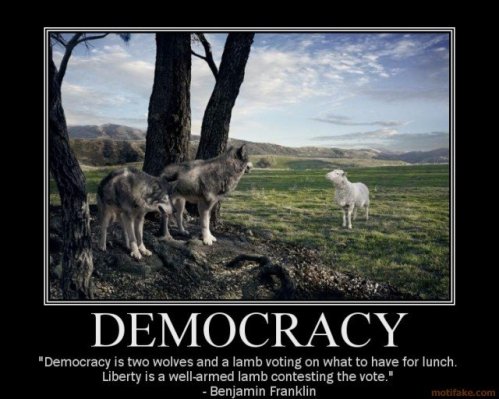
There’s an old saying that pure democracy is two wolves and a sheep voting on what’s for dinner. While we can assume there’s at least two votes not to eat the wolves, we might not assume there’s the same support for eating the sheep. After all, one of the wolves could be a vegetarian.

So now, I suppose, the question is – how long before the GOP wolves finally figure out how to eat the sheep.

Democracy_f59523_1766271

Weekly Read: Dreamland and Chasing the Scream

I read these two books back to back because they seemed to go together. One is a sober telling of how an epidemic swept the nation, landing right in my back yard (the book itself swept through my office earlier this year). The other is a passionate call to arms about the War on (Other Peoples’) Drugs. Both are essential reading.

The Dreamland in Dreamland, by former crime reporter Sam Quinones, is a public pool in Portsmouth, Ohio. For decades it was a hub of life in the town, ever expanding. It’s decline was tied to the region’s decline as a manufacturing hub. As jobs went away and poverty grew, addiction to powerful new opioid painkillers, and then heroin, ravaged the region. Dreamland was the perfect metaphor, withering away to merely a memory.

In Dreamland the book, Quinones lays out the perfect storm of factors that led to the opioid epidemic, which continues to claim lives all over the industrial Midwest and Appalachia. It’s made of three strands. The first is a revolution in the medical conception of pain, especially long term, chronic pain, and that it could and should be treated with powerful drugs. The second is the search for a safe drug to meet that need, which eventually led to Oxycontin. The third is slow expansion of a particular kind of heroin distribution operation from a particular small town in Mexico, Xalisco. As the “Xalisco Boys” operation spread into regions not generally thought of as “heroin country” (like West Virginia), they found a fertile ground of addicts already hooked on Oxycontin and looking for a cheaper, better fix.

Each strand has some particularly interesting stories to tell, although they’re not all of equal interest. The retail heroin distribution of the Xalisco Boys is, in fact, quite interesting – unlike the violent drug gangs who sell stepped-on product as a means to enhance the bottom line, the Xalisco Boys competed simply by selling a better product for less money. No violence and a focus on customer service. It makes getting heroin like ordering a pizza – an analogy to which Quinones returns over and over again. That’s the book’s main failing – it treads over the same ground repeatedly, particularly when it comes to the Xalisco Boys.

The other two strands weave together more effortlessly, particularly since they share a common root. In the 1980s a doctor published a “report” – really just a one-paragraph letter to the editor of a medical journal – that his practice hadn’t shown that patient who received powerful pain killers became addicted to them. This became the basis for Oxycontin advertising that opioid medications weren’t addictive, which recent history has shown to be completely false.* In the post-truth era of President Trump and “fake news,” it says something that the basis for Oxycontin’s development and sales was so poorly vetted because there was no profit to be gained in confirming it (because there never was in debunking it).

That’s one interesting linkage between the sellers of Oxycontin and the Xalisco Boys that Quinones hints at, but doesn’t quite make. Both are driven in what they do by the most basic of motives in a capitalist society – not just to make a profit, but to make as much of it as possible. That’s what drove the Xalisco Boys to look for untapped heroin markets. That’s what drove the Oxycontin peddlers to skip past the possibility of addiction and push doctors to prescribe the pills for damned near everything. The bottom line can be damned scary thing.

Dreamland is far from perfect. As stated above, it’s redundant, even beyond the stories of the Xalisco Boys. It’s also pretty dry writing, although it gets the point across. More important, Quinones gives short shrift to the fact that Oxycontin and other powerful pain killers are, for some patients, their only means of dealing with their pain. It also falls into a familiar pattern – of drug dealing bad guys (of various kinds) and good guy cops fighting to stop them – without providing any insight as to whether that’s a battle worth fighting.

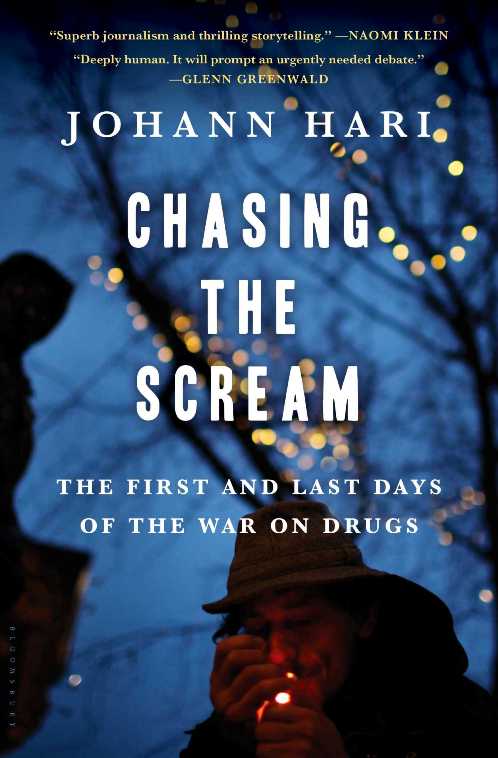
Where Dreamland is a sober telling of an important modern story, Chasing the Scream is a polemic, a call to wake up to the failure of the War on (Some Peoples’) Drugs after more than a century. Dreamland should depress you – Chasing the Scream should piss you off.

Chasing the Scream is journalist Johann Hari’s chronicle of his attempt to figure out how the drug war began and where it’s headed. He travels the world, from his native UK to North America and elsewhere seeking answers about policy, addiction, and alternatives to prohibition. If in the end he doesn’t come up with a singular policy proposal to end the drug war, Hari at least convinces that it’s a war that needs to end (full disclosure – 15+ years of criminal defense practice convinced me of this long ago).

One thing he collects along the way are a cast of rich, memorable characters, from the transgendered former dealer in New York City and the former addict who transformed a particularly seedy portion of Vancouver to an addict who died in prison, cooked alive in the Arizona sun, and a mother whose pursuit of justice for her daughter in Mexico just produced further violence. Most key to the Hari’s book, however, is Harry Anslinger.

Anslinger was the head of the Federal Bureau of Narcotics (the spiritual predecessor to the modern Drug Enforcement Agency) for more than three decades and was, to Hari’s telling, the paradigmatic drug prohibition enforcer. He saw addicts as less than human, used racial and ethnic hatred to stir up panics to grow the power of his office, and was an overall asshole (the “scream” of the title refers to a trauma of Anslinger’s early childhood). Along with jazz great Billie Holiday (one of Anslinger’s high profile targets) and gangster Arnold Rothstein (the prototypical violent drug lord), Anslinger’s ghost hovers over the entire book as the project he started, the War on (Other Peoples’) Drugs expands and is entrenched.

Anslinger is Hari’s antagonist and he spends most of the book looking at the impact of his drug war on those caught up in it and challenging the assumptions underlying it. Of particular importance, he emphasizes the psychological model of addiction over the pharmaceutical model, presenting evidence that most drug users consume their product of choice without much problem, like most people drink alcohol without becoming alcoholics. Along the way he suggests that the scientific literature is clear about the limited addictive power of opioid pain killers, for instance, a claim that Quinones severely undermines.

Compelling as the stories of those caught up in the drug war are, the more interesting bits of Hari’s book are his examination of questions of drug use more generally, and addiction in particular, that shows the entire is more nuanced that Anslinger-style prohibitionists allow. For example, he discusses studies of drug use by non-humans, which is apparently fairly common. Elephants in Vietnam, for instance, generally steered clear of poppy fields until the United States bombing campaign drove them to seek escape from their terror.

It also allows Hari to get into various experiments with alternatives to strict drug prohibition. That includes programs in the UK and elsewhere that allowed addicts to get drugs legally, via prescriptions doled out by a state monopoly. Far from turning into drug fueled free for alls, this allowed addicts to function in everyday society and didn’t lead to more drug use. It also cut off a powerful marketing tool for drug dealers, as the addicts are their best customers. It’s no coincidence that part of the Xalisco Boys scheme that Quinones documents is how they used addicts in a new market to help them advertise and otherwise find customers.

Hari also explores broader legalization and decriminalization programs, such as those in Uruguay and Portugal. Though showing their success, Hari doesn’t dive deeply enough into the Portugal experiment, in particular, for it’s unclear how the law squares legal use and possession of drugs with criminal distribution – the drugs being used have to come from somewhere, after all. More interesting is his examination of the different arguments used by the people backing marijuana legalization in Washington and Colorado in the past few years. The disconnect (WA – drug prohibition is worse that pot being legal, even if it’s bad; CO – pot isn’t bad at all, being less harmful than alcohol) shows that even folks who see the end of the drug war in sight don’t necessarily agree on how to get to that point.

In the end, Hari doubles back to Anslinger for a stinger that brings the rot at the core of the drug war home. The stinger is – Anslinger himself was a drug dealer. He provided for a sitting United State Representative who was an addict to get a safe supply of heroin at a pharmacy (paid for by Anslinger’s agency, no less). The final irony? It was Joseph McCarthy, infamous red scare scam artist. It’s the ultimate example of the hypocrisy that leads me to call the drug war the “War on (Other Peoples’) Drugs,” because it’s rarely about the powerful and connected that are targeted, but the outcast and the hopeless. The war on drugs, ultimately, is a war on them.

Chasing the Scream, as I said, is a call to arms. Unfortunately, Hari may not be the best person to lead the charge, given his prior history with plagiarism and Wikipedia sock puppet scandals. It gives people an instant reason to disagree with anything he says, from snarky internet commenters to book critics (but see, as we lawyers say).

Dreamland is a flawed book, but essential to understanding one of modern American’s great tragedies. Chasing the Scream is the polemic of a flawed messenger about one of mankind’s great modern mistakes. Both are necessary and highly recommended.

dreamland

drugs0118

* UPDATE: This article from Slate goes into more detail on the one-paragraph phenomenon and how it’s not an uncommon occurrence in scientific journals.

Weekly Read: Imbeciles: The Supreme Court, American Eugenics, and the Sterilization of Carrie Buck

It is better for all the world, if instead of waiting to execute degenerate offspring for crime, or to let them starve for their imbecility, society can prevent those who are manifestly unfit from continuing their kind. The principle that sustains compulsory vaccination is broad enough Three generations of imbeciles are enough.

– Buck v. Bell, 274 U.S. 200, 207 (1927)

In the rogues gallery of bad Supreme Court decisions – things like Dred Scott, Plessy, and Korematsu  – few had summed their own awfulness up so succinctly as Buck v. Bell, in which the Supreme Court upheld the constitutionality of Virginia’s law allowing the forced sterilization of the “feeble minded.” The decision was nearly unanimous (the lone dissenter didn’t write an opinion explaining his vote) and, horrifically, it is still “good law” in the 21st Century (a claim is shares with Korematsu).

Imbeciles, by lawyer turned journalist Adam Cohen, isn’t a deep legal analysis of Buck itself. Instead, it tells the story of the case by focusing on four people involved in it. First (and last) is Carrie Buck, the Virginia woman eventually sterilized for being “feeble minded.” Second is Albert Priddy, who ran the Virginia institution where Buck was committed prior to her sterilization (he dropped out before the case hit the Court, being replaced by Bell). Third is Aubrey Strode, the Virginia legislator and lawyer who helped pass the law and then defend it in court. Finally, there’s Olive Wendell Holmes, the Supreme Court Justice who authored the opinion. The result is an interesting, depressing, and angering story that provides a lot of needed background to the Court’s brief (5 paragraphs) opinion.

Cohen structures the book so that we begin with Buck’s life up to the case began and end with her life after her sterilization. In between, we get a chapter each on the background of the other guys and then a chapter covering their intersection with the case. It’s a fairly effective way to structure things, although not carried off very creatively (each chapter title is just someone’s name, like a George R.R. Martin tome). It also leads to some redundancy, particularly as Cohen uses Priddy’s and Strode’s background chapters as means to sketch out the broader picture of the eugenics movement.

That movement, though eventually discredited and forgotten (the Nazis being enthusiastic adopters of eugenics helped it slip down the memory hole), echoes in the 21st Century political diatribes about immigration and wall building. Indeed, the sterilization arguments were basically the same as the arguments for restricting the immigration of “undesirables,” with the added twist of them already being in the United States. Beyond that, sterilization was largely a way for society to deal with a perceived problem on the cheap – it was too expensive to warehouse the “feeble minded” in a more beneficent way. Sterilization followed by release into society was cheap, easy, and, thanks to the Supreme Court, perfectly legal.

I’ve read some complaints from readers that Cohen spends too much time diving into the biographies of his subjects, to the detriment of a broader understanding of the eugenics movement. I think that misses the point, somewhat. Cohen presents a good argument that Buck v. Bell was as much the result of those biographies as it was legal theory or factual findings. It’s not a complete success (Holmes may have been predisposed to support eugenics, but this wasn’t a close case), but I find it fairly persuasive. For example, see here for a law review article putting Holmes’s vote down his experiences during the Civil War (something Cohen touches on).

The personal relationships explain how the law’s most dubious component came into being. Strode drafted the law, perhaps in a way that meant to slow down its implementation. For example, he refused calls to have the sterilization scheme applied to all Virginians, rather than only those in state custody. Similar provisions in other states had been struck down on equal protection grounds. Cohen argues that while Strode was a skilled lawyer and advocate, he wasn’t the eugenic evangelist that Priddy and others were.

One of those provisions of the law was a requirement that it not go into effect until the Supreme Court approved it. On the face of it, this seems like a good thing – why not wait for the high court to weigh in? But that’s not the way the American legal system is designed to function. Courts (up to and including the Supreme Court) only adjudicate live “cases and controversies” – meaning actual disputes that require a resolution. That’s why issues of standing are so important, as there can be no actual dispute if someone doesn’t have the ability to seek redress against the other party. Our system is designed to allow two interested parties to argue against each other, present evidence to support their claims, and ultimately allow a neutral third party to pick a winner. It’s trial by combat, only less bloody and more mentally taxing.

By requiring the Virginia law to be blessed by the Supreme Court before it went into effect, Strode effectively set the stage for the farce that was Buck v. Bell. Cohen lays out how Priddy, Strode and others essentially conspired to produce a “test case” for the Court. Now, test cases and strategic litigation on social issues isn’t a bad thing – the one that always stands out to me is how the plaintiff in Brown v. Board of Education was chosen partly because the black school she attended was actually better than the closer white school she would have otherwise attended (that took the idea that it was separate, but not equal, off the table and forced the discrimination issue to the fore). But that’s different than a setup. Buck v. Bell was a setup.

That was largely true for two reasons. First, Buck herself was largely kept in the dark about the whole thing, both the operation to sterilize her and the litigation about it. It’s hard to have a real case or controversy if the plaintiff isn’t really driving the bus. Second, and more importantly, Buck’s lawyer, Whitehead, was in on it from the get go. He was friends with Strode and Priddy and did nothing that a competent lawyer would think of as competent. With only token resistance, Strode rolled through the courts and up to the Supreme Court, getting the ruling everybody wanted (and needed). This is, perhaps, the biggest flaw in Cohen’s argument that Strode wasn’t quite as on board with eugenic sterilization as the rest of those involved – he knew how the system was supposed to work and proceeded with the farce, anyway.

Ultimately, the focus is on Carrie Buck, who opens and closes the book. It’s a natural through line for the story of her particular case (obviously), but a little bit dangerous as a thread holding together a book about eugenics as a broader movement. That’s because, as Cohen makes clear again and again, there simply wasn’t evidence to support the conclusion that Buck was “feeble minded.” In fact, she appears to have been a perfectly normal person of average intelligence. As a result, the book comes dangerously close to suggesting that the real injustice is that Buck wasn’t actually a moron, rather than the state mandated sterilization of anybody. It’s a bit like telling the story of prison overcrowding through the eyes of someone who was wrongfully convicted. It’s powerful, but perhaps not for the right reason.

Imbeciles is a compelling story of a Supreme Court case, the people who guided it, and the woman who got caught up in its wake. Highly recommended.

imbeciles

Another Reason Judicial Elections Are Dumb

This year, for the first time in West Virginia, our judicial elections will be “non-partisan,” meaning candidates won’t be designated as belonging to a political party. That’s a shame, because that’s at least a useful data point to consider, even if it’s not definitive.

I’ve never been a fan of electing judges. Judges are supposed to be impartial servants to the law, not popular opinion. There are times when they should do the exact opposite of what the Twitter-mob wants. Insulation from the political process (with the acknowledgment that complete insulation is impossible) is critical if we expect the “rule of law” to mean anything.

Beyond such philosophical issues, there’s another reason that judicial elections are just dumb, one that I’ve been particularly aware of here as we begin to see campaigns for the West Virginia Supreme Court of Appeals get into full swing. People generally vote for politicians based on what they promise to do, either for particular groups of voters or the nation/state/county as a whole. It’s crass sometimes, but that’s how democracy works.

Here’s the problem when it comes to judicial elections – judges can’t make promises like that. For one thing, while the hoary right-wing chestnut that “judges don’t make law” is as silly as ever, courts are limited to issues brought before them in actual disputes between parties. No court has the power to simply issue an opinion on its own. For another, rules of judicial ethics prohibit candidates from promising to rule in particular ways on issues that may come before them. No judge can say if they’re elected they’ll rule a particular way on an issue or in favor of a particular party.

But if a judicial candidate can’t say “vote for me so I can do X,” what can they do? It comes down to a choice between meaningless fluff and vague non-sequitors.

In the current WV Supreme Court race the fluff angle belongs to Bill Wooten. His ads that I’ve seen (can’t find them online – how can a candidate for office in 2016 not have a web page?!?) all star his grandkids and highlight his role as a grandfather. Which is great (the kids are cute), but what does that have to do with his ability to be a justice? I realize that a big part of politics, at least locally, is name recognition, so the fluff accomplishes that (see also gubernatorial candidate Booth Goodwin’s ad about his WV birthmark), but it’s awfully thin gruel if you’re trying to figure out who to vote for.

At least fluff doesn’t promise anything more than that. This ad, from Beth Walker, promises something she can’t deliver:

Since when do Supreme Court justices decide to increase penalties for crimes? Putting to one side the foolishness of her plan (Really? We haven’t tried locking people in cages for selling drugs yet?), it’s just empty rhetoric. The cynic in me says all political rhetoric is empty – promises made are rarely kept, after all – but at least they’re plausible. The get tough promise is particularly odd in West Virginia, where sentencing is purely statutory and tied in with a parole system. Unlike the federal system, judges don’t have an awful lot of say on how long someone stays in prison.

That’s not to lay the blame at the feet of these, or any other, candidates. It’s not their ads that are dumb (although I disagree with Walker’s policy position), it’s the game they’re playing that is. They’re doing their best to convince people to vote for them in an election where they can’t promise to do anything if elected. It’s bound to lead to meaningless drivel in commercials. Which is kind of the point – is this any way to select the men and women who preside over the justice system?