Years ago – I mean years ago – I remembered Roger Ebert describing Michael Bay’s Pearl Harbor in this withering way:
“Pearl Harbor” is a two-hour movie squeezed into three hours, about how on Dec. 7, 1941, the Japanese staged a surprise attack on an American love triangle.
At the time I thought that was just a good burn on a bad, schlocky, blockbuster (surely less entertaining than the commentary track for whichever Kevin Smith film it was where they bust on co-star Ben Affleck relentlessly for it), but the more I think about it, Ebert’s observation identifies a key difficulty when it comes to historical fiction – are you telling a story about a historical event or about people in a historical time who might be impacted by it?
That dilemma hit me recently as I read a pair of books built around a period of local history known as the West Virginia Mine Wars. They take very different approaches to the material which left one much more successful than the other, at least for me.
The first was Rednecks, by Taylor Brown.
“Rednecks,” for those not familiar, was the term used to describe striking miners who would tie a red bandana around their necks (it was derogatory at first, then adopted by the miners). The book Rednecks acts almost as a kind of sequel to the great John Sayles’ film Matewan, starting with the “Matewan Massacre” that was the culmination of the film. It then tells of the events that led to the Battle of Blair Mountain, the largest armed conflict in the United States since the Civil War (so far, at least).
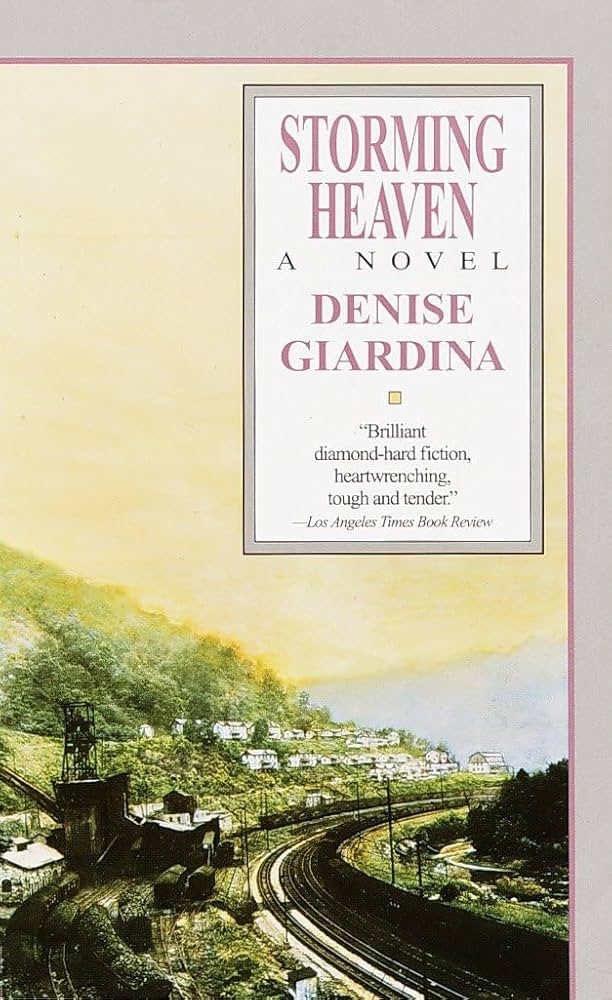
The second book was Storming Heaven, by Denise Giardina.
While it ends in roughly the same place as Rednecks, Storming Heaven covers the whole of the Mine Wars period, starting with the railroads coming into the West Virginia/Kentucky border area in the 1890s and buying up property using sketchy methods.
Beyond that, the two books differ in whose story is being told. The main characters in Rednecks are a local doctor (of Lebanese extraction, apparently inspired by one of the author’s ancestors) and a miner, both fictional, but lots of the smaller roles are filled by real people – Mother Jones, Sid Hatfield, and such. We get chapters from their points-of-view and some big speeches that are probably historically accurate. The downside is that they tend to drain the momentum of the main characters’ stories and can come off like one of those “you are there!” books for young readers.
By contrast, in Storming Heaven all the characters are fictional. They do occasionally interact with real people and some are fictional takes on real people – Sid Hatfield, for instance, gets a doppelganger who is also assassinated on the courthouse steps. In fact, the book takes place in a couple of fictional counties (one in West Virginia, on in Kentucky), but manages to interact with the “real world” enough to retain a sense of realism.
The result is that Rednecks feels like a book that was written to bring knowledge of a particular historical event to the public via fiction. That’s a noble pursuit and it’s certainly a mode of fiction that does a lot of work across literature, film, and TV. What it doesn’t really feel like is a story of people, characters, who feel alive and real in their own. I was far more engaged with Rednecks when it focused on the fictional doc and miner than when it leaned on actual historical figures.
Storming Heaven, by contrast feels like a fully fleshed out work of fiction that happens to be set during a particular historical period. I didn’t care about the characters because of the events they were living through, I cared about them as individuals. In the process, I think you get a better feel for what the historical period was like. No doubt, Rednecks is a lot more granular in terms of how Blair Mountain went down, but Storming Heaven hits harder emotionally, even with less historical detail.
I did an interview recently where I said that the most important element in good writing is building interesting characters. If you don’t care about the people to whom the events of the story are happening nothing else really matters. I think details of events are better left to non-fiction, to the work of historians and journalists. Historical fiction works best when it’s trying to capture the feeling of what it meant to live during the time period involved.
Or you can do what I do and plunder history for ideas and turn them into fantasy or sci-fi stories. Then there’s no worry about getting history “right” because the history is whatever you think it should be!
When I was first pulling together the world of the Unari Empire, one of the character ideas I had was that of an Imperial censor. That character would kind of pop up throughout the story, struggling to hold on as the Empire shattered around them, slowly losing their will to do the job that had defined them. I shelved that particular idea since I didn’t have a good handle on what the day-to-day life of a censor looked like.
Darnton explores the nitty gritty of how censors actually did their jobs during three historical periods – pre-Revolutionary France, India in the late 19th and early 20th centuries under British rule, and East Germany right around the fall of the Berlin Wall. It’s a dry work, without a lot of compelling through lines for casual readers, but it does offer some fascinating insights into what it means to be a “censor.”
Primarily, what censors did (or what these censors did) on a daily basis wasn’t squelch explicitly political speech aimed at criticizing the regime for which they worked. In a lot of ways they worked as hyper-powerful literary gatekeepers, helping to shape literature by acting as a kind of quality control. The French censors, many of whom were writers themselves, wanted to ensure the quality of French literature. The British censors in India were hopeful they could guide the Indians into writing great literature (“great” here meaning “what British thinkers consider great,” of course). The East Germans helped literary works get trimmed and massaged to reach an audience.
To an extent, in crafting these portraits, Darnton is trying to humanize the censors. They weren’t faceless thugs grinding ideas into the dirt under their bootheels – they were just people doing a job in which they believed, at least most of the time. This isn’t to say that Darnton comes across as a fan of censorship (he emphatically doesn’t), but it does create a more nuanced picture of what they do most of the time.
Of course, what they were doing all the time was still censoring writers (Darnton focuses almost exclusively on books, with some theater stuff thrown in), even if most of the time their motives were more benign than we might expect. The French censors Darnton talks about who squelched a bawdy insider narrative of life at Versailles might have thought it was low brow trash, but they were also aware that it made fun of the royal court and you can’t have that. That dynamic is even more clear with the British, who developed a real knack for decoding incipient strains of Indian nationalism and independence movements in modern retellings of ancient myths (not for nothing, but if you see rebellion in every work you read, maybe that’s saying something about you?). The East Germans, of course, made no bones that they were making sure new books were ideologically appropriate, regardless of the genre.
One interesting dynamic that plays out across all three eras is that every regime at least pays lip service to the importance of free speech. That is, none of the regimes saw their restriction of particular kinds of speech as any kind of violation. Hell, the East German censors (Darnton interviews two) don’t even think they engaged in censorship! This is true wherever you are, including the United States. The “freedom of speech” guaranteed by the First Amendment is term of legal art that excludes things like libel and obscenity. The grey areas of those definitions are where the rubber meets the road.
Given that these censors didn’t see their work as being conflict with a commitment to free speech, it’s not surprising that they tended to find objectionable material wherever they looked for it. If Hitchens was right that religion poisons everything then censorship does, too. There is no book or literary work so minor that it can’t be subversive or just not up to quality if you look at it from the right angle.
Which is perhaps the most important takeaway from Darnton’s work. Any censorship scheme is going to be carried out by human beings (or AI programmed by human beings, I suppose). Those human beings will come from different backgrounds, with different philosophies, shaped by whatever flavor of regime is in charge at the time. If you think there’s some kind of speech that should be obviously off limits – say, “hate speech” – it’s worth considering who’s going to decide what that is and what it isn’t. Chances are, they aren’t going to get it “right” all the time (but they’ll think they are).
Which is why I might come back to the idea of using a censor as a character in a story sometime. There’s more going on there than I suspected, even if it’s perhaps not as complicated as the person doing the censoring might want it to be.
Sometimes I fall down rabbit holes. This particular one I’m going to blame on Turner Classic Movies.
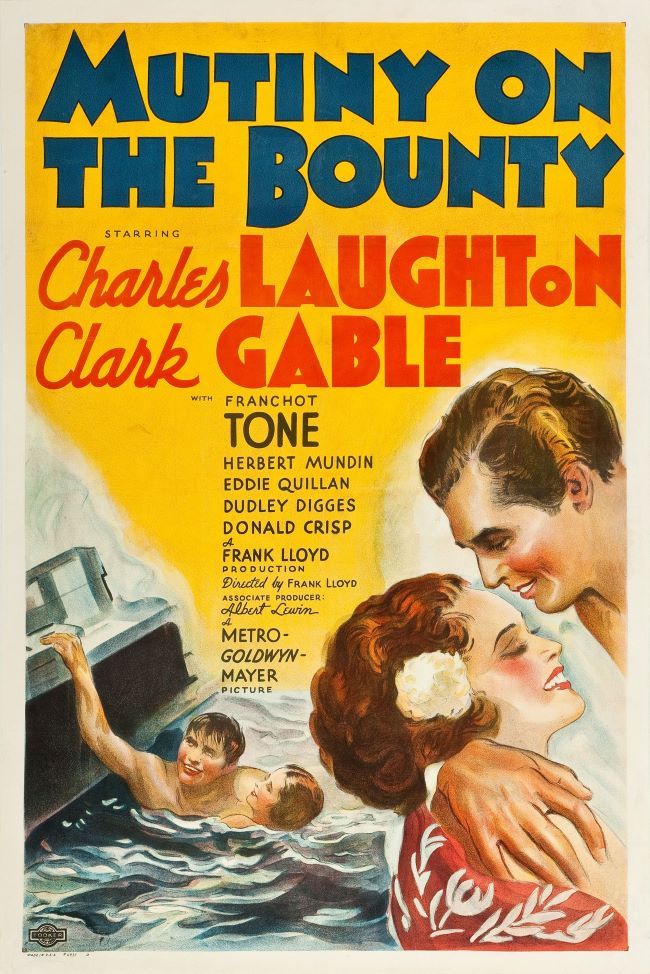
As I think I’ve said before, part of my work morning routine is to flip through the schedule on TCM to see if there’s anything worth recording that day. Months ago I found such a thing, the 1935 version of Mutiny on the Bounty, starring Charles Laughton and Clark Gable.
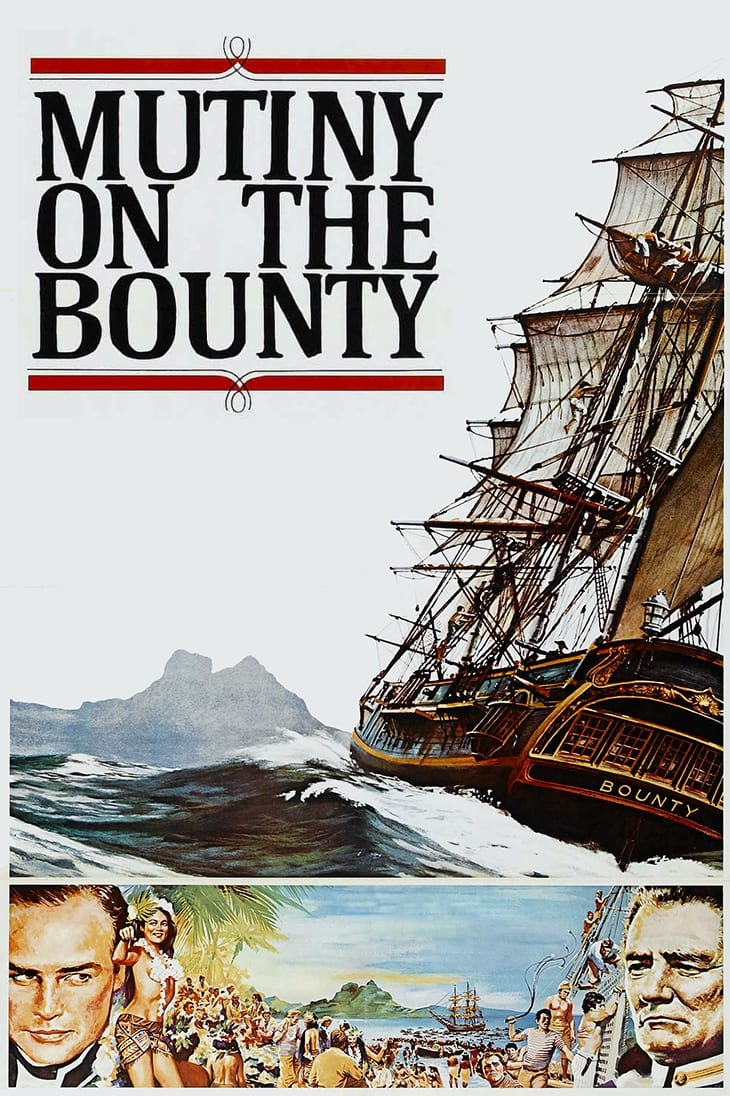
Having never seen it, or any other Bounty story, I recorded it. It sat on the TiVo long enough that TCM also showed the 1962 version (with Marlon Brando), so I recorded that as well.
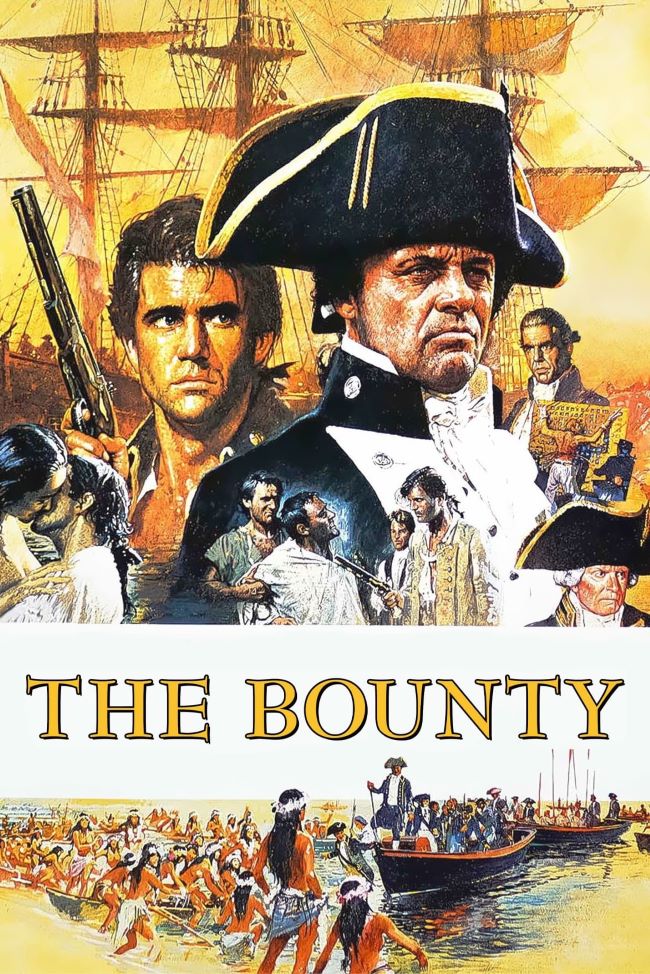
When my wife saw both sitting there, she wondered aloud about if I intended to watch the 1984 version, Bounty, with Mel Gibson and Anthony Hopkins (and Daniel Day Lewis and Liam Neeson!).
So, one Saturday, we did the deep dive and watched all three back-to-back-to-back. And then I read Caroline Alexander’s The Bounty: The True Story of the Mutiny on the Bounty to actually get the history of the whole thing.
Watching different versions of the same story, the history of which is not as clear as you might think, made for some interesting comparisons.
But first, the basic history – in 1787 Bounty left England, under the command of William Bligh, for a journey to Tahiti. There, the crew would harvest breadfruit plants for transport to Jamaica, where it was hoped they could be replanted and used as a cheap food for the enslaved population. Sometime after Bounty left Tahiti one of Bligh’s underlings, Fletcher Christian, led a mutiny. Bligh and several loyal men were put adrift in a launch (and managed to make it back to civilization), while Christian and the others found their way to Pitcairn Island, where their descendants live to this day.
What’s particularly interesting about the history (from Alexander’s book, at least) is that there is a gaping hole in the record when it comes to Christian. Bligh, the men in the launch, and even some of the other mutineers returned to England where there were various inquiries into the mutiny, but Christian never did, dying (or being murdered) on Pitcairn. His precise motivation for the mutiny is unknown, therefore, and leaves a lot of room for fictional variation in the story.
For example, the portrayals of Bligh vary considerably between the three movies. As played by Laughton in 1935, Bligh is a tough-love legal enforcer. The law of the sea is harsh and brutal, but it’s necessary to keep discipline on what is a very dangerous voyage. The 1962 Bligh, by contrast (played by Trevor Howard), appears to get off on the punishment he dishes out (which Christian calls him out for). He may use the legalish language that Laughton did, but it appears to be a cover for more personal motives. Hopkins in Bounty, on the other hand, dishes out much less discipline (particularly before the reach Tahiti), but seems much more paranoid about possible plots. Per Alexander’s book, Bounty was probably the closest to correct, as Bligh didn’t appear to be any firmer of a disciplinarian than the normal English captain of the time. That said, Bligh also suffered a rebellion (land mutiny?) when he was a territorial governor in Australia later in life, so clearly there was something about his leadership style that rubbed some people the wrong way.
The same is true for Christian, whose motives shift from telling to telling. Gable’s version, perhaps polished to match his matinee idol status, was driven to mutiny on behalf of the lowly sailors who Bligh abused. Notably, that version of Christian had served with Bligh before and had some idea that there might be trouble. It’s a pretty simple narrative. The 1962 version Brando played takes longer to get to the same place and, when he does so, simply snaps, rather than more coolly plots the mutiny. This Christian didn’t know Bligh before, so he’s perhaps more shocked by the brutality. Where Brando’s Christian really differs from Gable’s is the weight that command puts on him after the mutiny. Gibson’s version is motivated less by Bligh’s cruelty (since there’s less of it) than his affection for life on Tahiti. He appears, to quote Londo Molari, to have “gone native” and is willing to do whatever it takes to get back. This Christian didn’t just know Bligh prior to being on Bounty but was good friends with him, which again kind of pushes the cruelty angle to the side. Which of these is closest to truth, if any, is anybody’s guess.
The movies differ considerably in what happens after the mutiny, too. In the 1935 version, after Bligh makes it back to England, he is exonerated of anything to do with the mutiny, then heads off back to the South Pacific (true!) where he tracks down Christian on Tahiti and forces him to book it to Pitcairn (false!). Post-mutiny life for Christian is pretty swell, as least until Bligh shows up. In the 1962 version, Bligh is again acquitted, but with some comments from the judges afterwards that maybe he had it coming, anyway. There’s no return voyage. For Christian, as I said, command weighs heavily on him so much so that on Pitcairn he floats the idea of returning to England to tell their story. This prompts others to burn Bounty in the bay and Christian dies trying to save it (ending courtesy of Billy Wilder, rather than any historical basis). The 1984 version gives Bligh a full exoneration, while making Christian’s life after the mutiny even more miserable. The landing on Pitcairn comes off less of a triumph and more pathetic than anything else.
What none of the movies really do is dig into what happened in England once Bligh returned. There really was a court martial at which many of the mutineers (returned from Tahiti by other vessels) were convicted of mutiny, although many were acquitted (including a potential ancestor of mine!). Several were sentenced to hang, but two were pardoned. News coverage of the court martial was largely favorable to Bligh, but Alexander chronicles how that shifted over the years, thanks in part to Christian’s family and some of the other sailors involved. It’s safe to say that the popular conception of Bligh, closer to Laughton’s and Howard’s portrayals than to Hopkins’, is largely due to their out-of-court efforts.
Particularly interesting in the variations is that the 1935 and 1952 movies are both based on the same set of novels, so you’d think they’d be more similar. They’re both big screen spectacles and the 1952 version was no doubt made just to take advantage of color, but they are quite different in the people whose stories they are telling. I think I prefer the 1935 one. Laughton’s Bligh may be the farthest from the truth, but he’s pretty compelling and in his devotion to rules without empathy scarier to me than Howard’s psycho Bligh (remember, I’m a public defender by day). While I appreciate the ambiguity of the 1984 film, it doesn’t resonate quite as much (in spite of the Vangelis score).
Usually when a movie is made about a historical event the discourse breaks down into whether the movie got it “right” or how “wrong” it actually got things. The whole Bounty situation is a good example of how history isn’t so obvious in lots of situations and lends itself to different interpretations. Surely there’s another Bounty movie or TV series in the works that’ll provide an entirely different perspective, too.
I’ve said before that book titles can be tricky, particularly for non-fiction, since they act as a kind of “promise, a declaration of what kind of book the reader is getting into). That said, Susan Wels’ An Assassin In Utopia: The True Story of a Nineteenth-Century Sex Cult and a President’s Murder makes a hell of a promise. Pity it doesn’t come close to fulfilling it.
The sex cult in question is the Oneida Community, initially founded in New York in 1848 and persisting, in various forms, for the next three decades. The dead president in question is James Garfield, who perished after being shot only six months after taking office in 1881. What purportedly brings these two things together is Garfield’s assassin, Charles Guiteau, who had a couple of brief stints as a member of the Oneida Community.
It’s a pretty slender thread to tie together a book and, to be fair, Wels doesn’t really try too hard. As I said, Guiteau spent some time at Oneida, but given his particular mental quirks and psychopathy you can’t say what he learned there caused him to shoot Garfield (he couldn’t even get laid in a commune devoted to an early version of “free love”!). Rather, she collects stray historical anecdotes that cover several decades while Oneida was in operation and Garfield found his way to the White House. Many of them are interesting in their own right, but they don’t feel cohesive.
Which is a shame, because I would have loved more detail on the Oneida Community itself. Born from forward-thinking social ideas, and eventually infused with ideals of political socialism, Oneida was one of the first of many utopian communities that popped up in the United States in that period. That is descended into a typical sex cult, where a few leaders (old men all) decided who slept with who and, of course, who slept with them. Minors are raped, too, in the name of whatever ideals the leaders dreamed up, a pattern that echoes down through the succeeding generations.
Indeed, Oneida disappears entirely from the narrative once the focus turns to Garfield’s election (and surprise nomination in the first place) and assassination. Wels covers that briskly, but the shooting, and Garfield’s lingering as doctors probed his wounds until he died, is covered more thoroughly (and interestingly) in Candice Millard’s The Destiny of the Republic: A Tale Madness, Medicine and the Murder of a President. As I said way back when:
While Millard spends a great amount of time (particularly in the book’s second half) on Garfield’s lingering death, the first half of the book is spent setting up not only the lives of Garfield and Guiteau up to that point, but the world in which they lived. It’s a fascinating snapshot, showing both how different the United States of the 1870s-1880s is compared to today, and how disappointingly similar the two eras are.
***
In the end, where the book really shines is in the contrast of Garfield and Guiteau, two men swept into their fatal confrontation by things beyond their control. It’s ironic that Garfield, who never really wanted to be president, is the kind of person who we should want to become president – educated and inquisitive, a voracious reader, and apparently a genuinely decent guy. And yet, even as part of a very select club of assassinated presidents, he’s pretty much forgotten these days. Of course, Guiteau is not exactly a household name, either.
If you’ve never dived into this period of American history, or the Garfield assassination, this book is a reasonable start. Beyond that, The Destiny of the Republic does better on the assassination itself and there’s probably a more thorough treatment of the Oneida Community out there, too (which I might have to seek out).
In May, my wife and I took a much delayed (thanks COVID!) vacation to the United Kingdom, hitting London, the Scottish Highlands and Isle of Skye, and Edinburgh over the course of a couple of weeks.
As is my wont, the trip inspired me to come home and read/listen/watch various things about that part of the world. Here are some quick thoughts.
Wellington Memorial, LondonWhite Tower, Tower of LondonDunvegan Castle, Isle of SkyeWalter Scott Memorial, Edinburgh
The whole of the UK is steeped in history and it occurred while I was there that I knew precious little of it, particularly when it came to Scotland. I remedied that by digesting the entirety of Scotland: A History from Earliest Times, by Alistair Moffat.
Never was a book so aptly named, given that it spends a good hunk of its epic runtime (23+ hours in audiobook format) covering the geological history of Scotland before human beings even enter into it. Honestly, I wish the book would have condensed that considerably, since Moffat then covers basically all of Scottish human history (my other criticism is that he goes too close to current, lapsing from history to journalism in the end). As a result, it has a kind of bird’s eye view of things, without a whole lot of detail, but for someone like me who didn’t have a great idea of Scottish history, it was just about perfect. Particularly interesting to me was how Sir Walter Scott (who has a huge memorial in Edinburgh, pictured above) essentially created the modern conception of being “Scottish,” drawing on Highland things that had mostly been suppressed previously.
One of this historical things about which I knew nothing at all before we hit Scotland were the Jacobite Risings that happened there in the 17th & 18th Centuries. The last, started in 1745, was particularly prominent, in spite of the fact that it ended in bloody defeat for the rebels at the Battle of Culloden. We visited the battlefield and I wanted to get a better sense of the battle, so I read/listened to a book with the title Culloden, by Trevor Royle, which you’d think would do the trick.
Except that the full title is Culloden: Scotland’s Last Battle and the Forging of the British Empire. The Culloden part is, maybe, one third of the book, although perhaps it doesn’t need much more than that (it took place on wide open terrain and was over in about an hour – Gettysburg it was not). The rest is about how many of the officers and men at Culloden went on to fight Britain’s imperial wars around the world, with a decent focus on North America. It was interesting, in its own way, but not quite what I was looking for.
My thought was Culloden would be a good subject for a movie, so I was surprised that there weren’t many out there dealing with it directly (as opposed to using it as some kind of background). I finally found one called Chasing the Deer that I was able to watch on YouTube.
I was drawn to this partly because one of the actors is Fish, original lead singer of Marillion and successful solo artist in his own right. I knew he’d done a little bit of acting (this was his only feature film) so that made certain I had to check it out. It was well done in terms of tone and accuracy, but the small budget came through and the script wasn’t great (neither, sad to say, was Fish, although he was about par for the course with the rest of the cast). It did give you some idea of what the actual battle was like, however, so that counts for something.
We were in Westminster Abbey and I saw Oliver Cromwell’s tomb (well, slab of tile under which he’s buried) and realized I’d never really dug into Cromwell or the English Civil Wars. This book looked like just the thing to fill that gap. It’s just as long as Scotland, but only focused on about 100 years, after all. Still, I was disappointed that this was also pretty high-level history, without a lot of detail about life on the ground. In addition, the Civil Wars didn’t get any singular treatment and were just events along the way that happened to involve the royals that were really the focus of the book. There was no discussion of any political philosophy underlying the Republicans or Royalists. What is clear to me, however, is that this period was hugely influential on the American Founding Fathers, as you can pick precise parts of the Constitution that seem designed to prevent atrocities and injustices that happened during this era.
Speaking of Westminster Abbey, part of what we took in there were the tombs of Elizabeth I and Mary Queen of Scots. Somewhere along the way I found out there was a fairly recent movie about the pair, cleverly titled Mary Queen of Scots, with Saoirse Ronan in the title role and Margot Robbie as Elizabeth.
As the title suggests this is a Mary-forward portrayal of events and does give you a sense of the era (the claims of historical inaccuracy, based on my reading, are mostly down to interpretation rather than outright incorrectness). That said, it’s fairly dull for the most part, skipping large periods of time in order to cover all of Mary’s time in Scotland, but precious little of her time as a prisoner in England. And as much as I love David Tennant, one of John Knox’s rants on how wicked women are was enough. Nice bit of synergy, though – I started Devil-Land just after we saw this and it starts with the execution of Mary, so it was a nice transition.
Much less period, and not at all historical, but definitely getting points for Highland isolation is Calibre, from 2018.
Calibre is the story of two buddies, one of whom is getting ready to become a father, who jaunt into the Scottish wilderness for a hunting trip. They wind up in a very small town filled with very creepy people who are full of unheeded warnings. A tragic accident happens and the guys get stuck in town without an easy way out. The movies deals in tropes, to be sure (the “small town creepy hick” cliche transcends oceans), but the atmosphere is really well maintained and the acting is quite good. Like I said, nothing historical, but does give you a sense of what it’s like in the middle of nowhere Scotland (see also “Loch Henry,” one of the episodes of the new season of Black Mirror).
Spending a few days in a foreign land is hardly enough time to get a sense of the place. What it can do, at least for me, is spark a deeper interest in the area’s history and culture, such that it will always be something that captures my interest. I figure British history is a rabbit hole I’m going to plumet down into for a good long while to come.
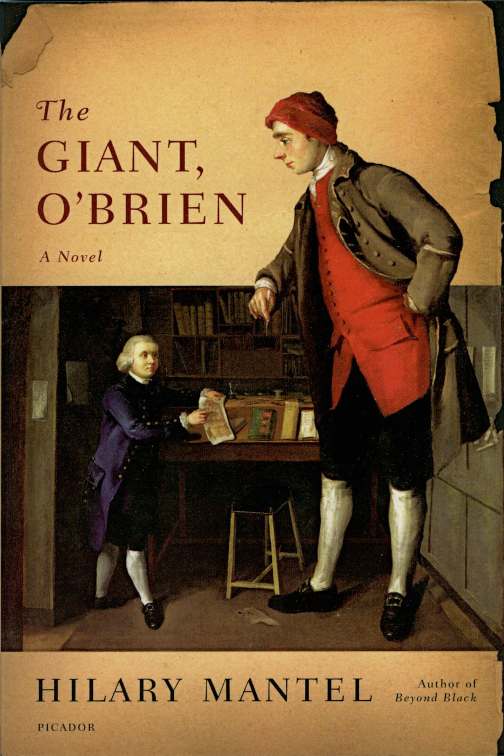
I am not, in general, a big reader of historical fiction. Not anything against it, I think I’d just rather read the history itself. Nonetheless, when Hilary Mantel died last year I thought I probably ought to check out some of her work. A little leery of wading directly into the Thomas Cromwell books I scanned her bibliography and saw a book called The Giant O’Brien. It rang a small bell and, after a bit of poking around, I found it was about, perhaps, a distant relative.
Said giant was Charles Byrne, who measured over seven-and-a-half feet tall. As chronicled in Mantel’s book, he leaves rural Ireland to go to London and become an attraction. What’s really interesting about the man in the book (whether it tracks reality I don’t know) is that he was very much in control of his exploitation. He’s not a simpleton dragged away from home by someone out to make a quick buck. Rather, he’s well aware of what’s going on and happy to make his way in the world in that manner, with the possibility of a young death hovering over him the whole time.
In the book, Byrne is pursued by a surgeon, John Hunter, who is a collector of “specimens” and wants the giant’s skeleton once he’s dead. Byrne makes it perfectly clear that he doesn’t want this to happen, but is betrayed by the hangars-on that have come with him to London, who eventually make the deal with Hunter for a few hundred pounds. The result was that Byrne’s skeleton was put on display at Hunter’s museum, where it became the most famous part of its collection.
There is some dispute as to how, precisely, Byrne’s bones came into Hunter’s possession – let’s hope he wasn’t so cruelly betrayed – but there’s no doubt Byrne didn’t want to go on display like a museum piece. Nonetheless, he was and there he hung for the next two centuries.
Until just recently. The museum is nearing reopening after several years of renovation and have announced that Byrne’s skeleton will no longer be on public display:
“What happened historically and what Hunter did was wrong,” said Dawn Kemp, a director at the Royal College of Surgeons of England, of which the Hunterian Museum is now part. “How do you redress some of these historical wrongs? The first step is to take Byrne’s skeleton off display.”
The real question now is what else, if anything, should be done with it. On the one hand, if we’re rectifying historical wrongs and Byrne wished not to be a specimen that should be the end of the discussion. On the other, there is something to be said for having Byrne’s bones around for scientific study:
“We shouldn’t think that we now know everything,” said Marta Korbonits, a professor of endocrinology at Queen Mary University in London, who has researched Byrne’s genes.
The research “isn’t done and dusted,” she added.
Indeed, Byrne’s skeleton has offered up new answers as medicine has evolved. In 1909, an American surgeon studied Byrne’s remains, and discovered that he had a tumor in his brain. Then, about a century later, researchers including Dr. Korbonits extracted DNA from Byrne’s teeth and found that he also had a rare genetic mutation that had been unknown until 2006.
“Without the public view, we wouldn’t have made that link,” Dr. Korbonits said.
I’ll admit, I’m a little conflicted. On the one hand, since I believe that a body after death is just meat and bone and the person who it once was is gone, I don’t get too worked up over what people do with dead bodies, particularly at the remove of a couple of centuries. And if there is some broader benefit for mankind that’s a good thing, right? On the other, disrespecting a person’s wishes is a shitty thing to do and it seems if you’re going to right that wrong you have to go all the way.
In the end, there’s no good answer, given the proven good that having Byrne’s skeleton around has done, although I could see a compromise – since we’ve gotten more out of him than we ever should have, maybe it’s time to say “thanks” and let the guy rest? It’s the least we can do for cousin Charlie.
One of my favorite David Fincher movies (of which there are several) is Zodiac. What makes it work so well isn’t that it “solves” one of the most infamous cold cases in American history, but that it compellingly portrays how the obsession with trying to solve something that might not be solvable can ruin a person’s life. In the end, it becomes less a triumph of perseverance and grit than a pathetic throwing away of a life’s potential.
The four-episode documentary series The Most Dangerous Animal of All, adapted from a book of the same name, is an interesting companion piece to Zodiac, although I’d hesitate to call it perfect.
It’s about Gary Stewart, who was adopted as an infant into a loving family. For decades, he struggled with questions of his real identity and what it meant to be abandoned by his birth parents, so he started working to track them down. He found his birth mother easily enough and through her learned that his father was a guy named Earl Van Best, Jr.
Best was a bad dude at the time he met Stewart’s mother. And by “met” I really mean kidnapped, raped, and abused. He was 27 years old at the time, she was only 14. Their “love affair” even made headlines, allowing Stewart to get not just a feel for the circumstances of his birth but pictures and even some in-court film of his father when he was eventually caught, convicted, and sentenced for his crimes.
All that was bad enough, but then Stewart, armed with a mugshot of his father, saw a documentary on the Zodiac killer and that iconic drawing of the suspect:
Stewart realized it looked a lot like his father. This sets him off on an odyssey to determine whether his father was, in fact, Zodiac and solve this coldest of cold cases. Through the first three of the four episodes, Stewart marshals his evidence and it sounds pretty compelling. He wrote the book upon which the series was based and then, well, it all went to shit.
What’s particularly interesting is, according to this article, said going to shit started happening while this documentary was in production. This left the creators in a pickle – how to deal with the evidence that seemed to show that Stewart’s argument that Best was Zodiac was full of shit? The way they handled it was to present, point by point, experts debunking each of Stewart’s claims – to him. Essentially, they made the documentary on one track, all the while building the case against Best as the Zodiac (culminating in records showing he wasn’t even in the United States when the Zodiac killings took place) on another, only bringing them together in the end.
The result is compellingly awkward. You might expect that Stewart, confronted with the evidence contradicting his theory (some of which implies he just made shit up), that Stewart would come clean or break down in some way, blame the stress of his quest for driving him down this particular rabbit hole. Instead, he steadfastly holds onto his conclusion that his birth father – who had nothing to do with raising him – is the Zodiac killer.
To what end? It’s not clear. Maybe it’s because Stewart is so desperate for a personal history, an identity that latching onto one that horrible is preferable to not having one at all. Maybe it’s that, if he’s going to be the offspring of a monster, anyway (which Best, by all evidence, was), might as well be the offspring of one of the most infamous (and unidentified) monsters of all time? Or, maybe it was all a grift, with Stewart coming up with a slick way to monetize his search into his background.
I don’t think it’s the last one. From the documentary it really appears that Stewart believes the story he’s trying to sell. Either of the others are heart wrenching, in their own way, and make you feel sorry for him. Which is what makes this series so compelling – come for the potential true crime bombshell, stay for the fascinating portrait of a man who is so wrapped up in the distant past that he can’t come to grips with the more recent version.
I’m not going to say that finding a great story to tell is easy, but in some ways coming up with the story itself can be easier than figuring out the proper form to tell it.
I’ve been thinking about this as the wife and I have been watching Gaslit, the Starz series about Watergate that wrapped up this past weekend.
See, the thing about Gaslit – from its title to its marketing (as you can see above) – is that it promises a new angle on Watergate. It was supposed to be focused on Martha Mitchell, a political celebrity and wife of Nixon’s one-time Attorney General John Mitchell. She knew all about Watergate and told the truth about it, only to be destroyed privately and publicly by, among others, her husband.
That is a fascinating story, horribly relevant in the world of #MeToo, that would provide some interesting insight into the general Watergate story we’ve all see over and over again. Only it really isn’t. Instead, Martha’s story is buried in the mix, forced to share or cede time to a cast of characters we’ve seen before and about whom the show has little to say.
Take the penultimate episode, which splits time about equally with Martha’s testimony before the Watergate committee – behind closed doors, ambushed by accusation of mental illness – and the struggle of Gordon Liddy in prison to kill a rat. Really, is that what the series is about? It doesn’t help that every time Liddy opens his mouth it sounds like he’s just one step away from lapsing into Doctor Evil’s meat helmet speech.
In other words, there’s a pretty good movie struggling to escape from an eight-episode limited series. A tight two hours or so that trusts the audience to already know what Watergate is and focus on the relationship of the Mitchells (played well here by Julia Roberts and Sean Penn), how it pulls apart, and the effect that daring to tell the truth had on her. It’s particularly sad that we didn’t get that movie, given that we’re in the fiftieth anniversary year of Watergate and we’re going to get lots of other general retrospectives on the scandal, including the one currently on CNN featuring John Dean (who gets a goodly amount of screen time in Gaslit as a Porsche-driving climber who kind of lucks into doing the right thing, eventually).
It’s entirely possible that Gaslit was only ever supposed to be a big ensemble piece and the purported focus on Martha came later, which would explain why much of it is not her story. It’s also possible that the Martha story was what drove the creators, but the network guided into a more blown out story. Obviously, you can’t tell at this point.
What you can tell is that whatever Gaslit is, it’s not what it wants to be or purports to be. Which is a shame, because with the talent on screen it could have been so much more if it had been so much less.
To wrap up the months of lists, it’s only natural to turn our attention to books. Just choosing ten favorite books is tough – so I’m going to cheat. A few years ago I did a post about ten books that were “particularly important to me,” spun off from a Facebook thing that was going around. Those are all favorites, right? Sure. There’s a difference between “favorite” and “important,” but I’m not sure that’s a hair worth splitting.
That said, I’ve read an awful lot more books since I did that, so rather than take apart that first list, I’m just going to add to it. So, these ten books are all recent favorites (recent to me, at least) and I love these and the old ones so much I don’t want to knock any of those off to make room. It’s my list after all, right? Speaking of, if Saga, by Bryan K . Vaughn and Fiona Staples was complete, it would be on this list in a heartbeat, but I worry about them sticking the landing (it’s still only about halfway through, after all). Thankfully, that leaves an open spot on the list (for now).
The only other cheat for this list is that I decided to consider series as a single entry, so I could consider those in their entirety. Other than that, no rules. Also apologies for the wonky order, as I originally had them listed by series title but the formatting looked awful. Honestly, they’re in alphabetical order! That said, let ‘er rip . . .
The Mechanical (2015) – The Rising (2015) – The Liberation (2016)
It’s 1926, but not the 1926 we remember. There is no Lost Generation following the First World War, no Jazz Age, no impending economic collapse. Instead, the world, or at least the largest part of it, is ruled over by the Dutch. How have the Dutch managed this feat? Magic, of course.
That’s the basic setup for the Alchemy Wars trilogy – one of the “clakkers” created by a combination of Dutch magic (here called “alchemy”) and steampunkish technology gets a case of free will and a war of liberation is on. Along the way, we get a heavy dose of live in the world’s only non-Dutch outpost – a rump New France based around Montreal. The Mechanical is a brilliant opening book, full of world building and questions on the nature of being. The Rising gets a little too action heavy, at the expense of the philosophical questions, but The Liberation rebounds, bolstered by some temporal sleight of hand that shouldn’t work as well as it does.
American Heiress: The Wild Saga of the Kidnapping, Crimes and Trial of Patty Hearst (2016)
by Jeffrey Toobin
Just by growing up when I did and sitting in the culture I knew the outlines of Patty Hearst’s story – she was a rich young woman who was kidnapped by radicals and eventually wound up taking part in some of their violent activities. I was vaguely aware of the debate about whether she was really transformed into a believe or just going along out of fear. Toobin’s (yeah, I know) book does a really good job of filling in not just her specific story, but the time period out of which it arose. I had no idea bombings were so common in the 1970s! He also manages to dig into the argument on Hearst’s culpability deeply enough to allow people to draw their own conclusions, if you even can (I’m not sure I have). Super bummed that any adaptations of this book apparently aren’t going to happen.
The Ball Is Round: A Global History of Soccer (2006)
by David Goldblatt
While soccer is my favorite sport, I admit that I’d not really dug too deeply into the history of it. I had a handle on the big stuff – Uruguay’s early success, our upset of England in 1950, Pele – but the development of the game itself was mostly a black hole for me. No longer, having absorbed this deep history of the development of the beautiful game. What amazed me is how much of the game’s reach today is the result of British influence overseas, both through empire and commercial power (Barcelona, AC Milan, and a host of South American clubs have English or Scottish origins). There’s such a wealth of interesting history that plays into the current state of the game that it’s easy to overlook some of the “you are there!” portions that try to describe game action but can only come up short.
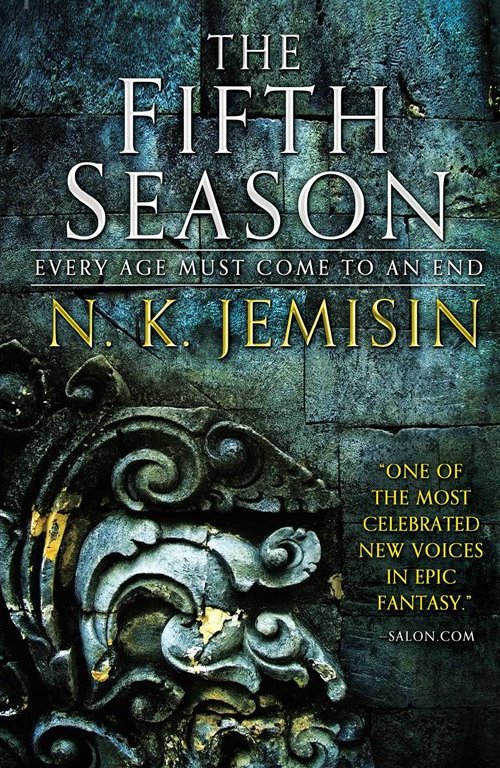
The Fifth Season (2015) – The Obelisk Gate (2016) – The Stone Sky (2017)
by N.K. Jemisin
I mean, these books only won the Hugo Award back-to-back-to-back, a feat never before accomplished, so it’s safe to say they’re pretty good. The Fifth Season is flat out brilliant, a structural bit of leger de main that completely reconceptualizes all that came before when you reach the end. The other two can’t quite reach that height, but that’s no slight. The world building is amazing. Jemisin has an amazing knack for brilliant scenes, the basic building blocks of writing. They’re not light reads, but well worth the emotional toil they’ll wreak upon you.
Children of Time (2015)
by Adrian Tchaikovsky
The main characters in this book are spiders. That is not a joke. They’re jumped up, hyper-evolved spiders, benefiting from a fuck up in human settlement on another planet. Science fiction has the ability to put readers in the head of truly alien creatures and Tchaikovsky did that here. But there’s also a second story line, of another ship full of humans (some on ice) where things are going to shit. They cross paths, of course. The next book in the trilogy, Children of Ruin, is just about as good. The only think keeping me from putting the whole trilogy on here is that it isn’t finished yet!
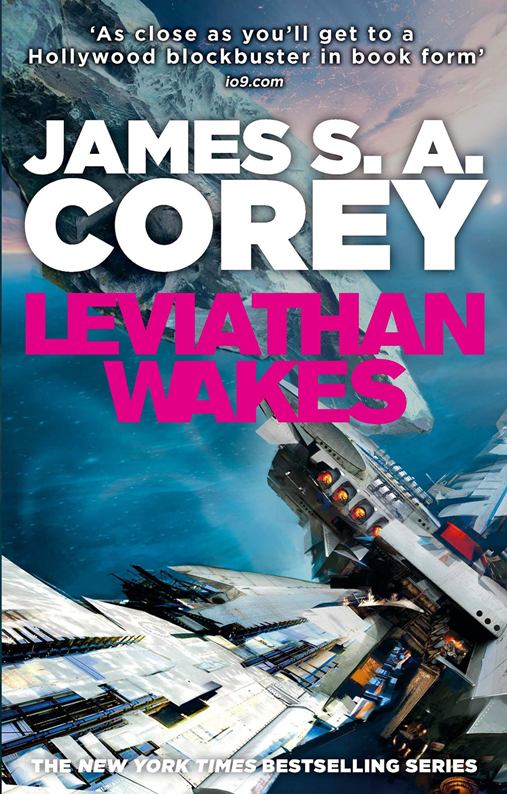
I’ve sort of concluded that the trilogy is the ultimate best length for a series. It’s long enough to tell tales of grand scope, but tight enough not to get away from the author. As a result, I rarely go more than a couple of books into a lengthy series unless I completely love it. Clearly, the fact that I’ve read all nine books in the Expanse series (and consumed all of the excellent TV adaptation) means that I loved this. It’s not all brilliant (looking at you, Cibola Burn), but the world that’s built is amazingly realistic (it feels that way, at least) and it’s full of characters I came to really care about. And, I have to say, I think the writers really nailed the ending in a way that was satisfying and felt complete. If you’re looking for a near-future space opera to simply lose yourself in, this is it.
The Half-Made World (2010) – The Rise of Ransom City (2012)
by Felix Gilman
The world of The Half-Made World looks a lot like the American west during the late 19th century, with white settlers streaming into “untamed” territory and finding conflict with the natives, not to mention each other. What really distinguishes this world is an ongoing (never-ending?) conflict between The Line (the embodiment of technological process in sentient train engines) and The Gun (chaos and immorality) that plays out in a world that is literally still in the process of being made. It’s a brilliant setup and serves to bring to life one of the most interesting characters I’ve ever encountered, John Creedmore. An agent of The Gun, Creedmore is a killer and a thug, but he’s also in thrall to a demon that lives in his gun. His struggle to leave it behind is exceptionally well done. Set in the same world and sharing some characters, this is more a pair of great standalone books (with The Half-Made World getting the nod) than an ongoing serious. Unless Gilman decides to give us another glimpse.
Hogfather (1996)
by Terry Pratchett
Generally speaking, I don’t reread books. It happens every now and then, but for the most part I’d rather move on to newer things, given the increasingly absurd size of my to-be-read pile. That is to say, Hogfather has a special place in my heart as I read it every year during the Christmas season. It’s a story of Hogswatch, the Discworld variant of Christmas, in which someone is trying to kill the Hogfather (i.e., Santa) leaving Death to fulfill his duties and Death’s granddaughter to stop all of existence from coming undone. It’s funny, sweetly nostalgic without overlooking how narrow nostalgia can be, and just all over brilliant. It warms my holiday cockles in a way that nothing else much does.
Say Nothing: A True Story of Murder and Memory in Northern Ireland (2018)
by Patrick Radden Keefe
Speaking of rereading books. I just went through a jag reading about Irish history, finishing up with a history of the (provisional) IRA, so I decided to dive back into Say Nothing, which covers The Troubles but on a more personal and street-level way. It also deals with questions of memory and how we talk about, and study, the past. It’s simply brilliant on every level. I can’t recommend it enough.
Sex Criminals (2014-2020)
by Matt Fraction & Chip Zdarsky
When I saw a story somewhere about a comic called Sex Criminals I thought it might be about the kind of people I represent in my day job as a defense attorney. How surprised I was that it was about people who had sex and then committed crimes! That’s because time literally stops when the two main characters (and several others, as things go on) have an orgasm, allowing them to get up to all kinds of nonsense (one of them takes the time to drop a shit in a plant in his boss’ office). If that was the entire joke the series couldn’t have run for more than thirty issues, but the series builds into a deeper exploration of relationships, depression, and other things. It wrapped up in 2020 in pretty satisfying fashion.
That’s it! The end of lists! Regular programming returns next week (probably).
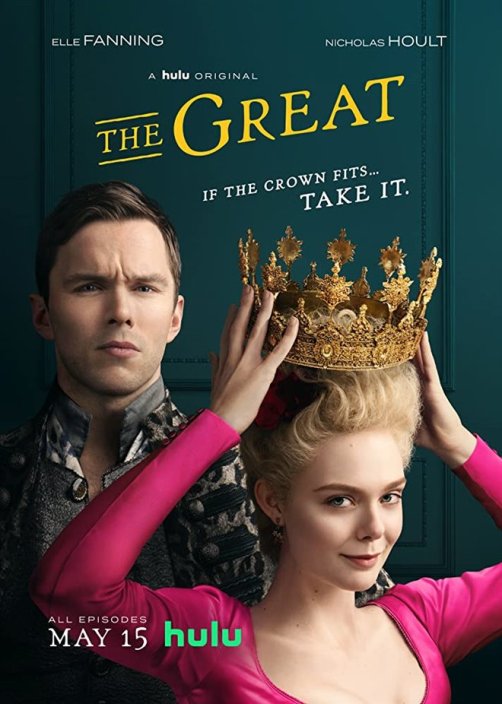
Over the winter my wife and I discovered The Great*, the Hulu series about (very loosely) the early reign of Russian empress Catherine the Great.
While I’m not certain the series quite lives up to the title, it is very entertaining and, in spots, riotously funny. What it definitely lives up to is the little asterisk the end of the title (as displayed in the opening credits, at least), which notes it is either “An Occasionally True Story” (season one) or “An Almost Entirely Untrue Story” (season two).
This post is very much not going to take the show’s creators to task for playing fast and loose with history, particularly since they admit it up front. Truth is, literature and theater and film/TV is full of examples of historical persons or events remolded for dramatic purposes. I know Salieri didn’t really work Mozart to death (they were pretty good buds!), but I still love Amadeus. Dollars to donvts Julius Caesar did not turn to Brutus and “et tu, Brute?” him in real life, but Shakespeare makes it work.
But as a writer, I wonder about the choices other writers made when playing with history. History is full of lots of interesting story fuel, after all. I’ve used some of it myself. I’ve said before that the idea for the basic arc of The Water Road trilogy came from seeing an “on this day” thing on Wikipedia about the anniversary of Napoleon’s return from exile to start the Hundred Days. I thought that sounded like something out of a fantasy series – a vanquished foe returning to the world to wreak further havoc – and wheels started turning in my head.
What never occurred to me was the make the story about Napoleon. I didn’t want to tell his story, but another one that might have echoes of his. Being a fantasy writer that’s not an issue, but with more traditional fiction things can get complicated. After all, a made up character doing made up things is the grist of fiction – sometimes everything even happens in made up places. But a made up town or neighborhood is one thing, what about a made up country?
I got to thinking about this again due to this piece in the New York Times about the recent glut of true-crime limited series that are all over streaming services. Things like Netflix’s Inventing Anna and Hulu’s The Dropout (both pretty good, though I’d go with the latter) are telling true-crime stories of recent vintage that, in most cases, have been thoroughly aired in other settings (Inventing Anna came out of a long-form magazine piece, The Dropout from a podcast of the same name). I don’t agree that just because these stories have been told in other mediums means the fictionalized TV versions are superfluous (not everybody consumes podcasts), but the author makes an interesting point:
Now, it is absolutely true that real life does not always give you neat “Rosebud” explanations; real people are often simply jumbles of unresolved contradictions. But that’s one reason we have drama: to make emotional, if not literal, sense of this kind of figure. (Hence Orson Welles reimagined William Randolph Hearst as Charles Foster Kane.)
Indeed, it seems much easier if you want to tell a story about a particular kind of person to do it with a fictional character rather than a real-life one. Legal issues aside, it allows you to mold and shape the story as dramatic (or comedic!) stakes dictate, without worrying about people complaining that you’re not “getting it right.” After all, fantasy only has to be compelling, not accurate.
So why not, if you want to tell a story that pretty much set in a fantastic version of a historical place, why not make it fantasy? What’s the pull of using a historical figure whose actual history you’re going to discard anyway? I suppose it’s easier to market a series about Catherine the Great (who’s not that well know in the US, anyway) with an ahistorical twist than it is to sell a bloody, bawdy, fantasy series nobody’s heard of before.
As I said, it’s silly to get bent out of shape about The Great’s lack of rigorous historicity. They’re doing something much more fun and not even hiding the fact. Nonetheless, it does make you think.
Come, join us in our fantasy worlds. The water’s fine – unless that’s not what you want! Huzzah!












 JD Byrne