Weekly Read: The Final Empire

As I said the other day, I’ve finally gotten around to discovering the work of Brandon Sanderson. He’s perhaps best known as the guy drafted in to finish the Wheel of Time series after Robert Jordan died. But he’s a prolific author in his own right and one of the hottest fantasy writers going (I swear there was one of those “a bunch of fantasy series that should be adapted for TV” lists that was made up mostly of his stuff).

Mistborn appears to be Sanderson’s magnum opus, comprising two trilogies and some other associated works. The Final Empire (or simply Mistborn, in some quarters) is where it all began. It’s a pretty fun read that does a good job of setting up the world in which Sanderson is playing, but it’s not without its faults.

The most intriguing feature of Mistborn is it’s system of magic (if that’s what it is), which is tied to the use of metals by particular people. The main branch is called allomancy and allows a person to “burn” a particular metal (already ingested) in order to enhance physical and mental abilities. A few people can use one particular metal with skill (although, naturally, the book is full with characters who can). But a very select few, the Mistborn, can burn all of them, turning them into, essentially, superheroes. There’s a less developed system, feruchemy, that also allows people to use metals in interesting ways.

Sadly, this system is dropped into a world that plies fairly common waters, with a black-hearted despot ruling a country full of put-upon subjects. To be fair, said subjects aren’t really bucking for rebellion (at least at first), which is a change. But the overall arc of the story is pretty clichéd. I thought, for a while, the big bad, the Lord Ruler, might be a more complex character than it appeared, but that didn’t come to fruition.

Allomancy also suffers from what I find to be a common fault in fantasy – it’s not very democratic. That is, you’re either born an allomancer (and of noble blood) or you’re not. And while it’s certainly up to each person to develop their inborn talents, there’s no question of someone really upsetting the magical applecart. Compare, for instance, the magic system in Jonathan Strange & Mr. Norrell, which implies that anyone with sufficient knowledge can perform magic, regardless of birth or station.

Taking us through this world, naturally, is the young allomancer just coming into her powers, Vin, and her swashbuckling mentor with a dark past, Kelsier. At least they each have some interesting things to work through. Vin, in addition to being a budding allomancer, gets thrown into the deep end as an undercover agent in the halls of the aristocracy, while Kelsier has to deal with the growing quasi-religious reputation arising from his cheating death well before the book begins.

Kelsier’s main problem, however, is that he’s too damned competent. That’s particularly apparent once he’s dead (you read that right). There’s a point where it appears the grand plan to which our heroes have been striving is in tatters, almost a complete failure. It’s a setback that, nonetheless, presents some opportunities, if seized. Turns out, this was all part of Kel’s grand plan, which means it wasn’t in tatters at all. It comes across as trick on the reader and, worst of all, doesn’t even serve as a good basis for what Vin eventually does to win the day.

There’s also one technical issue, an odd choice from Sanderson that I can’t quite figure. For almost all of the novel the two point-of-view characters are Kel and Vin. We see everything through their (allomantically enhanced) eyes. Yet, as the book winds toward a conclusion, a couple other POVs pop up. These aren’t new characters, but ones who have been around all along. The new, scattered, POVs don’t really add to proceedings and threw me on my back foot because of the switch. A head scratcher, that.

One funny thing about The First Empire. As I read comments on Goodreads and whatnot, the more negative comments focus on how “slow” the beginning is and how exciting the climax is. I’m just the opposite. I loved the early world building and thought the ending felt rushed too by-the-numbers. To Sanderson’s credit, the book actually ends, while easily setting up the next volume in the series. That’s too rare a find these days.

The Final Empire isn’t without its flaws. But Sanderson’s built and interesting world, one I’m interested in revisiting. Hence, I already have the next two volumes downloaded, ready to consume – the ultimate endorsement!

Mistborn-cover

When Magic Isn’t

I recently got around to reading the first of Brandon Sanderson’s Mistborn series, The Final Empire. It’s pretty good (full Weekly Read coming up later? Perhaps!). One of the distinguishing features of the series is the system of “magic” that it uses. The use of quotes is intentional, because about two-thirds of the way through the book I started to wonder if Sanderson was really dealing in magic at all.

The magic in Mistborn revolves around metals and what people can do with them. Allomancers can ingest small portions of certain metals, “burn” them, and thereby enhance their physical and mental powers. “Mistings” can burn only one particular metal, while “Mistborn” can burn all of them. Mistings are useful. My particular favorites were the “soothers,” who are able to calm or inflame another’s emotions to make them more cooperative. Mistborn, on the other hand, and basically superheroes, able to leap tall keeps in single bounds, possess extraordinary strength, and heal wounds more quickly.

Actually, the better analogy would be to characters in a video game. Indeed, one reviewer knocked Sanderson’s system for “sometimes feel[ing] a little like a video game trick (press X-Y-X-X to burn steel!). And, honestly, once you get past the “this is what this metal does” exposition, the constant references to characters burning this and pulling on that get old. It’s work-a-day, it’s formulaic it’s . . .

Not all that magical.

Which isn’t, inherently, a bad thing. I really like Allomancy (and the related Feruchemy that plays a role, too) – it’s certainly different than casting spells, waving around wands and such. But it does call for different characters wielding it. “Working magic” is my mind conjures someone like the wrinkled, slow, puppet-based Yoda of the first Star Wars trilogy, rather than the CGI-spawned ass kicker of the prequels. It takes some getting used to.

And it can seem kind of out of place for what is, after all, supposed to be fantasy. I’m not one to suggest fantasy has to have magic – far from it! The Water Road trilogy has not a whit of magic in it. But if you are going to build a world with magic, shouldn’t be a bit more magical and mysterious? Indeed, as one commenter put it elsewhere:

I’m inclined to label Sanderson’s Mistborn as hard sci-fi, because of the way he fleshes out the abilities of allomancers. This might seem odd, because the author really makes it look like magic. But the way they invoke their power, the limitations on its usage and strict adherence to the framework of physical laws that we the readers are already familiar with, strike me as less magical, and more of an empirically-discovered science, and thus some form of sci-fi rather than fantasy.

Putting to one side the hard/soft discussion, that sounds about right. Part of what makes magic special is that it’s inherently vague, squishy, and unpredictable. It shouldn’t work all the time, just because you know how to work with the constituent parts. It’s about corralling the elements and playing with the very stuff of existence, after all, not just figuring out how to use the natural world to do things better.

Or not. One of the great things about fantasy is that it’s only bounded by your imagination. I don’t think I’d come up with a system like Sanderson’s, but his works for his world and it’s consistent. It’s hard to ask more than that, even if, maybe, I do.

SpongebobMagic

Water Road: Wednesday: The Neldathi & Their Lands

Although the Altrerians lend their name to the land in which The Water Road takes place, it’s not theirs alone. The land to the south of the Water Road is quite different from that to the north and includes a very different species of inhabitants.

For starters, the Neldathi don’t have green skin, but blue, although some have complexions that near completely white. They’re still humanoid, but where the Altrerians are smaller than your average human, the Neldathi are bigger. For a sense of scale, Rob Gronkowski would on the small side of average for a Neldathi. Thus they’re strong, but also slower of foot and, to the Altrerians, slower of thought, as well. More on them as a people next week.

The lands south of the Water Road are defined by a series of rugged mountain ranges, all named by and after Altrerians, although very few of them live there. The mountains begin to rise just south of the river, becoming fearsome snow-capped peaks in short order. The ranges often run up against one another, sometimes parallel to each other. Some of the mountains are covered with great stands of timber. It’s forbidding territory, a place that’s referred to in curses and hushed tones by Altrerians.

Because the continent of Altreria is in the southern hemisphere, the further south one goes the colder it gets. The lands south of the Water Road, therefore, are frequently blanketed in snow, making existence there difficult. Neither the climate nor terrain lends itself to the kind of settlements that developed to the north. Unlike the north, there are no great cities in the south.

Which is not to say there are no cities at all. When the land nears the coast, warm currents provide a more hospitable climate. In four locations along the southern coast, the Slaisal Islanders have built cities, way stations for use during their trade with the Neldathi. The Islander cities are the one place where the Neldathi clans share space, along with a small population of Islander sailors and the occasional Altrerian, mostly traders and the like – or at least they appear to be.

Water Road Wednesday: Je Suis Napoleon!

“Wait a second,” I hear you saying. “I thought you wrote fantasy and the like. What’s Napoleon got to do with The Water Road?”

A fine question, one that comes down to that dreaded word (by some) – inspiration. As I’ve written before, ideas come from all over, often when you’re not expecting them. The key is having that flash of creativity in your brain that makes you think, “there’s a story there” when you see it.

One of my regular stops on the Internet is Wikipedia’s front page. It’s got several blocks of featured articles, one of which is a “today in history” thing. It lists about a half dozen historical events, in addition to a few holidays. I usually skim it, see nothing all that interesting, and move on.

One day, one of the events listed was either the date that Napoleon left Elba to return to France or the date he arrived in France. Either way, it was the start of the Hundred Days, which would end at Waterloo and with Napoleon’s second exile (it stuck that time). Now, this was not news to me – my undergrad degree was in history and the area that most interested me was 19th-century Europe and the rise of the nation states. Yet, somehow, for some reason, something struck me that had never struck me before.

Which was this – Napoleon’s arc of ravaging Europe, being defeated, being exiled, then returning for a sequel – sounds just like the bad guy in a fantasy series! After all, why kill or adequately imprison the villain if you need him for the rest of the trilogy? Honestly, it’s almost on the level of a James Bond villain’s diabolical scheme to kill Bond that, of course, always fails. Hanging would have been quicker and easier, but not left open the sequel!

Which is not to say that The Water Road trilogy is based on the life of Napoleon or that it tracks his defeat, exile, return, and defeat again. But that was one of the jumping off points. Things, naturally, got more complicated from there. That’s one of the great things about writing fantasy – when an idea comes along, the only thing that limits you as a writer is your imagination.

je_suis_napoleon_by_insanity540

When Law and Literature Collide

Let’s get one thing straight up front – any state that wants to throw someone in jail for criticizing its leader is repressive and not a friend to human rights. If free speech means anything, it means being able to say impolite things about those who wield power over you. Wherever the line is drawn when it comes to such things we should all be able to agree that, say, making fun of the king’s dog shouldn’t be a jailable offense.

Having said that, sometimes regimes that are so intent on maintaining their honor that they’ll lock citizens up for saying mean things about them at least make for interesting entertainment.

Consider the ludicrous prosecution of physician Bilgin Çiftçi in Turkey (via). His supposed crime? He shared a meme that compared president Tayyip Erdogan to Gollum from Lord of the Rings, particularly the Andy Sekris-inhabited version from the movies. Something like this:

o-RECEP-TAYYIP-ERDOGAN-GOLLUM-SMEAGOL-LORD-OF-THE-facebook

Stuck with a horribly oppressive law, Çiftçi is doing the only thing he could in his defense – he’s leaning in:

when he appeared in court, Çiftçi insisted that he hadn’t insulted anyone at all. For all his slimy skin and questionable syntactic habits, many say Gollum is not a villain. He may even be a hero. After all, it was he who freed Middle Earth from the tyranny of the ring by biting it off of Frodo’s finger and (albeit inadvertently) plunging with it into the lava roiling inside Mount Doom.

That might have been good enough – sure, it’s a post hoc justification most likely, but it’s plausible. We’re talking about art here, something open to multiple interpretations none of which are “wrong.” Alas, it wasn’t, leading to the court to summon an expert panel of five people (academics, psychologists, and a TV/movie expert) to weigh in on the merits. No word yet (that I can find) on the verdict.

Let’s hope Çiftçi’s ploy works, as he faces up to four years in prison if it doesn’t.

At least he’s not in Thailand, where the law prohibits anybody criticizing or making fun of the (largely ceremonial) king, even a king that’s been dead since 1605. The “lèse-majesté” even trips up unwary diplomats, such as US ambassador Glyn Davies (who, given his line of work, ought to know better). It even extends to making fun of the king’s dog, for which one unwary Facebook user is facing a potential 37(!) years in prison! He may not have as clever a defense:

‘I never imagined they would use the law for the royal dog,’ Siripaiboon’s lawyer told the Times. ‘It’s nonsense.’

It is nonsense, but not because it’s a law being stretched beyond its reasonable limits. It’s nonsense because such laws shouldn’t exist in the first place. They’re designed to be used unreasonably to stifle legitimate dissent and soothe hurt feelings. Being a president or a king (or even the king’s dogs) requires a little bit thicker skin.

Weekly Watch: The Force Awakens

I’m a sci-fi/fantasy geek writer – you thought I was going to pass this one up?

Unless you’ve been under a rock for the past two years, you know that last week brought the rebirth of the Star Wars franchise with The Force Awakens, the biggest movie event in – well, in ever, I think (I’ve never stood in line for a movie in my 42 years, much less for a mid afternoon Saturday matinee). This was the first of a new trilogy, the first since Disney bought the franchise, and the first to be made without the input of George Lucas. Could it bear the weight fandom has put upon it?

Short answer – very much yes.

Longer answer . . . well, read on (trying to be as non-spoilery as possible).

The good news is that the scripted, penned by (among others) West Virginia native and Empire Strikes Back scribe Lawrence Kasdan is strong where it counts most, which is in the actual interaction of people (well, “beings,” I guess) on screen. Not only are the characters, be they new or old, given interesting things to say and do, but J.J. Abrams manages to do something that Lucas has lost all talent for – getting good performances out of actors. You care about what happens to the people on screen, which goes an awful long way.

The effects, as promised, harken back to the first trilogy rather than the “throw all the CGI things on screen!” approach of the prequels. In fact, it’s quite fun to see the sleek, modern interior of the First Order TIE fighters contrasted with the decidedly retro (dare I say analog?) controls of the Millennium Falcon. When there are battles (and there are!), they’re refreshingly gritty and small enough that we can keep track of what’s going on (there’s one scene in particular where the camera keeps ground action in frame while tracking what a particular pilot’s doing in the air – great stuff).

As for the overall story, it’s a bit of a letdown. If you’re a fan of the series – hell, even if you’ve only seen Star Wars itself, it will seem awfully familiar. It’s not a carbon copy, which is best seen in the contrast between the two characters who begin things on a backwater desert planet, Luke and Rey. Luke wants nothing more than to get his ass off Tatooine in the beginning of Star Wars. Rey, on the other hand, wants nothing more to hang around on Jakku. But the beats are largely the same and as things wind to the big finale, the voice of Peter Griffin might pop into your head.

That’s not entirely a bad thing. The big ask of The Force Awakens was to wash the stench out of our mouths from the prequels, as well as set up two more movies (at least). It succeeds in that, partly by reassuring fans that it’s going back to its roots, that everything’s in good hands. It’s not the greatest movie ever made. It’s not the best Star Wars movie ever made. But it’s damned good and makes me look forward to whatever comes next.

Merry Xmas, everybody – Star Wars is back!

star-wars-force-awakens-official-poster

“Quotas” – A (Very) Short Story

I’ve written stories that are lots of different lengths. Moore Hollow’s a novel, albeit a fairly short one. The books of The Water Road trilogy, on the other hand, will all clock in at over 110,000 words a piece. Then, of course, in The Last Ereph and Other Stories there are stories ranging from just over four pages to nearly twenty.

But I’ve never written a story in 100 words before. Until author Eric Douglas (who interviewed me way back in April), issued a challenge to write a 100-word story for Halloween. Not less than 100 words, not about 100 words – 100 words exactly. Holy hell, was it hard! I had to bag my first attempt, but I really like what I wound up with.

Here it is – “Quotas”

“Nothing personal,” the demon said, squatting in a fetid cloud of hot vapor. “Just business.”

“You’re trying to take my soul!” I tried to back up, but the tunnel wall blocked any escape.

“It’s nothing to do with you. Trust me.” The demon waved an oozing appendage at him.

“You’re a demon!”

“Then don’t.” The demon shrugged, in the way it would if it had shoulders. “Can’t stop some things, regardless.”

“Like?”

“Death. Taxes. Such as it’s the end of the month,” the demon said, long forked tongue slipping over its calloused, slimy lips. “You know. Quotas.”

The demon sprang.

Happy Halloween!

Schary---Spooky-Devil-Cat--------Devil-Kitteh---Omg-And-Its-Not-Even-Halloween---Sounds-Like-Every-C

Be sure and check out Eric’s website for links to all the other 100-word stories he got!

Chasing the Dragon (After a Fashion)

There’s a thing long distance runners experience, a euphoria that comes over when they are almost completely exhausted, when they push through “the wall.” It’s called a runner’s high. It’s something I’ve heard about but never experienced – long distance anything, much less running, isn’t really my thing. But I think writers go through something similar.

I first noticed this in my day job. Doing appellate work for criminal defendants takes a certain kind of mindset. You’re representing people who have already been convicted (in most cases pleaded guilty) and been sentenced. The entire criminal justice system is now designed to keep those results in place – only about three percent of criminal cases in my circuit are reversed in appeal in some fashion.

Sitting down to work on an appeal, then, comes with a lot of negative baggage. Sometimes you don’t have any good issues to raise, but the client wants the appeal and you have to do the best with what you have. Other times you have what you think are good issues, but in the back of your mind know that the chances of success are still between slim and none.

That means when you start writing, you’re mostly thinking “this is shit. It’s pointless and it’s not going to work.” But somewhere along the line, usually a few days out from the deadline when the brief is all you’ve been working on for a couple of days, something happens. You start to believe in what you’re arguing. That argument that seemed hopeless before now seems pretty damned clever. In the push to finish the damned thing you now figure you’ve got a shot at winning.

You don’t, not really, but you think you do. It’s a writer’s high. You get so deep into it that any trace of doubt you once had is gone. It’s a pretty good buzz (and it usually wears off by the time you drive home).

Writing fiction can work in the same way.

I’ve been working on the second draft of the second volume of The Water Road, trilogy, The Endless Hills. It can be a slog. A few paragraphs here, a couple of pages there. If I get an hour or so on a weekend or day off I can maybe make it through a chapter and it feels like real progress. But because I’m focusing on more mechanical things sometimes the actual story seems obscure. Throw in breaks to get Moore Hollow published and promoted and I wonder if I’m doing anything worthwhile.

A couple of weekends ago, a bunch of things coalesced to give me lots of time to write. For one thing I didn’t have any other functions that weekend. For another, it was grey and rainy most of the weekend, so there was hardly a desire to go out (or, even worse, a need to do yard work). So I cloistered myself away in my studio and got to work.

Over several hours, spread across two days, I cranked through more than fifty pages of manuscript, about 8000 words. It’s not a huge chunk of the book (the first draft was 127,000 words), but it was enough – it covered several chapters – to get me back into the story a bit. It helped that I was working through the climax of the book, a bloody engagement between two armies called the Battle of Tivol Market. The rubber, so to speak was meeting the road.

Around mid afternoon on Sunday I had about reached my limit. I had other things I wanted to do (the pull of the PS3 and a room full of synths can be strong), but I also knew I needed to keep going. But powered by interesting electronic burbles from Bandcamp, I pushed on. After too long, the writer’s high started to kick in.

Not only did the actual writing get easier, like I had crested a rise and started to run downhill, but it seemed better. Connections between characters, the flow of the action (spread across four different POVs), and the endgame all came into focus. Just like when I reach this point in a brief and I think I might win, I started to think this was pretty good!

Maybe it isn’t (more editing is needed, of course). But it feels good, regardless, to suddenly have something flowing from your fingers that seems to be working! It gives you confidence to keep going, to keep plugging away, word after word, even when it seems like drudgery.

That’s my dragon to chase. Gotta get back at it.

Why The Muppets Doesn’t Work For Me

Last week, I had a chance to watch the pilot of the newest version of the Muppets, this time a prime-time sitcom called (creatively) The Muppets. In many ways it’s a setup taken from the beloved Muppet Show of the 1970s – our gang gets together and puts on a show every week, with backstage wackiness providing grist for the comedy mill. But something didn’t sit quite right about it with me:

There were a few good jokes, and it’s always good to see Dr. Teeth and crew back on TV, but the whole thing just didn’t work for me. I thought about it for a bit and finally figured out why. There’s one important difference between the classic Muppet Show and the new one, one that kind of ruins the whole thing for me.

If you look closely at the old Muppet Show, you’ll notice that it doesn’t take place in our world. Obviously, that’s true of any TV show with talking puppets, but what I mean is that it’s a Muppet world there – we’re just invited in every week. Look at the audience – it’s all puppets! It’s truly a fantastic thing, something that exists outside of reality and the humdrum of the real world. Human guest stars were clearly playing along for the fun of it.

By contrast, The Muppets is set in our world, modified slightly by the presence of a late-night talk show hosted and run by felt creatures (sort of like the kiddy morning show in that puppetastic episode of Angel). We’re not visiting their madcap, zany, confusing world – they’re visiting ours. And ours, well, kind of sucks in comparison.

I agree with David Sims, writing in The Atlantic:

But entirely gone is the manic energy of The Muppet Show, the classic behind-the-scenes formula that gave Jim Henson’s creations their big break. In its place is sardonic drudgery that makes for very unenjoyable viewing.

Dan Caffrey at the AV Club kind of hits on the same thing, from a different direction, when discussing a scene from that first episode:

Sometime later, there’s a flashback to the demise of Kermit and Piggy’s relationship . . .. The breakup itself isn’t anything surprising—Kermit has, quite fairly, grown tired of dealing with the constant bouts of vanity, jealousy, and anger from his famous partner—but then something unexpected happens. After he delivers the bad news, the handheld camera hangs on Piggy, shaking ever so slightly. Her breathing gets labored, her snout scrunches up, the camera continues to wobble. It looks like she’s going to cry—not the dramatic sob she’s done plenty of times in the past to get what she wants, but a stoic, painful, honest-to-goodness cry. Suddenly, we’re viewing Miss Piggy in a sympathetic light, thanks to the use of a convention we’ve seen in so many mockumentary breakup scenes before. Her character expands into something much more complex and—I’ll just come out and say it—human.

I don’t disagree with the technical aspects of the scene – they’re well done, even moving. But I don’t care because I don’t want Muppets who have real world problems. That’s the whole fucking point of the Muppets in the first place, isn’t it? If you’re telling stories that could just as easily be told with live people in their place, it seems kind of useless.

Let me say, at this point, that I’m talking strictly on a subjective level of “quality” here. The calls in some quarters for ABC to cancel the show because it’s “indecent” or whatever are just silly. Muppets dealing with some real world situations does not equal smut. You want smut with puppets? I’ll give you smut with puppets:

I’m clearly in the minority on this, but that’s OK. Over the years I’ve concluded I’m very hard on reboots for jettisoning what I see as the essential elements of the property being revived. Don’t care for Daniel Craig’s Bond flicks because, to me, they seem like generic action flicks, without the charm of the Bond flicks I grew up with. Don’t care for JJ Abrams’s reboot of Star Trek, which takes a thoughtful sci-fi property and turns into yet another excuse to blow shit up while being cool (I have more hope for his take on Star Wars, however). Just chock this up as another example.

Weekly Read: A Consternation of Monsters

A group of crows is a murder. A bunch of lions hanging around is a pride. So what do you call a group of beastly, ghostly, ghoulish things all packed into one place? A consternation, of course.

In this short story collection Eric Fritzius introduces us to a whole host of supernatural creatures, some more monstrous than others. In fact, he does a really good job of weaving in stories full of humor and cleverness among the more serious and terrifying. It would be easy for a collection of monster stories to devolve into variations on the same them. Fritzius studiously avoids that.

In fact, my favorite story in the collection is a funny one, “. . . to a Flame,” which stars (although that’s not the right word) one of West Virginia’s native monsters, Mothman. Particularly, it involves a local who accidentally kills one. There are problems of disposal and the lurking possibility of a visit from Men In Black, but the heart of the story, for me, is the conversation between the shooter and the narrator in which the shooter goes to great lengths to explain his error.

My other favorite is less directly funny, but has a bit of comedic irony at its core. In “The Wise Ones” we meet an old woman and her dog who are, naturally, not quite what they seem. The story works so well because this mystical woman, when stripped of her powers, is still clever and ruthless (and, one suspects, has a killer sense of humor).

A pair of stories, “The Hocco Makes the Echo” and “Puppet Legacy” involve the same character in a different way. Aaron is a child in “The Hocco . . .” when the titular beastie makes its appearance. Then in “Puppet Legacy” we see an older Aaron who discovers a monster of an entirely different type in his own family. It’s interesting to see the two stories play off against each other.

Add to all that stories about the real fate of Elvis, the strangest boating disaster you’ve ever heard of, and a wolf with a view of some very human monsters and there’s a lot to sink your teeth into here. It being a short story collection some stories work better (as I’ve said before) and some just don’t land, but the ratio of what worked for me versus what didn’t was very high.

A Consternation of Monsters is well worth the time if you like weird tales filled with weird creatures. Just don’t read it alone with the lights off!

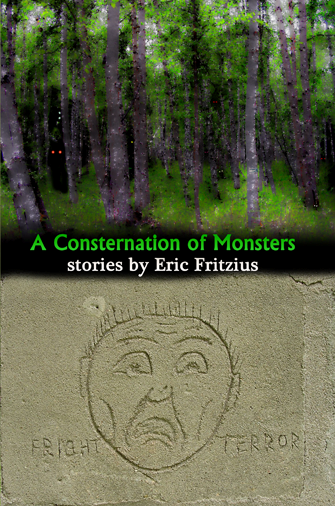
Consternation Cover