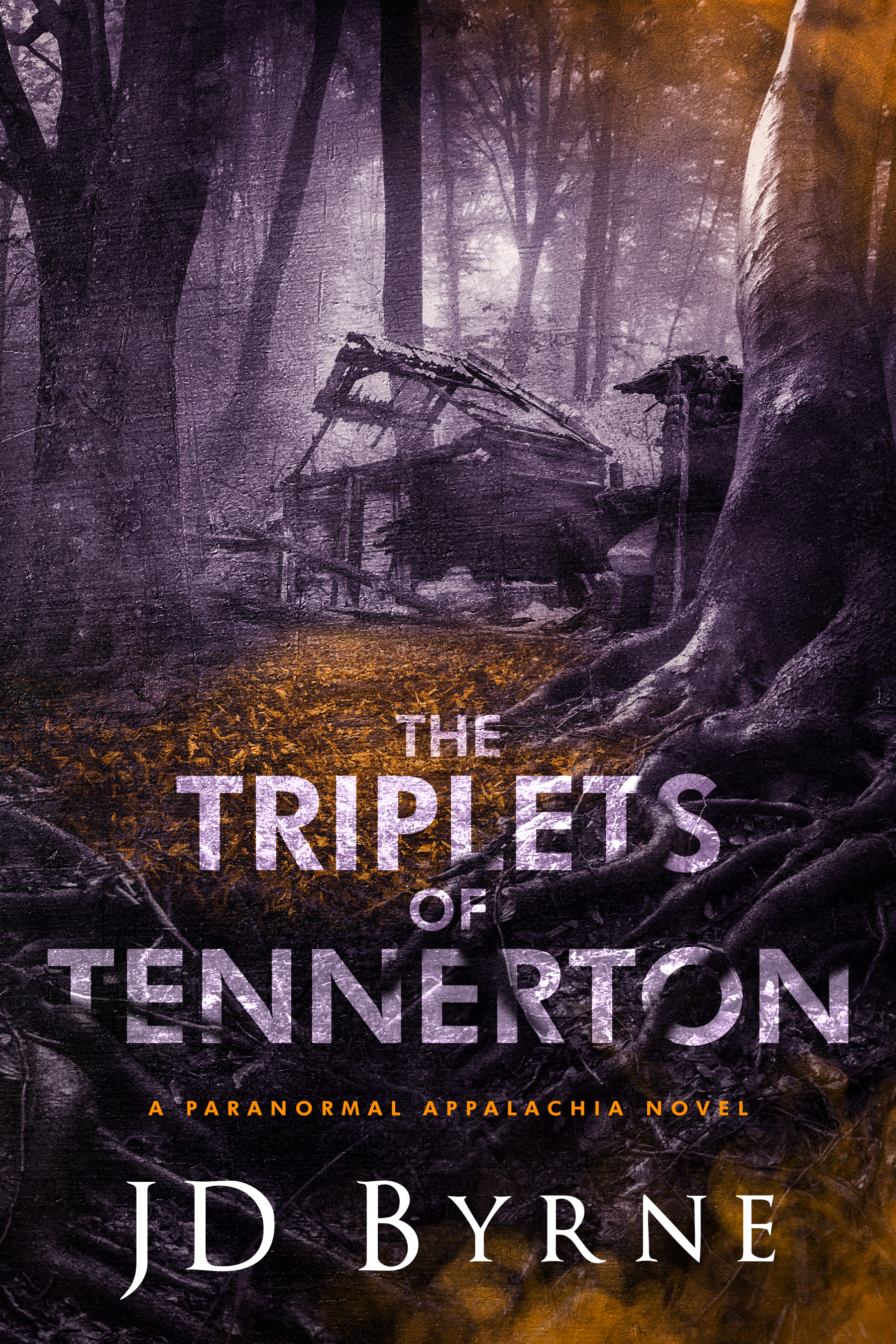
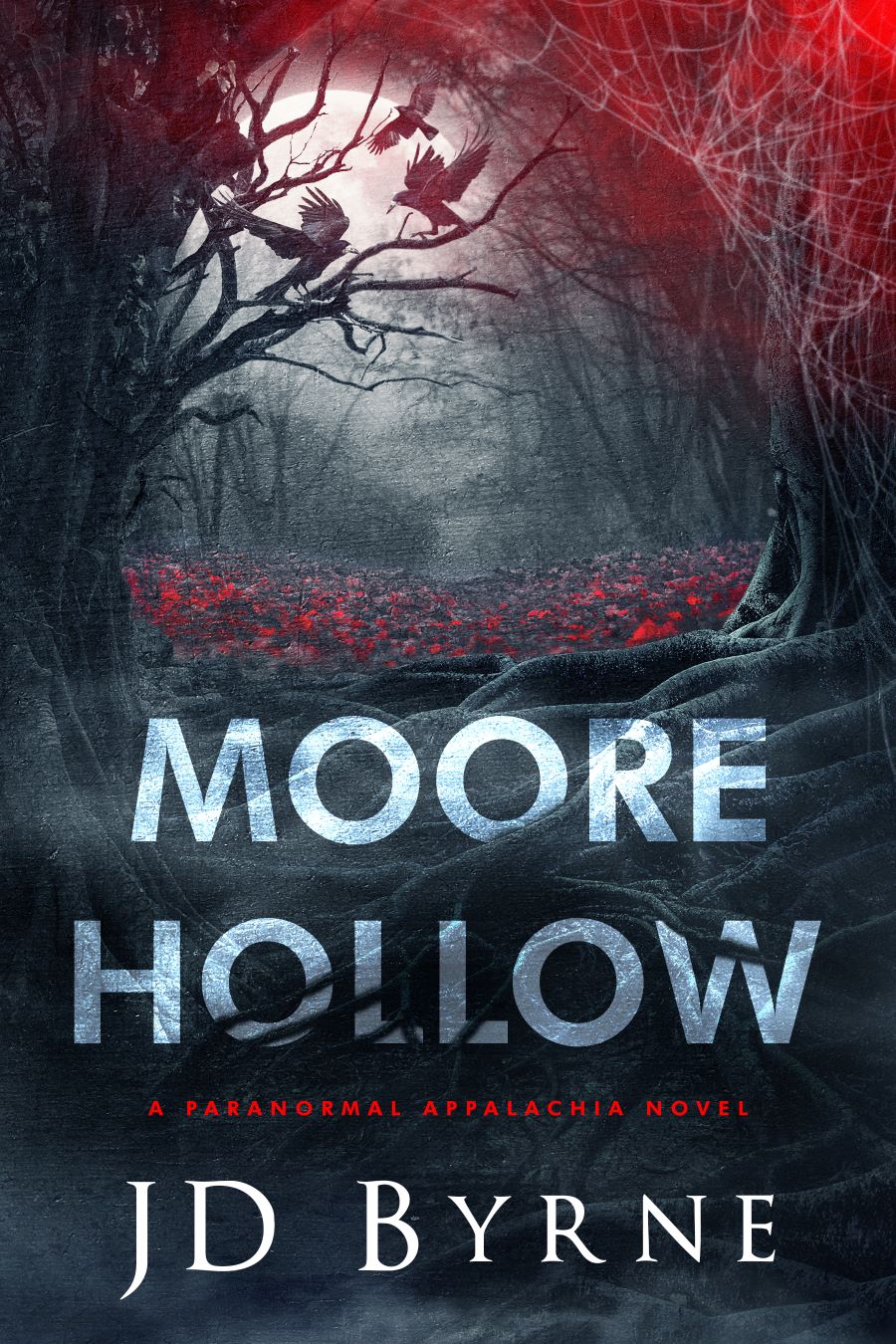
The Triplets of Tennerton – Out Now!

Today’s the day! The Triplets of Tennerton, the long-awaited sequel to Moore Hollow, is here!

You can get paperback and Kindle versions at Amazon and other eBook formats as well (eBook version only 99 cents for a limited time). If you’re in my neck of the woods and want to shop local, the paperback (along with the revised Moore Hollow, featuring new cover art) will be available at Plot Twist Books in South Charleston and Cicada Books & Coffee in Huntington.

Tell your friends! Tell your enemies, too, if they happen to be readers! If you like Triplets please write a review at your venue of choice. Even if you don’t like it, write one anyway, I won’t mind.

Welcome back to the life of Ben Potter and the weirdness that dwells in this part of the world. Welcome to Paranormal Appalachia.

The Triplets of Tennerton – The Inspiration

One of the things that made me think sequels to Moore Hollow might work is that West Virginia has a pretty rich collection of folklore, cryptids, and other oddities to keep Ben and crew busy for many books to come. Leave it to me, then, to take inspiration for The Triplets of Tennerton not from Mothman or the Flatwoods Monster (although he kind of makes an appearance), but from a house fire that happened in 1945.

George Sodder and his wife Jennie lived in Fayetteville along with their nine (!) children. On the night of December 24, 1945, the house burned down. Both parents and four of the children made it out alive. Five other children, however, were presumed dead – presumed because their bodies have never been found. But for that last detail the whole tragedy might have vanished into the ether of memory and history, but the circumstances of the fire and the lack of remains have made it a unsolved mystery of long standing.

The primary thing that stuck with me from a storytelling standpoint is that George, Jennie, and the rest of the family continued to believe that the missing children actually survived the fire. The lack of remains was part of that belief, as there had been a similar fire in the region shortly before where remains of those who didn’t get out were found. More than that, there were reported sightings of the kids in Charleston not too long after. Over the years, there were more reports, from as far away as Missouri and Texas, but none of them ever panned out. George even tracked down a man alleged to be one of his missing sons, but the man denied it.

The circumstances of the fire were suspicious, too. The family received an odd phone call about 12:30 in the morning. A half-hour later, Jennie awoke when she heard something hit the roof with a bang. A half hour later they smelled smoke. Once the fire was underway, George tried to climb up to the second floor to rescue the children trapped there, but a ladder they routinely used around the property was misplaced. George couldn’t start either of his trucks to move next to the house to use them to climb. There’s much more, but that gives you a sense of it.

And that’s before you get to a possible motive that involves the Sicilian mob and George’s vocal hatred of Benito Mussolini (George was born in Sardinia and came to the United States at age 13).

As so often happens with real-life inspirations for fiction, reality (such as we know of it) is really just a jumping off point. What grabbed me about the Sodder story was the lack of remains at the scene of the fire and the family’s unwavering belief that those children had survived. The Triplets of Tennerton  is not the story of the Sodder family. Sid Grimaldi isn’t George Sodder and what happened to Sid’s children is vastly different from what most likely happened to George’s. Nor was Sid’s family united in their belief, as the Sodders were. This is definitely “inspired by” territory, not “based on.”

If you want to know more about the mystery of the Sodder family, I recommend this three part podcast from Unexplained Mysteries. There’s also a good write up here from Smithsonian Magazine.

The Triplets of Tennerton – coming May 29

Pre-order now for Kindle and other eBook formats.

The Triplets of Tennerton – The Interview

In which I steal a bit from John Scalzi and sit down and talk with a probing interviewer – myself! – about my new book.

So you wrote a sequel to Moore Hollow?

Yes, it’s called The Triplets of Tennerton and it’ll be released on May 29.

What a sec – wasn’t Moore Hollow a standalone novel?

When it came out back in 2015, yes, that was the plan. Since its release, however, I had several people ask about writing a sequel. I didn’t really plan to do one, but I came across a real-life inspiration that made realize I could tell some more stories set in that world.

Good grief, you’re not doing another trilogy, are you?

No, not this time. This series is going to be open ended, with each book basically being a standalone adventure. Characters and references will build from book to book, but there won’t be one overarching story that’s driving to a particular conclusion. You can pick up any book in the series and enjoy it without knowing what came before.

So it’s just going to end one day?

That’s possible. I do have a pretty good idea of a story to tell to “end” it, but I’ll jump off that bridge when I come to it.

What’s the setup for this new series? How does it tie into Moore Hollow?

Ben Potter, the main character, has decided to relocate permanently from London to West Virginia. He’s bought a home in Sutton and set up a website called Paranormal Appalachia, where he’ll investigate various local beasties, legends, and other strange goings on.

Hold up – isn’t Paranormal Appalachia the name of this series?

Indeed! It’s what Frank Zappa called “conceptual continuity.”

There are bizarre musical references in this one, aren’t there?

A couple. Ben’s very much like me with regard to his taste in music.

No wonder he’s single.

Anyway, think of Moore Hollow as the movie that set up this world and Triplets (and later stories) as the TV series spun off from it.

In what way?

In the sense that there are several new characters in Triplets that will have a recurring role throughout the rest of the stories.

Such as?

The main one is a local lawyer, Grace, who actually comes out of my first successful NaNoWriMo novel (that nonetheless will never see the light of day). She was an Assistant Federal Public Defender who got a case that dipped into UFOs and whatnot and has developed a reputation for dealing with “weird” cases and clients.

I’m guessing that Ben gets wrapped up in one of those weird cases?

Yup. A old guy named Sid Grimaldi is charged with burning down his home decades before, resulting in the deaths of his infant triplet daughters. Grace takes the case and hires Ben to do some of her investigating.

Naturally, Sid didn’t do it.

That’s what he says, but there’s more.

Oh?

Sid says he knows his girls are still alive, that they didn’t die in that fire.

That sounds impossible.

Did I mention that Ben investigated paranormal and other weird things? Impossible is just the start of it.

Was there an inspiration for that case?

Yes, I’ll be talking about it more in a couple of weeks.

What else is there to look forward to in the coming month?

In addition to a post about the inspiration for this story there will be a couple of excerpts. Then it’ll be release day!

I guess that means it’s time for details.

Right. The new book is called The Triplets of Tennerton and it’s coming out May 29.

The original Moore Hollow has also been revamped to make it part of the Paranormal Appalachia franchise. Get yours now so you’ll be ready for Triplets when it lands on May 29.

Programming Note

I’ve been delinquent with the blog posts the past couple of weeks. Partly that was due to some business travel related to my day job, but more so it was due to having a few different irons in the fire I thought I’d tell you about.

First, you’ll recall my newest project, that I started during NaNoWriMo last year. As I said in December, although I’d “won” by hitting the 50,000-word target for the month, the first draft wasn’t finished. It wound up not actually getting finished, for a couple of reasons. One of them was that a second main character kind of appeared in my brain and inserted herself into the story in a way that shifted things a bit and made finishing the originally conceived first draft kind of pointless. Long story short, I’m now working on the second version of that first draft, polishing and adapting what’s already been done and weaving in my new character. I’m really excited to see how it comes together.

Second, you’ll also recall that I have a sequel to Moore Hollow in the works. I’m also doing the final prep on that to get it ready for release this summer. Part of that includes rebranding Moore Hollow as the first book in a new series, Paranormal Appalachia. Part of that is a new cover. I don’t want to share it, yet, but here’s some idea of the imagery in it:

The new book finally has a title, The Triplets of Tennerton. More details in the coming months!

So, for the next few weeks, I’m going to buckle down and work on that stuff. Back here in May, I imagine. Until then . . .

Returning to the End of the World (and the Story)

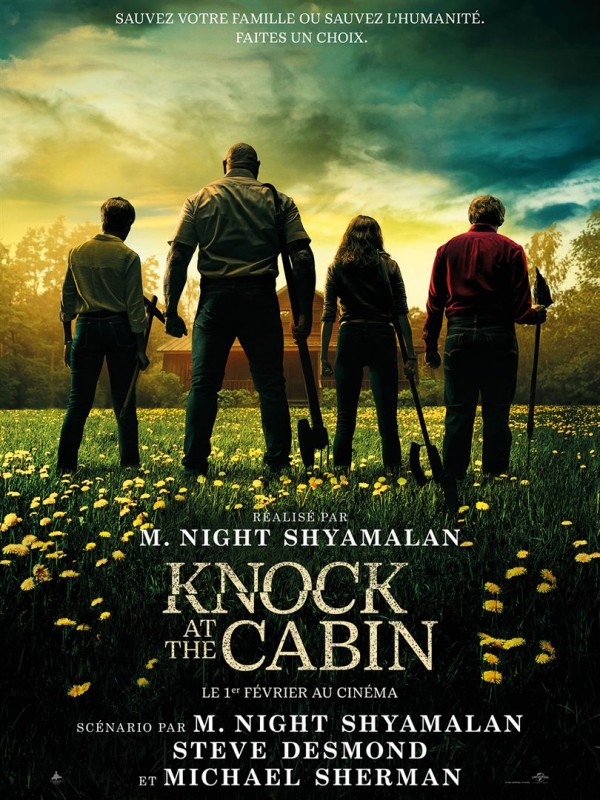
Last year I wrote some about how the ending of Paul Tremblay’s The Cabin at the End of the World, which I had just read, had been changed in pretty big ways for the film adaptation, Knock at the Cabin, directed by M. Night Shyamalan. At the time I hadn’t seen the movie for myself, and now that I have I wanted to circle back on the matter.

To recap (in spoiler-filled fashion), the book and movie are both about a family – two dads and their young daughter – who are beset in the titular cabin by a group of people who claim that the apocalypse is imminent and the only way to stop it is for one of the family members to kill another (suicide won’t work). The family refuses the bargain and the tension creeps up as it appears that, just maybe, the end of the world is nigh.

As I said last year:

Here’s where things part ways, significantly, between book and movie. In the book there is a struggle over a gun that leaves the little girl dead. Eventually the dads escape (all the intruders die) and they confront the question of sacrificing one of themselves just in case the world is really ending (one is now more of a believer than the other). Ultimately they decide not to, essentially concluding that any kind of God that would require such a thing isn’t worth obeying, and they walk off into a brewing storm that may or may not just be a storm. In the movie, by contrast, the girl is not shot and one of the dads decides to sacrifice himself to save the world on her behalf. The girl and her remaining father leave and find evidence that the sacrifice really is stopping the world from ending.

In that earlier post I was focused on the question of which ending was better described as a “happy” ending – the one where characters refuse to play the game of an abusive deity or the one where they sacrifice for the greater good. Both are a choice and neither is wrong in any kind of a normative sense – one will work better for some, the other for others. Nonetheless why the choice was made is kind of fascinating.

Having seen the movie I did my usual post-viewing due diligence (reading reviews and such) and came across this article which goes into why the ending for the movie was changed:

Steve Desmond and Michael Sherman, who wrote the screenplay with Shyamalan, agreed the book’s original, grim ending had to be changed for film.

“We adapted it slightly different than the book, and then [Shyamalan] had a whole new vision for what the ending could be,” Desmond and Sherman told Variety at the “Knock at the Cabin” premiere. “The book is the book, and the movie is the movie, and we think they both were exceptional mediums. This is a big, wide release movie that is meant for a very large audience. There are some decisions that the book made that were pretty dark and may have been a little too much for a broader audience. That was a decision that [Shyamalan] immediately recognized. It’s a great ending now.”

Now, without a doubt, more people saw Knock at the Cabin than read The Cabin at the End of the World. That’s true of any book turned into a movie or TV show (alas). Is that a good reason to change an ending? It feels kind of chickenshit to me to decide the masses can’t handle the ambiguity of the original and decide to spoon feed them a “happier” ending. It’s one thing to imagine that you’re just improving on it from an artistic standpoint (Shyamalan, at least, appears to lean more this way in terms of his outlook on the world), but to admit to dumbing it down feels cheap.

It should be clear by now that I prefer the book’s ending. The entire story, for me, is all about ambiguity: Is what these people are saying about the world ending real? Is it a hoax? Are they honest, but mentally ill, believers? It also gets at an issue that’s frequently lost in popular discussion about the existence of one god or the other – that even if some being like that exists it might not be worthy of worship or obeisance. The book leaves you much more to chew on than the movie does. I may be in the minority, but that’s OK.

Endings are hard. They’re harder still if you’re engaging in some kind of triangulation in an attempt to find the “right” ending for a particular audience, be it broad or narrow casted. Find the ending you think works best for the story. If it puts off some people, well, that sucks. You can’t please all the people all the time – and most of the time it’s a folly to even try.

New Story, New Music – and Come See Me!

A couple pieces of “new” to let you know about.

New Story & New Event!

First, I’m very happy to have a story in the debut volume of Old Bones, the new annual literary journal of Henlo Press.

The story is called “To the Sound of Birds.” It’s about a guy setting up to sell used pulp paperbacks at a swap meet in a high school parking lot when he starts to hear odd noises from the mountain across the highway. Naturally he investigates and discovers something beyond his wildest imagination.

For what it’s worth the inspiration for the story was just that – the high school parking lot where my local SCCA chapter used to autocross was across the highway from a pretty sizeable mountain and, one day, I heard something weird from over there. Didn’t check it out, though, so I suppose we’ll have to let my imagination run wild, right?

You can get a physical copy of Old Bones by clicking here or a Kindle version here.

Or, if you want not just a physical copy but a signed copy, you can come see me! On February 25 I’ll be at Henlo’s first Writers’ Block event at the community center in Barboursville, WV. Things kick off at noon and readings by some of the authors start about 12:45 – maybe you’ll get a chance to hear a chapter from my forthcoming Moore Hollow sequel. It all leads up to the launch of 304 Monsters by Stephen Bias, which looks pretty cool if you’re into the weird West Virginia thing (and who isn’t?). I’ll also have all my other books there, too, if you need to stock up.

New Music!

It’s been a couple of years since I put any new music up, but I’m finally getting around to finishing some of the bits and pieces that have piled up since. The genesis of this one actually dates back to the year of the plague, but I didn’t start to really develop it until recently. It’s called “Chihuahua Junk Pixies.” I don’t remember specifically where the name came from, but I’m sure it had something to do with these two:

It’s bouncy and fun, at least in parts, and, if I may say so, kind of catchy. Enjoy!

It’s All Right, They Have a Warrant (and Fangs)

I’ve seen a question posed in various places on social media the past few weeks:

I thought if anyone is qualified to answer this question it might just be the guy who is both a public defender and a writer of fantasy (with horror overtones in spots). So, what of it – can that vampire cop enter your house against your will?

Let’s start with the assumption that we’re talking about an American vampire cop here, so they’d have to comply with the Fourth Amendment to the Constitution, which prohibits “unreasonable” searches and seizures. It also requires a warrant to execute a search of a home. An arrest warrant will also allow police to enter a home, if they have the necessary suspicion that the person named in the warrant lives there.

A search warrant has to be based on probable cause that evidence of a crime is present in the place to be searched. It’s not a particularly high standard, not even up to the level of “preponderance of the evidence” used in civil proceedings (essentially 51% certainty) and a far cry from the “beyond a reasonable doubt” standard needed to convict someone of a crime. Warrants must be particular as to the things to be seized and the places to be searched. That’s supposed to prevent exploratory rummaging of the kind that occurred under “general” warrants in the pre-Revolutionary era. The application of all this in particular cases is tricky and what keeps me employed, but the basic concepts are easy to grasp.

Perhaps not quite so much for vampires, since their lore varies from telling to telling of particular stories. Nonetheless, there does seem to be a consensus that vampires require permission before they can enter a home. According to this article it dates back to at least the 17th Century and a Greek theologian who stated that a way to be safe from vampires was to stay at home, as they couldn’t enter without being invited. But why? One explanation is that the rule “reflects the idea that evil, represented by vampires, can’t harm you unless you allow it to. It’s a choice, an act of free will.” Tough shit if you get taken in by a slick talking blood sucker then!

With that said, let’s set the scene – Detective Angel and Lieutenant Louis show up at your home. As vampires they cannot come in uninvited. Fun fact – as cops, they can’t either! Except, of course, they have a search warrant, which they do (it allows them to search for any and all implements relating to killing the undead). Does the warrant let them in even if you don’t invite them?

The basic answer, I think, is “no.” The law is the law, but the rule that vampires can only enter with an invitation operates more like a law of nature. Police could no more get a warrant to stop the tides or keep the sun from rising than they could to allow a vampire entrance to a home without an invitation. Nor are warrants commands to someone to allow police into your home – they are permission for the police to enter using any means necessary, hence SWAT teams and knocking down doors in the middle of the night.

But the basic answer is not the only answer. For one thing, if we’re assuming a world with vampires – vampires who are police, no less – then presumably the law has made some accommodation for this. Can a court, as part of issuing a search warrant, compel a homeowner to give permission for the vampire police to enter? I don’t see why not. Courts frequently order people to do things they otherwise don’t want to do, including things like provide blood samples and fingerprints. This doesn’t feel any different and doesn’t lean into that kind of acquiescence that might trigger Fifth Amendment self-incrimination concerns (like giving up the password to your phone).

For another, who gets to give consent to enter and how much consent is enough? Many years ago the Supreme Court decided a case where police showed up to a home in response to a domestic dispute. They asked for permission to search the home – the husband denied it, the wife consented. Police searched the home and found drug paraphernalia. The Supreme Court ultimately held that the search was invalid because so long as one person present when the request for consent was made objected to the search, it didn’t matter what anybody else said. In such situations, police had to go get a warrant.

So what if, when our vampire police walk up with their warrant, you’re willing to invite them in but your significant other who also lives there is not? Does the Supreme Court’s rule for the Fourth Amendment carry over to vampire invitations? Or is it a one-person-to-a-home situation? I’m leaning towards the latter, since, as I understand it, once a vampire is invited into a home it is forever invited, implying that consensus among the occupants isn’t necessary.

What makes the question fun to ponder is the clash of what seems like two absolutes – a warrant permits entry versus a vampire’s need to be invited. But that rests on the presumption that the law wouldn’t evolve to account for the fact that (a) vampires were real and (b) they worked in law enforcement. The Founders didn’t imagine automobiles, but the Supreme Court figured out how the Fourth Amendment interacted with them. Same with cell phones. I have no doubt that a legal system that’s been in a constant state of evolution since at least the Magna Carta would figure out how to deal with vampire detectives.

But until then? Ask to see the warrant, then keep your mouth shut, unless you’re asking for your lawyer.

At Least I Got This Cool Graphic

NaNoWriMo is over, which means it’s time to take stock and see whether it was all worth it. Was it? Well, I did get this spiffy graphic:

Which means, yes, I “won” again this year. I’m particularly pleased since the month included not only Thanksgiving (which my wife and I host for the family, so lots of work) but a birthday weekend jaunt to New Orleans (thanks, honey!) and I still managed to keep to task and wind up with 50k+ words in the end.

I’m really happy with them, too. There are definitely things that need to get worked out in a second draft (I have notes, of course), but this story and this main characters and taking me to some different, interesting places. Alabrie, the city-state where the story is set, is shaping up to be a character all in itself.

It’s not done, of course, not even the first draft, but I can see the end of the tunnel. More than most books I had a real idea of what the entire story was before I sat down to write it. Still, much work still left to do.

Am I a Hack?

People create for lots of different reasons. Some folks do it purely for the fun or catharsis of creation. Some do it as a vocation, if they’re good at it, enjoy it, and can hit the market just the right way. Others are trying to tap into something fundamental about humanity or probe deep into the eternal mysteries of the universe. And some just want to share their creation with the world and hope it brings a few people joy.

I fall into that last category. I write largely because I enjoy it, because it’s fun to tell stories, and I hope some other folks out there will enjoy reading them. I’m not trying to write the “great American novel” or plumb the depths of the human condition to help better understand my fellow people. All I’m really interested in is entertaining, maybe more thoughtfully sometimes, but that’s it.

Does that make me a hack?

I never thought so until recently. To my mind, “hack” was a pejorative term. Wikipedia, at least, agrees with me, defining a “hack writer” as a:

Term for a writer who is paid to write low-quality, rushed articles or books “to order”, often with a short deadline. In fiction writing, a hack writer is paid to quickly write sensational, pulp fiction such as “true crime” novels or “bodice ripping” paperbacks. In journalism, a hack writer is deemed to operate as a “mercenary” or “pen for hire”, expressing their client’s political opinions in pamphlets or newspaper articles. Hack writers are usually paid by the number of words in their book or article; as a result, hack writing has a reputation for quantity taking precedence over quality.

Putting to one side the unwarranted bias against “pulp” writing or romances inherent in that definition, it’s clear that being called a hack is insulting. It’s a charge that your insincere, only in it for the money, not making art but some kind of crass commercial product. If I was called a hack I’d be deeply offended, same as if someone in my professional life called me a shill or a mouthpiece.

But maybe I’m looking at things all wrong, if this Slate piece by Sam Adams is right. Titled “Bring Back the Hack,” it argues that movie studios should look to “hack” directors to helm their big-budget franchises rather than getting up-and-coming auteurs whose singularity tends to get squished in the franchise machine, anyway:

The problem here is two-pronged. The first is Hollywood’s penchant for sucking promising young directors into its maw, tempting them into selling their artistic souls to the franchise devil with medium-fat paychecks and the possibility of speaking to a larger audience. The second is that the movies frequently end up being lousy, extinguishing whatever hint of personality made the filmmaker attractive in the first place and revealing them to be hopelessly out of their depth when tasked with bending a massive studio movie to their will. You don’t get the unique stamp of an artist, but you also don’t get the frictionless craftsmanship that would be brought to the job by a seasoned old hand—in other words, a hack.

Adams seems to deem the primary feature of a “hack” as being that “you don’t know who they are.” He then launches into a discussion distinguishing workmanlike directors such as Jon Turtletaub and even John Huston from true auteurs. Later on, however, he sort of admits that “hack” isn’t really the word he’s looking for:

That’s where hacks come in. A hack—or, if you insist on a less prejudicial term, a craftsperson—isn’t out to make a movie their own. Their aim is to fulfill the task set before them. Like former cinematographer Jan de Bont and former costumer designer Joel Schumacher, they often entered the business from the lower ranks of the crew rather than as writer-directors, rising to the top with an understanding based in the practicalities of production. A hack is a perfect match for a formula film, whether it’s the latest IP extension or simply squarely in an established genre, because they don’t consider themselves better than the material.

This “craftsperson hack” category includes, for Adams, people like Ron Howard (who won Best Picture and Best Director Oscars for A Beautiful Mind) and Jon Favreau (who launched the most successful film series in history, not to mention The Mandalorian). If those guys are hacks then I suppose I’d be happy to be called one, though that term doesn’t feel right. Neither is somebody that’s on my list of favorite directors, the kind of people whose stuff I want to see just because they made it. But Adams cites Favreau’s going to battle with the studio to cast Robert Downey, Jr. for Iron Man, which hardly seems like a pliant, go-along-to-get-along kind of thing. Hell, if hacks can make stuff like Rush then sign me up.

At any rate, I don’t think the same kind of distinction can be made with writers. Name brands are a thing, after all, since people like to read more books from an author if they liked one of their books. That applies equally to deeply sublime stuff and more pulpy just-for-fun stuff. I suppose the closest thing you have in books is situations where some established author’s name continues to hold sway even though others are actually writing the books. Zombie comic strips come to mind, too, I suppose.

I tend to agree with Adams that bringing in somebody known for their personal vision in movies to direct the next comic book flick is kind of a waste. Regardless, I don’t think defining hack so broadly as to lose its meaning does anybody any favors. Leave to it the stain of uncaring make work, produced without any personal motivation.

I may be a lot of things, but I think I’m safe in saying I’m not a hack.