Author Interview – William D. Richards

For the final interview of this year we’re off to New England to talk with sci-fi and fantasy writer William D. Richards.

 Who are you? Where are you? What kind of stuff do you write?

I am William D. Richards, a powerful being who has command over multiple universes!  At least that’s what my characters think. Otherwise, I’m just an average guy with a strange vocation who mows the lawn every once in a while and enjoys a dram of fine scotch.

I’ve lived in New England all my life, living in various parts of it at one time or another.

I write whatever strikes me as interesting. Mostly fiction, on occasion I dust off my old journalistic credentials and write something non-fiction and informative.

Tell us about your most recent book, story, or other project.

I just released my newest book, Aggadeh Chronicles Book 2: Dragon, two months ago.

The first book, Nobody, introduced us to the protagonist, Nem Aster. Nem is a person who finds himself way over his head in the events going on in the Aggadeh Empire and the world around it.

The reader doesn’t get a really good feel for who Nem is. I did this on purpose. The reader gets to know Nem at the same time the other characters in the story get to know Nem. Like getting to know a new friend, you only get a little bit here and there. Over time, you start to collect enough of these pieces to put together a more complete picture of who this person really is.

Since that’s the plan with Nem, how much does the narrative of the series revolve around unlocking his character?

The narrative of the series is focused on the story that is happening, of which Nem is at the center. Unlocking just who this nobody is, is just a part of that story. But it does help drive the plot. As other characters begin to discover the truth about Nem, the story begins to drive to the conclusion.

In what genre do you primarily write? Why did you choose that one?

Mainly science fiction and fantasy. It was science fiction that got me interested in reading and that’s what I grew up with. I preferred it because it really pushed my imagination beyond the envelope.

From the moment I discovered writing, my stories focused on life with the elements of the fantastic. Exploring other worlds, meeting beings that were different than we are, having adventures that went beyond the mundane.

Covers

Tell us briefly about your writing process, from once you’ve got an idea down to having a finished product ready for publication.

Briefly’? You realize you are asking this of a writer?

When I get an idea, it is usually a scene of some sort connected to a bigger story. I write out this scene. Often this scene is dialogue between a couple of characters. It might be just one quote from a character. Or it could be something far more complex like an entire chapter. One thing in particular is that there is a specific emotion that the character is feeling.

The idea is a small thing, like a singularity. The story simply explodes out of it. When I’m ready to write it out as a story. I try to figure out what happened to get to that scene and then what happens after the scene. That becomes the story.

If I’m feeling really strong about the story, then I’ll just start writing it. The narrative, dialogue, and plot just come out as I start writing. This is the seat-of-the-pants style of writing. However, as I write, I will add notes about the various characters I create on the fly so I have those references.

If I don’t have a strong feeling for the story, I’ll describe it to myself. I’ll just tell myself what this scene is, what happens here, what is driving the characters. It’s so passive it’s pathetic. But this is more like writing notes and outline than actually writing the story. The manuscript for Music on the Wind is written like this. It’s all descriptive and filled with tangents and dead ends. When I’m ready to write it, I’ll read through these notes and then choose the best parts and start writing them as active narrative.

For Aggadeh Chronicles, I actually wrote articles about the various locations of the world of Aggadeh and the various people. It reads more like a social studies book than anything. I even wrote out one of two books that appear within the series. One, Tales of the South Seas, is one of the books that Ophelia steals during the course of the story. Tales of the South Seas as a book about the sexual practices of the Islanders of the Southern Archipelago in Aggadeh. It turns out that Ophelia has a habit for stealing x-rated books from the various libraries when she goes on state visits. Each character has a story. The notes are over 100,000 words long. All that before I even began to write the story in earnest.

Where do those initial idea scenes tend to wind up in the final story? Beginning? Ending? Some major turning point?

Those scenes appear where they need to be in the story. Oddly, the very scene that I imagined when I first came up with the idea of the story might not ever appear in the story because I can’t see where it would fit. It doesn’t mean that I’ve completely thrown it away, but that the story has evolved from the initial concept enough that the original scene lost its place in the narrative.

Who is the favorite character you’ve created? Why?

Nem is the second oldest character I have in my repertoire. I first created him when I was in junior high as part of a much darker story that eventually evolved into Aggadeh Chronicles. There are a number of images from that original idea that are still in Aggadeh Chronicles. I may write that story as a bonus when I’m finished with Aggadeh Chronicles, just so fans of the series can see what its origin looked like.

Nem is an outsider. His name literally means “nobody.” Nem is short for nemo, which is the Latin word for nobody. He doesn’t really fit in or belong, a feeling a lot of creative people deal with in their lives. And it is a feeling that a lot of teenagers struggle with as they try to figure out who they are and how to fit in with the society around them. The fact he’s lasted this long in my imagination should be a pretty good indicator.

Ophelia is another favorite of mine. She is a lady just waiting for the opportunity to break out and be herself.

I initially created her just to be a romantic interest for Nem in Aggadeh Chronicles, but as I wrote out my notes about her—writing her backstory—she became a much more interesting character.

For one thing, she has a cache of dirty books that she has stolen from various private libraries she has visited. Someone of her social standing steals dirty books! The moment that came out, she went from being a side story to a main part of the story.

We get glimpses of Ophelia here and there in Nobody and Dragon. But we finally get to meet her for real in the third book of the Aggadeh Chronicles series, Oracle.

How long had Nem hung around in your head before you began writing a book about him? In that time how had your conception of his character change?

Nem has been bouncing around in my mind as a character since I was in my early teens. I only really started writing him into a story six years ago, so that’s a lot of time.

Nem as a person hasn’t changed too much. But his circumstances have. Originally Gahvel Nem, he was a street rat turning to thievery to survive. The street children in Balon are a homage to Nem’s original character. The Nem Aster that appears in Aggadeh Chronicles had an easier early life with a loving family and a home. But both are outcasts from society for various reasons. Gahvel because he was a thief, Nem because of his interactions with dragons. Both are the key to the survival of their worlds.

What’s the weirdest subject you’ve had to research as a writer that you never would have otherwise?

There are so many, I don’t know where to begin! I’ve had to research so many oddball, weird, unsettling, creepy, and illegal things, I am sure the FBI has an extensive file on me. One that sticks out in my mind: codpieces.

Yes, the humble codpiece. The willy wallet, peter pouch, schamkapsul, etc. No, I do not have one nor do I ever intend to try one on, thank you. But it does make for a humorous scene…

What’s the one thing you’ve learned, the hard way, as a writer that you’d share to help others avoid?

I already knew how the industry worked when I decided to step up and write full time. My first career out of school was as a journalist. Because I always daydreamed about writing a book, I kept researching different publishers and the industry in general. So I was all over the publishing industry from one end to the other. I knew how things worked and what to expect.

My big mistake? I didn’t actually write that story.

I saw how the industry worked and how difficult it was to get something published. I also knew how long it would take me to write something. The investment in time was just something I couldn’t do. I had to write articles, find work, and try and earn money so I could just survive. There was no time for creative writing.

I struggled, getting nowhere, until I finally left the writing industry. Only then, unhappy in the last job I landed, did I actually start writing again.

It felt SOOOOOO good to finally open my mind and let all this stuff come flowing out! Once I started, I just couldn’t stop. Story after story began to dump out as I wrote everything down. At lunch on my Palm Pilot, on the train using my laptop, I just wrote and wrote. What amazed me was how little spare time I dedicated to writing and just how much I actually wrote! The notes for roughly five different stories totaling over 400,000 words.

At this point, I knew I was going to write a book.

The issue again became, “When?”

I left my last job and then spent all my time looking for a new job—there were none to be had. A friend popped up with a business opportunity and I jumped at it. There was no time for writing. We got off to a good start, but the economy pulled the rug out from under our feet.

As it came crashing down around me, I had no prospects for the future. It was only then that I came to the realization that the only thing I had left was to actually sit down and do what I had always dreamed about doing: actually write a book.

My advice to others:

Just WRITE!

Set aside some time for yourself for each day so you can just sit down and write a story without feeling guilty about not doing other things. Write because you enjoy writing the story, not because you have to. Don’t set a deadline by which you have to finish writing. That kind of pressure can kill off your creative urge. Instead, treat the writing sessions as a reward for getting other things done during the day. Enjoy the sensation of your fingers dancing on the keyboard as you watch the words appear on the screen.

Don’t worry if your writing is good or not. Just enjoy the story that is coming out of you and follow it to the end. You can fix the rough parts and the passive parts after you have finished the story. (It’s called editing!)

Just write!

If you won $1 million (tax free, to keep the numbers round and juicy), how would it change your writing life?

It would affect my writing life immensely: I would build a house that is optimized for writing. I have a number of ideas for that, including outdoor writing places. Little nooks and crannies where you can have quiet conversations, share some tea or fine scotch with friends. Space enough to entertain friends and family for the holidays.

Whatever is left over I would invest in a dividend producing portfolio to generate income to pay the bills between books. (This is a whole other subject for new writers, delving into the business of being a writer, especially if you are self-published.)

What’s the last great book you read or new author you discovered?

This question would have been a lot easier had you asked what was my favorite book or what books influenced my own writing.

At the moment, I am reading Hunt’s Elements of the Mind and I am quite enjoying it. I really liked Hunt’s Dark Wing series and I am looking forward to the next installment in that series that he is working on right now. Hunt is a historian and his attention to the connections and details really weaves his stories together.

I am also reading Donna L. Armillei’s Shock of Fate. It’s her first book and that is always the toughest for a writer, especially when that first book is the first book in a series. Readers just don’t want to touch it until the whole story is complete. Donna has a great story idea aimed at the Young Adult audience, but I think readers of any age will enjoy it. You want to discover a new author? Buy Donna’s book and discover her for yourself!

What do you think you’re next project will be?

Oh, I don’t have to guess at the next project. I know what my next projects are.

At the moment, my primary focus is on the Aggadeh Chronicles series. I am now working on Oracle, the third book in the series and I’m pretty far along with the manuscript now. With the arrival of a new computer, I am aiming to have the manuscript finished by spring so we can finish the editing for a summer release. Much, much faster than the four-year wait readers had between books 1 and 2. (The delay the result of my earlier computer being destroyed in an accident. I had to borrow time on someone else’s computer to finish the manuscript. Four years! UGH!)

Another project I have is a science fiction under the working title of Privateer. The protagonist, shipwrecked in space by pirates, comes across a derelict ship in an uncharted star system in the far reaches of space. While the derelict has enough supplies that he could live out his lifespan, that is not what he intends to do. Can he repair the ship enough to get it moving again?

Another project I have is a fantasy titled The Science of Magic. It looks at magic in the modern age as a young man unexpectedly finds himself in the profession of magic.

Learn more about William on his web site.
Author Interview – Jeffrey Bardwell

For the penultimate interview of this year we’re back in the USA with epic fantasy & steampunkist Jeffrey Bardwell.

Who are you? Where are you? What kind of stuff do you write?

My name is Jeffrey Bardwell and I write under that name. I was born in Virginia, but have bounced around the USA in the last decade or so. I write speculative fiction.

Tell us about your most recent book, story, or other project.

My most recent project is developing my own secondary fantasy world: geography, cultures, history, the works. I call it the ‘Metal vs. Magic Universe’ and primarily focus on the conflicts between those who cast steel and those who cast spells. The latest book in one of the current ongoing series set in this universe is Hidden Revolt.

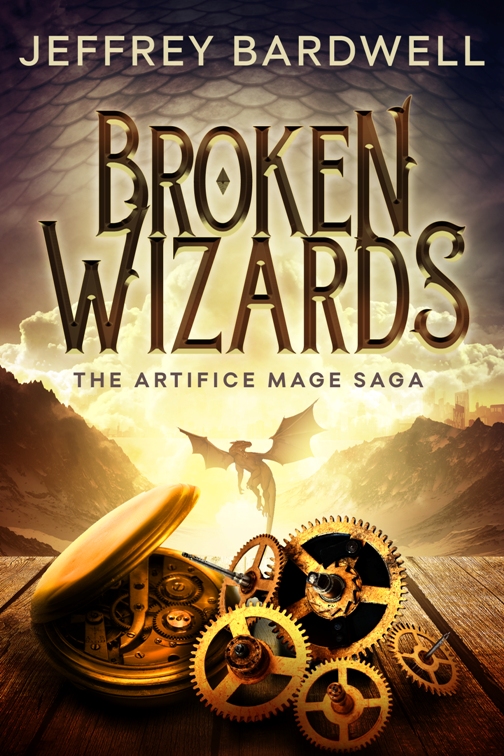
Broken Wizards cover

In what genre do you primarily write? Why did you choose that one?

I mostly write epic fantasy steampunk. I love the wide breath of options, from the brimstone dragon reek to the shrill whistle of science.

I was in a discussion recently about what “steampunk” really means as a genre – what does it mean to you? What’s the difference between steampunk and fantasy (or even alternate history) set in a late 19th-century type environment?

Steampunk probably means something different to me than most authors. The genre classically hearkens to the Victorian Era, but my fictional evil steampunk empire is more Late Medieval Era. It’s second world fantasy, but a good analogue from our own history would be to ask what if the Dark Ages never happened and Rome just kept going and innovating machines and technology? There’s also a strong whiff of magic in the world in other countries, so gas lamp fantasy might be more accurate to denote a story that combines magic and metal. However, each element is championed by separate societies: the one character who combines an affinity for both in one person is condemned and outcast.

Tell us briefly about your writing process, from once you’ve got an idea down to having a finished product ready for publication.

First, I file the idea away for later. I typically have a backlog portfolio overflowing with ideas and after I select one, I try and get a feel for the main characters’ interweaving arcs. This builds into an outline ranging from minor notes to entire scenes. Then I write the first draft, intently micro revising the previous day’s work as I go.

Soon, latent themes begin to emerge. Often inspiration strikes at random and new, minor developments push off the beaten path as I’m writing. Despite all the exploration and improvisation, the overall map and the destination remain the same.

Once the initial draft is done, I send it to an editor and/or several beta readers. Editing is a two pass system: first, the story is examined for large-scale flaws such as narrative flow, character motivation, internal consistency, and tone. Once every scene is polished and every characterization nailed down, the second pass examines small-scale issues like spelling, grammar, and punctuation.

AuthorPic

Who is the favorite character you’ve created? Why?

My favorite character is Styx, a tall automaton made from wood with brass fittings. His life truly begins when a young wizard finds his puppet body abandoned in the woods and accidentally-on-purpose gives him a soul. Styx has the innocent wonder of a child, but the down-to-earth nature of a wise, old man. He’s seen it all . . . he just wasn’t cognizant at the time.

First, is Styx named after the band or the river? Second, was he one of those ideas around which other things were built or was he a “minor note” that grew into something larger?

Styx is certainly undergoing a rite of passage throughout the series, so the allusion to the river from Greek mythology is appropriate. However, the true root of his name is just a childish misspelling of “Sticks,” the epithet after which the large wooden automaton names himself when he learns to think and speak. He is definitely a minor note whose gentle leitmotif is slowly rising with a strong crescendo.

What’s the weirdest subject you’ve had to research as a writer that you never would have otherwise?

The weirdest subject was looking up the original programmable clockwork automata build by Heron of Alexandria, Jacques de Vaucanson, and Henri Maillardet. This research helped me to ground Styx’s designs and the hypothesize the functionality of mechanized armor. Though, to be fair, I would have looked in them eventually regardless. Clockwork robots are cool.

What’s the one thing you’ve learned, the hard way, as a writer that you’d share to help others avoid?

Don’t neglect the actual time for writing among all the other trappings of a modern indie career. Outsource what you can when you can however often you can.

If you won $1 million (tax free, to keep the numbers round and juicy), how would it change your writing life?

I would use some of that money to buy ads for my series loss leaders and boxed sets, run those ads, and then take a vacation overseas, which would use up more of the money. Then, when I got home, I’d use a little more to hire a personal assistant. The rest I would invest in mutual funds, bonds, and real estate.

What’s the last great book you read or new author you discovered?

Anything by Terry Pratchett.

What do you think you’re next project will be?

My next project will be taking my epic fantasy steampunk universe into space after fast forwarding the clock a millennium or two.

Check out Jeffrey on Amazon, Facebook, or at his website

Author Interview – Holly Evans

This time we head to the Emerald Isle for some words with fantasist Holly Evans.

Who are you? Where are you? What kind of stuff do you write?

 I’m Holly Evans, an English expat with a love of blades, fae, and predators that hide in the shadows. I’m currently living in the Republic of Ireland. I write Urban Fantasy, mostly with LGBT+ casts, and mostly set in a huge fantasy kitchen sink world that I refer to as my Ink World.

Do your Ink World books tell an ongoing story or is it a shared universe with lots of separate stories going on?

I’m careful to keep the Ink World series separate so none of them spoil any of the others. If you look closely and read all of the books you’ll see there’s a larger arc there, but it’s kept far in the background. So really it’s more the latter, a shared universe with some overlapping locales and characters.

Tell us about your most recent book, story, or other project.

Seers Stone is book one in a new series. It follows treasure-hunting alchemist Kaitlyn Felis. It’s something I’ve wanted to write for years. It’s a quick-paced, adventure-focused Urban Fantasy set in my Ink World. Kaitlyn’s a vibrant character who has such a lust for life, she’s amazing fun to play with.

In Seers Stone she takes a new job in Prague and is sent to retrieve the mythical Seers Stone for her new boss. That takes her across Europe and sees her in a lot of fun situations along the way.

Cover

In what genre do you primarily write? Why did you choose that one?

 Urban Fantasy. It’s what I naturally write, I can’t imagine writing anything else. I love the mix of myth, magic, and mayhem, all set in the modern world. The idea that magic and adventure could be hiding just around the corner is too good to ignore. If you know which shadow to slip into, or which door to knock on, you can be transported into this amazing new world. How can I not love that?

 Tell us briefly about your writing process, from once you’ve got an idea down to having a finished product ready for publication.

 I don’t really have a set process. The idea gets written in my planning book. I’ll jot down broad strokes, scenes that pop into my head, and everything I can about the protagonist. That will involve lots of colour, my brain loves colour. That will sit and percolate in the back of my mind for a while, while I work on other things. When it’s time to write it I’ll return to my planning book and make more notes. They’re not usually too organized at that point, it’s lots of colour and notes on scenes that call to me. From there I’ll start pulling together an outline and then writing.

I tend to write roughly the first 10k pretty quickly, then I’ll pause, update my outline, and carry on. Once I hit the 20k mark I start wailing about how much I hate writing middles. I’ve started writing the endings before the middles as my ADD means I get bored and frustrated which leads to rushing the ending. So I’ll write the opening as much as I can, then the ending, then go back and gnash my teeth through writing the middle!

From there it goes over to my editor. I have a language-based learning disability, so my books require *a lot* of copy editing. My editor gives the draft a copy editing pass then a developmental pass. It’s rare that the developmental will call for anything more than tweaking a few sentences and expanding on a couple of scenes. Once I’ve done that (usually that takes me about 48 hours) it’ll go back to my editor for two more copy editing passes. I’ll then format it, and it goes on Amazon.

Have you ever had a situation where you wrote the beginning, wrote the ending, then in filling in the middle part decide that the ending you wrote doesn’t work anymore?

I came really close to needing to rewrite the end of one of my Infernal Hunt books. I wrote the book completely out of order from four different points. Fortunately the end only needed tweaking not a complete rewrite but it was a close call for a moment.

What’s your strategy for publishing a series (i.e., do you release each book as it comes, hold them all until the series is done, etc.)?

I release each book as they come in a series. I held onto the first three books of my first series so I could release them quickly, but after that I just release them when they’re done. I’d rather have regular releases than hold books back.

Who is the favorite character you’ve created? Why?

 I’m so hopeless about picking favourites! I think that’s a tossup between Tyn and Kaitlyn. Tyn’s a secondary character in both my Ink Born and Hidden Alchemy series. He’s my broken little kitten. He’s a Cait Sidhe (a fae cat) with a really tragic backstory, he’s so snarky, and broken, but also sweet, fierce, and incredibly loyal.

Kaitlyn’s amazing fun. She has such a lust for life. She lives to have adventures, and she’s just so vibrant, so incredibly alive.

What’s the weirdest subject you’ve had to research as a writer that you never would have otherwise?

 I don’t do much research for my writing. I have a pretty good knowledge-base of myths and such from spending my childhood and teenage years devouring everything I could find on that. I can’t think of anything to be honest.

What’s the one thing you’ve learned, the hard way, as a writer that you’d share to help others avoid?

 If you want to make readers happy, you have to keep them in mind. I wrote some books that were for me under another name, and they didn’t make readers happy. Looking back, I can absolutely see why. It’s so easy to go, ‘well I’m an avid reader, of course I know what readers want!’ and then it turns out that well, actually…

I suppose that really comes down to why you write. I’m a storyteller, I write for my readers, so I want to make sure that I write books readers love. If you’re writing more for the pure love of writing, then do what makes you happy.

What’s the best way to find out what makes readers happy?

Ask them 😛 I survey my newsletter subscribers on a semi-regular basis and ask what they enjoy, what they want, etc. I try to offer as many methods for engagement and reader feedback as I can. Reading reviews, your own and those of bestsellers also helps a lot. You can look down the top 100 in your genre and read the reviews, positive and negative. You’ll see some trends.

If you won $1 million (tax free, to keep the numbers round and juicy), how would it change your writing life?

 My husband and I want to become digital nomads, if I won that money we’d pack our bags and start travelling the next day. I’d visit all these wonderful places I want to visit, and I’d put them all in my books.

What’s the last great book you read or new author you discovered?

 I’m not normally an eRom reader, but a friend had a new book out that people were raving about so I picked up a copy. It was fantastic. Finn by Liz Meldon is exquisitely put together. I’m really impressed with how much character development she managed to pack into a little space.

What do you think your next project will be?

 I’m bouncing back and forth between the Ink Born series and the Hidden Alchemy series, so it’ll be whatever sequel is due along those lines. Right this very second that’s Ritual Ink (Ink Born 4). That being said I’m really tempted to start a third series in my Ink world, I’m weighing up the pros and cons right now.

Check out Holly’s blog here.

Author Interview – J.J. Green

Breaking cover during NaNoWriMo to bring you this conversation with J.J. Green.

Who are you? Where are you? What kind of stuff do you write?

I write under the name J.J. Green, but that’s only because I think it sounds cooler than Jenny Green. I’m British/Australian but I’ve been living in Taiwan for six years and plan on being here for another two at least. I’ve also lived in Laos. I write space opera and humorous sci-fi, and I’m hoping to begin writing thrillers under a pseudonym later in 2018.

How has living abroad impacted your writing? 

The simpler, cheaper lifestyle has made it easier to find time to write compared to living in the UK when I needed to work a full time job to support myself and my family. On the other hand, I find it much harder to go to conventions and conferences so my networking is confined mostly to the internet. I recently went to the 20 Books to 50 K writers’ conferences and it was great to finally meet some fellow writers face to face.

Tell us about your most recent book, story, or other project.

I recently finished my second sci-fi series! Called Shadows of the Void, it’s a ten-book space opera that progresses from a mysterious life form discovered on a remote planet to an all-out galactic war. The protagonists are a Martian security officer and an Australian starship pilot. The two characters are made for each other but it takes them a while to realize it.

Now that Shadows of the Void is complete, I’ve begun a new series, a space colonization saga. The prequel to the new series appears in an anthology called The Expanding Universe 2 under the title, Space Colony One: Night of Flames.

Generation Ebook1400x933

In what genre do you primarily write? Why did you choose that one?

Science fiction has been my favourite genre since I first encountered it when I was around eleven. I love everything sci-fi from H.G. Wells to Neal Stephenson, so it was the obvious choice when I decided I was going to take the plunge and write novels. I also love mysteries and thrillers, though, so I’m kind of torn. I like to include some elements of both of them in my science fiction.

Tell us briefly about your writing process, from once you’ve got an idea down to having a finished product ready for publication.

I try to have a plan but often the ideas don’t flesh out until I begin to write, and then they may change shape. Sometimes I re-read my plan after I’ve finished a book and think, oh, so that’s what I wanted to write.

I generally try to write as much as I can as often as I can. I aim for 3000 words a day as a minimum, but if something breaks my routine I usually miss that target.

After finishing the first draft, I go over the story again, correcting mistakes, filling out thin parts, checking for consistency, adding items I needed to research and improving the flow of the language. Then the manuscript goes to my editor, who finds more mistakes and gives me her gut-feel feedback as a reader. I fix the extra mistakes and tweak things according to how she’s seen them, then I publish.

How did you go about finding an editor that you trust and could develop a good working relationship with?

I’m very lucky in that I got to know a very good editor through my writers’ group. I knew from firsthand experience that she has an eagle eye for writing errors and because she’s a writer herself she has a good feel for what works and doesn’t work at sentence level. What’s more, she reads science fiction and fantasy, so she’s my target audience.

Who is the favorite character you’ve created? Why?

My favourite character is in my first series. Her name is Carrie Hatchett, and she’s a Transgalactic Intercultural Community Crisis Liaison Officer. What she lacks in smarts she makes up for in enthusiasm and effort and she usually saves the day, though she manages to get herself into quite a few scrapes along the way.

Carrie’s like a female Doctor Who in what she does, but she isn’t anywhere near as intelligent as the Doctor and she has only one—very big—heart.

Mission Improbable ecover (3)1000x1500

What’s the weirdest subject you’ve had to research as a writer that you never would have otherwise?

That’s a hard one to answer as I love to read about strange things that have no bearing on my life whatsoever, so I can’t honestly say that I wouldn’t have researched something if it weren’t for the fact I was writing about it.

Having said that, probably the most esoteric subject I’ve ever researched for writing purposes was Ediacaran life forms. They were organisms that evolved very early on in Earth’s history and they were soft-bodied, so little information about them has been gleaned from their fossils. The reason I was researching them was because I polled my readers on what animals to include in my Shadows of the Void series, and that was one of the suggestions. The Ediacarans went on to become the alien creatures called Paths (due to their telepathic/empathic abilities).

How did you poll your readers? Are there any other ideas you might leave up to their whims?

I’m afraid my polling skills are very amateurish. I simply ask my readers questions and ask them to reply on Facebook, Tweet me or write me an email. My method isn’t very scientific, but it helps me build a rapport with my readers, which I love.

What’s the one thing you’ve learned, the hard way, as a writer that you’d share to help others avoid?

There are so many to choose from! I would say, understand book covers before you shell out hundreds of dollars. I paid a couple of hundred for a nice, well-made cover that didn’t fit my genre at all. As a result, I received some negative reviews from readers whose expectations hadn’t been met. After that experience, I spent hours looking at covers in my genre and learning what elements were similar and what made a cover look good. I also learned the names of famous designers in the genre.

If you won $1 million (tax free, to keep the numbers round and juicy), how would it change your writing life?

It wouldn’t stop me from writing, that’s for sure, but I would finally be able to invest seriously in my self-publishing business. A little extra cash to pay for amazing covers and promotion might give me the kick start I need to progress to the next level. Bootstrapping is hard sometimes.

What’s the last great book you read or new author you discovered?

I recently began reading M.D. Cooper’s Aeon 14 series, which is pretty awesome and very useful for me because it’s full of hard sci-fi tidbits.

What do you think you’re next project will be?

As well as the space colonization series I mentioned above I’ve also begun work on a space fantasy series. I’m not so sure on the format that will take yet, but it involves a star mage who’s searching for the rest of her clan and the origin of humankind. The magic is based on the Chinese Wu Xing system, which describes interactions and relationships between objects through classification according to five planets or elements. I’ve written the prequel but the rest will have to wait until I’ve wrapped up the space colonization series.

Get in touch with J.J. on the Web, Facebook, and Twitter.

Author Interview – Timothy Ellis

For this interview we go (back) down under to talk with space opera writer Timothy Ellis.

Who are you? Where are you? What kind of stuff do you write?

Timothy Ellis. I live on the Gold Coast, in Queensland, Australia. I write Space Opera, with a spiritual underscore, a love of cats, and dabbling mix of other genres.

Tell us about your most recent book, story, or other project.

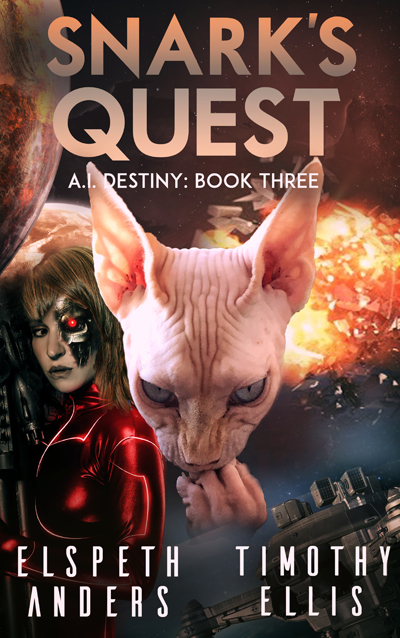
My current project is the A.I. Destiny series, which is a spin off from The Hunter Legacy series. Book 3 was Snark’s Quest, co-authored with Elspeth Anders. Snark is a centaur like Cat, in my Gaia galaxy, introduced in the previous book Queen Jane. While the series is called AI Destiny, Snark takes on a journey through a galaxy coming to grips with humans suddenly appearing, and being the strongest species around. Book 4 is Destiny Stone, continuing the quest. Book 5, Talisman of Tomorrow is currently in editing as I write this. All 3 are co-authored.

The series is a reversal for most Space Opera where humans are the underdog, and must save the universe. Here, humans, unknowingly led by AI’s have what everyone else wants, and Snark’s Quest begins a 3 book arc about the consequences of being top dog, instead of underdog. Especially on a cat world.

Snarks Quest 2nd cover-400

 In what genre do you primarily write? Why did you choose that one?

Space Opera is my first love. I didn’t actually choose what to write. It had been haunting my mind for twenty years before I first sat down and attempted to extract it. The first few books wrote themselves.

Spirituality, (without religion) has become my way of life, and so I decided to mix Space Opera with a spiritual main character. This introduces an aspect missing from many space military stories, where mine has a main character struggling to cope with a death toll he can’t avoid, and doesn’t want to be part of.

I also added in cats in space, since I love cats. Some of my funniest moments are cats doing in space what cats do naturally.

The last aspect of my writing is the Artificial Intelligence, and what happens when one is side kick to an eccentric human, and a group who accept who she without any need to justify anything. I took this is another level in the spin off series, where the AI goes from side kick to Queen.

In your mind, what sets space opera apart from other science fiction that’s set in space? Later on you mention a “spectrum” of space opera – what is that?

To my way of thinking, Space Opera is about people. It’s character driven, and is about them being put into situations, somewhere in space. Military science fiction on the other hand tends to be event driven story, populated by people doing things. Characters who get thrust into events, verses events where people have to deal with them. You can still have military based Space Opera, but the characters come first. In Military Sci-Fi, the events come first. For example, in Space Opera you meet Joe Bloggs having an ordinary day on his ship, and things go pear shaped. In Military Sci-Fi, your star system is invaded, and Joe Bloggs is the nearest who/whatever to deal with it. It may sound like the same thing, but remember, you’re in my mind here, a most dangerous place to be I assure you, and just about everyone has a different perspective on the distinction.

On one end of the Space Opera spectrum is pure life in space. There are no galaxy wide problems, no save the universe as we know it situations, and definitely no hero to the rescue. It’s about living in space, and the day to day events which make up real life. The best of this end can still be compelling reading, even if nothing actually blows up.

On the other end is the more traditional expectation of Space Opera. The system/political entity/galaxy/universe has been invaded or is about to end, and some hero type has to save everyone. The stakes are big, the problems seem insurmountable, and there is a great deal of handwavium, and pulling rabbits out of orifices at the last second. The movies get made at this end of the spectrum because of all the high stakes jeopardy for the characters, and everything going boom.

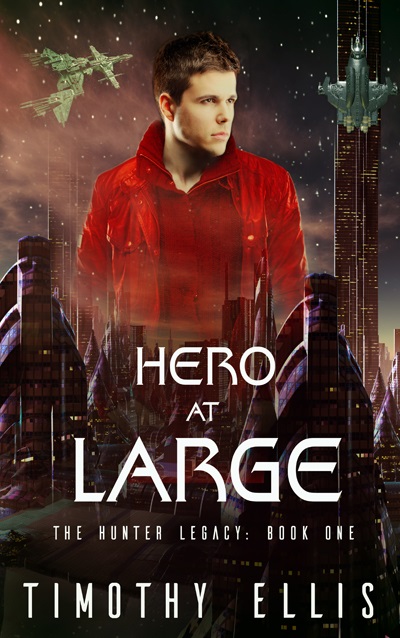
In the middle are series like my own, where life in space is the core, but there is a steady building, ebb and flow, and rebuilding towards the end of humanity situation. I have gone with the hero theme, but my hero has a daily life, and it’s not always about saving anything or anyone. He goes shopping, eats dinner in restaurants, throws up in the bathroom, gets drunk, showers, and goes naked in the spa. Sometimes alone, sometimes not. Most of my books cover somewhere between one and three weeks in time, and you live those weeks with the main character. The Christmas story for example, is one day in space, where the main character is losing his grip on the day, while everyone else thinks it’s all his doing. It could be anywhere, but it’s on a ship, and things happen which can only happen on a ship. This is Space Opera at its best for me. Life in Space. It’s not about where they’re going. It’s about what happens on the journey.

Hero-at-large-new-cover-400

Tell us briefly about your writing process, from once you’ve got an idea down to having a finished product ready for publication.

 I’m a ‘pantser’, so I start with an idea, usually knowing where the end is, and simply begin. The characters talk to me as we go, and I write about what they want to say, where they want to go, and what they want to do.

In some books I’ve need to meticulously plot time against multiple actions, so everything happens in the right order.

I edit what I write the day before first, and continue on writing.

Once complete, aiming for 85k words, I do a reading pass on the computer looking for anything wrong, and tidying things up. I usually add more than I delete.

Once the story is there, I throw it to my Kindle app, and start reading it as if it was someone else’s book, editing as I go. Rinse and repeat until I can’t find any errors.

Blurbs tend to write themselves during the editing process, and the cover is defined, commissioned, and completed by the time the editing process is complete.

I release as soon as I consider the book is polished well enough.

Who is the favorite character you’ve created? Why?

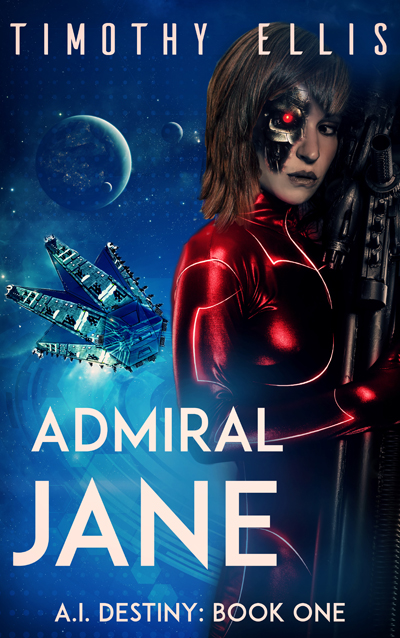
Jane is my first AI character. She starts out as a ship computer AI, gains a robot body, uses tech to appear human, and learns how to be so human, no-one can tell she’s not. She’s a fiercely protective side-kick, but has a sense of humour which produces some very funny dialog. She’s done disco dancing, fleet control, bait for a serial killer, killed the bad guy when the main character decided not to, and eventually becomes a Queen of her own Kingdom.

Admiral Jane cover-400

What’s the weirdest subject you’ve had to research as a writer that you never would have otherwise?

 Dismembering a corpse, within a combat suit, in the vacuum of a space hulk, using something resembling a Japanese Katana sword.

What’s the one thing you’ve learned, the hard way, as a writer that you’d share to help others avoid?

As distasteful as getting editors to cover your first novel in red is, it’s really necessary. I’ve seen too many authors release their first book with so much ego involved, having not had a good editor, or even a proof-reader look at it. They crash and burn, and that first book haunts them ever after.

All first time authors have blinkers on as far as their writing is concerned. Successful authors fall into 2 groups. Those who had their first books edited and learned how to do it themselves to a higher level, and those who still get their books edited by professionals. No matter how good you are, your first book needs a professional editor, and multiple proofreading passes, in order to polish it to a good enough standard to be acceptable to readers.

The process is hard to go through, since an editor will most likely gut what you think is your ‘voice’. But that is what they’re supposed to do. The first book is a learning journey on a steep slope. But it is necessary.

The other part of this is letting go of ego. Too many first time authors think they are the second coming, and their work is perfect as it is. They fail to listen to experienced authors trying to help them improve the book, blurb, and cover before they launch it, and crash and burn spectacularly. Help is out there on author forums and groups, and the authors who utilize the experience of successful authors who help new ones, do a lot better out of the gate.

The first launch is a matter of parking your ego, getting the best advise you can, using professional services to polish your story as much as you can, and producing the best possible story, presented in the best possible way, before you present it to readers. What happens then depends on how well people like the story, not on what was wrong with the presentation.

You mention the need for a professional editor for a first book, which implies you’ve moved past using one. What did you learn from initially using an editor that you’re able to use now and avoid going that route?

The first thing everyone learns is to hate the red which comes back. It’s a good motivator for learning how to edit yourself. What I did was looked hard at what the red was about, and I set down on paper all the common corrections. When my editor wasn’t available for book 3, I methodically used the find function in word, to check a long list of things I usually had wrong. These included two words where a contracted word is better, a list of words I over used badly and could easily be replaced by a better one with just a little thought, and typical spelling mistakes I make all the time, which the spell checker won’t pick up because they are real words.

There are two parts to editing. Looking at the story itself, and proofreading the words used. I tend to write fairly clean first drafts, so I don’t rewrite very much on the first editing pass. If anything, I add in new ideas, and clarification. While writing, I keep notes on what needs to be covered later on, so I rarely miss anything important, and pick these up on the first full read pass.

Proofreading is where most authors fail, as far as the final product is concerned. But learning to proofread is first a matter of learning about yourself. What do you always do wrong? Where are your blind spots? These are where editors and proofreaders will show you what you need to concentrate on when self-editing.

One of the tricks to proofreading is putting it on your reading device, and reading it like it’s someone else’s book. So much becomes obvious this way, which you never saw on the PC, no matter how many times you read there. I do most of my editing from my device, reading like a reader, and changing on the PC version as I go.

It’s a skill. You will either learn it or not. Editing and proofreading are separate skills, but they can be combined with writing. You just need to change hats a lot.

If you won $1 million (tax free, to keep the numbers round and juicy), how would it change your writing life?

Not much. 1 Mill isn’t all that much these days in the scheme of things. It won’t buy me a decent sized apartment on the beach, which is where I’d like to be living.

It would allow me to travel without needing to worry about those months where you don’t release, and so your income drops like a stone. I’d do the American Comic-con circuit for a while.

What’s the last great book you read or new author you discovered?

 The two authors I wait impatiently for the next book are Nathan Lowell and Glynn Stewart. Both have series on the go where the end of each book is always way too soon. Both write Space Opera, but on opposite ends of the spectrum.

I can’t say I’ve discovered a new author in recent times. One of the disadvantages of being in editing mode so often, is reading other people’s books is difficult, because you also edit them as you read. Hence, I only go looking for something really new, between releasing a book, and beginning writing the next one. Sometimes there is no gap, so I don’t even look.

What do you think you’re next project will be?

I have 4 on the go at the moment.

Editing the next A.I.Destiny/Snark based book is the primary focus right now. The fifth is in editing for release in the second week of October. The series finale is in planning.

I’m also developing a sequel to my original series, setting it up to be a core for more books in the original galaxy.

I’ve already begun something completely new as well. Crossing genres much more than I already have. For now, I’m not sure if it’s a standalone book, or the first of a new trilogy.

As well, with a co-author on the current project, I’m working towards co-authoring in my universe with other authors. I’ll soon have a universe with 2 galaxies, and separate characters and species, sharing technology with Humans and AI’s at the center of them. A second co-author is currently working on a backstory to one of my characters.

How do you keep track of your many ongoing projects? Do you try and prioritize one at a time or do you just work on whatever strikes your fancy on a given day?

I’m a fairly methodical person, so I work mainly on one thing at a time. Ideas come and go, I take time out to make notes, but I keep going on what the current book is. This doesn’t stop my head from going off track, but deadlines help keep you focused. Once a book in a series is released, you need to focus on 4 to 6 weeks later being the release date for the work in progress. You can deviate a bit, but too much makes your release date slip.

I do allocate some time each day to working on other projects, but come writing time, you work on only the current book.

AuthorPic

Author Interview – J. David Core

From one JD to another . . . and from next door in Ohio, to boot.

Who are you? Where are you? What kind of stuff do you write?

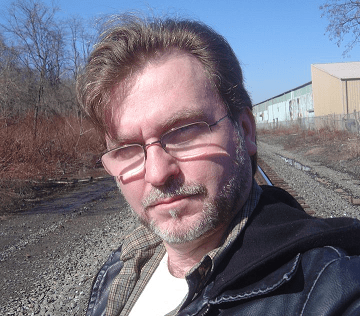
 I’m a fifty-five year-old grandfather from small-town Ohio. I’ve worked as a traveling photographer, a newspaper photog, a freelance writer, a cook, and a whole lot of retail. I write mysteries and crime thrillers mostly. I set most of my stories in the tri-state region of the upper-Ohio valley which is the stomping ground I call home.

Tell us about your most recent book, story, or other project.

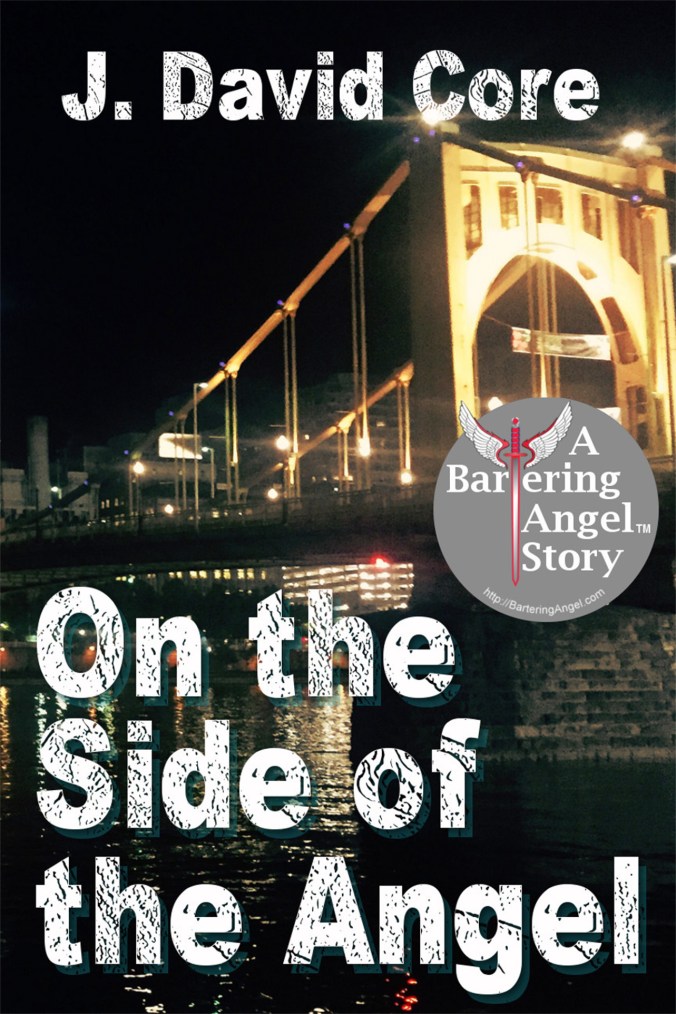
My most recent release is called On the Side of the Angel. It’s intended as part of a multi-author project. I contacted several writers and together we brainstormed a character and back story with the intention of each using the character in a shared capacity in our assorted projects. The stories would have no other connection except that the same character would feature prominently in each. When we began the project we had no idea who or what the character would be. Eventually we settled on a young, multi-racial woman who has been forced to fake her own death and is working as a fixer for the mafia in an effort to farm information for her vendetta against the person who murdered her family and forced her into this new life.

The character uses a different assumed identity in each iteration of her freelance career, and as she cleans the messes she’s tasked to clean, she curries favors to call in as needed. Because of this habit she is known in the underground only as the Bartering Angel.

My story is set early in her career just after she has faked her death. She shows up in Pittsburgh and is asked to help the son of a local drug dealer to escape the country after he and his girlfriend accidentally killed a store clerk in a botched thrill robbery. The Angel devises a scheme to misdirect the FBI with a dupe who is trying to cash several dozen winning lottery tickets without paying any taxes.

Cover

I’m really intrigued by the project that led to the Bartering Angel. How did you get involved in that? How many authors were involved? How do you ensure that all the different stories don’t take the character in conflicting directions?

I was listening to Simon Whistler’s podcast, and he was interviewing a romance author who mentioned that she was involved with a multi-author project with a shared character. In their case, it was a matchmaker. I thought it was a great way to cross-promote, and wondered if a group of thriller and mystery writers could do something similar, so I wrote a bunch of writers I have had previous dealings with and composed a post about the idea on a popular writers’ forum. To be honest, I doubted many writers would be interested, and one suggested that the idea of keeping all of the writers interested would be like herding cats, but I was tenacious. Eventually we wound up with a core group of around seven authors, and two of us besides me have already outlined and partly written their own stories. The others in the group are waiting until those stories are all released to begin working on their own stories. My story is set in 2005. The third story will be present day.  And a second story falls somewhere in the middle of that timeline. Once they are all released, I’ll create a wiki which we can use as a sort of story bible to keep consistency.

Meanwhile we are all working on the prequel story, so we are all familiar with the origin story. Beyond that, none of us is writing from her POV directly, so even if the stories have different voices, the character’s voice can be kept ambiguous enough. In a sense, it’s the same as when multiple authors write in – say – the Star Wars universe. Or when different directors make a Spiderman movie. We all know who the character is, and we all have our own spin on her, but the reader will still recognize her as the Angel just like they recognize Han Solo or Peter Parker.

Are there things about the Bartering Angel that would have changed if she was only “yours”? Might those things find their way into a future work of yours?

Frankly, I would never have thought to give her a fatal flaw. That was a suggestion by one of our writers, HN Wake. Then as a group we decided to give her agoraphobia, which she is struggling to overcome but which sometimes gets the best of her. So if she was just mine, she’d be less interesting in that regard. Also, I had originally suggested calling the character Betty Barter. Sometimes committee decisions are better.

As for whether I’d ever work my vision of the character into my own story; in my story about the angel set in 2005, On the Side of the Angel, I introduced a middle aged, gay, fixer with a stoic personality called “the painter” who gets involved on the case temporarily. He was how I envisioned the character before we began development. So in a way, I guess I did work my vision for the character into my story.

In what genre do you primarily write? Why did you choose that one?

Most of my stories involve crime. Some are thrillers. Others are mysteries. I have also written a handful of time travel stories which also involve crime as a central focus. I have no idea why I am so drawn to crime stories. I’m the most honest, milquetoast dude I know. There must be a dark corner in my psyche that wishes I could seek vengeance and embrace anarchy and sociopathology.

What’s the difference between “mysteries” and “thrillers”? Isn’t there a mystery at the heart of any good thriller?

I think a thriller certainly can have a mystery at its heart, but so can a romance or a science fiction novel. And a mystery is thrilling, but so is a horror story. Genre lines are vague in some ways, but like Justice Potter Stewart said about pornography, when it comes to the distinction between mystery and thriller, I know it when I see it.

Tell us briefly about your writing process, from once you’ve got an idea down to having a finished product ready for publication.

I get ideas for stories every day. Sometimes I have completely forgotten them by day’s end. If I haven’t forgotten an idea by the next morning, it begins to stick with me and I know I have a hold of something with a life of its own. I tend to let the idea fester and marinate for a while. Finally I’ll sit down and write out a rough synopsis. I then turn this into an outline, and then I flesh that out into beats.

By this time, I’m ready to write, so I draw in the chapter breaks and do whatever research the story requires, and they all require some research. Then I start writing. A 50,000 word novel usually takes about a month. A novella takes around a week. Then I let it sit for a month or so before going back in for rewrites. I like that break to give it freshness when I return to it. I find if I try to edit or rewrite just after I finish that I’m too close to what I’ve written. A month later though and I can read it like it’s something I’ve never seen, and it’s a lot less precious.

After the rewrites, I send it to my beta team. When I get it back, I make my corrections or rewrites. Then I’ll get one or two people who haven’t seen it yet to give the latest draft a read, then I do a final polish after they give their feedback. That’s it. I hit publish.

AUthorPic

Who is the favorite character you’ve created? Why?

I’m pretty impressed with the Bartering Angel. She was raised in Alaska on a secluded homestead by her parents who homeschooled her and taught her survivalism until they were murdered. After that she lived with her scientist aunt in Anchorage who taught her chemistry before she joined the military where she learned spec ops techniques until a bout of agoraphobia (brought on by unresolved issues resulting from the murder of her parents) forced her to leave the military. She sought therapy and joined the police academy as she tried working through her issues, but when her aunt took ill she left the force and studied forensics and computer science on her own from home. Then, when her aunt passed and she learned that she was going to be charged as the killer when poison is found in her system, she fakes her death and goes underground.

All of this gave her all the necessary tools to be the perfect fixer for the mob, a job she never wanted, but was forced into due to circumstances. It’s such a rich and perfect back story. But…

The problem is I didn’t develop all of this by myself. As I said earlier, she was created as part of a group project.

Then there’s Lupa Schwartz, a genius detective who loathes religion and loves classic cars and women and good food, and came to America from the Balkans as a Jewish refugee after the fall of the Soviet Union. He’s a rich and interesting character too, wearing only green shirts and black pants, insisting on releasing the air from the tires of parking violators so they can’t flee before the police have a chance to ticket them, vigorously denouncing the beliefs of others while holding to what some would consider ludicrous conspiracy theories involving shadow governments and corporate conglomerates. But…

If I’m being honest, most of that came about because the character is pastiche of Sherlock Holmes and Nero Wolfe. I just took existing tropes and twisted them into something recognizable and new but fully formed and informed by what came before.

What’s the weirdest subject you’ve had to research as a writer that you never would have otherwise?

One of my characters is a pedophile being brought to justice by a bounty hunter. On the trip they have a conversation, and I decided the child molester would try to make excuses for his behavior. I had to research countries with no age of consent or a very young one that he could use in his argument. I researched the history of consent in our country. It was a weird rabbit hole with a lot of very disturbing facts. And it left me with a very ugly Google cache I’m sure.

What’s the one thing you’ve learned, the hard way, as a writer that you’d share to help others avoid?

That’s a good question. I’d say I probably wasted way too much time trying to get an agent to shop my mystery series to traditional publishing houses. Of course this was long before the kindle revolution, but even so. Back in those days, an agent would ask for a query with a synopsis. If they liked that they’d ask for a manuscript. For this whole process they wanted non-simultaneous submissions, aka exclusivity on spec. This tied up the project for months and almost always ended in a rejection and they never even sent back the manuscript even though I sent a SASE. It was a giant time and money suck for no return.

Even today there are those who are still playing that game. Do not get sucked in. Even if you are one of the lucky chosen few, they own your labor’s fruit lock-stock-and-barrel. They decide after a month to pull it from shelves and take it out of print and it’s basically gone forever. You don’t own it anymore.

Be an indie publisher.

If you won $1 million (tax free, to keep the numbers round and juicy), how would it change your writing life?

Well, for one thing, I’d invest it in a start-up ebook retailer idea I have to compete with the likes of Kobo, Nook, and Amazon. I’d take a smaller cut on each sale letting authors pocket 80%, set sales or free days as they see fit, and run a discovery tool similar to the Netflix model. “Based on your like of Douglas Adams and Kurt Vonnegut, we recommend these indie authors.” Something like that.

Other than that, my own writing would be unaffected. I already write what I want when I want the way I want.

What’s the last great book you read or new author you discovered?

I really enjoyed The Coelho Medallion by Kevin Tumlinson and Revelation by Carter Wilson. They are two very different kinds of stories by very different authors, but each was enthralling and smart and fantastically researched.

What do you think you’re next project will be?

I have an idea for a science fiction series that I’m hoping to treat in a way similar to the Bartering Angel series in that it will involve several different authors writing in the same universe. I don’t have a name for the concept yet, but it involves an alternate version of our world where scientists in the 80s discovered a way to inject nanobots into our spinal columns that would create artificial stem cells that would replace all of our cells with improved robotic cells. What kind of world would we have today, 30 years later? There’d be luddites who refuse the operation, maybe some of them even working in an underground opposition. Some of the perfected people would figure out ways to use the technology to commit crimes. Each story would explore the universe from a different perspective. Some small and personal in scope, others more epic.

I’m working out the fine points before opening it to other writers.

Meanwhile I have a few more Lupa Schwartz mysteries to write and I’m putting out an audiobook of a noir collection I published last year.

Get in touch with Dave on the Web, Facebook, or Twitter and check out his podcast.

Author Interview – JD Weston

This time it’s off to the Middle East to talk with suspense, thriller, and hybrid writer JD Weston.

Who are you? Where are you? What kind of stuff do you write?

I am a Dubai based author and photographer, I find the sunshine helps my creativity (smug grin). I have lived in Dubai for close to ten years now and enjoy the central location to the rest of the world. Since being here, I have traveled to Africa, Asia, America, and all over the Middle-East, to places that from my home city of London, would have been slightly more difficult to get to, and likely would have never crossed my mind.

Tell us about your most recent book, story, or other project.

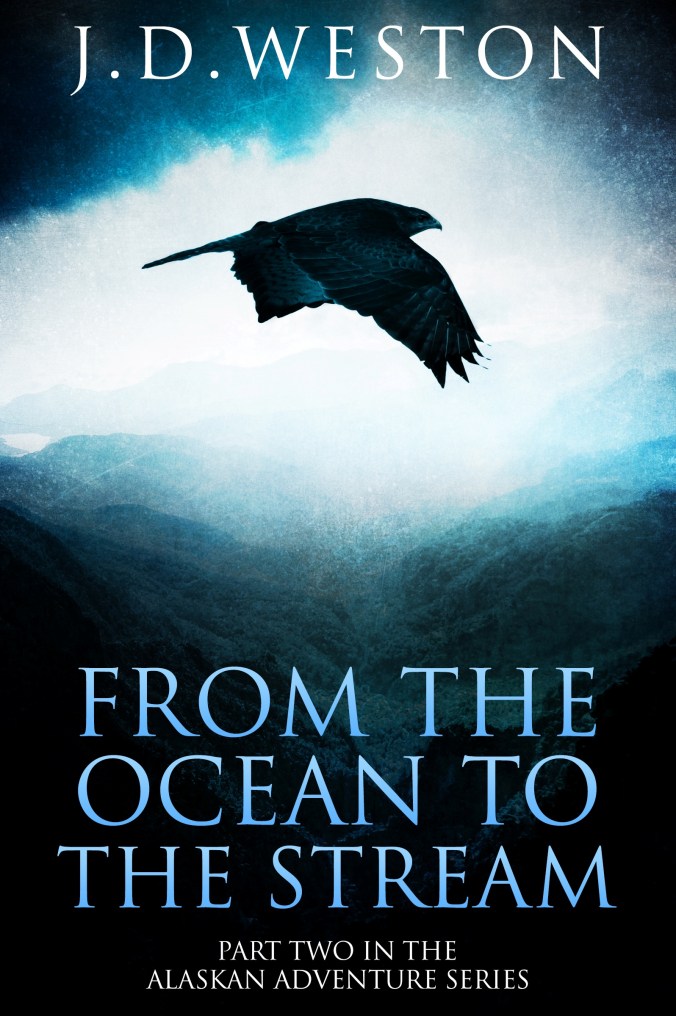
I have just finished a duology called, The Alaskan Adventure Series. The second part, From the Ocean to the Stream, was published on the 7th September. The story outlines the memoirs of a young man called Jim, who picks up from his father’s story in the first part of the series, during which time the family travel to France and undergo the horrific experience of their ship sinking. With the family split, each of them take on their own battles with the ocean and struggle to survive any which way they can before returning to Alaska.

From the Ocean to the Stream, sees Jim take on Alaska, his father’s birthplace in their log cabin on a lake deep in the Rocky Mountains. The horrors of the experience on the ocean and the things that Jim had to do to survive continue to haunt him through similes that lie in the shadows of the woods. His battle to overcome the memories and to find solace and peace in the wilderness, and to truly find himself are put to the test as the greed of man seeks to destroy all his family have ever worked for.

Cover2

Alaska has an important place in your work. How did it become such a key feature of books written by someone born in London and living in Dubai?

That’s a great question. I am a country boy at heart and a lover of the outdoors. I have family in Montana, where nature rules and the landscape and wildlife aren’t too dissimilar and as a result I’ve spent a lot of time there. Alaska is not far to travel from Montana and had always been on my list, so during a trip to Montana, I went further into Alaska and was blown away.  Once I’d been there and had stood deep in the silent wilderness; fully aware that I was far from the apex predator on so many levels; it left me feeling humbled and totally appreciative of the balance of nature. I was awed by the stories of the frontier; tales of men grunting their way through the hard winters, foraging and hunting and much like early man, constantly aware of the dangers. This is something that I think appeals to many people, it’s a sense that has evolved in man within the confines of the cities, where the dangers are still there but in a different form. Life in the remote parts of Alaska is not easy. Everything you do requires effort and planning. Boiling water requires wood, fire and effort. Finding food often involves patience, hiking and danger. I grew up in London, where many things are a phone call away, or the flick of a switch or remote control. I think that exposure to both the big cities and those remote wild places really gave me the holistic perspective I needed to identify life in the wild in a way that someone who has never experienced it could appreciate.

I used the trips to Montana to sit and reflect on the Alaska trip and to fill in the gaps in the flora and fauna that flavoured the books. I spoke to men who through experience were able to add substance to my own knowledge of the way things are done in the wild. Above all, in both Alaska and Montana, the feeling of sitting by a lake, high in the mountains with no other people for miles around is something that not everyone gets to experience. The silence of nature and the smell of the wilderness is captivating. It had such an impact on me, I had such a powerful connection with it all, I simply had to put it down in words.

In what genre do you primarily write? Why did you choose that one?

Perhaps like many authors I find my genre is a hybrid of many, with flavors of others. I enjoy the graphic detail and suspense that I am able to spin into a thriller, and the wild places that beg for action adventure. But yes, there’s a hint of romance in most of my books, just to spice it up a little.

You mention that your books tend to be hybrids, crossing genre lines. Has it been difficult finding a audience for such works? How have you connected with readers without being able to hang a clear genre label on your work?

In short, yes it has been difficult. The first book has received some fantastic feedback, but as I mentioned, it was a story that was inside me and I just had to write it. When I started, I had no intention of publishing it, I was simply enjoying writing; I loved the faraway places the story took me and at the time was unaware of writing to an audience, I was writing for myself. That first book was like lighting a fire beneath me; I had to write a second, which as I mentioned, followed more of a plot, and actually is channeled into a thriller genre more than any other, although it would still appeal to readers of adventure. Perhaps rather selfishly, it also gave me another excuse to visit my favourite place.

Now that I have the first two books complete, I am working on a new series with six books planned for the next year, all of which are specifically crime thriller and are written for that particular audience.

The Alaskan Adventure series was written with fluid, empathetic descriptions that convey the smells, the sounds and the feeling of being in the wild. Whereas the new series contains much more concise sentences, with the sharp dialogue of London’s east end organized crime scene, (think Snatch meets Jack Reacher). As I am writing, the voice in my head takes on the dialect of the character. So, while writing the Alaskan Adventure series, I spent a huge portion of the time with my own thoughts talking in that loveable, wild, North American slang which I adore. The new series sees me going back to my roots, with my head in full cockney mode, which the dialogue benefits from hugely. I think the audience of the crime thriller genre will identify with this accent, and it will become an underlying tone across the entire series.

One of the benefits of the east end/cockney language is that it can be written in plain English and the reader can still hear the cockney tone through the use of language and dialogue. Whereas I found with the Alaskan Adventure, the most effective way to really give the reader a sense of language, was to write in the actual dialogue, which raised some issues with the writing application during editing, but enables the reader to quickly slip into the tangle of trees and sit by the lake with the tastes and smells that the characters describe far easier than if they were written in plain English. In the end I compromised and changed the story to plain English, and kept the dialogue in the slang dialect, but I still prefer the original. It takes me away to some very special places.

Perhaps one of the biggest takeaways of the first two books, was indeed, identify the audience and then write for them and not for myself. I am a huge fan of Lee Child, Mr. King, and Wilbur Smith’s African themed Courtney series. I think my stories will always have a taste of the outdoors, it’s something that has been close to me for as long as I remember, but my experience of the cities allows me to focus on my audience now. As I mature as writer, and begin to find my feet, I feel I can channel the experience of city life into the thriller series, and throw in realistic tones of the outdoors.

Tell us briefly about your writing process, from once you’ve got an idea down to having a finished product ready for publication.

The first book I wrote started out as a chapter that then became two chapters, then three; pretty soon it was a book. The book that followed had a plot, aha, I’m learning new things. Since then my approach has differed.

The series I am working on now saw me outline an entire series on an A0 piece of paper, with individual story arcs and the full series arc. So now all I have to do is fill in the gaps with words.

I typically start writing at 0530 am for two hours and then again at midday. The break allows me time to digest what I have written, compare it to the story and series arcs and develop some ideas to follow it.  I aim for around 3,000 words per day, so around 8 weeks for a finished story, sometimes less. I’ll get the covers done halfway through the book, and try to do a book trailer as early as possible, these give my story a feel and of course allow me to shout about the book before it’s done. Once complete, I’ll fire off the manuscript to the editor, which is then butchered and the remains are then returned for me to do a final draft and send back for a final and edit and format.

It sounds like you edit as you write, rather than finish one draft then go back and take a next pass on it. How do you balance the editing with the need to push forward, getting plot on the page?

I do like to revisit the previous days writing to clean the phrasing up and improve the flow, and then by the time I pick where I left off, I am fully in the zone and ideas are already bouncing around. Once complete, I read the book through aloud and make changes before sending it to the editor.  I set myself a target of 2,200 words per day, which I normally smash. The series I am working on has the series arc laid out, with individual story arcs, so often the words are itching to get out before I even sit down. As a writer who is new to fiction, I am still finding my feet; the more advice I listen to, the more I understand the need to spew the words onto the page and edit later…but I can’t help myself, I love to go back and read what I wrote the previous day, if anything, for continuity of writing style and feel.

Who is the favorite character you’ve created? Why?

The first character I ever created in my first novel, Where the Mountains Kiss the Sun. Sonny was born and raised in the wilds of Alaska. There was nothing he couldn’t do, hunt, fish, trap, fell trees, start fires, and boy he could shoot. But one day, when he was just 18, his family had died leaving him alone, so he set off into the new world seeking adventure. He meets people for the first time, learns about civilized life, and goes to war with his nation where he experiences hell. His naivety and innocence find him a loving wife but also sends him to prison. His loyalty and devotion places him on a ship to France that sinks, and his courage and tenacity help him find his family again, where he can return to his home, Where the Mountains Kiss the Sun. Sonny is loveable, adorable and naïve in the city, but in the wilds of Alaska, he’s the king.

Cover1

What’s the weirdest subject you’ve had to research as a writer that you never would have otherwise?

I have had to research many weird things, often sat in a café’ where people who may be looking over my shoulder would see me frantically trying to understand what life was like in a New York prison in 1930, or how big the ships were that carried troops across the ocean and how many funnels they had. Or they may see me learning how to field dress and skin a deer. At number one on the weird list though, I would have to say is the long term effects of cannibalism on the human mind, and what the best parts of the human body to eat are. I probably got some odd looks during that phase; in fact, I probably shouldn’t go back there. Ever.

What’s the one thing you’ve learned, the hard way, as a writer that you’d share to help others avoid?

Patience. Plan, prepare and execute only when you are ready. There’s hundreds of blog posts and articles on release strategies and target audiences and all the other marketing elements, and don’t get me wrong, these are crucial to success. But before all those elements, you need to write a good book. Close off loose ends, spell check, edit, proof read, edit, proof read and format well. If none of those things are done and the book isn’t your absolute best, then it doesn’t matter what advertising, or keywords you use.

If you won $1 million (tax free, to keep the numbers round and juicy), how would it change your writing life?

I’d like to think I would continue to write and photograph, but I’d be doing it in various parts of the world, where the variety could influence both of my passions in a positive manner.

What’s the last great book you read or new author you discovered?

I personally like to read long books, or series. I bumble around from author to author, and often listen to audiobooks in my car as I drive to work. I recently found Jeffrey Archers, As the Crow Flies. He somehow manages to interweave story lines and timelines into a jumble of superbly written chapters with such vivid characters, that I almost feel I know them by the end of chapter one. He is of course, an extremely talented man, and I have read many of his books, usually in awe of the detail he provides the reader.

I have to give credit to the narrator also. John Lee is one of my favorite narrators and can throw his voice in so many different directions. He bounces from accent to accent in the midst of Jeffrey’s heavy reams of dialogue, and yet he does it such dexterity and grace, barely pausing for breath, that I often sit in my car waiting for the end of the chapter before heading into my office.

What do you think you’re next project will be?

I’m actually currently working on a thriller series based in my home town of London. It’s based around the story of a man who was raised to be a killer for a crime family, who strives to escape the life that accompanies such a vocation. During his efforts to escape he turns his talents to better purposes, cleaning the gene pool has never been so much fun.

When I write, I tend to think in the accent of the person; kind of like a bad movie going on in my head. The last series was based in Alaska, so I had two years of speaking like a backwoods hillbilly. The new series as I mentioned, is based in London, so I’m allowing my cockney self to run free and colour the dialogue that spills out daily. I find it’s a great way to actually put myself there at the scene, see the details and provide imagery that takes the reader there.

I aim to release books 1-6 every four weeks starting in May 2018. And right now, as well as writing like I’m possessed, I am working on campaigns, covers, book trailers, keywords and all the rest.

Author Interview – John Triptych

This time we’re headed to Asia to chat with science fiction & thriller writer John Triptych.

Who are you? Where are you? What kind of stuff do you write?

Hi, I’m John and I write science fiction and thriller novels. Right now I live out in Asia because I’m planning to settle here permanently. I’m a semi-retired businessman who decided to write novels because it’s always been my dream to be an author.

Why did you relocate to Asia and do you think your new surroundings will impact your fiction?

I worked as an expat, traveling and living in different parts of the world for almost 20 years so the area was pretty familiar to me. I also found the cost of living is much, much lower, and I didn’t have to work as hard yet still maintain my lifestyle if I stayed in the US. There’s plenty of American retirees living in the Third World and they live like kings!

As far as my surroundings having a say in my writing … it’s very strange in that I actually write more about the US ever since I’ve moved away, so while I’m in another part of the world, I still write about things I’ve experienced before.

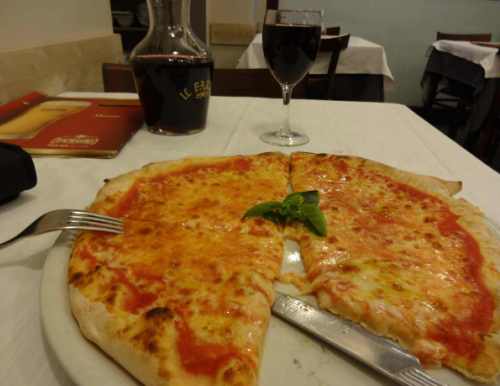
Pizza as Author Pic

I ask writers to send me a picture – John sent me a picture of a genuine Roman pizza!

Tell us about your most recent book, story, or other project.

I’m currently finishing up the first book in a new series called Alien Rebellion. Its set a few hundred years in the future, and there’s a human colony on an alien planet that’s undergoing some … drastic changes to put it lightly. It’s sort of like a cross between James Cameron’s Avatar movie and the anthropological science fiction of Ursula K Le Guin, and a bit of James Clavell too.

In what genre do you primarily write? Why did you choose that one?

I primarily write science fiction. I like writing in this genre because there are no limits to your imagination. You can create entire worlds from scratch and I love doing that. I have a background in tabletop role-playing games and even as a kid I loved to create my own little worlds, sort of like a self-centered demigod.

Tell us briefly about your writing process, from once you’ve got an idea down to having a finished product ready for publication.

I start out with nothing more than a concept. From there I think of an initial scene and start writing. I don’t plot in advance and I just create the story and characters on the fly. I’m a two-finger typist so it takes me a long time to write (and I stop every now and then to do research on the internet too whenever an idea pops up) but I still somehow get it done!

Once the manuscript is finished I go through it a few times before submitting it to the editor. After she sends it back to me I go through it again to see if we’ve both missed any errors. I also contact the cover artist and give them my idea on what the cover ought to look like.

The moment I am happy with everything I send it to the formatter to put it all together.

How deep does your “concept” go? Does it include the universe in which you’re going to tell the story, or just the basic 1-sentence hook? The idea of writing sci-fi off the cuff without a lot of preparation gives me hives!

The whole concept revolves a lot on instinct and feel for me. My background in playing RPGs and constant daydreaming seems to have affected a strange sense of deja-vu when I write, and everything just comes together somehow. I can’t fully explain the process, but I try to imagine myself living in that world, down to the smallest detail, and everything starts to gel to the point where I am overwhelmed by details.

It’s almost like a strange awareness of being able to project yourself into a whole different universe. You start to imagine what a table looks like in that place, and how stuff works, as well as the other little things that add to it.

Who is the favorite character you’ve created? Why?

The protagonist of my Ace of Space series: Stilicho Jones. I like writing him because he is my alter ego. Stilicho is a mercenary who is out for himself and he’s a smart aleck to boot. Some readers get turned off by his smugness but I love writing him since he jokes around a lot, and it helps because I felt my earlier novels were all too grim.

Ace of Space Cover

What’s the weirdest subject you’ve had to research as a writer that you never would have otherwise?

My Wrath of the Old Gods series is a mythological post apocalyptic storyline about the ancient pagan gods returning to modern day earth and causing all sorts of mayhem, so I had to research some very obscure deities because I wanted to get to the root of all these mythological stories and strip away popular misconceptions in order to get into what the old pagans gods were really like.

One of these gods I stumbled upon was a Hebrew god (or demon) named Peor (or Ba’al Pe’or, depending on the sources), literally the god of defecation! I added him into the third book of the series since there’s a subplot with one of the main characters trying to escape from hell. Great fun!

Wrath of Old Gods box

What’s the one thing you’ve learned, the hard way, as a writer that you’d share to help others avoid?

Hoo boy! I’ve learned a lot of things. One is you have to find a good editor. It’s not easy, but it will save you a lot of hassles in the end. Don’t be cheap, because good editors cost money.

Could you give an example of a time where an editor’s feedback really improved your finished work?

One of my editors is very good- she does a two step editing process. The first is that she just reads through the story, much like a beta reader, and looks for inconsistencies with the plot, characters, etc. and then sends me back the manuscript for rewriting. I go through her list of suggestions (like why would a character do this when he did this before, or that was a bad line, change it, etc.).

Once I’ve made my changes, then I send it back to her- after which she looks for grammatical errors, spelling and stuff. Once all that is done she sends it back to me again. All in all, she makes me realize about things I didn’t think about the first time over, and it has dramatically improved the quality of my work, though I still have a ways to go!

If you won $1 million (tax free, to keep the numbers round and juicy), how would it change your writing life?

Not much, to be honest! I’m semi-retired in the tropics and I live a fairly easy life. The books I’ve written have given me enough earnings to take care of my daily expenses so money isn’t too much of an issue. I guess one change would be is that I will probably take more international trips to do field research lol.

What’s the last great book you read or new author you discovered?

I don’t read a whole lot of indie books, and I always make it a habit to browse in the nearby used bookstores for some old tried and true stuff. A recent good book I’m currently reading is A Stranger is Watching by Mary Higgins Clark. It’s a classic suspense thriller that’s been made into movies more than once. I read a lot of books in different genres because of my varied tastes.

What do you think you’re next project will be?

An epic space opera series with some hard sci-fi elements. I’m currently doing research to make sure the space battles will have a bit of realism to them, but at the same time I’ve thought up an epic storyline that should interest most readers. Hopefully I will finish the first book sometime next year!

I am also writing more sequels to my hard sci-fi series Ace of Space, and my planetary romance series The Dying World. So plenty of the new and the usual too. I like variety.

2016-343 eBook John Triptych, Lands of Dust B01- small

Catch up with John on his blog, Amazon, Twitter, or Facebook.

Author Interview – E.M. Swift-Hook

This time we’re off to the north of England to talk with space opera writer E.M. Swift-Hook.

Who are you? Where are you? What kind of stuff do you write?

I am E.M. Swift-Hook, I live in the North East of England and I write books and stories which are woven around the characters who live in them.

 Tell us about your most recent book, story, or other project.

The last book I released was a collaborative project in alternate history called Dying to be Roman . It is a murder mystery whodunit, set in modern day Britain, but in a world where the Romans never left.

Roman Cover

In what genre do you primarily write? Why did you choose that one?

Primarily, I write space opera. I am not sure that I so much chose it as it chose me. Like most space opera (Star Wars and so forth), it is set in a science fantasy universe, and that allows wonderful scope to explore new and interesting possible settings for stories. I think it is probably the most liberating and extensive genre there is.

What makes space opera stand apart from other science fiction (especially space based)?

Space opera is focused on the people and how they live with the technology around them, rather than on a clever concept of intriguing physics or technology in its own right. I write character driven stories so my science-fiction is always pulled towards space opera and it human (or alien) interest.

How does someone who writes space opera get involved in a mystery involving a still extant Roman Empire?

Well, that was more a ‘who’ than a ‘how’. Jane Jago is a fabulous author and she and I began collaborating on a couple of ideas and Dying to be Roman came out of that. We both wanted to go for something in a genre we had not written before and alternate history was one we found held interest for us both and which neither of us had tried before.

Tell us briefly about your writing process, from once you’ve got an idea down to having a finished product ready for publication.

I usually get an idea in the form of a scene – a conversation between two characters, an event happening, an intriguing opening or climactic conclusion. This provides me with the impetus to think more about the characters involved and what they are up to. If the story is still seeming like a good one after a few weeks of hanging around at the back of my mind, I will sit down and record what I have for it and shape up a rough timeline of what I think will happen. Sometimes the events on the timeline will be very vague like ‘big scene here’ and sometimes quite detailed.

Then comes the writing, during which the original timeline events may be changed many times. Once the first draft is down I try to wait a week or so before ploughing into editing. I will run checks for my ‘bad’ words, for typos, for excessive descriptors, punctuation etc. When I have the book as clean as I can get it I will ask a people to read it and use their helpful feedback to do the final polishing and shaping. Then, as I am technically challenged, I send the whole lot off to my son who does the magic to put it on Amazon.

Who is the favorite character you’ve created? Why?

This is incredibly hard to answer as whichever character I am writing as tends to claim the crown for the duration. I think it is a bit like being a parent, they are all my favourites. That said the ones I spend most time with in the nine volumes that is Fortune’s Fools, probably win out. Avilon, for being the most intriguing to write through several incarnations; Jaz, for completely pulling me out of my usual style and approach and Durban – well, for being Durban, intense, puckish, fallible and contradictory,

What’s the weirdest subject you’ve had to research as a writer that you never would have otherwise?

I was not science trained and have had to delve deep into the world of quantum physics and relativity for the background to Fortune’s Fools and believe you me there is nothing weirder!

Since you mentioned not having a background in science – as a writer of science fiction, do you ever worry about not getting it “right?” Or do you trust the reader to suspend disbelief enough to overlook any minor flaws?

I do a heck of a lot of research and I have a local friend who is a mathematical physicist who is usually able to help when I hit issues. Thanks to him I have a Kaon Gravity Generator and a BEC based gravity shield for ships to take off from a planet without needing massive amounts of fuel. I also post questions on the SciFi Roundtable Facebook group where the people are always very happy to offer insights.

Haruspex

What’s the one thing you’ve learned, the hard way, as a writer that you’d share to help others avoid?

I’m going to cheat and go for two – one I learned myself and one I learned vicariously. Firstly, if you want to make money use your time and energy to get the qualifications you need to get a highly paid job instead of spending that time writing. If you write, do it because you love it and you want to – do not expect to ever sell a single copy of your books. If you do, bonus. But to begin with get anyone who is willing to read your work and tell you what they think. Give it away to beta readers, join review groups and give it away to garner reviews.

Secondly, I have seen other authors convinced their work is the best writing ever and become offended if anyone suggests something to improve it. Don’t be so precious. You are never as good as you think you are as a writer and the criticism others give you should be very carefully considered. If you don’t listen to those who well-wish you enough to take the time to read your books when you are an unknown, if you argue with your readers, if you continually reject advice from others, you will never improve.

If you won $1 million (tax free, to keep the numbers round and juicy), how would it change your writing life?

I would be able to afford top-flight editing for my books and pay for a well-known cover artist to package them. I would also have the money to hire a marketing team to advertise them. All that would probably improve the number of people who read my books.

What’s the last great book you read or new author you discovered?

That is tough. there are some stunning indie authors out there who may never get the recognition they deserve. If you have the time check out Chrys Cymri – I wish I could write as well as she does.

What do you think you’re next project will be?

I still have two books to finish writing in the Fortune’s Fools series and more Dai and Julia books planned with my co-author of Dying to be Roman, Jane Jago. After that my next big project will probably be an historical one set in Seventeenth Century England at the time of the Civil War. I am toying with how much fantasy will sneak in and a twist, maybe, of alternate history. The first book will be called The Cat’s Head and I have written some scenes already. You will be able to read one on the Working Title Blogspot in a couple of weeks time.

Learn more about E.M. at Amazon, on Twitter, on Facebook, or on the blog she shares with Jane Jago.

Author Interview – Diana Pishner Walker

For this interview we hop down the rabbit hole with children’s author Diana Pishner Walker.

Who are you? Where are you? What kind of stuff do you write?

 I am a WV author from Fairmont, WV originally from Clarksburg, WV.I have been writing for about 5 years now and have 4 published books. The first was a self- published memoir and the last 3 have been children’s books with an Italian American theme.

Tell us about your most recent book, story, or other project.

My latest book is the second in a series entitled Hopping to America,  A Rabbit’s Tale of La Befana. It is going to be a play at the Vintage Theater Company in August and performed also at the WV Italian Heritage Festival over Labor Day weekend on the children’s stage. The first in the series is Hopping to America, A Rabbit’s Tale of Immigration and is now being sold on the shelves of Ellis Island and the Statue of Liberty gift shops.

Cover1

What is “Le Befana”?

Diana answered with a quote from her book:

La Befana has been an Italian tradition for centuries. La Befana, an old witch, was too busy cleaning her house to go with the three wise-men on Christmas Eve. When she realized the mistake she had made, she gathered up a bag of gifts and set out in search of the baby Jesus by herself. Even though she followed the same star as the wise men, she couldn’t find the stable with the Christ Child and to this day, Italian legend states that she still travels the world on a broom stick, wearing tattered clothing still searching. On January 6th the feast day of Epiphany, Italian children believe that La Befana will reward them with candy and presents or lumps of coal if they have not been on their best behavior by coming down their chimneys and filling their stockings.

In what genre do you primarily write? Why did you choose that one?

Children’s books primarily and it’s a great story as to how it all began.

What’s the great story of how you began writing children’s’ books (you knew I had to ask)?

I began to write children’s books after I received a phone call from a woman who is very involved with literature of all sorts and lived in my home town. I had already self- published a memoir. The phone call encouraged me to write a story about my childhood and growing up Italian. I just began to write about my life as a child and came up with Spaghetti and Meatballs Growing up Italian. This book has won several national and a few international awards.

Tell us briefly about your writing process, from once you’ve got an idea down to having a finished product ready for publication.

Basically on paper..type ..edit …type. The ideas are all family oriented and based on personal experience. So it just comes out of my head whenever a memory comes to me and then onto paper.

My children’s books are all published by the same publishing company Headline Books. So after I submit my publisher, illustrator and I work together.

How does your collaboration with your illustrator work? Do they produce their own images based on your words, do you have specific instructions for what things should look like, or something in between?

My illustrator is amazing! Her name is Ashley Teets. It’s almost as if I picture it in my head and she draws it. We work very well together and just seemed to click from the beginning. She has illustrated all 3 of my children’s books. The first one she drew from family pictures that I had taken her. The cover picture of Spaghetti and Meatballs really looks like me! When I first saw the pictures she drew for that one I went to tears.

Cover3

Who is the favorite character you’ve created? Why?

My favorite character is a young bunny named Joby. The why is because he was first created by my mother.

Tell me more about Joby and how he or she came to be created by your mother and wind up in your books.

I came across a few lines at the bottom of an old Christmas card list that belonged to my mom after she had passed about a rabbit named Joby. I have no idea where she came up with the name. No one in the family is named Joby. My mom always wanted to be a children’s book author but did not pursue it. I took this as a sign and created the story for her.

What’s the weirdest subject you’ve had to research as a writer that you never would have otherwise?

Weirdest subject? Pepperoni rolls!

What’s the one thing you’ve learned, the hard way, as a writer that you’d share to help others avoid?

The one thing that I have learned the hard way is that you can NOT edit enough.

If you won $1 million (tax free, to keep the numbers round and juicy), how would it change your writing life?

A million? I would move my family near the beach, which I think is a great place to write. I would also love to be able to help young talented writers get a start…it is expensive starting out.

What’s the last great book you read or new author you discovered?

The last great book I read is The Hunger Saint by Olivia Kate Cerrone. It takes place in the coal mines in Sicily.

What do you think you’re next project will be?

My next project is already started, third book in my Hopping to America series. The bunnies in my stories have come to America and experienced their first Christmas and next I would like to write about a wedding.

Cover2