Weekly Listen: ROSFest 2017

I’ve returned from my annual trek to Gettysburg for the Rites of Spring Festival – aka ROSFest. This was ROSFest number seven for me, which  is low compared to some folks, but it doesn’t seem like I’ve been going that long!. Kudos as always to George Roldan and the crew who keep things running smoothly year after year.

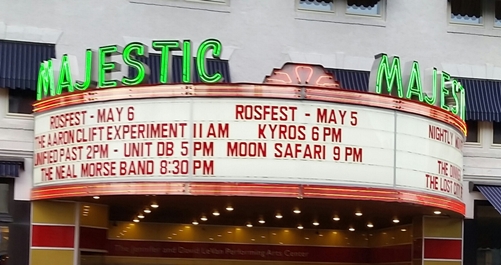
ROSFest Marquee

My thoughts on the bands:

Kyros – I liked them as Synathesia a couple years back and I think they’ve improved with (a little bit of) age. Their sound is heavy without being obnoxious and there’s lots of juicy keyboard work to go around (it’s a great ad for the Korg Kronos). Liked ‘em, bought the new album. Note – this was the first of three keyboardist/frontmen for the weekend – surely a record?

Moon Safari – I like, but don’t love, them (after about 90 minutes things just seem too sweet) but they delivered a good set, as expected based on their last appearance. The newer material didn’t thrill me. I continue to be amazed at their ability to harmonize after two hours.

Aaron Clift Experiment – I thought this was generally good, melodic stuff, although as somebody else pointed out it wasn’t particularly “proggy.” Only a few tunes really connected. I liked the fact that they brought a string quartet (once the sound guy saw they were there). But I disappointed that the keyboard player didn’t do more in a band with his name on it. Second keyboardist/frontman of the festival.

Unified Past –  These guys just didn’t work for me. Heavy prog with metal-style vocals with lots of instrumental pyrotechnics. Ephemeral Sun’s John Battema apparently stepped in at late notice to keep the band from having to cancel, so kudos to him – their material gave him quite a workout! I thought the Christ Squire “tribute” was odd, given that the bass player (with his Rick!) walked off stage for it.

dB Unit – The surprise of the fest for me. As other’s have mentioned, this was basically a few guys from Unitopia augmented by Steve Unruh (on violin, flute, and percussion). I only have one Unitopia album which is all right, so the idea of this collection of musicians didn’t thrill me. But the music was great and nice contrast from the metallic bombast of the rest of the day. Unruh is amazing. If they don’t make an album, I hope we get a recording of this set, at least. Slight demerit for using a bass backing track occasionally.

Neal Morse Band – Although I hadn’t heard much of Neal’s solo stuff going in, I knew what to expect musically from his days with Spock’s Beard, Transatlantic and, now, Flying Colors (whose second album I picked up). Aside from the prog-metal gloss on proceedings, it met expectations. Nothing stuck with me, but it was an enjoyable process as it went through. Neal and his band are all monster players and he’s a great frontman (number 3 in the . . . trinity of keyboard-based frontmen), so it was fun to watch.

The Fierce and the Dead – I suppose they were the “weird” band for the weekend, given the all-instrumental music. A great way to start Sunday. They reminded me of a heavier, more concise Forever Einstein (if that makes any sense). There were a few bits where they spaced out and kind of provided some breathing space. Great rapport with the audience. Pity they’re Arsenal fans!

Evership – This was another pleasant surprise. Young  band (they’ve been an actual band less than a year) cranking out adventurous (in terms of lyrical themes) symphonic prog with a heavy (but not overwhelming) edge. Lots of acoustic guitar work added a nice texture. Plus, they had cool toys on stage – a Theremin! a (pink) double-neck bass! a CP-80! Unfortunately, the lead guitar tone cut through my brain like a laser.

Edensong – Every year I skip out on one band (there’s only so much music a mind can handle) and I knew they’d be the one this year. I wanted to rest up for Anglagard and, having seen Edensong at 3RP long ago, knew their stuff really wasn’t for me. I hung around for a few tunes (all new, I think) and confirmed that thought. Major demerits for using obvious backing tracks (especially considering ACE’s string quartet from the day before).

Anglagard – This was my highest expectation of the weekend and they met it. They were a little looser (improvisational?) than I thought they’d be, but it worked. Loved bathing in the glow of real Melotron strings for the evening!

All in all another pretty good year.

Weekly Read: The Collapsing Empire

I don’t think this is unique to me, but it’s at least unusual that my entry into the realm of John Scalzi fan began not with his books, but with his blog, Whatever. I was a regular reader there for a few years before I started working through his ever expanding bibliography.

What’s more unusual is that, for the most part, I don’t care for Scalzi’s most well developed universe, the Old Man’s War series. I read the first book and liked it well enough, but military sci-fi has never been my favorite corner of the genre. I’m much more into Scalzi’s stand alone work, from The Android’s Dream to Redshirts to Lock In. Which is to say I was stoked when I heard Scalzi was opening up another space opera series.

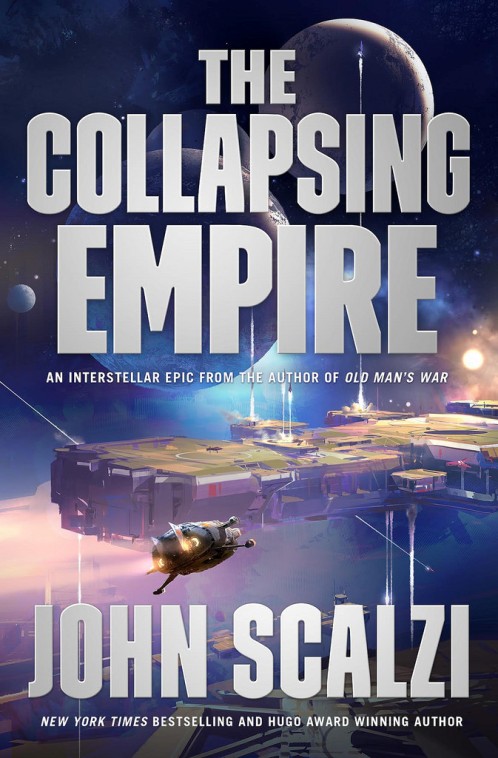
The Collapsing Empire has, at its core (or “Hub,” I suppose) a terrific idea. Humanity is spread across a multitude of worlds (Earth not being one of them, anymore), thanks to a faster-than-light McGuffin called “The Flow.” The Flow works . . . well, nobody is really sure why it works. But it does work, like a hyperspace equivalent of the jet stream or ocean currents, carrying spaceships along at post-light speed and making interstellar travel possible, if a pain in the ass.

Since people can only go where The Flow takes them, there are certain routes of travel. All lead to a planet called Hub, where the titular empire is headquartered. On the other end of the travelled galaxy is End, a sort of Australia (they send the troublemakers there) that, also, happens to be the only place where humans live under the open sky. The problem, as the book begins, is that The Flow is starting to fail. The bigger problem – most of the empire has no idea about it yet.

This is all background, against which a few stories play out. There’s a new emperox (not a typo – it’s a gender neutral imperial title) trying to figure out her new life. End is experiencing one of its periodic rebellions, although this one might actually stick. And someone is trying to inform the powers that be about the problem with the Flow. All of this is interesting, but none of it seems like a fully formed story.

That is The Collapsing Empire’s biggest problem – it’s not a complete story. Even in the context of a series (of which this is the first), it’s not too much to expect an individual volume to actually have some resolution. This doesn’t, really. In the end, it feels more like an extended, epic prologue or a backfill sequel than it does a novel of its own.

Which is a shame, because until you realize that the end is coming and there’s no way things are going to even try to wrap up, The Collapsing Empire is a fun read. Scalzi’s characters are well drawn and interesting. His great creation in this book is Lady Kiva, the “owner’s representative” on a ship that has to deal with The Flow and the rebellion on End.* She’s quick of wit, free with the word “fuck,” and willing to sleep with just about anything that moves. Think of her as Captain Jack Harkness’s long lost more vulgar cousin. The new emperox, Cardenia, isn’t developed quite as well, but her desire not to do the job sets up an interesting story going forward.**

Which brings me back to my complaint – this is all setup. It’s interesting setup. I’m definitely on board for the next book in the series, because I want to see how all this starts to shake out. But I’m left wanting more right now, something a little more solid and whole.

Still, I’m hooked. That counts for something.

* Bonus fun note – the ship names are great. A pair of sister ships are called the Yes Sir, That’s My Baby and No Sir, I Don’t Mean Maybe.

** Bonus fun note – the emperox has access to a “memory room,” in which she can summon the computer-generated simulacrum of any prior emperox. The discussions she has in there are all the better for the simulacra knowing just what they are.

CollapsingEmpire

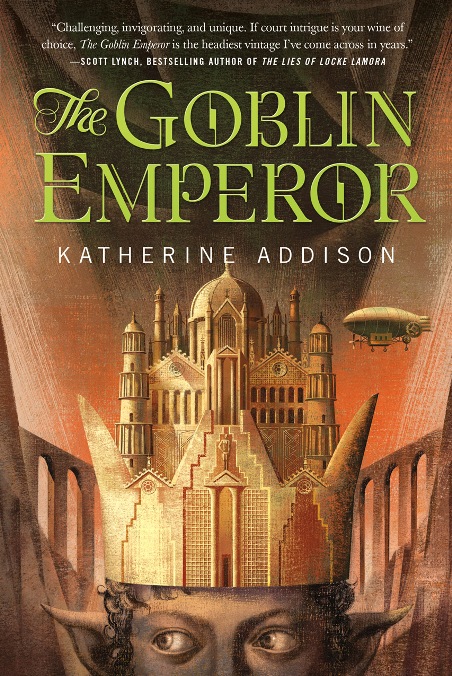
Weekly Read: The Goblin Emperor

I was really excited when I started The Goblin Emperor and found that the titular character was named Maia. After all, we’ve got one of those!

MaiaGoblin2.jpg
We’ve never figured out what the non-Chihuahua part of our Maia is, so I’ve taken to calling her Goblin Dog. Close enough.

The Maia of The Goblin Emperor is not part Chihuahua, but is part Goblin in an empire ruled by Elves. He’s the fifth (I think) son of the emperor, the result of a dalliance with a Goblin princess (who dies while Maia’s young). An assassination via airship crash (the tech level is one of the neat touches of The Goblin Emperor) eliminates not only the emperor but all his other heirs. The empire, thus, is forced to turn its eyes to Maia, who’s been raised in internal exile without any hint that he might one day wield power.

That’s the setup of The Goblin Emperor, but it’s a setup that never really pays off. You see, it’s not quite accurate to just say that the book is Maia’s story – he’s the title character, after all. No, the book is completely Maia’s story because his is the only point of view in the book. This is a serious problem because while some interesting things happen around Maia as emperor and even to him, he, himself, isn’t all that interesting.

As a for instance, the airship bombing that sets off the plot is investigated throughout the book and is resolved in the end. Rather than being on the ground with the person doing the investigating (an interesting character in his own right), we get the answers in a letter he writes to Maia explaining his findings. In other words, we aren’t shown the investigation – and all the interesting world building info that comes with it – we’re told about it. For a book with an assassination, a coup attempt, and a second attempted at regicide, it’s surprising dull.

That’s because the book is mostly about Maia easing into his role as emperor. What sets Maia apart from the traditional fantasy emperor is that he’s fundamentally a good guy and is trying to do the right thing, often in the face of traditional resistance (one review called him “one of the most lovable characters we’ve met in ages”). He treats his servants well (actually caring about their well being is a radical act) and he seems particularly tuned in to the desire of women to be something other than marriage fodder and breeding stock.

Having said that, Maia’s good nature is never given any real scope. Only near the end of the book does he finally realize that, as the emperor, he can do just about anything he fucking wants. He never tries to jump start any societal reform or really change things, even in light of the anti-tradition philosophy that powered the assassination. So, yes, Maia is good, but not very ambitious. Not for nothing but the major project he oversees during the book is the plan to build a bridge – not actually build it, mind you, just approve of its building.

The general lack of “oomph” in the story is a shame, because the world of The Goblin Emperor is interesting. For one thing it lacks humans, which is not very common in fantasy (I should know). For another while there are magical things that happen (the investigator of the airship explosion talks to the dead, in some fashion or another), there’s no capital M “Magic” involved (if you know what I mean). Finally, the folkways of the court that Maia has to navigate are interesting in their own right, they just don’t support much of an actual story. The writing is very lovely in spots, too.

Wikipedia slots this book under the heading of “fantasy of manners,” which I’m lead to believe is kind of like a “comedy of manners” but not necessarily with the comedy. I can see that. Such things are good background details for me, but ultimately I need more for a completely satisfying read. If you’re less in need of a driving plot, though, you’ll probably enjoy The Goblin Emperor much more than I did.

goblinemp_rev_comp_sm

Weekly Read: The Speed of Sound

Reviewing memoirs is a tricky thing. Essentially, it breaks down into answering three questions – Is the story of this person’s life interesting and worth reading about? Is the story told in such a way that elevates things beyond a simple “this is what happened” narrative? Does it say something profound about the world?

Thomas Dolby has the first part covered. If you only know him as the “She Blinded Me With Science Guy,” then his memoir The Speed of Sound: Breaking the Barriers Between Music and Technology will be a revelation. Only half the book is taken up with his music career. The other half deals with his second life as a Silicon Valley tech entrepreneur, a career that is probably reaching into the smart phone you’re using to read this.

Dolby’s music career is, in itself, pretty interesting as a cautionary tale of just how fickle the business is. Dolby found his first synth in the trash after being fired from his job at a produce shop. Via tinkering and experimentation he mastered the still relatively new tool and wound working with a lot of other people, either in their band or as a hired gun in the studio (the synths on Foreigner 4? All Dolby). Finally he was able to record his first album, The Golden Age of Wireless, which wasn’t doing much of anything until “She Blinded Me With Science” (not on the album itself, originally) broke big in the United States, thanks largely to MTV.

Wireless is now regarded as a classic and Dolby would spend the rest of the 1980s trying to replicate its success. That he didn’t owes less to the quality of music he was making than it does to commercial factors that were well beyond his control. The Flat Earth (which is brilliant), for example, tanked commercially largely due to the fact that his record label fired its main promo person (resulting in non-cooperation from his former contacts in the media) and picked a losing fight with MTV. Unable to back up the commercial success of Wireless, Dolby’s other albums sank like stones.

Which isn’t to say he got some interesting stories out of it. If nothing else, he wound up working with and rubbing elbows with lots of stars. There are anecdotes about David Bowie’s fear of flying (Dolby played with him at Live Aid), Michael Jackson’s nerdy interest in cutting edge music gear (Dolby’s “Hyperactive” was written for Jackson), and Eddie Van Halen’s (who played on Dolby’s album Astronauts and Heretics) lack of amusement about This Is Spinal Tap – because Van Halen thought it was about them! It’s all interesting, and fun, but it’s not very deep or dramatic. As I said, the downward slide of Dolby’s music career was due largely to factors outside of his control and since he was always a solo artist there aren’t any nasty inter-band dynamics to spice things up.

After four albums and lots of other session work, Dolby left the music business, but he didn’t leave the business of music. Always the tech head, Dolby was interested early on in making music a big part of the Internet experience (he refers to it as “sonicizing” the Web). He started a company that eventually became Beatnik. You probably don’t know it, but you likely use its tech every time your mobile phone rings (Dolby even had a role in selecting the ubiquitous “Nokia waltz”). The business world didn’t really suit Dolby, either (some of the ups and downs, caused by outside forces, echo what happened in his music career), so he eventually cashed out, returned with his family to the UK, and started making music again.

One of the disappointments with the book is the short shrift given to this last part of his career (that he’s turned yet another new page, teaching at Johns Hopkins University in Baltimore, is barely mentioned). In particular, I wanted to know something about the tour, the tech, and the conception of the tour that gave us The Sole Inhabitant, which is my favorite version of Dolby’s music. That’s par for the course, as the thing I wanted more of throughout was the nitty gritty of the music (I have the similar gripe about most music books or documentaries). We get a few tales of where songs came from (the genesis of “Wreck of the Fairchild” is particularly good), but little of the actual work of building up songs. Given Dolby’s nature as a tinkerer, rather than muse-inspired mouthpiece, I’d be interested in his process.

So, Dolby’s story is interesting, but that’s about all The Speed of Sound has going for it. The writing’s fine and pleasant, but nothing special. Dolby occasionally tells an anecdote that’s completely of its time, without meaningfully reflecting on it in any way (the Michael Jackson story ends with the appearance of neighborhood kids in their PJs, for example – this passes without comment). Likewise there’s nothing terribly profound in Dolby’s story. It’s a nice story about a guy who made a good life largely doing what he loves to do, which is mess around with music and tech stuff.  Good for him, certainly, but it doesn’t make for the meatiest of reads.

The bottom line is this – if you’re a fan of Dolby, or even just wonder what he’s been up to since he hit the “Where Are They Now?” file, The Speed of Sound is highly recommended. Otherwise, your time might be better spent elsewhere.

speedofsound

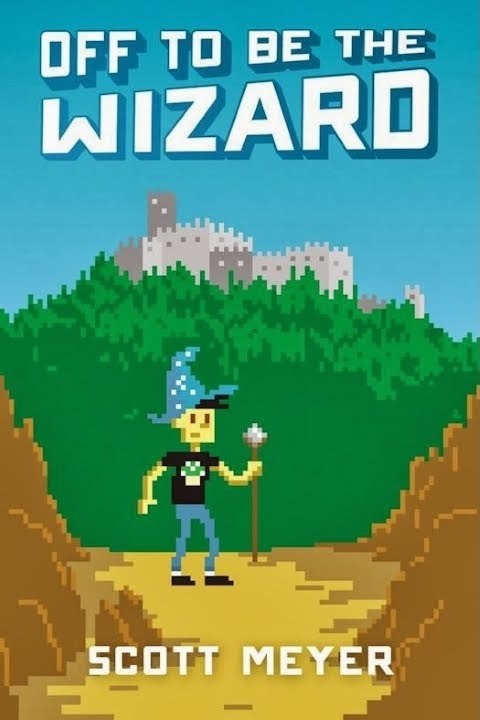
Weekly Read: Off to Be the Wizard

Off to Be the Wizard is a funny book. Very funny in some spots. It’s humor and general breeziness make it a quick read, but its charm can only carry it so far.

Martin is a computer geek. One night he discovers (on just about the very first page of the book – it works better than I expected) a text file, plays around with it, and discovers that chestnut sci-fi trope: that our world is really just a computer simulation, with parameters that can be endlessly modified. In short order he’s essentially practicing magic by summoning sums of money from thin air, teleporting, and travelling through time. It’s the first of those that gets him in trouble (damned Treasury agents) and cause him to flee not just to another place, but another time – medieval England.

At this point, I expected the story to turn into something like Doomsday Book, but with jokes, where Martin has to use his wits and “wizardry” to survive. Instead, Martin falls into a community of similar time travelers and spends most of the book interacting only with them. Aside from a few mentions here and there, the same story could have been told in the Old West, feudal Japan, or the prehistoric African plains. It’s a huge wasted opportunity and hints one of my main problems with the book.

That is, things are much too easy for Martin and his friends. Not only are they not subject to the vagaries of medieval life (aside from a wonderful running joke about stew), there isn’t even any real conflict happening until, about 3/4 of the way through the book, the author realizes there has to be. The resulting ending, with a big bad that comes out of nowhere and has a temporary menace that the rest of the book doesn’t justify, is too quick and perfunctory to mean much.

What that leaves is a bunch of Martin, mostly in the company of his older (and more interesting) mentor Phillip, learning how all the wizarding works. This provides some good chances for comedy, but the need to build up Martin’s need to pass “the trials” is undercut by there not actually being any. Aside from one run in with bullies, at no point does anything that might hint at a book-defining conflict pop up.

Along the way, anything that might complicate the wizards’ fairly easy life (typical time travel issues like changing the past/future, the ability to power computers in medieval England, etc.) get hand waved away. On the one hand, I like that – it’s a funny book, not a deeply thought out treatise on the potential hazards and difficulties of time travel. But still, having everything work out so easily almost renders the time travel pointless. No surprise, then, that Martin is never seriously pulled by a desire to return to his own time (to be fair, he’s never given a reason to be pulled).

That also keeps Martin from really interacting with the world he’s time travelled himself into. This is a particularly glaring missed opportunity because it really emphasizes the absence of women from the book. Martin’s mother gets a mention or two and there’s a crazy old woman with goat problems, but otherwise the only woman around is Gwen. She goes from a complete blank of a character (main defining feature – all the wizards want to do her) to,  magically, a big player when the plot finally cranks up. There’s no ground work laid for this and it comes completely out of the blue (deus ex vagina, perhaps?).

There are other women who have found the file and travelled back to this time, but they’ve all headed off to Atlantis, conveniently off screen (to be fair, the second book in the series goes there, so I’ve read). But that doesn’t explain why, in the day to day of living, Martin and his pals are able to avoid any contact with the opposite sex. It’s the kind of blind spot you’d expect in some of the foundational fantasy literature the book gently satirizes, but not something written in the second decade of the 21st Century.

That all sounds harsh, and maybe it is. But, like I said, being funny can take a book a long way and Off to Be the Wizard is funny. And in Philip, the wizard from a slightly older time who finds himself out of step with the more currently pop culturally savvy wizards (he knows not of The Simpsons, for instance), it has a really interesting, greatly drawn characters. Except for one thing – when, late in the book, he’s able to crank Genesis on his car stereo (yes, in medieval England – you’ll have to read the book), it’s completely out of character that it’s something from the poppy Phil Collins era (“That’s All,” to be specific – there’s a hilarious discussion of the video). I mean, come on! Surely “Watcher of the Skies” or the end of “Supper’s Ready” would have been more appropriate!

As I was saying – a fun book, a quick read with lots of laughs. However, its flaws stand out enough that I’m not interested in heading further into the series.

wizard

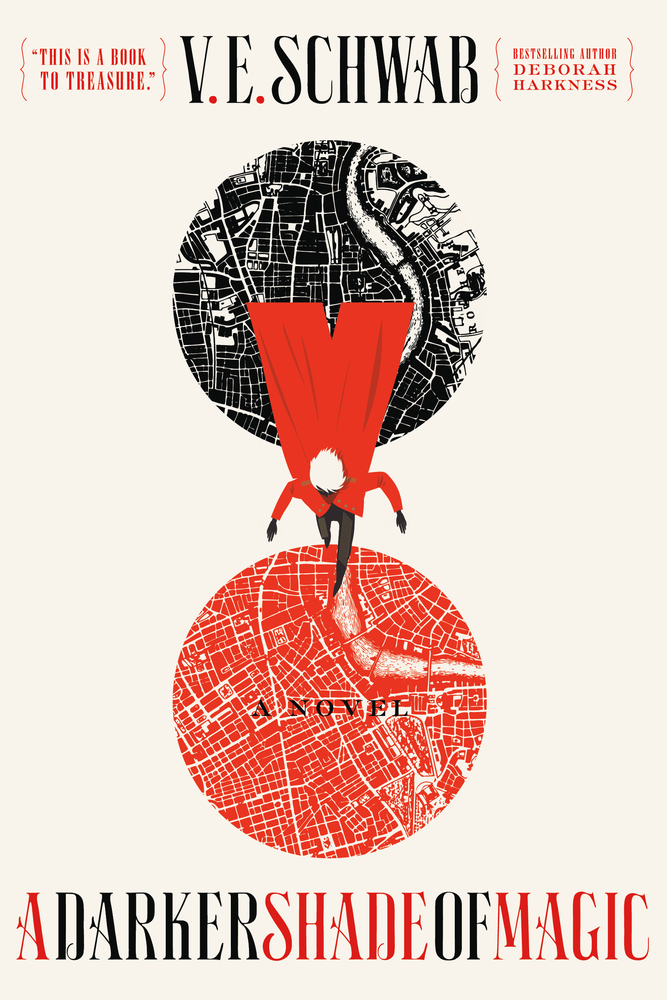
Weekly Read: A Darker Shade of Magic

According to Wikipedia there are over a dozen places (worth of note) across the globe called “London,” from Ontario to West Virginia to California to Kiribati, not to mention the big one in England. In spite of whatever differences those places have, they all share the fact that they are part of our world and bound by the laws of physics.

The Londons of A Darker Shade of Magic, not so much. They’re all in the same place as London, England, but all they really share in common is the name. Grey London (which is ours, I’m pretty sure) is dreary and dull, when it comes to magic. By contrast, magic thrives in Red London and is an important part of life there. It’s more of a power struggle in brutal White London. What magic did to Black London is, well, pretty awful.

A Darker Shade of Magic is the story of Kell, one of the few people with the ability to move back and forth between the various Londons. He serves as a courier, technically working for the king in Red London, but taking messages both ways. He also has a side gig, smuggling small objections from one London to the other. It’s in that capacity that he gets into trouble (isn’t that always the case?) and, in the process, threatens the safety of Red London and all those he cares about. Along the way he acquires a sidekick in Lilah, a pickpocket from Grey London with big dreams (she wants to be a pirate) and, we’re lead to believe, a bit of a secret when it comes to magic.

There are other characters, too, wonderfully drawn and (in some cases) downright frightening. Their interaction is the best thing about A Darker Shade of Magic, whether it’s slowly growing admiration of Lilah’s abilities by Kell, the attempts of Kell’s semi-brother Rhy to hit on her, or the way the king and queen of White London completely control a room (and a kingdom). It helps that the book takes the time to build these worlds up (the first third is, essentially, a travelogue as Kell moves from one London to the other) so that the characters seem like natural expressions of those places.

In fact, the scene setting is more interesting than the real plot, when it finally gets to it. Part of the issue is that there are dual threats that seem like they might be linked, but we never really find out if they are. They create a lot of havoc for our heroes, but it’s unclear to just what end. One thing I will note, however, is that while this is the first book of a series, it does tell a complete story, while managing to leave enough dangling to make you want to read more.

Where things go wonky is where magic plays a key role in the plot. That’s because the magic of A Darker Shade of Magic tends to morph to fit the needs of the plot. We’re initially told that what makes Kell (and his White London counterpart, Holland) special is that they alone can travel between the Londons, an increasingly rare skill. But by the end of the book Lilah and others are doing it, too, with no particularly good explanation. Also, at a critical moment near the climax of the book, game winning magic essentially becomes a Peter Pan “wish hard and it works” exercise. It’s kind of disappointing that for a story where magic is talked about so much and plays such a key role in things that it’s nature, scope, and impact doesn’t seem well thought out.

As big of a hole as that sounds for a book with the word “magic” in the title, it’s really not. The end destination may not live up to the hype, the journey is well worth it. As I said, this book tells a complete story and I could walk away from the series, satisfied, if a little disappointed. I’m not. Which should tell you something.

darkermagic

Weekly Read: The Liberation

It’s a good rule of thumb, although not an iron clad law, that the second part of a trilogy is never as good as the first part (Godfather Part Two, The Empire Strikes Back, and The Endless Hills are exceptions to the rule, of course). It’s hard to match the excitement of discovery you get from the first installment’s introduction of the characters and the world their moving around in. In addition, the second part is usually a bridge between the introduction and the climax. It’s a natural area for a bit of a letdown. The real issue is, how does the final installment stack up?

When I reviewed the first two parts of Ian Tregillis’s The Alchemy Wars last year, I noted that they followed the pattern. The Mechanical introduced us to a really cool world, a handful of interesting characters, and some big overarching questions about such minor things as free will and the nature of sentience. The Rising didn’t quite live up to that promise, focusing on some rousing action and pushing some of the more philosophical stuff to the side. Also, there was a whole section in the middle of the book that didn’t really seem to matter that much.

Well, remember what I said about middles and all that? Tregillis finishes up the trilogy with The Liberation, a rousing conclusion that, if anything, comes along just a little too quickly.

At the beginning of The Liberation, the Dutch Empire that has essentially conquered the world with its magically powered “clakkers” (clockwork people) has, to be kind, been put on its back foot. It’s not giving things away to say that The Liberation is about an oppressed people in revolt. What’s interesting is that it doesn’t present a simple good-guys-throw-off-their-yokes narrative. There are factions amongst the clakkers, deep philosophical divisions of the type that you’d find in most human uprisings. After spending most of The Rising in North America, the primary focus of The Liberation is the European mainland, particularly The Hague.

Having said that, there’s a key part of the story that plays out in North America (around the non-clakker enclave of New France). The stories in the New World and Old World play out in parallel, until, about two-thirds of the way in, we learn that one preceded the other. It’s a neat trick on Tregillis’s part, some temporal sleight of hand that allows the two stories to develop well on their own before the reader needs to know how they’re related.

It’s a bit of a shame, then, that when the end comes it comes very quickly. Not out of nowhere – the pieces are all moved into place quite well – but it doesn’t quite seem up to the task. I’m hesitant to complain because Tregillis has given us an ending, one that – just like the real world – wraps up most loose ends, but allows some questions to linger that will have to be answered in the future. It’s a fitting cap to an inventive and immersive read.

As far as I know, Tregillis doesn’t have any future plans for this universe. I hope I’m wrong, because I’d be really interested to see what’s happening in a generation or two.

tregillis_liberation-tp1

Weekly Read: Dreamland and Chasing the Scream

I read these two books back to back because they seemed to go together. One is a sober telling of how an epidemic swept the nation, landing right in my back yard (the book itself swept through my office earlier this year). The other is a passionate call to arms about the War on (Other Peoples’) Drugs. Both are essential reading.

The Dreamland in Dreamland, by former crime reporter Sam Quinones, is a public pool in Portsmouth, Ohio. For decades it was a hub of life in the town, ever expanding. It’s decline was tied to the region’s decline as a manufacturing hub. As jobs went away and poverty grew, addiction to powerful new opioid painkillers, and then heroin, ravaged the region. Dreamland was the perfect metaphor, withering away to merely a memory.

In Dreamland the book, Quinones lays out the perfect storm of factors that led to the opioid epidemic, which continues to claim lives all over the industrial Midwest and Appalachia. It’s made of three strands. The first is a revolution in the medical conception of pain, especially long term, chronic pain, and that it could and should be treated with powerful drugs. The second is the search for a safe drug to meet that need, which eventually led to Oxycontin. The third is slow expansion of a particular kind of heroin distribution operation from a particular small town in Mexico, Xalisco. As the “Xalisco Boys” operation spread into regions not generally thought of as “heroin country” (like West Virginia), they found a fertile ground of addicts already hooked on Oxycontin and looking for a cheaper, better fix.

Each strand has some particularly interesting stories to tell, although they’re not all of equal interest. The retail heroin distribution of the Xalisco Boys is, in fact, quite interesting – unlike the violent drug gangs who sell stepped-on product as a means to enhance the bottom line, the Xalisco Boys competed simply by selling a better product for less money. No violence and a focus on customer service. It makes getting heroin like ordering a pizza – an analogy to which Quinones returns over and over again. That’s the book’s main failing – it treads over the same ground repeatedly, particularly when it comes to the Xalisco Boys.

The other two strands weave together more effortlessly, particularly since they share a common root. In the 1980s a doctor published a “report” – really just a one-paragraph letter to the editor of a medical journal – that his practice hadn’t shown that patient who received powerful pain killers became addicted to them. This became the basis for Oxycontin advertising that opioid medications weren’t addictive, which recent history has shown to be completely false.* In the post-truth era of President Trump and “fake news,” it says something that the basis for Oxycontin’s development and sales was so poorly vetted because there was no profit to be gained in confirming it (because there never was in debunking it).

That’s one interesting linkage between the sellers of Oxycontin and the Xalisco Boys that Quinones hints at, but doesn’t quite make. Both are driven in what they do by the most basic of motives in a capitalist society – not just to make a profit, but to make as much of it as possible. That’s what drove the Xalisco Boys to look for untapped heroin markets. That’s what drove the Oxycontin peddlers to skip past the possibility of addiction and push doctors to prescribe the pills for damned near everything. The bottom line can be damned scary thing.

Dreamland is far from perfect. As stated above, it’s redundant, even beyond the stories of the Xalisco Boys. It’s also pretty dry writing, although it gets the point across. More important, Quinones gives short shrift to the fact that Oxycontin and other powerful pain killers are, for some patients, their only means of dealing with their pain. It also falls into a familiar pattern – of drug dealing bad guys (of various kinds) and good guy cops fighting to stop them – without providing any insight as to whether that’s a battle worth fighting.

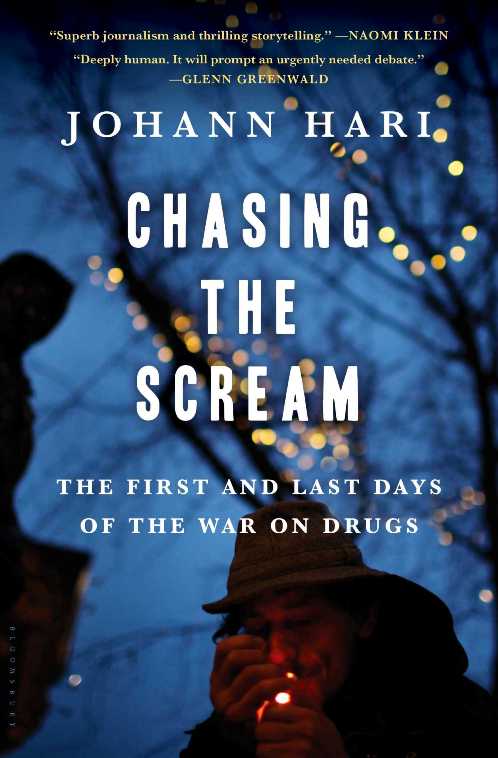
Where Dreamland is a sober telling of an important modern story, Chasing the Scream is a polemic, a call to wake up to the failure of the War on (Some Peoples’) Drugs after more than a century. Dreamland should depress you – Chasing the Scream should piss you off.

Chasing the Scream is journalist Johann Hari’s chronicle of his attempt to figure out how the drug war began and where it’s headed. He travels the world, from his native UK to North America and elsewhere seeking answers about policy, addiction, and alternatives to prohibition. If in the end he doesn’t come up with a singular policy proposal to end the drug war, Hari at least convinces that it’s a war that needs to end (full disclosure – 15+ years of criminal defense practice convinced me of this long ago).

One thing he collects along the way are a cast of rich, memorable characters, from the transgendered former dealer in New York City and the former addict who transformed a particularly seedy portion of Vancouver to an addict who died in prison, cooked alive in the Arizona sun, and a mother whose pursuit of justice for her daughter in Mexico just produced further violence. Most key to the Hari’s book, however, is Harry Anslinger.

Anslinger was the head of the Federal Bureau of Narcotics (the spiritual predecessor to the modern Drug Enforcement Agency) for more than three decades and was, to Hari’s telling, the paradigmatic drug prohibition enforcer. He saw addicts as less than human, used racial and ethnic hatred to stir up panics to grow the power of his office, and was an overall asshole (the “scream” of the title refers to a trauma of Anslinger’s early childhood). Along with jazz great Billie Holiday (one of Anslinger’s high profile targets) and gangster Arnold Rothstein (the prototypical violent drug lord), Anslinger’s ghost hovers over the entire book as the project he started, the War on (Other Peoples’) Drugs expands and is entrenched.

Anslinger is Hari’s antagonist and he spends most of the book looking at the impact of his drug war on those caught up in it and challenging the assumptions underlying it. Of particular importance, he emphasizes the psychological model of addiction over the pharmaceutical model, presenting evidence that most drug users consume their product of choice without much problem, like most people drink alcohol without becoming alcoholics. Along the way he suggests that the scientific literature is clear about the limited addictive power of opioid pain killers, for instance, a claim that Quinones severely undermines.

Compelling as the stories of those caught up in the drug war are, the more interesting bits of Hari’s book are his examination of questions of drug use more generally, and addiction in particular, that shows the entire is more nuanced that Anslinger-style prohibitionists allow. For example, he discusses studies of drug use by non-humans, which is apparently fairly common. Elephants in Vietnam, for instance, generally steered clear of poppy fields until the United States bombing campaign drove them to seek escape from their terror.

It also allows Hari to get into various experiments with alternatives to strict drug prohibition. That includes programs in the UK and elsewhere that allowed addicts to get drugs legally, via prescriptions doled out by a state monopoly. Far from turning into drug fueled free for alls, this allowed addicts to function in everyday society and didn’t lead to more drug use. It also cut off a powerful marketing tool for drug dealers, as the addicts are their best customers. It’s no coincidence that part of the Xalisco Boys scheme that Quinones documents is how they used addicts in a new market to help them advertise and otherwise find customers.

Hari also explores broader legalization and decriminalization programs, such as those in Uruguay and Portugal. Though showing their success, Hari doesn’t dive deeply enough into the Portugal experiment, in particular, for it’s unclear how the law squares legal use and possession of drugs with criminal distribution – the drugs being used have to come from somewhere, after all. More interesting is his examination of the different arguments used by the people backing marijuana legalization in Washington and Colorado in the past few years. The disconnect (WA – drug prohibition is worse that pot being legal, even if it’s bad; CO – pot isn’t bad at all, being less harmful than alcohol) shows that even folks who see the end of the drug war in sight don’t necessarily agree on how to get to that point.

In the end, Hari doubles back to Anslinger for a stinger that brings the rot at the core of the drug war home. The stinger is – Anslinger himself was a drug dealer. He provided for a sitting United State Representative who was an addict to get a safe supply of heroin at a pharmacy (paid for by Anslinger’s agency, no less). The final irony? It was Joseph McCarthy, infamous red scare scam artist. It’s the ultimate example of the hypocrisy that leads me to call the drug war the “War on (Other Peoples’) Drugs,” because it’s rarely about the powerful and connected that are targeted, but the outcast and the hopeless. The war on drugs, ultimately, is a war on them.

Chasing the Scream, as I said, is a call to arms. Unfortunately, Hari may not be the best person to lead the charge, given his prior history with plagiarism and Wikipedia sock puppet scandals. It gives people an instant reason to disagree with anything he says, from snarky internet commenters to book critics (but see, as we lawyers say).

Dreamland is a flawed book, but essential to understanding one of modern American’s great tragedies. Chasing the Scream is the polemic of a flawed messenger about one of mankind’s great modern mistakes. Both are necessary and highly recommended.

dreamland

drugs0118

* UPDATE: This article from Slate goes into more detail on the one-paragraph phenomenon and how it’s not an uncommon occurrence in scientific journals.
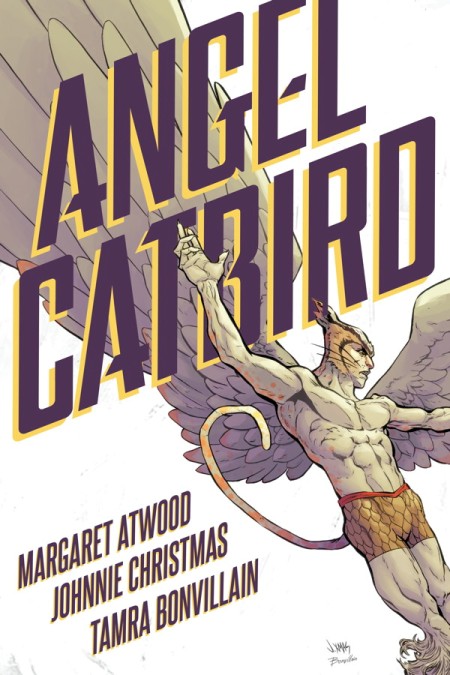
Weekly Read: Angel Catbird (Volume 1)

Not long ago, when reviewing Margaret Atwood’s The Heart Goes Last, I wrote:

all that makes The Heart Goes Last frustrating and I certainly wouldn’t suggest it as a starting point for someone who’s never read Atwood before. But she’s too talented a writer to not score some points along the way, so I’d definitely say it’s worth it (it’s pretty brief, all things considered). Nobody succeeds every time, but few of us are lucky enough to stumble as interestingly as Atwood.

I’ve now been proven wrong. Angel Catbird, Atwood’s attempt at a graphic novel/comic book, isn’t an interesting stumble. It’s an ill-conceived mess.

In a lengthy introduction, Atwood addresses the question that must have come to most minds when this project was announced – why was a serious novelist (or a “nice literary old lady who should be resting on her laurels in her rocking chair, being dignified and iconic,” as she slyly describes herself) writing a comic book? There’s a pretty good reason, as it turns out. Atwood grew up reading comics and loved them. She even wrote a few in college. If becoming one of the most celebrated writers in the world doesn’t give you the freedom to indulge in a project just because, then what’s the point?

Unfortunately, that introduction (which also includes how Atwood found her collaborators and how they worked on the project) is by far the most interesting part of the book.

The story is pure comic book pulp, but done without any verve or irony. It tells how Strig Feleedus becomes, via a freak scientific accident that doesn’t make any sense (par for the course for superheroes, I guess), the titular hero, a man capable of transforming into a half cat half bird being. He learns the world is actually full of “half-animals,” men and women who can shift into cats, rats, or any number of other critters. There’s a straight from central casting villain, a love interest, and an internal conflict for our hero (his cat part wants to eat birds, his bird part doesn’t).

The attempts to mine this for humor only work a couple of times and the whole thing is too damned silly to take seriously. The pacing is so rushed (the actual comic only takes up not much more than half of this volume) that everything is just surface, with no hint of anything interesting lurking under the surface. Compounding the simplicity are the infographics that pop up on the bottom of every few pages providing interesting facts about feline well being. Working them into the story itself would have been fine (some are kind of relevant), but as is they stick out like a sore, lecturing thumb. On top of all that, the artwork, while fine, doesn’t do anything to distinguish itself. Saga this ain’t.

In the end, the reason for Angel Catbird’s failure is right there in that introduction. Comics and graphic novels have come a long way since Atwood’s youth, but Angel Catbird seems like a throwback to simpler times and simpler stories. It just can’t live up to the modern genre it wants to be a part of.

angelcatbird

Weekly Read: The Name of the Wind

Every book has highs and lows, pros and cons that lodge in your brain as you try and come to terms with it. Rarely do the two things break down as starkly for me as they did when I finished up Patrick Rothfuss’s The Name of the Wind.

First of the Kingkiller Chronicle, it’s the first day (of three – it’s a trilogy, you see) of Kvothe telling his life story. Including, presumably, how he turns into a killer of kings. Thus, the book isn’t just a story in itself, it’s a story of a story being told, which opens up a lot of interesting avenues for writing. There are also odd things happening in the “present” as the story is told (how’s about spider demons the size of wagon wheels!). In spite of all that, my thoughts are kind of black and white as to its flaws and strengths.

On the one hand, it’s really well written. I mean in the actually putting words on the page in a right order kind of way. Rothfuss’s prose is breezy and quick, but he slips in a lot of clever bits for the reader to catch (my favorite is the comparison of who lives in the high-dollar and low-dollar sections of the city of Tarbean). In other words, it makes for entertaining reading. In addition, Rothfuss takes an interesting approach to world building, avoiding large dumps of background info that the characters already know just to inform the reader about things. While this leaves some gaps in our understanding (These folks know about germ theory? How?), it allows Rothfuss to casually slip in details that don’t seem important to things but that show their relevance later on. See, for example, the whole issue of “dragons” and their dangerousness.

On the other hand, for a book that’s several hundred pages long (and more than a full day in Audible time) precious little of substance actually happens. In fact, main character and narrator Kvothe admits near the end that all that came before was “foundation” for the interesting stuff to come later (did I mention that the trilogy is, as yet, unfinished?). Naturally, that means there’s nothing like a self-contained narrative arc for this book, which is frustrating. In addition, along the way we’re treated to tale after tale of the hyper-competent Kvothe, the teenager (he’s only 16 when this book ends) who knows every useful skill under the sun and is never bested in any kind of competitive environment. To be fair, he suffers negative consequences as a result of all his success, but, still, a main character who always wins a series of largely meaningless things isn’t all that compelling.

What’s amazing is that, for those pretty substantial cons, The Name of the Wind was still an engaging read. I really enjoyed it. I didn’t mind that things had moved along so little by the end, although I was frustrated by the “and here’s the end” resolution (a final scene between Kvothe’s student and the person recording the tale helps a lot). It makes me hesitant to press on with the series (particularly given this review of book two), but only because I’m not certain Rothfuss can sustain the trick. Eventually all the spinning plates have to come down, either in a crashing cacophony or a controlled descent – whether that happens with Kvothe and his tale, we’ll have to wait and see. At the very least, I’ll wait until the third book comes out (I know – glass houses and all that).

The Name of the Wind seems to be a book that most people either love or hate, given the vacillating 5 and 1-star ratings at Goodreads. I can understand that. A lot of what the 1-star folks complain about I agree with, I just don’t think it overrides the good stuff. Highly recommended from me, even if with a bit of an asterisk.

POSTSCRIPT: Over dinner I came up with a good comparison for how I think of The Name of the Wind – like it was a concept album (Kvothe is a musician – he’d dig it). Something where the story doesn’t really hold together but the music’s so good you don’t care. So, maybe it’s like The Lamb? Or Subterranea? Either way, not bad company.

nameofthewind