Weekly Read: Blue In Green

I have a weird relationship with jazz, in that I can appreciate it a lot more than I can love it. I can easily wrap my head around the awesome amount of talent it takes to improvise with any kind of skill, yet I mostly find myself left cold by a lot of that improvisation, too. It’s not just a jazz thing – a lot more of King Crimson’s improvs leave me wanting than strike me in any particular way, too.

I say all that because Blue In Green is very much “jazz” on the page, as much as any graphic novel can be. As it turns out, that’s not a happy coincidence. As this interview with writer Ram V and artist Anand RK explains, this book gave new meaning to the term “pantsing,” as Ram says:

It was literally us getting together each morning, going, “Okay, this is the previous page. I have looked at it. And now I think this is what the next page needs to be.” So every ensuing page is in reaction to whatever he drew on the previous page.

Later, Ram V makes clear that this was a one pass thing:

No, no, there was no going back to pages, because I mean, you can’t go back when you’re improvising in music either. So if you’re playing and you hit a sequence of notes, that’s it, it’s there and you can’t go back.

One the one hand, this is profoundly cool and a brave way to create a graphic novel. On the other hand, I think within that lies the reason I didn’t like it very much.

The story is of Erik, a sax player who has been relegated to teaching kids who want to know if they’ll be able to figure out when they’re great (it’s a fantastic opening scene). When he finds out his mother has died, Erik goes home for the funeral (although where home is happens to be . . . an issue). There he winds up getting sucked into a mystery about a strange, long dead player and how he relates to Erik’s late mother. Along the way, we get a fairly standard riff on the idea that to be great an artist has to sacrifice himself to some higher power, deal with the devil, etc. It ends fairly bluntly, but it’s earned, to be fair.

The best part of the book is the artwork. It’s very impressionistic and flows through different styles lyrically. That said, sometimes the art is a little too abstract and it becomes hard to figure out just who is doing what to whom at critical moments. Still, you could get a lot of enjoyment out of the book just by flipping through it and soaking in the images.

The writing is a different story. My previous experience with Ram was These Savage Shores, which used a lot of letters and journal entries to push things along. Here, almost everything is conveyed through Erik’s monologues and there is precious little dialog. It’s like a film where nobody talks to each other and  it’s all voice over. Eventually, it just got to be too much for me. It didn’t help that the monologue was overwritten in places.

I mentioned where Erik’s mother lived and this is where I think the whole improvisation thing caught up with Ram and his collaborators. I’m pretty sure Erik lives in New York City. When he goes to his mother’s funeral he gets on a plane (where he ponders the meaning of death), so she must live somewhere else, right? But the rest of the story takes place in NYC and Erik goes back to the house multiple times. On the one hand it’s not very important, but on the other it really niggled the back of my mind.

I’ve read a lot of praise for Blue In Green and I wouldn’t be surprised to see it on “best of” lists as the year draws to a close. It makes me think of Kind of Blue, the Mile Davis album (“Blue In Green” is one of the tracks on that album) that’s generally regarded as the best jazz album ever. You know what? It does nothing for me. It’s all laid back and cool and whatever, but it leaves me cold. It’s just not my thing. Seems like Blue In Green is in the same boat.

The Correct Answer Is Always “It Depends”

Law school is all about answering questions – usually when randomly questioned by a professor in front of the entire class. It can be intimidating, to say the least. So, imagine my relief/horror when one of my first-year professors explained that the correct answer to any legal question is “it depends.”

That’s not a cop out, at least for actual live legal issues (dumb stuff like this, not so much), since they turn on factual details unique to particular cases and the application of established law that is almost, but not quite, determinative. Angels may dance on the head of a pin, but lawyers play the tune.

Turns out that writing fantasy is a lot like that.

I’ve been thinking of “it depends” a lot in the discussions I see on one of the fantasy writers groups I’m on at Facebook. It’s a very helpful group of people, tightly moderated to keep it from being flooded with “buy my book!” posts. Generally, people ask good questions about writing problems, publishing options, and that kind of thing.

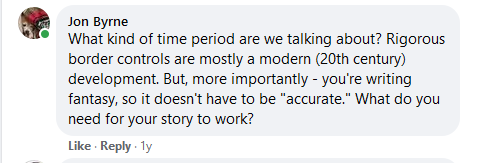
Lately, however, there’s been a few questions that have really rubbed me the wrong way. Not because they’re bad questions in general, but they’re odd questions to ask when you’re writing fantasy. Here’s an example:

Now, I’ve written before about research in fantasy and how helpful it can be and wondering about how border controls have worked through history is right in line with that advice. History is stranger than you might imagine and can provide great fodder for world building. The problem I have is the word “accurate.” After all, what does “accurate” mean when you’re writing fantasy? Not much. Hence, my bottom line advice:

Similarly, someone asked a question about a fundamental background piece of their world:

And, likewise, my answer:

But the one that really got me, and made me want to throw things across the room, was this one:

I didn’t answer this one, as I feared I’d be entirely too snarky. The question is just . . . odd. “Immortals” are not real. Everyone, and everything, dies. The only limit on an immortal character in a story – a classic trope for a reason – is (to quote Frank Zappa) “the imagination of the imaginer.” What possible answer could there be to a question like “can immortals have children?” Why the fuck not? Or, if you want it to be so, why not that instead?

All of this is to say that the great thing about fantasy – what really distinguishes it from its cousin science fiction – is that there are literally no limits. Whatever universe you build should make sense internally and not seem like a giant game of world building Calvinball (unless that’s the point!), but outside of that, go nuts! You don’t need for it to follow the real world or be a logical extrapolation of reality. That’s the entire point and joy of writing fantasy – the rules are yours to make.

So, next time someone asks whether they can do something particular in their fantasy story, remember there are no “yes” or “no” answers – as with the law, the right answer is always “it depends.”

Weekly Read: The Humans

The beginning of Matt Haig’s The Humans is great. After a quick intro that implies the following narrative will tell a tale of a mission gone wrong, we’re thrown into the main character’s point of view as he arrives on Earth. An alien, he takes over the body of an Oxford scientist who’s just made a breakthrough humanity hasn’t earned. It’s the alien’s job to squelch all knowledge of the breakthrough, by any means necessary.

That could be the setup for a very heavy book, but instead Haig plays it mostly light, invoking the vibe of Douglas Adams. The alien spends quite a while learning about life on Earth and, in the process, giving Haig the chance to point out all the weirdness of modern human life, from coffee to soccer to TV news (which the alien observes should be rechristened “The War and Money Show”). This portion of the book is generally funny (in a “because it’s true” way) and a quick, breezy read.

It’s once the alien has learned about the world a bit where things go downhill. Not far, and not very fast, but enough to make me wish things had turned out differently. The plot is predictable, as the alien – who comes from a species that views everything as math (perhaps not wrong) and humans as murderous, greedy beasts – learns to love the place and that complicates his mission, particularly the parts that might require him to kill the wife and son of the man whose body he adopted (who is already dead, of course). Complications ensue, although they’re dealt with pretty easily.

I will say this for Haig’s alien – I love where he finds his breakthrough for loving humanity. What does it for the alien is music. Not just high-falutin’ classical music either, being entranced by not just Le Mer but also the Beach Boys and Air (among others). He even makes a reference to how fun it is to count music, which warmed the cockles of my progressive rock loving heart. The turn isn’t something unexpected, but it’s done pretty well.

Once the turn happens, however, the alien goes from being a sharp, amusing observer of the human condition to a mawkish purveyor of chicken soup for the soul. One chapter is entirely given over to a list of 40 pieces of “advice for a human” that he writes for his sort-of-son. A lot of this is pleasant, if not good, advice (“be alive” – who could argue!), but it includes those kinds of “live for today!” things that fall apart with any thought. Like, “don’t worry about your abilities, you have the ability to love – that’s enough,” which is a nice idea, but love doesn’t pay the bills or put a roof over your head. I’m not anti-love, far from it, but reliance on it as a life plan isn’t exactly solid. Or, “in your mind change the name of every day to Saturday, change the name of work to play.” Putting to one side how you’re going to figure out when anything happens in your new world of Saturdays (maybe there’s a book for that), but the thing about work is just insulting to anyone who does what they have to do (probably out of . . . .love!) to feed their family. Not everyone can lead a fulfilling professional life (I’ve been lucky in this regard) – some folks just have to scratch out a living. Or, “failure is a trick of the light.” No, it fucking isn’t! Sometimes you try something and fail at it – dealing with that is as much a part of life as anything. To see the supremely rational, mathematical main character fall so headlong into that kind of dreck is disappointing.

The other Haig book I’ve read, How to Stop Time, I thought wrapped up way too quickly. The same is true for The Humans. The alien eventually walks away from his semi-family, moving to California to teach and continue to live life. But, of course, he comes back and there’s a hopeful note of reconciliation in the end. This isn’t bad, necessarily, but it plays out over a chapter or two, whereas some detail of the alien’s life alone and what he does would have made the semi-happy ending feel more earned.

I don’t want to sound too harsh about The Humans. It’s a fun read, for the most part, and has some really funny bits, but it kind of peters out after a while. I understand that Haig wrote it after his own battle with depression and, through that lens, I can see the kind of zealousness of a convert coming through in the alien’s transformation into a lover of humanity. Maybe this is just one of those instances of the book ultimately disappointing me because it wasn’t what I wanted it to be which, after all, is my problem, not Haig’s.

One of my favorite current comics is Pearls Before Swine, in which the two main characters are a rat, cleverly named Rat, and a pig, cleverly named Pig. Rat is cynical, generally hates people, and finds fault with everything. Pig is open hearted, kind of lovingly dumb, and generally doesn’t let the foolishness of others get him down. I like to think that they reflect the two parts of my personality, constantly battling it out in my head (or think of it as killers and angels, if you like). This book, in the end, drove the Rat side of me nuts. The Pig side of me really liked it.

Make of that what you will.

On Pardons and Admissions of Guilt

I’ve almost written this post several times, but I’m only just getting around to it. I’ve gotten plenty of opportunities, at least.

Over the years, every time Trump has pardoned one of his cronies – as he recently did with Michael Flynn – one of the reactions (mostly on the left) has been that by accepting the pardon the recipient admits his guilt to whatever offense he is being pardoned for. I think this rests on a misreading of the relevant Supreme Court case. More than that, any quick thought about how pardons normally work show that one doesn’t really have anything to do with admissions of guilt at all.

The Supreme Court case at issue is Burdick v. United States, 236 U.S. 79 (1915). And to be fair, in Burdick the Court did say this, in distinguishing between pardons and legislative immunity:

This brings us to the differences between legislative immunity and a pardon. They are substantial. The latter carries an imputation of guilt; acceptance a confession of it. The former has no such imputation or confession. It is tantamount to the silence of the witness. It is noncommittal. It is the unobtrusive act of the law given protection against a sinister use of his testimony, not like a pardon, requiring him to confess his guilt in order to avoid a conviction of it.

Case closed? No quite, for two reasons. First, there is absolutely no citation to any other case or source to support the idea that accepting a pardon means confessing guilt. Second, no court, even the Supreme Court, proclaims on law in a vacuum. So what was it that was the actual issue in that case?

Burdick was the editor of a New York City newspaper that had published leaks from inside the Treasury Department. The local US Attorney convened a grand jury to investigate and called Burdick, hoping he would name his sources. Instead, Burdick invoked the Fifth Amendment and his right to remain silent. To get him to talk, the US Attorney went to President Woodrow Wilson and obtained a pardon, which would extinguish the ability of Burdick to plead the Fifth (which, coincidentally, is where Flynn is now). Burdick refused to accept the pardon, continued to refuse to testify, and was eventually convicted of contempt for doing so.

When the case reached the Supreme Court the issue was, in the Court’s words, a “narrow question, is the acceptance of a pardon necessary?” Ultimately, the Court held that it was and that the person to whom the President wants to give a pardon doesn’t have to accept it (this is one hook upon which hangs the theory that Trump cannot pardon himself). It was in discussing why someone might not accept a pardon that the Court noted that it can be perceived as an admission of guilt. Thus, what a pardon means to the person accepting it wasn’t the issue before the Court – it was whether the person could reject the pardon in the first place. To my reading, that doesn’t to a clear legal basis for saying that the acceptance of a pardon is an admission of guilt.

But beyond what Burdick actually says (and about what), the idea that parsons require admissions of guilt just doesn’t make sense in a lot of cases and would create some real perversity in other cases.

For one thing, posthumous pardons exist, though they’re rare. In 1999, Bill Clinton entered the first federal one for Henry Flipper, the first African-American to graduate from West Point. It came 118 years after Flipper’s court martial and almost 60 years after he died. Trump did something similar with heavyweight champion Jack Johnson, granting a pardon in 2018 for a bogus Mann Act conviction that occurred in 1913 – Johnson died in 1946. There are countless other examples of posthumous pardons at the state level. Needless to say, the dead cannot admit to anything (they can’t accept anything, raising questions of whether these pardons actually mean anything) or confess to a crime in order to receive pardons. Whether posthumous pardons make any kind of sense, they are a thing, and they argue against the act of pardoning involving any kind of admission of guilt.

For another thing, some pardons are issued in anticipation of prosecution, not after a conviction. The most notable example is Gerald Ford’s pardon of Richard Nixon after his resignation, not for specific crimes for which he’s already been convicted, but for any crime for which he could have been charged. Notably, while Ford apparently carried hunk of Burdick around with him as proof that an acceptance of a pardon was a confession of guilt, Nixon’s own statement accepting the pardon didn’t confess to any particular crime (although he apologized for the “anguish” his actions had caused – the prototypical “I’m sorry because you’re sad” nonpology). What would the recipient of such a pardon confess to without having been convicted of something?

A related concern is mass pardons, which cover entire classes of people and aren’t concerned with the particular facts of any one case. Such pardons include Andrew Johnson’s mass pardon of ex Confederates after the Civil War (notably, the oath required to get one was all about allegiance going forward, not confessing to past crimes) and Jimmy Carter’s pardon of Vietnam War draft evaders.

Finally, requiring those who are offered pardons to admit guilt in order to receive them would lead to perverse results. Convicted people who are actually innocent may be loath admit to something they don’t believe – that they’re guilty of a crime – in order to get a pardon. This is the same dynamic that sometimes plays out with parole boards – they want some sign that the inmate at issue is remorseful and reformed, but if you’re wrongfully convicted how can you provide that? Furthermore, the use of the pardon power to spare the innocent is, arguably, it’s primary function. Thus, when the Governor of Illinois issue a pardon to Oscar Neebe and his codefendants (convicted in 1886 for taking part in the Haymarket bombing) in 1893, because they were innocent. In 2011, the Governor of Colorado posthumously pardoned a man who had been executed in 1939 because his conviction was based on “a false and coerced confession.” Other examples of similar pardons abound. If, as we’re often told, pardons are supposed to be a kind of safety valve in the criminal justice system, to allow executives to give relief to those who did not commit the crimes of which they were convicted, reading the acceptance of a pardon to mean a confession of guilt makes no sense. Pardons, as well as commutations of sentences, are acts of executive grace, the last vestige of the absolute power once granted to kings. They can be granted for good reasons, bad reasons, or no reason at all. That’s the point – this is the one area where the executive gets to make that decision themselves. Maybe that’s an idea whose time has passed, but it would require Constitutional amendments to change. The very nature of pardons is that they don’t come with strings attached (unless they specifically do), certainly not the requirement of admitting guilt from the one being granted the relief.

Can’t Talk – Writing

Hey, gang. Guess what time of year it is?

I mean, yeah, there’s an election that’s probably not going to be over with for a while, but beyond that, it’s November which means . . .

It’s National Novel Writing Month!

That’s when folks, including yours truly, take the month of November to focus on writing the first draft of a novel – well, at least 50,000 words of it. I’ve done this several times and it’s a great way to jump start a new project. So, this year, I’m going to be writing the third book in the Unari Empire trilogy, Heroes of the Empire (yes, yes, I know, Widows of the Empire isn’t out yet – it’s with beta readers, so it is coming), thus bringing the whole thing to a thrilling (?) conclusion.

Which means – it’s blog silence for me for the rest of the month (at the least). Stay safe and I’ll see you on the other side.

“Shift Change” – A Short Story

“Shift Change” – A Short Story

Finally! Something about 2020 that feels normal. As he’s done in years past, author Eric Douglas has invited other writers to do some short fiction for Halloween. It’s always been fun, so I was happy to chip in another entry. You can read my prior Halloween short story here, as well as my two prior 100-word entries here and here. And, as always, head over to Eric’s place to check out stories from all the other folks.

Now, without ado – “Shift Change”


Vuzzaz sat at the end of the hall of the Amalgamated Union of Transdimensional Frighteners, Demons, and Purveyors of Dread building and watched the shift change turnover. He pretended to be engrossed in paperwork, but really he was just trying to get comfortable in his chair, watching beings. It was one of those hard plastic things designed to make you uncomfortable, but at least this one had an opening in the back so he didn’t have to sit on his tail. It swished back and forth slowly behind him.

He’d chosen this location carefully, after years of trial and error. It was far enough away that he couldn’t really overhear what anyone else was saying, but not so far away as to draw notice. Kothol demons aren’t known for keen hearing, anyway, but not every monster knew that. From here he could blend in and watch the low-slung shoulders, the puffy eyes, and other indicia of feelings even if he couldn’t hear the words.

The beings from the A shift shuffled out of the shift room, heads and tentacles down, with an air of defeat. One big red demon with four arms and a pair of swooping black horns was actually crying. Behind him, Munol, Vuzzaz’s counterpart for the A shift, put a tentacle on his shoulder in an effort at consolation. It clearly wasn’t working, leading Munol to turn and lock eye stalks with Vuzzaz.

As the A shift slid down the corridor and the B shift started to trickle in, Munol squeaked down toward Vuzzaz, his pungent slime trail dripping through the grated floor.

“Is it really that bad?” Vuzzaz asked.

 Munol did the closest thing to a shrug a being with no shoulders and six flopping tentacles could. “I’ve never seen it like this. You have bad days, we all have bad days, but you don’t lose the love for the work.”

Vuzzaz looked through Munol as the rest of his shift shuffled in. “It can’t go on like this.”

“What are you going to do?” Munol’s dozen eyes all blinked at once.

Vuzzaz stood. “Go find every old timer you can find. I don’t care what they’re doing or how far up the chain they are. Tell them to come to the shift room as soon as they can.” As Munol began to ooze away, Vuzzaz grabbed a tentacle. “I mean every one.”

As Munol slithered down the hallway behind him, Vuzzaz watched as the stragglers of his shift filed into the room. Last, as always, was Bagrozoth, who looked like a pale three-foot-tall sprite or fairy, until her performance began and she tripled in size and turned coal black.

“Sorry, boss,” she said, voice squeaking.

“Get in there,” Vuzzaz said, following her in and closing the door.

The shift room was like a classroom that had seen better days. There was a lectern at the front from which Vuzzaz or his colleagues could speak to their charges. The members of the shift itself – normally an even dozen but Zongriruk was out sick today – sat in folding chairs barely big enough to hold most of them. There was room for, maybe, three or four beings to come and stand along the wall near the door.

The din of conversation among the shift quieted when Vuzzaz stepped behind the lectern. He took a deep breath, even puffing up his auxiliary swim bladder for effect. The room was very quiet for a long while.

“I understand,” Vuzzaz finally said, “that things are hard out there. But that is no excuse for not trying to do the best job we can. The Earth relies on us.”

“Then maybe the humans should cut us some slack.” It was Var’ath, a Kosmar demon who haunted dreams. “It’s a nightmare down there, even before I clock in.”

A rumble of agreement from their coworkers, including the low rumble that meant the mountain of rock named Billy, showed that they shared their opinion.

Vuzzaz held up his hands to quiet the crowd. “Tough times come and go when you’re an eternal purveyor of dread. Things will get better.”

“When?” Mizrolas stood up. She was a slender reed of a demon, pulsing blue green with three piercing yellow eyes and a mouthful of sharp, dagger-like teeth. “I was sneaking up on a girl, a teenager, someone I should scare the pants right off of. What’s she reading about on her phone? This pandemic that’s closing cities down, killing hundreds of thousands, impoverishing millions. How am I supposed to compete with that?”

Numerous others chimed in with nods of heads, stalks, or whatever appendage they had handy.

“I was nestled in the corner of a TV room,” said Jegexath, who for the moment had taken the form of a humanoid made entirely of chimney smoke, “just waiting for the right moment to seep out over the floor and imbue the family with dread. Do you know what they start talking about on TV?”

“Tell us!” cried out Gorkazod, like they were in their unholy church.

“Murder hornets!” Jegexath said.

Another dissonant din erupted from the room as some of the others called out the parade of horribles they had heard about, too.

“Wild fires!,” someone called out. “Australia was literally on fire!”

Another added, “so many hurricanes they’re running out of names!”

“Shortages of toilet paper! And yeast!”

They were so riled up that they didn’t even notice when Munol opened the door and walked in, along with one other old timer. Vuzzaz had hoped for more, but he’d have to work with what he had.

Vuzzaz put up his hands again, but with limited effect. “Now, now, let’s settle down.” That didn’t have much effect either. He didn’t want to go harder, but they were short on time and he had a point to make.

“KNOCK IT OFF!” Vuzzaz roared, eyes turning a shade of flaming orange while his knuckles went black as he clutched the lectern.

That quieted the crowd.

Vuzzaz took a few deep breaths to regain his composure. “Thank you. As I was saying, I know this year has been harder than most, but it’s nothing we haven’t dealt with before.” He looked to Gorkazod, a Muisto with a knack for dates and names. “When did I start trying to scare people?”

Its eyes rolled into its head for a second, then it answered, “1918.”

“That’s right. 1918.” Vuzzaz nodded, waiting to see if the date sank in. These young demons were so ignorant of history. “I first went to work while the Earth was convulsed in a terrible war, upon which a pandemic more deadly than the current one developed. Do you think I complained? No. I put my head down and did the job, because it needed to be done.”

“Due respect,” Gorkazod said, sheepishly raising a tentacle, “people were different then. They didn’t have all the horrors of the world beamed into their homes 24 hours a day.”

Silent nods greeted this, but at least they all kept quiet this time.

Vuzzaz hung his head, then turned to Munol. “Would you like to tell them when you first started?”

“1349,” it said, surveying the room. “That mean anything to anyone here?”

A silence fell over the room, punctuated only by the rolling gurgle that Xanuth did when he got nervous and couldn’t control his fluid sacs.

“The Black Death,” Vuzzaz said. “Killed half of Europe. People thought they were living in the last days, but did that keep Munol from doing his job?”

“You know it didn’t,” Munol said, folding his tentacles defiantly.

Sogthoz was just starting to explain his first years working during the era of the Mongol hordes when the door opened and Rilgaxoth walked into the room. Everyone froze – Sogthoz even stopped at mid sentence – when the boss entered. It took a moment for the shift to remember protocol before they leapt to their appropriate appendages.

Vuzzaz did his best to conceal a grin and made a mental note to buy Munol a couple of buckets of fish guts later.

“Good morning, First Supervisor,” Vuzzaz said, bowing slightly.

“Deputy,” Rilgaxoth said, with barely a notice. “Carry on.”

It took a moment for Sogthoz to get back up to speed, and Vuzzaz felt as though his hearts really weren’t in it at this point. Still, he at least made clear to Rilgaxoth why he’d been summoned here.

Before Vuzzaz had to think of where to go next, Rilgaxoth stepped next to him at the lectern, sulfur clouds billowing in his wake. “May I?”

Vuzzaz stepped to the side without a word.

“August 26, 1883,” Rilgaxoth said, barking like he was upset he had to be here. “A volcano called Krakatoa erupted, blowing most of an island off Southern Asia to hell. Killed tens of thousands. Was felt thousands of miles away. Affected the climate of the planet Earth for weeks.”

Rilgaxoth snapped his fingers and an image appeared in the aether beside him – a strange, malformed man with his hands to his face, mouth agape, under a blood red sky. “That’s what Norway – fucking Norway – looked like because of this. People thought the world was coming to an end.” He paused to let that sink in.

“And I started my work here on August 28, 1883. The Earth looked like it was on fire and I got out there and did my job. Now,” he barked again, before saying almost in a whisper, “get out there and do yours.”

Vuzzaz wasn’t sure if he actually shot out the door or just vanished, but all that was left at the lectern was a slowly dissipating cloud of sulfur. Vuzzaz stepped up and waved some of the fumes away. “Any questions?”

Xanuth, who had to double over just to fit through the door, sheepishly raised his hand.

“Yes?” Vuzzaz asked, glancing at the clock on the wall. He needed to wrap this up.

“If the humans are already so scared,” Xanuth said, “if their world is so terrifying, then why do we have to frighten them even more?”

Only then did Vuzzaz grasp how bad things were. His charges weren’t lazy or trying to get out of doing a hard job. They’d forgotten what their job was.

“What we do is so important,” he said, “regardless of what reality the humans are dealing with. The truth is, if the humans ever really sat and considered their situation, they’d never be able to leave the homes. They lead brief lives of survival and desperation on a rock hurtling through space with no purpose, no plan.”

He took a deep breath. “Our . . . competitors,” he said with a shudder, “think the way to help them deal with their situation is to give them hope, false hope, that it all really means something, that there is some ultimate reward. We know better. We know that humans can do it, they can face their fears and improve their lot. That’s why we frighten. That’s why we scare. We give their minds a place to confront darkness and vanquish evil so that in their waking lives they can get on with the business of surviving. After all, Xanuth, what’s another jammed commute or a terrorist attack or even a global pandemic once they’ve dealt with you?”

“Fair point,” Xanuth said, shaking what passed for his head.

“You’re damned right!” Vuzzaz was starting to warm up now. “Same for you and you and you,” he went around the room looking every last one of them in the eye. “You all make that world a better place, by giving them a chance to confront some fears they can conquer!”

“Yeah!” A ragged chorus responded.

“So what are we going to do?” Vuzzaz asked stepping from behind the lectern.

“Scare people!”

“And are we going to do it the best we damned well can?”

“Yes!”

He yanked open the door. “Then let’s get going!”

The shift jumped to their feet and tentacles and stumps and started pouring through the door.

Vuzzaz waited until they were all out and striding down the hall with purpose.

“Hey, all of you!”

They turned at his call.

“Let’s be scary out there, all right?”

They nodded, whooped and gave each other high regards in various numerals. Before Vuzzaz knew it, they were out the door.

Munol was standing just behind him. “Good speech. I’ll have to remember that next time.”

“Won’t work next time,” Vuzzaz said. “Sad fact is, if that world down there doesn’t start to improve, our jobs are going to suck for the foreseeable future. I think I owe you some fish heads.” Munol licked his lips. All five of them.


HAPPY HALLOWEEN!

Weekly Read: The Feather Thief: Beauty, Obsession, and the Natural History Heist of the Century

One of my favorite semi-recent films is David Fincher’s Zodiac, about the lengthy hunt for the Zodiac Killer (made before everybody agreed it’s Ted Cruz). While that’s an apt description of the film, it’s also pretty shallow. What the movie is really about is obsession, about the need to find answers, and what it does to people who dedicate their lives to trying to find them, yet don’t.

I thought a lot about Zodiac while reading The Feather Thief. Not because the crimes involved are in any way similar or because The Feather Thief is a gripping whodunnit. In fact, there’s no doubt whodunnit – on June 24, 2009, an American flautist-in-training (!) named Edwin Rist, studying at the Royal Conservatory in London, travelled to the nearby village of Tring and stole nearly 300 specimens of rare tropical birds from a branch of the Natural History Museum. This is hardly a spoiler, as it’s right there in the prologue. If the story is that simple, why is The Feather Thief worth reading? For several reasons.

First, Kirk Wallace Johnson does a really good job of laying out why anyone would bother to steal a bunch of birds. This starts with a history of these birds themselves, many of which were captured and cataloged by Alfred Russel Wallace, Darwin’s rival in developing the theory of natural selection. Then there’s the late-Victorian fashion fad of using rare birds (not just their feathers, either!) as status symbols and the backlash that produced one of the first animal conservation movements. Laws and treaties followed and the birds were generally relegated to becoming museum specimens at places like the Natural History Museum. They were in a small-town outpost in 2009 because they had been relocated there for safekeeping during World War II.

That these kinds of birds were basically illegal to possess, or at the very least sell on the open market, led to them becoming particularly valuable to a particular community – that of expert fly tiers. These are not folks that tie flies in order to use them fishing, but rather out of artistic drive and the desire for historical accuracy. Rist was not only a member of this community, but a leading light of it, even as a teenager. He was, broadly speaking, in the right place at the right time to know the value of these birds and have access to them.

The second thing that makes The Feather Thief compelling is Johnson’s role in this tale. He was once responsible for trying to rebuild parts of Iraq after the war, then transitioned into helping Iraqis who had worked with the United States seek asylum in the US.  Although he wants to know why Rist did it (which is pretty obvious), he’s more interested in trying to right the wrong and locate the birds that hadn’t been recovered via the usual process of Rist’s criminal prosecution (he got no time, thanks to a shaky autism diagnosis by – no shit – Sasha Baron-Cohen’s cousin). This began with a stray comment from a buddy while fly fishing and, well, the rest is history.

This is where the Zodiac connection really comes in. Almost everyone in The Feather Thief is driven by an obsession that border on all-consuming. Wallace spent years in the Asian jungles in pursuit of specimens (while Darwin jumped in front of him with the whole evolution thing). Rist took to fly tying the way an addict-in-waiting takes to heroin. The ecosystem in which he swam online was obsessed with these birds as a means to creating the perfect fly. And, finally, Johnson himself nearly let his life get away from him as he tried to track down all of Rist’s birds.

None of these obsessions really end well, which returns us to Zodiac. There is no happy ending here, except maybe for Rist – yes, he’s a convicted felon, but he got his degree from the Conservatory and is making a living as a professional flautist. Johnson doesn’t find a trove of stolen birds. He can’t make the museum, and science itself, whole. Instead, he has to walk away before it consumes him, unsatisfied that he wasn’t able to make a difference.

The Feather Thief isn’t the knottiest whodunnit. The bad buy here isn’t really that inscrutable (whatever he convinced a court about his motivations). It’s more about the impact of a crime and the need to try and set it right. Along with the realization that, a lot of the time, that’s a hopeless crusade.

On Changing the World

There are generally two kinds of speculative fiction in terms of where those stories take place. One kind takes place in a world that is wholly divorced from our own. In fantasy that means the typical kind of second world story (like, say, The Water Road), but it applies to a lot of science fiction, too. Even if a sci-fi story is told in our reality, if it does so hundreds of years in the future it’s hardly “our world” it’s taking place in.

The second type, of course, takes place in what is basically our current world and universe – at the very least, it looks like what we think our world looks like (before The Year of the Plague, at any rate). Think urban fantasy or any of the numerous examples of near-future sci-fi that dot our pop culture landscape. There’s a particular issue with this, however, something that pops up more often in fantasy and something I first thought about because of a bunch of law professors.

The Volokh Conspiracy is a blog collective of most libertarian law profs and scholars. A few of them are also sci-fi/fantasy geeks, and so talk about that occasionally in and among lengthy posts on the Fourth Amendment and what have you. Several years ago, one blogger talked about having read Lev Grossman’s The Magicians trilogy.

For those not familiar with the books (or the excellent SyFy series that was based on them), the elevator pitch is “Harry Potter, but at college.” With that in mind, the blogger highlights an important difference:

Like the Harry Potter series, Grossman’s world features a hidden society of magicians who wield enormous power yet are unknown to normal humans, whose history they have little effect on. In the Potter series, however, there is a very powerful wizard government that prevents wizards from revealing their powers to Muggles and trying to dominate the world. The magical authorities in Grossman’s world are a lot weaker. It therefore strains credulity to believe that powerful sorcerers have been around for centuries, yet have never revealed themselves to normal humans, seized political power, or had any impact on history.

In other words, the world of The Magicians is different from ours not just in the general sense that “magic exists,” but that people have been trained to use it for generations and are living among us and . . . so what? What major historical catastrophe was averted? What major political movement played out a different way? The answer is nothing, and it’s a bit disappointing.

As I said, the issue has stuck with me. When I read Jonathan Strange and Mister Norrell I really loved the way that magic worked in that book – it was about knowledge, it was about books, not bloodlines and destinies and all that. The relationship between Strange and Norrell reminded me of the apprentice system that trained new lawyers before law schools rose to prominence in the 20th Century. My mind whirred and I came up with an idea for a world, like ours, where magicians organized into firms and did contract work for clients, just like lawyers do, complete with oversight by the state (my main character was going to be the equivalent of a State Bar investigator). “Okay, cool,” I thought, “but how is this world different from ours? After all, if magicians have been operating like this for decades, things should be different, yes?” I’ve foundered on the shoals of that question for years.

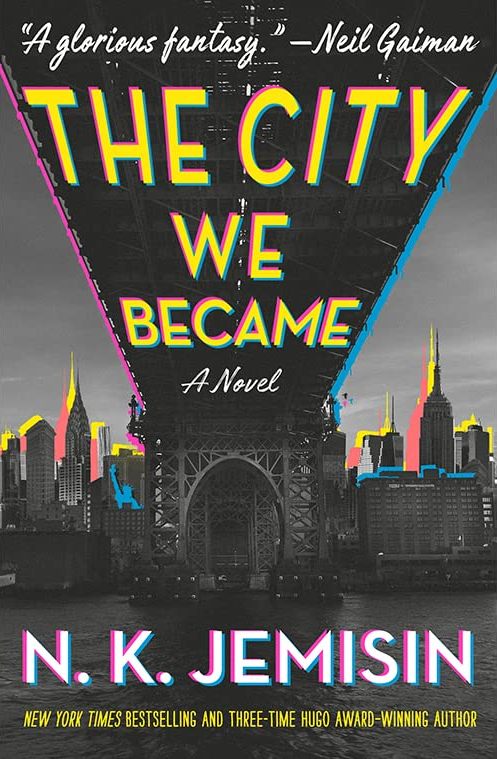
This issue raised its head again recently while I was reading N.K. Jemisin’s new novel, The City We Became.

If you’ve read her short story collection you’ll recognize the basic idea from the story “The City Born Great,” which effectively serves as the prologue for this book. Essentially, for reasons that aren’t really all that clear, at some point certain cities are “born” into actual, living entities. Some of these births go well – London, Hong Kong, and Sao Paolo are all living breathing cities at this point – while others don’t make it, or don’t make it for very long – think Atlantis and Pompeii, and New Orleans is having troubles, too. In the book it’s New York City’s turn and its difficult birth in the prologue leads to the avatars of the city (one per borough and an additional one overall) fighting to keep it living.

The book overall is pretty good. Jemisin can lay words on the page like just about nobody else going right now and the individual scenes and chapters are great as set pieces. The broader plot doesn’t quite work, however, and the book winds up feeling like less than the sum of its parts (props here to the audiobook production which, aside from one minor quibble – longer pauses between scenes please! –is brilliant both in production and performance). One reason that’s true is that we’re not given any idea why any of this matters. I mean, there’s a villain to vanquish (in the next book, apparently – grumble, grumble) and a city to save, but as to what makes London and Hong Kong and Sao Paolo different from what New York was prior to its birth we never learn.

On the one hand, this doesn’t necessarily mean the main story suffers. After all, it’s likely that The City We Became didn’t address this issue because it wasn’t really applicable to the story Jemisin set out to tell. Still, one of the great pleasures of speculative fiction is digging into a fully developed world that’s not ours and glossing over such things can leave the experience a little hollow. In other words, if you’re writing modern-world fantasy, or near future sci-fi, it’s worth thinking about what’s going on in the world beyond the discrete story you’re telling. Maybe it’s not that important, but it introduces some interesting possibilities for how to deepen the world you’re building and provide some extra details for readers who are interested in sinking their mental teeth into that kind of thing.

Thoughts On Buttered Cats

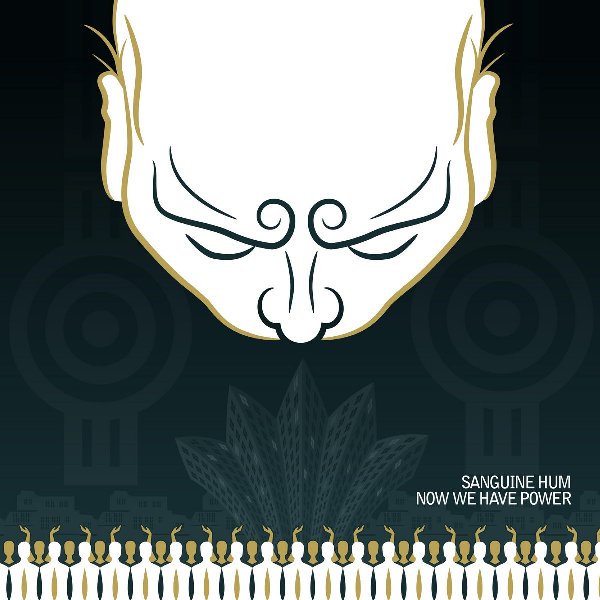
One of my favorite bands is Sanguine Hum, which marries intricate song writing and arrangements with an absurdist streak derived from the original Canterbury scene (not for nothing was an earlier version of the band called Antique Seeking Nuns). A few years ago they released a pair of concept albums – Now We Have Light and Now We Have Power – inspired by what’s called the “buttered cat paradox.” Did I mention the absurdist streak?

The buttered cat paradox is best explained in this short video, where butter is substituted with jam, but the principle is the same:

The further step upon which the Sanguine Hum albums are based is the idea that if the cat will hover off the ground, rotating, that the rotational force could be capture as a form of generating power. As one song from the first album goes:

The simplest way to describe
What is lighting up the night’s sky
Is rotatory fur!
It spins through the air.
We buttered their backs
Now we have light!
Now we have power!

This is, of course, basically a joke (remember the absurdum!), but the whole idea never sat right with me. If the cat wants to land on its feet and it’s falling feet first, why on Earth would it suddenly stop and start spinning? Sadly, my education left me without a good means of figuring this out. The closest I got to science in college was a survey-level Biology class, with nary a Physics class in sight. If you need someone to explain the histiocity of Holocaust denial or expound on legal philosophy, I’m your man. How things move in the universe, not so much.

I did some poking around and someone confirmed that I was right to think this doesn’t make any sense! The long and short of it involves the much larger mass of the cat as compared to the buttered/jammed toast:

So there it is – a completely hypothetical, terminally absurd thought experiment is debunked. I do take some satisfaction in this, even as I try to always keep in mind the MST3K motto to “repeat to yourself it’s just a[n album], you should really just relax.”

Let’s do just that, then, shall we?

Now We Have Light by Sanguine Hum

Now We Have Power by Sanguine Hum

The Mouse That Didn’t Roar

A lot has been written in the past few days (and will be written in the foreseeable future) about the legacy of the late Ruth Bader Ginsburg, both as an advocate before the Supreme Court and as a long-serving Justice. I wanted to highlight something that might get overlooked in all that (although at least one other commentator mentioned it), an instance where she made a huge impact on an important part of federal law without any explanation of why she made the decision she did.

Sentencing in federal criminal cases changed dramatically in the 1980s. Up until then, judges had great leeway to impose a sentence within a broad statutory range, with release on parole at the back end further mitigating potentially harsh sentences. Confronted with great disparities in sentencing, a bipartisan law, the Sentencing Reform Act (passed in 1984) gave birth the US Sentencing Guidelines (which went into effect in 1987).

The Guidelines are a mechanistic system that converts not just the defendant’s offense of conviction but related conduct into an “offense level” that goes from 0 to 43. Many of the facts related to that calculation comes from judges, not juries, and can even include conduct for which the defendant was acquitted at trial. The Guidelines do a similar thing with a defendant’s criminal history, placing them in a Criminal History Category from I to VI. Where those two values meet is the Guideline range, where the sentence is supposed to be imposed.

Starting in 1987 judges, for the most part, were required to impose sentences within that range (exceptions were largely controlled by the Guidelines, too).

From the get go, defense attorneys argued that the Guidelines (and various state equivalents) violated the Sixth Amendment because they increased punishment for a defendant based on facts beyond those found by a jury (or admitted during a guilty plea). Judges finding facts, the argument went, shouldn’t be the basis for ratcheting up punishment. Courts weren’t interested, however, and the Guidelines helped to drive the country’s overincarceration problem for the next two decades.

Things started to change in 2000, when the Supreme Court held that a New Jersey statute that allowed a judge to increase the statutory punishment for a defendant based on a judicially-found fact violated the Sixth Amendment. Ginsburg was in the majority in that case, but the cause of the revitalized Sixth Amendment was really championed by her opera buddy, Justice Scalia. With that case in hand, defense attorneys once again began to argue that the Guidelines were unconstitutional. Now the issue was whether an increase in those Guideline ranges were an increase in the statutory maximum for a particular offense.

Nothing came of those arguments until 2004, when the Supreme Court decided Blakely v. Washington. Blakely involved a sentencing guideline scheme in Washington state that was very similar to the federal Guidelines. In a 5-4 decision, the Court held that those guidelines violated the Sixth Amendment. Notably, the Court didn’t prescribe any kind of remedy, instead remanding the case and letting Washington deal with it. Ginsburg was, again, in the majority.

After Blakely it was only a matter of time before the Court had to consider what this all meant for the federal Guidelines. In 2005 the Court finally dealt with the matter in United States v. Booker. The facts of the case lay out the starkness of the issue – Booker was convicted of a drug offense that carried a statutory range of 10 years to life in prison. His Guideline range, on the other hand, bulked up by judicially found facts about the amount of drugs involved, was 30 years to life in prison. Two decades in a cage is a hell of a thing to require based on facts found by a single person (and not even beyond a reasonable doubt).

Booker, as it turned out, was actually two decisions for the price of one. In the first, the 5-4 majority followed Blakely and held that the US Sentencing Guidelines violated the Sixth Amendment. In the second, a different 5-4 majority held that rather than leave it at that and let lower courts and Congress sort it out, the appropriate remedy to resolve the issue was to strike down the statutory language that made the Guidelines mandatory in the first place. Thus were the advisory Guidelines born, which we’ve had ever since.

What made for these two conflicting opinions? After all, most of the majority for the remedial opinion were dissenters from the other opinion (led by Justice Breyer, who helped draft the initial Guidelines). It was Ginsburg – she was the fifth vote in both majorities. But in a rare instance of opaqueness, she didn’t write an opinion explaining her decision. Sure, she joined the ones written by Stevens and Breyer that were the majority opinions, but she didn’t write separately to explain why she had a foot in both camps.

In a career that made a lot of impact on peoples’ lives, Ginsburg’s decision in Booker may be her most important. Since the Guidelines became advisory in 2005 hundreds of thousands of people have been sentenced as part of a system she basically created (for some idea of the numbers, in its last report to Congress on the impact of Booker, the Sentencing Commission noted that more than 85,000 defendants had been sentenced in the past year). Yet there was no sweeping opinion, no reading from the bench to spur Congress into action. Just a decision, made thoughtfully I’m certain, but without any transparency.

Are we – or, should I say, are federal criminal defendants – better off with the advisory Guideline scheme rather than whatever else Congress might have created? Hard to say, given how little experience the system has with juries finding sentencing facts. I will say that judges have seized their authority under Booker (and its progeny) to vary from and, in some cases, completely ignore the “advice” provided by the Guidelines. Still, they exert a kind of gravitational pull at sentencing and are pretty central to most proceedings. It’s the irony that gets me, I suppose. Ginsburg was arguably the Court’s most public face over the past few years. That she has had such a major impact without doing much more than casting a vote seems out of whack, but such is life. And the law.