I’m at Tamarack!

I’m at Tamarack!

Opened in 1996, Tamarack (just outside of Beckley) is a showcase for West Virginia artists of various kinds. According to its website, it was the first of its kind – a center devoted to the promotion of regional arts. In the 20 years since its opening more than 7 million people have visited.

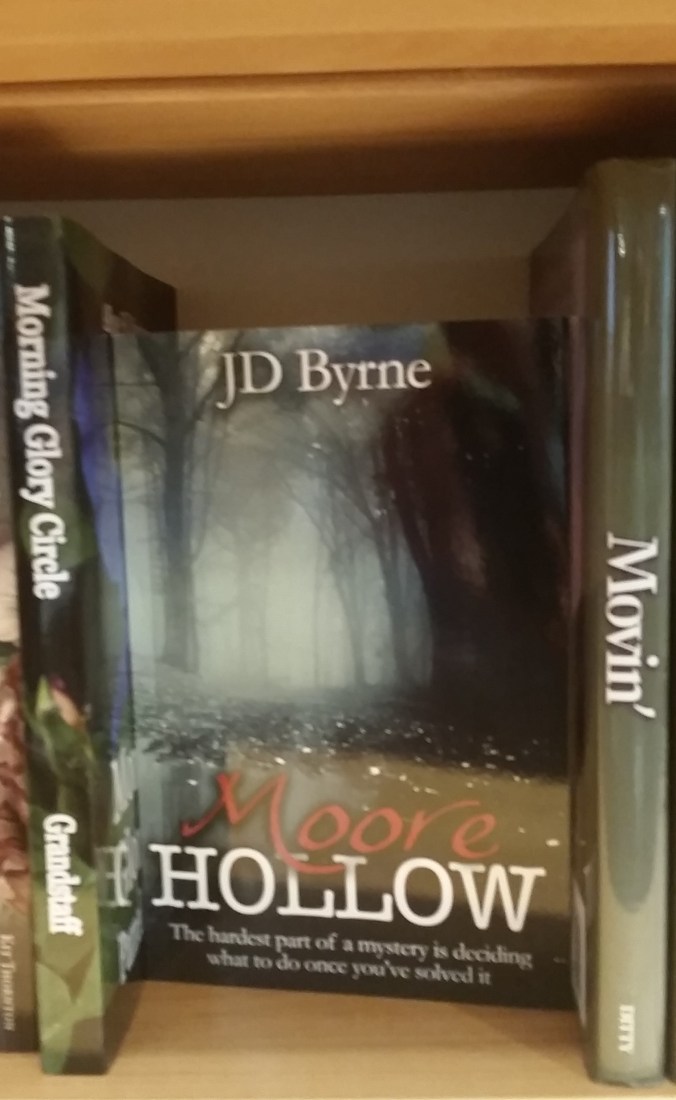
Items sold at Tamarack have been juried and approved, which means getting into the collection there is something of an accomplishment. So I’m very pleased to report that my first novel, Moore Hollow, is now available there:

Book@Tamarack1

Cell phone picture – pardon the quality

I think Moore Hollow is a natural fit for Tamarack, given that it’s set largely in West Virginia. It also ties a little bit into the political history of the state and, I hope, might give people a reason to rethink their perceptions of small mountain towns and the people who live there.

Of course, Moore Hollow is also still available from Amazon, as well.

What Vinyl Can Learn From The Americans

Almost every piece of fiction is, in fact, about creating an alternate reality. No matter the verisimilitude of a story, not matter how “real” the characters feel, the simple truth is they aren’t. They’re creations of a writer who controls their every movement and word. Our world is not their world for the basic reason that they don’t exist in our world.

Alternate histories, of course, take this premise and run with it. What if the Allies lost World War II? What if the American Revolution never happened? Stories that ask such questions are all about messing with history. The only limits on the changes you make are whether they make some sense in relation to the big change.

Things are a little trickier when you’re telling a story set in the past that doesn’t have quite the same ambition. If you’re not really changing the past, how much of “history” as we know it can you play with? And how? Two current TV shows deal with this issue, one much more successfully.

Vinyl, on HBO, has a hell of a pedigree. The show, about the head of a struggling record company in the early-to-mid 1970s, boasts Martin Scorsese, Mick Jagger, and Terrence Winter (of The Sopranos and Boardwalk Empire fame) among its creative forces. The company is on the brink, the main character is a coked-up killer, and, well, there are other complications. It’s gotten a fairly cool reception from critics, but has already been renewed for a second season. I’m not sure I’ll be on board for it.

Vinyl-Key-Art-FINAL

Although I have several issues with the show, the one that really drives me nuts (and prompted this post) involves how the fictional record label interacts with real world stars. Already this season we’ve seen our heroes interact with Led Zeppelin, David Bowie, Alice Cooper, and Elvis. While there’s a chance to play that for fun, or verisimilitude boosting background, the show doesn’t go that route. Instead, we’re shown multiple instances of the fictional record label trying to do business with these luminaries that we know won’t because we’re still in the “real” world. Whatever conversations you might dream up for Alice Cooper to say in your version of 1973, you’re not going so far as to have him sign with a fictional record label. It drains these incidents of any tension or drama, regardless of how well they’re executed.

Compare that approach with the one taken by FX’s The Americans. It’s got considerably higher fictional stakes – telling the story of a pair of Soviet spies posing as a suburban American family during height of the Cold War 1980s. They should bump into historical biggies every week, yet they don’t. In fact, the only major historical fact in play in the series is the one that hangs over the whole thing like a specter – we know that these folks play for the losing team.

the-americans

Yet, the drama of the series still works because our “heroes” aren’t interacting with bigger specific historical events that have happened around them. They never try to assassinate Reagan, for example (although I suppose you could conspiracy theory that one into real history), or engage in some epic act of sabotage that didn’t happen in the real world. As a result, we’re more caught up in the tension of their existence because we’re unsure how their small part of the larger story is going to play out.

Vinyl lacks that. Whatever the fate of American Century Records will turn out to be it has fuck all to do with hitching its star to David Bowie or Elvis. It’s a much better show when it’s playing with its fictional artists, people in whom viewers can invest some real emotion.

It’s fun to play around with history. But I think you have to have a solid idea of why you’re doing it and how your fictional characters are going to fit into that history. Are they swept along with the tide we all know or are they changing it into something entirely different? It’s a fine line and easy to wind up on the wrong side of it.

Water Road Wednesday: Oberton

I’ve talked a little bit about the great walled cities of the Arbor, the large city-states that formed the Confederation. While they dominate the dense wooded area, they aren’t the only thing there. Smaller cities and towns pop up in various clearings. One of them, even, takes a slightly different route.

Oberton isn’t quite a mythical city, but it’s a city with a lot of mythology around it. That’s pretty much par for the course when you build a city in the trees. Here’s Rurek, introducing Strefer to the mythos of Oberton:

“Oberton is a city in the Arbor…” he said, before Strefer interrupted with a wave of her hand.

“Hang on. I thought the names of all the cities in the Arbor ended the same way: Tomondala, Kerkondala, whateverdala,” she said, emphasizing the last two syllables before trailing off.

“Sort of,” Rurek said. “In the ancient tongue, ‘dala’ literally meant ‘walled city.’ So ‘Tomondala’ literally means ‘Walled City of Tomon.’ The seven city-states that make up the Confederation are all walled cities, so their names all end the same way. But there are lots of other cities and towns in the Arbor, Strefer. You didn’t think there were only the seven, did you?” he asked with the kind of grin that said he hoped she did, so he could hold it over her in the future.

“Pfft,” she said, waving off his accusation, “of course not.” She wasn’t so drunk to concede that she had never actually given the matter any thought.

“Oberton is a city that’s almost right in the center of the Arbor, somewhere between Maladondala and Vertidala,” he said.

“Somewhere?” Strefer asked.

“Nobody is quite sure where it is, to tell the truth,” he said.

“Wait, are you sure it really exists at all?” Strefer asked. “It sounds a little fishy.”

Rurek rolled his eyes, as if the existence of Oberton was a settled fact where he came from. “It’s not like the other cities in the Arbor, Strefer. It’s up in the trees, built along the tops of the massive trunks that have grown up there. They say you could be standing right underneath the town square and never know it.”

Strefer was not quite buying this, but he might as well continue, anyway. “Sorry to interrupt.”

Rurek took a drink and continued his explanation. “It’s renowned as a city of learning and history. Sort of like your people, Strefer, when the awakening came and the priests and monks of the various orders there put aside the gods and became scholars of history. They say Oberton has a great library that holds many ancient texts and great secrets. In Oberton, they treasure learning and truth above all else.” [/quote]

Hmm. A mysterious city in the trees where truth is valued above all else. A woman who needs to get the truth out whatever it takes. Wonder if those things might play well with each other?

NOTE: As it happens, the theme for this week’s edition of One Line Wednesday on Twitter is “up.” Look for more blurb about Oberton there using #1lineWed.

Water Road Wednesday: Rurek of Kerkondala

Does every story need a sidekick? If so, then I suppose you can consider Rurek a sidekick in The Water Road trilogy. He’d be a pretty good one, if you needed it. Strefer certainly thinks so.

Rurek is a Sentinel. As I mentioned earlier, Sentinels are both the intelligence gatherers for the Triumvirate and also act as a police force for the city of Tolenor. Rurek works in Tolenor, although he had a brief stint in one of the forts along the Water Road (as all Sentinels do). He walks a beat, trying to keep people out of trouble, a role that suits him quite well.

Rurek is originally from Kerkondala, one of the great walled cities of the Arbor (the suffix “dala” means “walled city” in the old tongue). Kerkondala sits on the bank of the River Adon at a place called The Narrows, where the Adon and the River Innis are at their closest. Because of that, at one time Kerkondala controlled all passage from north to south. After a great war with Maladondala, to the south, it had to relent and open the Arbor to more people.

Like every other Sentinel, Rurek’s been trained in the use of the pikti, the fighting staff. He’s a student of its history and, while not a master, can use it very effectively. For a time at the Sentinel academy in Tolenor he taught new recruits how to use the Sentinel’s signature weapon.

Rurek has a professional relationship with Strefer, the reporter for the (Sermont) Daily Register. At least he’s a source, one of many she pumps for information at night in the pubs where off duty Sentinels congregate. He tends to have a good handle on what’s going on in the city, since a lot of other Sentinels report to him. He’s fond of Strefer, but never in his life did he imagine the kind of trouble she would eventually get him into.

Water Road Wednesday: My Bad

So, the plan with Water Road Wednesdays was to have a post a week every week until the trilogy was released. Sadly, real life sometimes intervenes and has distracted me from my assigned task.

Part of this is related to the book, at least, as I’ve been spending time dealing with two potential cover designers. I’m excited to see what they come up with, but it takes time. And it can be a little distracting.

Also, my day job demands that I go out of town today to go to court to argue a case. It’s my favorite part of the job, so I can’t complain, but it does blow a hole in the week leading up to the argument.

Regular programming resumes next week.

well-be-right-bark

Promise!

Water Road Wednesday: Life In the Guilds

As I mentioned last week, Strefer Quants is from the United Guilds of Altreria, what’s commonly referred to as the Guildlands. The Guilders (as they’re known in The Water Road universe) live in a society that’s arranged completely differently from everywhere else in their world, even the Neldathi. Where family and kin create bonds in most places, Guild society is organized around the Guilds to which people belong. There are no families, as we traditionally think about it.

Here’s Strefer explaining to Rurek, her companion through The Water Road, a little bit of how that works:

“You talk about your mother and father, your siblings? We don’t really have concepts like that in the Guildlands. Sure, some woman gave birth to me and some man did his part so that I was conceived, but neither one of them raised me.”

Rurek shook his head. “You don’t even know who your parents are?”

“I told you, the concept of ‘parents’ really doesn’t exist where I come from. But to answer your question, yes, I do know who the two people who produced me were. I’ve met who you would call my mother once or twice. She is in the Guild of Musicians. I met her after seeing her sing at a concert once. She has a beautiful voice. Shame I didn’t inherit it,” Strefer said with a laugh. “The one you would call my father was from the Guild of Soldiers. He was killed fighting the Azkiri, from what I learned, before I could meet him.”

“I’m so sorry,” Rurek said with genuine compassion.

Strefer shook her head. “You still don’t get it. I’m not talking about someone like your father, who helped raise you, taught you things, protected you. To me he was never more than a name, and may have always been that way. I’m just answering your question about whether I knew who my biological ancestors were.”

“All right, then. No more sympathy from me,” Rurek said jokingly.

“I’ll take sympathy, thank you, but at the appropriate time and place.”

“Duly noted,” he said. “So, with that bridge crossed, who did raise you, then?”

“Not surprisingly,” Strefer said, starting on the final side of the pocket in which the pages had been hidden, “there’s a Guild for that. It’s called the Guild of Midwives, but it really includes a lot more people than that. Men and women, both, you know. Midwives, wet nurses, caregivers, you name it. They’re the ones that do the hard work of actually raising children.”

“But there’s more to it than that, surely,” Rurek said. “Parenting is more than just making sure your daughter gets fed and has a roof over her head at night.”

“It does in Kerkondala, because your society is structured around individual family units. Families just don’t exist like that in the Guildlands. Have you ever wondered about my last name?” she asked.

“Not really,” he said. “I know it sounds a lot like the city where you’re from, but that’s not uncommon in the Arbor or Telebria.”

“Except that, in the Arbor or Telebria, a similarity between a name and place is probably due to that person’s ancestors naming the town. Quants isn’t a family name, Rurek. It’s a short way of telling people I was born in Quantstown. My actual full, official name, as it appears on the rolls now, is Strefer of Quantstown of the Guild of Writers. Quite a mouthful, huh?”

He nodded. “I guess it is.”

“That Alban who got his head bashed in? His last name was Ventris, because that’s where he was from. Nothing more. My point is there is nothing about me that reaches back to some long line of ancestors, like you have.”

“Who named you, then?” Rurek asked.

Strefer stopped sewing for a moment, looked out over the water, and said, “You know, I’m not sure. Never occurred to me to ask. From as young as I can remember, I was Strefer. I could change it if I wanted to, but it works just as well as any other name, doesn’t it?”

“No argument here,” he said. “Rurek is an old family name, goes back generations. I hate it.”

“Why don’t you change it, then?” Strefer asked, returning to her task.

“Because,” Rurek said, stopping for a second to think about it, “it’s just not done where I come from. Like it or not, I do have some connection to my distant ancestors to worry about. Besides, we were talking about you and your childhood. So the Guild of Midwives did the care and feeding part, right? Then who taught you to read and write and how the world works and all that?”

“The Guild of Teachers,” she said. “I don’t know about Arborians, but I’ve heard Telebrians talk about the limited role teachers play in the education of their children. Makes no sense to me. The Guild of Teachers is where the experts are, in everything from how to cook a meal to how to mend your clothes to how to read and write.”

“So you went to school, then?”

“Of course,” she said. “But that’s not the only place you learn things. You know that. The members of the Guild of Teachers work in schools, but also in the dormitories where children live and all over. They teach adults, too, if they want or need to learn about something new.”

Rurek did not ask any more questions and they sat in silence for a few minutes. Finally, he said, “It just all seems so strange.”

“That’s because it’s not what you grew up with,” Strefer said, finishing her sewing and handing the coat back to Rurek. “We are most comfortable with what we know. That’s doubly true when you talk about things like how we grew up. To me, it sounds strange to hear people talking about their families and how much they despise a brother or cousin or whatnot, but will then turn around and defend them from attack by outsiders. It makes no sense to me.” She stood up and slung her satchel over her shoulder.

Guilders form bonds, but on their own terms and for their own reasons, rather than out of a sense of societal inertia. It’s a good example of how they interact with the world – rationally and practically, without an overlay of tradition or concerns about doing things differently. It’s a world view that others in the universe of The Water Road have a hard time grasping.

Same As It Ever Was

On my old blogs, where I discussed legal stuff more often, I talked about how conflicted defense attorneys are about defendants who “roll” on each other – that is, who testify against another defendant in return for either a reduced sentence or beneficial plea bargain from the prosecution. That conflict came to mind while reading about a similar situation that occurred on the other side of the planet.

The Master of Confessions is journalist Thierry Cruvellier’s account of the trial of “Duch” before the name, the international court currently trying former members of the Khmer Rouge for crimes against humanity. Duch was the lead interrogator at the Tuol Sleng prison I mentioned a while back, also known as S-21. Duch’s job was to get people to confess not only their crimes against the revolution, but to rat out others in their “line,” a process known as denunciation.

One of the interesting things about the book is that Cruvellier isn’t writing history. He’s writing about it, but he’s doing it from the vantage point of his own observation of the trials (and other similar trials around the world). Thus, it gives him room to make astute observations that might not be so well placed in a work a pure history.

On the subjection of denunciations, he writes (paragraph breaks added by me):

The court openly hates the very idea of denunciation. Given that at S-21 thousands were tortured and mercilessly killed, the court vehemently rejects the validity of the denunciations obtained there. But in other circumstances, the international legal establishment can be more accommodating.

Mandatory denunciation (though obtained without torture) is a crucial element in many confessions made before international tribunals and, in these circumstances, lawyers find that their consciences remain quite untroubled by it. On the contrary, they actively encourage it. A defendant who pleads guilty to a UN tribunal is told to denounce his accomplices if he wants to win over the prosecutor and earn the judges’ leniency. He isn’t forced to name names under torture, of course, but if he wants to make the most of his guilty plea and obtain a lighter sentence, then he has no real choice but to comply.

Rwanda’s community courts, known as Gacaca courts, which have been so misguidedly praised over the past ten years, feed off of mass denunciations. Though they don’t torture people, snitching is inextricably linked to confessions in Gacaca courts. The result is an all-consuming, rampant, and poisonous judicial operation that had produced more than a million suspects. Throughout Rwanda, the pressure to name one’s accomplices has given rise to slander so great it wouldn’t be out of place in the archives of S-21.

‘Denunciation is another form of lying,’ Francois Bizot, a survivor of imprisonment by the Khmer Rouge, says in court. International justice, it seems, only hates lying in certain circumstances.

This captures the essential issue when it comes to defense attorneys and rolling codefendants. On the one hand, their testimony is inherently suspect because it’s being given in return for something of value – more lenient treatment. Indeed, a federal court once recognized this for what it is – bribery – but swiftly backpedaled upon realization that banning the practice would bring the criminal justice system screeching to a halt. On the other hand, providing what the federal system calls “substantial assistance” is often the only way one of our clients can help reduce their sentence.

Which goes to show, I guess, that “justice” and what it looks like isn’t so different, whether you’re dealing with petty drug dealers in West Virginia or the architects of mass murder in Cambodia.

Water Road Wednesday: Strefer Quants

If Antrey Ranbren is the most important person in The Water Road trilogy, Strefer Quants is right behind her and, in truth, might have a case for knocking Antrey off the top. The Water Road itself is largely their two stories, splitting off from each making the same world shattering discovery.

Unlike Antrey, who’s a woman without a country, Strefer comes from the United Guilds of Altreria. As a Guilder, Strefer was raised without a traditional family, including a mother or father. This is reflected in her full name – Strefer Quants of the Guild of Writers. Quants is derived from Quantstown, where she was born. Her Guild affiliation is, just that – it shows to which Guild she owes loyalty.

Although Strefer is a Guilder, she works for a Telebrian in Tolenor. She’s the lesser of two reporters stations in the city for the (Sermont) Daily Register, the newspaper of record for the Telebrian capital. Strefer’s boss, Tevis, gets the plum assignments like covering the sessions of the Grand Council of the Triumvirate and writing about matters of state. Strefer, on the other hand, has a much rougher beat to cover.

Her attitude towards her job is summed up in this blurb from last week’s One Line Wednesday session on Twitter:


But it’s a job at which she’s very good, particularly when it comes to getting people to open up to her and talking her way into places where she probably shouldn’t be. She has the typical Guilder worldview that prioritizes doing what works and confronting reality head on, rather than adherence to high ideals of an earlier age.

When The Water Road begins, Strefer is in need of a good story (hence the blurb above). She’s about to find it.

Not Getting It Right Versus Getting It Wrong

A little while back someone in one of the online writers’ forums I haunt asked about what, within our particular area of real life expertise, makes us throw up our hands when we see it in fiction. This was particularly in a sci-fi and fantasy context, so my own area of expertise – criminal law – doesn’t really come into play. But reading the discussion and thinking about the question made me realize there is a fine line in fiction between not getting something right and actually getting it wrong.

Exhibit A, since it’s right in my wheelhouse – Law & Order. I’m talking the mothership here, the one that effectively split its time between the courtroom and the police investigation. To put it bluntly, Law & Order very rarely actually got things right, but it didn’t very often actually get things wrong. The former is forgivable, understandable, and even to be encouraged in the interest of drama. The latter just makes me want to punch the TV.

An episode that was on the other day while I was knocking around the house provides great examples of each. “Charm City” is the first part of the first crossover between Law & Order and my favorite cop show of all time, Homicide: Life On the Street. A gas bomb attack in New York has ties to a similar attack years earlier in Baltimore, bringing Baltimore detectives to town to crack the case.

The eventual trial provides an example of the first situation – not getting it right, but in the understandable service of the narrative. Curtis testifies at trial and, among other things, tells the jury that a partial thumbprint was found at the crime scene and it matched the defendant. In no way would a detective testify about this in a real trial. That evidence would come in via an expert witness, probably from the state or city’s crime lab. But we’ve never seen a crime lab expert in this episode, so it’s a waste of narrative resources to introduce an entirely new character to pass on this single (uncontested) fact. Curtis is a main character, by contrast, so give it to him to carry. It’s not right, but it’s not all that wrong, either.

By contrast, earlier on is the kind of thing that Law & Order routinely does that makes me howl. The two New York detectives question the suspect, who gives up nothing. Their boss lets the Baltimore guys take a run at him. Homicide viewers knew that Pembleton’s great skill was extracting confessions in “the box,” and, he does, but only after the suspect says he “can’t talk about it.” Pembleton responds, “you mean you’re unable to talk about it, or you just don’t want to talk about it?”

The confession winds up getting suppressed because, in the Law & Order universe, “I can’t talk about it” is an invocation of the right to remain silent and the right to counsel. There’s even a good back and forth about how it doesn’t matter that such things will “fly” down in Baltimore. In truth, such things “fly” everywhere that Supreme Court precedent controls. Invocation of counsel, or the right to remain silent, has to be explicit before it keeps the cops from barreling on with their inquiries.

The ruling was, simply, TV-land bullshit, an attempt to throw an obstacle in the path of our heroes. This was getting it wrong, seriously wrong, more than just not getting it right. And, in the end, it didn’t really make a difference (the guy was convicted anyway, without much drama). The overly-defense friendly law is a staple on Law & Order, but it’s usually at least closer to getting it right than this.

In the end, does it really matter? No, because the vast majority of people watching Law & Order aren’t lawyers, much less criminal defense lawyers who might zero in on that kind of thing. For most viewers it’s just an obstacle for our heroes to overcome. That, after all, is why we’re watching. Which is why it’s important for “experts” to back off a little bit and give fiction some room to breathe. Everybody sing along:


Weekly Read: Dead Wake

On May 7, 1915, a torpedo struck the liner Lusitania off the coast of Ireland. It sank in less than 20 minutes, taking almost 1200 lives. It was a cause célèbre during World War I, a conflict that was just settling down into a lengthy stalemate of trench warfare. Not for nothing did those lost include dozens of American citizens. The United States had not yet entered the war.

That the sinking of the Lusitania is tragic is without question. That the people killed were innocents who had nothing really to do with the war being fought around them is equally without question. One would think their story might make for a gripping read. Maybe it is, but Dead Wake isn’t it.

Erik Larson is one of the stars of popular history. In books like The Devil in the White City (about the 1898 Chicago World’s Fair and the serial killer who stalked it) and Thunderstruck (about Marconi’s development of wireless technology, and its relation to a grisly murder), he weaves multiple story lines together in a way that sheds light and provides dramatic structure for whatever historical event is the main focus. He does the same in Dead Wake, but it just doesn’t work as well.

Part of that, sad to say, is because he spends an awful lot of time aboard Lusitania before it sinks. To be blunt – the people he introduces us to just aren’t very interesting. To be more specific, the only thing interesting about their journey – their story in this book – is that the boat sinks. But we already know that, so where’s the dramatic interest? Much as I hate to say it, perhaps a fictional story is the better way to do this, ala Cameron’s Titanic.

That compounded by the fact that, looking back with a hundred extra years of history between now and then, the sinking of Lusitania doesn’t seem like the great crime it once was. After all, we’ve seen the incineration of entire cities and indiscriminate terrorist attacks since then. Lusitania being sunk was a horror, but (1) it wasn’t a neutral ship, however much time Larson spends on how the Germans dealt with such; (2) it was carrying armaments; and (3) it sailed into a declared war zone after specific warnings about the danger of doing so.

Also, for all the furor that the sinking caused, it didn’t really change anything. We spend a lot of wasted time in Dead Wake with a love-struck Woodrow Wilson, presumably because of the impact Lusitania’s sinking had on the American entry into the war. But that didn’t come until two years later and, at any rate, was part of the (arguably more interesting) aftermath of the sinking which Larson sails past (pun intended).

In addition to the strands of the Lusitania and Wilson, there’s a third bit where the book is at its best – on the U-boat that sunk the ship. Larson does great work in describing the nature of submarine life at that time. Not only does he cover the technical aspects, but his descriptions of the innards of the boat (and the sweaty guys aboard it) really come to life. He touches on the issues submarines brought to the rules of war, but only briefly. I wish he had spent more time diving deep into the philosophical depths on that one.

As I mentioned above, what’s arguably most interesting about the sinking of the Lusitania is what happened after the ship disappeared beneath the sea. The UK, in the middle of a war, had good information about what exactly happened, but tried to frame up the ship’s captain anyway (for reasons that are unclear). Americans were outraged, but did nothing about it – hard to imagine such restraint prevailing now. And there are so many unanswered questions about the sinking that conspiracy theories have sprouted up, fed by the continued secrecy of various sources of information. This would have been a fertile area for exploration, more so than the dull daily lives of passengers on board the ship.

One thing that Larson does through the book is highlight the power of coincidence and, for lack of a better word, “luck.” Lusitania was delayed about two hours on its way out of New York because it had to stop and get passengers from another liner. Had it not, it would have passed by the U-boat in the fog, preventing any attack. The ship’s captain, unaware of the U-boat lurking nearby, unwittingly turned the ship in a way that made it the perfect target. Things like that reinforce the randomness that often helps produce momentous events.

Dead Wake isn’t a bad read. It’s quite informative in spots and well written (as always). But it pales in comparison to Larson’s earlier work.

DeadWake