When I went to college most of the music I had was on cassettes recorded from the record collections of my brothers. As a result, I didn’t have the liner notes that came with those albums and, thus, no lyrics to pore over. This wasn’t a huge problem, but I did always wonder what Jon Anderson was singing about on old Yes albums.
I got online during my junior year of college and quickly discovered primitive websites devoted to bands I loved. Some of them even had song lyrics on them! So I dutifully dove into some of those old Yes albums and . . . didn’t really get any better understanding of the lyrics. Turns out Anderson was more focused on what words sounded like rather than meaning, so they were pretty vague on purpose – what on Earth (or beyond) is “cold summer listening” and how does “hot color melt the anger to stone,” anyway?
Still and all, Anderson never wound up in the crosshairs of J. Edgar Hoover. And he never inspired , one of my favorite Bloom County strips of all time:
The joke works, of course, because nobody really knows what the words to “Louie, Louie,” are, which is pretty amazing given how much the song has seeped into our culture. How exactly did that happen? Turns out, it’s precisely because purveyors of moral panic can try to make the lyrics be any old thing they wanted.
This article in Reason tells the tale. The song was written in 1956, but didn’t really breakthrough until it was recorded by the Kingsmen in 1963 (it peaked at No. 2 on the Billboard chart) and even then it took a while to get rolling. As the article points out, it’s not a particularly deep song:
It was nothing more than a lovesick sailor’s lament to a bartender about wanting to get back home to his girl. But because Jack Ely, the Kingsmen’s lead singer, slurred the words beyond recognition, it became something of a Rorschach test for dirty minds. Schoolyard rumors about filthy lyrics in “Louie, Louie” stoked parental fears, prompted fevered complaints, and ultimately triggered a prolonged nationwide investigation.
My favorite overreaction to this comes from the governor of Indiana who “claimed that the record was so obscene it made his ‘ears tingle’” and used his connections with radio stations to effectively ban the song in that state. That’s peanuts to the multi-year investigation that the United States government launched into the song, via the FBI and the fellas at the freakin’ FCC, among others. Even with all that time and all those resources involved, investigators couldn’t figure out what the Kingsmen were on about!
My other favorite detail is this – it took the crack investigators at the FBI 18 months to think to go look up the actual lyrics on file with the U.S. Copyright Office! Mystery solved, at least, right? Not really. There were “other versions” of the lyrics circulating in schoolyards and such, which seems to say less about “Louie, Louie” than it does about the hyper sexed minds of young adults everywhere.
There’s lots of other interesting stuff in the article, so I recommend the full read. I will go ahead and spoil the ending, though – “Louie, Louie” won, in the end, becoming its own kind of classic. Did you know that April 11 is International “Louie, Louie” Day? Now you do, just in time to celebrate and tell the censorious prudes to go fuck themselves.
The comments I read when the news came out was mostly amusement and pleasure at Pratchett’s wishes being so scrupulously honored. After all, if he was so specific as to how his literary executor was to deal with his unfinished work he must have felt fairly passionately about it never seeing the light of day. Who could argue that the right thing to do is precisely what the author wants?
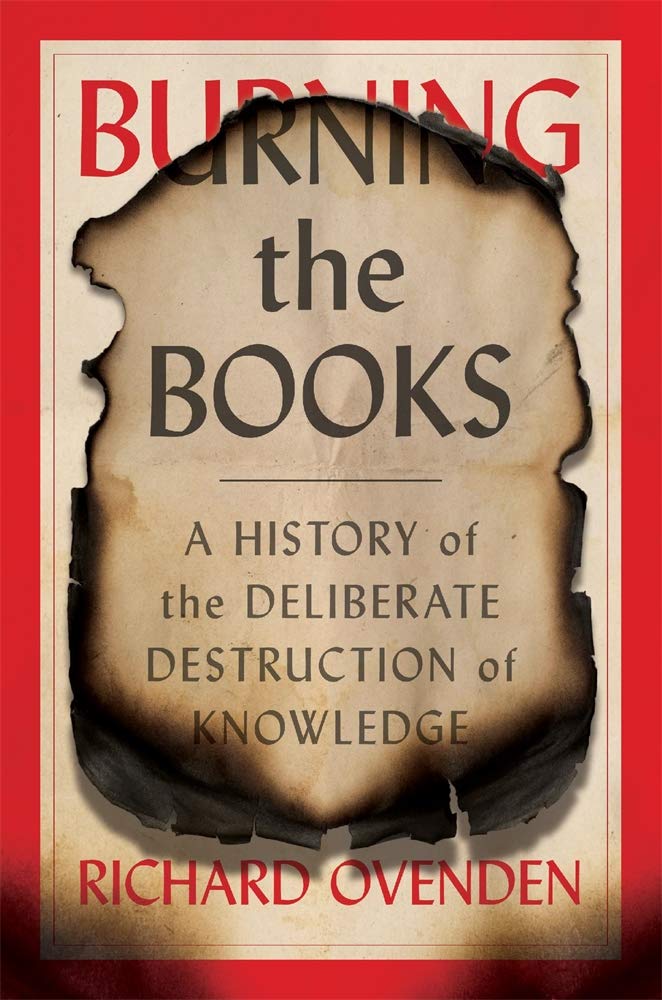
I got to thinking about this again reading Richard Ovenden’s Burning the Books: A History of the Deliberate Destruction of Knowledge.
What I thought was going to be a particularly timely look at the social or political factors behind drives to ban books was actually a love letter to libraries and archives and the need for society to protect and support the collection and retention of knowledge. No great surprise, I suppose, given that Ovenden is the librarian at the famed Bodlean Library at Oxford.
In a couple of chapters, Ovenden discusses particular situations where authors either took affirmative efforts during their lives to destroy their unfinished work or asked executors/family to do the destroying once they were dead. In some instances (like Franz Kafka) it was unfinished work, where some others involved personal papers like letters or notes. Ovenden’s point of view is clearly that any loss of this information is a cultural travesty and implies that the heroes here are people who go against the wishes of their friends/loved ones and preserve their work anyway.
I get that, on the one hand. Destroyed knowledge is pretty much gone, after all, without any hope of getting it back. The world is undeniably richer for having Kafka’s unfinished work or the papers of someone like Sylvia Plath that gives insight into a writer’s life and process. But whose decision is it to make that determination?
The author’s wishes deserve at least some consideration, right? Maybe because in one side of my life I’m a writer and in another I fight battles to vindicate the Fourth Amendment and rights to privacy (usually unsuccessfully, alas), but airing things the original author never wanted to see the light of day seems like a violation. I’m not sure the world is entitled to anything the author doesn’t want to show it.
As is happens, after Burning the Books, I decided to read one of the most famous posthumously published works, Kafka’s The Trial.
I’d had it in my collection for a while but never got around to it. I’m glad I did, just to have been able to say I’ve read it. As a lawyer, you’d think it would be required reading, although the deep secret buried in The Trial is that there never is an actual trial that takes place. I sort of know that’s the point, but I expected a little bit more procedural chicanery – the kind of stuff that happens in regular courtrooms that get dubbed “Kafkaesque.”
The Trial definitely feels unfinished. My understanding is that the first and last chapters were actually written and designated as such by Kafka, but the rest was assembled by his executor, Max Brod, after his death. That said, it does have a memorable ending, so it doesn’t just peter out. I also found the atmosphere to be more dreamlike than nightmarish. The main character, K, is more frustrated and aggravated by the situation than he is terrified. In a way that makes it worse.
While there is no trial per se in The Trial, lawyers and the court system come off pretty badly. The part that stuck with me the most is a scene where K is in the court building and passes a group of litigants just huddled around not doing much of anything. It’s explained that they’re waiting for rulings in their cases, some of them for years, and that all they can do is continue to wait. That put me in mind of several of my clients who have watched their cases languish in court, just waiting for the judge to make a decision. They’d rather the judge get it wrong but actually get it done – at least then they could move on to the next phase of things.
My ultimate conclusion about The Trial is that I think K was dead the entire time. The suddenness of the accusation, the ultimate futility of fighting the charges, and the references to K needing to defend his entire life make me think that he’s in some kind of limbo (from which he’s ultimately released in the end). The way “the law” is discussed, too, sounds more like a religious concept than a purely legal one. It doesn’t ultimately matter, but it’s what jumped to mind while reading it.
Since I was on a Kafka kick, I decided to wrap things up with a book that dove more deeply into the battle over his literary legacy, Kafka’s Last Trial, by Benjamin Balint.
The titular trial here took place in Israel in this century and was a battle over where Kafka’s literary legacy would have its home. It stems from how Brod dealt with Kafka’s literary estate and whether it should be retained by the descendents of his secretary or should be taken into the National Library of Israel as a cultural treasure of the Jewish people (or even in an archive in Germany). The legal wrangling isn’t that interesting (it turns on technical distinctions between different kinds of gifts – you can read up on it here), but the question of legacy is really fascinating. There’s an entire chapter dedicated to the issue of whether Kafka was a German writer (though he lived in what is now the Czech Republic) who happened to be Jewish, or a Jewish writer who happened to write in German and what the answer to that question means.
Of course, that issue could be hashed out regardless of whether Brod had destroyed Kafka’s unfinished works as asked (assuming Kafka became a big enough name without it). And it would have avoided an awful lot of expensive litigation generations later. So, in the end, is it better to encourage executors, friends, and families to abide by the wishes of the writers who trust them to do so?
I’m inclined to think so, but I also think that the question may be moot. After all, once a writer is dead he or she isn’t going to know what their executors do one way or the other. One pleasant thing about death is you don’t have to worry about your reputation. Weighing all the considerations, maybe Brod was on to something in the first place.
A couple of weeks ago I talked a little bit about how, in reaction to the Russian invasion of Ukraine, people and businesses had been cutting ties with all things Russian. Some of these make sense, as a way to starve the Russian economy and isolate/shame people with close ties to Putin, but some of them are pretty stupid, like pouring out (presumably quality) Russian vodka that you’ve already paid for. That’s a fairly pointless gesture, after all.
Which brings us to the weirdness revolving around Yuri Gagarin. Gagarin, of course, was the first human in space, an icon of the Space Race . . . and died in 1968. Putin was a teenager when Gagarin died, so it’s fairly safe to say he had nothing to do with the decision to invade Ukraine.
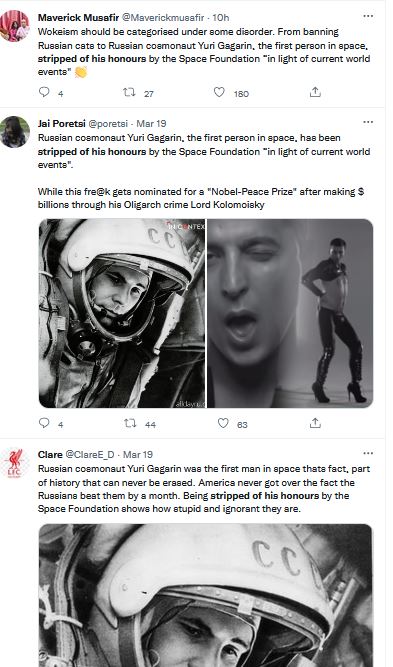
So imagine my surprise when I saw on Twitter over the weekend that Gagarin was being cancelled. Actually, what Tweet after Tweet said was that he had been “stripped of his honours” – complete with British spelling:
Where was this coming from? Even during the height of the Cold War I don’t remember Gagarin being treated as anything other than a pioneer. What would lead to his cancellation due to a war that started four and a half decades after he died? Turns out it’s slightly more complicated, at least in terms of the reach.
As it happens, there is a thing called the Space Foundation, which, according to Wikipedia, “is an American nonprofit organization that advocates for all sectors of the global space industry through space awareness activities, educational programs, and major industry events. It was founded in 1983.” At the beginning of April they’re having a Space Symposium (apparently a yearly event) that, according to Futurism, was supposed to have a night or panel called “Yuri’s Night.” Now, per a now deleted Tweet (cowards) it’s been renamed “A Celebration of Space: What’s Next.”
So it’s a schmoozy meet and greet cocktail party thing and, to me, sounds like it’s primarily geared toward fund raising. As explained in the Futurism story:
The nonprofit Space Foundation announced in a now-deleted note that ‘in light of current world events’ it would be changing the name of a fundraiser from ‘Yuri’s Night” to ‘A Celebration of Space: Discover What’s Next’ at its Space Symposium conference.
‘The focus of this fundraising event remains the same — to celebrate human achievements in space while inspiring the next generation to reach for the stars,’ the deleted update notes.
I agree with the author of the Futurism piece that this is a “rather dubious show of solidarity with the Ukrainian people” and is ultimately a dumb move, but I can see how it happened. In an environment when every corporate entity has to take a stand on current events, you’re going to have places that decide to avoid any hint of controversy as much as possible (and trigger the inevitable backlash).
But let’s keep in mind what this is not – there is no cancelling of Gagarin going on here. He’s not being erased from history books. There are no “honours” the Space Foundation has bestowed upon him that they could now revoke. How could they? Gagarin will always be the first person in place.
My point here is not that the Space Foundation was the right one. I think it’s pretty stupid, but I think equally stupid, or maybe even more so, is the reaction to it which is fairly divorced from the initial decision. It feels to me like it’s one of those minor stupidities that blows up over social media based on details that aren’t accurate. Dealing with the fallout from the Russian invasion is hard enough without reacting to stuff that didn’t actually happen.
A little white back, my wife and I saw The East, a 2013 film starring and co-written by Brit Marling:
Marling’s character infiltrates an off-the-grid terrorist organization that’s been striking out at corporations that have gotten out of hand. One is responsible for an oil spill, another for despoiling a town’s water supply, and a third for releasing a drug onto the market that has horrible side effects. Part of what makes the movie interesting is that Marling isn’t a cop or a crusading journalist, but rather an agent for a private security firm. It made me think about the importance of who your main character works for in a story and what it means for their development (or lack thereof) as a character.
A lot of stories are about main characters solving some kind of mystery, figuring out the solution to some problem. It’s no surprise, then, that lots of stories have main characters whose jobs require them to solve those mysteries – cops, private detectives, journalists. It gives them not just a motivation for getting into the problem in the first place but a destination as well – an arrest, the confirmation of a dark secret, an expose article. But it can also give them interesting limitations, blinders, or obstacles to overcome.
The natural job for a character like Marling’s in The East would be a cop of some variety – a person tasked by society with taking down bad guys. A person who should, at least in theory, be motivated to serve justice and help people. We’ve seen that story before, however, so making Marling’s character a private security operative boxes her in interesting ways since she’s not working for society in general, but for specific clients.
There is a scene, for instance, where she winds up in a middle of a plot the group is pulling that will poison dozens of people at a drug exec’s party. When she realizes that and calls her boss for guidance, she’s gently reminded that the drug company is not their client, so she shouldn’t try to stop what’s happening, just keep gathering info for the client that actually hired her. It creates an extra amount of tension over what she’s going to do and why, which I thought worked pretty well.
I’ve been thinking about this as I work on the sequel to Moore Hollow.
Yeah, so, I’m doing a sequel to Moore Hollow, the first of many, I think (currently now being worked on around the final volume of the Unari Empire trilogy, Heroes of the Empire).
For the books going forward, Ben Potter, the disgraced journalist who is the main character of Moore Hollow, permanently relocates to West Virginia and throws himself into investigating the area’s rich tradition of beasties, legends, and general weirdness. In the second book, though, he hooks up with a lawyer to help represent a particular client. That will give him different motivations and restrictions than his normal work as a paranormal journalist. I hope to explore how those roles are different as the series goes forward and Ben sometimes does and sometimes doesn’t work with that attorney.
Of course, those choices don’t always work for every reader/viewer. Consider this view, from a review of The East:
Yet the biggest issue with The East is that Batmanglij and Marling so thoroughly rig the script in the environmentalists’ favor. By casting Marling as a corporate spy instead of a government agent, it sets up a fatally compromised situation where her bosses have the same profit motive as the companies being jammed. So choices that might be made in the name of justice are instead a matter of loyalty to one set of values that’s clearly more compromised than the other. Environmental activists like the ones in “The East” live by a code, but the same can’t be said of Sarah’s employer. Going native is easy when you don’t have to follow the letter of the law.
But for me, it’s precisely that lack of direction that makes the character (and her journey) interesting. In the end, I think she finds a lot of commonality between her employer and the would-be do-gooders.
What I’m saying is that, oftentimes, our main characters born out of what they’re going to do in our story. Still, it’s useful to think about the context in which they’re going to do it, which includes how they’re making a living. It can open up some interesting storytelling avenues.
When Russia invaded Ukraine a few weeks ago, the world responded pretty quickly to isolate Russia and exclude Russians around the world from various things. A major Russian conductor was dropped for concerts at Carnegie Hall because of his close ties to Putin and unwillingness to criticize the invasion (a similar result came with an famed opera singer a little while later). Bars stopped serving Russian vodka. Hell, even rapacious companies like BP decided that being in business with Russia was a no-go.
Soccer was one of the first parts of the sporting world to respond. UEFA, the European federation, announced that it was moving the Champions League final, the capstone of its most important club competition, from St. Petersburg to Paris. In the wake of that, several countries – notably Poland, Sweden, and the Czech Republic – announced they would not play Russia under any condition. That was important, as they were all involved with Russia in the same playoff round of World Cup qualifying and so were, potentially, forfeiting a chance to make this year’s World Cup Finals (other federations with less skin in the game, including the US Soccer Federation, made similar statements). Eventually, FIFA stepped in and banned Russia from further competition, leaving the Swedes, Poles, and Czechs to fight it out for World Cup berth with clean hands.
Sort of.
It was a shock, to say the least, when Qatar beat out Australia, Japan and others to win the right to host the 2022 World Cup (in the same process that awarded the 2018 World Cup to . . . Russia). The Qatari heat would require the tournament to take place in November and December, rather than in the middle of the summer. Beyond that, of course, Qatar is not a democracy and has a shady human rights record.
But specifically, the numerous new stadiums the nation needed to build for the World Cup, are killing workers at an alarming rate, up to 6500 migrant workers from India, Pakistan, and surrounding areas alone. A minimum wage for those workers only came into effect in 2021. A good idea of what laboring to build the stadiums is like can be found here. So not only are there ethical questions about the host nation for the World Cup in general, but specifically linked to the competition itself.
So what should the countries that have qualified do about it? The invasion of a sovereign nation by a neighbor, in a way that wrecks the equilibrium of modern Europe, may be sui generis. After all, the nations who initially stepped up to say that wouldn’t play Russia could find themselves in Putin’s crosshairs sooner rather than later. Lots of the other countries, including the United States, are doing everything they can to stop the war without it blowing up into World War III.
What’s gone on in Qatar isn’t that, but it isn’t good. More and more, repressive regimes are using sports to try and launder their reputations. Called “sportswashing,” it’s probably a driving force behind the fact that there are now things like a Formula 1 race in Saudi Arabia and the recent Winter Olympics (and current Paralympics) in China. Letting Qatar host the World Cup is more of the same.
But it’s very likely that they are going to host, so what to do about it? Is the reaction of the sporting world to Russia’s aggression the beginning of a new era in sports activism? Or is it so beyond the pale of the modern world that it won’t impact anything else? I wish I knew, because I struggle with what to do about the World Cup, too. I watched almost every game of the 2018 version in Russia and the Americans didn’t even qualify. If we make it this time? You bet I’ll be paying attention, but won’t feel good about it.
Let me address the elephant in the room – if global sports is going to develop a conscience about things like human rights and violating international law, won’t that standard mean excluding the United States from certain things? Maybe. People asking “what about Iraq?” have a very good point. There are differences between the two situations, but I’m not sure they make a difference. Nor is invading Iraq without cause our country’s only sin when it comes to international relations. If that means we get punished for it, I’m not sure that’s a bad thing.
For most of us, sports are a distraction, a fun way to spend free time and we try to keep that frame even when we’re engaging with multi-billion dollar competitions that span the globe. We want them to an escape from the regular world, from the conflicts that rage in “real” life. But they’re part of our world, in all its pain and joy, and that means inextricably entwined with world affairs.
For the first time since the COVID pandemic hit, I’ll be taking part in a convention, the annual HerdCon at Marshall University on Saturday, March 5.*
It’s full of fun stuff related to pop culture – cosplay, panels, games, and lots of vendors. I’ll be there with a table full of books, including my latest, Widows of the Empire.
The fun starts at 10am at the Memorial Student Center. See you there!
* Fun fact – my wife got me a nifty collapsible cart to help haul my books around with for Christmas of . . . 2019. Now I finally get a chance to use it!
Coming late to this, but last June there was an interesting article in The Atlantic about the rise in literary adaptations on television (broadly defined to include streaming services). It’s fascinating because there’s some evidence that there is so much adaptation going on that it’s actually impacting the publishing process.
Why is that? Part of it is just because there’s so much TV content being generated these days that producers are turning to extant products to fill the demand (per another, more recent article, the same demand is also creating a new boom in work for “older” actresses). But there are also certain features that are prevalent in titles that are optioned for adaptation (although not present in all), including “episodic plots, ensemble cases, and intricate world-building.” While, certainly, there are books (or short stories) that lend themselves more easily to adaptation, I think the story overlooks one important thing and gets another wrong, both of which are important in thinking about the current TV landscape.
What the article overlooks is that the definition of “television,” and what a TV show is these days, has changed radically with the rise of streaming services. Not only are there more TV shows than ever before, but they’ve gotten more compressed compared to the sprawling network series of the past. Where a new series once had to produce two dozen episodes per season (for multiple seasons), TV is now awash with series with only eight or ten or twelve episodes per season. Beyond that, the limited series – one season and done – has gained popularity, too. Those shorter seasons (and series) fit book adaptations particularly well, giving creators enough time to cover all the events of the book without the need to create ongoing stories to feed additional episodes/seasons.
Beyond that, the TV audience is so fractured at this point that bringing already-established fans from a book to the TV show is a solid way to build some viewership. To give some perspective, the 1993-1994 season of Seinfeld (the show’s fifth season) averaged about 30 million viewers, while the top episode of scripted TV last year (from NCIS) couldn’t even manage half that. Game of Thrones, on the other hand, pulled more than five million viewers for its first episode (across multiple showings), demonstrating the value of a built-in base audience. Even if the book being adapted isn’t a huge, sprawling series, it can bring a certain bit of gravitas to TV just by being a book!
What the article gets wrong, I think, is that “episodic” books are more likely to be snapped up for adaptation. This is presumably based on the idea that such stories lend themselves to the episodic nature of TV, but that overlooks the fact that TV is getting less and less episodic as we go along. Not only do lots of current short-season TV shows tell single, ongoing stories, they often don’t really bother making the individual episodes work on their own. To go back to Game of Thrones, episode breaks there were often purely down to time restraints, more than anything else. It would be hard to take most episodes of that show, pull them out of sequence, and show them to someone with any hope they’d know what’s going on or be hooked enough to watch more.
Truly episodic TV has a better chance to do that, at the risk of losing the overarching narrative drive. I’m thinking of two long-running series that I got into in the middle, because of episodes that told complete stories.
One was Babylon 5, famous for being designed to tell a five-season story in novelistic fashion. That said, each episode could generally be consumed as a discrete chunk (occasional multi-part episodes to one side), such as “No Surrender, No Retreat,” the first episode I saw. Now, there’s an awful lot of backstory in that season four episode that I didn’t learn until later, but the basics – who the good guys were, who the bad guys were, and who might be neither – were clear. There was an objective that could be obtained or not, within the space of the episode. It wasn’t merely a set of events playing out from the prior episode and into the next one.
The other was Doctor Who, for which my entry episode was “The Unicorn and the Wasp,” which involves Agatha Christie and explains her famous disappearance. Now, Doctor Who isn’t nearly as tightly serialized as Babylon 5, but there was, again, a lot of lore, backstory, and character development about which I had no idea. But the episode told its own story, with a beginning, middle, and end. It was a great hook.
None of which is to say the super-serialized series that are so popular these days are doing it wrong (although maybe they sometimes do). But it does suggest that what’s drawing TV developers to literary titles is not their “episodic nature.”
Ultimately, I think it’s great that more and more books are being developed for TV series. There’s lots of great stuff out there and it beats pointless reboots of series from decades ago. The series usually bumps the popularity of the books, too, so authors get a couple of benefits from it! I’m all for more of that.
As it happens, I wound up reading Leviathan Wakes, the first book of The Expanse series not too long before the TV show began. As a result, as the TV series went on I read the next book in the series just before the new season dropped. Now that the TV show has finished, after six seasons, and the book series has wrapped up, after nine volumes, I decided to plow through and finish the books in one go.
The first of the last three (The Expanse is sort of three linked trilogies, really), Persepolis Rising¸ starts with a pretty audacious gambit – it skips the story forward three decades.
Before we dive in further, let me specify just what I mean when I say “time jump.” I’m talking about a narrative (either within a single work or across multiple ones) where there are large breaks during which a large period of time passes. I’m not talking about the usual passage of time – most sequels or new seasons don’t pick up right after the prior one, after all. Nor am I talking about flashbacks or flashforwards or stories about characters who, to borrow a phrase, have come “unstuck in time.” I’m talking about situations where the main narrative is still driving forward, but it’s like somebody’s picked up the needle and we’ve skipped some tracks.
It’s a bold gambit because, presumably, the world of the story continues to exist during the time that’s skipped over. Things change, just as they do in regular life over years. Picking up months or years in the future should be a means of exploring how those changes impact the characters.
A good example of this I recently read is Middlegame by Seanan McGuire.
In the world of Middlegame, an alchemist in the modern United States is using semi-fraternal twins as a means to bring about the presence of a great power he wants to tap into. The book is the story of two twins, Roger and Dodger (the rhyming names are quite intentional) who, in spite of attempts to keep them apart, keep finding themselves over the years. The book proceeds in hunks (while also skipping around in time), first when the two are young kids, then when they’re college students, and then grown adults. Between hunks, years pass and it matters. Not only do the characters change, but their relationship to each other does, too, partly because of the passage of time.
Another good somewhat recent example is the jump in time between seasons two and three of the Battlestar Galactica reboot. At the end of one season Gaius Baltar is installed as president. At the beginning of the next a year has passed and we can see what “President Baltar” really means – everything goes to shit and the Cylons return! The time skip moves the plot along while providing the writers a good way to show what went on in the interim and the impact it’s had on the characters.
Sadly, Persepolis Rising doesn’t handle the time jump nearly as well. I understand the bind James S.A. Corey (actually Daniel Abraham and Ty Franck working in collaboration) was in – the story needed to jump ahead decades in order to play out, but what to do with the characters you’ve spent six books lovingly developing? The answer here is mention a few extra aches and pains and leave it at that. For the crew on the Rocinante, thirty years passing was just like thirty minutes.
Which is supremely disappointing! The five folks on the ship are in exactly the same shape they were in at the end of Babylon’s Ashes: Holden and Naomi are still together, Amos and Clarissa have their weird connection, and Bobbie and Alex have whatever they’ve got. Alex has, in the intervening decades, been married and divorced again, but the only outgrowth of that is a son off screen he occasionally worries about. There’s no aggravation/shifting of loyalties that have occurred over three decades of doing the same damned thing in the same damned (small) place.
All of this violates what I’m officially dubbing Rufus’ Rule of Gullibility, which I discussed in a book review many years ago:
There’s a scene deep in Kevin Smith’s Dogma in which Rufus, the thirteenth apostle, explains to a credulous Bethany who she can be a descendant of Christ. ‘Mary,’ she points out, ‘was a virgin.’ Rufus explains that while it’s true Mary was a virgin when Christ was born, she was married to Joseph for an awful long time after that. Why assume she stayed a virgin? He concludes: ‘The nature of God and the Virgin birth, those are leaps of faith. But to believe a married couple never got down? Well, that’s just plain gullibility.’
I just can’t believe that five people could live in such close quarters for three decades and nothing changes. This fall I’ll will have been in my current job for just twenty years and there has been a consistent churn of turnover among my coworkers the entire time. And we don’t have to worry about the rigors of space travel! It’s just not plausible that things stay the same all those years (after all, as the song says, things change).
Which is a shame, because where the crew ends up by the finale works really well and changes the game up significantly. That’s not to say that the book doesn’t have other flaws – the bad guys aren’t nearly as interesting as those in prior books and the POV bad guy, particularly, is a dweeb – but it’s still a really good read about characters we’ve come to care about.
Time jumps can be a valuable tool when writing, but you have to ask yourself two questions if you’re going to play around with them. First, why do you think the story needs to jump ahead so much? Second, what are the effects on the characters moving that far forward? If you don’t have good answers to both of those questions, probably start rethinking.
If you’re reading this, you probably know that as an author I primarily write fantasy stories. As I’ve said before, I love that fantasy basically has no rules and, so long as the world you build makes sense on the page, you can do anything you want. Given that, I figure it’s time that I came clean about my deep, dark secret as a fantasy writer:
I have never read a word by J.R.R. Tolkein.
It’s not that I have anything personal against ol’ JRR. I’ve seen all the movies! Not the super-extended versions that take entire years to watch, but all the ones as released in theaters. I enjoyed them, too (well, the actual Lord of the Rings ones). But if I’m honest, the Tolkien link that has the most meaning to me is the fact that Marillion was originally called Silmarillion, before changing their name early on to avoid any legal problems.
Nor was this a case of conscious avoidance of Tolkien’s work as a reader. I just never really was that interested in diving into it. When I was young and first encountered traditional fantasy books it was the first couple of Narnia books and, particularly, Lloyd Alexander’s The Chronicles of Prydain, which I really enjoyed. But once I finished those my tastes turned more towards science fiction.
I wasn’t until I was in my thirties that I really dug back into reading fantasy, thanks mostly to my wife, who introduced me to Neil Gaiman and George R.R. Martin. While both of them would, assuredly, note the influence of Tolkien on their work, their stuff (or at least the stuff that appealed to me) isn’t very Tolkienesque. Gaiman’s work like American Gods and the Sandman series showed me that “fantasy” was a much broader thing than stories about wizards and goblins and the like. A Song of Ice and Fire draws deep on Tolkien-style world building, but does so in the service of a story that’s more about political maneuvers and human failings than it is about grand quests.
That part of the fantasy world hasn’t appealed to me that much lately. I’ve got nothing against a good quest – I’ve got a quest story percolating I hope to write one day – but I was more drawn to weird worlds and things that didn’t require the explanation/technobabble of science fiction. That’s where I found my inspiration to tell stories in worlds that aren’t our own, but aren’t necessarily filled with magic.
Am I missing out on something? Possibly. Am I going to try and rectify that situation? Not necessarily. I read for pleasure and so I’m not likely to decide to read something as homework just because most others might. Hell, I write for pleasure, too (that others enjoy the end product is a bonus), so I can’t see taking the time to force feed any particular author’s work.
The bottom line is I know enough about Tolkien to understand the memes and spot the references in progressive rock songs. Right now, that’s all I need. Plus I got to play the first movement of this in high school:
It always drives me nuts that when the start of December rolls around (sometimes even earlier!) we begin to see “best of . . .” lists for that year. As if nothing interesting ever happens in December. So, to buck the trend, I wait until January to talk about stuff I found interesting in the year prior. With that said, here’s what most interested me about media – books, music, TV, and movies – last year. Not all of these are 2021 releases, keep in mind. Sometimes I’m a little slow on the uptake.
Books
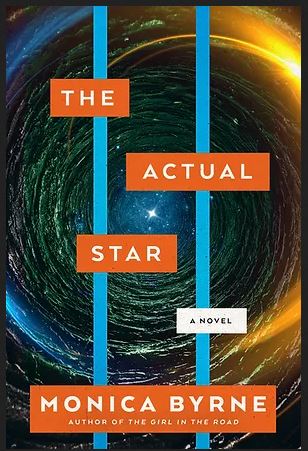
In term of fiction, the only new-for-2021 book that really stuck with me was The Actual Star, by Monica Byrne (no relation, so far as I’m aware).
The story sprawls out across three separate timelines, each 1000 years apart (basically the far past, the present, and the distant future) and leans more heavily in to fantasy than sci-fi for me, but ultimately the label doesn’t matter. The stories playing out in the three eras tie together really well and there’s a lot of interesting ideas tossed around to chew on. Highly recommended.
In terms of endings, I have to give a shout out to Sex Criminals, by Matt Fraction and Chip Zdarsky, the comic/graphic novel that wrapped up its run in late 2020 (I didn’t get the sixth and final volume until January of last year).
The series never really reached the heights of the first volume again – the pages (three-and-a-half of them!) where Suzie sings “Fat Bottomed Girls” in a bar, with all the words covered over with exposition explaining how expensive it is to quote song lyrics in a comic – still leaves me rolling. It touched on a lot of interesting things along the way and was never less than interesting. The ending worked, too.
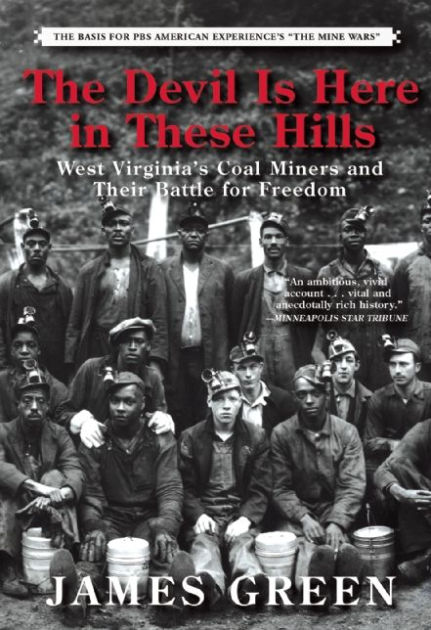
It covers the tumultuous history of labor organization in the WV coal fields, generally referred to as the Mine Wars. Very in depth, with lots of necessary background context, but also very readable.
It’s probably the most tragic thing I read last year, given that it tracks how the initial enthusiasm for fighting Communism curdled into dictator-propping-up realpolitk cynicism. Oh well.
2021 was a weird year, musically. Several of my favorite artists – Mogwai, Steven Wilson, St. Vincent, Resistor – released albums last year. All of them are good – I even like Wilson’s electro-pop driven The Future Bites better than most proggers – but none of them really grabbed me. Maybe they’ll grow on me in the future, but for now there wasn’t anything in 2021 really worth taking note of.
As a result, last year was more about getting caught up in some things I’d overlooked – in some cases for a long long time.
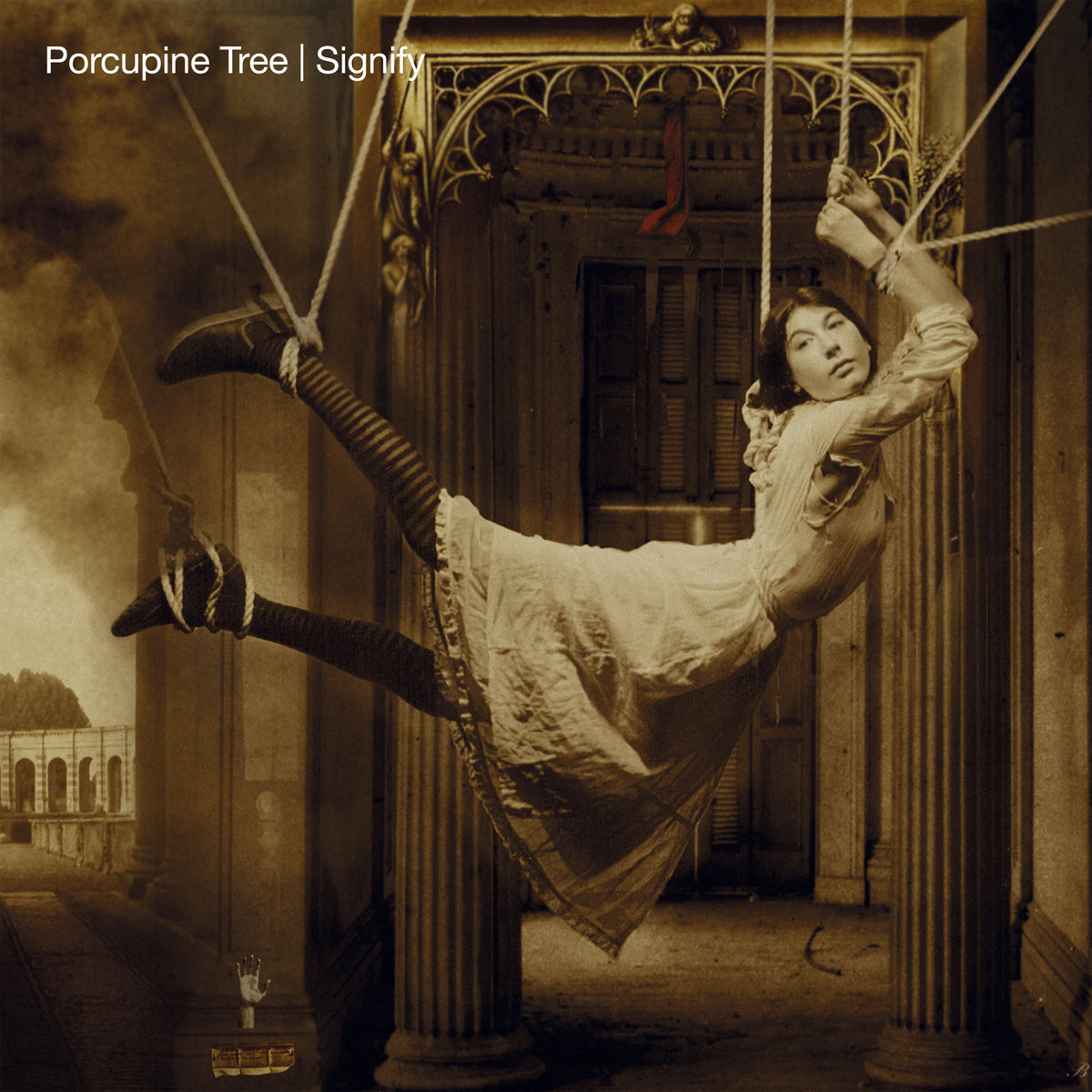
Speaking of Steven Wilson, my history with his old (and new again!) band Porcupine Tree is that I preferred the “newer” stuff, from Stupid Dream on, to the older material. The Sky Moves Sideways just feel tedious to me, for instance. But poking around Bandcamp (my happy hunting ground) I found a recent rerelease of the band’s 1996 album, Signify.
That album really hits a sweet spot between the spacier stuff and the tighter, song-driven rock stuff. I also love the recurring samples that mostly touch on religious themes (the guy on “Idiot Prayer” switching from his LSD trip being nearly rapturous to just repeating “please help” does it for me every time).
I’ve given some time over the years to reevaluating music that was popular while I was growing up in the 1980s. Part of that is due to getting into electronic music, including the synthpop of my youth. Part of it is just maturing as a listener to realize that just because something is popular doesn’t mean it’s crap (95% of it is, of course). So when I came across this article written by a professor who used pop culture to open discussions of how people felt during the Cold War I was inspired to go dive into some of the music, including the second Men At Work album, Cargo.
The singles are good and some of the deeper cuts are just as good. “No Sign of Yesterday,” which closes out side one is great. It’s fairly recognizable pop/new wave, but with just enough weirdness to distinguish it.
Finally, another pleasant discovery from Bandcamp was the album Prophecy by Solstice:
Solstice were part of the neo-prog scene of the early 1980s, but with definite folk and Celtic shadings. They only released one album back then, but have released a few more over the years, with Prophecy coming in 2013. It’s great melodic stuff. Wonderful find.
Television/Streaming
You don’t need me to tell you we’re living in the era of peak TV. There’s just so much good stuff out there that I couldn’t touch them all. So let’s focus on pleasant surprises – things that I thought might be decent, but turned out to be really good.
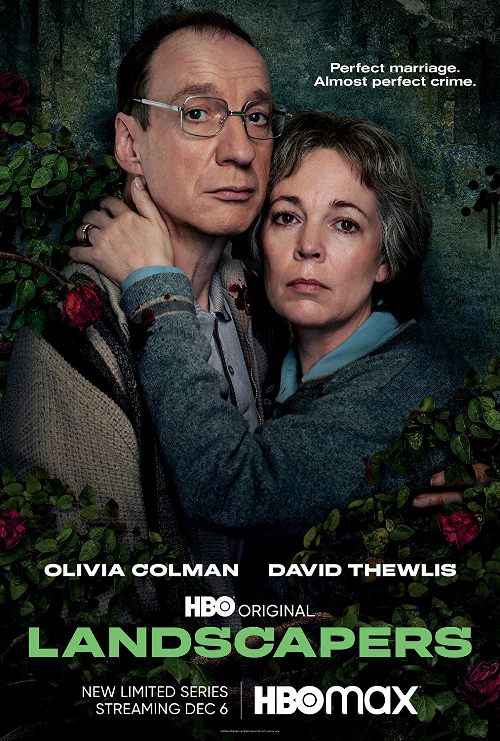
The poster child for this approach is Landscapers.
On the one hand, it’s a true crime story of a married couple who murder the wife’s parents and bury them in the garden then go on the run for fifteen years. On the other, it’s a close study of a couple shut off in their own little world where reality only sometimes intrudes. It’s shot with a grab bag of styles related to classic cinema and includes a bravura scene where the police interrogation room is pulled apart to reveal a set while the scene resets. Brilliant? I’m not sure, but it wasn’t like anything else I saw last year.
I feel somewhat the same about Only Murders In the Building, in that I thought it might have potential, but didn’t think I’d enjoy it as much as I did.
The Martin Short/Steve Martin pairing is as good as ever and Selena Gomez slipped into the mix very well. I’m not sure the actual mystery made much sense, or that I really cared about it, but given the light-hearted nature of things, who cares?
Staged, on the other hand, I was relieved was as good as it was.
I missed the first season in 2020, even though David Tennant and Michael Sheen doing comedy should have drawn me in. That season chronicled their involvement with rehearsals of a play that never actually happened (delayed by COVID and then collapsing). Shot via Zoom (or some similar platform), with their significant others playing themselves it managed to be funny and thoughtful at the same time. The second season, from last year, expands a bit as an American remake is in the works – one which isn’t going to use either one of them as stars (since, apparently, we don’t like them over here). It’s more meta and sillier, but equally good.
Finally, I’m giving a provisional shout out to Yellowjackets.
The first season hasn’t even finished as a write this and it may go way off the rails in coming years (it’s allegedly going to run for five seasons) but so far it’s been engrossing.
Movies
I can’t say much about movies in 2021 since I didn’t set foot in a movie theater all year (the pandemic and all). I watched a few 2021 releases on streaming services, but nothing that really wowed me. As a result, I think the “movie” that stuck with me most from the year was Get Back, Peter Jackson’s epic excavation of The Beatles. I already wrote about that here.














 JD Byrne