Weekly Watch: Star Trek: Strange New Worlds

Last year, in my review of the first season of Star Trek: Discovery, I laid out how I’m not really a fan of nu-Trek and was happy to let the rest of that series go on without me. What really dragged it down for me was that it didn’t feel very “Trekky” and it was too slavishly devoted to the modern streaming serialized storytelling ideal.

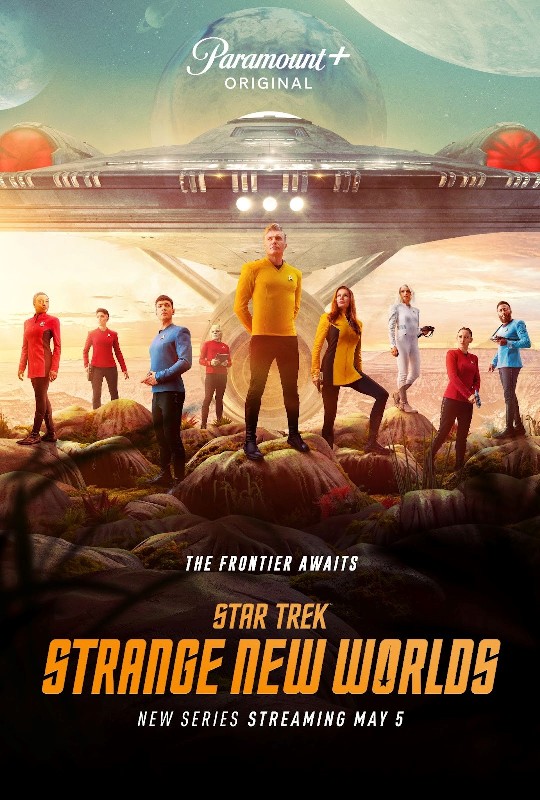
So along comes Star Trek: Strange New Worlds. Another prequel (of sorts), but also a spinoff of something that occurred in a subsequence season of Discovery, Strange New Worlds gets us back on the Enterprise during the time it was commanded by Christopher Pike. Pike is well known to original Trek fans as the guy from the pilot (replaced by Kirk for the series), with said pilot being cut up for use in a later episode that reveals Pike to be horribly injured, but with great loyalty from Spock.

 Although I’m skeptical of prequels, I thought I’d give Strange New Worlds a shot, for a few reasons. First, since there’s not a lot out there on the pre-Kirk Enterprise, I figured there was some room to tell some cool stories. Second, given that this is the Enterprise we’re talking about here and the name of the show is Strange New Worlds, I hoped it would lean into the exploration angle more than Discovery did. Finally, what I read about the show suggested it was going to be less serialized and more “mission-of-the-week,” which, again, provided some room for good stories (and to not be stuck dealing with the aftereffects of bad ones).

I’m fairly happy with how Strange New Worlds met those expectations. The prequel part is the least successful, I feel. It’s one thing to have certain characters involved because we know they were there from original Trek (Spock & Chapel, mostly), but is there a particular reason the security chief has to be named Noonien-Singh?. And isn’t Kirk’s fight with the rubber-suited guy supposed to be first contact with the Gorn? Then there’s the final episode of the first season, which is a take on the original Trek episode “Balance of Terror” (the one where we first meet the Romulans), where Kirk himself shows up. There’s more of him promised for season two, as well, which makes me worry that the writers aren’t confident in the new stories they have to tell and will keep wrapping in known characters from the show as crutches. I won’t get into potential continuity issues with the original Trek stuff (it makes my head hurt) except to say, again, what’s the point of a prequel if it doesn’t lock in certain things about your world?

 All that said, most of the stories told in the first season of Strange New Worlds are really good, some inching towards great. As promised, the episodes do tend to stand alone, which provides a good variety of atmospheres (so to speak). “Children of the Comet” is a pretty cool culture clash story, with the do-gooders on the Enterprise confronted with religious dogma. “Spock Amok,” in addition to having fun body-switching, has a diplomatic plot that reminded me of something out of Babylon 5 (high praise from me). “The Elysian Kingdom” was probably my favorite, using a typical old-school Trek plot device (an energy being!) as an excuse to dress everybody up in fantasy garb to push to a really heart-wrenching ending (sort of). Then there’s the aforementioned “A Quality of Mercy,” which “what if?”s that classic Trek episode in a pretty satisfying way.

My only real beef is that the writers had a lot of issues with endings (I can sympathize – endings are hard). Take “The Elysian Kingdom,” for example, which looks like it’s going to end on a note of melancholy uncertainty as the ship’s doctor says goodbye to his ill daughter who is going to live with/as the nearby energy being. Rather than leave this unsettled – you think you do the best thing but how can you know? – the writers went ahead and threw in a little more to make sure of a happy ending. Not bad, but could have been better. There were a couple of other episodes that went the same way, headed towards really great but they couldn’t stick the landing. Or, alternately, they didn’t do more with it, as in the episode that was less a riff than a cover of “The Ones Who Walk Away from Omelas” (should have started with that ending and explored what it means).

And I have to say that while these stories were mostly self contained, there was an overarching theme to the season in terms of characters, particularly Pike. Apparently, in the Discovery episodes that spawned Strange New Worlds, Pike learns his eventual fate as we’ve seen from original Trek (it’s unclear if he learned he’ll become a running joke on Futurama) and so in this season he’s trying to figure out if there’s a way around that end. That’s what triggers “A Quality of Mercy,” but Pike confronts it several other times during the season. It’s well done.

Which is to say, I’m cautiously optimistic about the second season. Given results thus far, I’m willing to give everyone the benefit of the doubt that we won’t be overwhelmed by Kirks (Jim’s brother is on this ship, too, for some reason) and we’ll be introduced to more strange new worlds.

I Meant to Do That

Make a Jazz Noise Here, one of the live albums documenting Frank Zappa’s final tour, kicks off with a rousing version of “Stinkfoot” which ends, as his opening numbers tend to do, with an introduction of the various people in the band. At the end of the roster is Ed Mann, Zappa’s long-time percussionist. Zappa explains that prior to the show one of the fans came up to Mann and “treated like a war criminal” because he “fucked up” a riff in a song called “Dicky’s Such an Asshole” (it’s about Nixon) at a show weeks before. Zappa explains how the people who come to the show listen so carefully that he wanted to take time to allow Mann to “warm up” for that big riff by practicing it right now. The band drops out and Mann plays the riff perfectly. Then he says something to the effect of “here’s how we played it that night” and plays a different riff. The band cranks on, point made.

The point was, of course, that Mann hadn’t “fucked up” anything weeks before, he’d played the riff differently on purpose (at Zappa’s insistence, or at least with his blessing, surely). In other words, when a professional is doing something, maybe assume that they’ve got everything under control and what seems like a mistake to you might actually be completely intentional.

I thought about that episode when I came across this column from April by Damon Young. It’s entitled “A letter to that man who emailed me to correct my grammar” and, well, it’s brilliant. Young is a regular at the Washington Post and has a long string of credits, including a book of essays that won the 2020 Thurber Prize for American Humor. It’s safe to say he knows his way around words.

He certainly has no problem claiming that expertise, as the first line of the response column is “I’m better at this than you are at everything you do.” Harsh, but probably fair. Later, he digs into the specific complaints of the email:

In your email, you declared that my use of the word “ain’t” was a “really poor choice,” corrected my use of “them,” and demanded that I don’t try to sound like I’m “still in the street.”

If you were better at this than I am, you would know, as I do, that the rules of grammar are mostly suggestions. Guardrails to help us corral and curate the mess in our heads into something cohesive.

***

You would also know — if you were better at this than I am — that sentences are music. And that both sentences and music are math. Equations. Beats separated by pauses. Microbursts of energy clustered and cut and culled to find balance. You would know that sometimes “ain’t” just fits in a way that “isn’t” or “is not” does not. Same with “them” instead of “those.” You would know that even the choice of “does not” at the end of the above sentence instead of “doesn’t” was intentional, because of the repetitious rhythm of “does not” existing immediately after “is not.” You would know that short phrases lead to shorter sentences, which punch in a way that longer ones sometimes can’t. Like this just did. You would know that “ain’t” ain’t a signifier of being “still in the street.” You would know that “still in the street” ain’t do what you think it did. You would know that writing a thing like that just proves you’re a living anachronism. But not in a romantic way, like a streetcar or a Ferris wheel. But like cigarette smoke indoors.

I mean, damn, that’s gotta’ sting.

Young is right, of course – rules are meant to be broken. But beyond that, what he’s saying (I think) is that people who break rules know they’re doing it and have a good reason to do so. That’s why as a writer or musician or whatever it’s important to learn the rules, even if you intend to ignore them completely in your creations. Rules, even as suggestions, have some value in generating expectations among your audience and if you’re going to confront them with something different it’s best to both realize it and question whether it’s worth it. Young, clearly, knew the score and what he was doing.

Of course, when it comes to rules, Young has broken one of the cardinal ones in even writing this piece. Writers are repeatedly (and correctly, in my opinion) advised never to engage with critics or reviews of their work, even positive ones. It’s a hard firewall we’re supposed to put up to avoid being dragged into the social media muck. Go blow off steam with your spouse or writing buddies, but, for the love of all that’s holy, don’t respond online.

But again, Young knows what he’s doing. He knows the rule about responding to critics and decided that, in this instance and in this way, he should break it. As such, this pieces serves as a bit of wish fulfillment for writers everywhere who don’t have the courage (or the skill) to clap back at critics.

Inspiration Strikes at Odd Times

So, you know how I’ve released two volumes of the Unari Empire Trilogy, right? That would be Gods of the Empire and Widows of the Empire.

What about the final volume, you might ask, Heroes of the Empire? Any update on it? Yes, friends, and it’s good news!

But first, some context.

Although Widows just came out last fall, I’ve been working on Heroes since about a year before that. It was my NaNoWriMo project in 2020, so I started writing it in November of that year. I “won” that year, but the book was nowhere near finished, so I kept working on it into the new year. By June of 2021, according to a timestamp on the Word file, I had something saved as “First Draft.” Except it really wasn’t.

What had happened is that I got about 80% through the draft and my creativity came to a complete halt. I didn’t have a good idea of how to bring things in for a landing, so rather than try to push through the end, I took a different approach.

In my day job, sometimes I take pieces of legal writing from others in my office and synthesize them into a single brief. It’s safe to say that each of the attorneys in my office has a different voice and just cutting and pasting won’t work to produce a clear, readable final product. So I have lots of experience rewriting the words of others to produce a smoother end product.

When I wrote Moore Hollow and The Water Road I did the same thing – I took my first draft of each book and rewrote them completely, filling in any shallow bits and using the quicker pace to connect up things better. It worked well, but I hadn’t felt a need to write that way for the other books that followed.

Until Heroes. Since I was stuck I decided to pull a Bruford and go back to the beginning again and rewrite the first draft. According to yWriter I started that process last April and everything went swimmingly for a while, until things bogged down again. In particular, when I got to that ending, I just completely lost momentum. It wasn’t that I didn’t know where the story was going to end up, I just didn’t quite know how it was going to happen.

Last week I was bogged down (again) in what I thought was the next-to-last chapter. It shifts POVs a lot as the climax happens and that made it hard to write, anyway. Otherwise, I was just kind of drifting.

Then I got up to take a piss one night.

I was up in the middle of the night to go to the bathroom, my mind barely functioning, when it hit me. This was out of the blue inspiration of the kind I don’t generally have. The solution was simple – a short time skip to move straight to the consequences of what we’re seeing, rather than the details of the incident itself. I was so stoked I couldn’t really get back to sleep (which made work the next day quite a drag).

This is a long way of saying, this past weekend, I finally put the final words of the first draft of Heroes of the Empire into yWriter! It’s finished! Well, I mean, it tells a complete story. Now comes the fun part, the several rounds of edits, but at least I can see the end of the process at this point.

Thus, coming late this year or (more likely) early next, the final, gripping part of the Unari Empire story, Heroes of the Empire.

Weekly Watch: The Staircase(s)

A few weeks ago, in my list of favorite movies, I mentioned that Jean-Xavier de Lestrade, director of the Oscar-winning documentary Murder On a Sunday Morning, went on to direct The Staircase, an epic (it eventually had 13 episodes) true-crime documentary about the death of Kathleen Peterson and the trial of her husband, Michael. It is basically the urtext of the modern true-crime doc boom. So when I heard that someone had made a non-documentary miniseries not only about the Peterson case but about the documentary itself, I wondered whether this was something the world really needed. Having binged it over a weekend I’m still not sure it was necessary, but it certainly was interesting.

The base facts of the case are fairly simple – in December 2001, Peterson found his wife dead at the bottom of a set of stairs in their home. The scene of her death was seriously bloody, evidence of a violent and tormented death. Everything else is supremely complicated. Peterson was charged with murdering his wife and eventually convicted, but his trial was rife with prosecutorial misconduct and expert witness fraud, leading to the conviction being overturned. Rather than go through with a second trial and risk going back to prison, Peterson eventually entered what’s called an Alford plea to manslaughter, in which he did not admit responsibility for his wife’s death (the point of an Alford plea is to allow a defendant to get the benefit of pleading guilty while maintaining their innocence – admittedly, it’s counterintuitive).

Part of what made the documentary series so riveting is that Lestrade and his team basically embedded with Peterson, his defense team, and his family, providing the kind of in-the-moment access that most true-crime docs can only dream of. The crew initially had similar access to the prosecution team, but that waned as the case went on.

Given that the documentary was such an interior view of proceedings, what does the miniseries bring to the table that it couldn’t?

Primarily, it brings life to Kathleen Peterson, whose death hovers over the documentary but who isn’t given any chance to be developed as a person. The miniseries splits its timeline three ways, with one being events leading up to Kathleen’s death. It does a good job of bringing to life someone who tends to get overlooked in the whole true crime genre and Toni Collette does a great job with the part.

Another thing the miniseries gives us is a more in depth look at the Peterson family and how the trial impacted them. The way that family was put together would strain fiction – two sons from Peterson’s prior marriage, a daughter from Kathleen’s prior marriage, and two adopted daughters whose mother had died in Germany (at the bottom of a set of stairs, no less!). They pull apart in different ways as the miniseries goes on and lends a real sense of how a case like this grinds up everyone who is caught up in it.

Finally, the meta touch of the miniseries is that it includes the makers of the documentary in it as characters. With one notable exception this really isn’t commented upon that much, as in large part their presence is simply noted in the background as filming takes place. The exception – and it is a doozy – is that the editor of the documentary wound up in a multi-year romantic relationship with Peterson while he was in prison, casting her objectivity into doubt (she has issues with some of the facts portrayed in the series – and isn’t the only one – but doesn’t deny the relationship). I mean, it’s an “ooh, I didn’t know that” moment, but unless you think documentaries are rigorous exercises in balance the idea that the documentary had a POV (and it was that Peterson was innocent) doesn’t come as a shock.

But is he innocent? It’s here that I find the differences between the documentary and the miniseries have the most interesting effect.

As I said, the doc is largely framed through the trial itself and the ways the state’s case is shaky (and the doc doesn’t even include an entire state’s expert witness whose testimony was struck for perjury!). That plays into, at least in my criminal defense lawyer brain, the presumption of innocence. If it can’t be proven, beyond a reasonable doubt, that he did it then he didn’t right? The Alford plea at the end of things is meaningless in this regard as the entire point is that it allows a defendant to take a deal while maintaining innocence. There’s a burden and the state didn’t meet it. Simple as that.

But the miniseries, perhaps because of its broader scope, leaves me less certain. I think it’s that in paring away a lot of the legal wrangling you’re left with there being, basically, two stories of what happened – one in which Peterson killed Kathleen for not particularly well explained reasons and one in which it was simply a horrible accident. Neither story accounts for all the physical evidence and the only person who knows the truth, Peterson, has issues with honesty. I still think, if I was on a civil jury, I’d find that he didn’t do it, but it would be a much closer question.

So back to the original question – did we need a fictional take on The Staircase (aside from the incredibly funny Trial and Error)? Probably not. In truth, the miniseries doesn’t shed any more light on the case or the people involved. It does allow for some dramatic speculation, however, about areas that were beyond the scope of the documentary. So necessary? No. Worth a watch? Absolutely.

“Trust” – A Short Story

As promised, here’s the other new short story for your reading pleasure. This one was from the NYC Midnight short story context last year. For that one I had to write a sci-fi story involving “shared custody” and “a liar.” Difficult assignment, but I think I came up with a neat way to handle it.

Without further ado – “Trust”


Shaylan was reduced to this – trying to find the doorbell of a spaceship.

Hand Cannot Erase sat alone in the far outer ring of the docking station. Aside from a few hoses running to it from various huge vats it looked like a museum piece. No lights blinking. No ramp deployed for crew or visitors to easily enter. No one climbing over the outside of the ship, making last minute repairs.

She looked around one more time then pulled out her hand terminal. She was in the right place – where was her welcoming party? She thought her message, watched the text appear on the terminal, and then zip into the aether. “I’m here?”

A moment passed before her terminal buzzed. “Shit! Sorry!”

From the other side of the ship came a rush of air and a mechanical whirring noise, like machinery operating over protest.

“Sorry, sorry, sorry,” Asulon said as she ran around to where Shaylan was standing. “I thought it was half past, wasn’t it half past?”

Shaylan held up her terminal. “It is half past.” She snapped off a quick salute, hoping it didn’t look too practiced. “Shaylan Moore, reporting for duty.”

The ship’s executive officer waved off the formality. “Save it for Captain Bhemhath. Come on, I’ll introduce you around.”

Inside, Hand Cannot Erase was tight and utilitarian. There was no wasted space, with access panels and storage cubbies along every corridor. Shaylan and Asulon couldn’t even walk through the corridors side-by-side.

“I was so glad when I saw your file,” Asulon said over her shoulder. “It’ll be nice to have another human on board.”

“Another?” Shaylan asked. She hadn’t given any thought to the makeup of the ship’s crew. All she knew was that there were seven of them, including her, and some of them were aliens. She’d said she didn’t have a problem with that in the interview, but she wasn’t sure it had been true.

“It’s just you and me, sister.” Asulon stopped and turned. “There’s nothing wrong, they’re all great, you’ll see. It just takes some time to learn everyone’s quirks. It’ll just be nice to have someone else familiar around.”

“Sure.” Shaylan didn’t know how closely Asulon had read her file. This we her first time on a ship, her first time off planet. She’d seen aliens out and about, like everybody, but she’d never worked with them. Certainly not in close quarters like this.

Asulon led her around a few more bends before she turned into an opening, knocking on the doorway on her way in. “Good! Looks like just about everybody is here.”

Shaylan turned the corner into what appeared to be the galley and conference room. Three aliens were sitting around the table, murmuring to each other. Nearby was a fourth, a green, gaseous blob about three feet in circumference, floating on the air like a dandelion seed. A tendril appeared from one side and wiggled at Shaylan.

“That’s Khels, our navigator,” Asulon said, before going down the line. “That’s Es’un, our pilot.”

Es’un, a spindly grey being with eye stalks and at least four arms, waved one of them. “Hi.”

“Hi,” Shaylan said, with a nod, thankful she had her translator implant refurbished before she arrived.

Asulon pointed to a thick, blue-scaled, lizard being who barely fit in the ship. “That’s Qhaax, head of security. Don’t worry, he’s not as crabby as he looks.”

Qhaax frowned, but didn’t object.

“And this is Zingaell, our cargo specialist,” Asulon said, pointing to a tall, thin, bald, green biped. “Don’t believe anything he says and you’ll be all right.”

The others all nodded, even Khels, somehow.

Shaylan was about to ask was Asulon meant about Zingaell when an electronic chime sounded.

“Sorry, gotta go,” Asulon said. “Captain wants me on the bridge.” She turned back to the table. “Can one of you show her to her quarters?”

Zingaell stood and nodded.

“Thanks, Zing,” Asulon said, slapping Shaylan on the back. “Welcome aboard!”

Zingaell slipped past her, into the corridor. “Come. Your quarters aren’t far.”

As they walked, Shaylan couldn’t shake the idea that this being, part of her new crew, wasn’t trustworthy. She had to ask. “What was all that about not believing anything you say?”

“A joke, nothing more,” he said, turning another corner. “You’ll learn that our fellow crewmembers think they are much funnier than they really are. You can rely on me just as much as any of them.”

Shaylan nodded, trying to shrug it off. “Sorry. Should have figured as much.”

He stopped at the next door, which was already open. “You’re in here. There are instructions for setting the biometric locks inside.”

“Thanks,” Shaylan said. “What do I do next?”

“I’ll let the captain know you’re settling in,” Zingaell said.

“Will you let me know if he needs me to come see him?” Shaylan didn’t want to get off on the wrong foot.

“Of course,” he said, smiling a thin-lipped smile.

Shaylan stepped inside and stowed her gear. She found the biometric instructions and coded the door lock to her eye scan, with a two-password backup. Intending to review the details of their last job, she flopped onto the bed and quickly fell asleep..

~~~~~

Shaylan awoke to pounding on her door, angry muffled thumps. She shook her head and heard a voice join in, gravelly and agitated.

“Moore? You already asleep on the job? I’ll toss you out the airlock if you don’t get out here now!”

“Captain?” Shaylan said, head still hazy. Reality clicked in quickly. She jumped off the bed, smoothed her jumpsuit, and ran to open the door. “Captain Bhemhath!”

On the other side of the door stood a squat, hairy biped with short arms. His face and hands were covered in silver grey fur. “This is not the best way to start our relationship.”

“I know, sir,” Shaylan said, fighting the urge to kneel so she could look him in the eye. “I must have dozed off. I thought Zingaell was going to come get me?”

Bhemhath shook his head. “Didn’t anyone tell you not to believe anything he says?”

“Yes, sir, XO Asulon did,” Shaylan said. Before she could go further, the captain cut her off.

“Well, do what the XO says. That’s how a ship works. I tell her what to do, she tells the crew what to do, and it gets done. Get it?” He put his hands on his hips and tapped one foot.

“Yes, sir,” she said and decided her confusion about Zingaell could wait. “Is there something I can do for you, sir?”

He nodded. “Grab your hand terminal and get down to the galley. I want to go over your duties with you and Asulon. Five minutes!” He stormed away down the corridor.

Shaylan took a moment to splash water on her face, grabbed her terminal, and headed toward the galley. She wasn’t about to be late.

~~~~~

Life on board settled into an easy routine. Shaylan’s job was to analyze potential targets for acquisition. Captain Bhemhath didn’t like the word “salvage” – “makes us sound like carrion eaters,” he’d said – preferring to think of them as engaging in targeted waste disposal. Shaylan had an office just off the cargo bay where she surveyed wrecks and other jobs, matched them with potential buyers, and figured out how much junk the ship could haul at once. After she saw the cargo bay she understood why the rest of Hand Cannot Erase was so tight and cramped – as much room as possible was given over to cargo.

Everything ran so smoothly that she didn’t get a chance to talk to Zingaell. She wanted to confront him about how he let her face the captain’s wrath, but their schedules were mixed up. They’d pass in the corridor, each on the way to somewhere else. They were never in the galley at the same time, able to strike up a casual conversation.

One day, Shaylan went to get tea on her break and found Khels floating near the dehydrator. She had to start somewhere. “Can I ask you something?”

“Of course,” the green blob said, sounding like a drunken angel.

“It’s about Zingaell.”

The blob nodded, Shaylan was certain of it.

“When I first came on, Asulon told me not to believe anything he said,” Shaylan explained. “Then, after he left me high and dry with the captain, the captain said the same thing. How do you all work with someone you can’t trust?”

“There is no question of whether you can trust Zing,” the blob said. “He is eminently trustable. You will know that after working with him. Set him a task and he does it. Ask for help and he provides it. He is critical to what we do.”

“Then why can’t I believe what he says?”

Khels floated closer to her, like it was going to whisper. “You’ve never met a Thulean have you?”

Shaylan shook her head.

“Thuleans are incapable of speaking truth. By that, I mean, that they have no way of knowing whether they mean what they say. It’s an odd quirk of their evolution. What did he do that set the captain on you?”

“I asked if he’d let me know if the captain wanted to see me, then he didn’t tell him,” Shaylan said. “He lied to me.”

A tentacle appeared and Khels waved it, a substitute for shaking the head it didn’t have. “Lying requires that the being saying it knows it’s false. Zing doesn’t know that. It’s why you cannot trust anything he says.” It put great emphasis on the last word.

“So he doesn’t lie all the time,” Shaylan said, working it through, “but you never know when he’s telling the truth. Is that it?”

“More or less,” Khels said. “It takes time to read him, to establish the rapport, but don’t worry. You’ll get there.” It floated out of the room.

Shaylan leaned on the counter and sipped her tea. She couldn’t afford to let this fester. She needed to build some trust with Zingaell, quickly.

~~~~~

They made two hauls from wrecks before heading for Keneally Station, which was in orbit above a small, lush moon, to unload. This was where Zingaell was in his element shifting the cargo out, so Shaylan did her best to stay out of his way. She convinced the captain that she needed to go to the surface, “for research,” but all she wanted to do was get away for a while.

Not far from the spaceport she found a walkway that ran along a meandering river. Stalls were set up every few yards with vendors selling all kinds of goods. The sun was strong and warm, the air clingy and damp. It was a welcome change from the dry, sterile environment on the ship. She sampled a local root vegetable on a stick, roasted and covered in a savory brown sauce, while exploring other vendors.

As the river bent around a copse of trees, she saw a small stand set up in their shade. In the pale yellow grass in front of the stand she saw what looked like small, furry meatballs bounding up and down. As she got closer, she could see that they were creatures of some kind – almost perfectly round, with three stumpy legs that made them look like a cotton ball sitting on a stool. The one closest to her turned and gazed at her with its single, large brown eye.

“Oh my gods, they are so cute,” Shaylan said, holding her hand out. The creature jumped into her palm and started rubbing itself against her outstretched thumb. She stood and asked the woman manning the stand, “what are these?”

“Joyrits,” the woman said, snatching up one that had been hopping around the table. “They make wonderful companions. Great source of happiness.”

“How big do they get?” The one in Shaylan’s hand closed its eye as she stroked its back.

“No bigger than this.”

“Really?”

The woman nodded. “These are all full grown. Hypoallergenic, sterile. They’ll never breed, never grow bigger. Only need food or water.”

An idea began to form in Sheylan’s head. “Have they been cleared for transport off planet?”

The woman pointed to a graphic on the tablet laying on the table, displaying the clearance.

“Just a sec,” Shaylan said, putting the creature down in the grass, where it bounded away to join the others. She pulled out her hand terminal and searched for “Joyrit,” to see if she could find anything negative about them. All she found was countless videos of them being adorable. She thought about clearing it with Asulon or even the captain first, but decided to bite the bullet.

“I take two,” she said, waving her hand terminal over the payment droid.

~~~~~

Back on the ship, Shaylan waited until they were underway, then made it a point to track down Zingaell. He was in what passed for the ship’s library, which was really just a couple of seats in front of computer terminals.

“Hey, Zing,” she said, trying to make it sound natural. “Can I borrow you for a moment?”

“Of course not,” he said, then shut down the monitor and stood up. “What do you need?”

“Come with me.” There was a small cubby in the wall, between her office and the cargo door, that she’d managed to convince to remain open all the time. Inside, the small puffballs bounced happily around in an enclosure, chirping quietly.

Zingaell lowered his head and looked at the creatures. “What are those?”

“They’re called Joyrits,” Shaylan said. “Do you have pets on your world?”

Zingaell stiffened. “No. We find them distracting.”

Unsure what to make of his answer, she pressed on. “Well these little things, which I’ve named Bob and Betsy, are pets. They’re our pets.”

Zingaell snapped his head to face her. “Ours?”

“Yes. I want you to help me take care of them. Feed them, play with them every now and then. Keep an eye on them. Would you like to help me with that?”

“No,” he said. “What do I need to do?”

She handed him a sheet of paper.

“This feeding schedule is very detailed,” he said, studying.

“I know,” Shaylan said. “Little guys need to eat a little bit several times a day. I thought we could alternate days, you know? Share the burden, a little bit.”

“May I?” Zingaell nodded toward the habitat. At her nod, he reached in and petted one of the small creatures, eliciting a low, long coo.

“Nice, huh?”

“Not really,” he said, but his manner didn’t match the words. “Do I start today or tomorrow?”

“I’ve got today,” she said nodding.

“I’ll go study, then,” he said, waving the papers. Then he added, “I’ll help you take care of them. You can trust me.”

As Zingaell walked into the corridor, Shaylan felt that, for the first time, she could believe that.


For more of my short fiction, click here. And, yes, the ship is named after the Steven Wilson album.

Short Fiction Update (With Very Short Story!)

It’s been a while since I had something to say about my short fiction, so here’s an update and a bit of free stuff to read to boot (in this post and the next).

New Story Coming Your Way!

The update is that I’m very happy to have a short story that will be a part of a collection published this fall by Speculation Publications. They do volumes dedicated to a particular weird phenomenon filled with speculative stories explaining that phenomenon. This volume is about the “dancing plague” of 1518 in Strasbourg (in what is now France).

My story took inspiration from the great Fritz Lang film M, in which a group of mobsters unite to catch a serial killer because all the extra police attention is bad for business. More details the closer we get to release day – put on your dancin’ shoes!

More New Stories – One Right Here and Now!

I’ve also got a couple of stories I can share just for the hell of it. They’re both things I wrote for NYC Midnight competition, which I’ve mentioned a couple of time before. This one was written for the microfiction contest earlier this year. Microfiction, in this context, is 100 words or less. For the contest the assignment was to write a ghost story that involved putting flowers in a vase and used the word “free.” Here it is, “The Flowers in the Window”:

Something transitory, a final moment of beauty, is what the medium said. That meant flowers. Rhea had clipped a few stems with brilliant purple blooms from the lilac bush at the corner of the house and put them in a plain white vase on the table by the front window.

That night, she and Jason slept better than they had for months, since the accident. It was a night free from strange noises and freakish breezes.

In the morning, Rhea went downstairs, to the front room. The flowers were gone. She said a silent thanks. Her daughter was finally free.

Short but bittersweet (I hope). Click over to the next post for another new story.

Artists Need to Eat, Too

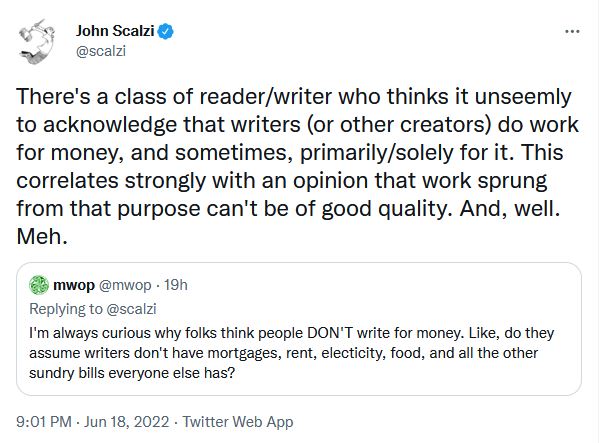
There’s been some interesting talk online about some of the economics of writing or, rather, being a writer. I have a day job I love that pays the bills, so this isn’t something I lose a lot of sleep about, but if you enjoy reading books or watching movies or listening to music, it’s worth remembering that the people that make them have all have bills to pay and families to feed, too.

Things sort of got summed up by John Scalzi on Twitter over the weekend:

I suppose this is an offshoot of the idea that artists need to suffer to make great art, which always kind of mystified me. Yes, there are writers and musicians that are tortured souls and managed to turn that into great, moving works of art. But there are just as many who seem pretty well adjusted and just love doing what they’re doing, the only real suffering coming from when people expect them to continue entertaining them for free or, worse, “for exposure.” “Happy” and “artist” should be used in the same sentence together a lot, I’d thihk.

Growing up, I sort of assumed that anybody who wrote a book or released an album made their livings doing that. It really wasn’t until I dove into the progressive rock world in college that I realized how many amazing musicians actually had day jobs to pay the bills (hopefully in music or some related field, but oftentimes not). That sort of opened my eyes about how economics and the arts intersect in the United States.

Now in the era of streaming services things are even worse for musicians. The per-play rate for a song on even the most generous service is pennies (and often a fraction of that). Fans need to realize that if they want more of their favorite music, they need to do more than just stream it. Buy LPs or cassettes, if your that particular kind of hipster. Or buy downloads directly from the band (or via something like Bandcamp) as a way that puts the most money directly in their pockets. Love and adulation is great, but it doesn’t pay the rent.

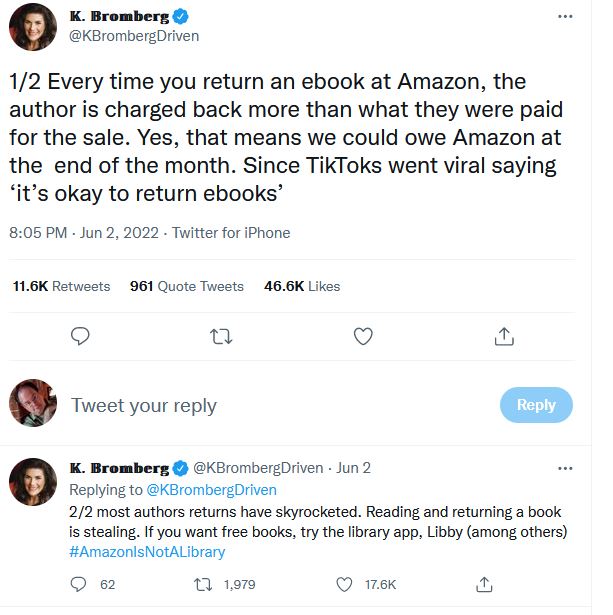
But whatever you do, don’t buy it, listen to it, and then return it.

I didn’t even realize this was a thing until posts like this started circulating from writers no Twitter:

As this article explains, Amazon allows you to return Kindle books within a week after purchasing them. Although this is to allow refunds for “accidental” purchases (mistakes happen, after all), some folks have spread this as a “hack” to allow readers to buy a book, read it quickly, and then return it for a refund:

It’s not immediately clear if new videos about returning e-books in the form of a “Kindle hack” were being spread around, but it was the subject of discussion on BookTok several months back as a debate over whether returning a fully read Kindle book could be considered “stealing.” Some who think the claim is nonsense compare returning a book you don’t like to returning a top that doesn’t fit or being comped for a meal when you find a bug in your food.

It should be obvious that returning a book that you read to completion is nothing at all like returning a piece of clothing that didn’t fit or getting bugged food for free. In both of those situations the product you received was defective in some way. They analogize to situations with books where you honestly buy the wrong one, get something other than is advertised (it’s a short story, not a novel, for example), or the file is corrupt and unusable.

But if you buy a book (or an album or a movie) and you read it then that’s it, you’ve got no right to a refund. It doesn’t even matter if you didn’t finish it because you thought it sucked. There’s a certain about of buyer beware that applies to any purchase, but that’s doubly true for art. It’s simply impossible to buy something to which reactions are so subjective with an expectation that you’ve got a money-back guarantee. Trying a new author or checking out a new band is an act of faith, of hope that it will be amazing, but you’ve got to be willing to accept that it might not be.

To return to the restaurant analogy, if you and a friend decide to try a new place that has a great reputation and seems just up your alley, but you don’t find that it met your expectations, you still have to pay for the meal. Sometimes, where matters of taste are involved, things don’t work out the way we want them to. That’s life.

A good rule of thumb for negotiating the world or books, music, or any other artistic thing in the modern era is to ask, “is this going to mess with the livelihood of the person (or persons) who created this?” before doing something that impacts their bottom line. If the answer is “yes,” think long and hard as to whether that’s justified. Deep down, I think you’ll realize it very rarely is. At the very least, before you start demanding your money back it ought to rise to this level:

Weekly Watch: Gaslit

I’m not going to say that finding a great story to tell is easy, but in some ways coming up with the story itself can be easier than figuring out the proper form to tell it.

I’ve been thinking about this as the wife and I have been watching Gaslit, the Starz series about Watergate that wrapped up this past weekend.

See, the thing about Gaslit – from its title to its marketing (as you can see above) – is that it promises a new angle on Watergate. It was supposed to be focused on Martha Mitchell, a political celebrity and wife of Nixon’s one-time Attorney General John Mitchell. She knew all about Watergate and told the truth about it, only to be destroyed privately and publicly by, among others, her husband.

That is a fascinating story, horribly relevant in the world of #MeToo, that would provide some interesting insight into the general Watergate story we’ve all see over and over again. Only it really isn’t. Instead, Martha’s story is buried in the mix, forced to share or cede time to a cast of characters we’ve seen before and about whom the show has little to say.

Take the penultimate episode, which splits time about equally with Martha’s testimony before the Watergate committee – behind closed doors, ambushed by accusation of mental illness – and the struggle of Gordon Liddy in prison to kill a rat. Really, is that what the series is about? It doesn’t help that every time Liddy opens his mouth it sounds like he’s just one step away from lapsing into Doctor Evil’s meat helmet speech.

In other words, there’s a pretty good movie struggling to escape from an eight-episode limited series. A tight two hours or so that trusts the audience to already know what Watergate is and focus on the relationship of the Mitchells (played well here by Julia Roberts and Sean Penn), how it pulls apart, and the effect that daring to tell the truth had on her. It’s particularly sad that we didn’t get that movie, given that we’re in the fiftieth anniversary year of Watergate and we’re going to get lots of other general retrospectives on the scandal, including the one currently on CNN featuring John Dean (who gets a goodly amount of screen time in Gaslit as a Porsche-driving climber who kind of lucks into doing the right thing, eventually).

It’s entirely possible that Gaslit was only ever supposed to be a big ensemble piece and the purported focus on Martha came later, which would explain why much of it is not her story. It’s also possible that the Martha story was what drove the creators, but the network guided into a more blown out story. Obviously, you can’t tell at this point.

What you can tell is that whatever Gaslit is, it’s not what it wants to be or purports to be. Which is a shame, because with the talent on screen it could have been so much more if it had been so much less.

The Month of Lists – My Favorite Books

To wrap up the months of lists, it’s only natural to turn our attention to books. Just choosing ten favorite books is tough – so I’m going to cheat. A few years ago I did a post about ten books that were “particularly important to me,” spun off from a Facebook thing that was going around. Those are all favorites, right? Sure. There’s a difference between “favorite” and “important,” but I’m not sure that’s a hair worth splitting.

That said, I’ve read an awful lot more books since I did that, so rather than take apart that first list, I’m just going to add to it. So, these ten books are all recent favorites (recent to me, at least) and I love these and the old ones so much I don’t want to knock any of those off to make room. It’s my list after all, right? Speaking of, if Saga, by Bryan K . Vaughn and Fiona Staples was complete, it would be on this list in a heartbeat, but I worry about them sticking the landing (it’s still only about halfway through, after all). Thankfully, that leaves an open spot on the list (for now).

The only other cheat for this list is that I decided to consider series as a single entry, so I could consider those in their entirety. Other than that, no rules. Also apologies for the wonky order, as I originally had them listed by series title but the formatting looked awful. Honestly, they’re in alphabetical order! That said, let ‘er rip . . .

The Mechanical (2015) – The Rising (2015) – The Liberation (2016)

by Ian Tregillis

As I said in my initial review of the first two books in this series:

It’s 1926, but not the 1926 we remember. There is no Lost Generation following the First World War, no Jazz Age, no impending economic collapse. Instead, the world, or at least the largest part of it, is ruled over by the Dutch. How have the Dutch managed this feat? Magic, of course.

That’s the basic setup for the Alchemy Wars trilogy – one of the “clakkers” created by a combination of Dutch magic (here called “alchemy”) and steampunkish technology gets a case of free will and a war of liberation is on. Along the way, we get a heavy dose of live in the world’s only non-Dutch outpost – a rump New France based around Montreal. The Mechanical is a brilliant opening book, full of world building and questions on the nature of being. The Rising gets a little too action heavy, at the expense of the philosophical questions, but The Liberation rebounds, bolstered by some temporal sleight of hand that shouldn’t work as well as it does.

American Heiress: The Wild Saga of the Kidnapping, Crimes and Trial of Patty Hearst (2016)

by Jeffrey Toobin

Just by growing up when I did and sitting in the culture I knew the outlines of Patty Hearst’s story – she was a rich young woman who was kidnapped by radicals and eventually wound up taking part in some of their violent activities. I was vaguely aware of the debate about whether she was really transformed into a believe or just going along out of fear. Toobin’s (yeah, I know) book does a really good job of filling in not just her specific story, but the time period out of which it arose. I had no idea bombings were so common in the 1970s! He also manages to dig into the argument on Hearst’s culpability deeply enough to allow people to draw their own conclusions, if you even can (I’m not sure I have). Super bummed that any adaptations of this book apparently aren’t going to happen.

The Ball Is Round: A Global History of Soccer (2006)

by David Goldblatt

While soccer is my favorite sport, I admit that I’d not really dug too deeply into the history of it. I had a handle on the big stuff – Uruguay’s early success, our upset of England in 1950, Pele – but the development of the game itself was mostly a black hole for me. No longer, having absorbed this deep history of the development of the beautiful game. What amazed me is how much of the game’s reach today is the result of British influence overseas, both through empire and commercial power (Barcelona, AC Milan, and a host of South American clubs have English or Scottish origins). There’s such a wealth of interesting history that plays into the current state of the game that it’s easy to overlook some of the “you are there!” portions that try to describe game action but can only come up short.

The Fifth Season (2015) – The Obelisk Gate (2016) – The Stone Sky (2017)

by N.K. Jemisin

I mean, these books only won the Hugo Award back-to-back-to-back, a feat never before accomplished, so it’s safe to say they’re pretty good. The Fifth Season is flat out brilliant, a structural bit of leger de main that completely reconceptualizes all that came before when you reach the end. The other two can’t quite reach that height, but that’s no slight. The world building is amazing. Jemisin has an amazing knack for brilliant scenes, the basic building blocks of writing. They’re not light reads, but well worth the emotional toil they’ll wreak upon you.

Children of Time (2015)

by Adrian Tchaikovsky

The main characters in this book are spiders. That is not a joke. They’re jumped up, hyper-evolved spiders, benefiting from a fuck up in human settlement on another planet. Science fiction has the ability to put readers in the head of truly alien creatures and Tchaikovsky did that here. But there’s also a second story line, of another ship full of humans (some on ice) where things are going to shit. They cross paths, of course. The next book in the trilogy, Children of Ruin, is just about as good. The only think keeping me from putting the whole trilogy on here is that it isn’t finished yet!

Leviathan Wakes (2011) – Caliban’s War (2012) – Abaddon’s Gate (2013) – Cibola Burn (2014) – Nemesis Games (2015) – Babylon’s Ashes (2016) – Persepolis Rising (2017) – Tiamat’s Wrath (2019) – Leviathan Falls (2021)

by James S.A. Corey

I’ve sort of concluded that the trilogy is the ultimate best length for a series. It’s long enough to tell tales of grand scope, but tight enough not to get away from the author. As a result, I rarely go more than a couple of books into a lengthy series unless I completely love it. Clearly, the fact that I’ve read all nine books in the Expanse series (and consumed all of the excellent TV adaptation) means that I loved this. It’s not all brilliant (looking at you, Cibola Burn), but the world that’s built is amazingly realistic (it feels that way, at least) and it’s full of characters I came to really care about. And, I have to say, I think the writers really nailed the ending in a way that was satisfying and felt complete. If you’re looking for a near-future space opera to simply lose yourself in, this is it.

The Half-Made World (2010) – The Rise of Ransom City (2012)

by Felix Gilman

The world of The Half-Made World looks a lot like the American west during the late 19th century, with white settlers streaming into “untamed” territory and finding conflict with the natives, not to mention each other. What really distinguishes this world is an ongoing (never-ending?) conflict between The Line (the embodiment of technological process in sentient train engines) and The Gun (chaos and immorality) that plays out in a world that is literally still in the process of being made. It’s a brilliant setup and serves to bring to life one of the most interesting characters I’ve ever encountered, John Creedmore. An agent of The Gun, Creedmore is a killer and a thug, but he’s also in thrall to a demon that lives in his gun. His struggle to leave it behind is exceptionally well done. Set in the same world and sharing some characters, this is more a pair of great standalone books (with The Half-Made World getting the nod) than an ongoing serious. Unless Gilman decides to give us another glimpse.

Hogfather (1996)

by Terry Pratchett

Generally speaking, I don’t reread books. It happens every now and then, but for the most part I’d rather move on to newer things, given the increasingly absurd size of my to-be-read pile. That is to say, Hogfather has a special place in my heart as I read it every year during the Christmas season. It’s a story of Hogswatch, the Discworld variant of Christmas, in which someone is trying to kill the Hogfather (i.e., Santa) leaving Death to fulfill his duties and Death’s granddaughter to stop all of existence from coming undone. It’s funny, sweetly nostalgic without overlooking how narrow nostalgia can be, and just all over brilliant. It warms my holiday cockles in a way that nothing else much does.

Say Nothing: A True Story of Murder and Memory in Northern Ireland (2018)

by Patrick Radden Keefe

Speaking of rereading books. I just went through a jag reading about Irish history, finishing up with a history of the (provisional) IRA, so I decided to dive back into Say Nothing, which covers The Troubles but on a more personal and street-level way. It also deals with questions of memory and how we talk about, and study, the past. It’s simply brilliant on every level. I can’t recommend it enough.

Sex Criminals (2014-2020)

by Matt Fraction & Chip Zdarsky

When I saw a story somewhere about a comic called Sex Criminals I thought it might be about the kind of people I represent in my day job as a defense attorney. How surprised I was that it was about people who had sex and then committed crimes! That’s because time literally stops when the two main characters (and several others, as things go on) have an orgasm, allowing them to get up to all kinds of nonsense (one of them takes the time to drop a shit in a plant in his boss’ office). If that was the entire joke the series couldn’t have run for more than thirty issues, but the series builds into a deeper exploration of relationships, depression, and other things. It wrapped up in 2020 in pretty satisfying fashion.

That’s it! The end of lists! Regular programming returns next week (probably).