I really enjoyed Robert Eggers’ first two films, The Witch and The Lighthouse. They both ooze atmosphere and can get by on that alone, but they’re also seriously weird, to boot. The kind of movies you walk away from asking, “what did I just see?” So while Viking revenge fantasy isn’t necessarily high on my list of favs, I did take the chance to watch his latest, The Northman when it came along.

The Northman is the story of Amleth, a 10th-century Viking prince who sees his father killed by his uncle, who then promptly carries off his mother. Amleth vows revenge and if you think this sounds a little like Hamlet, you’re right – they both riff on the same legend. His journey involves Viking raids, mysterious seers (one of who is played by Bjork!), a witchy ally, and, eventually, a mano-a-mano battle on an active volcano (shades of Revenge of the Sith? You bet!). It’s worth a watch, even if not up to the same level as Eggers’ prior work.
I do have some thoughts . . .
Can something be too accurate?
Eggers has a reputation for exacting precision in world building, going all in an getting the details right of the world of each particular movie. Not for nothing have all three Eggers films been set in the past (in one interview he laughed at the idea of making a contemporary film). For The Northman he engaged several experts on Viking history, ritual, and the like to create a world that sure feels awfully “real,” even if does involve things like unshakable faith, sorcery, and Valkyries carrying souls to Valhalla (as detailed in this profile).
I dig the detail. The world of The Northman is so gritty and granular that it feels “real,” even if there’s a lot about it that doesn’t exactly jive with reality. But can it go to far? I found a couple of reviews (one here, for example) that suggested that Eggers and crew get so caught up in details and being “right” about all sorts of small things that maybe other important parts of movie making get lost in the shuffle.
There are parts of The Northman that seem to be there solely because Eggers (or Alexander Skarsgard, who plays Amleth and was a producer) found out some cool things about Viking lore and wanted to put them on screen. I have no objection to that, but your mileage may differ. In fact, I can’t think of anything that feels like it could have been done “better” by fudging the details of the setting (most of the dialogue is in English, to be fair), so I don’t think Eggers puts verisimilitude as the highest and only value, but it’s clearly important. The film’s flaws (Amleth is a pretty boring hero with no apparent inner life or ability to reconsider his fate) are more down to the kind of story Eggers wants to tell rather than a fault in how it’s told.
Destiny versus storytelling
As I mentioned above, the legend of Amleth was the basis for Hamlet long before The Northman, but it makes for an interesting point of comparison. As this New Yorker review explains, Eggers’ Amleth is really nothing like Shakespeare’s melancholy Dane:
In regressing to Shakespeare before Shakespeare, Eggers replaces intricate and complex poetry with thudding banalities. He voids Amleth—a muscular warrior raised in crude ways and trained in cruder ones—of any inwardness, as if in fear of rendering him effete or off-putting. Eggers’s action-film Hamlet is neither bookish nor inhibited nor speculative nor plotting with far-reaching imagination of complicated stratagems—nor witty nor, above all, endowed with a sense of humor.
In other words, Hamlet is a tragic figure you can at least sympathize with – Amleth, not so much. Again, I don’t think this is a fault in Eggers’ execution as much as it is the kind of story he’s telling and the kind of world he’s telling it in. In Amleth’s world the constraints of fate are as real and binding on him as the law of gravity. If his destiny is to take revenge on his uncle it matters not that his uncle’s already had his downfall (his kingdom was taken by another king and he was exiled) or that his mother comes clean about who Amleth’s father really was (and her role in his death). Even the promise of a normal life in Orkney with the witch and their children can’t keep him from his destiny.
That’s the problem with destiny or fate or prophecy as a storyteller. Generally, writers and readers/viewers want characters – heroes, at any rate – who have agency. Or if they don’t they at least recognize that fact and rail against it or unsuccessfully avoid their fate. Tragedy is when you can’t stop yourself from doing what you shouldn’t, not when you just shrug your shoulders and go along for the ride. That said, the idea of a life free from moral choice – if I’m fated to die on a volcano, why live a moral, upstanding life – is one worth exploring, but it’s not what Eggers was after, for better or worse.
And, yes, the actual film doesn’t match the tagline on the poster.
The berserker and the office drone
Through sheer serendipity I saw The Northman while one episode away from end (of the first season?) of Sweatpea, a British TV offering showing on Starz in the United States.

Sweatpea is about an outwardly mild and meek office drone, Rhiannon, who been bullied by various people all her life and starts working towards bloody vengeance. Her primary target is Julia, a school bully (leader of a clique, in fact) whose abuse was so bad Rhiannon was literally tearing her hair out. Julie is first and foremost on Rhiannon’s list of “people I’d like to kill,” so she kidnaps her with every intent of doing her in.
Except there’s a complication – Julia, it seems, is a victim of her own, as her fiancé is abusive to her. Rhiannon is thus confronted with a person she wants dead who is suffering through the same stuff she’s gone through – but does that make right all the abuse Julie perpetrated in the first place? I don’t know how it’s going to play out as I write this, but the contrast with Amleth is striking. If Rhiannon goes through with killing Julia it will no doubt be her choice and I doubt it will be portrayed as glorious. Certainly, she’s not going to be flown off into Valhalla. But, then again, she lives in a modern world where things like fate and destiny are only found in, well, in movies and the like.
This Vox review has an interesting take on The Northman:
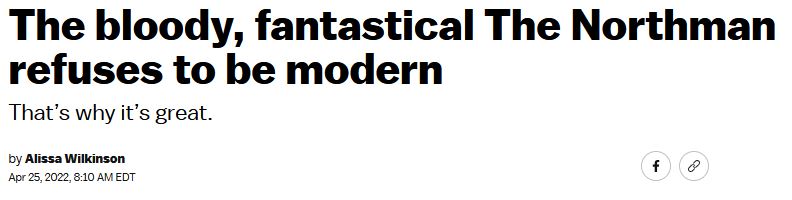
I wouldn’t go so far as “great,” but Eggers’ refusal to try and tell a story that’s such a throwback at least makes for an interesting watch. Consume in a darkened room and you may wind up thinking you’re back in Iceland, with the spirits of the dead all about you.

 JD Byrne