My mother passed away this past weekend. It wasn’t unexpected, but it still came as a shock. Naturally, I’ve been doing a lot of remembering in the past few days and I pulled a story out of my brain involving my mother and the ultimate development of my bizarro musical tastes.
My musical tastes were shaped by two main forces inside my family. The first was my brothers, who are 10 and 13 years older than I am. I say that not to call them old (we’re all old now!), but to point out that just when I was old enough to start thinking about popular music they were old enough to have established tastes and preferences. It’s why, in spite of going through junior high and high school in the 1980s my musical likes lagged by about ten years. It’s through my brothers that I discovered progressive rock – they introduced me to Yes, Genesis, Zappa, etc.
The other force inside my family was my parents. They were my introduction to the world of “serious” music – the symphony, opera (my father is a huge opera fan), musical theater. I never jumped into that stuff quite as much as I did prog, but its influence definitely contributed to that. In addition, both my parents were singers, having been in the WV Symphony Chorus for years. They were big fans of vocal harmony groups like The Hi-Los and the Swingle Singers. I can draw a direct line from hearing that sort of stuff to bands like Gentle Giant, echolyn, and Moon Safari that feature exquisite vocal harmonies.
With that said, my first music collection was mostly cassettes recorded from albums my brothers had (they each had, over time, bitchin’ stereos, while I made due with a boom box). At one point, probably because they were about to move out, I made a more concerted effort to make cassette copies of some albums that I didn’t necessarily love but figured I should have anyway.
Enter Relayer.
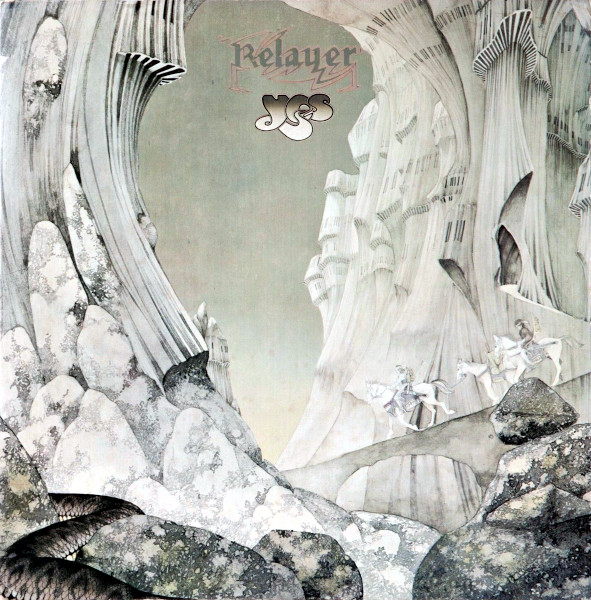
The seventh Yes album, the first and only with Swiss keyboard player Patrick Moraz. I was aware of it at the time, but not really familiar with it. But it was Yes and I was a fan, so I needed a copy.
One day I was the only person in the house and decided that would be a good time to record and listen. See, kids – back in those days if you wanted to record something onto cassette it took as long as the album lasted, so you might as well listen as you went. I wasn’t trying to be clandestine, just considerate.
My parents came home at some point. I’m not sure what attracted my mother, whether the music itself or the cover, but she took a look at the track list on the back of the LP cover.

As you can see, side one is one long piece called “The Gates of Delirium.” My mother was convinced that this twenty minutes of progressive rock madness could only be about one thing – drugs. For whatever reason, she decided to put her foot down and stop me from listening to/recording any of it. I still don’t know why – my house growing up was not exactly censorial and I got exposed to a lot of stuff I was too young to understand, from George Carlin to Monty Python (remember, two older brothers!) and, as I mentioned, Frank Zappa! None of this was an issue with my mother but, for some reason, “The Gates of Delirium,” that great ode to the power of drugs, was a bridge too far.
I didn’t argue with her. As I said, Relayer didn’t mean much to me at the time and I couldn’t mount a credible defense for “The Gates of Delirium,” anyway. Jon Anderson’s lyrics were always what you might call “opaque” – I read somewhere that he was more interested in how words sounded than in what they meant – and I didn’t know, at the time, what it was really about. So I put Relayer away and got on with whatever album was next.
I only later learned what “The Gates of Delirium” was really about – War and Peace. That’s right, in typical prog fashion, Anderson had decided to whittle down a 1200+ page classic of world literature into one side of an album. While I’m certain drugs were involved in the creative process, it isn’t actually about that, much less a celebration of it (as the lyrics make fairly clear – as clear than Anderson typically gets, anyway).
You’d think after all that I’d bear some grudge against my mother for denying me this masterpiece for so long. You’d be wrong! See, the thing is that all of Relayer, and large chunks of “The Gates of Delirium,” are by far the weirdest, most aggressive things Yes ever did and at the time I was trying to record it I didn’t really like it much. When came back to it in college or law school I’d started listening to way weirder stuff and so Relayer didn’t strike me as “too much.” Rather, it hit just the right sweet spot. That it was, in some minor sense, “forbidden” probably didn’t hurt. If I’d lived with it for years by that point, I’d probably just shrugged it off as not for me.
So thanks, Mom, for letting that rarely used overly protective streak come out in this particular instance. It probably led to this becoming one of my favorite bits of Yes music ever.
For Mom . . .
 JD Byrne
Pingback: The Obligatory Holiday Post | JD Byrne